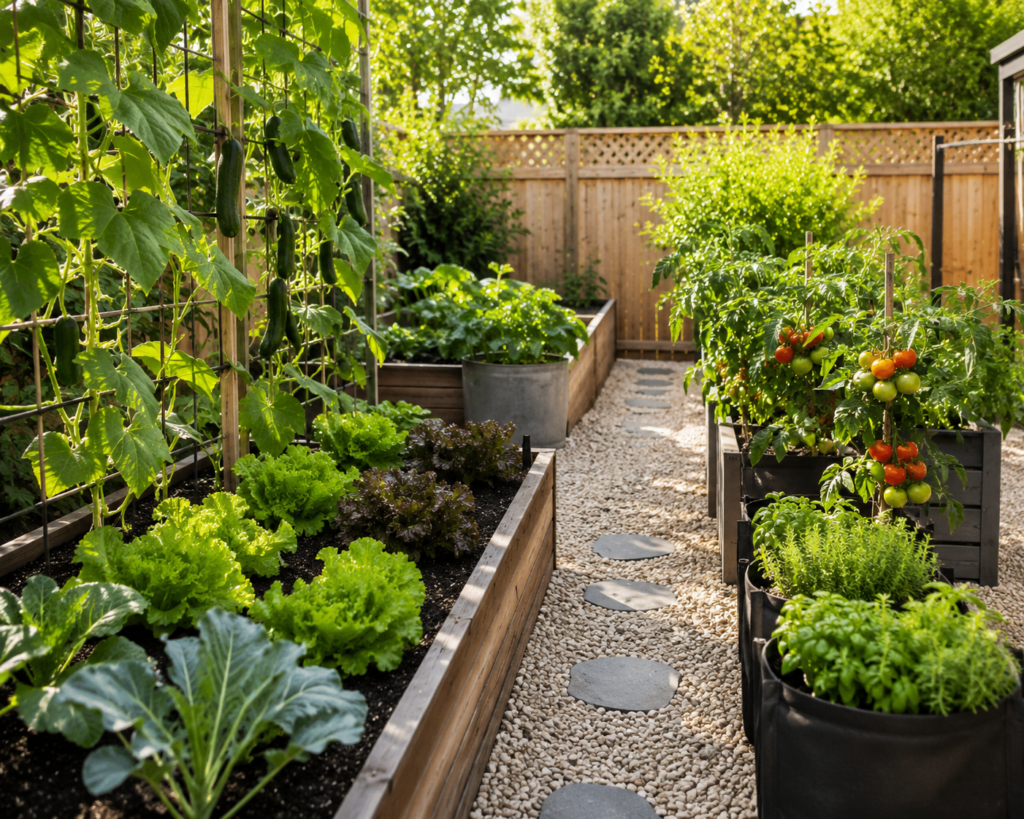
Vegetable backyard planter ideas help transform small patios, balconies, and compact backyards into productive food gardens with raised beds, grow bags, vertical planters, and containers. These space-saving setups improve drainage, airflow, sunlight exposure, and harvest efficiency while reducing weeds, overcrowding, and soil problems common in traditional gardens.
The best small-space planter gardens combine smart layouts, deep containers, vertical growing, and productive vegetables to maximize harvests in limited areas. Planter gardening also simplifies watering, maintenance, and pest control, making it easier for beginners to grow fresh vegetables successfully at home.
Best Vegetables for Planters
Small backyards become far more productive when planter systems are chosen based on space efficiency, sunlight exposure, crop type, and maintenance simplicity rather than appearance alone. Many homeowners initially overcrowd their gardens with random containers, but organized planter systems usually produce larger harvests because vegetables receive better airflow, root space, and sunlight distribution. Raised beds, vertical planters, grow bags, stacked containers, and narrow fence systems consistently outperform scattered pots because they create structured growing zones that are easier to manage throughout the season.
Modern small-space gardening focuses heavily on vertical efficiency and controlled growing environments. Productive backyard planter layouts often combine multiple systems together instead of relying on only one planter type. For example, tomatoes and cucumbers may grow vertically against a trellis while lettuce, herbs, and radishes grow in shallow front containers underneath. This layered planting approach increases harvest density while reducing wasted space in compact gardens. Real-world backyard gardens often produce surprisingly large vegetable harvests simply because vertical surfaces and overlooked corners are utilized properly.
Best planter systems for small backyard gardening include:
- Raised cedar garden beds
- Fabric grow bags for flexible layouts
- Vertical cucumber trellises
- Hanging herb baskets
- Tiered vegetable shelves
- Fence-mounted planters
- Rolling patio containers
- Compact galvanized beds
Raised beds work best for long-term permanent gardens, while grow bags benefit renters or homeowners who frequently reorganize backyard layouts. Vertical systems become especially important in narrow side yards where horizontal gardening space remains limited. Tomatoes, lettuce, herbs, and peppers are reliable starter crops.
Why Raised Garden Beds Improve Vegetable Growth
Raised garden beds improve vegetable growth through better drainage, deeper root space, improved soil control, and healthier moisture balance than traditional ground gardening. Elevated planting areas reduce soil compaction while allowing gardeners to customize soil quality for stronger vegetable production in small backyard spaces.
Loose, oxygen-rich soil conditions help vegetables develop healthier roots while reducing fungal problems caused by waterlogged ground soil. Raised beds also simplify weed control, improve fertilization efficiency, and support cleaner harvests for vegetables like tomatoes, peppers, carrots, and cucumbers.
| Raised Bed Benefit | Gardening Advantage |
|---|---|
| Better Drainage | Reduces root rot risk |
| Loose Soil | Improves root expansion |
| Reduced Compaction | Supports healthier growth |
| Easier Maintenance | Simplifies harvesting and weeding |
| Improved Soil Warmth | Supports faster early growth |
Which Vegetables Grow Best in Backyard Planters?
Tomatoes, peppers, lettuce, cucumbers, and herbs grow especially well in backyard planters because they adapt easily to controlled soil conditions and compact spaces. Fruiting vegetables prefer deep containers and full sunlight, while leafy greens tolerate shallower planters and partial shade. Matching vegetables with proper container depth and sunlight improves harvest quality and reduces common beginner mistakes.
Vegetables that grow especially well in planters include:
- Tomatoes
- Peppers
- Lettuce
- Cucumbers
- Herbs
Tomatoes and cucumbers need large deep containers with full sunlight exposure, while leafy greens tolerate smaller shallow containers and partial shade conditions. Root vegetables also require loose deep soil to prevent malformed growth. Many beginners fail simply because they underestimate root space requirements or overcrowd containers with incompatible crops. Productive planter gardening focuses on matching vegetables carefully with container size, drainage quality, and available sunlight rather than planting randomly.
Sunlight Needs for Vegetable Planters
Most vegetables need 6–8 hours of direct sunlight daily for strong growth and harvest production. Fruiting crops like tomatoes, peppers, and cucumbers perform best in full sun, while leafy greens tolerate partial shade. Morning sunlight is ideal because it reduces moisture buildup and fungal problems. During extreme summer heat, mulch and lighter-colored containers help stabilize root temperatures.
Vegetable sunlight recommendations include:
- Tomatoes: 8+ hours
- Peppers: Full sun
- Cucumbers: 6–8 hours
- Beans: Full sun
- Lettuce: 4–6 hours
- Spinach: Partial shade tolerant
- Herbs: 5–8 hours
- Kale: Moderate sunlight
Use full-sun locations for fruiting vegetables and partially shaded areas for leafy greens. Small-space gardens become far more productive when sunlight exposure is prioritized before arranging containers or choosing crops.
Vertical Gardens for Bigger Harvests
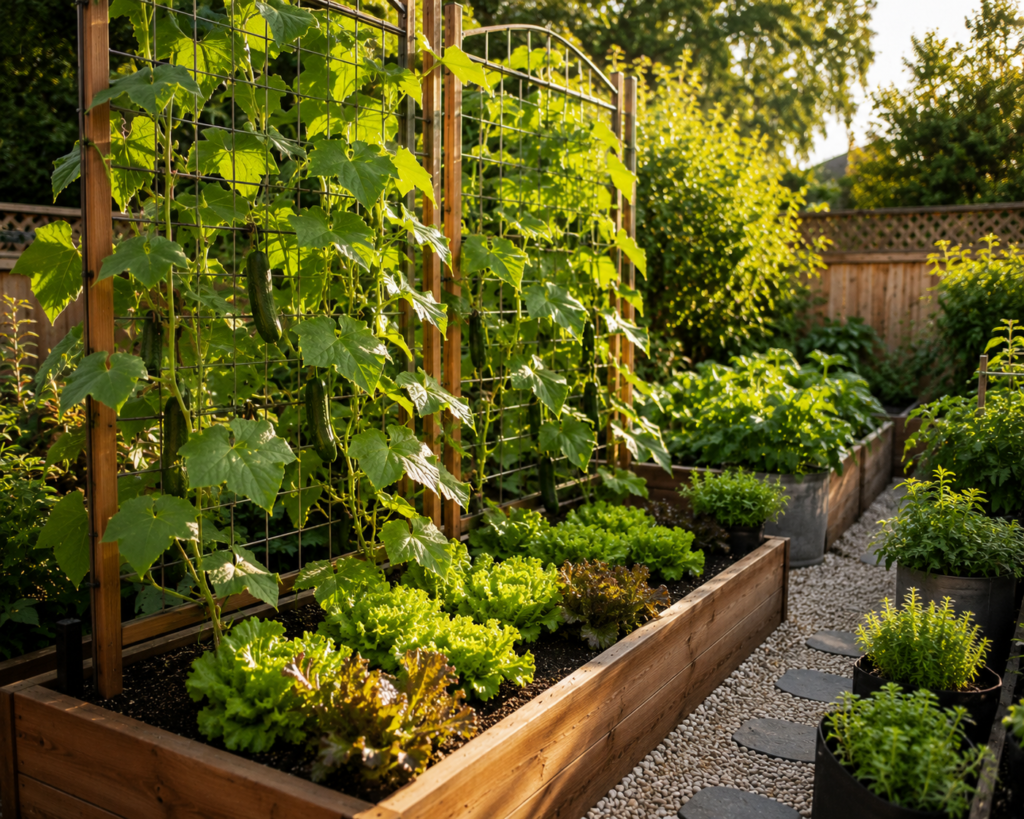
Vertical gardening increases harvests by using trellises, hanging systems, and fence planters to maximize unused space. Climbing vegetables like cucumbers, beans, and tomatoes grow upward instead of spreading across the ground, improving airflow, sunlight exposure, and harvesting access. Vertical layouts also help small patios and side yards appear cleaner and more organized.
Benefits of vertical vegetable gardens include:
- Better airflow
- Cleaner harvests
- Easier maintenance
- Improved space efficiency
Vertical gardening also improves visual structure in modern backyard landscapes. Trellises, arches, and wall planters create attractive edible garden features while helping tiny patios or side yards appear larger and more organized. Not all vegetables perform equally well vertically. Cucumbers, peas, beans, tomatoes, and certain squash varieties adapt especially well to climbing systems, while root vegetables and compact greens remain better suited for raised beds or shallow planters below vertical structures.
Raised Beds vs Grow Bags vs Containers
Raised beds, grow bags, and containers each solve different backyard gardening problems depending on available space, budget, and long-term growing goals. Raised beds work best for gardeners focused on maximum vegetable production and organized layouts. Their deeper soil volume supports stronger root growth, better moisture stability, and larger harvests over multiple growing seasons. They also create cleaner pathways and make crop rotation easier in productive backyard gardens.
Grow bags are a flexible and affordable solution for renters, beginners, or gardeners working with small patios and temporary growing spaces. Their lightweight structure allows plants to be moved easily for sunlight control or seasonal adjustments. Air-pruning fabric also helps prevent root circling, which improves root health for crops like tomatoes, peppers, and potatoes.
Containers are ideal for compact decorative gardening on balconies, patios, or small backyards where visual appearance matters alongside productivity. They work especially well for herbs, lettuce, peppers, and compact vegetables. Decorative pots also allow gardeners to match outdoor design styles while still producing edible plants in limited spaces.
Quick Comparison:
| Option | Best For | Main Advantage | Main Limitation |
| Raised Beds | Large productive gardens | Higher yields and organization | Higher startup cost |
| Grow Bags | Flexible small-space gardening | Affordable and portable | Dry out faster |
| Containers | Patios and decorative spaces | Compact and visually attractive | Limited root space |
Best Depth for Vegetable Planters
Container depth plays a major role in vegetable productivity because roots require enough space to expand, absorb nutrients, and stabilize moisture levels properly. Many vegetables fail in shallow containers because roots become restricted, overheated, or unable to access consistent moisture during warm weather. Beginner gardeners often underestimate how aggressively vegetable roots grow, especially with tomatoes, cucumbers, peppers, and root vegetables. Deep containers generally support healthier growth because larger soil volumes remain cooler, hold moisture longer, and provide more nutrient stability throughout the growing season.
Shallow-rooted vegetables such as lettuce, spinach, basil, and green onions adapt well to compact planters because they do not require extensive root systems. Fruiting vegetables and root crops, however, demand significantly deeper containers for long-term productivity. Real-world container gardens frequently show dramatic differences in harvest size simply because larger containers support stronger root development. Tomatoes grown in undersized pots may survive temporarily, but they often develop weak growth, blossom drop, and reduced fruit production later in the season due to restricted root expansion.
Lettuce and herbs grow well in 6–8 inches of soil, while tomatoes and root vegetables usually prefer 12–24 inches.
Choose larger containers whenever possible because deeper soil improves root stability, watering consistency, and long-term vegetable productivity. Shallow containers work best only for herbs and leafy greens.
Best Soil for Vegetable Planters
Productive vegetable planters require lightweight, compost-rich soil that balances drainage, airflow, and moisture retention. Compost improves fertility, while coco coir and perlite help prevent compacted soil conditions. Tomatoes and peppers prefer excellent drainage, while leafy greens benefit from slightly higher moisture retention. Mulch also helps reduce moisture loss during summer heat.
- Compost
- Organic garden soil
- Coco coir
- Perlite
- Aged manure
- Vermiculite
- Pine bark fines
- Organic mulch
Tomatoes and peppers require excellent drainage to prevent root disease, while leafy greens benefit from slightly higher moisture retention. Mulching also becomes especially important in container gardens because exposed planter soil dries rapidly during summer heat. Gardeners who prioritize soil quality early usually experience stronger vegetable growth, fewer nutrient deficiencies, and longer harvesting seasons compared to gardeners relying on poor compacted soil mixtures.
Watering by Container Type
Different planter types dry out at different speeds depending on soil volume, airflow, drainage, and sun exposure. Smaller containers usually need more frequent watering, while larger raised beds retain moisture longer and provide more stable root conditions.
Quick Watering Comparison:
| Container Type | Watering Frequency | Moisture Retention | Best For |
| Raised Beds | Every 2–4 days | High | Large vegetable gardens |
| Grow Bags | Daily in hot weather | Medium-Low | Flexible small-space gardening |
| Plastic Containers | Every 1–3 days | Medium-High | Herbs and compact vegetables |
| Terracotta Pots | Often daily | Low | Dry-climate plants and herbs |
| Self-Watering Containers | Every 5–10 days | Very High | Busy gardeners |
Raised beds generally require less frequent watering because deeper soil holds moisture longer. Grow bags dry out faster due to increased airflow through fabric sides, especially during summer heat. Plastic containers retain moisture better than terracotta pots, which lose water quickly through porous clay surfaces.
Self-watering containers reduce maintenance by storing water beneath the root zone, making them useful for beginners, patios, and hot climates where consistent moisture is difficult to maintain.
Arrange Planters for More Harvests
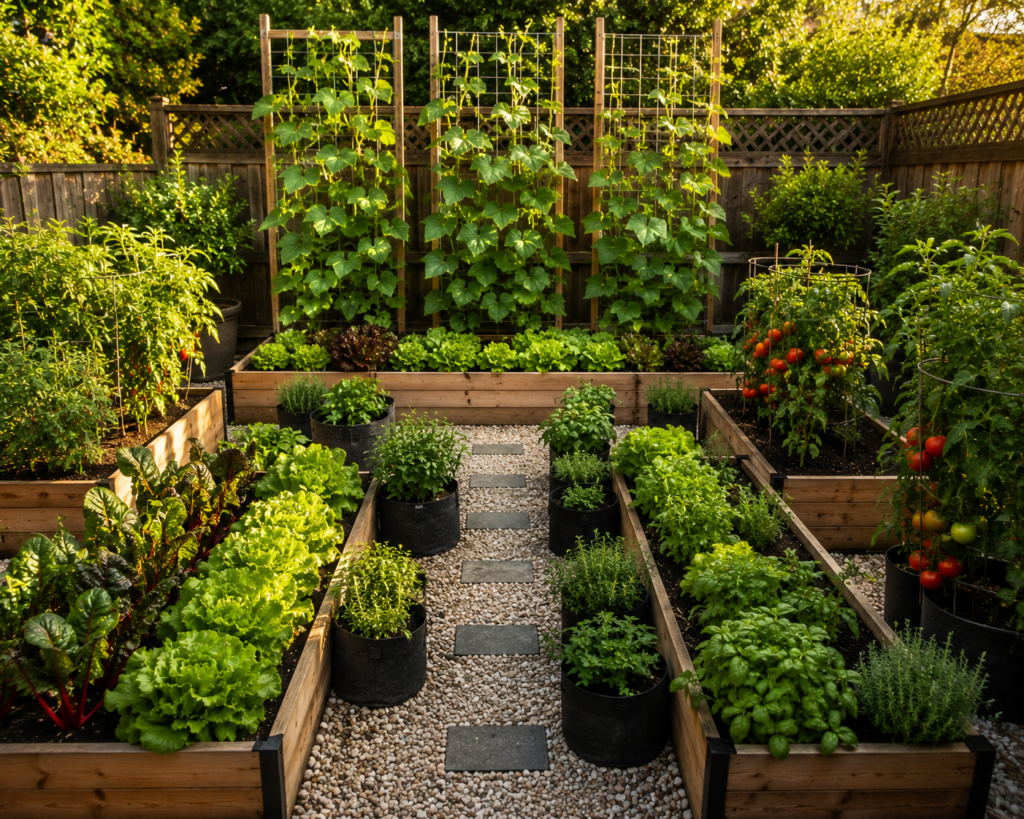
Planter arrangement directly affects vegetable productivity because sunlight exposure, airflow, accessibility, and crop competition all depend on proper garden layout planning. Many small-space gardens fail not because of poor plant selection, but because containers are placed randomly without considering mature plant size or seasonal sunlight movement. Productive vegetable gardens use structured layouts that maximize light distribution while maintaining enough space for harvesting, watering, pruning, and airflow between plants.
Tall vegetables should generally be positioned where they will not block sunlight from shorter crops. In many backyard layouts, placing trellised cucumbers or tomatoes along northern edges prevents shade from falling across leafy greens or herbs during peak daylight hours. Layered planting systems also improve productivity by combining vertical vegetables with compact lower-growing crops beneath them. Real-world backyard gardens often become significantly more productive after simple layout adjustments that improve airflow and reduce overcrowding between dense foliage areas.
Smart vegetable planter arrangement strategies include:
- Position tall plants at rear sections
- Group vegetables by sunlight needs
- Use companion planting combinations
- Leave walking pathways accessible
- Create vertical growing zones
- Separate aggressive spreaders
- Improve airflow between containers
- Rotate crops seasonally
Decision clarity becomes especially important when balancing productivity with maintenance accessibility. Overcrowded gardens may initially appear full and productive, but poor airflow often increases fungal disease risks and complicates harvesting later in the season. Companion planting also improves efficiency naturally because compatible vegetables support each other through pest reduction, shade moderation, or improved space usage. Organized planter layouts consistently outperform cluttered gardens because every vegetable receives proper environmental conditions throughout the growing cycle.
Small Backyard Vegetable Garden Example
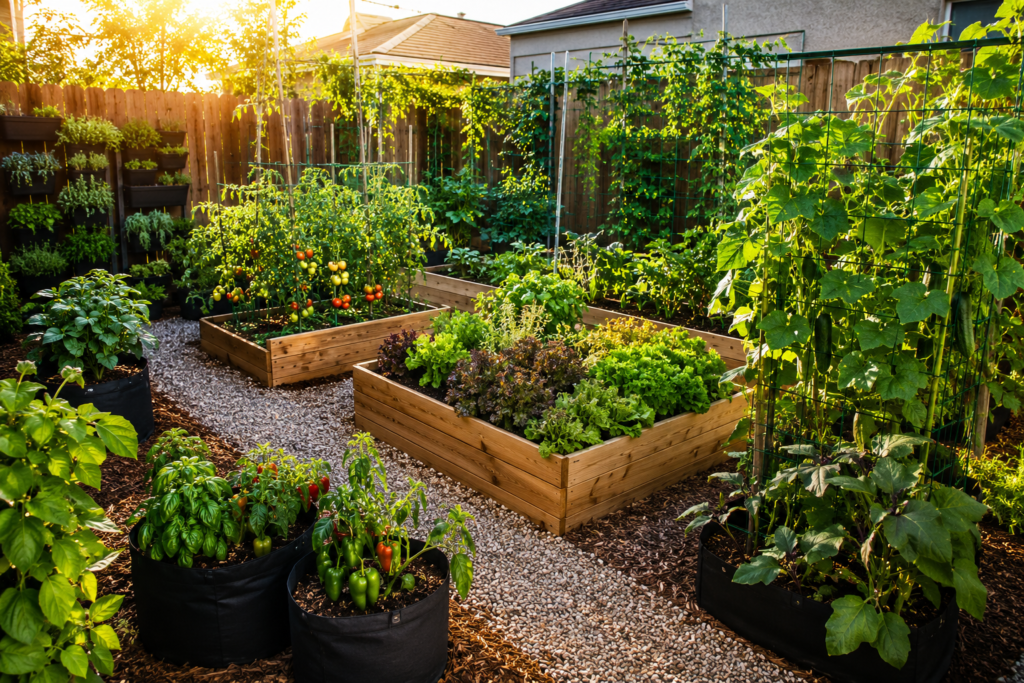
A productive backyard garden can combine raised beds, grow bags, containers, and vertical trellises within a compact layout. Tomatoes and peppers work well in raised beds, cucumbers grow vertically, and herbs or lettuce fit easily into smaller containers near patios or walkways. Gravel or mulch pathways improve access while keeping the garden organized and easy to maintain.
Example Layout
| Area | Garden Use |
| Raised Beds | Tomatoes, peppers, lettuce |
| Grow Bags | Potatoes, herbs |
| Vertical Trellis | Cucumbers, climbing beans |
| Containers | Basil, mint, parsley |
| Walkways | Gravel or mulch paths |
This type of layout balances productivity, accessibility, and visual organization while working well in compact backyard spaces.
Beginner Vegetable Garden Ideas
Beginner vegetable gardens work best when layouts stay simple, productive, and easy to maintain. Combining raised beds, grow bags, containers, and low-cost DIY planters helps maximize small backyard spaces without creating overcrowding or complicated maintenance routines.
Tomatoes, lettuce, peppers, herbs, and cucumbers are reliable beginner vegetables because they adapt well to containers and raised beds while producing steady harvests. Simple DIY planters such as buckets, grow bags, wooden pallets, and basic raised beds also reduce startup costs while keeping gardening accessible for new growers.
Simple Beginner Garden Setup
| Garden Feature | Recommended Use |
|---|---|
| Raised Bed | Tomatoes, peppers, lettuce |
| Grow Bags | Potatoes, herbs |
| Containers | Basil, mint, lettuce |
| Vertical Trellis | Cucumbers, beans |
| DIY Buckets/Pallets | Low-cost starter planting |
Keeping pathways organized and limiting plant variety improves watering access, airflow, harvesting, and overall garden management in compact backyard spaces.
Common Harvest Mistakes
Many small backyard gardens produce lower harvests because of a few common planning and maintenance mistakes. Problems like overcrowding, inconsistent watering, poor sunlight exposure, and weak soil quality can reduce plant growth and increase disease risks.
Overplanting is especially common in small spaces because beginners often place vegetables too closely together. This limits airflow, increases competition for nutrients, and creates conditions for fungal problems. Irregular watering can also stress plants and reduce fruit production during hot weather.
Common Harvest-Reducing Mistakes
| Mistake | Common Result |
| Overcrowding | Poor airflow and smaller yields |
| Inconsistent Watering | Weak growth and fruit stress |
| Poor Sunlight | Slow growth and reduced harvests |
| Weak Soil Quality | Nutrient deficiencies |
| Ignoring Vertical Space | Wasted growing area |
Using proper spacing, healthy soil, consistent watering, and vertical supports helps improve harvest size while keeping backyard gardens easier to manage.
Seasonal Productivity Tips
Seasonal planning helps small backyard vegetable gardens stay productive throughout the year. Different vegetables perform better during specific temperature ranges, so rotating crops by season improves harvest consistency and reduces plant stress.
Cool-season vegetables like lettuce and herbs grow well during spring and fall, while tomatoes, peppers, and cucumbers perform best in warmer summer conditions. Simple seasonal adjustments such as mulching, vertical support, and regular watering help maintain healthier growth during changing weather.
Seasonal Gardening Overview
| Season | Best Crops | Main Focus |
| Spring | Lettuce, herbs | Early planting |
| Summer | Tomatoes, peppers | Water management |
| Fall | Leafy greens | Cooler-season harvests |
| Winter | Protected herbs | Frost protection |
Rotating crops seasonally improves soil balance, supports healthier plant growth, and helps maximize production in limited backyard spaces.
Final Thoughts
Vegetable backyard planter ideas allow even the smallest outdoor spaces to become highly productive edible gardens when layouts are planned strategically. Raised beds, vertical gardens, grow bags, hanging systems, and compact container gardens improve drainage, airflow, sunlight exposure, and maintenance efficiency while maximizing harvest potential.
The most successful small-space vegetable gardens focus on proper container depth, smart crop selection, vertical growing techniques, healthy soil, and organized layouts rather than simply adding more plants into limited spaces. Productive gardens balance airflow, accessibility, sunlight, and watering consistency while avoiding overcrowding and poor drainage problems.
Beginners often achieve better long-term results by starting with a few easy vegetables in organized planter systems rather than attempting overly complex garden layouts immediately. Tomatoes, lettuce, peppers, cucumbers, herbs, and leafy greens remain among the most productive and beginner-friendly vegetables for backyard planters because they adapt well to controlled container environments.
Well-designed vegetable planter gardens not only improve harvests but also create attractive outdoor living spaces that combine productivity with modern backyard design.
FAQs
What vegetables grow best in backyard planters?
Tomatoes, peppers, lettuce, spinach, cucumbers, herbs, and radishes grow especially well in backyard planters because they adapt easily to controlled soil conditions and compact growing spaces. Vertical vegetables also perform efficiently in small gardens.
How much sunlight do vegetable planters need?
Most vegetables need 6–8 hours of direct sunlight daily, while leafy greens tolerate partial shade more effectively.
Are raised beds better than containers for vegetables?
Raised beds usually produce larger harvests because they provide deeper soil and better moisture stability. Containers work better for patios, renters, and flexible garden layouts.
How deep should vegetable planters be?
Leafy greens grow well in 6–8 inches of soil, while tomatoes, cucumbers, peppers, and root vegetables generally require 12–24 inches of depth for healthy root development.
Which vegetables grow best in shallow containers?
Lettuce, spinach, basil, cilantro, green onions, and radishes grow very well in shallow containers because they have relatively compact root systems.
Do grow bags work well for vegetable gardening?
Yes. Grow bags improve root airflow and drainage while helping prevent root circling. Tomatoes, peppers, potatoes, and herbs commonly perform very well in fabric containers.
Why are my container vegetables growing slowly?
Slow growth is usually caused by insufficient sunlight, shallow containers, overcrowding, inconsistent watering, or nutrient-poor soil. Healthy roots and proper sunlight are essential for productivity.
How often should vegetable planters be watered?
Most containers require watering every 1–2 days during warm weather, especially grow bags and hanging planters.
What vegetables grow best in vertical gardens?
Cucumbers, pole beans, peas, and indeterminate tomatoes grow especially well vertically because they naturally climb trellises and maximize small-space productivity.
Why do vegetable planters dry out so quickly?
Containers dry faster because exposed planter walls lose moisture rapidly during heat and wind exposure.
What soil works best for vegetable planters?
Vegetables perform best in lightweight, compost-rich, well-draining soil containing compost, coco coir, and perlite.
Can vegetables grow in partial shade?
Leafy greens and herbs tolerate partial shade well, but tomatoes, peppers, cucumbers, and beans usually require full sunlight for strong harvests.
What are the biggest mistakes in container vegetable gardening?
Common mistakes include overcrowding plants, poor drainage, shallow containers, inconsistent watering, and insufficient sunlight exposure.
How can I increase vegetable harvests in small spaces?
Vertical gardening, deep containers, healthy soil, companion planting, and proper spacing all help increase harvests in compact backyard gardens.
Are self-watering vegetable planters worth it?
Yes. Self-watering planters help maintain moisture consistency and reduce watering frequency, especially during hot weather and summer growing seasons.
How do I prevent root rot in vegetable containers?
Use containers with drainage holes, lightweight soil, and proper watering routines. Overwatering and compacted soil are the main causes of root rot.

Myra is the founder and lead writer of Backyard Planter Ideas, where she shares practical, well-researched guidance on planter design, plant selection, and outdoor styling. Her goal is to help homeowners create attractive, functional garden spaces with clear, reliable, and easy-to-apply advice.