
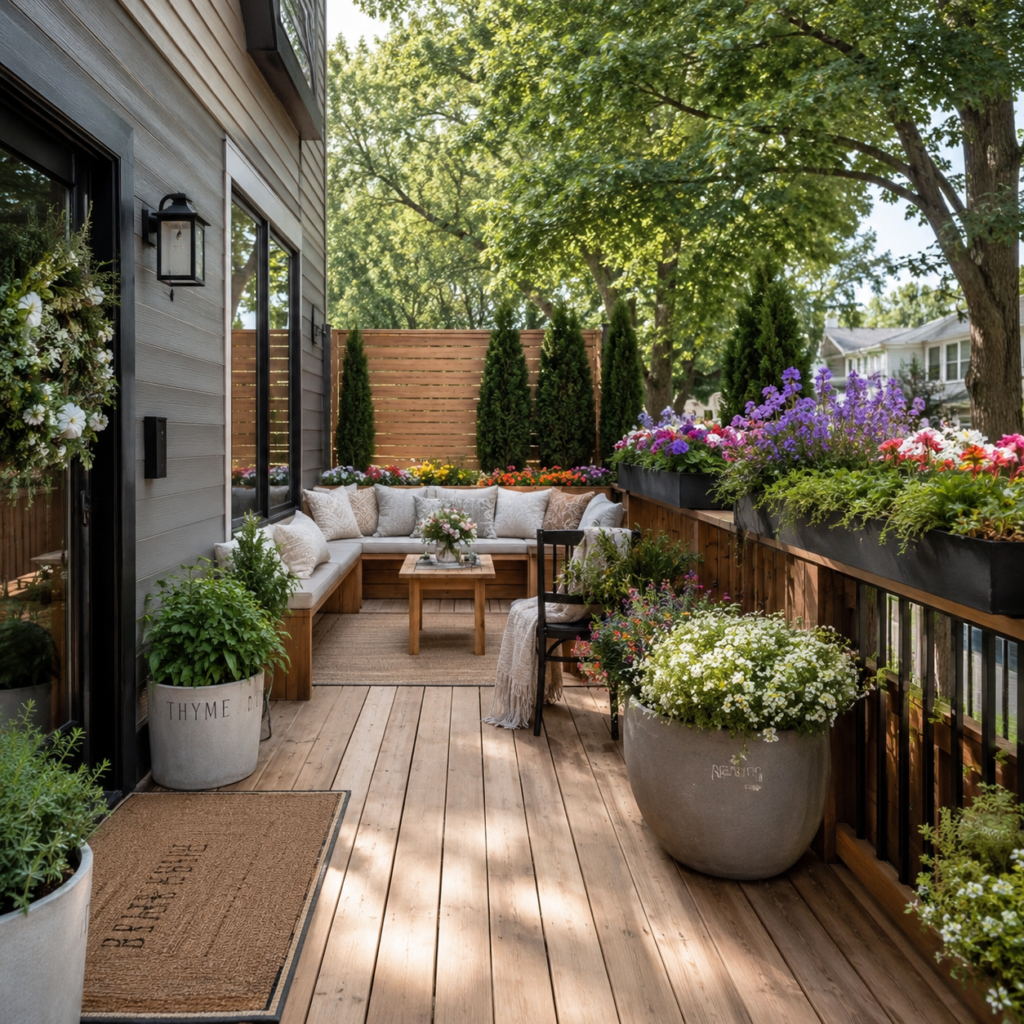
Backyard deck planter ideas work best when they add greenery without blocking walkways, trapping water, or overloading the deck. Use railing planters, corner pots, lightweight containers, built-in boxes, and privacy planters to frame seating, grow flowers or herbs, and make the deck feel softer, safer, and more inviting.
A deck is different from a patio or garden bed because every planter sits on a raised or finished surface. That means the best ideas are not only about beauty. They also need to protect deck boards, handle drainage, avoid excess weight, and leave enough space for chairs, doors, stairs, grills, and foot traffic.
The strongest deck planter layouts combine three things: smart placement, deck-safe materials, and the right plants for sun, shade, wind, and container depth. When those pieces work together, even a plain backyard deck can feel like a cozy outdoor room.
Best Backyard Deck Planter Ideas
The best backyard deck planter ideas are the ones that make the deck greener without making it harder to use. A deck is not the same as an open garden bed because every planter sits on a finished walking surface. That means each container should have a purpose. It may add color to the railing, soften a seating corner, grow herbs near the kitchen door, create privacy from neighbors, or fill an empty edge without blocking movement.
In real backyard decks, the most successful planter layouts feel intentional. A narrow deck may only need railing boxes and one tall corner planter. A large deck may need planters around seating, stairs, and dining areas to create outdoor zones. If the deck feels exposed, use privacy planters. If it looks flat, add height with grasses, shrubs, or vertical shelves.
Good backyard deck planter ideas include:
- Railing planters: for flowers, herbs, and trailing plants.
- Corner planters: to soften empty deck edges.
- Tall privacy planters: for grasses, shrubs, or trellis vines.
- Built-in planter boxes: for a custom deck design.
- Lightweight containers: for raised or older decks.
- Vertical plant shelves: for compact decks.
- Herb planters: near the kitchen door.
- Self-watering planters: for hot, sunny decks.
Beautiful Backyard Deck Planter Ideas
The most beautiful deck planter ideas match one clear design goal with the right container style. Railing flower boxes create a cheerful cottage look, tall black planters create privacy, and wooden planter boxes make the deck feel warmer and more natural.
Built-in planter benches are also useful because they combine seating, greenery, and structure in one permanent design.
- Railing flower boxes: best for colorful deck edges.
- Tall privacy planters: best for exposed seating areas.
- Corner planter groups: best for empty deck corners.
- Herb planters: best near kitchen or dining doors.
- Built-in planter benches: best for permanent upgrades.
Beginner setup: Start with one railing planter, two lightweight corner pots, and one herb planter near the kitchen door. This gives color, structure, and function without crowding the deck.
How to Choose Deck Planters
Choose planters for a backyard deck by looking at weight, drainage, material, sunlight, walkway clearance, wind, and how close the planter will sit to railings, stairs, doors, seating, or grills. This is where deck planning becomes different from normal patio decorating. A planter that works on the ground may be too heavy, too wet, or too awkward for a raised deck. Before buying anything, walk across the deck and notice where people naturally move. Doorways, stair openings, chair pull-out space, and grill zones should stay open.
The smartest decision is to match each planter to a specific job. Use railing planters where floor space is limited. Use tall planters where privacy is needed. Use slim rectangular planters beside furniture. Use lightweight containers if the deck is older, elevated, or difficult to access. Also think about watering. A planter placed far from a hose may be ignored during hot weather. A container without drainage can damage plants and deck boards. In real use, the best planter is not always the prettiest one. It is the one that fits the deck safely and stays easy to care for.
Before choosing deck planters, check:
- Deck size and open walking space
- Wood, composite, or vinyl deck surface
- Full sun, part sun, or shade exposure
- Drainage holes and airflow under pots
- Planter weight after soil and water
- Distance from doors, stairs, and railings
- Wind exposure on raised decks
- Access to water for regular care
- Whether the container can be moved for cleaning
Best Deck Planter Sizes
The best deck planter size depends on plant type, available space, wind exposure, and deck weight limits. Small herbs and annual flowers can grow in railing planters around 6–8 inches deep, while vegetables, shrubs, and privacy plants need deeper containers.
For most backyard decks, medium containers are easier to manage than oversized pots. A 12–16 inch pot works well for many flowers, herbs, and compact plants, while tall privacy planters should have a wide base for wind stability.
- 6–8 inches deep: herbs, lettuce, small flowers, railing planters.
- 10–12 inches deep: strawberries, larger herbs, compact annuals.
- 12–16 inches deep: peppers, mixed flowers, small shrubs.
- 18+ inches deep: tomatoes, privacy shrubs, trellis vines.
- Long troughs: best for railings, privacy lines, and narrow decks.
Are Heavy Planters Safe?
Heavy planters can be safe on a raised deck only when the deck is structurally sound, the weight is spread carefully, and the containers are not oversized for the space. This is one of the most important safety points because planters become much heavier after soil, water, mulch, and mature plants are added. A large container may look manageable when empty, but once filled with wet potting mix, it can become difficult to move and risky on an older or elevated deck. Concrete, stone, ceramic, and deep planter boxes need the most caution.
In real-world deck design, the safest approach is to avoid concentrating too much weight in one corner or along a weak railing. Lightweight planters often provide the same visual impact without unnecessary load. Resin, fiberglass, composite, and sealed wooden containers are usually more deck-friendly than oversized concrete or stone. If the deck is old, high, damaged, or showing soft boards, loose railings, or sagging areas, large heavy planters should not be added without professional advice. This is especially true for second-story decks or decks with unknown framing quality.
Be careful with:
- Large concrete planters
- Stone urns
- Oversized ceramic pots
- Deep raised planter boxes
- Wet soil-filled troughs
- Large container trees
- Multiple heavy pots grouped together
- Built-in planters added after construction
Better deck-safe choices include:
- Lightweight resin planters
- Fiberglass trough planters
- Composite planter boxes
- Sealed cedar or redwood boxes
- Planters with false bottoms
- Lightweight potting mix instead of garden soil
Best Deck Planter Materials
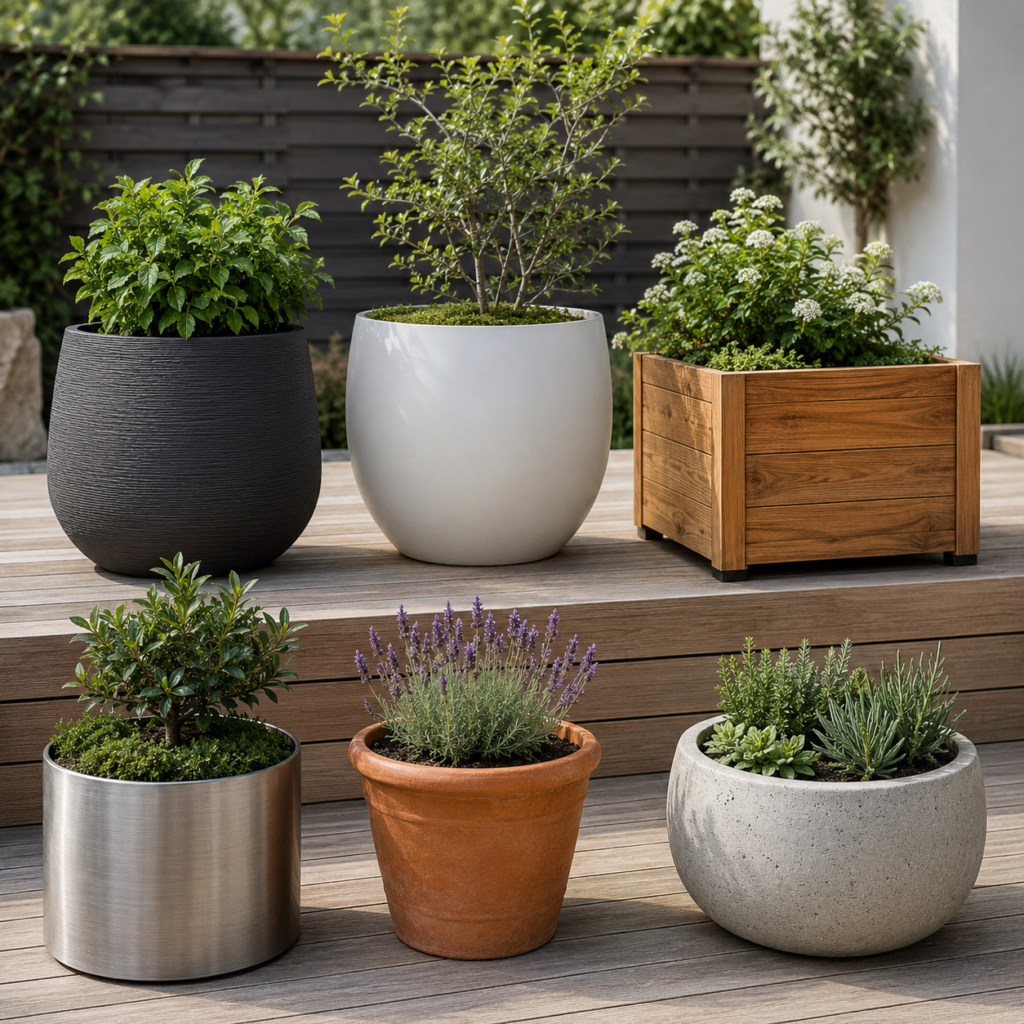
The best deck planter materials are lightweight, weather-resistant, stable, and unlikely to trap moisture or stain the deck surface. Resin, fiberglass, composite, sealed wood, and powder-coated metal are usually the most practical choices.
Material choice should match the deck’s structure and weather exposure. Use lightweight containers on raised decks, sealed wood for a natural look, fiberglass for modern style, and concrete only when the deck can safely support the weight.
Use this comparison before buying:
| Material | Best For | Deck Safety | Main Concern |
| Resin | Everyday deck planters | Very good | Thin versions may fade |
| Fiberglass | Modern deck designs | Excellent | Higher price |
| Sealed wood | Natural deck style | Good | Needs maintenance |
| Composite | Low-maintenance decks | Very good | Limited styles |
| Metal | Modern accents | Good | Heat and rust risk |
| Concrete | Luxury ground-level decks | Risky if large | Very heavy |
| Terracotta | Small herbs and flowers | Moderate | Breaks and dries fast |
Space-Saving Railing Planters
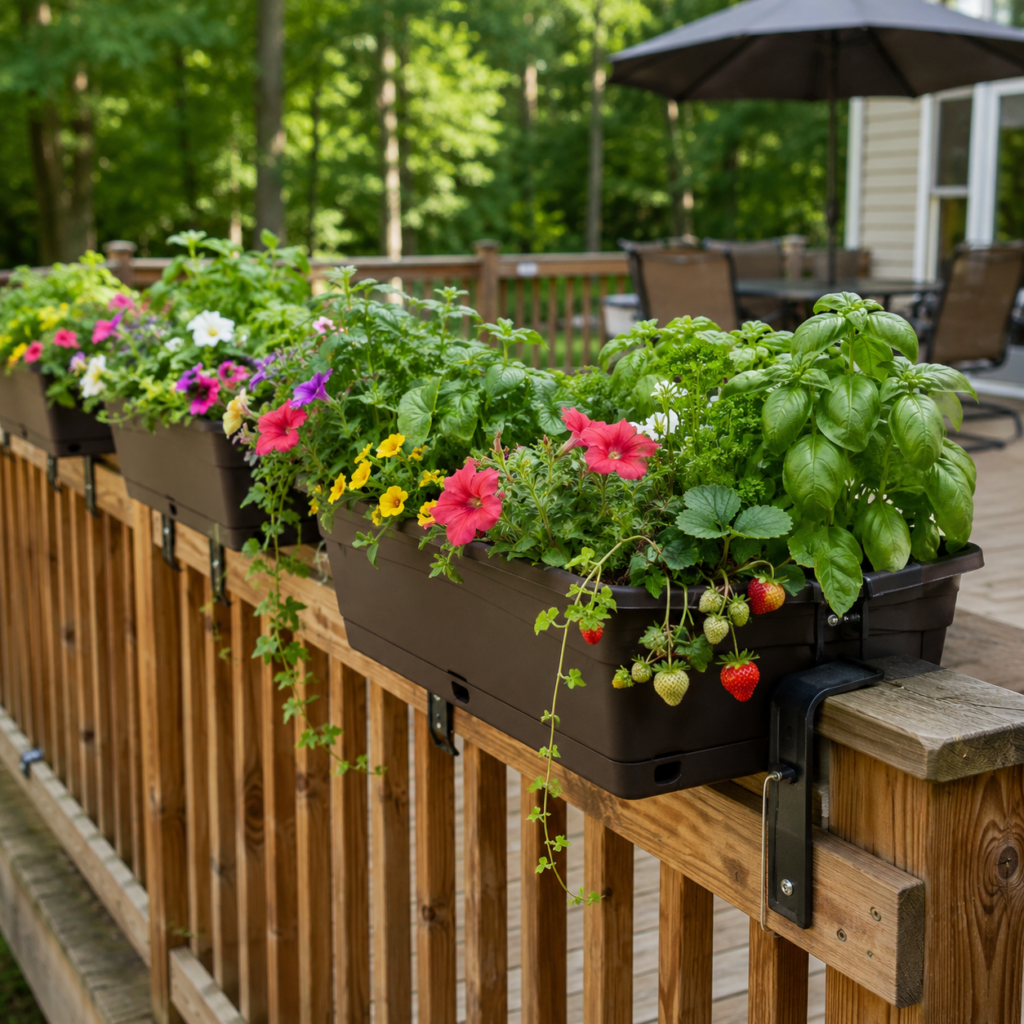
Railing planters save deck space by using the edge of the deck instead of the walking surface. They are one of the best planter ideas for small decks, narrow decks, townhome decks, balcony-style decks, and any backyard deck where floor space is limited. Instead of adding more pots around furniture, railing planters lift flowers, herbs, and trailing plants to the perimeter. This keeps the center of the deck open while still adding color and softness.
The key decision is safety and fit. A railing planter should match the railing width and stay secure in wind and rain. Some railing planters sit over the rail with a grooved base, while others attach with brackets, hooks, or adjustable supports. For a neat look, repeat the same planter style across the railing. For a softer cottage look, mix colorful blooms with trailing greenery. For a practical kitchen deck, use railing planters for basil, parsley, thyme, mint, or strawberries. Just avoid overloading railings with large wet containers or top-heavy plants.
Good plants for railing planters include:
- Petunias
- Calibrachoa
- Geraniums
- Nasturtiums
- Sweet potato vine
- Ivy
- Creeping Jenny
- Basil
- Parsley
- Thyme
- Strawberries
Use railing planters when:
- The deck is small
- The floor feels crowded
- You want flowers without losing seating space
- You need herbs near the kitchen
- You want trailing plants over the railing
- You want a green border around the deck
Small Deck Planter Ideas
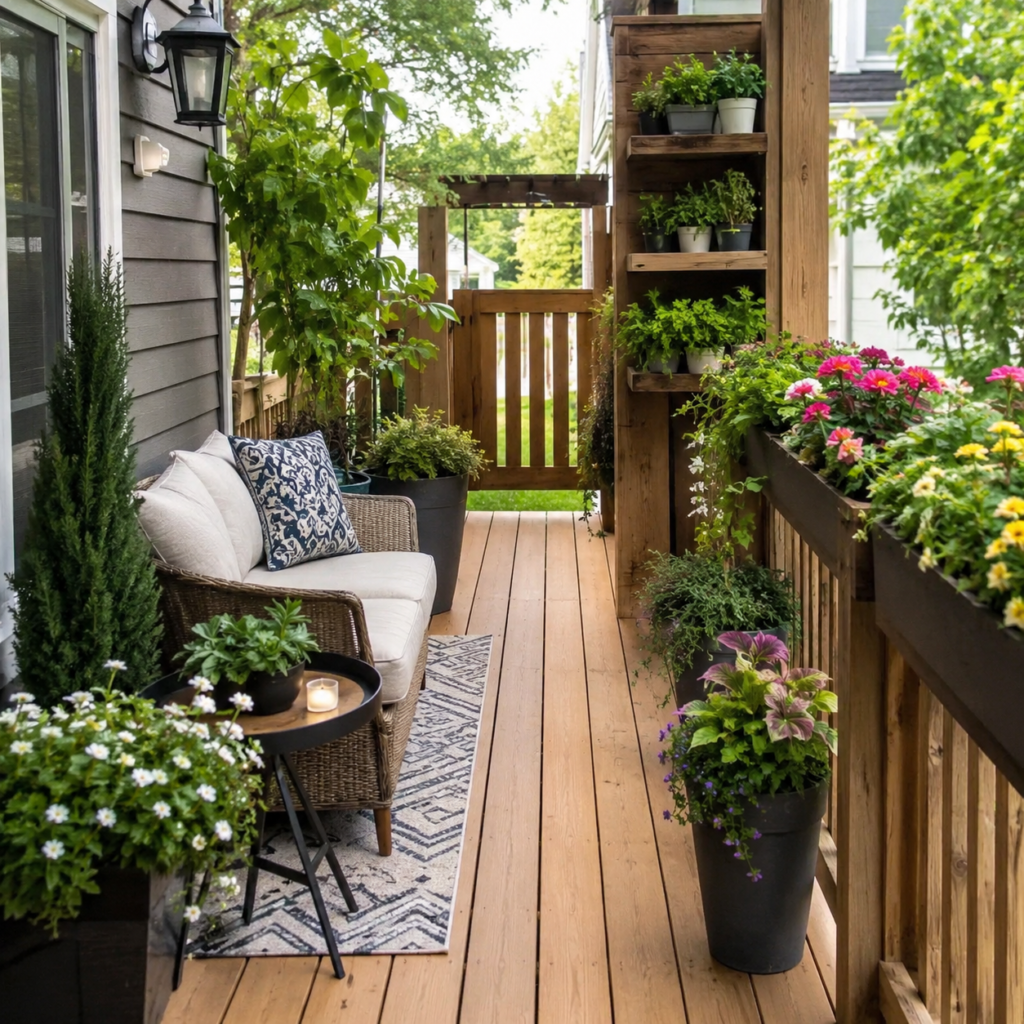
Small decks need planter ideas that add greenery without stealing valuable floor space. The best options are railing boxes, slim troughs, vertical shelves, hanging baskets, corner pots, and tall narrow containers. A small deck can become beautiful very quickly, but it can also feel cramped if too many pots sit around the furniture. The goal is to use the edges, railings, corners, and vertical space before placing planters in the center.
In real backyard use, fewer planters usually look better on a small deck. Many tiny pots can create clutter and require more watering. Three or four well-placed containers can feel cleaner, calmer, and more intentional. For example, one railing planter can add flowers, one corner pot can add height, one herb planter can sit near the door, and one hanging basket can add softness without taking up floor room. This gives variety without making the deck hard to walk through.
Best small deck planter ideas include:
- Railing flower boxes
- Slim rectangular trough planters
- Tall corner containers
- Hanging baskets
- Tiered plant stands
- Wall-mounted planters
- Vertical herb shelves
- Small self-watering containers
- Narrow privacy planters
Avoid on small decks:
- Too many tiny pots
- Oversized round containers
- Heavy planters in walking paths
- Wide planters beside chairs
- Tall unstable pots in windy spots
- Plants that spill into the walkway
A simple small deck layout:
- One railing planter for flowers
- One tall corner planter for height
- One herb planter near the door
- One hanging basket or wall planter
- One slim trough beside the railing
Deck Privacy Planters
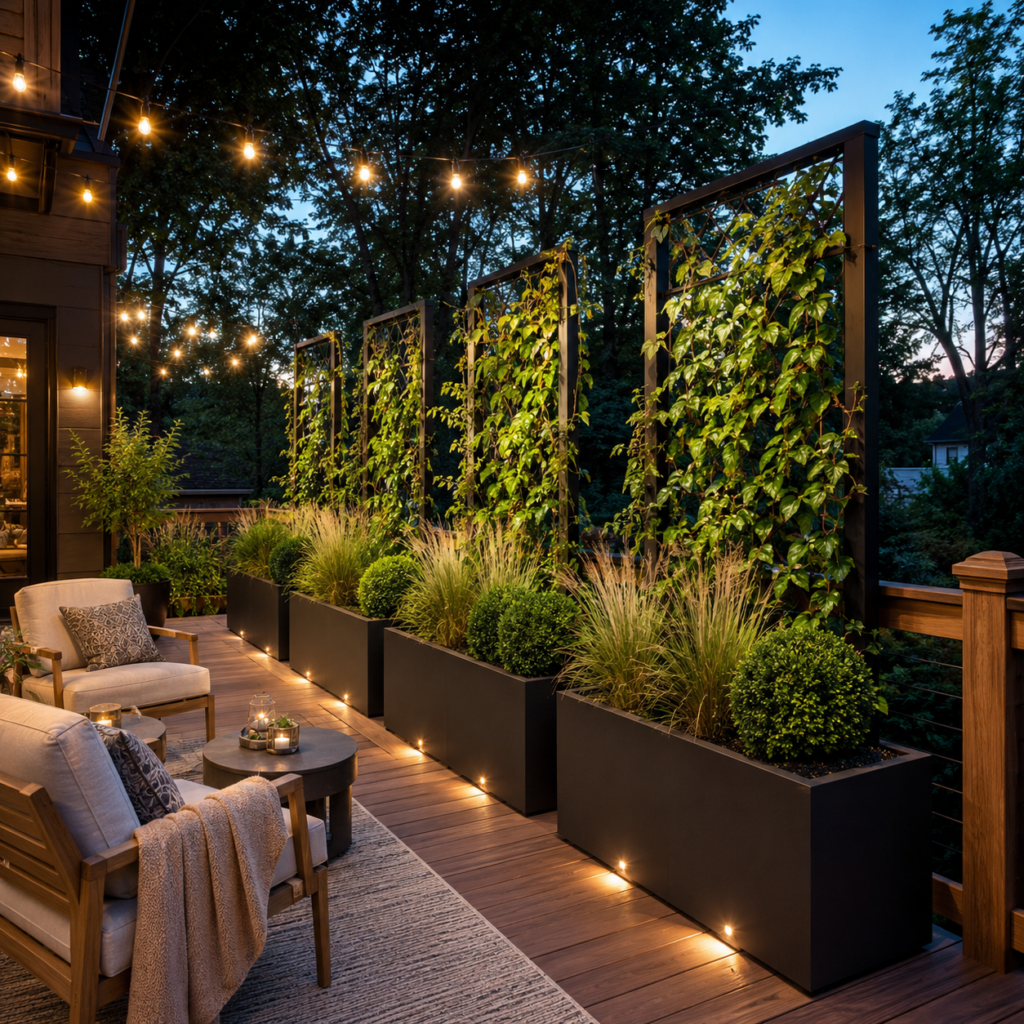
Deck planters create privacy by using tall containers, dense plants, trellis boxes, ornamental grasses, compact shrubs, or climbing vines to screen exposed areas. This is especially useful when a backyard deck faces neighbors, windows, fences, streets, or nearby patios. Unlike solid walls, privacy planters feel softer and more natural. They can block views while still allowing light, airflow, and seasonal beauty.
The best privacy planter depends on how much screening you need. For light privacy, ornamental grasses or tall flowers may be enough. For stronger privacy, use long rectangular planters with boxwood, dwarf arborvitae, bamboo-style plants, or trellis vines. Place them where privacy is actually needed, such as behind lounge chairs, beside a dining table, near a hot tub, or along the most exposed railing. Do not cover every side of the deck unless you want a more enclosed outdoor room.
Good privacy plants for deck planters include:
- Ornamental grasses
- Fountain grass
- Boxwood
- Dwarf arborvitae
- Compact holly
- Clumping bamboo in containers
- Jasmine on a trellis
- Clematis on a trellis
- Climbing roses in large containers
- Tall lavender in sunny spots
Best privacy planter styles:
- Tall rectangular troughs
- Trellis planter boxes
- Wide-bottom containers
- Built-in railing planters
- Planter benches with back screens
- Long lightweight privacy boxes
Real-world decision clarity:
- Use grasses for soft movement
- Use evergreens for year-round privacy
- Use vines for vertical screening
- Use shrubs for structure
- Use lightweight troughs on raised decks
- Avoid top-heavy pots in windy locations
Best Plants for Deck Planters
The best plants for deck planters are compact, container-friendly, and matched to the deck’s sunlight, wind, and container size. Decks often feel hotter than garden beds, so containers may dry faster in sun and reflected heat.
For sunny decks, use petunias, geraniums, lavender, rosemary, salvia, marigolds, and ornamental grasses. For shaded decks, use begonias, impatiens, coleus, ferns, caladiums, hostas, parsley, mint, and creeping Jenny.
- Flowers: petunias, geraniums, begonias, impatiens, marigolds.
- Herbs: basil, rosemary, thyme, parsley, mint, chives.
- Privacy plants: grasses, boxwood, dwarf arborvitae, jasmine.
- Trailing plants: sweet potato vine, ivy, nasturtiums, calibrachoa.
- Edibles: lettuce, strawberries, peppers, cherry tomatoes.
You can also grow vegetables in deck planters if the deck gets enough sun and the containers are deep enough. Herbs, lettuce, strawberries, peppers, cherry tomatoes, radishes, and bush beans are some of the easiest choices.
- Shallow planters: herbs, lettuce, radishes, and strawberries.
- Deeper pots: peppers, cherry tomatoes, and compact vegetables.
- Railing planters: herbs, leafy greens, and strawberries.
Protecting Deck Boards
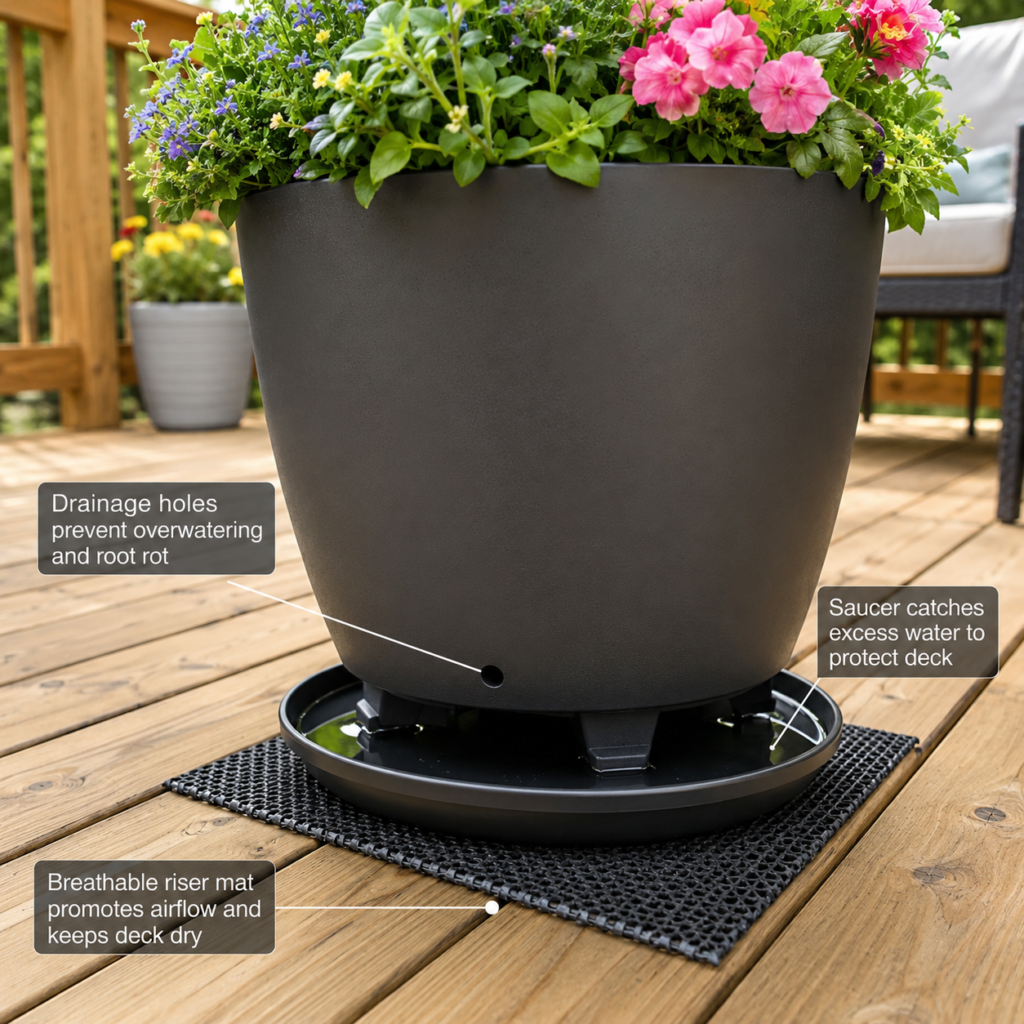
Protect deck boards from planter damage by lifting containers off the surface, controlling drainage, using trays carefully, and cleaning under pots regularly. A planter should not sit flat on wood or composite boards for months because moisture can collect underneath. Over time, trapped water may cause stains, mildew, algae, discoloration, rot, or dirt marks. Even composite decking can show marks if wet soil, rust, or plant debris sits too long.
Airflow is the most important protection method. Pot feet, risers, plant caddies, and raised stands allow water to dry under the container. Saucers and trays are useful, but they should not stay full of water. After rain or watering, empty standing water when possible. Also check for rust from metal containers, mineral stains from terracotta, tannin stains from wood, and soil spills from overfilled pots. A planter setup is only successful if the deck stays clean and healthy beneath it.
Use these deck protection tools:
- Pot feet
- Outdoor risers
- Plant caddies with wheels
- Raised planter stands
- Breathable deck mats
- Drain trays
- Saucers
- Non-rusting hardware
- Lightweight containers with drainage holes
Avoid these problems:
- Pots sitting directly on boards
- Saucers full of water
- Rusting metal bases
- Leaking wooden planters
- Soil spilling through drainage holes
- Concrete planters scraping the surface
- Heavy pots that cannot be moved
Real-world maintenance tip:
- Move planters occasionally
- Sweep under containers
- Check for stains or soft spots
- Clean trapped leaves and soil
- Empty saucers after heavy rain
- Reposition pots seasonally
Arranging Planters Around Furniture
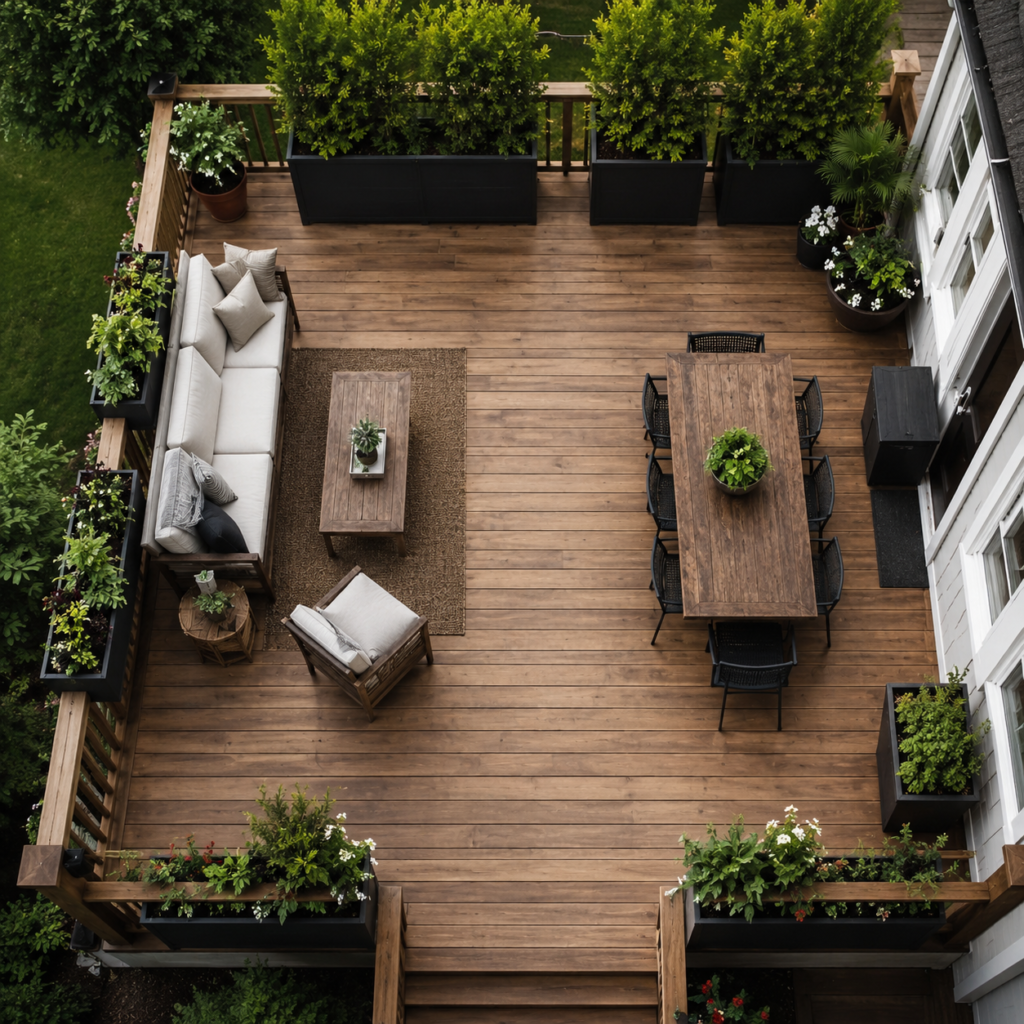
Arrange planters around deck furniture by framing seating zones, softening corners, and keeping walkways open. A dining deck needs chair clearance, while a lounge deck needs cozy edges and taller planters behind seating.
Use planters like outdoor room dividers. A pair of matching pots can frame stairs, a tall planter can mark a seating zone, and railing boxes can add flowers without taking floor space.
- Open deck: use larger planters to define zones.
- Dining deck: use low railing planters and herbs near the table.
- Lounge deck: place tall planters behind chairs or sofas.
- Grill deck: keep plants away from heat and flames.
- Small deck: use railing boxes, hanging baskets, corner pots, and vertical space.
- Sunny deck: use larger lightweight pots and heat-tolerant plants.
- Covered deck: use ferns, begonias, coleus, and shade herbs.
- Raised deck: use lightweight containers and spread the weight.
Deck Planter Mistakes
The biggest deck planter mistakes are using heavy pots on weak decks, blocking walkways, trapping water under containers, ignoring drainage, and choosing plants that do not match the light. These mistakes usually happen when people decorate a deck like a ground-level patio.
A good planter should look attractive, drain properly, stay stable, and keep the deck easy to use. If a container creates weight, water, or movement problems, it needs to be moved, lifted, or replaced.
- Using large concrete pots on older raised decks.
- Placing wet planters directly on deck boards.
- Buying containers without drainage holes.
- Letting saucers stay full of water.
- Blocking doors, stairs, or chair movement.
- Using unstable railing planters.
- Placing plants too close to grills or fire pits.
Deck Planter Safety and Layout Checklist
Before adding planters to a deck, check the safety, drainage, weight, and placement of each container. This checklist helps prevent common problems before they happen. It is especially useful for raised decks, small decks, wood decks, composite decks, and decks with railings or stairs.
Use this checklist before buying or placing planters:
- Is the deck structurally sound?
- Will the planter become too heavy when watered?
- Does the container have drainage holes?
- Is there airflow under the planter?
- Can water escape without staining the deck?
- Will the planter block doors, stairs, or walking paths?
- Is the railing planter securely fitted?
- Is the plant matched to sun or shade?
- Can you reach the planter with a hose or watering can?
- Can the planter be moved for seasonal cleaning?
- Is the planter stable in wind?
- Is the container material safe for the deck surface?
- Will the saucer or tray hold water too long?
- Is the planter too close to a grill or fire pit?
- Can the plant grow without outgrowing the container quickly?
Conclusion
Backyard deck planter ideas work best when they combine beauty with smart planning. Use railing planters, lightweight containers, privacy planters, herb pots, vertical shelves, and corner containers to add greenery without blocking walkways or damaging deck boards.
Choose planters with drainage, lift pots off the deck surface, match plants to sunlight, and keep heavy containers placed safely. With the right setup, even a small backyard deck can feel cozy, green, private, and useful.
Deck planters are worth it when they add color, privacy, herbs, or comfort without blocking walkways, trapping water, or adding unsafe weight.
FAQs
What are the best planter ideas for a backyard deck?
The best backyard deck planter ideas include railing planters, corner pots, privacy planters, herb planters, hanging baskets, and lightweight containers. Choose based on deck size, sunlight, drainage, and walking space.
What planters are best for a backyard deck?
Lightweight planters with drainage holes are best for backyard decks. Resin, fiberglass, composite, sealed wood, and quality plastic are usually safer than heavy concrete or stone.
Can planters damage a deck?
Yes, planters can damage a deck if they trap water or sit directly on boards for too long. Use pot feet, risers, trays, or breathable mats to reduce stains and moisture damage.
What can you put under planters on a deck?
Use pot feet, risers, saucers, drain trays, plant caddies, or breathable deck mats under deck planters. Avoid plastic sheets, indoor rugs, flat rubber mats, or anything that traps water and blocks airflow.
Are railing planters safe on decks?
Railing planters are safe when they fit properly and are secured with strong brackets or supports. Avoid large, wet, heavy railing planters on older or weak railings.
How deep should deck planters be?
Small herbs, lettuce, and flowers can grow in 6–8 inch deep planters. Larger herbs, peppers, tomatoes, shrubs, and privacy plants usually need 12–18 inches or more.
Are heavy planters safe on a raised deck?
Heavy planters may be safe only if the deck is structurally sound and the weight is spread carefully. Avoid grouping large concrete, stone, or wet soil-filled pots in one area.
What plants grow best in deck planters?
Petunias, geraniums, begonias, herbs, lavender, grasses, boxwood, lettuce, strawberries, peppers, and cherry tomatoes grow well in deck planters. Match plants to sun or shade.
Can I grow vegetables in deck planters?
Yes, vegetables can grow well in deck planters if they get enough sun and container depth. Herbs, lettuce, strawberries, peppers, cherry tomatoes, radishes, and bush beans are easy choices.
How do you arrange planters on a deck?
Arrange planters around edges, railings, corners, stairs, and seating zones while keeping the center walkway open. Use tall planters behind seating and railing boxes where floor space is limited.
What is the best way to create privacy with deck planters?
Use tall rectangular planters with ornamental grasses, boxwood, dwarf evergreens, bamboo-style plants, or trellis vines. Place them near exposed railings, seating areas, or hot tubs.
What should you avoid with deck planters?
Avoid heavy pots on weak decks, containers without drainage, standing water in saucers, unstable railing planters, blocked walkways, and pots too close to grills, doors, stairs, or fire pits.

Myra is the founder and lead writer of Backyard Planter Ideas, where she shares practical, well-researched guidance on planter design, plant selection, and outdoor styling. Her goal is to help homeowners create attractive, functional garden spaces with clear, reliable, and easy-to-apply advice.