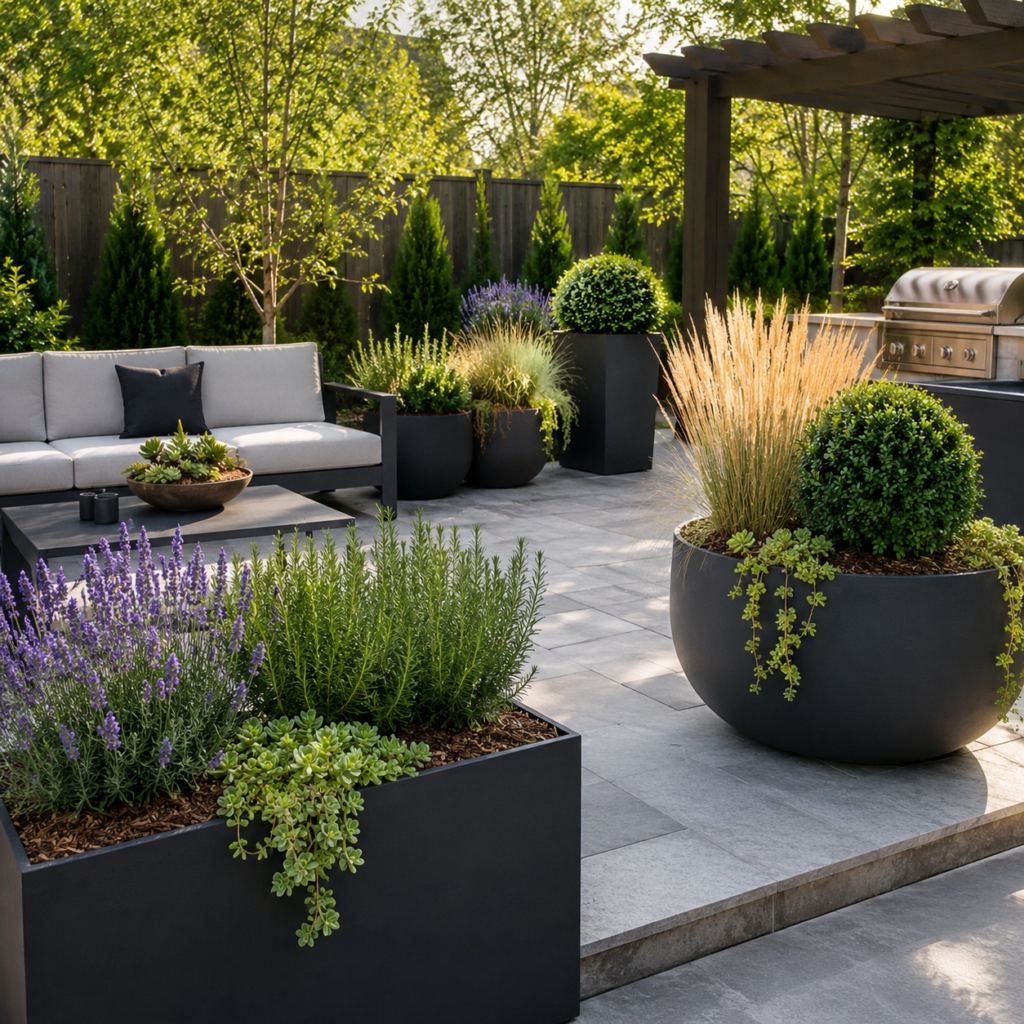
Low maintenance backyard planter ideas are the easiest way to make your outdoor space look beautiful without constant watering, pruning, replanting, and daily plant rescue. The best setups use large durable containers, drought-tolerant plants, self-watering systems, well-draining soil, mulch, and simple plant groupings that match your backyard’s sun, shade, and climate.
A low maintenance planter is not just a pot with “easy plants.” It is a complete system where the container size, material, drainage, soil mix, watering method, and plant choice all work together. When these parts are chosen correctly, backyard planters stay healthier for longer and require far less effort.
This guide covers the best low maintenance backyard planter ideas for patios, small yards, sunny gardens, shaded corners, modern spaces, budget layouts, and beginner-friendly outdoor designs.
Best Low Maintenance Backyard Planter Ideas
The best low maintenance backyard planter ideas are designs that reduce watering, prevent drainage problems, and use plants that can handle outdoor conditions without constant attention. Large trough planters, self-watering containers, raised planters, evergreen shrub pots, succulent bowls, herb planters, and ornamental grass planters are some of the easiest choices because they solve common backyard problems before they start. Instead of depending on delicate seasonal flowers, these planter ideas focus on structure, soil volume, durable materials, and plants that naturally tolerate heat, wind, dryness, or shade. This makes the whole garden easier to manage, especially for homeowners who want outdoor beauty without daily maintenance.
If your backyard has shade, a foliage planter with hosta, heuchera, ferns, or compact evergreen shrubs is easier than forcing sun-loving plants into the wrong place. The winning idea is not always the most colorful one; it is the one that stays healthy with the least effort.
Best low maintenance planter ideas include:
- Large rectangular trough planters with ornamental grasses
- Self-watering patio planters for herbs and flowers
- Succulent bowls for sunny, dry backyard corners
- Evergreen shrub planters for year-round structure
- Raised planters with mulch and drip irrigation
- Modern fiberglass planters with repeat planting
- Concrete-look planters with drought-tolerant perennials
- Herb planters with rosemary, sage, thyme, and oregano
Why Some Planters Need Less Care
Some backyard planters need less maintenance because they are built around plant health instead of decoration alone. The easiest planters have enough soil volume, drainage holes, durable materials, moisture control, and plants that match the exact light conditions of the backyard. When these parts work together, the planter does not dry out too quickly, does not stay soggy, and does not force you to constantly replace stressed plants. This is why two planters can look similar on day one but behave very differently after a few weeks outside. One may stay fresh with basic care, while the other may wilt, rot, crack, or become overgrown.
Low maintenance planters usually have:
- Large soil volume for stable moisture
- Drainage holes at the bottom
- Outdoor potting mix instead of heavy garden soil
- A mulch layer to reduce evaporation
- Weather-resistant planter material
- Plants with similar sunlight and watering needs
- Easy access to a hose, watering can, or drip line
How to Choose Easy-Care Planters
Choose low maintenance backyard planters by looking at sunlight, planter size, material, drainage, and watering access before choosing the plants. Many homeowners buy attractive pots first and then try to make plants work inside them, but the easier method is to study the location first. A sunny patio, shaded fence line, windy deck, covered porch, small backyard, and open lawn edge all need different planter decisions. If the planter does not match the site, even the best plant can become difficult to maintain. This is why choosing correctly at the start saves more time than trying to fix problems later.
Start with size. Larger planters are usually easier because they hold more soil, support stronger roots, and dry out more slowly. Then check the material. Fiberglass, resin, composite, concrete-look, and glazed planters usually need less ongoing care than untreated wood or unglazed terracotta. After that, check drainage. A beautiful planter without drainage holes can become a root rot problem. Finally, think about watering access. If the planter is far from a hose or hidden in a hard-to-reach corner, you may avoid watering it when life gets busy.
Use this buying checklist:
- Choose larger pots for fewer watering problems
- Make sure every planter has drainage holes
- Pick weather-resistant materials for outdoor use
- Keep planters near a hose or irrigation line
- Match plants to sun, shade, wind, and heat
- Avoid fragile materials in harsh climates
- Choose fewer large planters instead of many small pots
Are Self-Watering Planters Worth It?
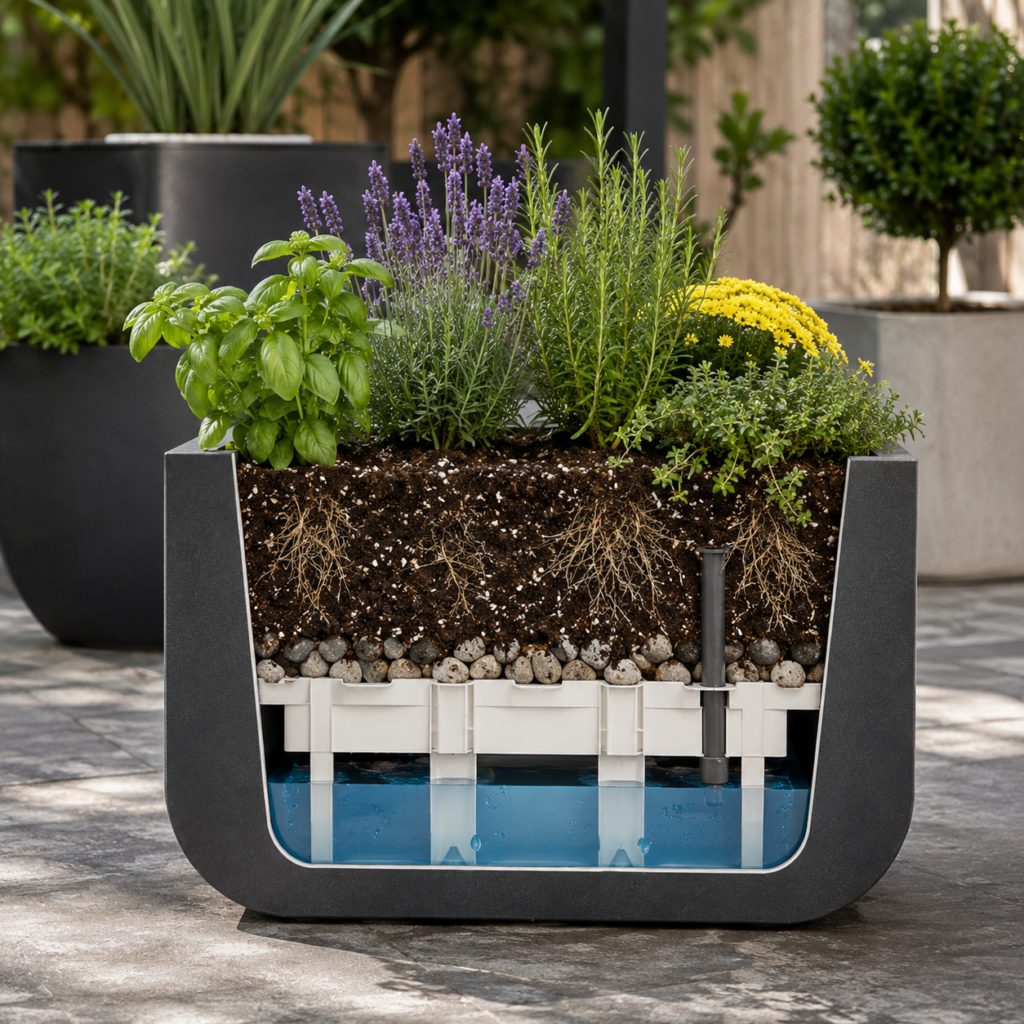
Self-watering planters are worth it for many backyards because they reduce watering frequency and make container gardening easier for busy homeowners, renters, and people who travel. These planters usually include a water reservoir below the soil, allowing roots to draw moisture as needed. This creates a more consistent watering pattern than occasional surface watering. They are especially useful on patios, decks, balconies, and sunny areas where regular pots dry out quickly. If watering is the reason your outdoor plants often fail, a self-watering planter can be one of the smartest upgrades.
However, self-watering planters are not a perfect solution for every plant. They work best for herbs, flowers, leafy greens, and plants that enjoy consistent moisture. They are less ideal for succulents, cacti, lavender, rosemary, and many Mediterranean herbs if the soil stays too wet. This does not mean you cannot use them, but you must choose plants carefully and check that the planter does not hold too much moisture around dry-loving roots. Even self-watering systems still need attention during heatwaves, heavy rain, or long dry periods.
Self-watering planters are best for:
- Busy homeowners who forget watering
- Patio and balcony gardens
- Renters who want easy container gardens
- Herbs that like steady moisture
- Seasonal flowers in hot weather
- Small vegetables and leafy greens
- Outdoor spaces far from daily attention
Best Plants for Low Maintenance Planters
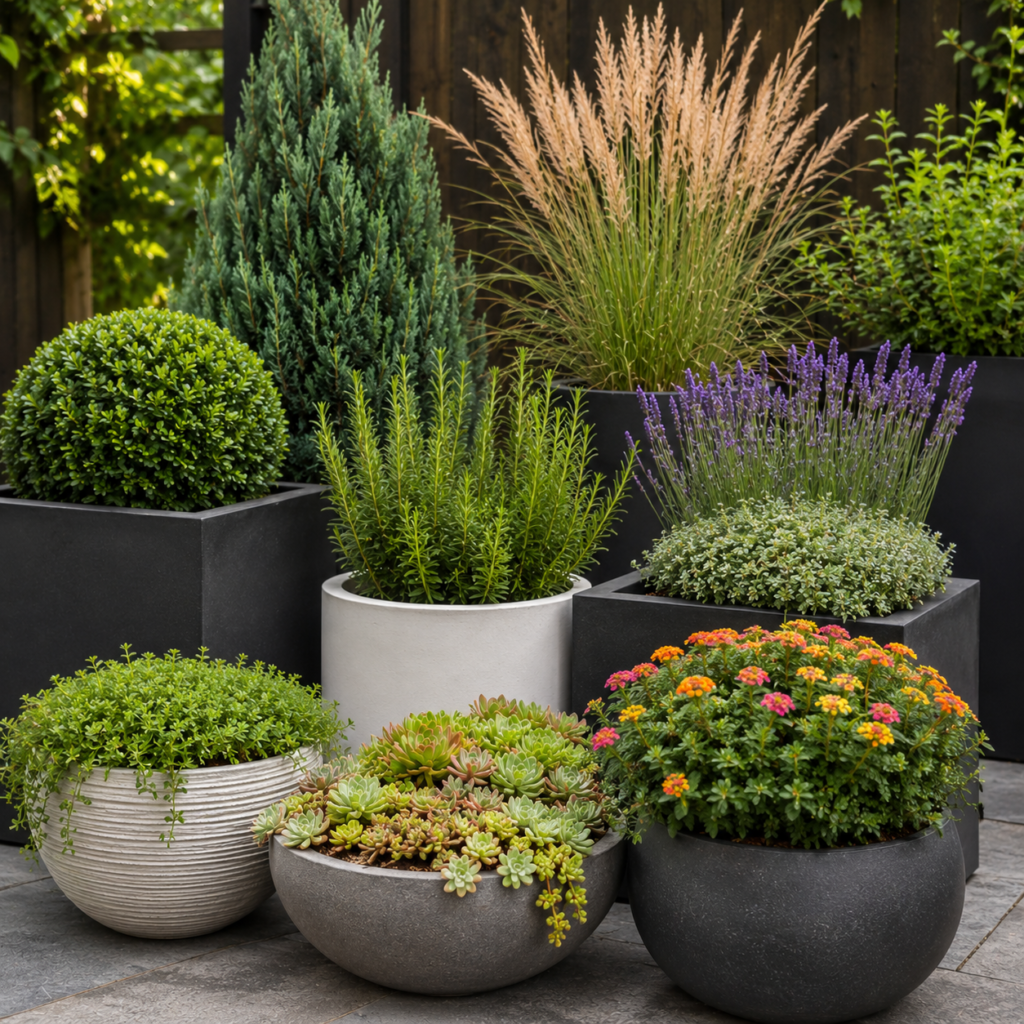
The best plants for low maintenance backyard planters are drought-tolerant, slow-growing, pest-resistant, and suited to the light conditions of the space. Good choices include succulents, Mediterranean herbs, ornamental grasses, evergreen shrubs, and heat-tolerant flowers. These plants usually perform better because they do not need constant deadheading, heavy feeding, or daily watering once they are established. A low maintenance planter becomes much easier when every plant inside has similar needs. That means dry-loving herbs should stay together, shade plants should stay together, and thirsty flowers should not be mixed with drought-tolerant succulents.
Best low maintenance plants include:
- Sedum for sunny succulent bowls
- Rosemary for fragrant edible planters
- Lavender for sunny fragrant planters
- Thyme for low-growing herb edges
- Ornamental grasses for structure and movement
- Dwarf juniper for evergreen texture
- Boxwood for formal year-round shape
- Lantana for heat-tolerant color
Perennials vs Annuals for Easy Planters
Perennials are usually better than annuals for low maintenance planters because they can return for more than one growing season when matched to the right climate, container size, and soil. They reduce seasonal replanting and give planters a more stable structure.
Annuals are still useful for quick color, but they often need more watering, feeding, trimming, and replacement. The best approach is to build the planter with long-lasting shrubs, grasses, herbs, or perennials first, then add a few annuals for seasonal color.
- Choose perennials: for long-term structure and less replanting
- Choose annuals: for quick seasonal color
- Choose evergreen shrubs: for year-round shape
- Choose ornamental grasses: for texture and movement
- Best mix: permanent plants with small seasonal accents
Best Low Maintenance Planters for Full Sun
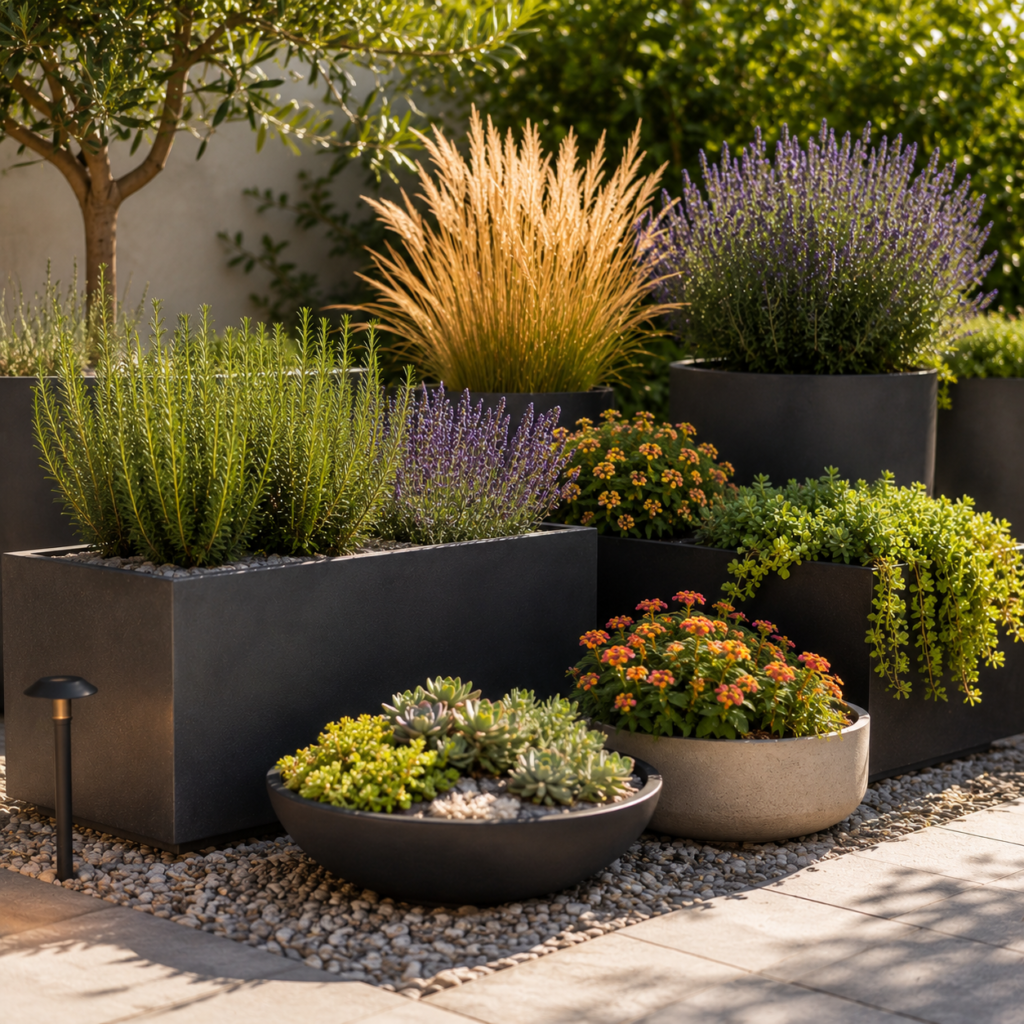
The best low maintenance planters for full sun use heat-tolerant plants, larger containers, mulch, and materials that do not dry out too quickly. Full sun planters can look beautiful, but they must be designed for heat, direct light, and faster moisture loss. A backyard area with six or more hours of sun is excellent for herbs, succulents, lavender, grasses, and many flowering plants. However, small pots in full sun can dry out quickly, especially on patios, decks, and concrete surfaces that reflect heat. This is why full sun planters should usually be larger and more drought-focused.
Best full sun planter ideas include:
- Lavender and rosemary planter
- Succulent bowl with sedum and echeveria
- Ornamental grass trough planter
- Lantana planter for bright color
- Mediterranean herb planter
- Concrete-look planter with dwarf shrubs
- Gravel-top sedum planter
- Large fiberglass planter with heat-tolerant perennials
Best Low Maintenance Planters for Shade
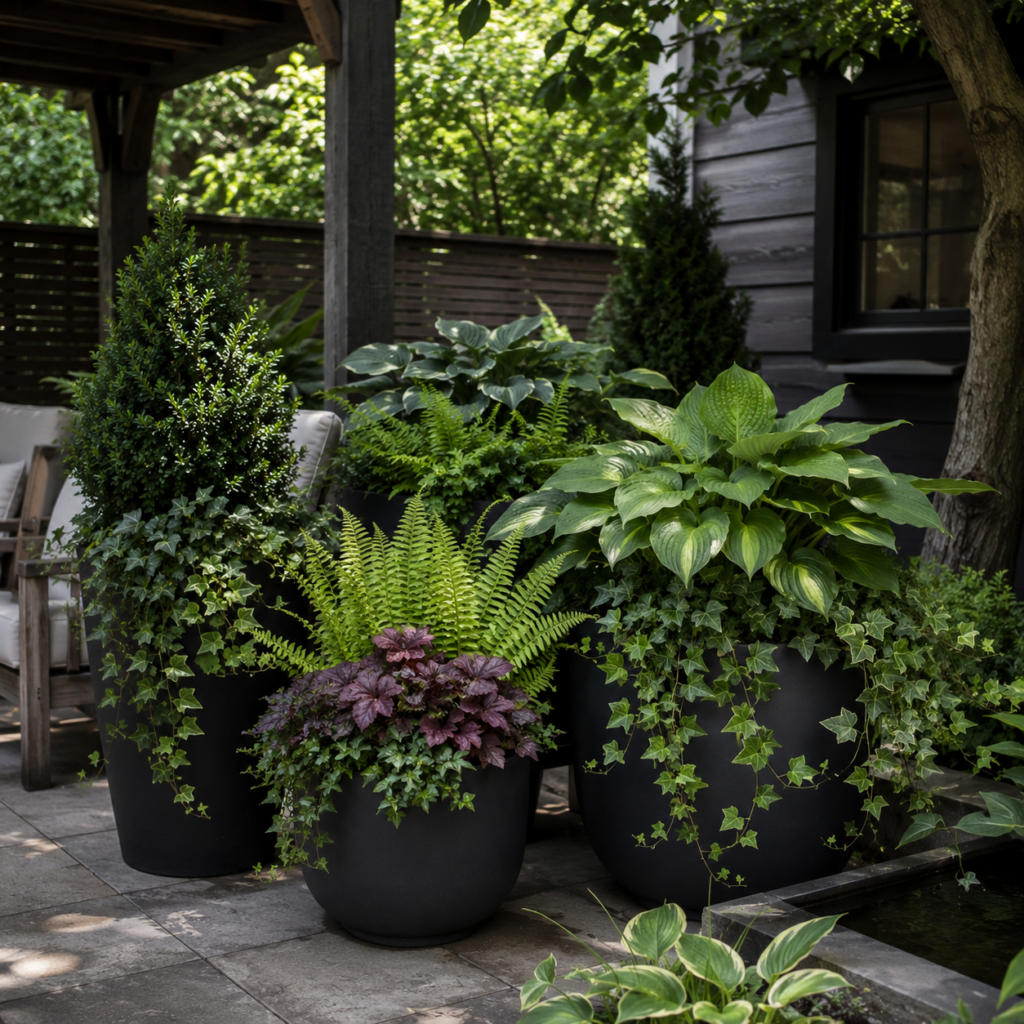
The best low maintenance planters for shade use plants that tolerate lower light and soil that drains well without drying too quickly. Shaded backyard corners, covered patios, fence lines, side yards, and north-facing spaces can still look beautiful when you focus on foliage, texture, and structure instead of forcing heavy blooms. Shade planters often need less watering than full sun planters because the soil dries more slowly, but they still need careful drainage. A shaded planter that stays too wet can become just as problematic as a sunny planter that dries too fast.
Best shade planter ideas include:
- Hosta planter for bold foliage
- Fern and heuchera container
- Evergreen shrub pot for year-round structure
- Caladium planter for warm-climate color
- Tall corner planter for shaded patios
- Wall planter for narrow shaded areas
- Mixed foliage trough with ivy and ferns
- Large resin planter under a covered seating area
Lowest Maintenance Planter Materials
The lowest maintenance planter materials are usually fiberglass, resin, composite, concrete-look, metal, and high-quality glazed containers. These materials generally need less sealing, less seasonal protection, and less frequent replacement than untreated wood or fragile terracotta. Planter material affects more than appearance. It changes how fast soil dries, how heavy the container becomes, how well the pot handles weather, and how often it may need repair or replacement. A planter that looks beautiful but cracks, fades, dries out too fast, or needs constant sealing is not truly low maintenance.
Fiberglass and resin are often the easiest choices for most homeowners because they are lightweight, weather-resistant, and available in many styles. Concrete planters look premium and last well, but they are heavy and should be placed carefully before filling. Metal planters suit modern spaces, but they can heat up in full sun. Cedar offers a warm natural look, but it may need sealing over time. Terracotta is attractive and classic, but it is porous, so it dries quickly and may crack in freeze-thaw climates.
Planter material comparison:
- Fiberglass: low maintenance, modern, lightweight
- Resin: budget-friendly, easy to move, weather-resistant
- Composite: durable, clean-looking, good for long-term use
- Concrete: strong and premium, but heavy
- Metal: modern and sleek, but can heat up
- Cedar: natural and warm, but needs protection
- Terracotta: beautiful but dries quickly
- Ceramic: decorative but can chip or crack
Large Planters vs Small Pots
Large planters usually need less care than small pots because they hold more soil, support stronger roots, and dry out more slowly. They are especially useful in hot, sunny, windy, or exposed backyard spaces where small containers lose moisture quickly. A small pot may look cute on a table or step, but it often needs frequent watering and gives roots very little room. A large planter creates a more stable growing environment, which means fewer sudden wilting problems and less stress during hot weather.
Large planter benefits include:
- More soil volume for moisture stability
- Better root space for healthier plants
- Less frequent watering than small pots
- Stronger visual impact in the backyard
- More room for mulch and irrigation
- Better support for shrubs and grasses
- Fewer containers to manage overall
How to Reduce Planter Watering
You can reduce watering in backyard planters by using larger containers, drought-tolerant plants, mulch, self-watering reservoirs, drip irrigation, and moisture-balanced outdoor potting mix. Watering is the biggest maintenance task in most container gardens, so reducing watering stress makes the whole backyard easier. The goal is not to keep soil wet all the time. The goal is to create steady moisture while still allowing drainage. Plants need oxygen around their roots, so water control must always work with drainage, not against it.
Start with planter size because larger containers hold moisture longer. Then add the right plants. Drought-tolerant herbs, succulents, ornamental grasses, and evergreen shrubs usually need less frequent watering than delicate annual flowers. Mulch is another simple upgrade. A thin layer of bark, gravel, composted mulch, or decorative stone reduces evaporation and makes the planter look more finished. Drip irrigation is helpful when you have several planters or a busy schedule. Self-watering planters are useful for patios, renters, and people who travel.
Ways to reduce watering include:
- Choose larger containers
- Use drought-tolerant plants
- Add mulch over the soil surface
- Group planters together to reduce wind exposure
- Use drip irrigation for steady watering
- Choose self-watering planters where suitable
- Avoid tiny pots in harsh afternoon sun
- Use quality outdoor potting mix
- Water deeply instead of lightly sprinkling
Easy Planter Ideas for Beginners
The easiest low maintenance planter ideas for beginners are large herb planters, succulent bowls, evergreen shrub containers, ornamental grass troughs, and self-watering flower planters. These setups are simple, forgiving, and do not require advanced gardening skills. Beginners often struggle because they choose too many plants at once or copy complicated nursery displays. A professional mixed container may look beautiful, but it can include plants with different watering, pruning, and feeding needs. For a beginner, simple is better.
The best beginner planter uses one clear sunlight condition, one main plant group, and one easy watering routine. A sunny beginner planter could include rosemary, thyme, sage, and oregano. A dry patio planter could use sedum and hens and chicks. A shaded planter could use hosta, heuchera, and ivy. A modern beginner planter could use one ornamental grass repeated in three matching pots. These ideas work because the plant needs are similar, so there is less guesswork.
Beginner-friendly planter ideas include:
- Large herb planter with rosemary, thyme, sage, and oregano
- Succulent bowl with sedum and hens and chicks
- Evergreen shrub planter with boxwood or dwarf juniper
- Ornamental grass trough for a modern patio
- Self-watering flower planter with vinca or lantana
- Shade foliage pot with hosta and heuchera
- Raised planter with mulch and simple irrigation
Mistakes That Make Planters Harder
Backyard planters become high maintenance when they are too small, poorly drained, overplanted, placed in the wrong light, or filled with plants that need different care. Most planter problems start before the first plant is added. A container without drainage holes can cause root rot. A tiny pot in full sun can dry out too fast. A mixed planter with thirsty flowers and dry-loving herbs creates constant watering confusion. These mistakes make the planter harder to manage even if the plants are healthy when purchased.
Another common mistake is using garden soil inside containers. Garden soil can become heavy, compacted, and poorly draining in pots. Outdoor potting mix is usually better because it allows water, oxygen, and roots to move more freely. Overcrowding is also a major issue. A planter may look full and beautiful on day one, but plants grow. When roots compete for water and nutrients, the planter dries faster, plants weaken, and maintenance increases. Low maintenance design needs space for growth, not just instant fullness.
Avoid these high-maintenance mistakes:
- Using pots without drainage holes
- Choosing tiny pots for hot sunny areas
- Mixing plants with different water needs
- Placing shade plants in full sun
- Using garden soil instead of potting mix
- Overcrowding too many plants in one container
- Skipping mulch in exposed planters
- Choosing fragile materials for harsh weather
- Ignoring mature plant size
- Buying plants only for flower color
Easiest Low Maintenance Planter Setup
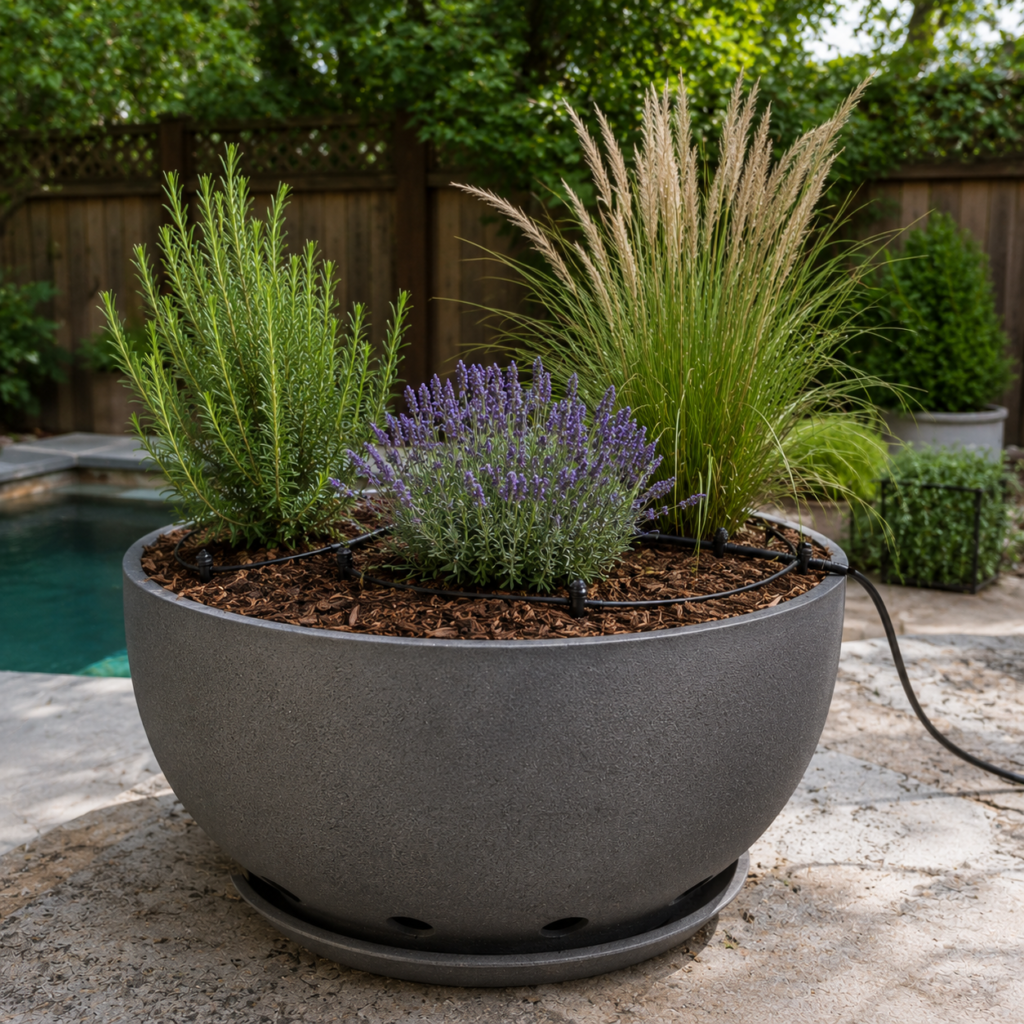
The easiest low maintenance backyard planter setup is a large durable planter with drainage holes, quality outdoor potting mix, drought-tolerant plants, mulch, and either drip irrigation or a self-watering reservoir. This setup solves the most common problems: fast drying, root rot, overcrowding, and inconsistent watering. It also gives plants enough room to grow naturally, which reduces stress and replacement. The easiest planter is not complicated; it is simply planned correctly from the beginning.
For a sunny backyard, use a large rectangular planter with rosemary, lavender, thyme, ornamental grass, and sedum. Add well-draining potting mix and gravel mulch. Place it where it gets strong light but can still be watered easily. For a shaded backyard, use a large resin or fiberglass planter with a compact evergreen shrub, hosta, heuchera, and trailing ivy. For a modern patio, use two matching trough planters with ornamental grasses and hidden drip irrigation. Each version works because the plants share similar needs.
The easiest setup formula:
- One large planter
- Drainage holes
- Quality outdoor potting mix
- Plants with the same sunlight needs
- Plants with the same water needs
- Mulch layer
- Easy watering access
- Simple repeat planting
- Optional drip irrigation or reservoir
FAQs
What are the easiest backyard planters to maintain?
Large self-watering planters, succulent bowls, ornamental grass troughs, evergreen shrub containers, and herb planters are the easiest. They need less watering, pruning, and seasonal replanting.
What outdoor potted plants need the least care?
Succulents, rosemary, thyme, lavender, sedum, ornamental grasses, dwarf juniper, boxwood, vinca, and lantana need very little care. Match sun-loving plants to sun and shade plants to shade.
How do I make backyard planters low maintenance?
Use large containers, drainage holes, outdoor potting mix, drought-tolerant plants, mulch, and simple plant groupings. Add drip irrigation or self-watering planters to reduce watering.
Do large planters need less watering than small pots?
Yes, large planters usually need less watering because they hold more soil and moisture. Small pots dry out faster in full sun, wind, and hot patio areas.
Are self-watering planters good for backyards?
Yes, self-watering planters are good for patios, decks, rental spaces, and busy homeowners. They work best for herbs, flowers, leafy greens, and plants that like steady moisture.
What planter material is lowest maintenance outside?
Fiberglass, resin, composite, concrete-look, and metal planters are usually lowest maintenance. They last longer outdoors than fragile terracotta or untreated wood.
What is the best low maintenance planter for full sun?
A large trough or deep container with lavender, rosemary, thyme, sedum, ornamental grasses, lantana, or dwarf shrubs works best in full sun.
What is the best low maintenance planter for shade?
A large container with hosta, fern, heuchera, ivy, caladium, or compact evergreen shrubs works best in shade. Good drainage matters because shade soil dries slower.
How do I stop backyard planters from drying out fast?
Use larger containers, mulch, quality potting mix, drought-tolerant plants, drip irrigation, or self-watering planters. Avoid tiny pots in harsh afternoon sun.
Are perennials better than annuals for low maintenance planters?
Yes, perennials are usually better because they can return for more than one season. Annuals add quick color but often need more watering, feeding, and replacement.
What is the biggest mistake with backyard planters?
The biggest mistake is using small pots with poor drainage and mismatched plants. This causes wilting, root rot, drying, and frequent plant replacement.
What is the easiest low maintenance backyard planter setup?
Use a large durable planter with drainage holes, outdoor potting mix, drought-tolerant plants, mulch, and drip irrigation or a self-watering reservoir.
Myra is the founder and lead writer of Backyard Planter Ideas, where she shares practical, well-researched guidance on planter design, plant selection, and outdoor styling. Her goal is to help homeowners create attractive, functional garden spaces with clear, reliable, and easy-to-apply advice.