
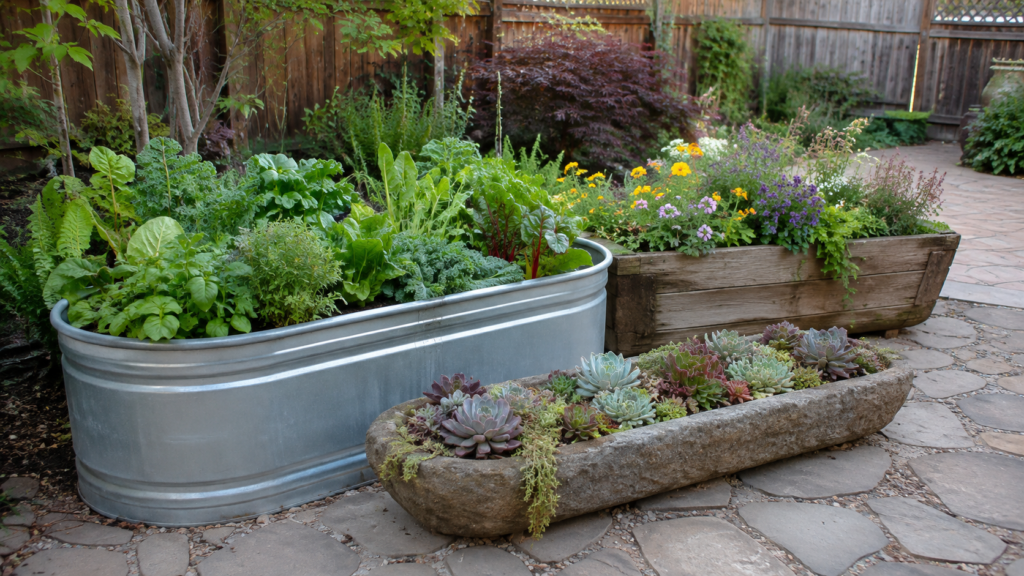
Backyard trough planter ideas can turn long, unused spaces beside patios, fences, decks, and walkways into productive gardens for flowers, herbs, vegetables, strawberries, succulents, and ornamentals. The best trough combines enough root depth, reliable drainage, suitable growing media, appropriate materials, and plants matched to the site’s sunlight, heat, and watering
A single trough can define a patio edge, fill a narrow fence line, create a kitchen herb garden, provide partial screening, or function as a compact raised vegetable bed.
The most useful rule is simple: choose what you want to grow first, determine the root space those plants need, then select a trough that fits both the plants and the backyard.
Quick Trough Planter Selector
| Your goal | Best trough type | Good plants | Main consideration |
|---|---|---|---|
| Vegetable garden | Deep galvanized/wood trough | Greens, peppers, beans | Root depth |
| Kitchen herbs | Medium wood/resin trough | Basil, parsley, thyme | Easy access |
| Succulent display | Shallow hypertufa trough | Succulents, alpines | Fast drainage |
| Patio flowers | Medium decorative trough | Annuals, trailers | Mature size |
| Small backyard | Narrow trough | Herbs, greens, flowers | Walking space |
| Patio divider | Long medium/deep trough | Dense foliage | Width |
| Portable display | Resin/fiberglass trough | Seasonal plants | Stability |
| Strawberries | Medium trough | Strawberries | Drainage |
| Large vegetables | Deep stock trough | Tomatoes, potatoes | Soil volume |
| Fence line | Long wooden trough | Herbs, flowers | Moisture exposure |
Best Backyard Trough Planter Ideas
The strongest backyard trough planter ideas solve a practical problem while improving the layout of the garden. A vegetable trough needs more root volume than a succulent planter, while a patio divider needs enough width and plant mass to define a space without blocking movement.
Before choosing a design, decide whether your priority is food production, flowers, herbs, screening, accessibility, or visual impact. That decision should control the trough size, material, soil, and plant selection.
1. Use a Galvanized Trough as a Vegetable Garden
A galvanized livestock trough can function like a ready-made raised vegetable bed. Its long surface allows several crops to grow in rows or planting zones without building a permanent timber frame.
Good choices include:
- lettuce;
- chard;
- spinach;
- radishes;
- green onions;
- herbs;
- peppers;
- compact tomatoes in deeper troughs.
Choose the final location before filling the trough because soil and water make large stock tanks difficult to move. Check drainage first as well; livestock troughs were originally designed to hold water rather than release it.
2. Add a Long Flower Trough Along a Patio
A flower trough can soften the hard edge of paving without taking up as much space as several individual pots.
Use a simple layered arrangement:
- taller plants toward the back or center;
- mounding plants through the middle;
- trailing plants along the edge.
Repeat one flower color or foliage texture elsewhere in the backyard to connect the trough visually with surrounding beds and containers.
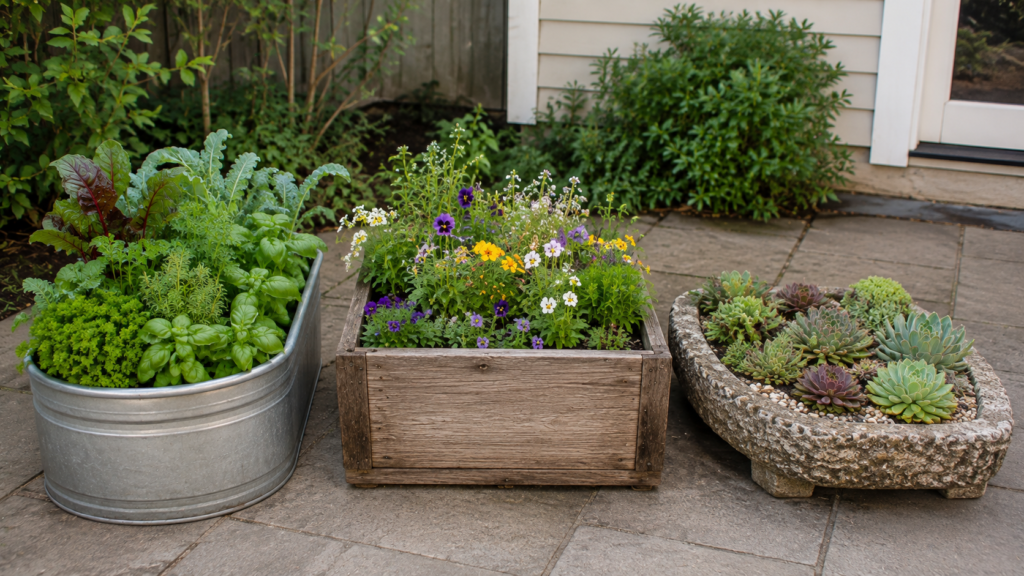
3. Use Wooden Troughs Along a Fence
Wooden trough planters work naturally against timber fences because their rectangular shape follows the same horizontal line.
They are useful for:
- herbs;
- flowers;
- leafy greens;
- strawberries;
- compact perennials.
Use outdoor-appropriate timber, provide drainage, and avoid unknown treated wood when growing edible crops.
4. Create a Kitchen Herb Trough
A trough near the kitchen, grill, or outdoor cooking area can become one of the most useful containers in the backyard.
Suitable herbs include:
- basil;
- parsley;
- chives;
- thyme;
- oregano;
- cilantro;
- sage;
- compact rosemary.
Group plants with similar moisture requirements. Basil and parsley usually prefer more consistent moisture than thyme and oregano.
Keep mint in its own container because it can spread aggressively through a shared trough.
5. Make a Salad Trough
Leafy crops make excellent use of the long surface area of trough planters without requiring the root depth of large vegetables.
Try:
- lettuce;
- spinach;
- arugula;
- mustard greens;
- Asian greens;
- scallions;
- radishes.
Plant small sections every few weeks rather than filling the whole trough at once. Staggered planting provides a longer harvest and prevents everything from maturing at the same time.
6. Create a Pollinator Flower Trough
A flower trough can provide a concentrated strip of blooms beside a patio, deck, or walkway.
Combine plants with different:
- flower shapes;
- heights;
- flowering periods;
- foliage textures.
Keep taller plants toward the back or center and avoid species that become disproportionately large for the container.
7. Create a Succulent or Alpine Trough
Shallow stone, concrete, or hypertufa troughs are well suited to succulents, alpine plants, miniature conifers, and compact rock-garden plants.
These troughs require:
- excellent drainage;
- appropriate growing medium;
- compatible moisture needs;
- restrained watering.
Because stone-style troughs can become very heavy, choose the final location before filling them.
8. Use a Trough as a Patio Divider
A long trough can separate different backyard zones without creating a permanent wall.
Use one to divide:
- dining space from lawn;
- seating from a walkway;
- patio from vegetable garden;
- outdoor kitchen from lounging space.
For stronger screening, use a deeper trough or combine it with larger planters rather than forcing tall plants into a shallow container.
9. Frame Steps With Matching Troughs
Two matching troughs can frame deck stairs, garden gates, pergola entrances, or patio openings.
Repeat one focal plant or foliage color in both troughs and vary the supporting plants slightly.
Allow space for mature foliage so plants do not narrow steps or interfere with handrails.
10. Grow Strawberries in a Trough
Strawberries work well in medium-depth troughs because they benefit from horizontal planting space without requiring the depth of large fruiting vegetables.
Space plants along the container and allow some foliage to spill over the edge.
Keep runners under control if they begin crowding neighboring plants or extending into walkways.
11. Add a Trellis to a Trough
A trough-and-trellis combination uses both horizontal and vertical space.
Suitable climbers include:
- peas;
- climbing beans;
- smaller flowering vines;
- selected compact climbers.
For vigorous plants, support the trellis independently rather than depending on a lightweight trough to carry the entire structure.
12. Group Troughs at Different Heights
Several troughs at different heights can create more visual depth than one oversized container.
For example:
- shallow trough for succulents;
- medium trough for herbs;
- deeper trough for vegetables.
This also lets you separate plants that need different soil types or watering routines.
What Size Trough Planter Do You Need?
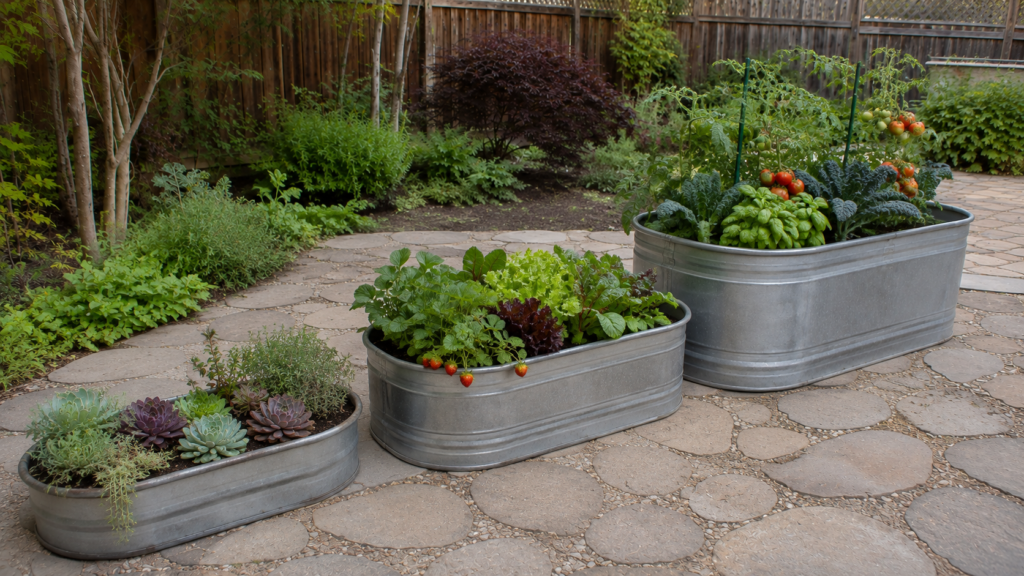
Choose trough size according to root depth, growing volume, available space, and accessibility. A long trough may look large but still provide limited root depth, while a tall livestock trough can hold far more soil than smaller plants actually need.
| Trough type | Best use | Main limitation |
|---|---|---|
| Shallow trough | Succulents, herbs, flowers | Dries faster |
| Medium trough | Greens, herbs, strawberries | Moderate volume |
| Deep trough | Vegetables, larger plants | More soil and weight |
| Tall stock trough | Raised vegetable garden | Hard to relocate |
| Narrow trough | Fence/patio edge | Limited root width |
| Wide trough | Mixed vegetable garden | Harder center access |
For smaller plants, roughly 6–8 inches of usable soil may be adequate. Medium-rooted crops often benefit from about 8–12 inches, while larger vegetables usually need substantially more depth.
Width matters too. If you cannot reach the middle without leaning into the trough, maintenance becomes difficult.
Choose the smallest trough that still provides enough root room and moisture stability for the intended plants.
Which Trough Planter Material Is Best?
No single material is best for every backyard. Material affects appearance, weight, heat exposure, durability, portability, and maintenance.
Is Galvanized Steel a Good Trough Material?
Galvanized steel is durable and widely used for livestock-trough gardens.
Its main disadvantages are weight after filling and increased heat exposure in very sunny locations.
Are Wooden Troughs Better?
Wood offers a softer, more traditional appearance and can be customized to almost any length.
Use exterior-appropriate timber and protect the structure from constant moisture.
What About Concrete and Hypertufa?
Concrete and hypertufa troughs suit:
- succulents;
- alpines;
- miniature gardens;
- ornamental planting.
They look substantial and age naturally, but they are difficult to move once filled.
Are Resin and Fiberglass Troughs Useful?
Yes. Resin and fiberglass troughs work well when portability matters.
Should You Line a Trough Planter?
Not every trough needs a liner.
A liner can help:
- protect some wooden troughs;
- prevent soil escaping through gaps;
- simplify seasonal removal;
- separate soil from an uncertain surface.
However, a liner should never block drainage. Solid plastic liners need drainage openings, while permeable materials can help retain soil without creating a waterproof basin.
Sound galvanized and purpose-built planters generally do not need lining simply because they are metal.
Line a trough only when the liner solves a specific problem.
Are Galvanized Troughs Safe for Vegetables?
Clean galvanized troughs from a known source are commonly used for vegetable gardening. The zinc coating helps protect steel from corrosion, and these containers can work well as raised beds when drainage and soil conditions are appropriate.
Avoid troughs that:
- previously held chemicals or fuels;
- have unknown coatings;
- show severe internal corrosion;
- cannot be traced to a known use.
Very acidic soil can accelerate the deterioration of some metal coatings, so avoid creating unnecessarily acidic conditions unless the crop genuinely requires them.
For food crops, use a clean, known-source trough and avoid questionable second-hand containers.
Do Trough Planters Need Drainage?
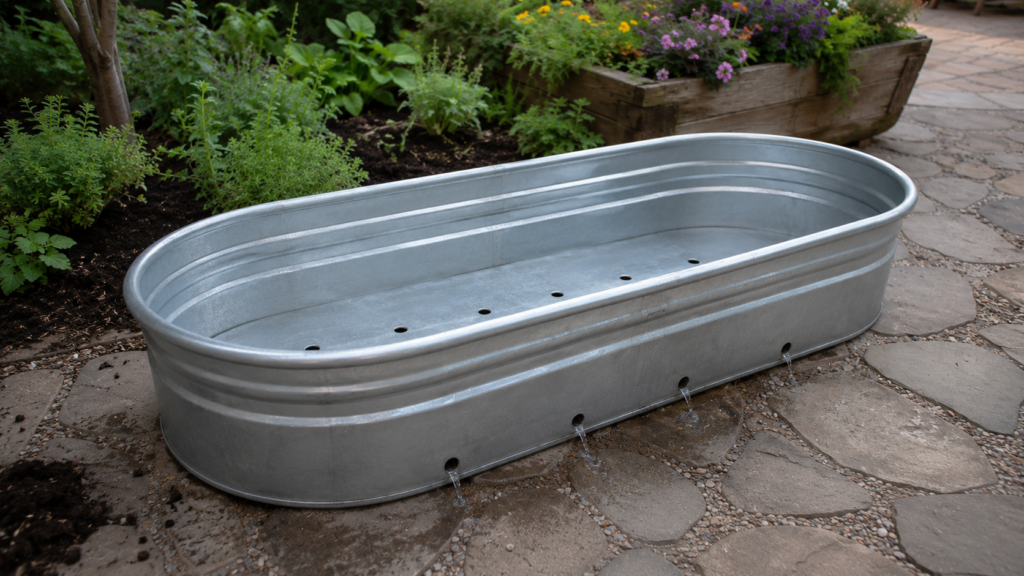
Yes. Soil-filled trough planters need reliable drainage.
Livestock troughs deserve particular attention because they were designed to hold water. One factory outlet may not provide enough drainage across a long container.
Good drainage requires:
- several appropriate openings;
- unobstructed outlets;
- suitable growing media;
- somewhere safe for runoff to go.
If a trough sits on paving, slightly elevating it may help keep drainage openings clear.
Should You Put Gravel in the Bottom?
Do not rely on gravel as the main drainage solution.
Instead:
- provide adequate drainage holes;
- use suitable growing media;
- keep the outlets clear;
- water according to plant needs.
What Soil Is Best for Trough Planters?
The right growing medium depends on whether the trough behaves more like a container or a raised bed.
Smaller troughs usually benefit from a container mix that provides:
- drainage;
- moisture retention;
- aeration;
- manageable weight.
Large stock troughs used as raised beds can use an appropriate mixture of topsoil and mature compost.
Avoid filling small troughs entirely with dense backyard soil because it can compact and become excessively heavy.
Succulent troughs need a faster-draining medium than vegetable or herb troughs.
How Much Soil Do You Need?
Use the inside dimensions of the usable planting area:
Soil volume = inside length × inside width × intended soil depth
For example:
- length: 120 cm;
- width: 40 cm;
- soil depth: 30 cm.
120 × 40 × 30 = 144,000 cm³
That equals approximately 144 litres before allowing for settling, root balls, and space below the rim.
Measure the soil depth the plants actually need rather than automatically filling the entire physical trough. Leave some room below the rim so watering does not wash soil over the sides.
What Plants Grow Best in Troughs?
Trough planters can support many plants when root space, sunlight, and moisture requirements are compatible.
Good choices include:
- annual flowers;
- herbs;
- leafy greens;
- strawberries;
- bulbs;
- succulents;
- compact vegetables;
- small perennials;
- ornamental grasses.
Avoid combining plants with completely different growing needs simply because they look good together.
For decorative troughs, use:
upright + mounding + trailing
For edible troughs, group plants according to:
- root depth;
- water needs;
- sunlight;
- mature size;
- harvest frequency.
Do not overcrowd young plants. A slightly open trough usually fills naturally as plants mature.
Can You Grow Vegetables in Troughs?
Yes. Deep troughs can function effectively as raised vegetable beds when they provide enough soil, drainage, sunlight, and water.
Compact crops are easiest:
- lettuce;
- spinach;
- radishes;
- chard;
- scallions;
- herbs.
Larger troughs can also support:
- peppers;
- bush tomatoes;
- beans;
- potatoes;
- cucumbers with support.
If the trough is repurposed, confirm that its previous use makes it suitable for food production.
Do Metal Trough Planters Get Too Hot?
Metal troughs can warm in direct sunlight, but overheating depends on the actual site rather than the material alone.
Important factors include:
- climate;
- trough color;
- soil volume;
- paving;
- reflected heat;
- afternoon sun;
- wind.
A large trough containing substantial growing medium usually changes temperature more slowly than a small metal pot.
For hot sites:
- monitor soil moisture;
- choose heat-tolerant plants;
- maintain adequate soil volume;
- use mulch where suitable;
- consider afternoon shade in extreme climates.
Evaluate the microclimate, not the metal alone.
How Often Should You Water Trough Planters?
There is no universal watering schedule.
Water demand changes with:
- trough size;
- growing medium;
- plant maturity;
- temperature;
- sunlight;
- wind;
- crop type.
Check moisture below the surface rather than judging only by the top layer.
Water deeply enough to moisten the root zone instead of repeatedly wetting only the surface.
For long vegetable troughs, drip irrigation can provide more even watering and reduce maintenance.
Check moisture at both ends and the center because hand watering may leave one area consistently drier.
Where Should You Place a Trough Planter?
Choose the location before filling a large trough.
Consider:
- sunlight;
- access to water;
- level ground;
- drainage runoff;
- walking clearance;
- access for maintenance;
- nearby walls and fences.
Good locations include:
- along fences;
- beside patios;
- deck edges;
- along blank walls;
- beside walkways.
Vegetable troughs generally need stronger sunlight than many leafy greens or shade-tolerant ornamentals.
Do not place a trough where drainage constantly crosses a walkway or collects against a structure.
Meet plant needs first; optimize appearance second.
What to Check Before Buying a Trough Planter
Use this checklist:
- Measure the available length.
- Measure the available width.
- Decide what you want to grow.
- Check required root depth.
- Confirm trough depth.
- Check drainage openings.
- Identify the material.
- Confirm suitability for food crops.
- Estimate soil volume.
- Consider final filled weight.
- Check sunlight.
- Plan watering access.
- Confirm you can reach the center.
- Consider heat exposure.
- Check runoff.
- Decide whether the trough may need moving.
Also measure the route to the final location. A large livestock trough may fit the destination but not pass through a narrow gate.
How Do You Test a Trough Planter?
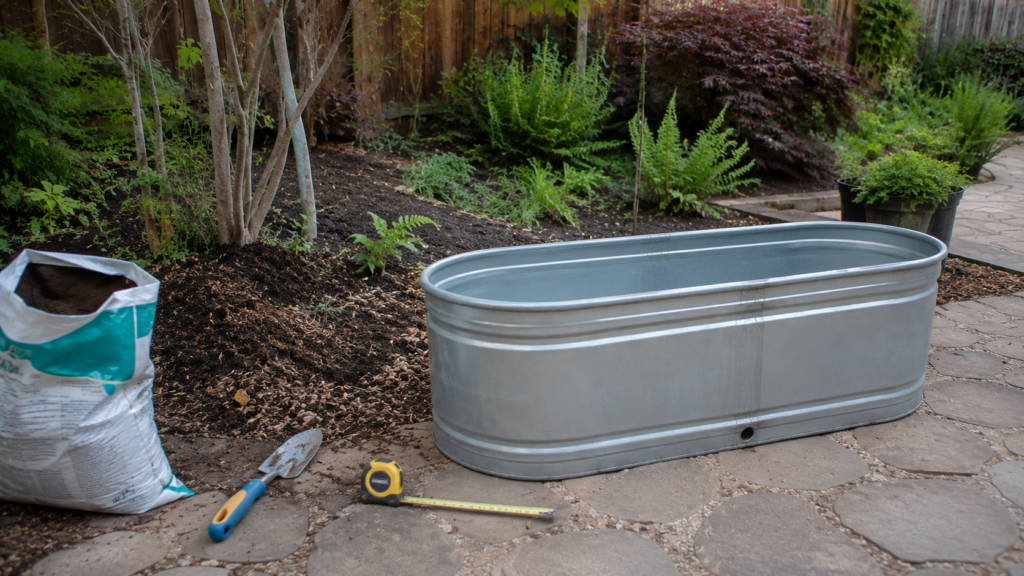
Test the trough while it is still empty.
Place it in the intended location and check:
- whether it sits level;
- drainage outlet position;
- walking clearance;
- center reach;
- watering access;
- nearby walls or structures.
Then add water to confirm that drainage works correctly.
How Do You Record a Trough Planter Test?
Record:
- trough material;
- inside length;
- inside width;
- total depth;
- actual soil depth;
- approximate soil volume;
- drainage-hole layout;
- plants used;
- hours of sun;
- watering method;
- watering frequency;
- surface beneath the trough;
- results after 30 days.
Photograph:
- the empty setup;
- the newly planted trough;
- the trough several weeks later.
Only use statements such as “we tested,” “we observed,” or “after 30 days” after you actually conduct the test.
Which Backyard Trough Planter Idea Is Best?
For most backyards, a medium-to-deep rectangular trough with dependable drainage provides the best balance between planting flexibility and manageable soil volume.
Choose:
- galvanized trough for vegetable growing;
- wooden trough for custom dimensions and natural style;
- hypertufa trough for succulents and alpines;
- resin/fiberglass trough for portability;
- deep stock trough for large vegetables;
- narrow trough for fences and patio edges.
Use this order:
- Decide what you want to grow.
- Determine root depth.
- Measure the space.
- Choose the material.
- Confirm drainage.
- Calculate soil volume.
- Check sunlight.
- Plan watering.
- Confirm accessibility.
- Plant for mature size.
The best trough planter is the one that fits the plants, site, maintenance routine, and backyard design without unnecessary size or complexity.
FAQs About Backyard Trough Planter Ideas
What can you plant in an outdoor trough?
Troughs can grow flowers, herbs, strawberries, leafy greens, vegetables, succulents, and bulbs. Match plants to the container’s depth, sunlight, and drainage.
How deep should a trough planter be?
Depth depends on the crop. Herbs and greens can use shallower troughs, while tomatoes, potatoes, beans, and other large vegetables need deeper soil.
Are galvanized troughs safe for vegetables?
Clean galvanized troughs from a known source are commonly used for vegetable growing. Avoid badly deteriorated or unknown containers that previously held chemicals.
Do trough planters need drainage holes?
Yes. Adequate drainage openings allow excess rain and irrigation water to escape and reduce prolonged waterlogging.
Should you put gravel in the bottom?
No. Gravel should not replace proper drainage holes. Use suitable growing media and keep drainage outlets open.
What soil should you use?
Use container mix for smaller troughs and a suitable raised-bed mix for large vegetable troughs. Avoid dense, compacted backyard soil.
Should you line a trough planter?
Not always. Liners can protect some wooden troughs, but they should never block drainage. Sound purpose-built troughs often do not need one.
Can you grow tomatoes in a trough?
Yes, if the trough provides enough root volume, sunlight, water, and support. Use a deeper trough rather than a shallow decorative container.
Can a trough sit directly on a patio?
Yes, provided drainage openings remain clear and runoff can escape safely. Slight elevation can improve drainage and simplify cleaning.
How often should trough planters be watered?
Check the growing medium rather than using a fixed schedule. Frequency depends on trough size, plants, sunlight, weather, and soil moisture.
Final Tips for Backyard Trough Planter Ideas
Successful trough planting begins with the plants rather than the appearance of the container.
Remember to:
- choose plants first;
- provide suitable root depth;
- confirm drainage;
- use appropriate growing media;
- calculate soil volume;
- position large troughs before filling;
- match plants to sunlight;
- make watering convenient;
- avoid overcrowding;
- use suitable materials for edible crops;
- keep the center reachable;
- keep paths and entrances clear.
A trough should make backyard gardening easier rather than becoming a heavy container that constantly needs correcting.
Choose the plants, determine the space they need, then select the trough that fits both the plants and the backyard.
Sources and References
Use authoritative horticultural references for technical claims involving:
- vegetable container depth and volume;
- raised-bed growing media;
- galvanized trough gardening;
- edible-container materials;
- drainage;
- irrigation;
- trellis support.
Strong source types include university Extension services, Master Gardener programs, recognized horticultural organizations, and manufacturer guidance for specialized trough systems.
Important technical claims about drainage, crop depth, growing media, and edible-container safety should be supported inline within the published article rather than relying only on an end-of-page source list.

Myra is the founder and lead writer of Backyard Planter Ideas, where she shares practical, well-researched guidance on planter design, plant selection, and outdoor styling. Her goal is to help homeowners create attractive, functional garden spaces with clear, reliable, and easy-to-apply advice.