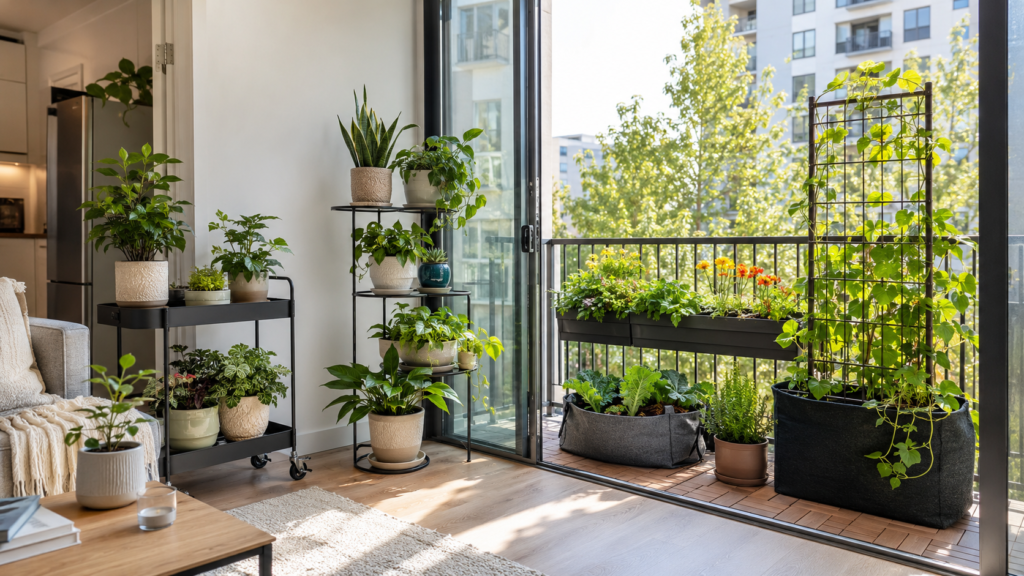
Renter-friendly planter ideas use portable, removable, rolling, clamp-on, or freestanding systems instead of permanent construction. Strong options include cachepots, plant stands, rolling carts, grow bags, balcony containers, and freestanding trellises. Before choosing, check available light, wet weight, drainage, wind exposure, rental rules, and how easily the planter can be cleaned or moved.
These renter-friendly planter ideas cover indoor rooms, balconies, patios, courtyards, and temporary garden spaces without relying on permanent landscaping.
Safest default for most renters: Keep the plant in a draining nursery pot, place it inside a waterproof cachepot or detachable saucer, and display it on a stable freestanding stand or rolling cart. This setup requires no structural attachment, controls runoff, and can move with you.
How We Evaluated These Ideas
Each idea was assessed as a complete system, including the plant, wet growing medium, tray, stand, reservoir, attachment, mature size, and moving requirements. A renter-friendly planter must support healthy growth, protect the property, remain stable, and leave without major repair.
We compared the 21 ideas by alteration risk, water risk, wet weight, stability, space use, cleaning access, portability, changing light, and rental compatibility. The recommendations use container-gardening principles and renter-safety criteria rather than assuming every lightweight or no-drill product is suitable.
Container gardening lets renters grow houseplants, herbs, flowers, and vegetables on windowsills, balconies, patios, courtyards, or temporary yards. The strongest setup balances plant health, property protection, maintenance, appearance, and move-out practicality.
To keep the evaluation useful, each idea was judged by its weakest practical point. A beautiful planter scored poorly when it depended on an uncertain attachment, trapped water, became difficult to lift, or created a cleaning problem. This prevents attractive but impractical options from receiving an unrealistically strong recommendation.
Choose a Renter-Friendly Planter in 60 Seconds
The best renter-friendly planter ideas solve the space’s main limitation without creating unnecessary installation, drainage, or moving problems. Identify the main limitation first. A small apartment needs vertical capacity, a room with changing sunlight needs mobility, a windy balcony needs a low stable container, and a frequent mover needs lightweight materials. Choose the least permanent option that solves the problem.
- Tiered stand: limited floor space
- Rolling cart: changing light or frequent cleaning
- Cachepot system: controlled indoor drainage
- Grow bag: portable vegetables
- Freestanding trellis: removable privacy
- Long, low planter: exposed balcony
- Self-watering planter: steady moisture
- Wheeled trough: flexible patio or yard planting
Choose mobility when seasonal light, cleaning, or relocation matter. Choose a fixed freestanding stand when stability and vertical capacity matter more.
If two options solve the same problem, choose the one with fewer failure points. A freestanding stand usually needs less checking than an adhesive shelf, while a nursery pot inside a cachepot is easier to inspect than a sealed decorative planter. Simpler systems are safer, easier to clean, and easier to move.
Compare All 21 Renter-Friendly Planter Ideas
| Planter idea | Risk | Portability | Best for |
|---|---|---|---|
| Rolling plant cart | Low | Excellent | Changing light |
| Tiered plant stand | Low | Good | Vertical display |
| Ladder-style shelf | Low | Good | Empty wall space |
| Tension-rod garden | Medium | Good | Lightweight hanging plants |
| Over-the-door planter | Medium | Excellent | Herbs and propagation |
| Windowsill row | Low | Excellent | Compact plants |
| Nesting stands | Low | Excellent | Flexible layouts |
| Modular crate display | Low | Excellent | Budget display |
| Decorative cachepots | Low | Excellent | Controlled drainage |
| Room-divider planter | Low | Fair | Zoning and privacy |
| Railing planter | Medium | Good | Saving balcony floor space |
| Railing-height planter | Low | Fair | Eye-level flowers |
| Fabric grow bags | Low | Excellent | Seasonal crops |
| Rolling caddy | Low | Excellent | Heavy pots |
| Trellis planter | Low | Fair | Climbers and privacy |
| Tiered corner planter | Low | Good | Sheltered corners |
| Vertical tower | Low | Good | Herbs and strawberries |
| Self-watering planter | Low | Fair | Consistent moisture |
| Long, low planter | Low | Fair | Windy balconies |
| Tabletop herb station | Low | Excellent | Small edible garden |
| Slim console display | Low | Good | Narrow rooms |
Cachepots, carts, tiered stands, windowsill trays, and nesting stands are the lowest-risk defaults. Tension rods, railing brackets, and door systems save space but require stronger compatibility, load, and surface checks.
Use the table as a shortlist rather than a universal ranking. Indoor renters should prioritize runoff control and cleaning access. Balcony renters should prioritize exposure, attachment security, and complete load. Garden renters should prioritize portability and whether soil, turf, fencing, or shared access would be altered. Frequent movers should prefer modular systems that separate into manageable pieces.
What Makes a Planter Renter-Friendly?
A renter-friendly planter supports healthy growth without causing alterations, stains, blocked access, or difficult repairs. It must remain safe after watering and after the plant reaches mature size.
The setup should be reversible, drainage-safe, portable, stable, accessible, lease-compatible, surface-safe, and reusable. It should not rely on weak paint or railings, block drains, become unmanageable, or trap moisture.
Use one test: Will the plant stay healthy, will the property stay protected, and can the setup leave without major repair? If yes, it is probably suitable.
Check These Five Things Before Adding Planters
1. Rental and Building Rules
Check restrictions on wall fixings, railing attachments, screens, exterior appearance, runoff, balconies, shared spaces, and heavy outdoor items. No-drill does not automatically mean permitted.
2. Available Light
Observe the location morning, midday, and afternoon. Record direct sun, indirect light, filtered light, or shade. University of Minnesota Extension notes that many flowering and vegetable plants prefer about six hours of sun, while adaptable foliage plants and leafy crops can accept less.
3. Complete Wet Weight
Calculate planter + potting mix + retained water + mature plant + tray + stand or support. This matters for shelves, caddies, railings, balconies, terraces, and hanging systems.
4. Drainage and Runoff
Use drainage holes, a detachable saucer or waterproof cachepot, container mix, and a practical way to empty collected water.
5. Wind and Stability
Choose broad bases and low centers of gravity in exposed areas. Keep containers inside balcony edges and ensure supports remain stable after plants mature.
Before installation, confirm that the setup fits the rules, light, weight, drainage, cleaning access, and future doorway clearance.
Which Planter Material Is Best for Renters?
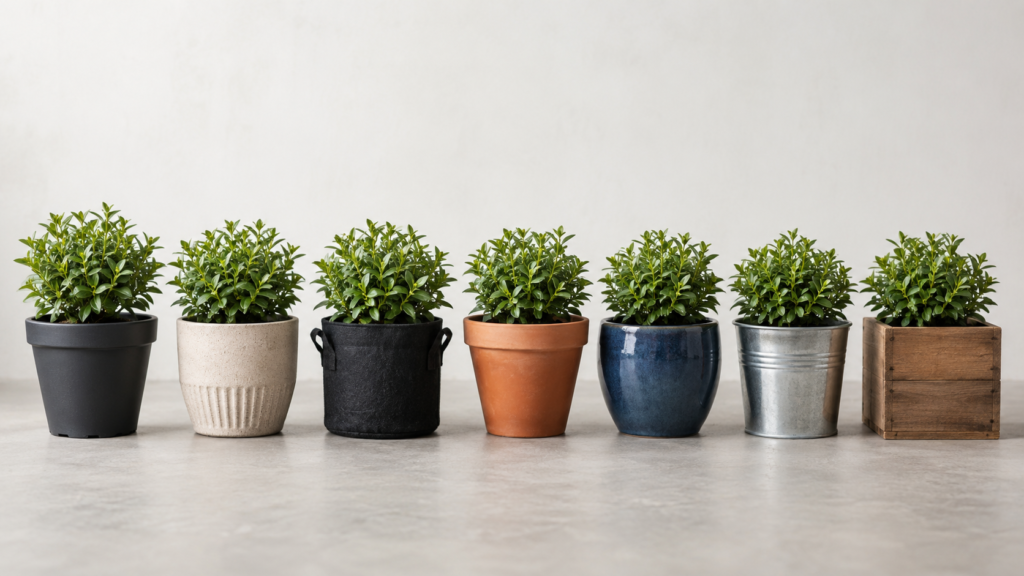
Material affects portability, drying, heat, breakage, and reuse. Frequent movers benefit from lightweight pots, while exposed balconies need a stable shape rather than unnecessary weight. The most practical renter-friendly planter ideas use materials that balance manageable weight, suitable moisture behavior, stability, and future portability.
| Material | Portability | Key trait | Best use |
|---|---|---|---|
| Plastic | Excellent | Retains moisture | Frequent moves |
| Resin or fiberglass | Excellent | Lightweight and decorative | Indoor or balcony displays |
| Fabric | Excellent | Dries quickly | Seasonal vegetables |
| Terracotta | Fair | Faster drying | Renters who overwater |
| Glazed ceramic | Poor–fair | Heavy and nonporous | Indoor focal plants |
| Metal | Good | Heats quickly | Lined outer planters |
| Wood | Fair | Needs lining | Raised planters |
| Concrete or stone | Poor | Stable but very heavy | Long-term placement |
Plastic, resin, or fiberglass is the best all-round choice for movers. Fabric suits vegetables. Terracotta suits overwaterers when flooring is protected.
Color and shape also affect performance outdoors. Dark metal or plastic containers can heat quickly in direct sun, while very light containers may become unstable when tall plants catch wind. A broad resin planter often gives renters a better balance of low weight, weather resistance, and stability than a narrow decorative pot.
No-Drill Indoor Planter Ideas
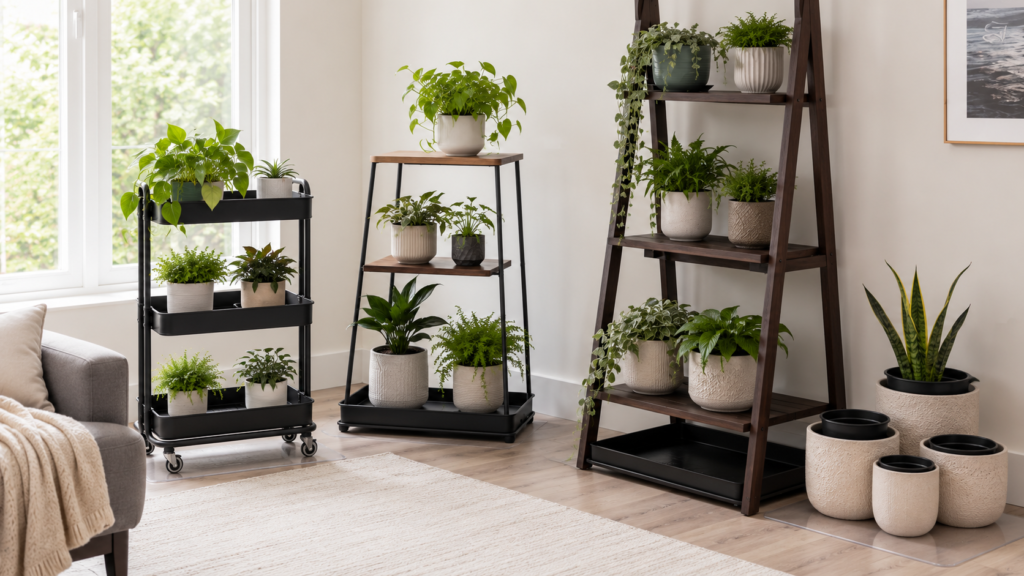
1. Rolling Plant Cart
Best for rooms where sunlight changes. A cart allows seasonal repositioning and keeps care supplies together. Use waterproof trays, wheels suited to the floor, and place the heaviest pots low.
2. Tiered Plant Stand
Best for small rooms that need vertical capacity. Choose a broad frame, keep heavy pots near the base, and use lighter trailing plants above.
3. Ladder-Style Shelf
Best for an empty wall where drilling is prohibited. Protect contact points and use a model designed to stand securely rather than a decorative ladder that can slide.
4. Tension-Rod Garden
Best for lightweight hanging plants in a suitable recess. Include wet soil, cords, hooks, and mature growth in the load calculation, then inspect the rod regularly.
5. Over-the-Door Planter
Best for herbs, cuttings, and compact foliage. Use removable inner pots, protect the door from scratches, and avoid a heavily used door that moves forcefully.
6. Windowsill Planter Row
Best for herbs and small plants. Group pots on one waterproof tray and ensure every container sits fully on the sill. Watch for cold glass and intense summer sun.
7. Nesting Planter Stands
Best for multipurpose rooms. Separate or condense the stands as the layout changes, and keep one manageable plant on each level.
8. Modular Crate Display
Best for low-cost, reusable storage. Keep the arrangement broad and stable rather than stacking it high, and protect wooden crates from constant moisture.
9. Decorative Cachepots
Best for attractive indoor displays. Keep the plant in a draining nursery pot, remove it for watering when practical, and empty the outer container afterward.
10. Room-Divider Planter
Best for studio apartments. Use open shelving, place heavy pots low, and leave visual space between plants so the divider does not overwhelm the room.
Renter-Friendly Balcony and Patio Planter Ideas
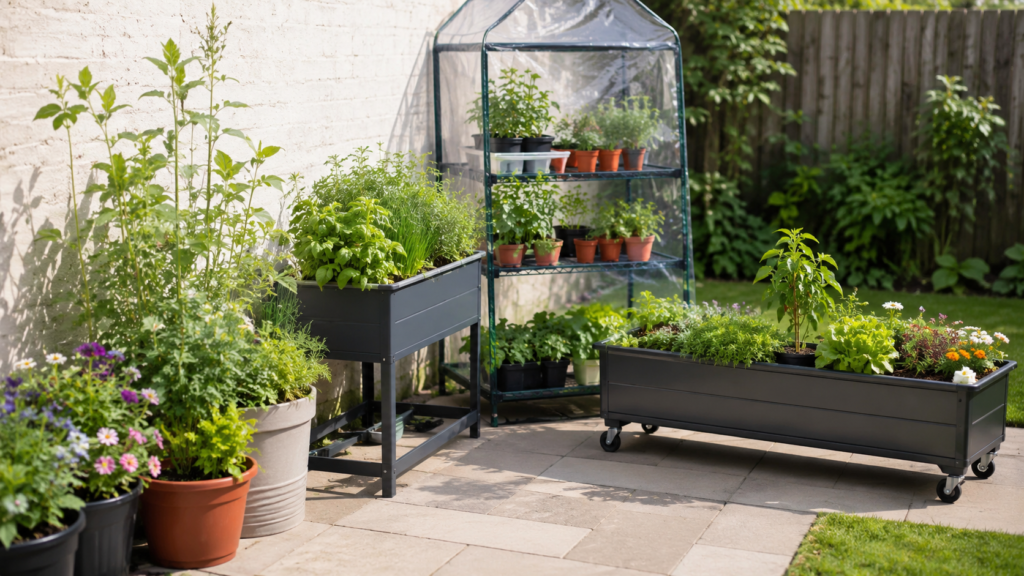
Outdoor renter-friendly planter ideas must account for wind, direct sun, drainage, structural load, and building restrictions. Outdoor planters must handle wind, heat, runoff, structural load, and building rules. Use fewer, better-planned systems rather than filling the floor with unrelated pots.
11. Clamp-On Railing Planter
Best for preserving balcony floor space. Confirm bracket fit, building permission, complete weight, and the safety of areas below. Choose a freestanding alternative when compatibility is uncertain.
12. Freestanding Railing-Height Planter
Best when attachments are prohibited. A tall floor planter gives an eye-level display while remaining removable. Use a broad base and avoid top-heavy planting.
13. Fabric Grow Bags
Best for vegetables and frequent movers. They are light and foldable but dry faster and produce more runoff, so use appropriate trays or outdoor drainage.
14. Rolling Planter Caddy
Best for large containers that need shelter or cleaning access. Choose a caddy rated above the complete wet weight and use locking wheels on a level surface.
15. Freestanding Trellis Planter
Best for climbers and removable privacy. Use a broad base because foliage increases wind resistance, and prune growth before it becomes unbalanced.
16. Tiered Corner Planter
Best for sheltered corners. Keep drains, doors, vents, and utility access clear, and place larger plants behind smaller ones.
17. Stackable Vertical Tower
Best for herbs, strawberries, greens, and compact flowers. Keep the base heavier than the top, rotate for even light, and choose a model that separates for moving.
18. Self-Watering Planter
Best for plants that prefer steady moisture. Avoid it for species that need the growing medium to dry deeply, and inspect the reservoir to prevent overflow.
19. Long, Low Planter
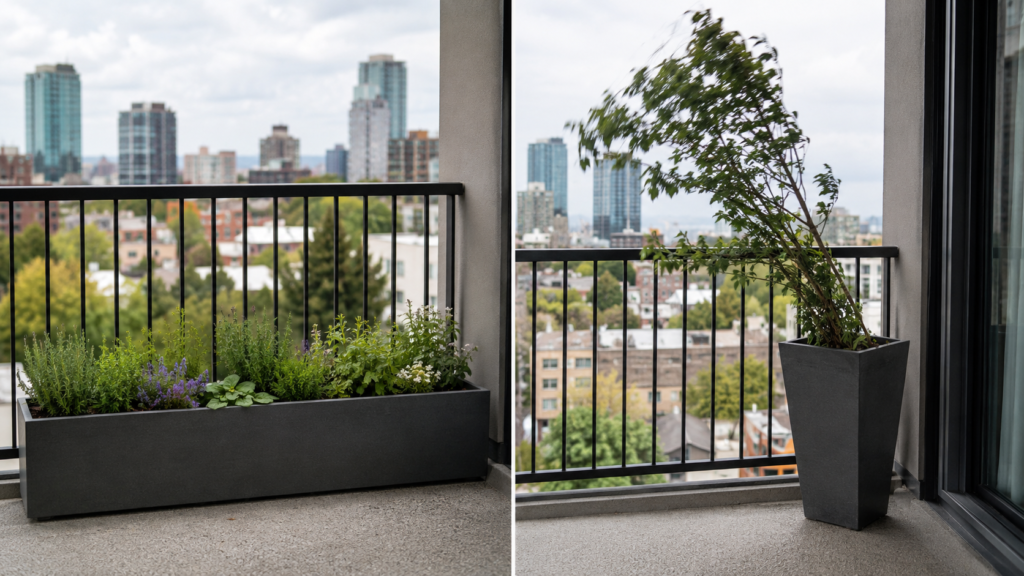
Best for windy balconies. Its lower center of gravity makes it safer than a tall, narrow pot. Use compact plants and keep the container inside the railing.
Renter-Friendly Yard and Garden Planter Ideas
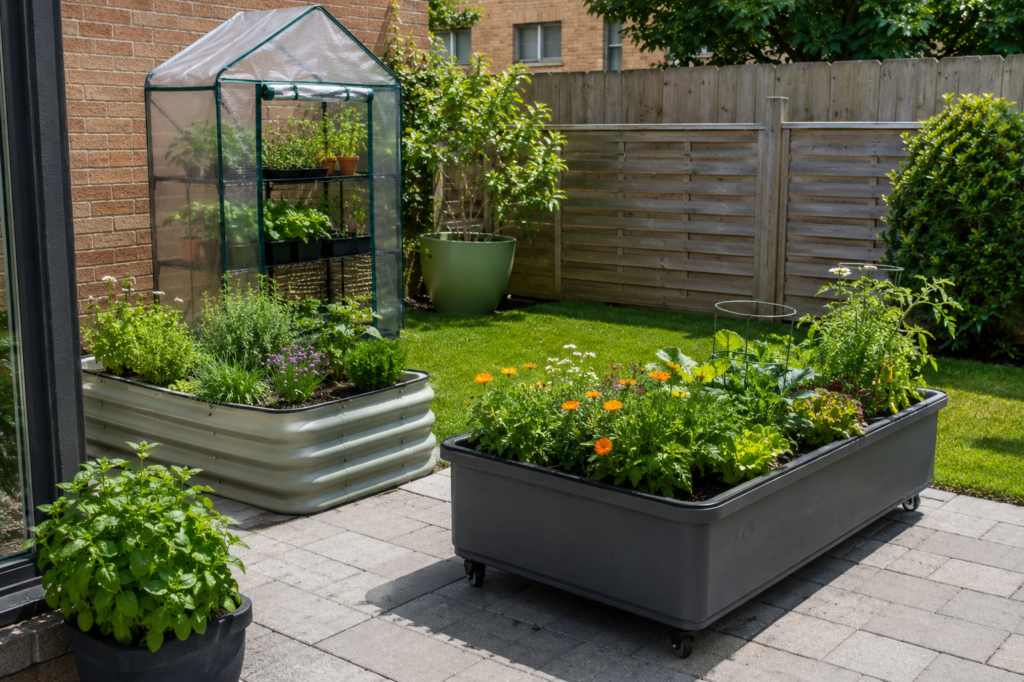
Renters with a patio, courtyard, deck, or yard can add temporary structure without digging. Check permission before removing turf, installing irrigation, or fixing supports to fences.
A portable container border creates visual impact. A lightweight raised planter supports herbs or vegetables without disturbing soil. A wheeled trough adds movable food or privacy planting. A portable mini greenhouse protects seedlings but needs safe wind protection.
Choose borders for appearance, raised planters for access, troughs for mobility, and mini greenhouses for seasonal protection.
Renter-Friendly Planters for Very Small Spaces
Small rentals benefit from one organized plant zone rather than scattered pots.
20. Tabletop Herb Station
Place herbs, cuttings, or seedlings on one waterproof tray, away from hot appliances and food preparation.
21. Slim Console Display
Use a narrow table with one continuous tray. Combine one upright, one full, and one trailing plant without crowding the surface.
Start with three to five compatible plants. Add more only when light, airflow, drainage, cleaning access, and maintenance time allow.
Match Plants to Light, Space, and Lifestyle
The planter and plant must work as one system. Choose the location first, measure its conditions, and then select the species.
- Use adaptable foliage plants in lower light.
- Use herbs and sun-tolerant plants near bright windows.
- Use compact vegetables on sunny balconies.
- Use low-growing plants in wind.
- Choose lightweight, compact plants when moving frequently.
- Verify pet safety before bringing plants indoors.
- Match plants sharing one container by light, water, and soil needs.
- Look for compact, patio, bush, dwarf, miniature, or determinate varieties.
Container size should match mature roots. Small herbs may suit modest pots, while larger vegetables require deeper and wider containers. Penn State Extension recommends about a 20-inch container for one tomato plant and roughly 14 inches for peppers or eggplants, depending on variety. Avoid placing a large plant in a decorative pot chosen only for appearance.
When several plants share one container, match their light, moisture, soil, and feeding needs. A drought-tolerant succulent and a moisture-loving herb may look attractive together but require conflicting care. Renters with pets or children should also verify plant safety and place fragile, thorny, or irritating species outside easy reach.
Protect Floors, Walls, and Your Security Deposit
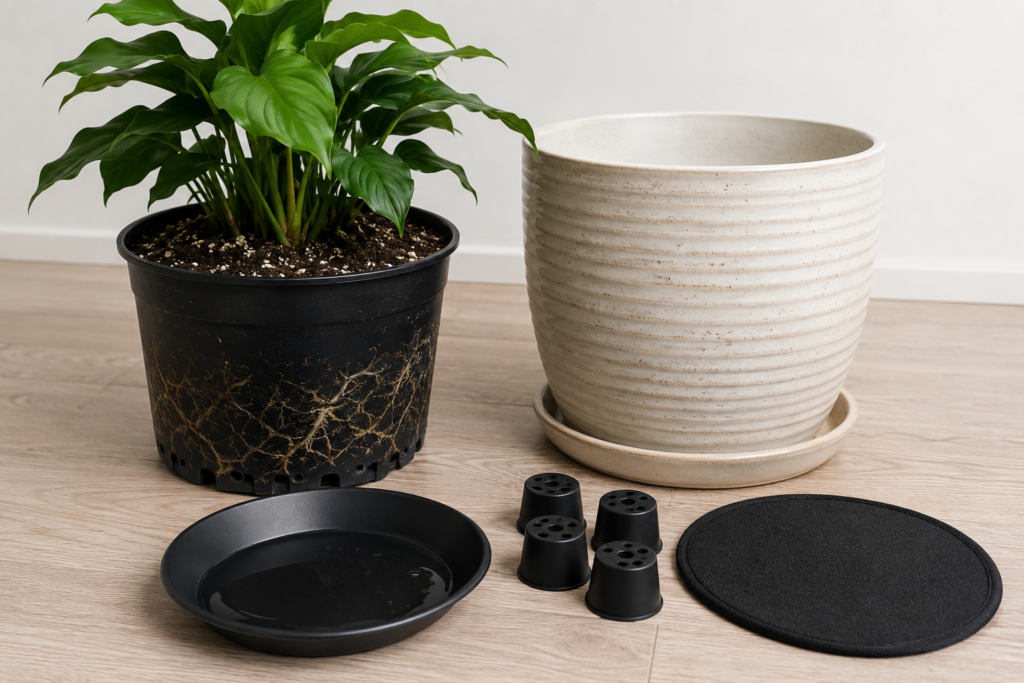
Use a four-layer system:
- Contain: Keep plants in pots with drainage holes and suitable potting mix.
- Catch: Use a detachable waterproof saucer or cachepot.
- Separate: Raise the planter with pot feet, a caddy, or a protective mat.
- Inspect: Check underneath after watering.
| Problem | Likely cause | Immediate fix |
|---|---|---|
| Water beneath saucer | Overflow or condensation | Dry area and raise pot |
| Water in cachepot | Inner pot sitting in runoff | Empty outer pot |
| Mold underneath | Trapped moisture | Dry surface and improve airflow |
| Rust under stand | Corroding metal | Add waterproof barrier |
| Balcony puddling | Blocked drainage | Clear the route |
Illinois Extension advises against gravel as a drainage substitute. Do not leave ordinary plants standing in water or place untested pots on vulnerable flooring.
Budget Renter-Friendly Planter Ideas
Low-cost options include nursery pots, trays, grow bags, crates, secondhand stands, carts, and lined baskets. Moderate upgrades include tiered stands, caddies, vertical towers, and trellises. Premium options include resin planters, self-watering systems, and modular gardens.
Spend first on drainage, stability, and mobility. Decorative containers can come later. A rolling cart or caddy often delivers more long-term value than a heavy statement pot because it remains useful after moving.
How to Make Portable Planters Look Intentional
Repeat one material, color, or finish. Combine one upright, one full, and one trailing plant. Use two or three height levels, group small pots on one tray, and leave negative space.
Coordinated containers look stronger than unrelated pots scattered across surfaces. Hide nursery pots inside matching cachepots, keep trays accessible, and use a stable stand instead of forcing a large plant into an undersized pot.
How to Move a Container Garden to a New Rental
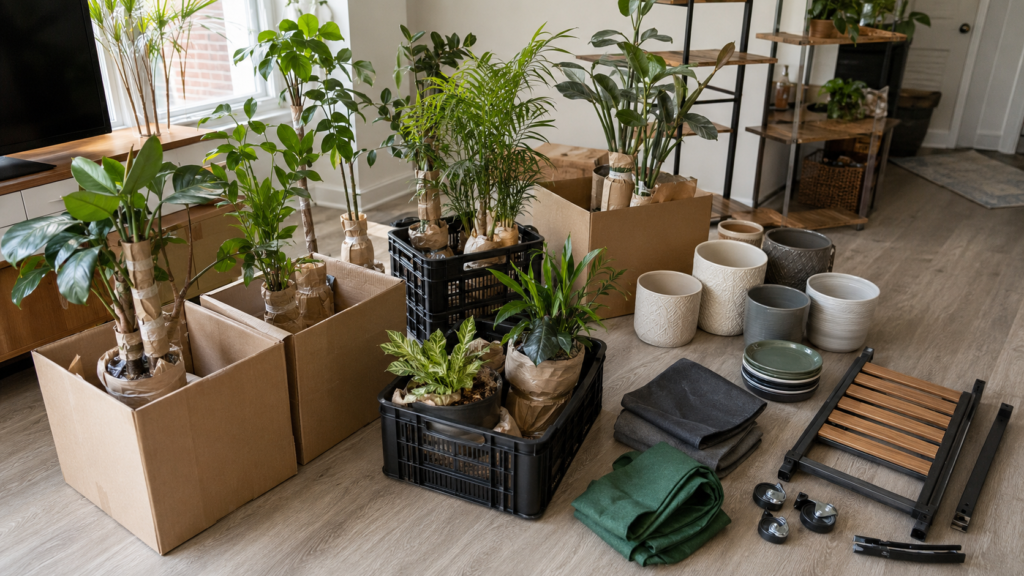
Plan for relocation before buying large containers. Measure doors, stairs, elevators, gates, and vehicle openings.
Before moving:
- Remove dead plants and broken pots.
- Inspect for pests.
- Empty saucers and reservoirs.
- Secure loose potting mix.
- Support stems and keep plants upright.
- Protect plants from temperature extremes.
- Reassess light at the new property.
Grow bags, nursery pots, resin planters, nesting stands, and modular systems move most easily. Large ceramic, trellis, concrete, and stone planters may need emptying or professional help.
Common Renter Planter Mistakes
Avoid:
- Assuming no-drill means damage-free
- Ignoring complete wet weight
- Leaving pots in water
- Using dense garden soil
- Adding gravel instead of drainage
- Choosing plants before checking light
- Blocking balcony drains
- Using tall pots in strong wind
- Preventing cleaning access
- Buying containers too large to move
Evaluate the complete mature setup before purchase, including water, support, access, and moving logistics.
Renter-Friendly Planter Shopping Checklist
Check:
- Drainage holes
- Detachable saucer
- Water containment
- Empty and wet weight
- Mature plant size
- Material durability
- Door and hallway clearance
- Stability
- Cleaning access
- Lease compatibility
- Wheel or bracket rating
- Outdoor weather suitability
- Safe access for watering
- Portability
Give one point for each positive answer:
- Healthy drainage
- Water containment
- Easy movement
- Fits through doors
- Matches available light
- Supports the mature plant
- Avoids permanent alteration
- Stable when filled
- Easy to clean underneath
- Compatible with rental rules
8–10 points: Strong renter-friendly choice
5–7 points: Acceptable with modifications
0–4 points: Choose another planter
Red flags include a missing load rating, no practical way to empty runoff, wheels that do not lock, a stand that wobbles when unevenly loaded, an attachment that does not match the exact surface, and a planter too large for the access route. Rejecting one unsuitable product is usually cheaper than repairing a floor, replacing a damaged plant, or arranging specialist lifting later.
FAQs
What are renter-friendly planter ideas?
They use removable or freestanding containers that avoid permanent changes, manage drainage, protect surfaces, and move easily.
What is the safest planter setup?
Use a draining nursery pot inside a waterproof cachepot or saucer on a stable stand or cart.
Can renters display plants without drilling?
Yes. Use stands, carts, ladder shelves, windowsill trays, nesting stands, tension systems, or door holders.
Are railing planters safe?
They can be when permitted and correctly fitted. Check weight, wind, runoff, and areas below.
How do I protect rental floors?
Use a draining pot, waterproof saucer, and raised protector. Empty runoff and inspect underneath.
Can I use a planter without drainage?
Use it as a cachepot with a separate draining nursery pot, then remove collected water.
Which material is best for renters?
Plastic, resin, and fiberglass suit movers. Fabric suits vegetables; ceramic is heavier and breakable.
What works on a windy balcony?
Choose a broad, long, low planter with compact plants, sheltered inside the railing.
Can renters grow vegetables?
Yes. Herbs, greens, peppers, strawberries, and compact tomatoes can grow with enough light.
Which planters move most easily?
Grow bags, resin pots, nursery pots, modular systems, and containers on rated caddies.
Final Thoughts
The strongest renter-friendly planter ideas support healthy plants, protect the rental property, and remain easy to clean, rearrange, and relocate. The best renter-friendly planter ideas keep plants healthy, protect the property, and remain easy to remove. Start with one growing zone, review the rules, measure light, calculate wet weight, and install reliable drainage protection.
Choose fewer, better-planned containers rather than crowding the space. A successful setup stays stable, clean, accessible, reusable, and practical to move throughout the tenancy.

Myra is the founder and lead writer of Backyard Planter Ideas, where she shares practical, well-researched guidance on planter design, plant selection, and outdoor styling. Her goal is to help homeowners create attractive, functional garden spaces with clear, reliable, and easy-to-apply advice.