
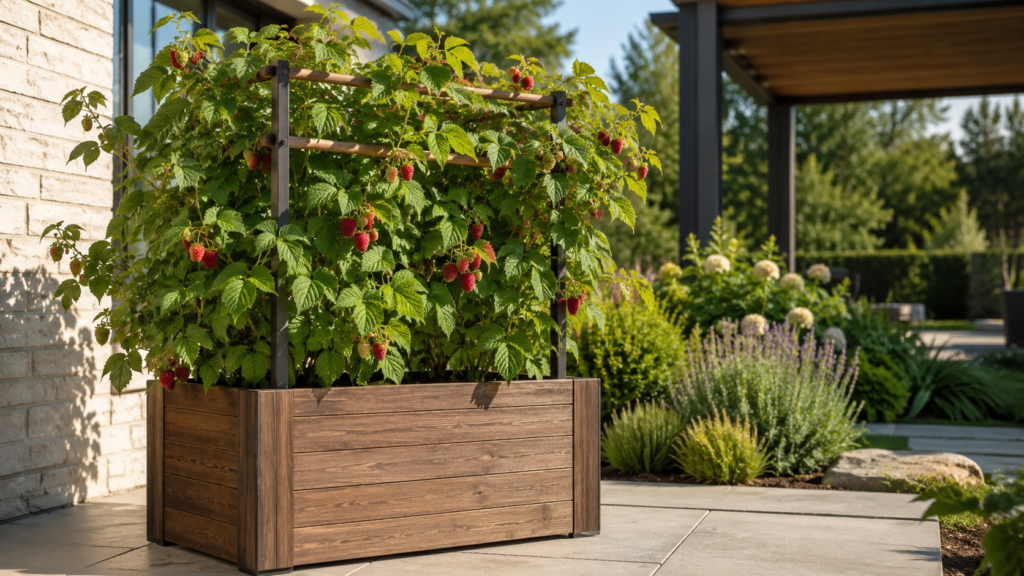
Raspberry planter ideas can turn a patio, balcony, side yard, or small backyard into a productive berry garden. Large pots, half-barrels, raised beds, narrow troughs, and trellis planters can all work when they provide enough root space and suit the mature size of the raspberry plant.
The most important decision is to choose the raspberry before choosing the planter. Compact cultivars can grow in relatively modest containers, while standard raspberries need considerably more growing volume and stronger cane support. Think about space, drainage, sunlight, pruning access, and mature growth before buying the container.
Quick Answer: What Are the Best Raspberry Planter Ideas?
The best raspberry planter ideas include large pots for compact varieties, half-barrels for extra root room, deep troughs for narrow spaces, trellis planters for cane control, and raised beds for several raspberry plants. For most beginners, one compact raspberry in one generous container is the easiest setup. If you want several plants or higher long-term production, a deep raised planter is usually more practical.
- Best for beginners: Large round pot
- Best for root space: Half-barrel
- Best for narrow areas: Deep trough
- Best for balconies: Dwarf raspberry pot
- Best for cane support: Trellis planter
- Best for several plants: Raised bed
- Best long-term setup: Raspberry harvest station
Quick Guide: Which Raspberry Planter Idea Is Best for You?
Choose your planter according to the main limitation in your garden.
| Planter | Best For | Space | Main Benefit |
|---|---|---|---|
| Large pot | One compact plant | Small | Simple |
| Half-barrel | Larger plant | Medium | Root space |
| Trellis planter | Walls/fences | Medium | Cane control |
| Raised bed | Several plants | Large | Production |
| Deep trough | Narrow spaces | Narrow | Space efficiency |
| Dwarf raspberry pot | Balcony | Very small | Compact growth |
| Wheeled planter | Flexible patio | Small-medium | Mobility |
| Timber planter | DIY garden | Medium | Custom design |
| Tall square planter | Modern patio | Small | Small footprint |
| Fence planter | Boundary | Long | Efficient layout |
Start with the planter that solves your biggest practical problem rather than simply choosing the most attractive design.
Raspberry Planter Fit Score: Which Design Performs Best?
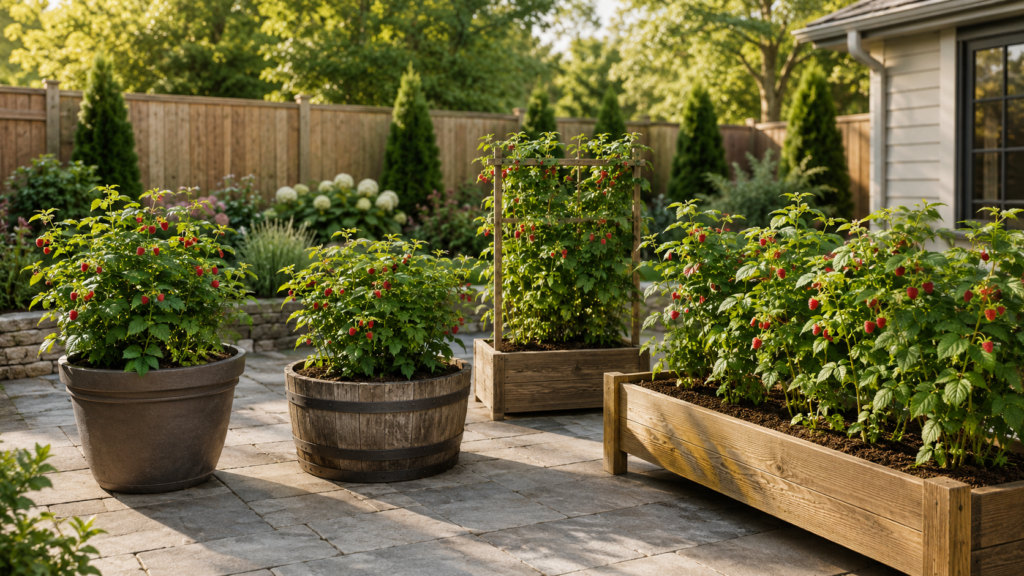
Different planters perform better for different goals.
| Planter | Root Room | Small-Space Fit | Cane Support | Easy Care |
|---|---|---|---|---|
| Large pot | 3/5 | 5/5 | 3/5 | 5/5 |
| Half-barrel | 5/5 | 3/5 | 4/5 | 5/5 |
| Trellis planter | 4/5 | 4/5 | 5/5 | 4/5 |
| Raised bed | 5/5 | 2/5 | 5/5 | 4/5 |
| Deep trough | 4/5 | 5/5 | 5/5 | 4/5 |
| Dwarf raspberry pot | 3/5 | 5/5 | 3/5 | 5/5 |
| Harvest station | 5/5 | 1/5 | 5/5 | 5/5 |
For small spaces, prioritize footprint and plant size. For vigorous raspberries, prioritize root room and support.
1. Large Round Pot for a Simple Patio Raspberry Planter
A large round pot is one of the easiest raspberry planter ideas for patios and decks. It suits one compact raspberry and can blend naturally with ornamental containers, herbs, or outdoor seating.
Compact raspberries can start in a container around 16 inches wide and 12 inches deep, although larger is often easier to manage. Choose a stable pot with proper drainage and leave enough room around it for harvesting.
Best for: beginners, patios, decks, and compact raspberry cultivars.
2. Half-Barrel Raspberry Planter
A half-barrel provides considerably more soil volume than a normal flower pot and works well for larger raspberry plants. Its wide base also provides stability when canes become taller.
Position the barrel before filling it because the final container will be very heavy. Add two posts or a simple wire support if the raspberry produces long canes.
Best for: permanent patios, cottage gardens, and gardeners who want more root room without building a raised bed.
3. Raspberry Planter Box With a Built-In Trellis
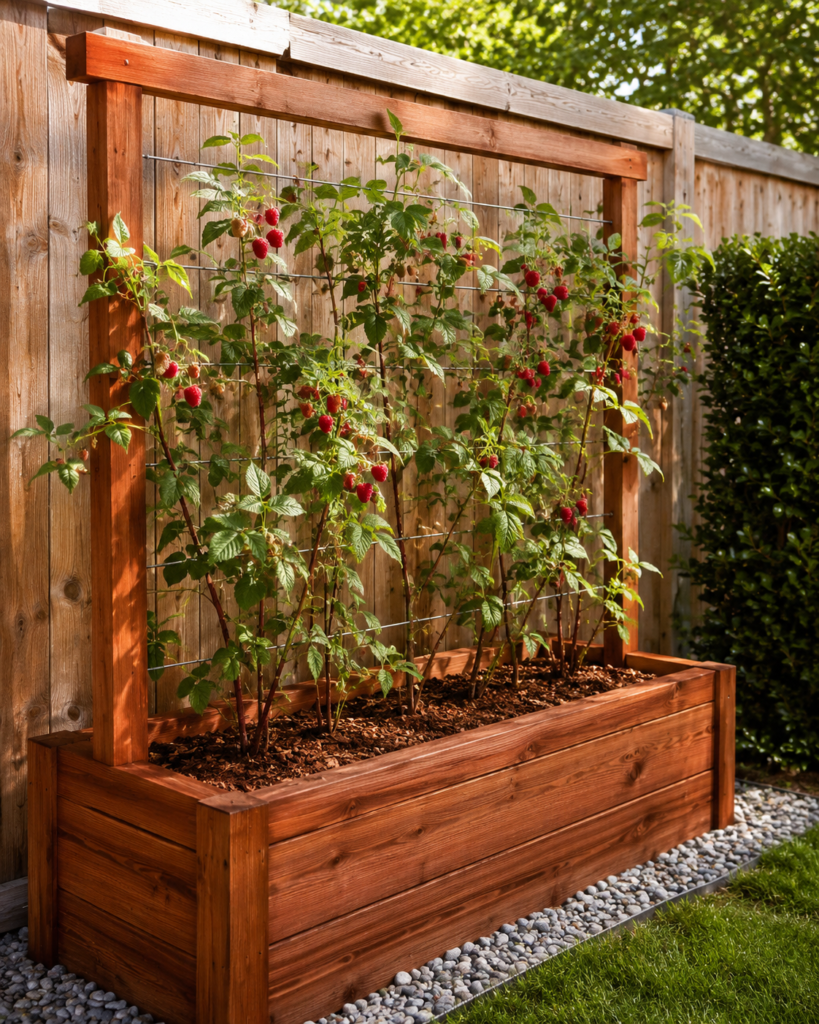
A planter with a built-in trellis combines root containment with cane support. Place the trellis toward the back of the planter so berries remain easy to reach from the front.
Horizontal wires or rails usually work better than tightly woven decorative lattice because raspberry canes need support rather than something to climb. This design also keeps long canes away from paths and furniture.
Best for: fences, walls, patios, and narrow garden spaces.
4. Long Raised Raspberry Planter Bed
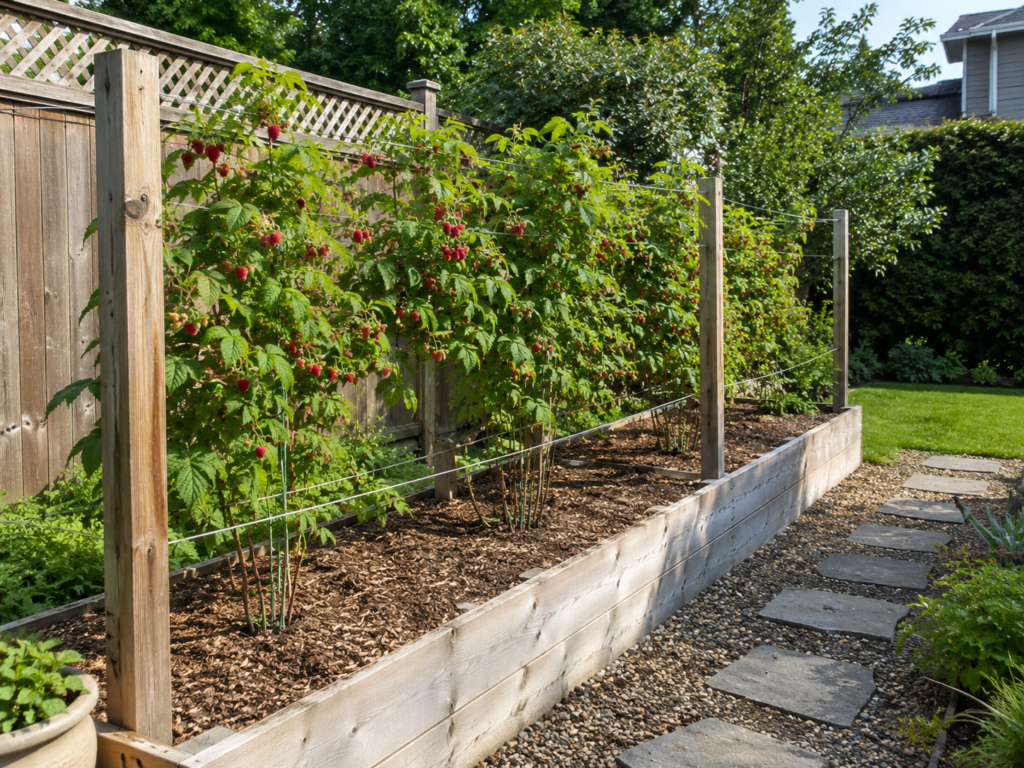
A raised raspberry bed is a strong option when you want several plants. The continuous root zone provides more growing space than individual pots and makes permanent trellis posts, wires, mulch, and irrigation easier to install.
Keep the planter narrow enough that you can comfortably reach the center. A very wide bed against a fence can become difficult to prune and harvest.
Best for: larger harvests, multiple plants, and permanent backyard berry gardens.
5. Narrow Raspberry Trough for a Side Yard
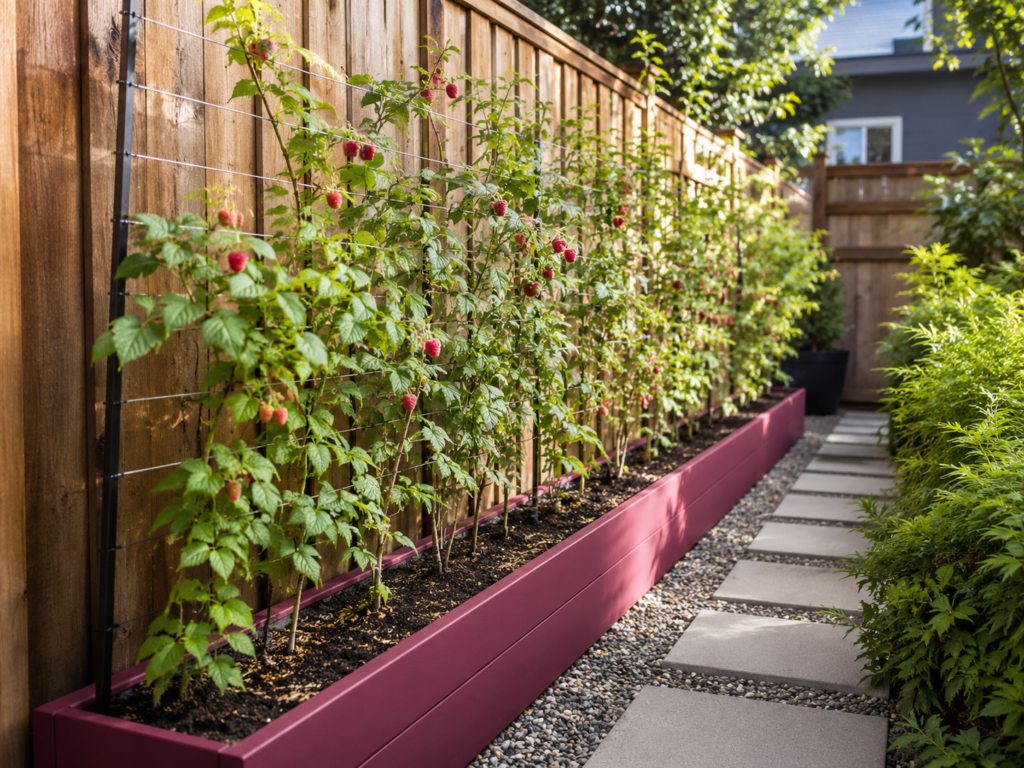
A deep trough can transform unused space beside a fence, shed, garage, or walkway into a raspberry-growing area. Depth matters more than length, so avoid shallow decorative troughs that provide very little root volume.
Pair a deep narrow planter with an upright trellis so the canes grow vertically instead of spreading into the walkway.
Best for: side yards, narrow patios, and urban gardens.
6. Dwarf Raspberry in a Decorative Patio Pot
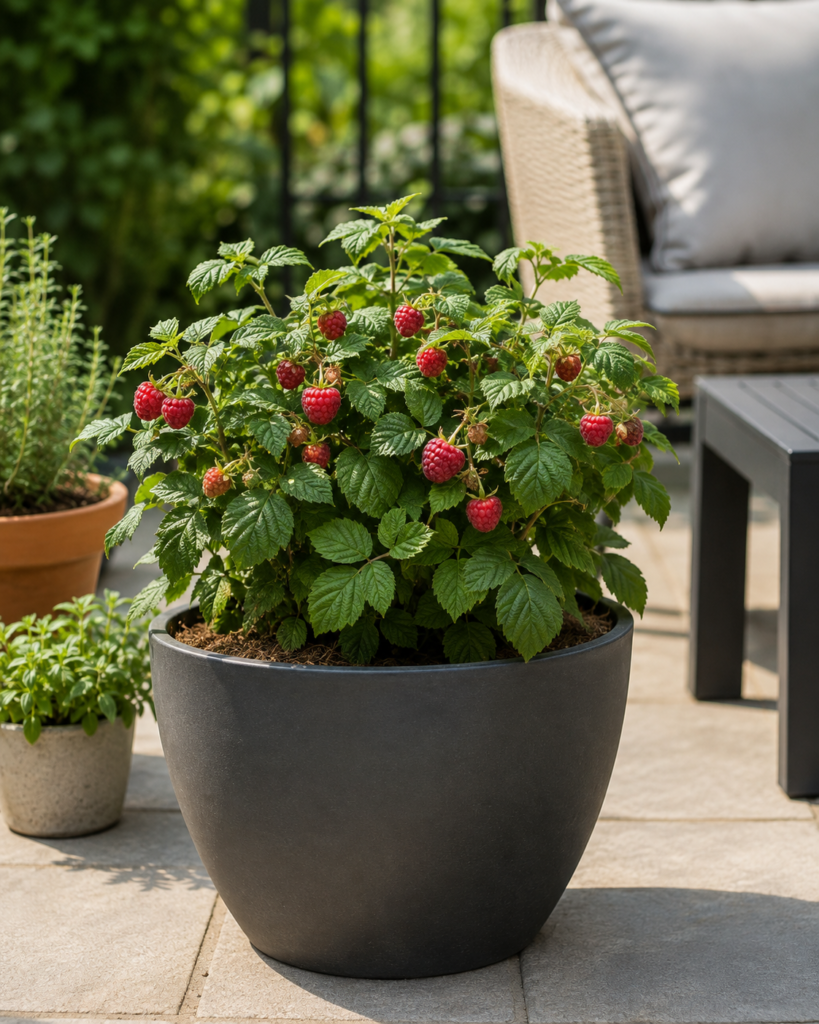
Compact raspberry cultivars are ideal where both appearance and space matter. A dwarf raspberry can grow in a generous decorative pot without producing the large, spreading growth of a conventional raspberry.
It can also be grouped with herbs, strawberries, or ornamental patio plants. Do not mistake “dwarf” for “tiny.” The roots still need a useful volume of growing media.
Best for: balconies, small patios, renters, and decorative edible gardens.
7. Raspberry Planter on Wheels
A wheeled raspberry planter is useful where the patio layout changes during the year. Use a strong wheeled base with locking casters because a large container filled with moist growing media becomes very heavy.
Mobility is especially useful for rented homes or multipurpose patios, but the planter does not need to be moved regularly if it already has a good sunny position.
Best for: flexible outdoor spaces and rented properties.
8. Cedar or Timber Raspberry Planter Box
A timber planter can be built to match the exact dimensions of your garden. Wood also makes it easy to attach trellis posts, wires, irrigation tubing, or protective netting.
Prioritize internal growing depth and strong construction rather than decorative trim. A custom planter is most useful when it is designed around the raspberry’s mature size.
Best for: DIY projects, cottage gardens, vegetable areas, and permanent installations.
9. Tall Square Raspberry Planter for Modern Gardens
A tall square planter can make raspberries look intentional in modern patios and formal landscapes. Check the internal dimensions carefully because some tall decorative planters contain false bottoms, meaning they provide much less soil volume than their exterior suggests.
Also choose a stable base because tall raspberry canes can catch the wind.
Best for: contemporary patios and gardens where visual design matters.
10. Raspberry Privacy-Screen Planter
A long raspberry planter with upright supports can create seasonal screening while producing fruit. Do not pack the canes together like a hedge. Open growth makes pruning and harvesting easier and improves airflow.
Raspberry plants lose much of their screening effect during dormancy, so this is better viewed as a seasonal edible divider than a permanent privacy wall.
Best for: patios and garden zones needing seasonal separation.
11. Corner Raspberry Planter
A square, triangular, or L-shaped planter can make productive use of an empty garden corner. The main challenge is access, so leave enough room to reach the rear canes for pruning, tying, and harvesting.
Avoid enclosed, heavily shaded corners where growth becomes difficult to manage.
Best for: sunny courtyard corners and awkward backyard spaces.
12. Metal Raspberry Planter With Wood Trellis
Metal planters work well in modern landscapes and can be paired with timber supports for a softer look. Choose a planter designed for outdoor growing, with adequate internal volume and unrestricted drainage.
The timber support makes it easy to attach wires, clips, and protective netting later.
Best for: modern gardens and permanent contemporary planter designs.
13. Modular Raspberry Planter System
A modular system lets you begin with one raspberry and expand later. It is also useful for keeping raspberry varieties with different pruning routines separate.
Each module still needs enough soil volume. Avoid placing vigorous raspberries into several small matching boxes simply because the system is modular.
Best for: beginners, expanding gardens, and mixed raspberry collections.
14. Raised Raspberry Planter Along a Fence
A fence-line planter uses the outer edge of a backyard without occupying valuable central space. Install the trellis slightly in front of the fence rather than tying every cane directly against it. This leaves room for pruning, harvesting, and airflow.
Check sunlight first because tall fences can create significant shade.
Best for: medium gardens, narrow yards, and permanent raspberry rows.
15. Dedicated Raspberry Harvest Station
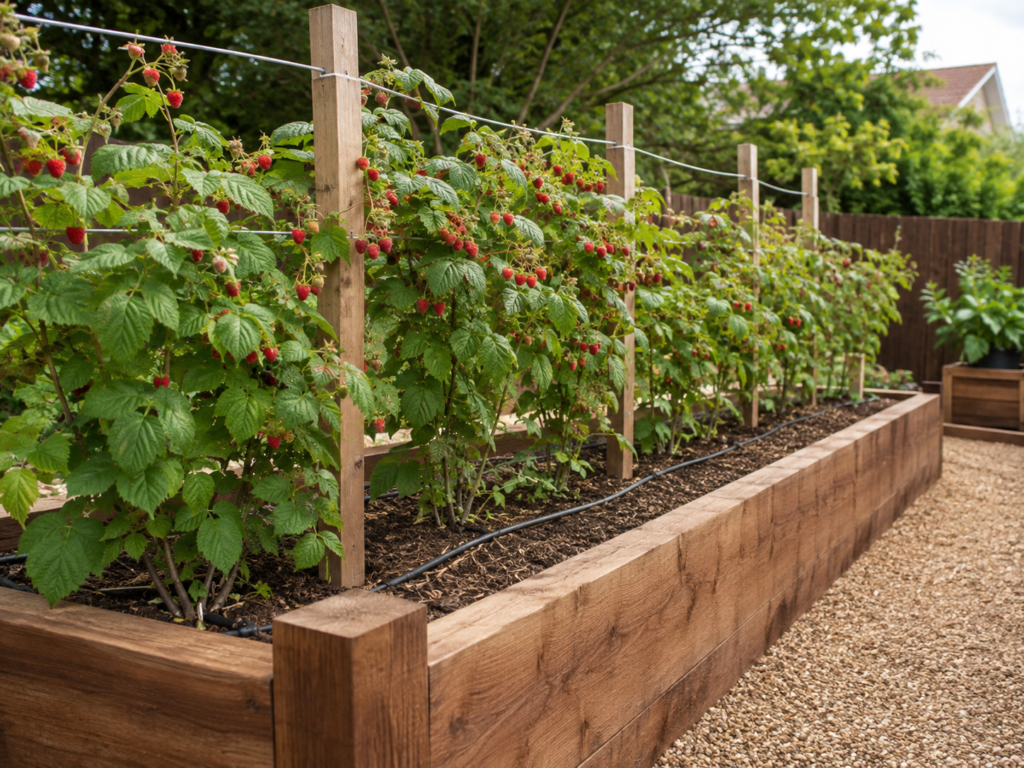
A dedicated raspberry station is built around long-term growing rather than appearance alone. Include a deep bed, permanent support posts, horizontal wires, easy harvesting access, mulch, and a nearby water source.
For gardeners who expect raspberries to become a major backyard crop, this organized setup makes watering, pruning, harvesting, and cane renewal much easier.
Best for: serious home growers and long-term production.
When to Choose — and When to Skip — Each Raspberry Planter Style
Choose the planter based on the problem it solves:
- Large pot: choose for one compact raspberry.
- Half-barrel: choose when root room matters more than mobility.
- Trellis planter: choose when cane control is important.
- Raised bed: choose for several plants.
- Deep trough: choose for narrow areas.
- Wheeled planter: choose only when mobility is genuinely useful.
Skip a design when its main limitation conflicts with your garden. For example, avoid a half-barrel if you need regular mobility, a shallow trough for vigorous raspberries, or a corner planter you cannot reach for pruning.
Small-Space Raspberry Planter Layouts That Actually Work
Small-space raspberry growing works best when you save floor space through compact cultivars and vertical support, not by making the root zone too small.
For a balcony, use one compact raspberry in one generous container. On a patio, position the planter away from major walking routes. In a narrow side yard, combine a deep trough with a linear trellis. Along a fence, use a narrow raised bed with support slightly forward of the boundary.
Always plan around the mature plant rather than the small nursery raspberry.
Raspberry Planter Size Ladder: Match the Container to Plant Vigor
Use plant vigor to determine planter size:
- Compact raspberry: generous individual pot
- Moderately vigorous raspberry: large tub or half-barrel
- Standard vigorous raspberry: very large deep container
- Several raspberries: raised bed or long planter
Compact raspberries may start around 16 inches wide and 12 inches deep, while conventional raspberries can require substantially larger containers, sometimes in the 20- to 30-gallon range. Larger containers also hold moisture more steadily, which can make summer care easier.
What Size Planter Do Raspberries Need?
There is no universal raspberry planter size. Compact cultivars can grow in relatively modest pots, while conventional raspberries need substantially more root space. The important measurement is usable internal volume, not exterior height.
Use:
- Large pot for compact plants
- Half-barrel for larger individual plants
- Very large container for vigorous raspberries
- Raised bed for several plants
Do not choose the smallest planter in which the raspberry can survive. Choose one that remains practical as the plant matures.
Best Raspberry Planter Materials
The best material depends on location, weight, style, and maintenance:
- Wood: customizable and easy to attach trellises to
- Plastic/resin: lighter and easier to move
- Clay: attractive and stable but heavy
- Metal: strong modern appearance
- Fabric: economical and useful in productive areas
Container size and drainage matter more than material. Choose the required dimensions first and the finish second.
Best Soil and Drainage for a Raspberry Planter
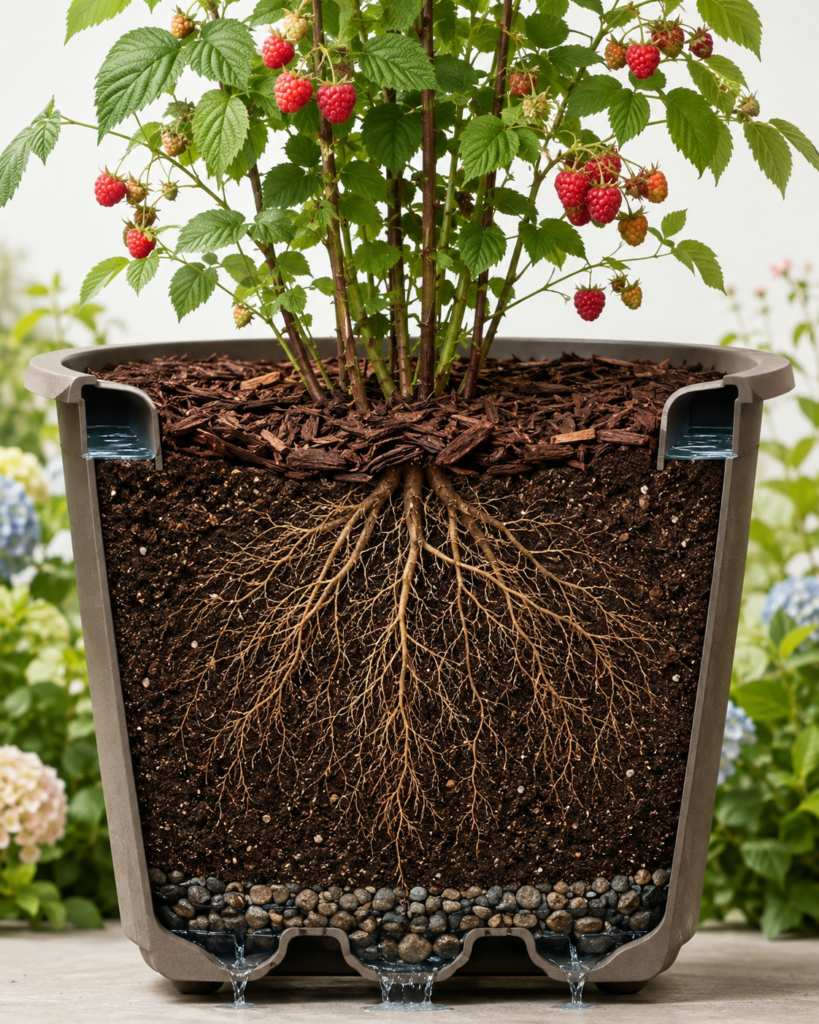
Raspberry roots need a growing medium that holds moisture while still draining freely. Use a good-quality container-growing mix rather than dense garden soil alone.
Make sure the planter has open drainage holes. Gravel at the bottom cannot replace proper drainage. The ideal root zone should be evenly moist, never permanently waterlogged.
A surface mulch can help reduce moisture loss, especially in warm weather.
How to Plant Raspberries in a Planter
Follow a simple sequence:
- Choose the raspberry variety.
- Match the planter to its mature size.
- Check drainage.
- Install major supports.
- Add suitable growing media.
- Position the raspberry correctly.
- Water thoroughly.
- Add mulch if useful.
Installing the trellis before the roots become established reduces the risk of damaging them later.
Do Raspberry Planters Need a Trellis?
Compact raspberries may need little support, while taller varieties usually benefit from stakes, posts, or wires.
A trellis helps:
- Keep canes upright
- Improve access
- Save horizontal space
- Simplify pruning
- Keep fruiting growth away from paths
Do not tie canes tightly. Use loose ties that allow stems to expand.
How to Water Raspberries in Containers
Do not water according to a fixed daily schedule. Check the growing media below the surface and water when the root zone begins to need moisture.
Water deeply enough to wet the root zone, then allow excess water to drain. Water demand changes according to:
- Weather
- Container size
- Wind
- Plant size
- Growing media
- Fruit production
For large permanent beds, drip irrigation can make watering easier and more consistent.
Feeding Raspberry Plants in Containers
Container raspberries have access to a limited nutrient supply, so feeding may be needed during long-term growing. Use fertilizer appropriate for fruiting plants and follow the product instructions rather than repeatedly applying strong feeds.
Before assuming a weak raspberry needs fertilizer, check:
- Moisture
- Drainage
- Sunlight
- Root space
- Cane crowding
More fertilizer does not automatically mean more fruit.
How to Prune Raspberries Growing in Planters
Pruning depends on the raspberry’s fruiting habit. Primocane-fruiting raspberries can produce fruit on current-season canes. When managed for one autumn crop, all canes can often be cut to ground level during dormancy.
Summer-bearing raspberries fruit mainly on older floricanes. Remove those canes after fruiting while keeping healthy younger growth for the following season.
Container raspberries also need thinning. Keep a manageable number of strong, well-positioned canes rather than every shoot that appears.
Best Raspberry Types for Planters
Compact varieties are usually the easiest raspberries for container growing.
Good categories include:
- Compact patio raspberries
- Dwarf raspberries
- Manageable primocane-fruiting varieties
- Locally recommended container cultivars
Primocane raspberries can be particularly convenient because their pruning system can be simpler. Cultivar performance varies by region, so choose plants recommended for your local winter temperatures, summer conditions, and growing season.
Where Should You Put a Raspberry Planter?
Choose a sunny or bright location with easy access for watering, pruning, and harvesting.
Avoid positions where mature canes will interfere with:
- Doors
- Paths
- Patio furniture
- Play areas
Also consider wind exposure and access to water. The best location is not simply where the pot fits. It is where the mature raspberry remains practical to manage.
Climate Note: Adjusting Raspberry Planters for Your Region
Container care should change with local conditions:
- Hot climates: monitor moisture more frequently.
- Windy sites: use stable planters and secure supports.
- Wet climates: prioritize drainage and airflow.
- Cold climates: follow local winter-protection guidance.
- Humid climates: prevent dense cane growth.
- Short seasons: choose locally suitable cultivars.
The planter principles are global, but cultivar selection and seasonal care should always be adapted to local conditions.
Seasonal Care for Raspberry Planters
Spring
Check supports, remove damaged growth, and restart regular moisture monitoring.
Summer
Water as needed, support new canes, thin weak growth, and harvest frequently.
Autumn
Clean fallen fruit and leaves and identify canes that need pruning.
Winter
Follow a pruning and protection routine appropriate for your cultivar and local climate.
Seasonal care should respond to the raspberry’s growth stage rather than following one universal calendar.
Common Raspberry Planter Problems and How to Avoid Them
Yellow Leaves
Check watering, drainage, nutrients, root space, and natural leaf aging.
Weak Growth
Review sunlight, container size, moisture, and cane crowding.
Rotting Fruit
Improve airflow and harvest ripe fruit promptly.
Dying Canes
Determine whether the cane has naturally finished fruiting or whether disease or damage may be involved.
Plant Outgrowing the Pot
Thin excess canes or move the raspberry to a larger long-term growing system.
10 Raspberry Planter Mistakes to Avoid
Avoid these common mistakes:
- Buying the planter before choosing the raspberry
- Using a shallow decorative container
- Crowding several vigorous plants together
- Ignoring drainage
- Installing support too late
- Keeping the root zone constantly wet
- Keeping every new cane
- Pruning all raspberry types the same way
- Choosing appearance over maintenance access
- Following the same care schedule in every climate
Most container problems are easier to prevent during setup than correct after the raspberry becomes established.
Raspberry Planter Decision Matrix
| Your Priority | Best Option |
|---|---|
| Smallest space | Dwarf raspberry pot |
| Beginner setup | Large round pot |
| Extra root space | Half-barrel |
| Cane control | Trellis planter |
| Several plants | Raised bed |
| Narrow space | Deep trough |
| Mobility | Wheeled planter |
| DIY project | Timber planter |
| Modern style | Tall square or metal planter |
| Fence line | Raised fence planter |
| Long-term harvest | Dedicated raspberry station |
For most beginners, one compact raspberry in one generous pot is the easiest setup. For larger harvests, choose a deep raised planter with permanent support.
Before You Buy: Raspberry Planter Decision Checklist
Before purchasing, ask:
- What type of raspberry am I growing?
- How vigorous will it become?
- Is the planter deep enough?
- Does it have proper drainage?
- Can I reach the plant for harvesting?
- Is there room for a trellis?
- Does the site receive enough light?
- Can I water it easily?
- Will the planter remain stable?
- Can the surface support the filled weight?
- Will the setup still work in several years?
If two planters are otherwise similar, choose the one with more usable root volume, better drainage, and easier maintenance access.
Final Takeaway
The best raspberry planter ideas combine enough root space with practical drainage, cane support, and easy access. Choose a compact raspberry in a generous pot for a balcony or small patio. Use a half-barrel when you want more root room. Choose a deep trough for a narrow side yard, and use a raised planter when you want several raspberry plants or a larger long-term harvest.
Keep the decision process simple:
- Choose the raspberry first.
- Match the planter to mature growth.
- Prioritize usable root volume.
- Provide free drainage.
- Add support early.
- Keep the plant easy to reach.
- Prune according to raspberry type.
- Adjust care to local conditions.
Choose the plant first, solve root space and support second, and then select the planter style that fits your backyard.
That approach gives you a raspberry planter that remains attractive, productive, and manageable for more than one growing season.

Myra is the founder and lead writer of Backyard Planter Ideas, where she shares practical, well-researched guidance on planter design, plant selection, and outdoor styling. Her goal is to help homeowners create attractive, functional garden spaces with clear, reliable, and easy-to-apply advice.