
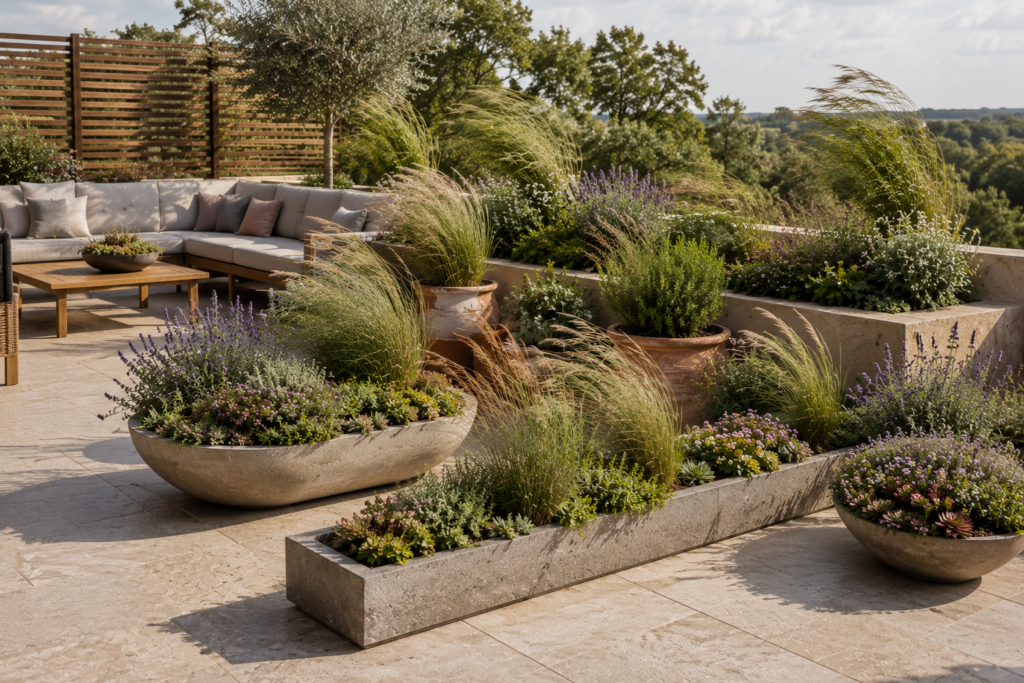
The best planter ideas for windy areas use low, wide containers, compact or flexible plants, open drainage, and protected placement. Rectangular troughs, broad bowls, and low square planters usually resist tipping better than tall, narrow pots. Ground-level spaces can support heavier stone or concrete containers, while balconies and rooftops may need lightweight planters secured with approved brackets.
Choosing the right planters for windy areas is not only about appearance. A low centre of gravity, broad base, suitable container weight and compact planting can reduce tipping while protecting stems and roots from repeated wind stress.
Quick Guide to Planter Ideas for Windy Areas
| Location | Best planter type | Suitable plant form | Main concern |
|---|---|---|---|
| Open patio | Low concrete, stone, or broad trough | Compact grasses and mounding plants | Drainage and weight |
| Small balcony | Inward-facing railing box or floor trough | Low herbs and trailing plants | Brackets and load limits |
| Rooftop | Lightweight broad planter with restraint | Compact drought-tolerant plants | Gusts and structural load |
| Coastal garden | Wide salt-resistant planter behind filtered shelter | Salt-tolerant compact plants | Salt scorch and drying |
| Wind tunnel | Grouped low planters with a permeable screen | Flexible grasses and groundcovers | Corner turbulence |
| Storm-prone garden | Movable modular planters | Seasonal compact plants | Safe storm storage |
Planning a windy balcony garden? Compare low-profile floor troughs and inward-facing railing planters before selecting plants.
The Wind-Resistant Planter Formula
A dependable planter combines:
Wide base + manageable height + compact canopy + open drainage + protected placement + secure restraint where necessary
No single feature makes a planter windproof. A heavy container can still tip if its base is narrow, while a low planter may become unstable when supporting a tall shrub or privacy screen.
Choose a Planter for Your Wind Level
Observe the space before buying. Look for shifting pots, leaning stems, torn leaves, scattered mulch, rapidly drying compost, or debris collecting behind a wall. These clues show where wind enters and where sheltered pockets already exist.
Air often accelerates around building corners, passes through narrow gaps, or changes direction near rooftop walls and balcony railings. Two planters only a few feet apart may therefore experience different exposure.
| Exposure | Common signs | Best response |
|---|---|---|
| Light breeze | Leaves move but pots remain stable | Standard containers with compact plants |
| Moderate wind | Small pots shift and soil dries quickly | Wide planters grouped in shelter |
| Strong wind | Lightweight pots tip and stems break | Heavy or securely restrained planters |
| Coastal wind | Salt scorch and persistent drying | Salt-tolerant plants with filtered shelter |
| Balcony gusts | Sudden wind-direction changes | Low, inward-facing, secured containers |
| Wind tunnel | Fast airflow between structures | Reposition planters and add permeable screening |
For mild exposure, planter shape and plant selection may be enough. Stronger wind may require shelter or restraint. On balconies and rooftops, structural load, drainage, and fall prevention matter more than adding weight.
Planter Stability Score
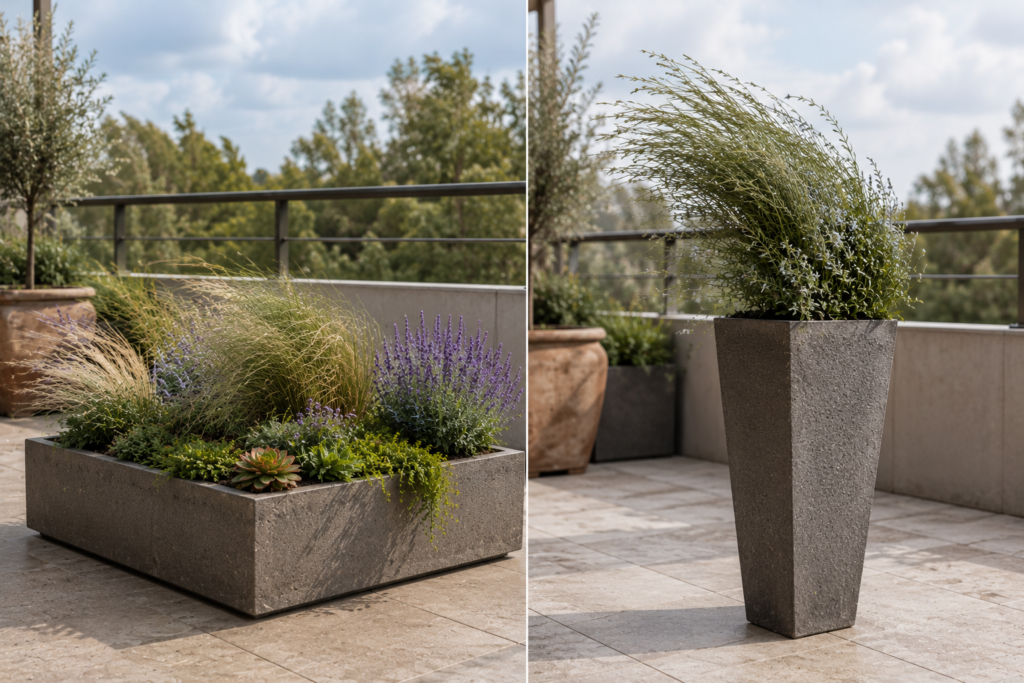
Use this planning tool to compare planter designs. It is not an engineering wind rating.
The most reliable planters for windy areas are usually low troughs, wide bowls and broad cylinders. These shapes distribute weight across a larger footprint and expose less container surface to strong gusts than narrow, top-heavy pots.
| Factor | 0 points | 1 point | 2 points |
|---|---|---|---|
| Base | Narrow | Moderate | Broad |
| Total height | Very tall | Medium | Low |
| Canopy | Dense or rigid | Mixed | Compact or flexible |
| Placement | Fully exposed | Partially protected | Sheltered |
| Restraint | Needed but absent | Temporary | Secure or unnecessary |
- 8–10 points: Generally suitable for regular wind.
- 5–7 points: Improve the base, canopy, placement, or restraint.
- 0–4 points: Redesign before using in an exposed location.
Evaluate the planter when filled. Wet potting mix, reservoir water, mature plants, trellises, and decorative materials add weight. A broad trough with low herbs may remain stable, while the same container supporting a dense privacy screen may not.
Correct the weakest feature rather than automatically adding ballast.
Windy Patio Planter Ideas
Ground-level spaces usually allow heavier materials and larger soil volumes, but planter proportions and mature plant size still matter.
1. Low Rectangular Troughs
Low troughs are among the most reliable planter ideas for windy areas because their long footprint distributes weight across a broad surface. Position the long side across the prevailing wind where practical.
Fill them with compact herbs, low grasses, sedums, groundcovers, or mounding flowers. Avoid a continuous row of tall foliage that catches wind.
2. Wide Bowl Planters
Wide bowls create a low center of gravity and suit courtyards, entrances, and exposed patio corners. Choose enough depth for mature roots.
Suitable plants include compact perennials, sedums, low herbs, small grasses, and drought-tolerant groundcovers. One substantial bowl is generally easier to stabilize than several tiny pots.
3. Grouped Planters
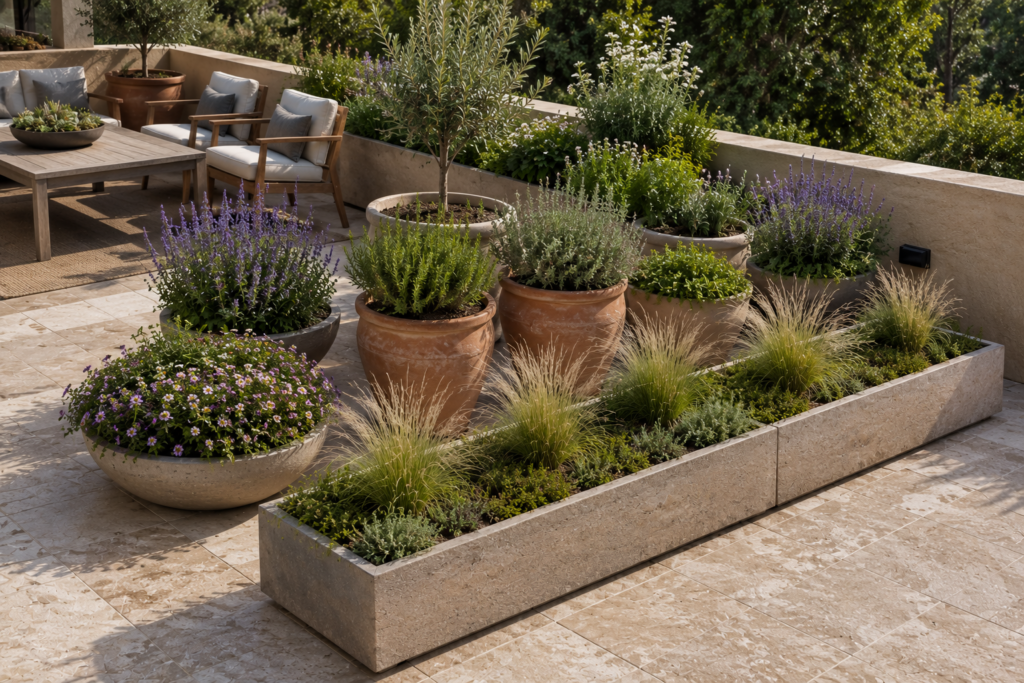
Grouped planters allow stronger containers to protect smaller ones. Place broad, low pots on the windward side, medium containers behind them, and delicate flowers in the most sheltered zone.
Repeat one material, color, or plant for visual unity. Leave space for watering and inspection, and ensure every container remains independently stable.
4. Built-In Bench Planters
Built-in bench planters combine seating and planting in one feature. Position the planting on the windward side so the seat benefits from partial shelter.
Use compact shrubs, flexible grasses, and layered perennials. Include dependable drainage and maintenance access. The bench and planter should function as one stable structure.
5. Heavy Terracotta Planters
Thick terracotta adds useful weight and works well in partially sheltered corners. Choose a broad cylinder instead of a tall urn.
Terracotta dries faster than non-porous materials, so monitor moisture carefully. In cold climates, use frost-resistant pots and prevent winter waterlogging.
6. Wall-Side Planter Rows
Low rectangular planters beside a wall create an organized display. Leave a gap for airflow, watering, drainage inspection, and building maintenance.
Avoid placing fragile plants at the wall’s end, where wind may accelerate around the corner.
Windy Balcony and Rooftop Planters
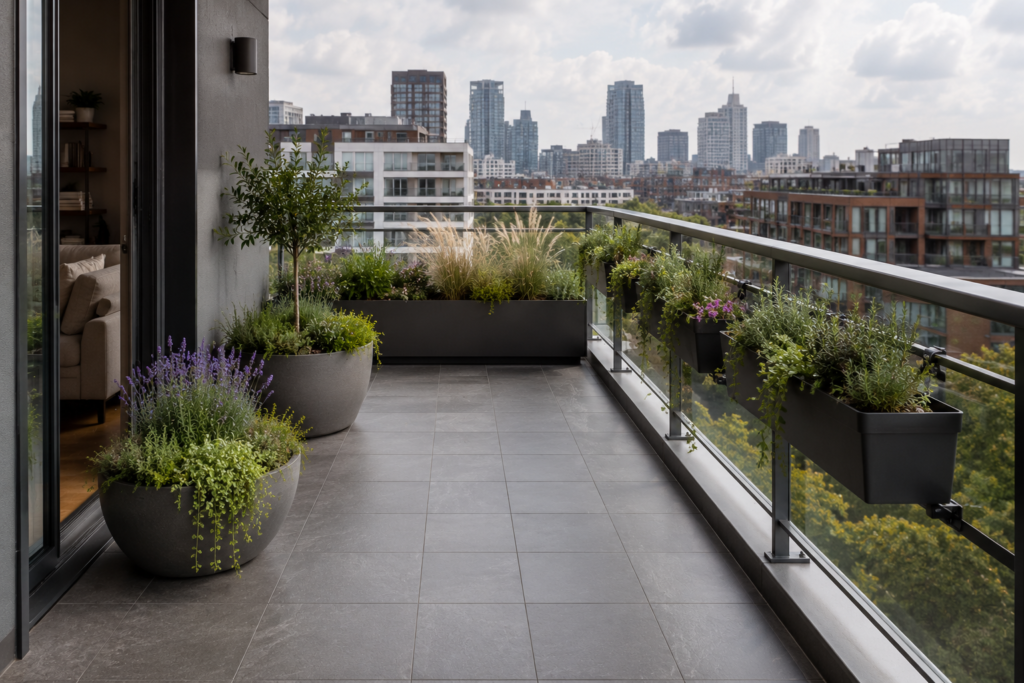
Elevated spaces create a trade-off: heavy pots resist movement but increase structural load, while lightweight planters need secure positioning.
7. Double-Potted Lightweight Planters
Place a planted inner container inside a broader decorative pot. This simplifies seasonal changes and can improve stability when the outer pot has a wide base.
Keep the inner pot above trapped water and inspect the outer container after heavy rain.
8. Inward-Facing Railing Planters
Position railing planters inward whenever possible. Use brackets that match the railing and container, and inspect them for corrosion, cracks, or loose fasteners.
Control drainage and trailing foliage. Never rely on string, thin wire, or adhesive hooks.
9. Ground-Level Balcony Boxes
Low balcony boxes keep plants below stronger airflow and reduce the consequences of movement. Use groundcovers, compact fillers, and modest height.
Keep boxes clear of drains, doors, ventilation, fire routes, and inspection points. Lockable casters must be rated for the filled weight.
10. Self-Watering Troughs
Self-watering troughs reduce rapid moisture fluctuations. Choose a model with an overflow outlet and monitor the reservoir until you understand plant usage.
Stored water adds weight and should be included in structural-load calculations.
11. Seasonal Modular Groups
Modular containers can be rearranged during normal weather and moved into shelter before storms. They suit renters and spaces where permanent anchoring is prohibited.
Choose strong handles, manageable filled weights, or suitable plant caddies. Plan the storage location in advance.
Planter Windbreak Ideas
Some planter designs can reduce wind pressure around nearby plants and seating. The goal is to filter airflow, not block it completely.
12. Low Ornamental-Grass Planters
Compact grasses add movement and texture without creating the resistance of large leaves. Choose clump-forming varieties suited to the local climate and container size.
Use one medium grass in a broad trough with lower plants. Avoid tall grasses in narrow pots and check local invasive-plant guidance.
13. Coastal Herb Planters
A wide herb trough can combine rosemary, thyme, sage, oregano, lavender, or marjoram where climate allows. Place taller herbs on the protected side and lower plants near the edge.
Choose salt-tolerant, winter-hardy cultivars and harvest regularly to maintain a compact canopy.
14. Permeable Screen and Planter Combinations
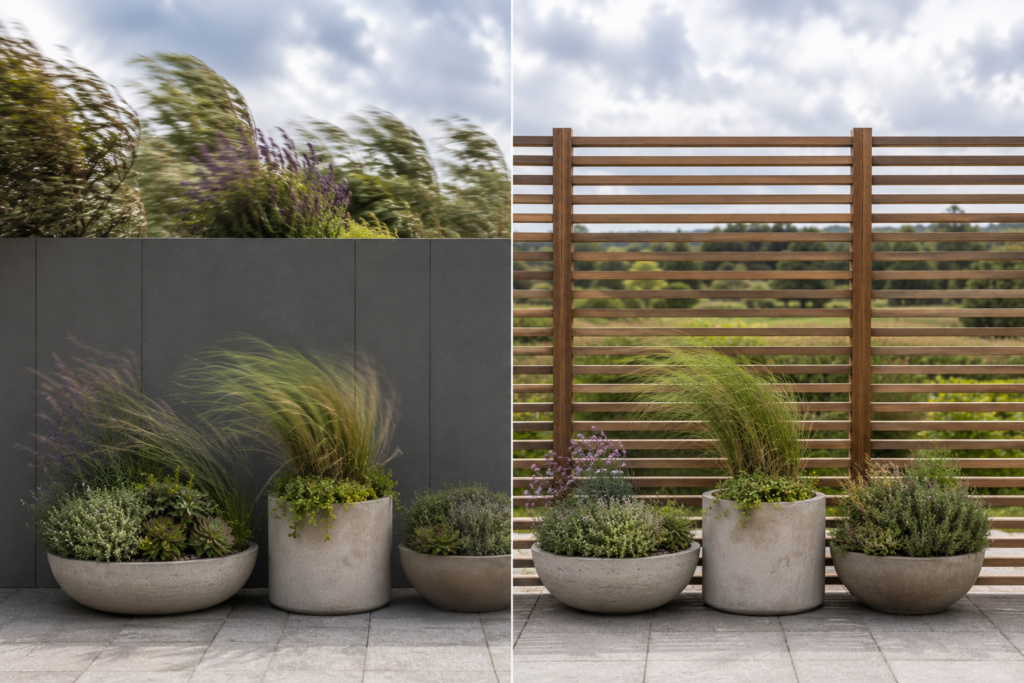
Permeable screens reduce wind speed while allowing air to pass through. Options include spaced timber slats, wind mesh, woven panels, and open trelliswork.
Place planters on the sheltered side and leave maintenance space. Never attach a large panel to an ordinary decorative pot.
A permeable timber screen can make planters for windy areas easier to manage because it filters airflow instead of stopping it abruptly. Completely solid barriers may create turbulence on the sheltered side, while evenly spaced slats encourage gentler air movement.
Good drainage remains essential for planters for windy areas, especially when containers are grouped beside walls or screens. Keep drainage and overflow holes unobstructed, raise pots slightly where necessary, and leave enough access for watering, inspection and seasonal maintenance.
15. Anchored Privacy Planters
Privacy planters combine containers with trellises or vertical frameworks. They provide shelter but catch more wind than ordinary pots.
Use an engineered system for tall panels. Keep climbers pruned and reject the design when the fixing method is uncertain or drilling is prohibited.
Six Plant Combinations for Windy Planters
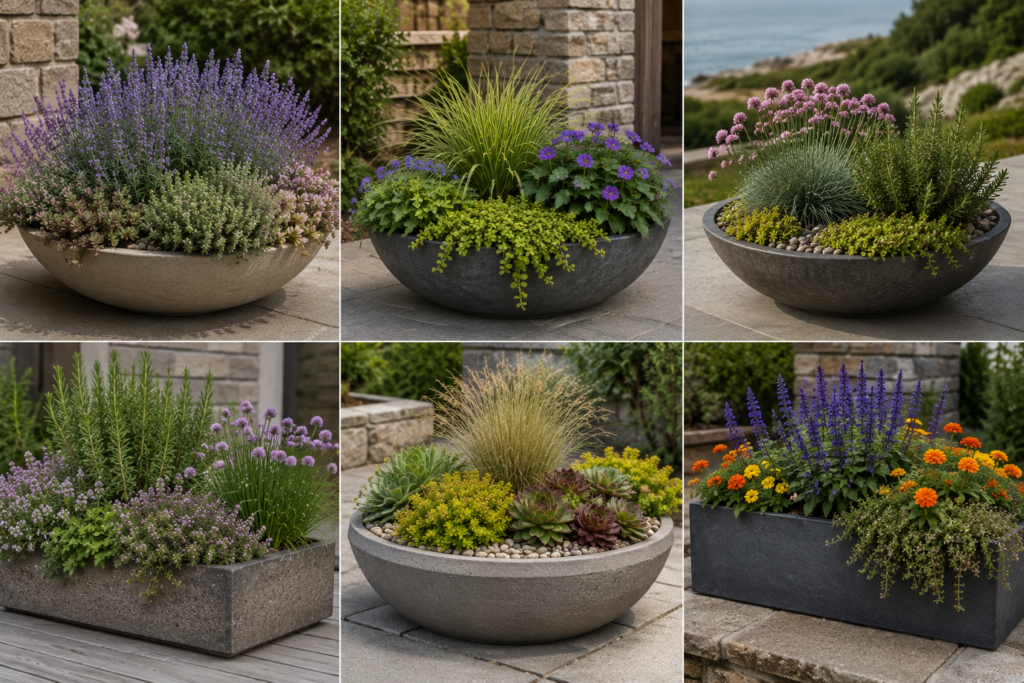
Plants sharing a container should have compatible light, moisture, drainage, and climate requirements.
| Situation | Suggested combination | Why it works |
|---|---|---|
| Sunny patio | Compact lavender, thyme, and sedum | Low profile and similar drainage needs |
| Part-shade balcony | Compact Carex, hardy geranium, and trailing groundcover | Flexible growth and moderate height |
| Coastal planter | Sea thrift, compact grass, and a local coastal herb | Layered texture and coastal adaptation |
| Edible container | Compact rosemary, thyme, and chives | Useful plants with manageable growth |
| Low-maintenance bowl | Sempervivum, sedum, and a small grass | Very low canopy |
| Seasonal trough | Compact salvia, low marigolds, and trailing thyme | Color without a fragile centerpiece |
Adjust each combination for local hardiness, heat, rainfall, and invasive status. Use compact cultivars and avoid combining drought-tolerant plants with species that require constantly moist compost.
Best Planter Shapes and Materials
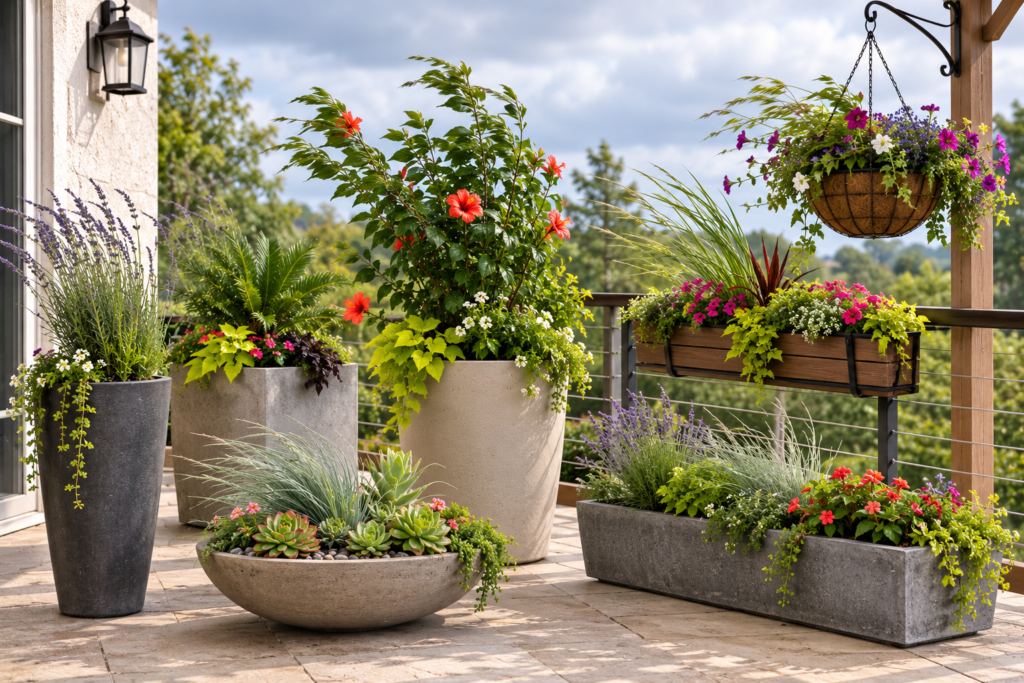
Shape often matters more than empty weight. A heavy narrow urn may become unstable with a tall shrub, while a lighter trough can perform better because of its broad footprint.
| Shape | Stability | Best use | Main caution |
|---|---|---|---|
| Low trough | High | Patios, walls, balcony floors | Difficult to move when large |
| Wide bowl | High | Patios and focal displays | Shallow bowls dry quickly |
| Broad cylinder | Moderate to high | General container planting | Match height to base |
| Square cube | Moderate to high | Modern entrances and patios | Tall cubes become top-heavy |
| Tall tapered pot | Low to moderate | Sheltered entrances | Narrow base |
| Railing box | Depends on fixing | Balconies | Requires compatible brackets |
| Hanging basket | Low in exposure | Sheltered porches | Swings and dries quickly |
Concrete and stone suit exposed ground-level patios but may be too heavy for elevated structures. Terracotta offers weight but dries quickly. Wood suits troughs but needs protection from decay. Metal can overheat in sun. Fiberglass and resin work well when securely fixed. Fabric grow bags are best in sheltered locations.
Do not use gravel or pot shards as a routine drainage layer. Open drainage holes and suitable potting mix preserve more root space.
Best Plants for Windy Planters
Choose plants by growth habit rather than appearance alone. Compact, flexible, narrow-leaved, waxy, hairy, or silver-leaved plants often tolerate exposure better than broad, fragile foliage.
Useful categories include:
- compact herbs;
- dwarf shrubs;
- mounding perennials;
- clump-forming grasses;
- low groundcovers;
- suitable succulents;
- locally recommended coastal plants.
Check mature dimensions before buying. Plants sharing a container should need similar light, drainage, and moisture.
Avoid large soft leaves, brittle branches, unsupported stems, dense climbers, heavy blooms, or trees in undersized pots. Delicate plants can still work when protected behind a stable windward layer.
Arrange Planters for Wind Protection
When arranging planters for windy areas, place the lowest and toughest containers along the exposed edge. Position broad herb planters behind them and keep delicate flowering bowls closer to a wall, permeable screen or sheltered seating area.
Arrange planters according to the prevailing wind.
- Place the lowest, strongest container on the windward side.
- Position medium-height planters behind it.
- Keep delicate plants in the innermost zone.
- Add a permeable screen only where needed.
- Preserve access for watering and inspection.
- Keep doors, drains, railings, and emergency routes clear.
Create gradual height changes rather than one abrupt wall. For example, place a trough of compact grasses at the exposed edge, broad herb containers behind it, and flowering bowls nearest the seating area.
Check each pot separately because windward containers may dry faster.
Stop Planters Blowing Over
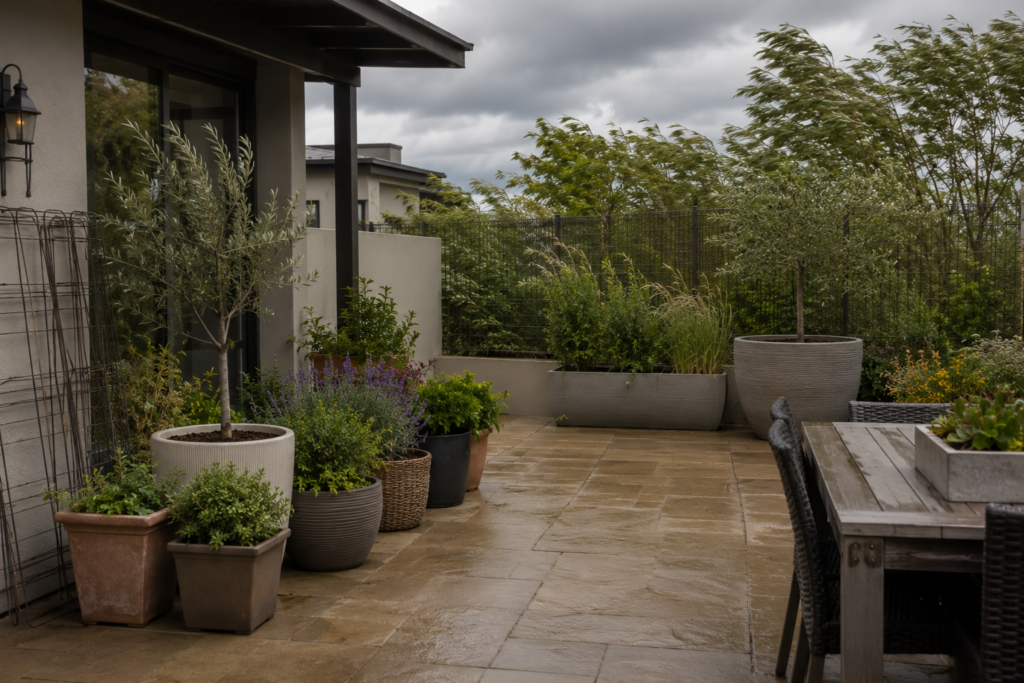
Correct the cause instead of simply adding weight.
| Problem | Likely cause | Best correction |
|---|---|---|
| Planter slides | Light base or smooth surface | Reposition or add a suitable anti-slip base |
| Planter tips | Narrow base or tall canopy | Replace with a wider, lower planter |
| Plant bends | Excessive or rigid growth | Prune correctly or change plant type |
| Railing planter moves | Loose bracket | Use an approved fixing system |
| Screen planter rocks | Large wind-catching surface | Reduce height or use an engineered unit |
| Pots fail in storms | Temporary extreme exposure | Move them beforehand |
Do not fill containers with concrete, bricks, or excessive rocks. Before storms, move portable pots, remove hanging baskets and trellises, inspect brackets, and clear drainage holes.
Watering Planters in Windy Areas
Wind increases moisture loss, so exposed containers need regular checks. Watering frequency depends on pot size, material, plant type, sunlight, temperature, and rainfall.
- Water thoroughly until excess drains from the base.
- Check exposed pots daily during warm weather.
- Use larger containers to slow drying.
- Apply suitable mulch.
- Install drip irrigation or a reservoir where helpful.
- Keep drainage and overflow holes open.
- Reduce watering during cool or wet weather.
Wilting with dry soil may indicate thirst, while wilting in wet compost may signal root stress. Check the potting mix before watering.
Windy Balcony Planter Safety
Calculate the complete weight of the container, wet potting mix, water, mature plant, trellis, mulch, and fittings.
Follow these rules:
- confirm building restrictions;
- keep planters inside the balcony boundary;
- use approved brackets;
- control drainage;
- keep doors, drains, and emergency routes clear;
- inspect fasteners regularly;
- avoid tall solid screens;
- move portable items before storms;
- seek advice when load limits are unclear.
A broad lightweight planter with secure restraint is usually safer than adding uncontrolled weight.
When to Get Professional Advice
Seek professional or building-management advice when:
- balcony or rooftop capacity is unknown;
- installation requires drilling;
- anchoring may penetrate a roof membrane;
- a privacy screen creates a large vertical surface;
- the filled planter cannot be moved safely;
- a component extends beyond a railing;
- drainage may affect the building;
- access could be blocked;
- the manufacturer does not approve the bracket;
- the planter will support a tree or large shrub.
Professional confirmation matters when failure could cause falling objects, structural damage, or water problems.
Windy Planter Mistakes to Avoid
- Choosing a narrow, top-heavy planter.
- Using fragile broad-leaved plants in full exposure.
- Installing a completely solid wind barrier.
- Ignoring faster moisture loss.
- Blocking drainage with ballast.
- Leaving elevated planters unsecured.
- Having no severe-weather plan.
Act on rocking, leaning, cracks, loose brackets, standing water, broken stems, or blowing mulch. Fix the cause rather than automatically adding weight.
Windy Area Planter Checklist
Container
- broad base;
- suitable depth;
- open drainage;
- manageable filled weight;
- strong handles.
Material
- UV and frost resistance;
- coastal suitability;
- heat retention;
- crack or corrosion risk;
- winter-storage needs.
Placement
- structural capacity;
- permitted anchoring;
- controlled drainage;
- access to doors and drains;
- storm-relocation plan.
Plant
- mature height and spread;
- wind and salt tolerance;
- light and moisture needs;
- local hardiness;
- invasive status;
- support requirements.
Choose by location first, then compare material, dimensions, drainage, and fixing options.
FAQs About Planter Ideas for Windy Areas
What type of planter is best for a windy area?
A low, wide planter with a broad base is usually best. Troughs, bowls, and broad cylinders are more stable than narrow, tall pots.
How do I stop a planter from blowing over?
Move it into shelter, reduce plant height, and replace narrow pots with wider containers. Use approved restraints where necessary.
Are tall planters suitable for windy patios?
They can work in sheltered areas with a broad base and compact planting. Avoid tall, narrow pots with shrubs or trellises.
What plants grow best in windy planters?
Compact, flexible, narrow-leaved, waxy, or low-growing plants often perform best. Match choices to local climate and sunlight.
How often should I water windy planters?
Check the soil daily during warm, windy weather. Small, porous, or exposed containers may need more frequent attention.
Are heavy pots safe on balconies?
Only when the structure supports their complete wet weight, including soil, water, plants, and accessories.
Is a solid or permeable windbreak better?
A permeable windbreak is usually better because it filters airflow. Solid barriers may create turbulence.
Are hanging baskets suitable for windy areas?
They are unsuitable for severe exposure because they swing and dry quickly. Use them only in sheltered positions.
Should I put gravel in the bottom of a planter?
No. Gravel does not improve drainage and reduces root space. Use open drainage holes and suitable potting mix.
How do I protect pots before a storm?
Move portable pots into shelter, remove hanging baskets and trellises, and inspect brackets before strong wind begins.
Final Thoughts
The best planter ideas for windy areas match container shape, plant canopy, placement, drainage, and restraint to the actual exposure. Start with a broad base, manageable height, and compact planting. Use stable planters on the windward side and keep delicate plants behind them.
For elevated spaces, verify load limits and use approved attachments. For coastal sites, choose salt-tolerant plants and durable materials. In storm-prone gardens, prioritize movable containers and a clear storage plan.
With stable containers, compact plants and thoughtful placement, planters for windy areas can remain attractive without making the patio feel crowded. Start with low, broad designs and introduce taller containers only in genuinely protected positions.
Editorial Method
We evaluated each planter idea according to base width, height, plant canopy, drainage, mobility, moisture loss, placement, and suitability for ground-level or elevated spaces.
The Planter Stability Score is an editorial comparison tool, not a structural assessment or certified wind rating. Structural installations may require approval from a property manager, manufacturer, engineer, or another qualified professional.

Myra is the founder and lead writer of Backyard Planter Ideas, where she shares practical, well-researched guidance on planter design, plant selection, and outdoor styling. Her goal is to help homeowners create attractive, functional garden spaces with clear, reliable, and easy-to-apply advice.