
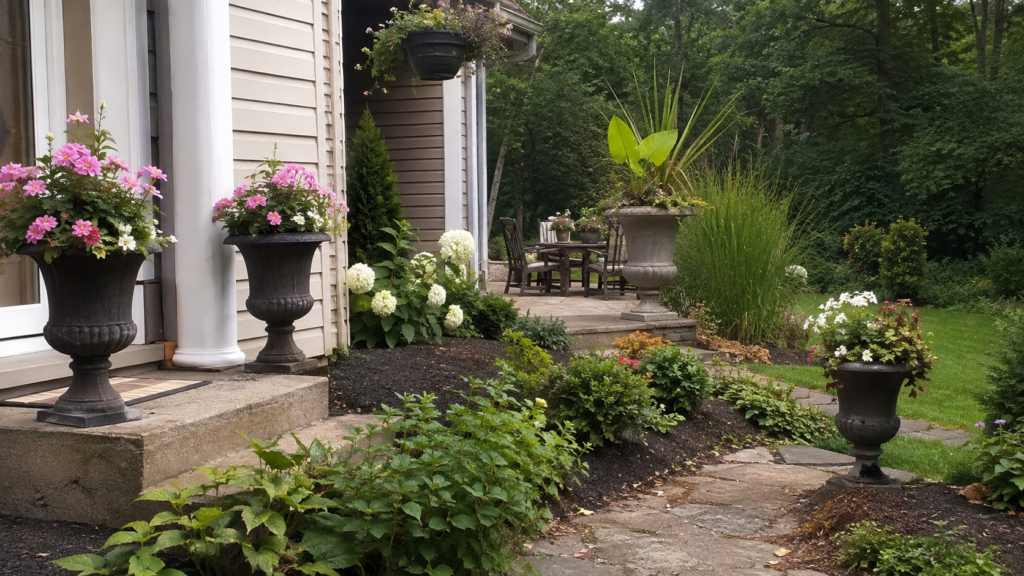
Outdoor urn planter ideas work best when the container, plants, location, and maintenance needs are planned together. Use urns to frame entrances, anchor patios, soften garden paths, or add seasonal color, but always match plants to sunlight, drainage, root space, wind exposure, and watering conditions.
Urn planters create more visual impact than ordinary pots because their raised bowls, pedestal shapes, and decorative profiles naturally act as focal points. A single large urn can strengthen an empty patio corner, while two matching urns can frame a doorway, gate, or garden steps.
Use this planning order:
location → growing conditions → urn → plants → maintenance
It helps prevent poor drainage, overcrowding, unstable planting, and containers that become difficult to maintain.
Which Outdoor Urn Setup Is Right for You?
Choose the setup according to the location before deciding on plant colors or decorative style. Matching urns work well beside formal entrances, while one substantial urn is usually better for an open patio. Shade, wind, hot paving, and narrow walkways all affect the best choice.
Use this quick guide:
- Front door: matching urn pair.
- Open patio: one large focal urn.
- Full sun: heat-tolerant mixed planting.
- Partial shade: compatible flowers and foliage.
- Deep shade: foliage-focused arrangement.
- Windy site: compact plants in a stable urn.
- Low maintenance: suitable succulents or structural foliage.
- Seasonal display: removable inner pot.
- Narrow steps: compact upright planting.
- Formal garden: evergreen or topiary urn.
The best question is not simply “Which urn looks best?” but “Which combination will still work when the plants mature?”
Which Outdoor Urn Planter Ideas Work Best?
The best outdoor urn planter ideas solve a practical design problem while remaining easy to maintain. A doorway urn should strengthen the entrance without restricting movement, while a patio urn needs enough scale to suit surrounding furniture and hardscape.
Use these ideas as adaptable frameworks rather than fixed planting recipes.
1. Frame a Front Door With Matching Urns
Two matching urns create symmetry and work especially well beside entrances, gates, porch steps, and balanced facades.
Use either a simple evergreen or topiary in each urn or a fuller arrangement with an upright centerpiece, medium-height fillers, and trailing plants.
Keep mature foliage away from:
- door swings;
- locks and handles;
- house numbers;
- lights;
- stairs and paths.
The urns should suit the scale of the entrance rather than simply being as large as possible.
2. Use One Large Urn as a Patio Focal Point
One substantial urn can work better than several small containers when a patio needs a clear focal point.
Good positions include:
- an empty corner;
- beside outdoor seating;
- near a dining area;
- at the end of a sightline;
- where two paths meet.
A large urn should contain enough plant mass to balance its scale. One structural centerpiece with supporting plants often looks stronger than many small flowers.
Plant a Thriller-Filler-Spiller Urn
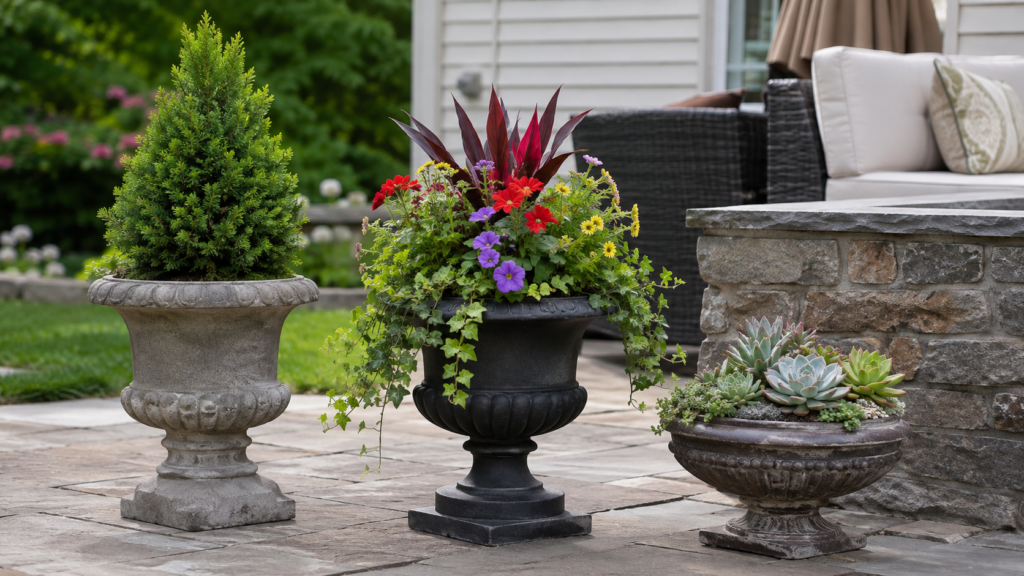
The thriller-filler-spiller method creates a balanced mixed urn:
- Thriller: height.
- Filler: middle-level fullness.
- Spiller: downward movement.
If the urn is viewed from every direction, place the thriller near the center. If it stands against a wall, move the tallest plant slightly toward the back.
All plants should have compatible sunlight and moisture needs.
4. Create a Full-Sun Flower Urn
Sunny urns can support colorful flowers, but paving, walls, and concrete can increase reflected heat.
Check:
- hours of direct sun;
- morning versus afternoon exposure;
- reflected heat;
- wind;
- soil volume;
- watering access.
A simpler combination of heat-tolerant plants often performs better than an arrangement that constantly wilts.
5. Make a Shade-Loving Foliage Urn
Shade urns can look impressive without relying heavily on flowers. Use contrasting leaf shapes, colors, and textures.
Suitable plant forms include:
- upright ferns;
- broad foliage;
- compact mounding plants;
- trailing greenery.
Shade does not automatically mean moist soil. Covered porches and tree-covered areas can still dry quickly.
6. Plant an Evergreen or Topiary Urn
Evergreens and topiary provide long-lasting structure and work well beside entrances, gates, patios, and steps.
Check:
- usable root depth;
- opening width;
- drainage;
- mature height;
- wind exposure.
A tall topiary in a narrow lightweight urn can become unstable, so exposed locations usually benefit from a broader container and more compact plant.
7. Create a Succulent Urn
Succulents work well in sunny locations with excellent drainage and can give traditional urns a more contemporary appearance.
Combine:
- one architectural succulent;
- compact rosette forms;
- low-growing varieties;
- a trailing succulent.
Avoid overcrowding initially. Good drainage and suitable growing media matter more than simply watering less.
8. Use Trailing Plants to Soften a Tall Urn
Trailing plants create downward movement and help connect the planting to the shape of a pedestal urn.
Use them to:
- soften a thick rim;
- emphasize urn height;
- make mixed planting look fuller.
Choose trailers according to mature vigor and keep stems away from stairs, doors, seating areas, and paths.
9. Create a Cottage-Garden Urn
A cottage-style urn should feel relaxed without becoming overcrowded.
Use:
- varied flower heights;
- soft foliage;
- two or three repeated colors;
- gently trailing plants.
Plants should still share compatible growing requirements. Visual appeal should not override moisture and sunlight needs.
10. Use Urns Along Garden Steps
Urns can mark transitions between garden levels.
Place matching containers at the top or bottom of steps where space allows, but keep safety first.
Check:
- walking width;
- handrail access;
- mature foliage spread;
- drainage runoff;
- stability.
If stairs are narrow, place the urns beside them rather than on the steps.
11. Group Urns at Different Heights
A group of urns can create visual depth without requiring one oversized planter.
Try:
- one tall focal urn;
- one medium companion;
- one lower planter.
Repeat one feature across the group, such as material, color, foliage, or flower palette. Slightly staggered containers usually look more natural than a rigid line.
12. Create a Seasonal Urn You Can Refresh
A removable inner pot makes seasonal planting easier because the decorative urn can remain in place while the planting changes.
Seasonal displays may include:
- spring bulbs and cool-season flowers;
- summer annuals;
- fall foliage and flowers;
- winter greenery where suitable.
Make sure both the insert and decorative urn drain freely.
Which Plants Work Best in Outdoor Urns?
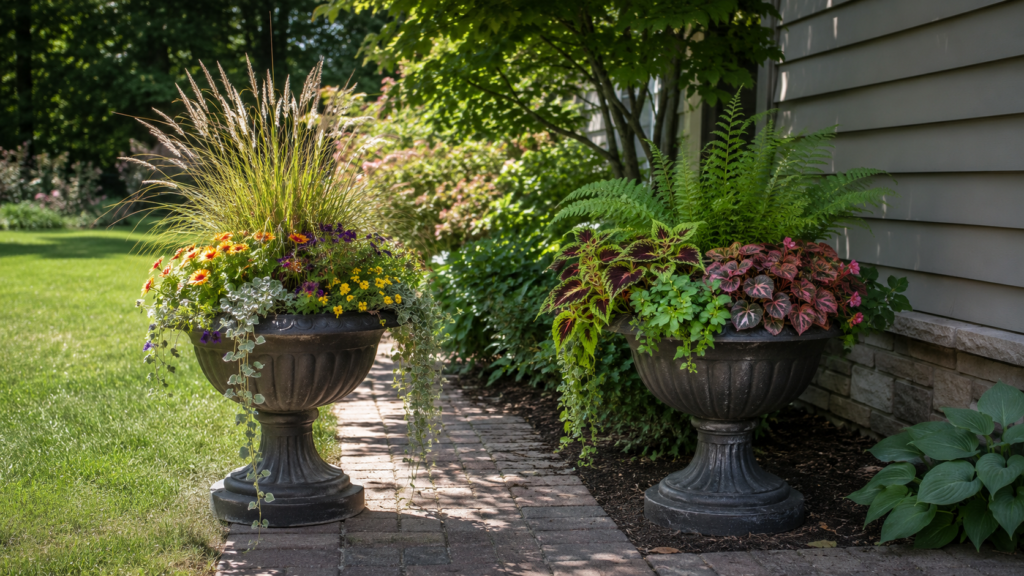
Choose plants according to sunlight, mature size, root volume, moisture needs, and growth habit. For mixed displays, combine compatible upright, mounding, and trailing plants rather than choosing varieties only by color.
Useful plant roles include:
- Structural plants: ornamental grasses, upright foliage, compact evergreens, small topiary.
- Fillers: flowering annuals and mounding foliage.
- Trailers: plants that soften the rim.
- Shade plants: ferns, begonias, coleus, heuchera, and suitable foliage where locally appropriate.
| Exposure | Thriller | Filler | Spiller |
|---|---|---|---|
| Full sun | Ornamental grass | Lantana | Calibrachoa |
| Sun/part sun | Angelonia | Euphorbia | Bacopa |
| Partial shade | Coleus | Heuchera | Ivy |
| Shade | Fern | Begonia | Shade-tolerant foliage |
These are examples rather than universal prescriptions. Confirm local climate, hardiness, sunlight, and moisture requirements before planting.
How Should You Arrange Plants in an Urn?
Arrange plants according to the main viewing direction and mature size. Place the tallest plant near the center when the urn is viewed from all sides, or slightly toward the back when it sits against a wall.
For an urn viewed from every direction:
- center the focal plant;
- distribute fillers around it;
- use trailers around several parts of the rim.
For an urn viewed mainly from the front:
- move taller plants toward the rear;
- keep shorter flowers toward the front;
- use trailers along the visible edge.
Avoid overcrowding nursery-sized plants. Leave room for foliage expansion, airflow, watering, and pruning.
Repeating one filler, trailer, flower color, or foliage texture usually creates a stronger arrangement than using many unrelated plants.
What Size Outdoor Urn Do You Need?
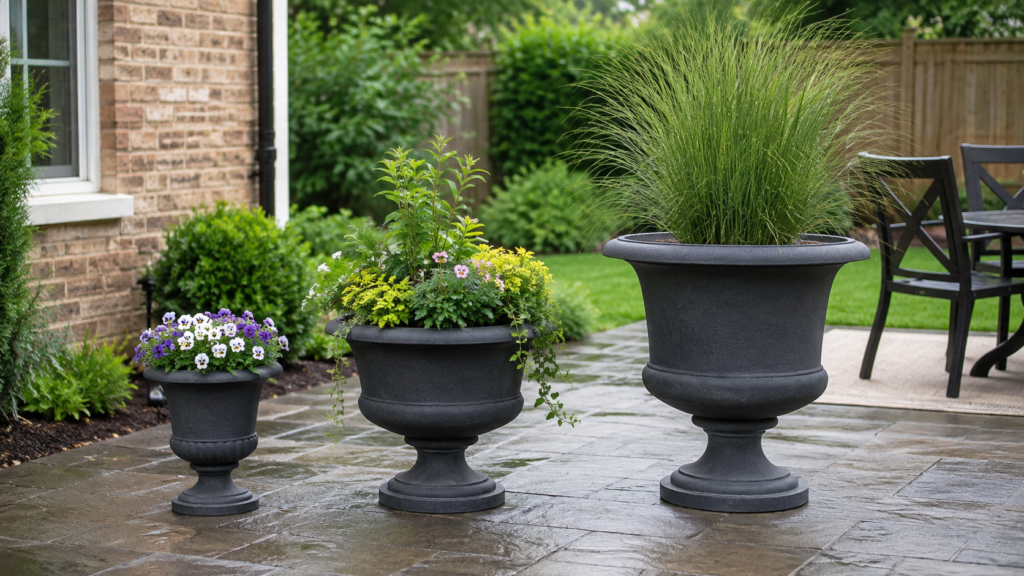
Choose urn size according to usable root space, mature plant size, stability, and the scale of the surrounding area.
Four measurements matter most:
- overall height;
- opening width;
- usable soil depth;
- base width.
Small urns suit compact seasonal flowers but dry more quickly.
Medium urns are versatile for annuals, herbs, compact grasses, and mixed planting.
Large urns suit substantial structural plants but become difficult to move once filled.
Do not judge planting depth from exterior height alone. Some pedestal urns appear tall while providing only a moderate planting bowl.
Choose the smallest container that still provides adequate root space and moisture stability.
How Do You Fill a Deep Outdoor Urn?
A deep urn does not always need to be filled completely with growing medium. Measure the actual planting cavity and determine how much root space the plants require.
If the manufacturer provides an insert, false bottom, or removable inner container, use it as intended.
Before filling:
- measure usable depth;
- determine plant root requirements;
- keep drainage open;
- avoid materials that trap water;
- consider final wet weight;
- leave watering space below the rim.
Match soil volume to the plants rather than automatically filling the entire urn.
Where Should You Place Outdoor Urns?
Place urns where they strengthen an entrance, path, patio, staircase, or focal view without interfering with movement.
Good locations include:
- beside front doors;
- beside gates;
- patio corners;
- the top or bottom of steps;
- path intersections;
- beside seating areas.
Before filling, check sunlight, reflected heat, wind, runoff, watering access, and surface stability.
Large planted urns can be difficult to relocate, so choose the final position first.
How Do You Keep Outdoor Urns Stable?
Stability depends on base width, overall height, filled weight, mature plant height, and wind exposure.
Check:
- level ground;
- base width;
- mature plant height;
- empty and filled weight;
- wind exposure;
- manufacturer guidance.
For windy locations:
- choose compact plants;
- use a broader or more substantial urn;
- avoid very tall unsupported centerpieces;
- keep urns away from stair edges.
Evaluate the entire setup rather than judging stability from weight alone.
Do Outdoor Urns Need Drainage?
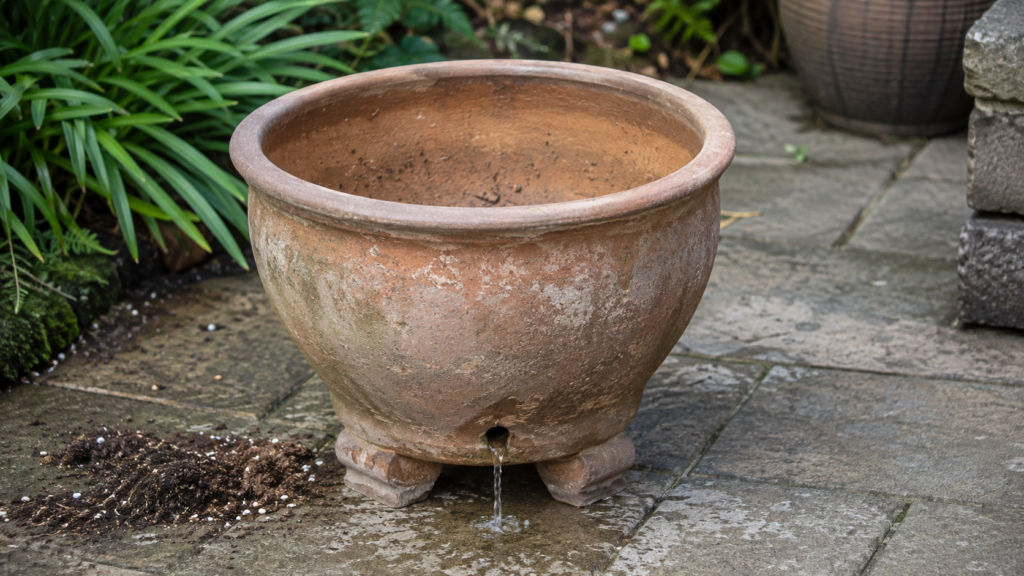
Yes. Soil-filled outdoor urns need functioning drainage holes or outlets so excess rain and irrigation water can escape.
Good drainage requires:
- open outlets;
- suitable container growing media;
- unobstructed holes;
- safe runoff.
Should You Put Gravel in the Bottom?
Do not add gravel or rocks simply to improve drainage.
Gravel reduces usable root space and does not replace functioning drainage holes.
Should an Urn Be Raised Slightly?
If a drainage opening sits directly against paving, stable pot feet may help keep it open.
Do not reduce stability simply to raise the urn.
Why Test Drainage Before Planting?
Decorative urns may contain plugs or unusual internal shapes.
Test the empty urn with water and check:
- where it exits;
- how quickly it drains;
- whether paving blocks the outlet;
- where runoff lands.
Correcting drainage before adding soil is much easier.
What Soil Is Best for Outdoor Urns?
Use a growing medium designed for containers rather than dense backyard soil.
A suitable mix should provide:
- drainage;
- aeration;
- moisture retention;
- root support;
- manageable weight.
Flowering annuals and foliage plants generally need a balanced container mix. Succulents require faster drainage, while long-term woody plants may have more specific needs.
Leave space below the rim so water can soak into the growing medium instead of immediately overflowing.
How Do You Water Outdoor Urns?
Water according to actual moisture in the root zone rather than following a fixed schedule.
Water demand changes with:
- urn size;
- plant maturity;
- sunlight;
- temperature;
- wind;
- growing medium;
- container material.
Check below the surface because the top layer can appear dry while deeper soil remains moist.
When watering is needed, moisten the root zone evenly and allow excess water to drain.
Which Outdoor Urn Material Is Best?
No single material is best for every location.
| Material | Advantage | Main Consideration |
|---|---|---|
| Resin/fiberglass | Lightweight | Stability |
| Terracotta | Traditional look | Porous and breakable |
| Cast stone/concrete | Stable | Very heavy |
| Metal | Decorative | Heat exposure |
| Ceramic | Wide design range | Frost and weight |
Resin and fiberglass are useful where portability matters. Terracotta provides a traditional appearance but loses moisture more quickly. Cast stone and concrete are substantial but difficult to move. Metal can become warm in direct sun, while ceramic suitability depends on the specific product and climate.
Can Outdoor Urns Stay Outside in Winter?
Some urns can remain outside through winter, but suitability depends on material, drainage, freeze-thaw conditions, plant hardiness, and manufacturer guidance.
Before leaving an urn outside:
- identify the material;
- check outdoor or frost ratings;
- keep drainage outlets clear;
- prevent standing water;
- assess plant hardiness;
- inspect cracks;
- follow manufacturer instructions.
Do not assume all urns made from the same general material perform identically.
How Do You Change Urns With the Seasons?
A removable inner pot is one of the easiest ways to refresh outdoor urns seasonally.
Use locally suitable plants for:
- spring;
- summer;
- fall;
- winter.
Seasonal planting should follow local conditions rather than calendar dates alone.
An insert can simplify replacement, reduce soil waste, and allow planting elsewhere. Both containers still need functioning drainage.
What Outdoor Urn Mistakes Should You Avoid?
Most problems come from practical mistakes rather than poor styling.
Avoid:
- ignoring drainage;
- choosing plants before checking sunlight;
- combining incompatible moisture needs;
- overcrowding;
- using dense backyard soil;
- choosing insufficient root space;
- ignoring wind exposure;
- blocking paths;
- forgetting filled weight;
- making watering difficult.
Choose a design you can maintain consistently rather than the most elaborate display possible.
What Should You Check Before Buying an Urn?
Buy according to plants and location rather than appearance alone.
Check:
- opening width;
- usable internal depth;
- overall height;
- base width;
- drainage holes;
- empty and filled weight;
- material;
- outdoor or frost rating;
- insert availability;
- watering access;
- final position.
Also measure the route to the installation area. A large urn may fit its destination but fail to pass through a narrow gate.
Use this order:
plants + location → required size → material → urn
How Do You Test an Outdoor Urn Setup?
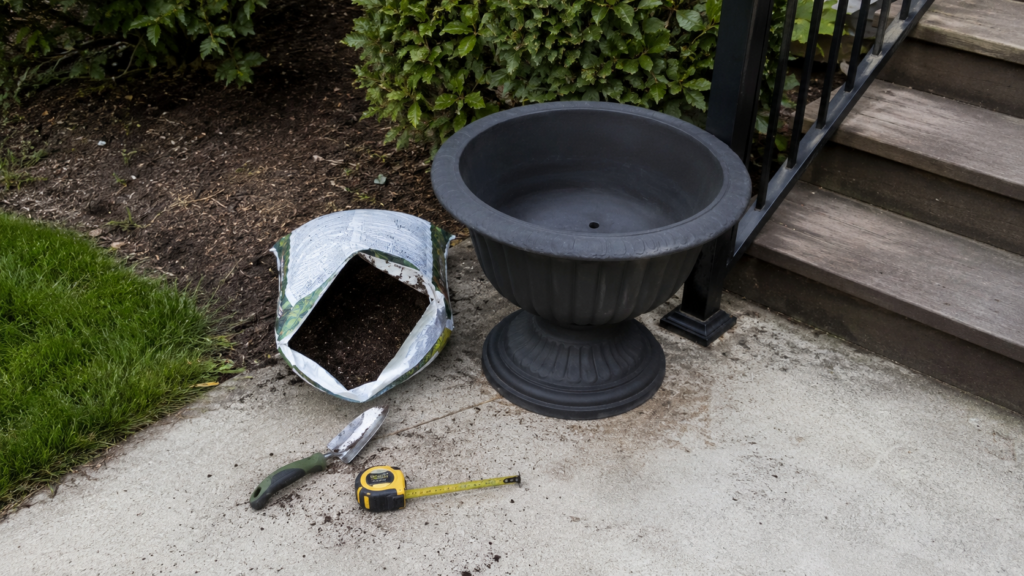
Test the urn while it is empty by checking position, dimensions, stability, sunlight, and drainage.
- Position the empty urn.
- Check doors and paths remain clear.
- Measure opening width and usable depth.
- Test drainage with water.
- Observe sunlight.
- Choose compatible plants.
- Photograph the planted urn.
- Record actual watering.
- Photograph it again several weeks later.
| Check | What to Record |
|---|---|
| Opening | Actual width |
| Root space | Usable depth |
| Drainage | Outlet position |
| Sun | Approximate hours |
| Plants | Exact varieties |
| Water | Actual frequency |
| Exposure | Wind and heat |
| Day 1 | Photograph |
| Day 30 | Photograph |
| Result | Growth or problems |
Only use phrases such as “we tested,” “we measured,” or “after 30 days” after actually completing and documenting the test.
Which Outdoor Urn Planter Idea Is Best?
The best outdoor urn planter is the simplest arrangement that matches the location, sunlight, drainage, root space, wind exposure, and maintenance routine.
Choose:
- matching urns for formal entrances;
- one large urn for a patio focal point;
- thriller-filler-spiller for mixed displays;
- foliage urns for shade;
- succulents for suitable sunny locations;
- evergreen/topiary for structure;
- removable inserts for seasonal displays.
Use this order:
- Choose the location.
- Measure the space.
- Observe sunlight.
- Check wind and heat.
- Decide what to grow.
- Select urn size.
- Confirm drainage.
- Choose compatible plants.
- Allow for mature growth.
- Plan maintenance.
The best choice remains practical and attractive after the plants mature.
FAQs About Outdoor Urn Planter Ideas
What are the best outdoor urn planter ideas?
Good options include matching entrance urns, patio focal urns, thriller-filler-spiller displays, foliage urns, succulent urns, and seasonal arrangements. Choose according to sunlight, drainage, space, and maintenance.
What plants look best in outdoor urn planters?
Combine one upright focal plant with medium-height fillers and trailing plants. Make sure all plants have compatible sunlight and moisture requirements.
What should you put in the center of an urn planter?
Use a taller focal plant such as ornamental grass, upright foliage, flowering plants, or compact topiary suited to the urn size.
Do outdoor urn planters need drainage holes?
Yes. Soil-filled urns need functioning drainage holes so excess water can escape.
Should you put rocks in the bottom of an urn planter?
No. Gravel does not replace proper drainage and reduces usable root space.
How do you fill a deep outdoor urn?
Use only the soil depth the plants need. Where appropriate, use a manufacturer-approved insert while keeping drainage open.
How often should outdoor urns be watered?
There is no fixed schedule. Check moisture below the surface and adjust watering for heat, wind, plant maturity, and container size.
Can outdoor urns stay outside in winter?
Some can, depending on material, drainage, freeze-thaw conditions, plant hardiness, and manufacturer guidance.
How do you keep a tall urn from tipping?
Use a level surface and consider base width, filled weight, mature plant height, and wind exposure.
Final Tips for Outdoor Urn Planter Ideas
The strongest outdoor urn planter ideas combine visual impact with practical gardening.
Before planting:
- measure the space;
- observe sunlight;
- check drainage;
- confirm root depth;
- choose compatible plants;
- allow for mature growth;
- use suitable container growing media;
- consider wind;
- position heavy urns before filling;
- keep paths and doors clear;
- make watering convenient.
For decorative planting, thriller + filler + spiller is a useful design formula.
For long-term success, use:
right location + right urn + compatible plants + reliable drainage + practical maintenance
The best outdoor urn planter is one that remains healthy, proportionate, stable, and manageable throughout the growing season.
Which Sources Support This Urn Planter Guide?
Technical claims about drainage, growing media, watering, winter exposure, and plant compatibility should be supported with reputable horticultural references such as university Extension programs, recognized gardening organizations, and manufacturer guidance.
Prioritize inline citations for:
- drainage;
- the gravel drainage myth;
- container growing media;
- watering;
- plant compatibility;
- frost exposure;
- material performance.
Use manufacturer guidance for product-specific claims such as frost ratings, drainage plugs, durability, and year-round outdoor use.
Only describe measurements or observations as first-hand experience when they have actually been completed and documented.

Myra is the founder and lead writer of Backyard Planter Ideas, where she shares practical, well-researched guidance on planter design, plant selection, and outdoor styling. Her goal is to help homeowners create attractive, functional garden spaces with clear, reliable, and easy-to-apply advice.