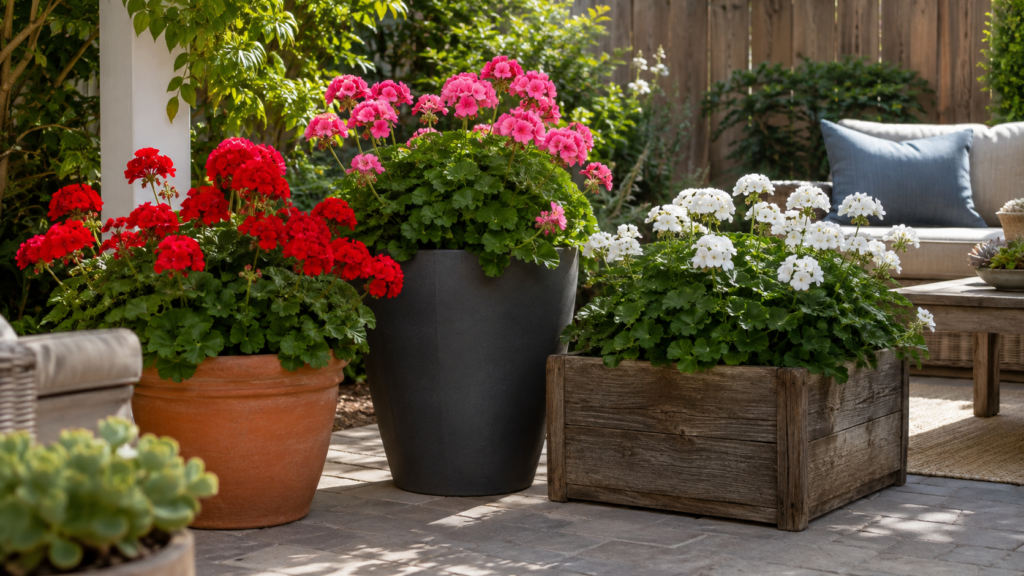
Geranium planter ideas range from classic terracotta pots and modern patio containers to hanging baskets, window boxes, and mixed flower arrangements. The best design matches the geranium’s growth habit with adequate root space, reliable drainage, suitable light, and a planter that fits both the mature plant and the available space.
Geraniums are practical container plants because they provide strong seasonal color without requiring complicated planting schemes. They work well on patios, porches, balconies, entrance steps, window ledges, decks, and small backyards where permanent flower beds may not be practical.
For the best results, design for the mature plant rather than how a young geranium looks on planting day. Container size, light, drainage, wind exposure, watering access, and plant habit all affect how attractive and manageable the planter will remain.
In this guide, “geranium” mainly refers to Pelargonium, the colorful tender plant commonly grown in patio pots, window boxes, and hanging baskets. True Geranium species are generally hardy cranesbill perennials and have different growing habits and winter requirements.
Quick Geranium Planter Chooser
- Sunny patio: upright zonal geranium + broad pot.
- Hanging basket: trailing ivy-leaved geranium.
- Window box: compact or trailing geranium.
- Small patio: compact pots or vertical planters.
- Front entrance: broad, stable statement planter.
- Modern garden: white or red geranium + charcoal planter.
- Cottage garden: pink or red geranium + terracotta.
- Simplest care: one geranium variety in one well-drained pot.
Best Geranium Types for Planters
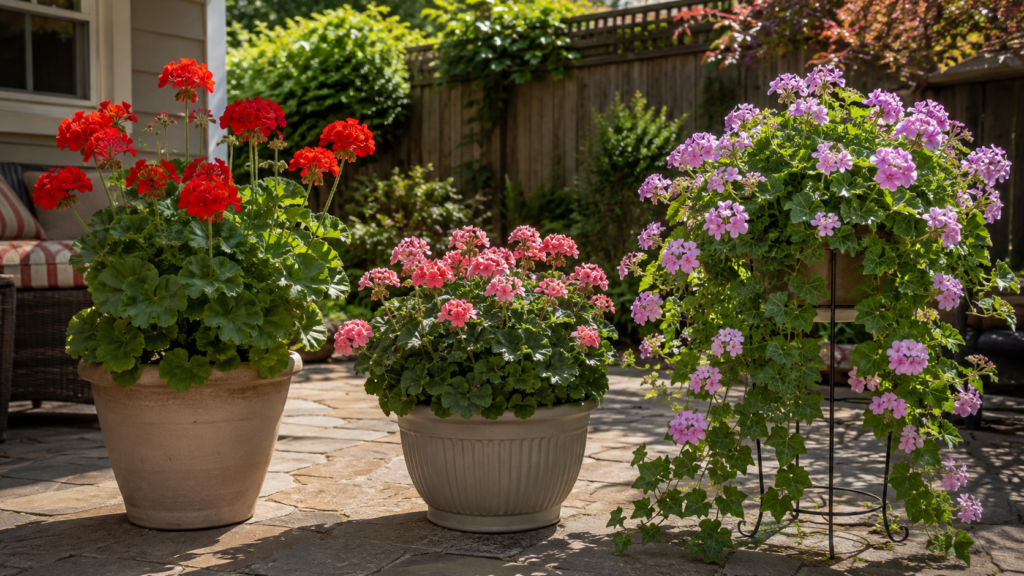
Choose the geranium type before choosing the planter style. Zonal geraniums grow upright and bushy, making them ideal for patio pots, porch containers, and entrance planters. Ivy-leaved Pelargoniums naturally trail, so they work better in baskets, window boxes, and raised containers.
Compact angel Pelargoniums suit smaller containers, while regal Pelargoniums create showier statement displays. Scented-leaved types are especially useful when foliage texture and fragrance matter as much as flowers.
| Geranium type | Growth habit | Best planter use |
|---|---|---|
| Zonal | Upright and bushy | Patio and porch pots |
| Ivy-leaved | Trailing | Baskets and window boxes |
| Angel | Compact | Smaller planters |
| Regal | Upright and showy | Statement containers |
| Scented-leaved | Variable | Patio pots |
The simplest decision is to decide whether you want the mature plant to grow upward, outward, or downward. Choosing the correct natural habit reduces pruning and produces a more convincing finished display.
Best Geranium Planter Ideas
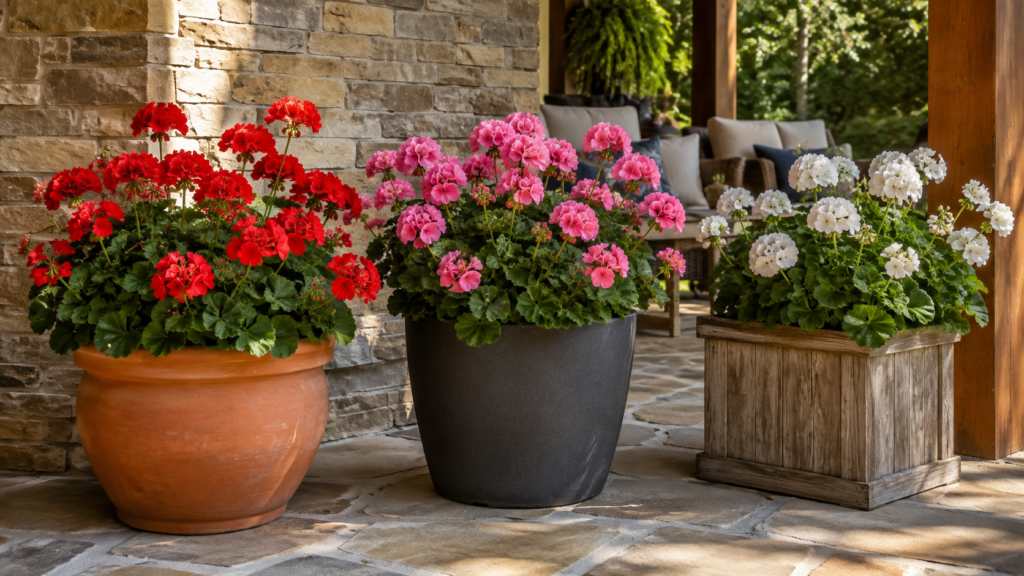
The strongest geranium planter ideas differ by function rather than simply by pot color. A front-door planter needs visibility and stability, a window box must use limited space efficiently, and a hanging basket needs a naturally trailing plant.
Before choosing a design, consider available light, mature canopy size, watering access, floor space, wind exposure, and whether the container will need to be moved seasonally.
1. Classic Terracotta Geranium Planter
A broad terracotta pot filled with red, pink, salmon, or white geraniums creates a timeless patio display. Warm clay suits cottage, Mediterranean, rustic, and traditional gardens.
Terracotta can dry faster than less porous containers, so check moisture more frequently during warm or windy weather.
2. Large Geranium Patio Pot
Use a large freestanding pot where a small container would look lost against broad paving, substantial furniture, or a tall fence.
One dominant geranium color usually creates a stronger focal point than several competing flowers. Avoid putting a very small root ball directly into an enormous container.
3. Geranium and Trailing Plant Planter
Use an upright geranium as the main flowering plant and add one restrained trailing companion around the edge.
Choose a trailer with similar light and moisture needs. Leaving some visible growing mix initially is better than overcrowding the planter for instant fullness.
4. Red Geranium Front Porch Planter
Red geraniums provide strong color around entrance steps and doorways. Use one broad planter for an informal look or matching pots where symmetry suits the house.
Terracotta, charcoal, cream, aged stone, dark green, and natural wood all pair easily with red flowers.
5. Pink Geranium Cottage Planter
Pink geraniums work naturally with weathered terracotta, aged ceramic, and painted wood. Pale flowers or fine green foliage can create a softer cottage-style display.
Keep the arrangement relaxed but allow enough room for plants to mature.
6. White Geranium Modern Planter
White geraniums create clean contrast in charcoal, matte black, gray, or concrete-look containers.
Use a simple planting composition rather than adding many flower colors. This works especially well beside modern paving, dark fencing, and neutral walls.
7. Geranium Window Box
Window boxes provide seasonal color without taking up patio floor space. Compact geraniums create a neat flowering band, while trailing varieties soften the front edge.
Make sure the box is securely mounted, drains freely, and remains easy to reach for watering and maintenance.
8. Trailing Geranium Hanging Basket
Ivy-leaved Pelargoniums are ideal for hanging baskets because their stems naturally cascade over the rim.
Hanging containers often dry more quickly than large ground-level pots, so check them frequently during hot or windy conditions and use a secure support.
9. Rustic Wooden Geranium Planter
Wooden containers soften patios dominated by brick, stone, or concrete. Red, white, pink, and salmon geraniums all work well against timber.
If the wood is only a decorative outer planter, make sure drainage water does not remain trapped around the inner pot.
10. Three-Pot Geranium Grouping
Three individual pots can create more visual depth than one large mixed planter.
Use different heights while repeating one feature such as planter material or flower color. Separate pots also make individual plants easier to move, repot, or replace.
11. Geranium and Foliage Planter
Use foliage to create contrast without introducing too many flower colors.
Chartreuse foliage can brighten a dark container, while deeper green or burgundy leaves make pink, red, and white flowers stand out. Choose foliage plants with compatible growing requirements.
12. Geranium Planter for Small Patios
Small patios usually benefit from fewer, better-positioned containers.
Use compact pots, tall stable planters, hanging baskets, or window boxes to preserve walking space. Repeating one geranium color can also make the area look more organized.
13. Tall Entrance Geranium Planter
Tall planters raise the flowers closer to eye level and work well near steps, railings, and high doorways.
Choose a stable base because a mature geranium canopy can make a narrow lightweight planter top-heavy.
14. Monochromatic Geranium Container
Using one geranium color creates a cleaner and more intentional display than mixing many shades.
Variation can come from foliage texture, planter shape, and different heights. This approach works especially well in contemporary and formal spaces.
15. Mixed-Color Geranium Planter
Red, pink, and white geraniums can create an attractive mixed display when the palette remains controlled.
Use a broad enough planter for the plants to mature without crowding. Repeating one of the colors elsewhere helps connect the container to the wider patio.
Geranium Planter Ideas by Space
Choose the planter according to the location first, then match the geranium type and decorative style.
| Location | Best approach | Geranium style |
|---|---|---|
| Sunny patio | Broad freestanding pot | Upright zonal |
| Small patio | Compact grouped pots | Compact type |
| Window ledge | Window box | Compact or trailing |
| Hanging position | Hanging basket | Ivy-leaved |
| Front entrance | Statement planter | Upright zonal |
| Cottage garden | Terracotta | Pink, red, or white |
| Modern backyard | Charcoal planter | White, red, or pink |
| Fence or wall | Elevated planter | Trailing type |
Use a simple decision sequence:
- Choose the location.
- Check useful light.
- Measure available space.
- Choose upright or trailing growth.
- Consider wind and heat.
- Select planter size and material.
- Choose colors last.
Stand where the planter will actually sit before buying it. Check doors, pathways, furniture, nearby walls, and watering access. A beautiful planter is less useful if it blocks movement or becomes difficult to maintain.
How to Choose a Geranium Planter
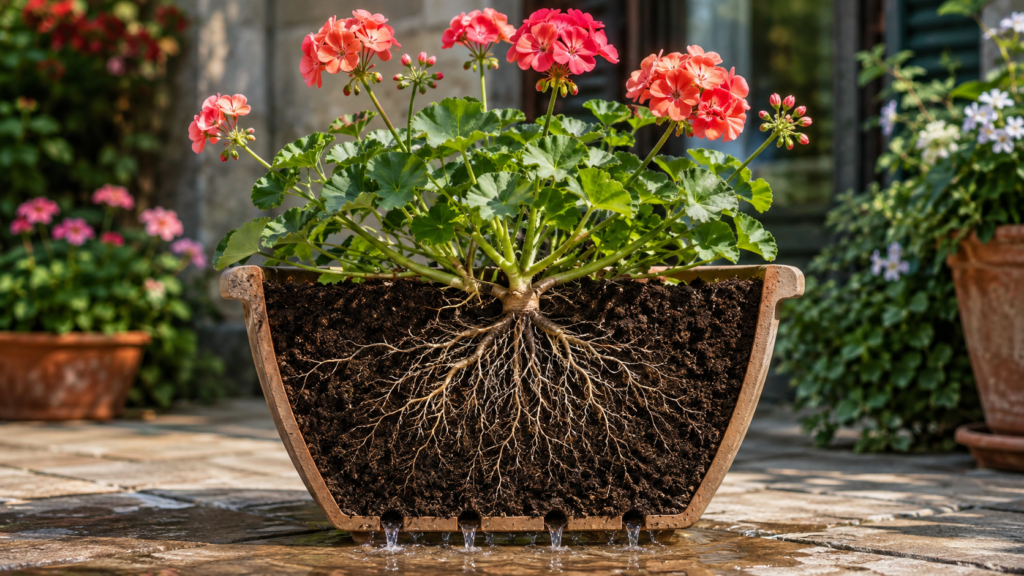
A good geranium planter provides adequate root space, reliable drainage, physical stability, and proportions that suit the mature plant.
How Large Should a Geranium Planter Be?
There is no single ideal size for every geranium. Plant age, root-ball size, cultivar vigor, and whether other plants share the container all matter.
Choose a pot that gives the roots additional space without being unnecessarily oversized.
What Size Pot Should You Move a Geranium Into?
Use these ranges as practical starting points:
| Starting plant | Practical next pot |
|---|---|
| 4-inch nursery pot | About 6–7 inches |
| 6-inch nursery pot | About 8–10 inches |
| Established single geranium | Often around 8–12 inches |
Repot when roots densely fill the container, emerge through drainage holes, or the pot begins drying unusually fast.
How Many Geraniums Should You Put in One Planter?
There is no fixed number.
One mature geranium can fill a modest pot, while a large window box or broad planter can hold several. Judge spacing by mature spread, not by how small the plants look when purchased.
Do Geranium Planters Need Drainage Holes?
Yes. Excess water should be able to escape after watering or rain.
If a decorative planter has no drainage holes, use it as an outer pot around a draining inner container and remove standing water.
A gravel layer is not a substitute for functioning drainage and appropriate potting mix.
Which Planter Material Works Best?
| Material | Main advantage | Main tradeoff |
|---|---|---|
| Terracotta | Classic appearance | Dries faster |
| Glazed ceramic | Decorative and substantial | Heavy |
| Resin/plastic | Lightweight | Can be less stable |
| Wood | Natural appearance | Durability matters |
| Metal | Contemporary | Can heat in strong sun |
| Concrete | Very stable | Difficult to move |
Choose material according to climate, weight, watering habits, and whether the pot must be moved before frost.
How Important Is Planter Stability?
Stability matters most with tall planters, exposed patios, and mature bushy geraniums.
Choose a broad enough base and consider the final weight after adding moist growing mix and the mature plant.
What Color Planter Looks Best?
Terracotta complements warm reds, pinks, salmon, and white. Charcoal creates stronger contrast, while cream and pale neutrals suit softer spaces.
Natural wood works especially well beside decks and fences.
Comparing Geranium Planters
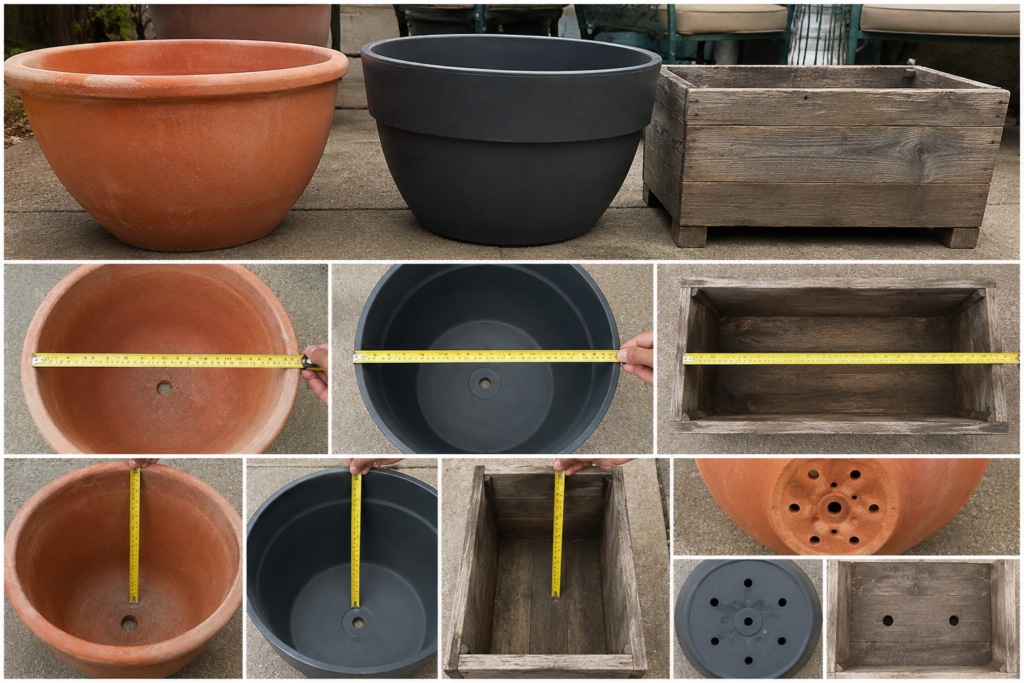
External dimensions do not always show how much usable growing space a planter provides. Thick walls, tapered sides, false bases, and decorative rims can substantially reduce internal dimensions.
When physically comparing planters, record:
- Outside width.
- Internal width.
- Usable depth.
- Drainage-hole number.
- Empty weight.
- Material.
- Base width.
- Stability.
- Ease of moving.
- Approximate soil volume.
Real Geranium Planter Comparison
| Planter | Internal width | Usable depth | Drainage | Stability |
|---|---|---|---|---|
| Terracotta | Add real measurement | Add real measurement | Add real result | Add real result |
| Resin | Add real measurement | Add real measurement | Add real result | Add real result |
| Wooden | Add real measurement | Add real measurement | Add real result | Add real result |
Do not estimate these values. Measure the actual containers.
Use real photographs of the planters together, internal width, usable depth, drainage holes, and the complete planter. This creates stronger first-hand evidence than relying solely on advertised dimensions.
Best Plants With Geraniums
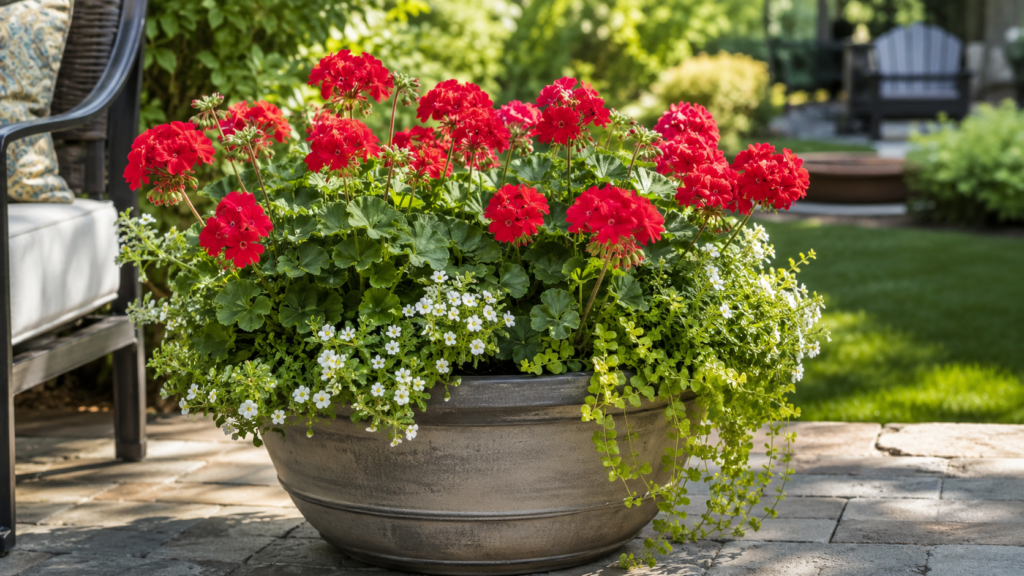
Geraniums can be grown alone or with plants that prefer similar light, moisture, and container conditions.
Useful companions include bacopa, calibrachoa, petunias, verbena, and compatible trailing or foliage plants.
Classic Red Combination
Use red geraniums as the main flowering feature, add small white flowers such as bacopa, and finish with restrained green trailing foliage.
Soft Cottage Combination
Combine pink geraniums with pale flowers or fine green foliage in terracotta, weathered ceramic, or wood.
Contemporary Combination
Pair red, deep pink, or white geraniums with dark or chartreuse foliage in a charcoal or concrete-look planter.
Can Geraniums Be Planted Alone?
Yes. One healthy geranium or several plants of the same variety can create a complete display.
Single-species containers are also easier to water, feed, and troubleshoot.
Best Potting Mix for Geranium Planters
Use a quality container potting mix that retains enough moisture for the roots but still drains freely.
A suitable mix should:
- Drain after watering.
- Stay loose and aerated.
- Resist heavy compaction.
- Retain moderate moisture.
- Wet reasonably evenly.
Avoid filling containers with dense garden soil alone. If a mix remains wet for unusually long periods, an appropriate aeration amendment such as perlite may improve its structure.
The main drainage system should be appropriate potting mix plus clear drainage holes, not a thick gravel layer at the bottom.
Best Place for Geranium Planters
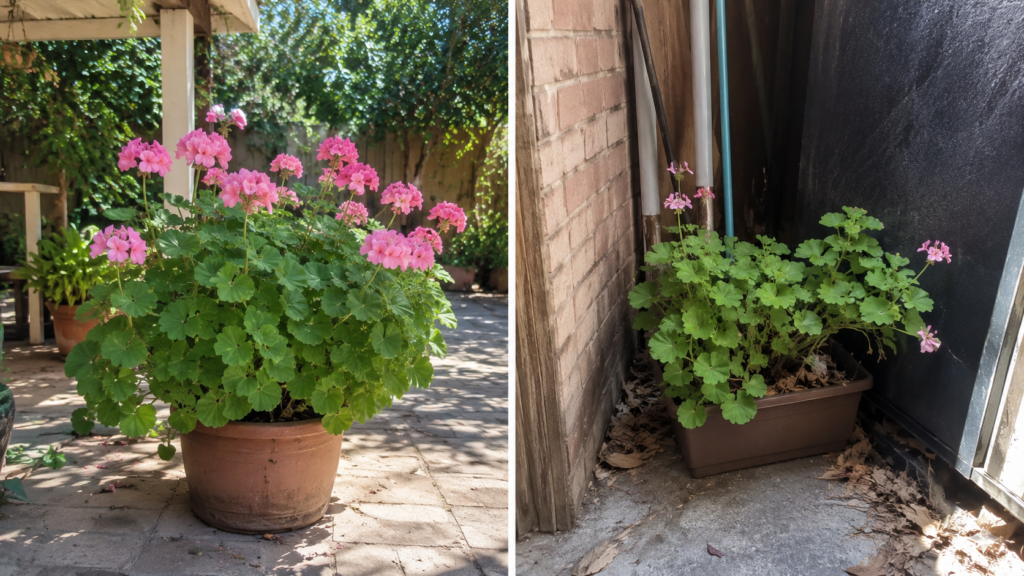
Many common Pelargoniums perform best in bright conditions, but exact exposure depends on climate, heat, cultivar, and the surrounding surfaces.
A sunny position in a mild climate may become excessively hot beside reflective paving or a west-facing wall in a hotter region.
Check:
- Morning and afternoon sun.
- Reflected heat.
- Wind exposure.
- Rain exposure.
- Shade from roofs or trees.
- Ease of watering.
Sunny Patios
Many geraniums work well on bright patios. In very hot locations, monitor moisture and foliage carefully.
Porches
A bright porch can protect flowers while still providing useful light. Deep shade may reduce flowering.
Window Boxes
Compact and trailing geraniums both work well if the box is secure, well drained, and reachable.
Balconies
Consider wind, heat, rapid drying, planter weight, and safe attachment.
How to Keep Geraniums Full
Healthy fullness comes from good growing conditions rather than overcrowding.
Watering
Check the potting mix instead of following a rigid schedule. Water thoroughly when needed and allow excess moisture to drain.
Feeding
Container plants may need feeding during active growth because nutrients are limited to the potting mix. Follow fertilizer directions rather than assuming more fertilizer produces more flowers.
Deadheading
Remove spent flower clusters and declining material to keep the plant tidy.
Preventing Leggy Growth
Evaluate light first. Weak, stretched stems and fewer flowers can indicate that the location is too dark.
Winter Care
Tender Pelargoniums need protection from freezing temperatures. In frost-prone climates, move suitable plants into protected frost-free conditions or treat them as seasonal plants.
Troubleshooting a Struggling Geranium
| Problem | First thing to check |
|---|---|
| Long stems, few flowers | Light |
| Frequent wilting | Rapid drying or root crowding |
| Mix remains wet | Drainage, pot size, growing mix |
| Yellow leaves with wet soil | Root-zone moisture |
| Basket dries very fast | Heat, wind, soil volume |
| Plant tips over | Pot stability |
Diagnose the environment before automatically adding more fertilizer or water.
Geranium Planter Mistakes to Avoid
Avoid:
- Pots without functional drainage.
- Standing water in decorative outer containers.
- Overcrowding plants for instant fullness.
- Oversized pots around very small root balls.
- Companion plants with conflicting water needs.
- Deep shade for light-demanding geraniums.
- Tall lightweight pots in windy positions.
- Ignoring mature canopy size.
- Choosing upright geraniums when trailing growth is required.
Before planting, imagine the container fully grown and freshly watered. It should still be stable, easy to reach, properly drained, and proportionate to the space.
Which Geranium Planter Should You Choose?
Use these shortcuts:
- Easiest: one geranium + well-drained pot.
- Traditional: red or pink + terracotta.
- Modern: white or red + charcoal.
- Small space: compact pot, window box, or basket.
- Trailing: ivy-leaved Pelargonium.
- Cottage: pink geranium + pale companions.
- Entrance: broad stable statement pot.
- Flexible: grouped individual planters.
- Minimalist: one geranium color.
If uncertain, choose the simpler design. A healthy mature geranium in a suitable pot usually looks better than an overcrowded mixed arrangement.
For related inspiration, link naturally to your Patio Planter Ideas, Outdoor Planter Ideas, Terracotta Planter Ideas, Front Porch Planter Ideas, and Plants for Planters guides.
Geranium Planter FAQs
Can Geraniums Grow Well in Planters?
Yes. Geraniums perform well in containers with suitable light, appropriate potting mix, enough root space, and reliable drainage.
What Size Pot Is Best for a Geranium?
An established single geranium often suits an 8–12 inch pot, depending on cultivar and root size. Move smaller plants up gradually.
How Many Geraniums Should You Put in One Planter?
There is no fixed number. One mature geranium can fill a modest pot, while broad containers can hold several when mature spacing is considered.
Do Geranium Planters Need Drainage Holes?
Yes. Drainage holes allow excess water to escape and reduce the risk of persistently wet roots.
What Can You Plant With Geraniums?
Bacopa, calibrachoa, petunias, verbena, and compatible foliage plants can work well when they have similar light and moisture needs.
Which Geranium Is Best for Hanging Baskets?
Ivy-leaved Pelargoniums are ideal because their stems naturally trail over the basket edge.
How Much Sun Do Potted Geraniums Need?
Most common Pelargoniums flower best in bright conditions. Adjust exposure for cultivar, climate, and extreme afternoon heat.
Can Geranium Planters Stay Outside in Winter?
Tender Pelargoniums need protection from freezing temperatures. In frost-prone climates, move them to protected conditions or treat them as seasonal plants.
How We Evaluate Geranium Planters
Useful planter evaluation should consider more than appearance.
Where real comparisons are included, evaluate:
- Internal growing dimensions.
- Drainage construction.
- Empty and filled weight.
- Stability.
- Ease of moving.
- Watering access.
- Fit with the mature plant.
Use directly observed measurements and genuine photographs whenever first-hand testing is claimed.
AI-generated images can illustrate general planter concepts, but they should not be presented as evidence of physical testing or measurement.
Final Thoughts
The best geranium planter ideas combine attractive design with practical growing conditions.
Choose a planter that is properly drained, stable, proportionate, easy to maintain, and suited to the mature geranium’s growth habit.
Terracotta works beautifully in traditional spaces, charcoal containers create modern contrast, and window boxes or hanging baskets make excellent use of small areas.
Beginners do not need elaborate mixed plantings. One healthy geranium in one suitable planter can create a strong display.
Design for the mature plant and real backyard conditions, not simply for how the planter looks on planting day.
Geranium Planter Sources
Reliable horticultural references for the plant-care guidance in this article include:
- Royal Horticultural Society — How to Grow Pelargoniums
- Royal Horticultural Society — Pelargonium Plant Guide
- RHS guidance for trailing and ivy-leaved Pelargoniums
- University of Georgia Extension — Geraniums
- University of Minnesota Extension — Growing Geraniums
- Clemson Cooperative Extension — Annual Geranium
Use these sources for Pelargonium identification, container culture, light, drainage, feeding, growth habit, and frost protection.
Myra is the founder and lead writer of Backyard Planter Ideas, where she shares practical, well-researched guidance on planter design, plant selection, and outdoor styling. Her goal is to help homeowners create attractive, functional garden spaces with clear, reliable, and easy-to-apply advice.