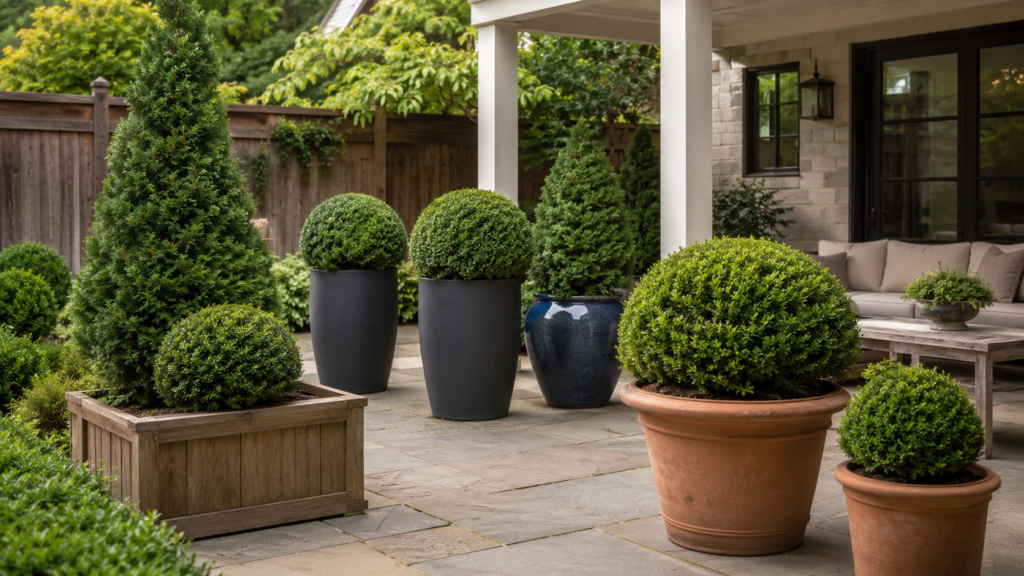
The best boxwood planter ideas combine evergreen structure with a stable, well-drained container sized for the shrub’s roots and mature form. Use boxwood alone for a clean architectural look, pair it with seasonal flowers for color, or repeat matching planters to frame entrances, patios and pathways.
Boxwood works well in outdoor containers because it provides year-round structure. A rounded shrub can anchor a patio, matching boxwoods can frame a front door, and upright topiary can add height without using much floor space.
Success depends on matching the design to the plant. Boxwood needs adequate root space, drainage, suitable potting mix, appropriate light and a cultivar suited to the climate and eventual container size. This guide focuses on living boxwood (Buxus spp.) in outdoor planters.
Which Boxwood Planter Ideas Work Best?
The best design depends on the location, available space, desired formality and maintenance level.
Front entrances usually benefit from symmetry or height, while seating areas often work better with lower forms that preserve sightlines. Exposed patios also need heavier, more stable containers than sheltered courtyards.
Choose according to your priority:
- Formal entrance: matching boxwood planters
- Traditional patio: rounded boxwood in terracotta
- Modern exterior: charcoal or concrete-look planter
- Small patio: naturally compact boxwood
- Vertical interest: upright topiary
- Seasonal color: boxwood with annual flowers
- Lowest maintenance: one boxwood per planter
- Walkway definition: repeated matching containers
Decide what the planter needs to accomplish before deciding how decorative it should be.
What Are the Best Boxwood Planter Ideas?
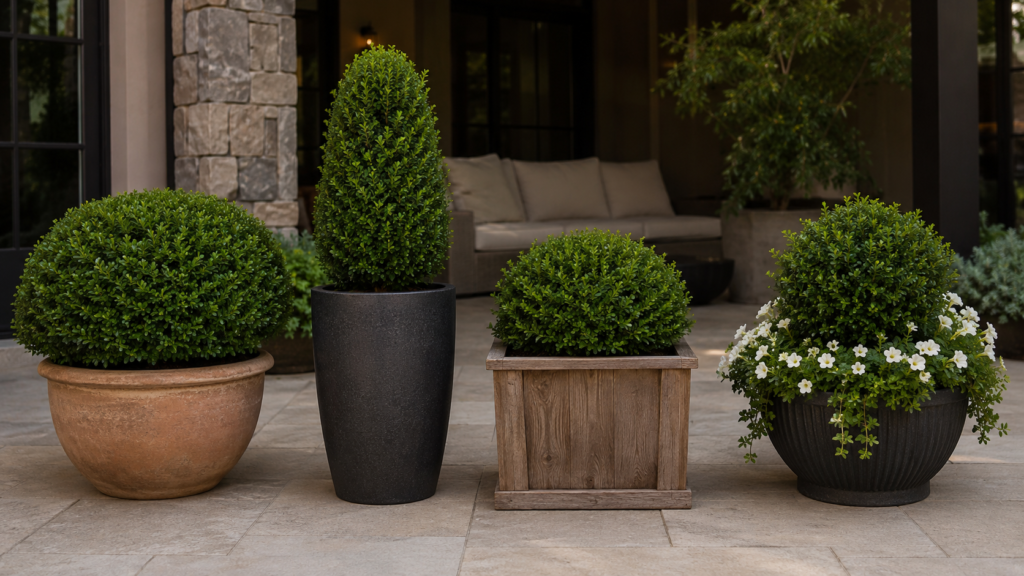
1. Frame a Front Door With Matching Boxwoods
A matching pair creates a strong formal arrangement. Place one planter on either side of the entrance and use similar plant forms, pot sizes and materials.
Rounded boxwoods work beside broad entrances, while cones or narrow topiary forms add height without occupying much walking space.
This works best when both sides receive similar light and weather exposure.
2. Use a Rounded Boxwood in Terracotta
Terracotta and boxwood create a classic combination. Warm clay contrasts with evergreen foliage, while a broad pot balances a clipped globe.
Unglazed terracotta can lose moisture faster than less porous materials, so check the root zone more often during hot or windy weather.
This style suits brick, stone and traditional patios.
3. Put Boxwood Topiary in a Tall Planter
Tall planters suit cones, columns and other upright forms.
Use them beside:
- doors;
- gates;
- stair landings;
- porch columns;
- narrow walls.
Stability matters as much as root space. A tall plant in a narrow lightweight planter can become top-heavy.
4. Grow Boxwood in a Wide Bowl
A low, broad planter keeps sightlines open while adding evergreen structure around seating areas.
Wide bowls work well beside sofas, benches, low walls and steps.
Measure usable internal depth before planting. Decorative bowls can have shallow interiors or raised bases that reduce root space.
5. Surround Boxwood With White Flowers
White flowers brighten dark boxwood foliage without overwhelming its form.
A simple arrangement is:
- boxwood in the center;
- compact flowers around it;
- restrained trailing greenery at the edge.
Choose companions with similar light and moisture needs and leave room to inspect the boxwood base.
6. Change Flowers With the Seasons
Keep the boxwood as the permanent plant and replace smaller companions through the year.
Spring, summer and autumn can each provide different color without disturbing the central shrub.
This works well if you want seasonal change while retaining permanent structure.
7. Use a Rustic Wooden Planter
Wood softens the formal appearance of clipped boxwood.
It suits cottage gardens, timber decks, brick patios and informal backyard spaces.
Use weather-resistant construction and maintain reliable drainage. A draining inner pot can work well inside decorative wooden containers.
8. Group Three Boxwood Planters
A three-container grouping adds depth without one oversized pot.
Use:
- one dominant planter;
- one medium planter;
- one smaller accent.
Repeat the material, color or clipping style so the group feels intentional.
9. Repeat Boxwoods Along a Walkway
Repeated containers can define a path or patio edge without creating a permanent hedge.
Use the same cultivar and similar pots when symmetry matters.
Leave enough space for watering, pruning and airflow.
10. Choose Compact Boxwood for Small Patios
A small patio needs a naturally compact boxwood, not simply a young specimen of a large-growing cultivar.
Look for:
- compact mature width;
- slow growth;
- dense foliage;
- manageable pruning;
- climate suitability.
Always check the mature size of the exact cultivar.
11. Put Boxwood in a Garden Urn
Urns emphasize boxwood’s formal character and work well beside brick steps, classical entrances and traditional pathways.
Rounded shrubs create symmetry, while narrow cones add height.
Check drainage because some decorative urns have limited drainage openings.
12. Use a Charcoal Modern Planter
A charcoal, black or concrete-look planter pairs well with contemporary architecture.
Use a simple clipped boxwood and avoid overcrowding it with companion plants.
The stronger the planter’s form, the simpler the planting can be.
13. Build a Winter Boxwood Planter
Living boxwood already provides evergreen structure for winter displays.
Temporary branches, cones or seed heads can be added around the shrub without replacing it.
Keep access to the soil surface and maintain appropriate moisture and drainage.
14. Create a Foliage-First Planter
Flowers are optional.
Boxwood can be paired with restrained foliage plants in partially shaded spaces.
Use contrasting leaf textures or growth habits without allowing companions to overwhelm the shrub.
15. Let One Boxwood Fill the Planter
A single boxwood is often the strongest long-term option.
It provides:
- more root space;
- easier watering;
- better visibility;
- easier pruning;
- less competition.
For permanent container planting, simplicity often improves both appearance and maintenance.
What Size Planter Does Boxwood Need?
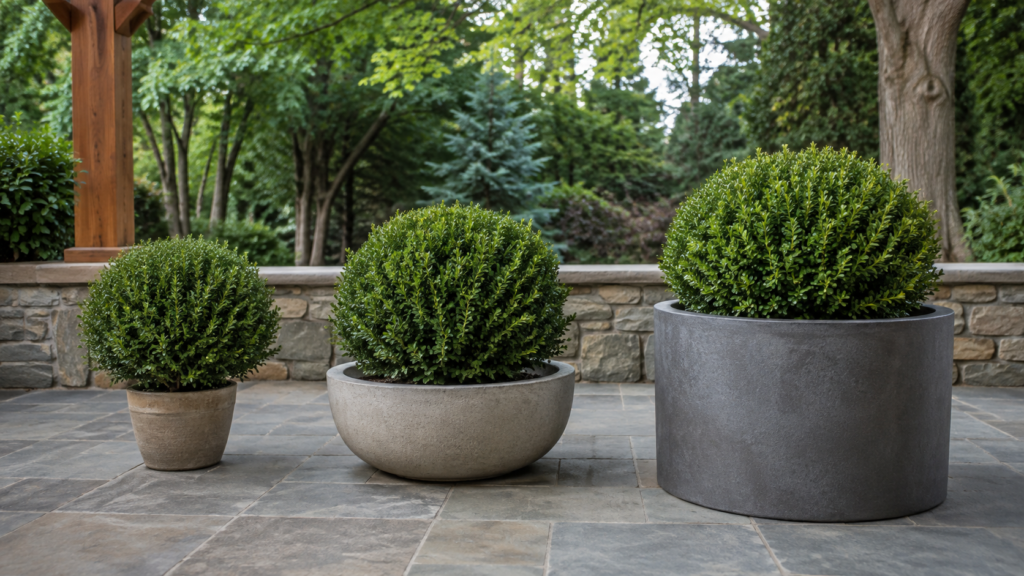
A boxwood planter should fit the current root ball comfortably, provide additional growing room and remain stable as the shrub matures.
There is no single correct diameter. A compact young plant and a mature topiary have different root and stability requirements.
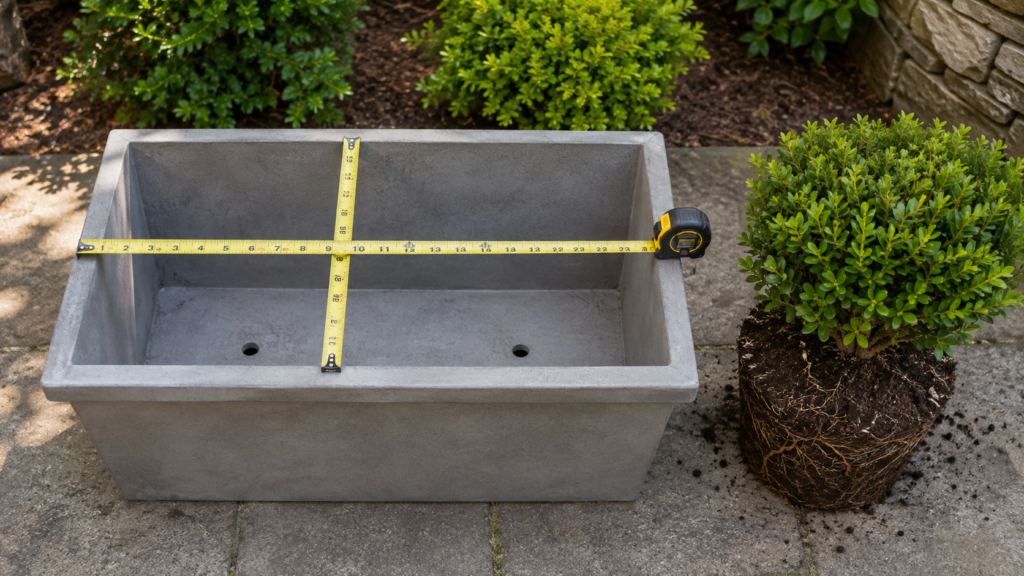
Measure:
- root-ball width;
- root-ball depth;
- planter internal width;
- usable planter depth;
- drainage-hole position.
Do not rely only on external product dimensions. Thick walls, tapered sides and false bottoms can reduce usable volume.
Use This Four-Part Planter Check
Root fit: The root ball fits without compression.
Growth room: Fresh potting mix surrounds the root system.
Stability: The planter supports the plant’s eventual size.
Water balance: The pot is neither cramped nor unnecessarily oversized.
Signs a boxwood may need more root room include circling roots, roots emerging from drainage holes, unusually fast drying or poor stability.
Practical rule: measure the root ball and usable planter interior, not just the exterior pot size.
Which Planter Material Is Best for Boxwood?
No single material is best everywhere. Choose according to climate, watering habits, weight and design.
Terracotta
Best for traditional patios.
Its porous structure can dry faster in warm weather, so moisture needs closer monitoring.
Glazed Ceramic
Best for decorative entrances and sheltered patios.
It offers strong visual impact but can be heavy, and winter durability varies by product.
Resin or Composite
Best where mobility matters.
It is lightweight and available in large modern shapes, although tall topiary may need extra stability.
Wood
Best for rustic or cottage-style spaces.
Use weather-resistant construction and reliable drainage.
Concrete or Stone
Best for permanent placements.
These materials provide excellent stability but are difficult to move once filled.
Whatever the material, prioritize drainage, root space and stability before appearance.
Which Boxwood Is Best for Planters?
Choose a boxwood whose mature size and natural habit match the intended planter.
Naturally compact forms are easier to maintain in smaller containers, while upright selections make better topiary candidates.
Examples include:
- ‘Green Gem’;
- ‘Green Velvet’;
- ‘Winter Gem’;
- Buxus sempervirens ‘Suffruticosa’;
- compact Buxus microphylla selections.
Do not choose by nursery size alone. A young plant can fit perfectly at purchase and later become disproportionate.
For small containers, prioritize compact mature dimensions.
For topiary, choose a plant with enough natural vertical growth.
For global use, confirm cultivar hardiness and disease suitability with reliable local guidance.
How Do You Plant Boxwood in a Planter?
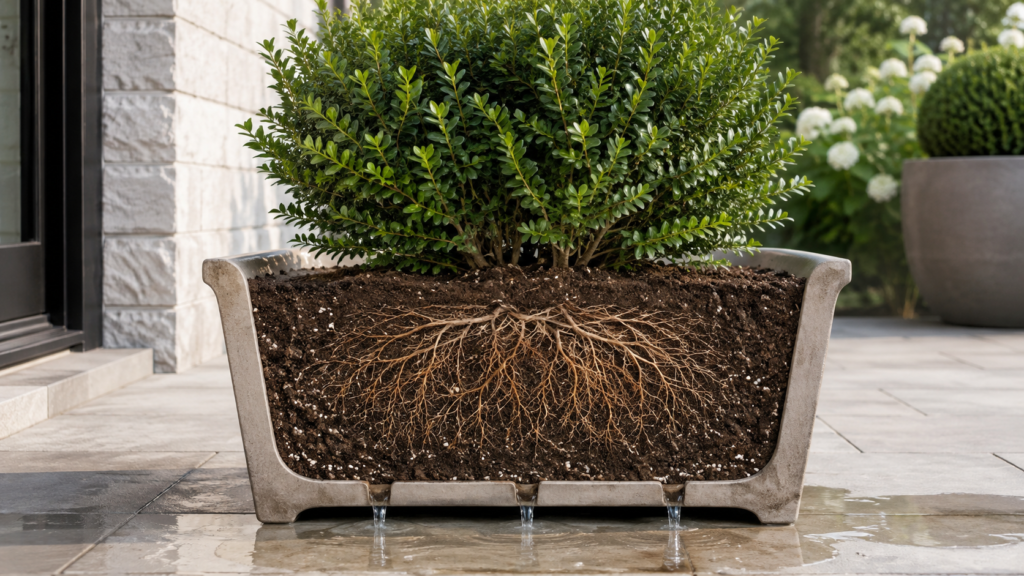
Plant boxwood at approximately the same depth it was already growing and use a container with working drainage holes.
1. Check Drainage
Confirm that water can escape once the planter is in its final position.
2. Skip the Gravel Layer
Do not place gravel beneath the potting mix to improve drainage.
Use suitable growing medium and unobstructed drainage holes instead.
3. Inspect the Root Ball
Look for:
- circling roots;
- damaged roots;
- severe root matting;
- overly dry or saturated mix.
4. Set the Correct Depth
Keep the existing soil surface close to its previous level.
Do not bury lower woody stems simply because the planter is deep.
5. Backfill
Add potting mix around the root ball without compressing it heavily.
Leave space below the rim for watering.
6. Water Thoroughly
Moisten the complete root zone and confirm that surplus water exits through the base.
Check again after the mix settles.
What Potting Mix Is Best for Boxwood?
Use an outdoor container mix that retains useful moisture while draining freely.
A good growing medium should:
- drain after thorough watering;
- retain some moisture;
- maintain air around roots;
- resist heavy compaction;
- remain suitable for woody plants.
Avoid dense garden soil used alone.
Focus on how the growing medium performs rather than following one rigid global recipe.
Does Potted Boxwood Need Sun or Shade?
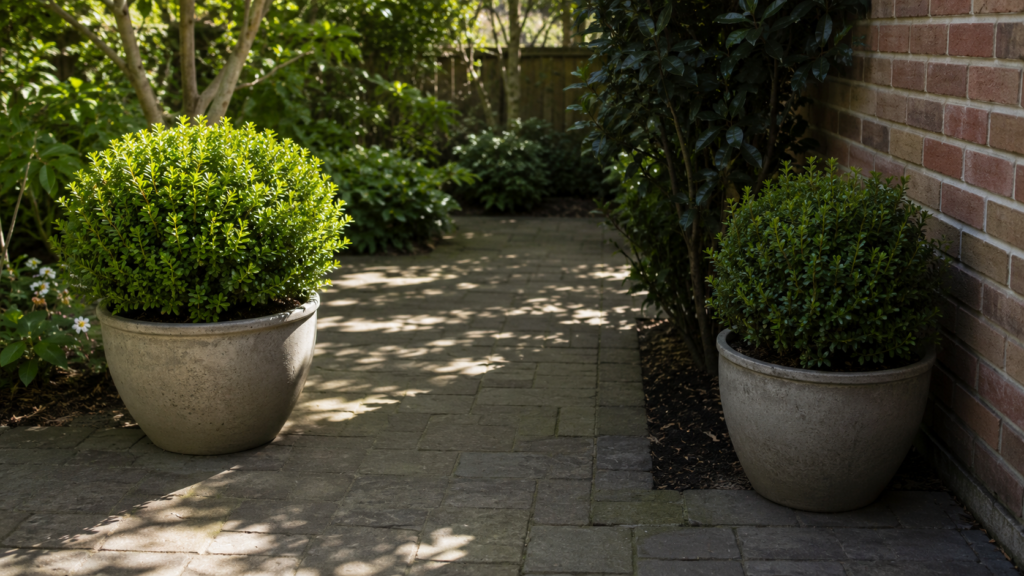
Boxwood can grow in sun or shade, but the best exposure depends on cultivar, climate and microclimate.
Full Sun
Can work where the cultivar is suitable, watering can be monitored and reflected heat is not excessive.
Bright Partial Shade
Often practical in hot locations because it reduces intense afternoon heat while providing useful light.
Heavy Shade
Boxwood tolerates shade, but a dark, cramped corner with little airflow is different from open shade.
Consider light, heat, airflow, wind and moisture loss together.
How Does Climate Affect Boxwood Planters?
Climate changes the most suitable cultivar, planter, exposure and watering strategy.
| Climate | Main concern | Priority |
|---|---|---|
| Cold winter | Root freezing, winter burn | Shelter and hardy cultivar |
| Hot and dry | Rapid moisture loss | Root volume and heat protection |
| Hot and humid | Disease pressure | Drainage and airflow |
| Mild and wet | Saturated roots | Free drainage |
| Windy | Drying and tipping | Heavy, stable planter |
Cold climates require more attention to exposed container roots.
Hot-dry climates require closer moisture monitoring.
Humid or wet climates increase the importance of airflow and drainage.
How Often Should You Water Potted Boxwood?
Water according to actual root-zone moisture rather than a fixed schedule.
Water demand changes with:
- temperature;
- sunlight;
- wind;
- planter material;
- container size;
- rainfall.
Check below the surface before watering.
When irrigation is needed, wet the complete root zone and allow surplus water to drain.
Recently repotted plants need closer attention because the original root ball can dry differently from the new potting mix.
Do not water because it is Tuesday. Water because the root zone needs it.
Does Potted Boxwood Need Fertilizer?
Boxwood may need supplemental nutrients over time, but more fertilizer is not automatically better.
Before feeding a struggling plant, check:
- drainage;
- moisture;
- root condition;
- pests;
- disease;
- winter damage.
Yellow or brown foliage is not automatically a nutrient deficiency.
Aim for steady, healthy growth rather than excessive soft growth.
What Flowers Grow Well With Boxwood?
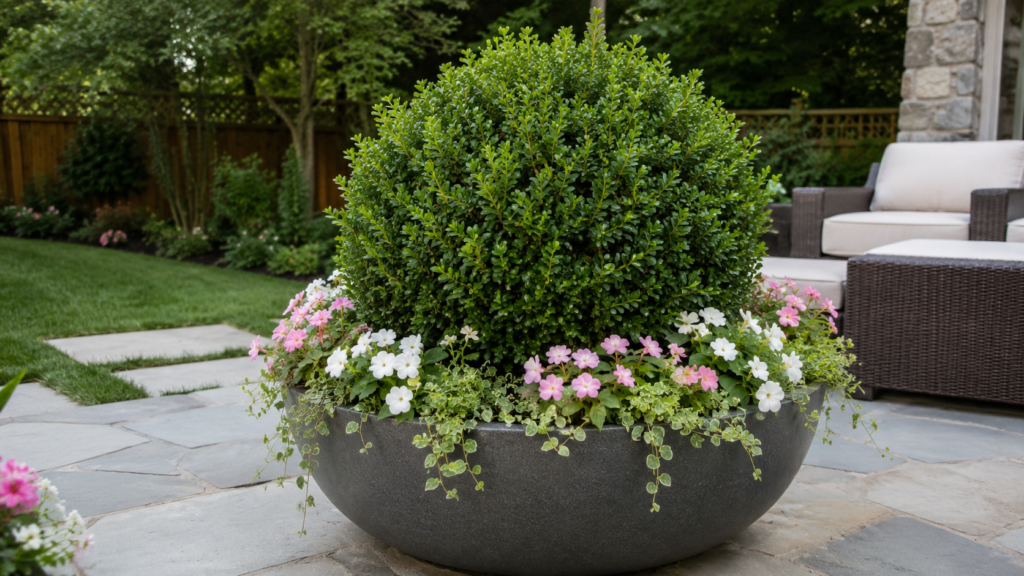
Flowers can share a large container with boxwood when their light, moisture and root-space requirements are compatible.
Use this hierarchy:
Boxwood = structure
Flowers = seasonal color
Trailing plants = edge softness
White flowers create clean contrast.
Pink flowers soften the formal look.
Purple flowers provide deeper contrast.
Foliage plants work well where shade limits flowering.
Avoid overcrowding. Companion plants can compete for moisture, hide the boxwood base and reduce airflow.
How Do You Prune Potted Boxwood?
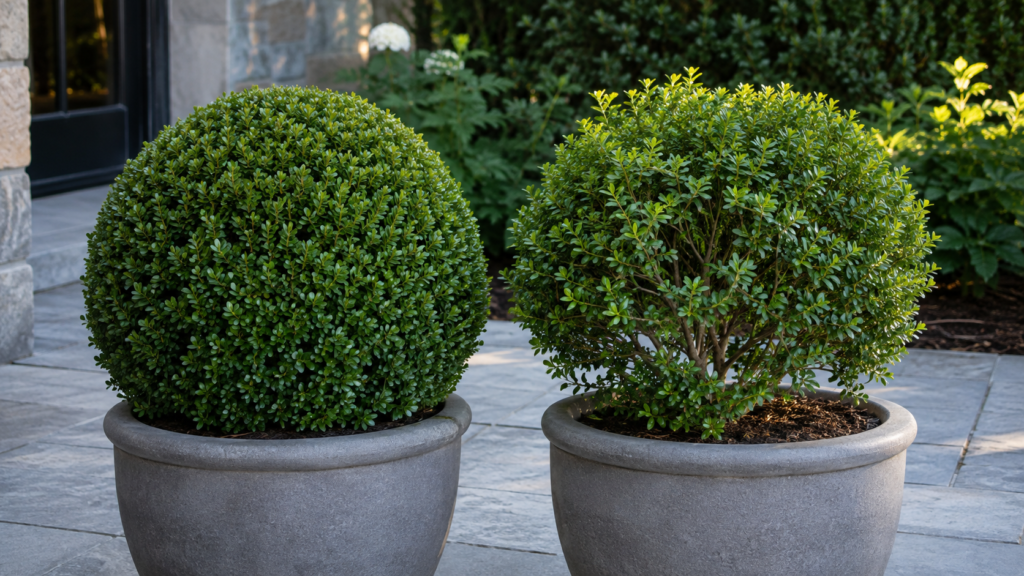
Use light shaping to maintain form and selective thinning to keep the interior from becoming too dense.
Shaping
Useful for globes, cones, columns and matching entrance plants.
Thinning
Useful for improving airflow, bringing light into the center and removing damaged stems.
Repeatedly shearing only the exterior can create a dense outer shell.
Keep pruning tools clean, especially when working on several boxwoods.
If constant aggressive pruning is required simply to make the plant fit, reconsider the cultivar or location.
Can Boxwood Stay in Planters Over Winter?
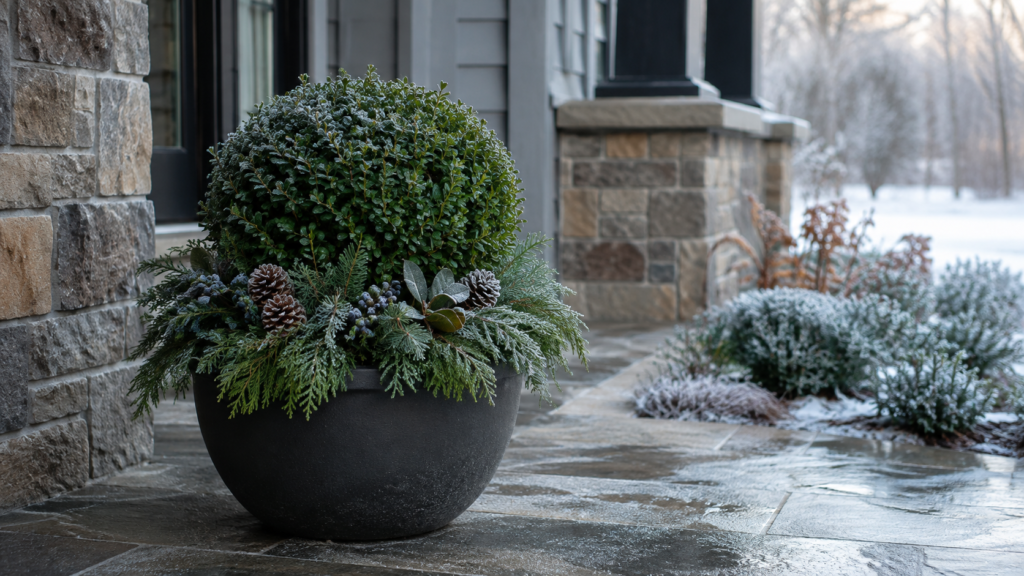
Yes, where the cultivar and climate are suitable.
Above-ground roots are more exposed to temperature changes than roots in garden soil.
Consider:
- cultivar hardiness;
- winter wind;
- winter sun;
- root moisture;
- planter material;
- drainage.
In colder regions, shelter from severe drying wind can help.
Make sure the planter itself is suitable for freeze-thaw conditions.
What Problems Affect Potted Boxwood?
Container boxwood can suffer from environmental stress, root problems, pests and disease.
Box Blight
Possible signs include:
- brown foliage;
- bare patches;
- leaf drop;
- stem lesions.
Box Tree Moth
In affected regions, watch for:
- chewed foliage;
- webbing;
- caterpillars;
- defoliation.
Check current local plant-health guidance because pest distribution can change.
Root Stress
Look for blocked drainage, standing water, severely dry potting mix or congested roots.
Winter Injury
Brown or bronzed foliage can result from winter sun, drying wind or root exposure rather than disease.
Diagnose the cause before applying treatment.
Why Is My Potted Boxwood Turning Brown?
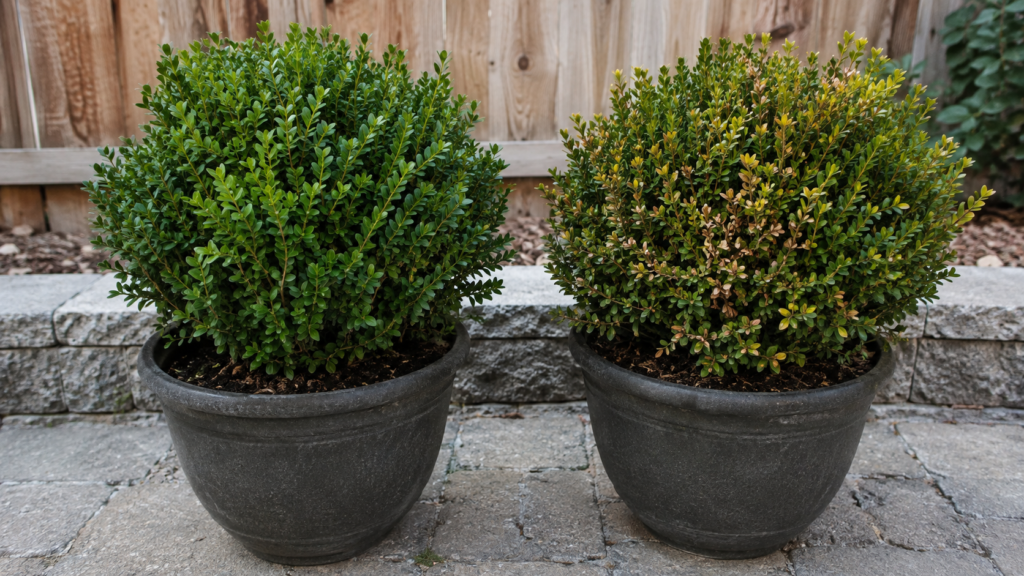
Brown foliage is a symptom, not a diagnosis.
Is the Root Ball Dry?
Look for dry mix, crisp foliage and recent heat or wind.
Is the Planter Staying Wet?
Check blocked holes, standing water and saturated growing medium.
Did Browning Follow Winter?
Consider winter sun, drying wind or cold-related root stress.
Are Leaves Dropping or Spotted?
Inspect for disease symptoms.
Is There Webbing or Chewing?
Look for insect feeding.
Is the Interior Bare?
Repeated shearing may have shaded the center.
Make one diagnosis-led correction at a time instead of watering, fertilizing, pruning and spraying simultaneously.
What Should You Check Before Buying a Boxwood Planter?
Measure both the root ball and usable planter interior before purchasing.
Check:
- internal width;
- usable depth;
- drainage holes;
- root-ball dimensions;
- stability;
- material;
- final filled weight;
- intended location.
What Boxwood Planter Mistakes Should You Avoid?
Common mistakes include:
Choosing a Pot That Is Too Small
This can create rapid drying, limited root room and poor stability.
Choosing an Unnecessarily Huge Pot
Provide useful growth room without creating excessive unused growing-medium volume.
Adding Gravel for Drainage
Use working drainage holes and suitable potting mix instead.
Blocking Drainage Holes
Check saucers, flat surfaces and decorative outer containers.
Overcrowding Flowers
Too many companions increase competition and reduce airflow.
Ignoring Mature Cultivar Size
Buy for the eventual plant, not only the nursery specimen.
Constant Heavy Shearing
Use selective thinning as well as shaping.
Treating Symptoms Without Diagnosis
Brown foliage does not always need more water, and yellow foliage does not always need fertilizer.
Are Boxwood Planter Ideas Worth It?
Yes, when you want long-term evergreen structure and local conditions suit boxwood.
Advantages include:
- year-round foliage;
- entrance symmetry;
- compatibility with many planter styles;
- seasonal companion planting;
- clipping into controlled forms.
The tradeoff is ongoing care.
Expect to manage moisture, pruning, roots, winter exposure, pests and eventual repotting.
Boxwood planters suit gardeners who value permanent structure and are comfortable with long-term container maintenance.
FAQs About Boxwood Planter Ideas
Can Boxwood Grow Permanently in a Planter?
Yes. Boxwood can grow long term when it has sufficient root space, drainage, suitable growing medium and appropriate climate conditions.
What Size Planter Does Boxwood Need?
Choose a planter larger than the current root ball with useful room for growth. Measure internal dimensions rather than exterior size alone.
How Deep Should a Planter Be for Boxwood?
It should contain the full root ball at its existing planting depth while leaving room for potting mix and watering space.
Do Boxwood Planters Need Drainage Holes?
Yes. Excess rain and irrigation water need a clear route out of the root zone.
Should You Put Rocks Under Boxwood?
No. Use suitable potting mix and unobstructed drainage holes instead.
What Potting Mix Is Best for Boxwood?
Use an outdoor container mix that holds moisture while draining freely and maintaining air around the roots.
Does Boxwood Prefer Sun or Shade?
Boxwood tolerates both depending on cultivar and climate. Also consider heat, airflow and moisture loss.
How Often Should You Water Potted Boxwood?
Water according to actual root-zone moisture rather than a fixed schedule.
Can Boxwood Stay in Pots All Year?
Yes in suitable climates, although winter root exposure needs extra attention in colder regions.
Why Is My Potted Boxwood Turning Brown?
Possible causes include drought, excess moisture, root stress, winter injury, pests and disease.
Can You Plant Flowers Around Boxwood?
Yes. Choose compatible companions and leave enough root space for the permanent shrub.
What Boxwood Is Best for a Planter?
Choose a cultivar whose mature size, growth habit and climate tolerance match the container.
What Makes a Boxwood Planter Successful?
A successful boxwood planter combines the right plant with the right root environment.
Use this order:
- Choose a climate-suitable boxwood.
- Check its mature size.
- Measure the root ball.
- Measure the planter internally.
- Confirm usable depth.
- Check drainage.
- Evaluate stability.
- Choose the location.
- Plant at the correct depth.
- Establish consistent moisture.
- Add companions only where space remains.
- Prune for shape and airflow.
- Monitor pests, disease and winter stress.
The simplest formula is:
Right boxwood → right planter → right root environment → right location → compatible styling → long-term maintenance.
Design the planter from the roots outward.
Myra is the founder and lead writer of Backyard Planter Ideas, where she shares practical, well-researched guidance on planter design, plant selection, and outdoor styling. Her goal is to help homeowners create attractive, functional garden spaces with clear, reliable, and easy-to-apply advice.