
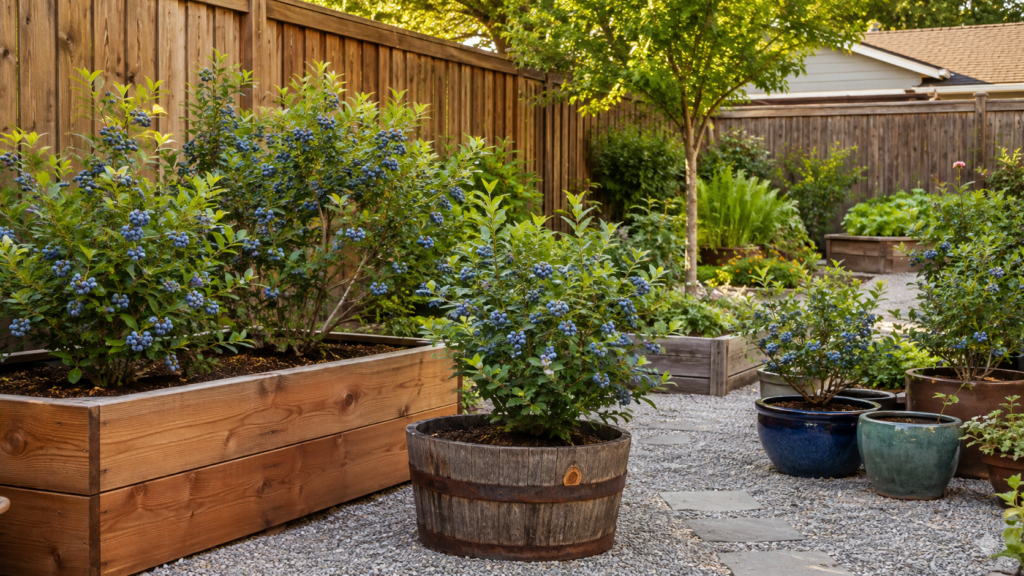
The best blueberry planter ideas combine a wide, stable container with acidic growing media, reliable drainage, consistent moisture, and enough soil volume for a mature shrub. Half-barrels, wooden boxes, large patio pots, and raised beds can all grow blueberries successfully when the planter suits the cultivar, climate, and available space.
Blueberries are especially useful container plants because a planter lets you control the root environment. This is valuable when backyard soil is alkaline, compacted, poorly drained, or otherwise unsuitable. Blueberries generally prefer acidic growing conditions around pH 4.5–5.5, and their relatively shallow root systems make planter width, moisture stability, and mulch particularly important.
The right planter therefore needs to do more than look attractive. It should provide a long-term growing environment that supports healthy roots, reliable fruiting, easy watering, and comfortable harvesting.
10 Best Blueberry Planter Ideas
Choose the planter according to the mature blueberry, not the size of the young nursery plant. One mature bush usually works best in a substantial individual container, while several bushes are easier to manage in coordinated pots or a dedicated raised bed.
1. Wide Half-Barrel Blueberry Planter
A half-barrel is one of the most practical choices for a mature blueberry because it naturally provides a broad root zone and good soil volume.
It works especially well:
- beside patios
- near vegetable beds
- along wooden fences
- in cottage gardens
- within edible landscapes
Make sure several drainage holes are open at the base. If the barrel rests on paving, raise it slightly so water can escape.
The broad shape is more useful than a very tall narrow container because blueberry roots benefit from lateral growing space.
2. Square Wooden Blueberry Planter
A large square wooden planter gives blueberries useful width while fitting naturally into modern or traditional backyard designs.
Cedar or another durable exterior-grade wood works especially well beside:
- raised garden beds
- timber fences
- gravel paths
- decks
- garden benches
Straight-sided wooden boxes can also provide more usable soil volume than strongly tapered decorative pots.
Because blueberry soil remains consistently moist, long-term durability matters. Choose outdoor-rated timber and sturdy construction rather than a lightweight decorative box intended for temporary planting.
3. Two Matching Blueberry Patio Pots
Two matching large containers are an excellent choice when you want two compatible blueberry cultivars.
Keeping one shrub in each pot provides:
- separate root zones
- easier watering
- easier pH management
- less root competition
- cleaner patio symmetry
- opportunities for cross-pollination
Choose cultivars that flower at overlapping times and suit the local climate.
The plants do not need to share a container to benefit from pollinating insects moving between their flowers.
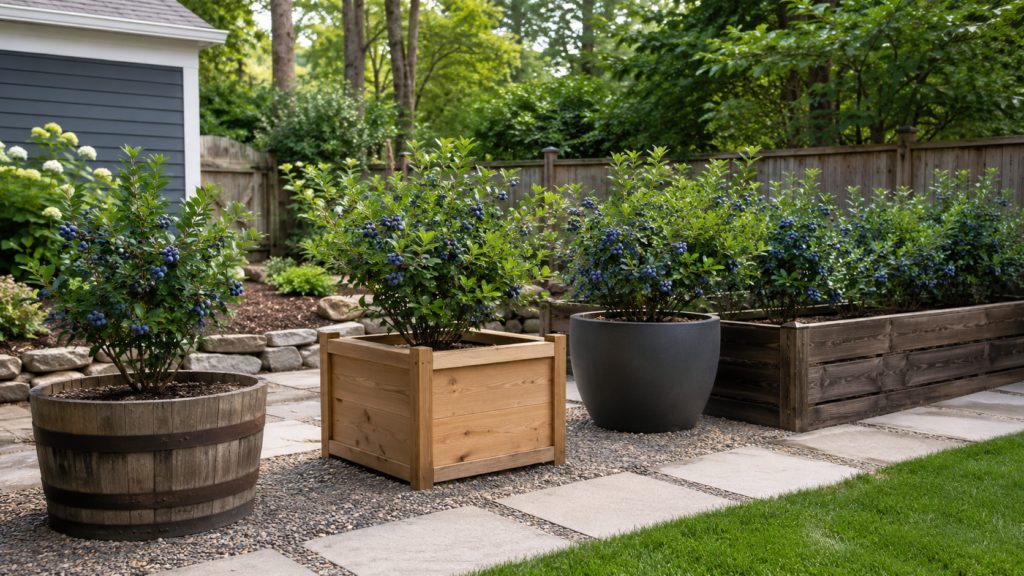
4. Raised Blueberry Planter Bed
A long raised bed is one of the best blueberry planter ideas for several bushes.
It creates one controlled acidic root zone where you can manage:
- soil pH
- drainage
- irrigation
- mulch
- spacing
- pollination
- bird protection
Raised beds are especially useful when surrounding soil is alkaline or difficult to improve.
Because blueberry roots are relatively shallow, prioritize useful width rather than unnecessary depth. A broad bed with comfortable access in front is usually more practical than a very tall narrow structure.
5. Modern Resin or Composite Planter
Large resin and composite containers work well on contemporary patios where rustic wooden barrels do not fit the design.
Their advantages include:
- clean finishes
- good weather resistance
- relatively low empty weight
- useful moisture retention
- many large sizes
Check the inside carefully before buying. Some tall planters contain false bottoms or raised internal floors that significantly reduce usable root volume.
Judge the planter by its internal dimensions, not just its exterior height.
6. Compact Blueberry Planter for Small Yards
A small backyard does not mean a blueberry should grow in a tiny pot.
Instead, choose a compact or half-high cultivar and give it a properly sized container.
Useful locations include:
- sunny fence lines
- patio corners
- beside compact vegetable beds
- along garden paths
Leave enough room to reach the plant for watering, pruning, and harvesting.
The correct small-space strategy is smaller cultivar + adequate planter, not large cultivar + undersized pot.
7. Blueberry Planters Along a Fence
Several matching containers can turn a sunny fence into an organized edible planting area.
Repeating one planter material creates visual consistency even when different blueberry cultivars are used.
Before positioning the pots permanently, observe the fence throughout the day. A boundary that looks sunny at midday may cast significant morning or afternoon shade.
Also leave enough room behind and between containers for airflow and maintenance.
8. Blueberry Planter Beside a Patio
Blueberries can function as ornamental shrubs as well as fruit plants.
They provide:
- spring flowers
- green foliage
- colorful berries
- woody structure
- seasonal leaf color
A substantial decorative planter beside a seating area can therefore become part of the landscape rather than looking like temporary food production.
Keep mature canopy size in mind so branches do not eventually block furniture, doors, or walking paths.
9. Mobile Blueberry Planter
A mobile planter is useful where winter exposure, wind, or intense summer heat makes seasonal movement beneficial.
Use a heavy-duty wheeled platform before filling the container.
A large planter filled with moist growing media can become extremely heavy, so mobility needs to be designed into the setup from the beginning.
Move the container only when there is a clear seasonal reason, rather than constantly repositioning it.
10. Dedicated Blueberry Planter Corner
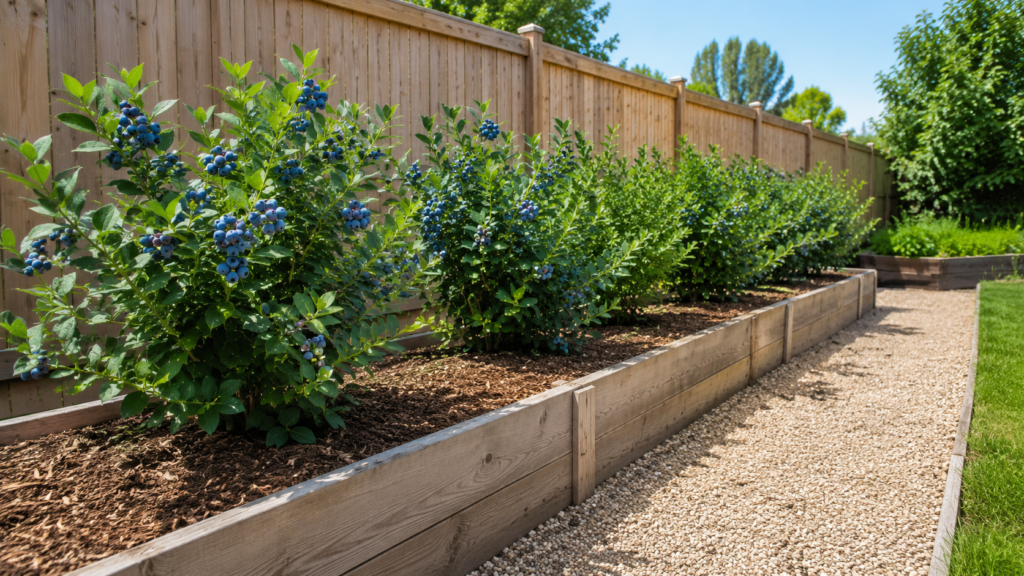
Grouping several containers together creates a practical backyard blueberry garden.
A good layout may include:
- two to four large planters
- compatible cultivars
- gravel or paved paths
- irrigation access
- mulch
- room for bird protection
Grouping plants simplifies watering, harvesting, pH checks, and pollination planning.
It also creates a stronger landscape feature than scattering unrelated pots throughout the yard.
What Size Blueberry Planter Do You Need?
For a mature highbush blueberry, approximately 24 inches (61 cm) deep and 24–30 inches (61–76 cm) wide is a useful planning benchmark. Compact cultivars may require less space, while vigorous plants can benefit from larger containers.
Container capacity matters, but shape matters too. Approximately 15–20 US gallons (57–76 L) can provide a useful reference range for substantial blueberry containers, depending on cultivar and growing conditions.
When comparing planters, check:
- internal width
- usable soil depth
- total soil volume
- base width
- taper
- false bottoms
- drainage openings
A tall container is not automatically a large root zone.
For example, a planter that is 36 inches tall but only 14 inches wide may provide less useful blueberry root space than a planter 24 inches deep and 28 inches wide.
Young blueberries can start in smaller containers and be repotted as they grow. However, do not keep an established shrub permanently confined simply because it still fits visually inside the pot.
Why Does Planter Width Matter?
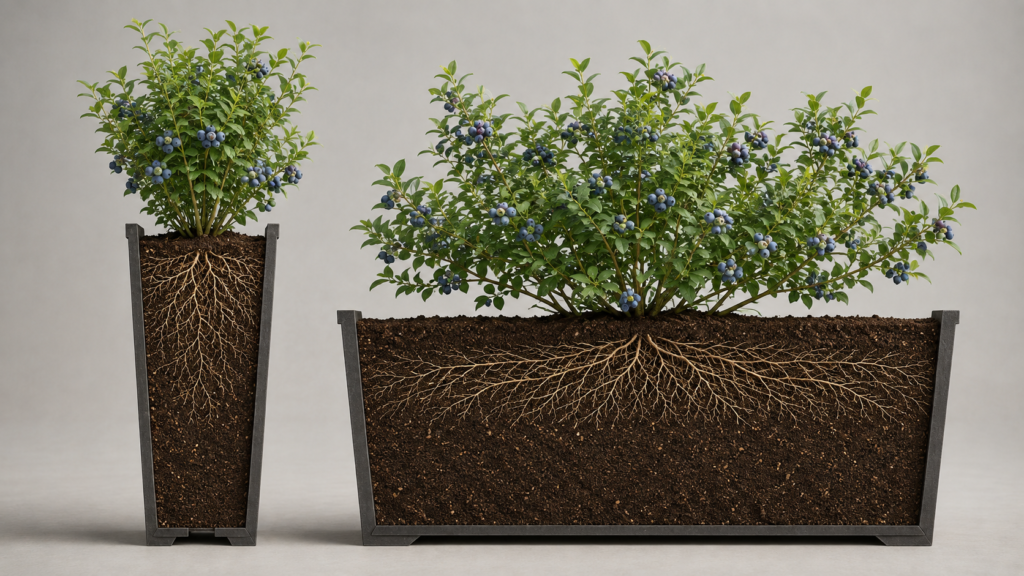
Blueberries have relatively shallow, fibrous roots, so broad usable soil space is especially important.
Much of the root system occupies the upper soil profile instead of extending through one deep taproot.
A wider planter can provide:
- more lateral root space
- greater soil volume
- better moisture buffering
- more surface area for mulch
- greater stability
- easier irrigation
This is why extremely tall, narrow decorative pots are often less practical than moderately deep, broad containers.
Once adequate depth is available, additional width usually contributes more useful growing space than extra unnecessary height.
This root pattern also explains why surface conditions matter so much. Mulch, consistent moisture, soil aeration, and proper watering all affect the active root zone close to the top of the planter.
Which Blueberry Planter Material Is Best?
No single material is best for every garden. Choose a planter that is durable outdoors, large enough internally, stable when filled, and appropriate for the climate.
Wood
Wooden planters look natural and coordinate easily with fences and raised beds.
They are also easy to modify for additional drainage.
The main disadvantage is gradual decay from long-term contact with moist growing media.
Resin or Plastic
Large resin containers are lighter when empty and usually retain moisture better than porous terracotta.
Check for false bottoms and ensure drainage is adequate.
Very dark containers can also absorb significant heat in exposed sunny locations.
Composite
Composite planters can provide strong durability and a modern appearance.
Their internal construction varies, so confirm the actual growing depth before buying.
Terracotta
Terracotta is attractive but porous and may dry faster during hot weather.
Large pots can also become extremely heavy and may crack during freezing conditions unless designed for cold climates.
Masonry or Stone-Look Containers
These provide excellent stability but are difficult to move once planted.
Consider heat exposure before positioning dark masonry planters against sunny walls.
What Soil Is Best for Blueberry Planters?
Use an acidic, moisture-retentive but freely draining growing medium intended for blueberries or other acid-loving plants.
Blueberries generally prefer approximately pH 4.5–5.5.
The growing medium needs to provide three conditions at once:
- acidic pH
- moisture retention
- air around the roots
In the UK and some other regions, appropriate products are commonly sold as ericaceous compost. In the United States, labels may say acid-loving potting mix or blueberry container mix.
Avoid filling the planter mainly with ordinary backyard soil. Heavy garden soil can compact in containers, drain poorly, and may have an unsuitable pH.
General-purpose potting mix should only be used when its formulation is appropriate for acid-loving plants. Some mixes contain lime, which raises pH.
Do not assume dark, rich-looking soil is automatically suitable for blueberries. Check the product specifications whenever possible.
How Much Drainage Do Blueberry Planters Need?
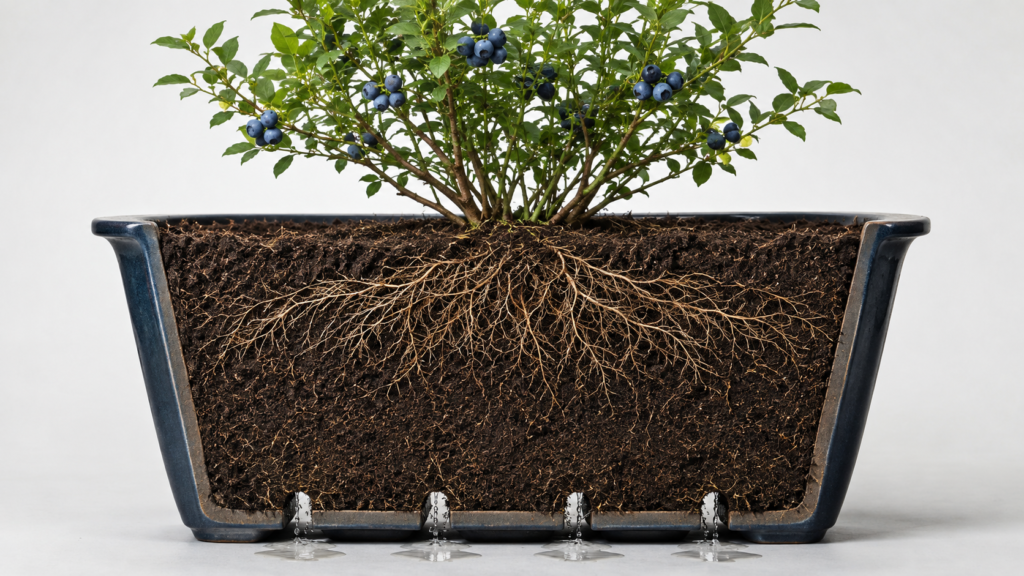
Blueberry planters need enough drainage to release excess water while keeping the root zone consistently moist.
Use several unobstructed drainage openings rather than relying on one tiny hole.
Good drainage requires:
suitable growing medium → open drainage holes → somewhere for the water to exit
Check that the planter is not sitting so flat against paving that the drainage holes become blocked.
Should you put gravel at the bottom?
No gravel layer is necessary when the planter has proper drainage and suitable growing media.
A thick stone layer:
- reduces useful soil volume
- adds weight
- does not replace drainage holes
Use decorative gravel around the planter for paths or edging instead.
The inside of the container should prioritize growing media and root space.
Where Should You Place Blueberry Planters?
Choose a sunny position with convenient water access, good drainage, and enough room for the mature shrub.
Before filling a large planter, check:
- morning sunlight
- afternoon sunlight
- fence shadows
- reflected heat
- wind exposure
- roof runoff
- hose access
- walking space
Blueberries generally fruit best in full sun.
In very hot climates, containers near heat-reflective walls or paving may require more careful moisture management.
Patios
Patios work well because watering and harvesting are convenient.
Keep the planter away from narrow walking routes where the mature canopy could become an obstruction.
Balconies
Blueberries can also grow on balconies, especially compact cultivars.
Consider:
- container weight
- structural load
- sunlight
- wind
- drainage
- winter exposure
Use a genuinely compact cultivar rather than trying to restrict a large blueberry in a very small pot.
Do Blueberry Planters Need Two Plants?
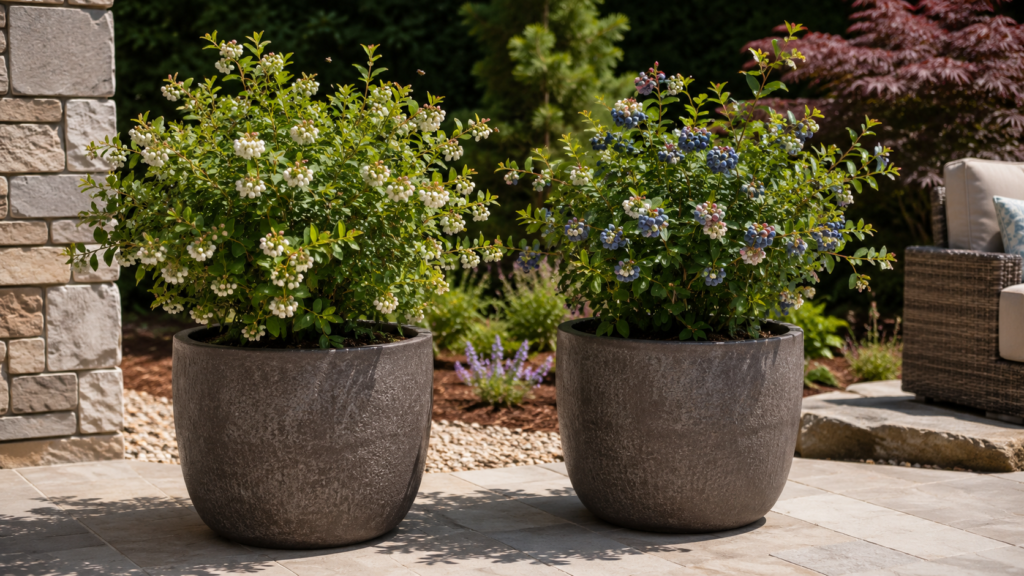
Not every blueberry requires a second plant, but compatible cultivars can improve pollination and fruit performance.
If space allows, two different cultivars with overlapping flowering periods are often a useful strategy.
Choose varieties according to:
- climate
- flowering period
- chill requirements
- mature size
- pollination compatibility
Two bushes do not need to grow in the same planter.
In fact, separate containers are usually easier because each plant receives its own root zone.
Two blueberries should share one planter only when the container is large enough to function like a true raised bed.
How Does Climate Affect Blueberry Planters?
Container design should reflect the main environmental stress in your climate.
Cold climates
Container roots are more exposed to low temperatures than roots protected by surrounding ground.
Consider:
- cold-hardy cultivars
- larger containers
- sheltered positions
- insulation
- seasonal relocation where practical
Hot climates
Small pots can dry and heat rapidly.
Prioritize:
- generous soil volume
- mulch
- regular moisture checks
- protection from extreme reflected heat
Wet climates
Make drainage the priority and avoid positions where water collects beneath the planter.
Windy climates
Use broad, stable containers rather than tall narrow pots that may become top-heavy.
Always choose the blueberry cultivar for the climate first and then select the planter.
How Do You Water and Mulch Blueberry Planters?
Keep blueberry growing media consistently moist without leaving the roots waterlogged.
There is no universal watering schedule.
Frequency depends on:
- temperature
- wind
- planter size
- plant size
- mulch
- planter material
- rainfall
Check the growing medium rather than watering automatically every few days.
Water deeply enough to moisten the full root zone and allow excess water to leave through the drainage openings.
Rainwater can be useful in regions with hard or alkaline tap water, but preventing drought stress remains the priority.
Apply approximately 2–4 inches (5–10 cm) of suitable organic mulch where appropriate.
Mulch helps:
- conserve moisture
- protect shallow roots
- moderate soil temperature
- reduce weeds
Keep mulch slightly away from the main stems and crown.
How Do You Protect Blueberries From Birds?
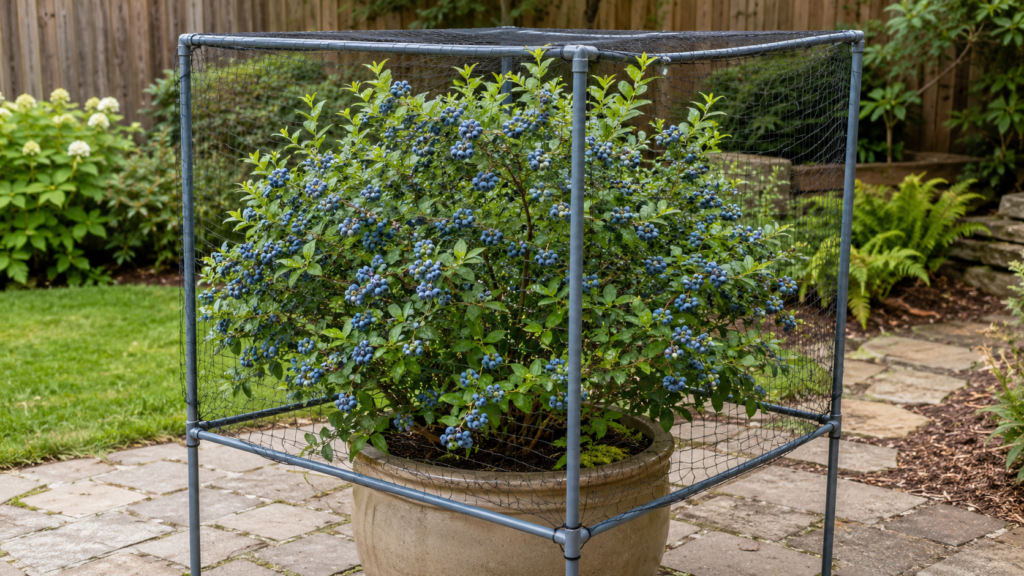
Use a supported physical barrier before berries become fully ripe.
A removable frame is generally easier to manage than loose netting tangled directly through the branches.
Good bird protection should:
- cover the fruiting canopy
- remain supported above branches
- close gaps around the sides
- allow harvesting access
- be removed when no longer needed
Several blueberries in one raised planter can often share one larger protection frame.
This is one reason to leave reasonable access around the planter when designing the layout.
What Maintenance Do Blueberry Planters Need?
Long-term maintenance focuses mainly on moisture, pH, drainage, mulch, plant health, and the condition of the planter itself.
Check regularly:
- soil moisture
- drainage openings
- mulch depth
- pH
- weeds
- foliage health
- planter stability
- timber decay
- winter exposure
Use fertilizers appropriate for acid-loving plants and prune according to the cultivar, plant age, and regional recommendations.
Do not assume every yellow leaf means the plant needs fertilizer.
Yellowing can also result from:
- unsuitable pH
- drought
- waterlogging
- root stress
- environmental conditions
Check the root environment first.
What Blueberry Planter Mistakes Should You Avoid?
Avoid these common mistakes:
Choosing a planter that is too small
Plan for the mature shrub rather than the nursery plant.
Choosing height instead of useful width
Very tall narrow containers may provide surprisingly little lateral root space.
Using unsuitable soil
Blueberries need acidic growing conditions.
Blocking drainage
Moisture is necessary; permanent saturation is not.
Allowing repeated drought
Container blueberries can dry rapidly during warm or windy weather.
Choosing the wrong cultivar
Climate adaptation matters as much as planter design.
Crowding two bushes
Use separate substantial pots unless the shared planter is genuinely large.
Adding unnecessary gravel inside the planter
Reserve root-zone volume for appropriate growing media.
Ignoring mature canopy size
Leave enough space around the container for harvesting and pruning.
The strongest rule is to plan for how the blueberry will look and function several years from now rather than only on planting day.
What Should You Check Before Buying?
Compare internal root-zone performance before choosing color or decorative style.
Before buying a blueberry planter, check:
- internal width
- usable depth
- total capacity
- planter taper
- false bottoms
- drainage holes
- weather resistance
- stability
- final filled weight
- room for mulch
- access to water
- sunlight
- winter protection needs
Online product photographs can make containers appear much larger than they really are.
A slightly shorter, straight-sided planter may provide more usable soil than a taller decorative pot with thick walls and a raised internal floor.
How Can You Test a Blueberry Planter?
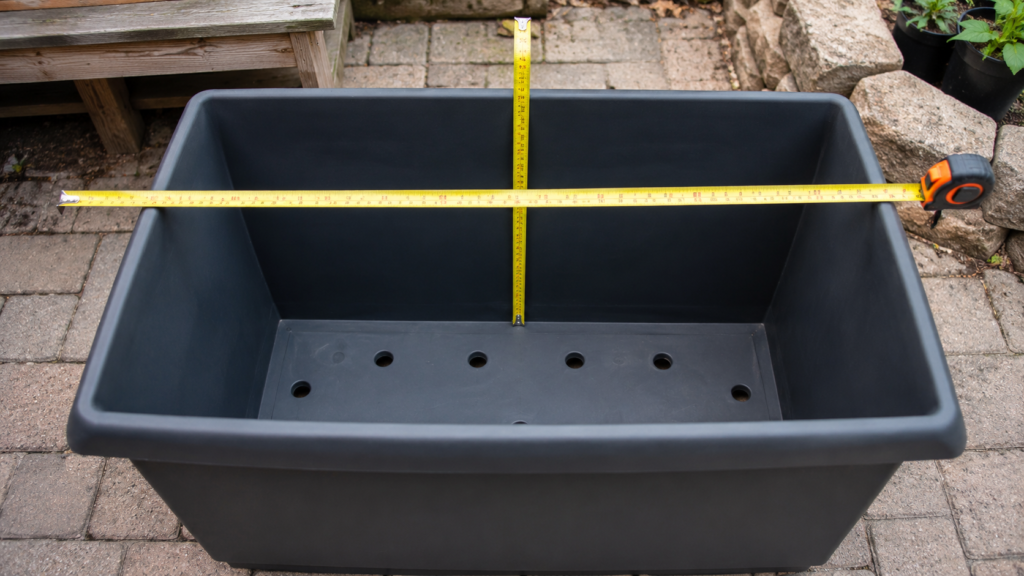
Measure the planter before filling it. This is one of the simplest ways to separate true usable root space from decorative exterior size.
Record:
- internal top width
- internal base width
- usable depth
- approximate capacity
- drainage-hole number
- false-bottom depth
- planter material
For original experience evidence, photograph a real planter with a tape measure showing its internal width and depth.
If you grow a blueberry in that planter, record:
- cultivar
- plant age
- watering frequency
- drainage performance
- moisture stability
- whether the planter still feels appropriately sized later
Only publish first-hand observations that were actually measured or experienced.
Original measurements add more value than simply adding more generic planter advice.
Are Blueberry Planters Better Than In-Ground Planting?
Planters are especially useful when native soil has unsuitable pH, drainage, or structure, but blueberries can grow very well in the ground when conditions are naturally appropriate.
Planters give you more control over:
- soil pH
- growing-medium texture
- drainage
- location
- watering
- mulch
Their disadvantage is that they require more active management.
Containers can dry more quickly, experience greater temperature swings, become extremely heavy, and eventually restrict root growth.
Choose a planter because it solves a real soil, space, accessibility, or landscape problem—not because blueberries inherently require pots.
What Is the Best Blueberry Planter Idea?
For one mature blueberry, choose a wide half-barrel or substantial square planter. For two cultivars, use two matching large pots. For several bushes, a dedicated raised bed is usually the strongest option.
Use this final decision guide:
- One bush: half-barrel or square planter
- Two bushes: two coordinated large pots
- Several bushes: raised blueberry bed
- Small yard: compact cultivar + broad planter
- Balcony: compact cultivar + stable container
- Alkaline soil: isolated planter root zone
- Modern patio: resin, composite, or geometric wood planter
- Cold climate: large protected or movable container
Make the decision in this order:
cultivar → mature size → root space → acidic soil → drainage → water → location → pollination → climate → appearance
The simplest rule is:
Choose the blueberry planter from the roots outward, not from the decoration inward.
Blueberry Planter FAQs
Can blueberries grow well in planters?
Yes. Blueberries perform well in large containers with acidic soil, good drainage, consistent moisture, and sufficient sunlight.
What size planter is best for blueberries?
For mature highbush blueberries, approximately 24 inches (61 cm) deep and 24–30 inches (61–76 cm) wide is a useful benchmark.
Do blueberries need deep or wide pots?
Both matter, but width is especially useful because blueberry roots are relatively shallow and spread through the upper soil profile.
Can blueberries grow in a 5-gallon pot?
A 5-gallon pot can temporarily hold a young blueberry, but it is generally too small for a mature highbush plant.
Do blueberry planters need drainage holes?
Yes. Several open drainage holes help excess water escape while the root zone remains moist.
Should you put gravel in the bottom?
No. Proper drainage holes and suitable growing media are more important than a gravel layer.
What soil is best for blueberry planters?
Use an acidic, well-draining growing medium formulated for blueberries or other acid-loving plants.
What pH do blueberries need?
Aim for approximately pH 4.5–5.5.
Do you need two blueberry bushes?
Not always, but compatible cultivars growing nearby can improve pollination and fruit performance.
Can blueberries grow on a patio or balcony?
Yes. Provide a sufficiently large planter, adequate sunlight, drainage, and a cultivar that fits the available space.
Should blueberry planters be mulched?
Yes. Organic mulch helps conserve moisture and protect the shallow root zone.
Can blueberry planters stay outside in winter?
Often yes, but container roots may need additional protection in very cold climates.
Why are my blueberry leaves turning yellow?
High pH, drought, poor drainage, root stress, or nutrient problems can all cause yellowing. Check the root environment before adding fertilizer.
Are blueberries better in pots or in the ground?
Both can work well. Pots provide better control over soil pH and drainage, while in-ground planting works well where naturally acidic, well-drained soil is available.

Myra is the founder and lead writer of Backyard Planter Ideas, where she shares practical, well-researched guidance on planter design, plant selection, and outdoor styling. Her goal is to help homeowners create attractive, functional garden spaces with clear, reliable, and easy-to-apply advice.