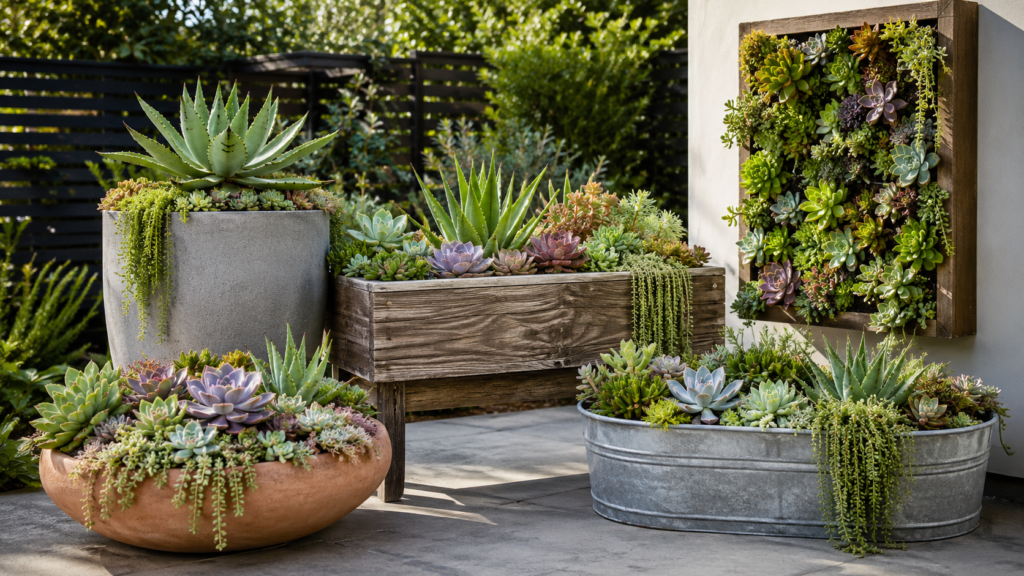
Backyard succulent planter ideas can turn an empty patio, plain fence, narrow side yard, or open garden into a distinctive low-maintenance feature. The best designs balance drainage, sunlight, climate tolerance, and mature growth.
Each section supports faster, confident design decisions.
Find the Right Succulent Planter for Your Backyard
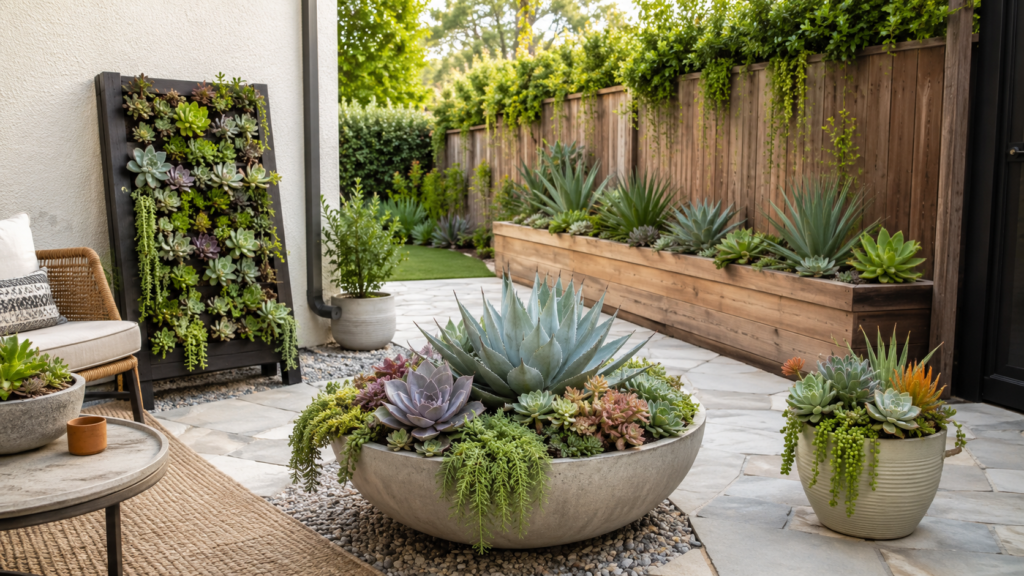
Choose a planter by matching it to the site rather than copying a photograph. Observe morning and afternoon sunlight, reflected heat, wind, rainfall, winter temperatures, and the route taken by drainage water. Consider filled weight. Concrete and large ceramic containers create excellent focal points but may become almost impossible to move, while small hanging pots save space but dry faster and need closer monitoring.
| Backyard condition | Best choice | Why it works |
|---|---|---|
| Small patio | Tiered or vertical planter | Uses height instead of floor space |
| Narrow boundary | Long wooden trough | Creates a slim planting line |
| Large garden | Oversized bowl or concrete pot | Matches the scale of the landscape |
| Rental home | Resin or lightweight pots | Easy to move without permanent changes |
| Rainy climate | Sheltered raised planter | Reduces prolonged saturation |
| Frost-prone climate | Wheeled or portable container | Simplifies winter protection |
| Modern backyard | Geometric concrete planter | Complements clean architecture |
| Rustic backyard | Wood, terracotta, or galvanized metal | Adds texture and warmth |
Score each option from zero to two for climate fit, drainage, mobility, mature-size fit, and maintenance. A total of eight to ten indicates a strong choice; five to seven requires modification; four or less suggests choosing another planter.
Best Succulent Planter Ideas by Climate
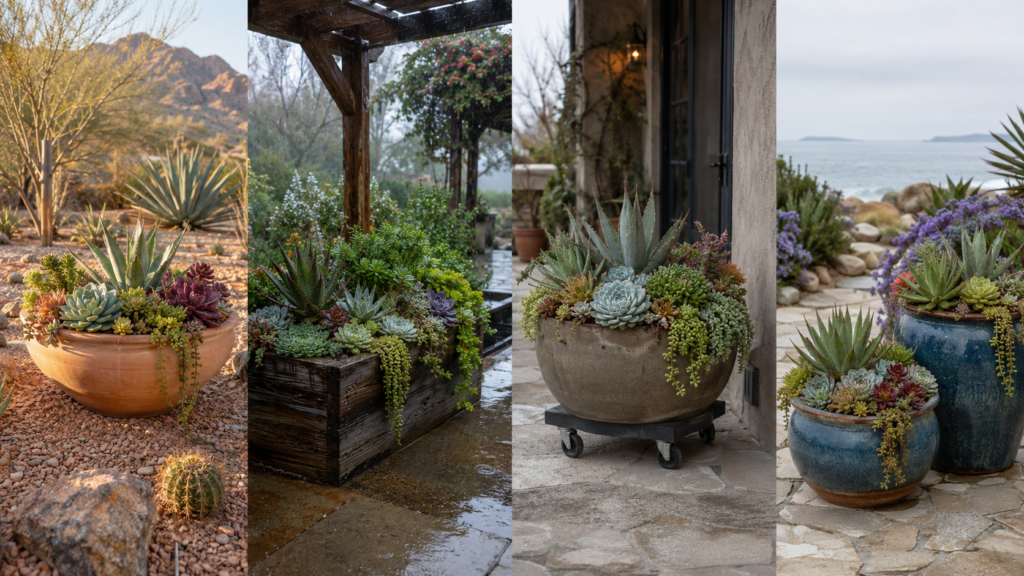
Backyard succulent planter ideas must account for drying speed, heat stress, rain exposure, and winter survival. In hot, dry backyards, use larger pale containers that heat and dry more slowly than small dark pots. Morning sun with afternoon protection can be safer than full exposure beside reflective paving or walls.
Hot, humid, or rainy gardens need unobstructed drainage, generous spacing, and airflow. A bright covered patio often performs better than an open position that receives every storm. Frost-prone gardens should use locally hardy plants or lightweight containers that can be moved before freezing weather. Mild coastal locations may support many succulents, but strong wind and salt exposure favour stable pots and protected placement.
Large Backyard Succulent Planter Ideas
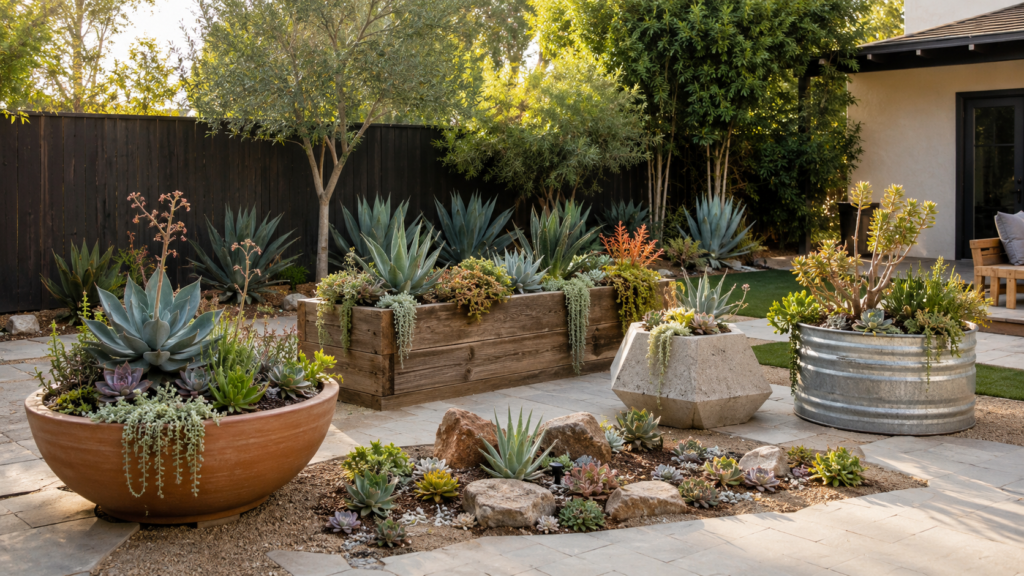
Large Backyard Succulent Planter Ideas
Large spaces need sufficient planter scale and repetition.
1. Oversized Terracotta Succulent Bowl
A broad terracotta bowl creates a Mediterranean-style focal point beside seating, an entrance, or the end of a path. Position one architectural succulent slightly off-centre, surround it with compact rosettes, and allow one trailing plant to soften the rim. Leave open soil between plants so the arrangement can expand naturally.
Terracotta encourages relatively fast drying, which can be useful in humid weather. In hot wind, however, it may need closer moisture checks. Choose frost-resistant terracotta where freezing is common.
2. Long Raised Wooden Succulent Trough
A wooden trough suits fences, deck edges, and narrow boundaries. Repeat upright plants at measured intervals, fill the spaces with compact clusters, and use trailing growth only along selected edges. Repetition creates rhythm and prevents the trough from looking like a random collection.
Use planter-safe timber, reinforce the corners, and raise the base above wet ground. A liner can protect the wood, but it must include drainage openings.
3. Modern Geometric Concrete Planter
Concrete planters complement minimalist homes, pale paving, and straight paths. Select one strong upright form and several low plants with contrasting shapes rather than filling the container with numerous similar rosettes.
Concrete is durable and stable in wind, but its filled weight makes relocation difficult. Position the container before adding soil and confirm that the patio or deck can support it.
4. Galvanized Tub Succulent Garden
A galvanized tub creates a farmhouse or industrial look and offers enough width for layered planting. Combine one focal plant, two or three compact groups, open gravel areas, and a controlled trailing edge.
Drill several drainage holes and lift the base slightly. Metal can become extremely hot beside reflective surfaces, so use afternoon protection in severe summer climates.
5. Succulent Rock-Garden Planter
Use a broad stone-look bowl or hypertufa trough to build a miniature dry landscape. Place one larger rock near the anchor plant and use smaller stones to guide the eye through the design. Vary stone sizes and preserve open space rather than covering the surface uniformly.
Apply only a thin mineral top dressing so soil moisture remains easy to check.
Small-Space and Vertical Succulent Planter Ideas
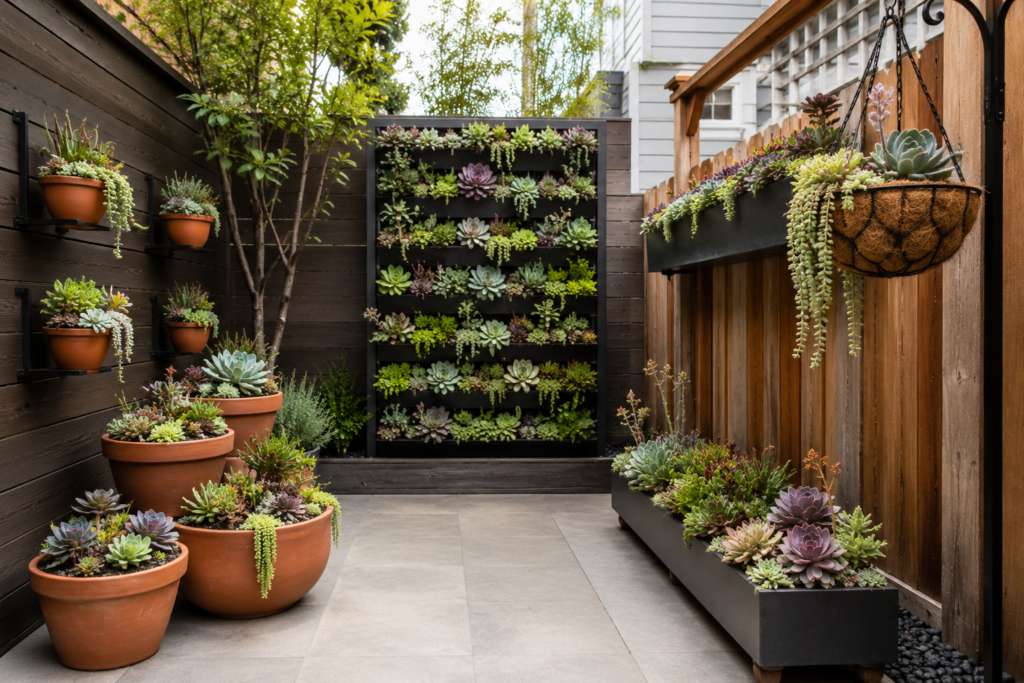
Small backyards can use fences, walls, railings, corners, and overhead structures. Elevated containers save floor space, but their exposure to wind and sun can create uneven drying.
6. Tiered Terracotta Pot Display
Arrange matching pots on stable outdoor steps or shelving. Place the largest plants on the lowest level, medium rosettes in the centre, and small trailing plants near the top. This creates balance and keeps heavier containers closer to the ground.
Check every pot separately because the upper containers usually dry faster.
7. Vertical Succulent Wall
A modular wall turns a blank fence into a living feature. Removable panels are preferable to a permanently sealed system because damaged plants, blocked pockets, and irrigation problems can be corrected individually.
Install a moisture barrier where runoff could damage the wall, and use hardware rated for the structure’s full wet weight. Expect upper pockets to dry faster than lower pockets.
8. Fence-Mounted Succulent Pots
Individual fence pots provide flexibility without the complexity of a complete wall. Rearrange them when sunlight changes or plants outgrow their positions.
Use lightweight containers, secure brackets, and a safe route for runoff. Leave enough space to lift each pot from its support without disturbing neighbouring plants.
9. Hanging Succulent Basket
A hanging basket adds greenery above a patio, pergola, or seating area. Use trailing plants around selected edges and compact growth in the centre. Avoid overfilling the basket at installation because trailing stems soon add volume.
Lower the basket regularly to inspect drainage, pests, and mounting hardware. Wet growing medium is considerably heavier than dry mix.
10. Narrow Railing Box
A railing box suits balconies, deck edges, low walls, and tight walkways. Select compact varieties that will not become top-heavy or overwhelm the limited root space.
Calculate the filled weight, use a secure mounting system, and prevent runoff from falling onto paths or neighbouring property.
DIY and Upcycled Succulent Planter Ideas
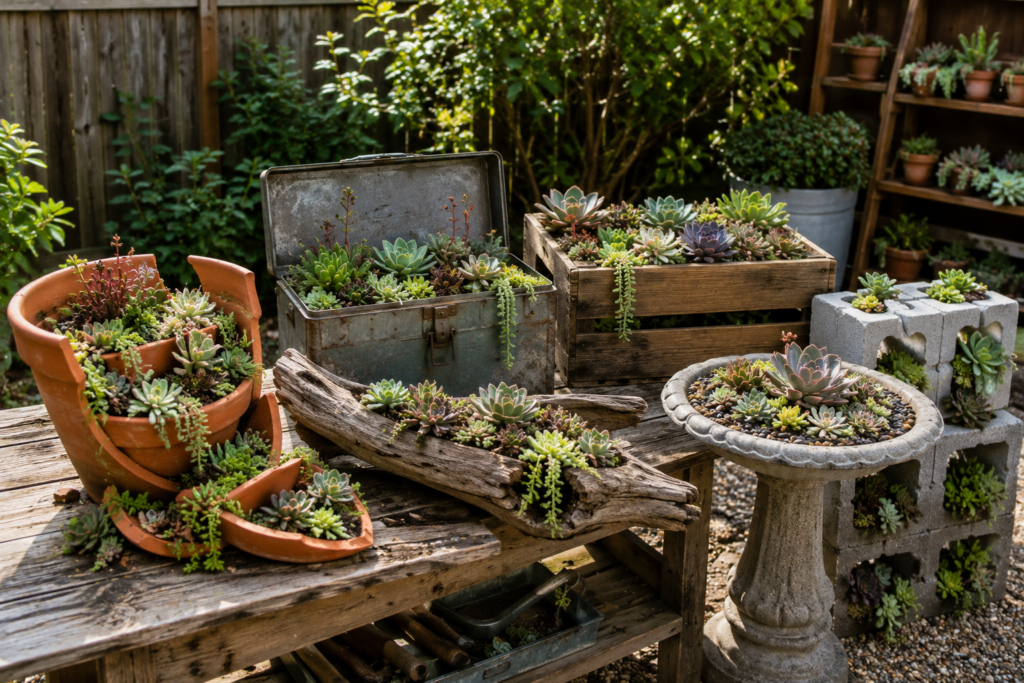
Upcycled containers can reduce cost and create original designs, but every object must be clean, stable, weather-resistant, and safe. Never use containers that held fuel, pesticides, industrial chemicals, or unknown substances.
11. Broken-Pot Succulent Garden
Use large terracotta fragments to create two or three planting levels inside a damaged pot. Keep the design simple so plants remain the focus. Stabilise every piece, smooth sharp edges, and reject a container that may collapse when moved.
12. Driftwood Succulent Planter
Driftwood adds a coastal or naturalistic character. Large cavities can conceal removable nursery pots, giving roots more space and making watering easier than planting directly into shallow cracks.
Avoid rotting sections and hollows that trap water. Use responsibly collected wood and inspect it as weathering progresses.
13. Repurposed Metal Toolbox Planter
A clean toolbox can become a compact industrial planter for a shelf or outdoor table. Add drainage holes and consider a removable inner pot to reduce direct root contact with hot metal.
Reject toolboxes with chemical residue, sharp rust, or an unstable base.
14. Recycled Wooden Crate Arrangement
Reinforce the crate, add a breathable liner, and preserve clear drainage. Plant one anchor, several compact supporting plants, and one trailing accent.
A sealed plastic liner may trap water and accelerate decay, so cut drainage openings and keep the crate above constantly wet ground.
15. Succulent Birdbath Centrepiece
An unused birdbath creates a raised focal point. If drilling is safe, add drainage holes; otherwise place a shallow draining planter inside the basin. Do not remove an active wildlife water source without providing an alternative.
16. Cinder-Block Succulent Wall
Stack blocks on a level base to create modular planting pockets and negative space. Keep the structure low and stable, especially where children or pets are present.
Each pocket may receive different sunlight and rainfall, so inspect and water them individually.
Backyard Succulent Planters by Design Style
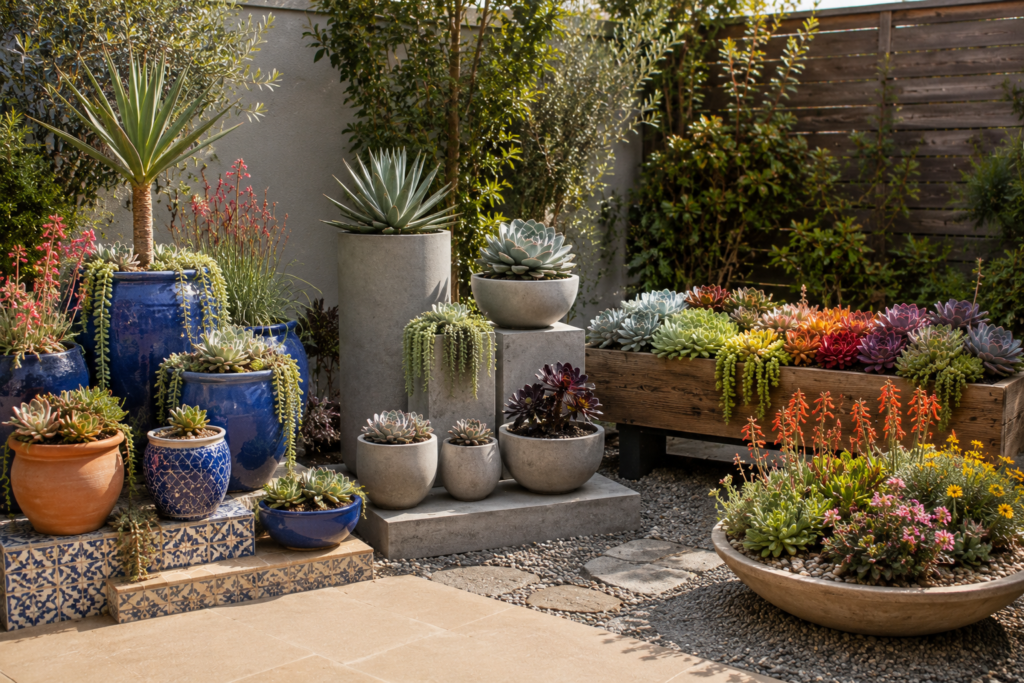
After solving practical requirements, coordinate containers and foliage with the backyard architecture.
17. Mediterranean Blue-and-Terracotta Display
Group one large blue ceramic pot with two medium terracotta containers. Repeat at least one plant variety across the group to connect the display. Check each pot separately because glazed ceramic usually remains moist longer than unglazed terracotta.
18. Monochrome Modern Succulent Collection
Choose containers in one colour, such as white, charcoal, sand, or pale grey. Limit the collection to two or three shapes and establish one dominant focal pot. Use architectural foliage and leave open space between containers.
19. Colour-Gradient Succulent Arrangement
Arrange foliage from silver and blue-green through lime, bronze, burgundy, and red. A long trough makes the transition easy to read. Select plants by compatible care needs before colour because seasonal light and stress may alter foliage tones.
20. Flowering Succulent Pollinator Planter
Use locally suitable flowering succulents that share similar water, light, and temperature needs. Compare flowering periods and mature sizes, avoid invasive plants, and choose species known to offer value to local insects.
Climate-Smart and Movable Succulent Planters
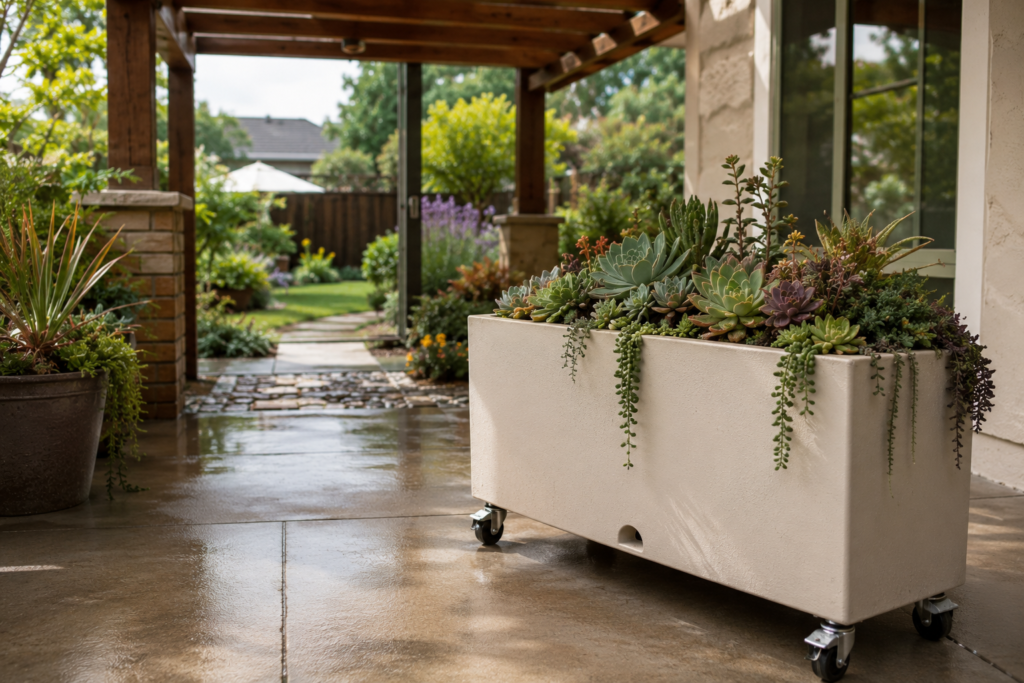
21. Movable Succulent Planter on Casters
A wheeled planter can move beneath shelter during prolonged rain, into protection before frost, or away from intense reflected heat. Use an outdoor-rated platform with locking wheels and a capacity above the estimated filled weight. Keep the planter narrow enough to pass through gates and doorways.
For rain protection, move it beneath a bright ventilated cover and empty trays. For winter, choose a cool, bright protected position. For heat, use pale containers, airflow, and gradual sun acclimation.
Backyard Succulent Planter Inspiration Gallery
Show backyard succulent planter ideas through six to eight original images that explain distinct decisions rather than repeating similar beauty shots. Include one large focal planter, one vertical solution, one DIY container, one modern arrangement, one rustic design, and one movable planter. Descriptive filenames and alt text should identify the container, plants, setting, and purpose without keyword repetition.
Compare the Best Planter Materials
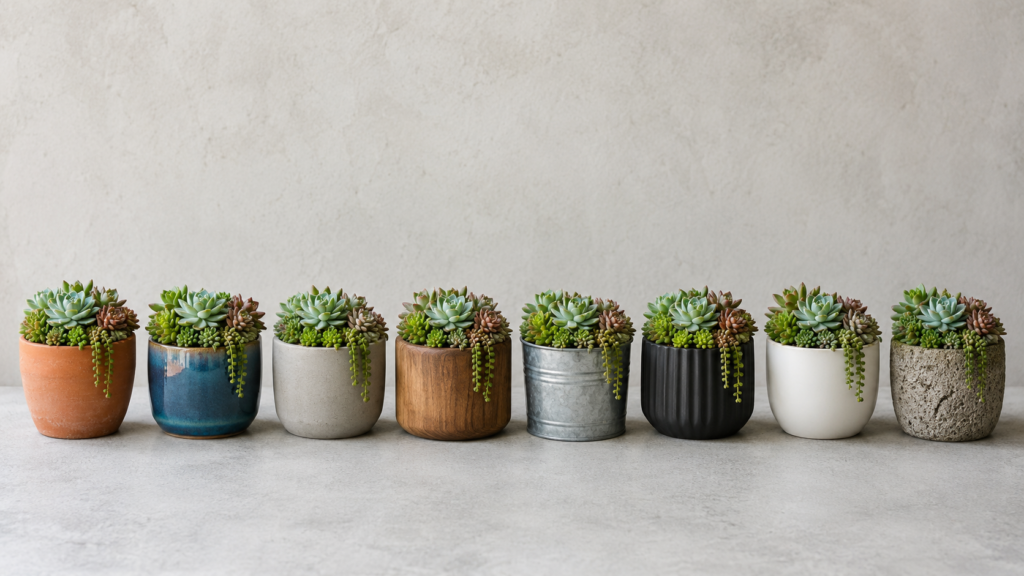
Compare the Best Planter Materials
| Material | Best use | Main limitation |
| Terracotta | Faster drying and Mediterranean styling | Can crack in frost |
| Glazed ceramic | Decorative colour and focal pots | Retains moisture longer |
| Concrete | Permanent architectural features | Heavy when filled |
| Wood | Troughs and rustic gardens | May rot or warp |
| Metal | Farmhouse and industrial designs | Can overheat |
| Plastic or resin | Budget and movable arrangements | May fade |
| Fibreglass | Large lightweight planters | Higher purchase cost |
| Hypertufa | Rock gardens and naturalistic bowls | Can be fragile |
Choose material according to climate, watering habits, mobility, and scale. Unglazed terracotta suits faster drying; concrete suits permanent focal points; fibreglass and resin suit seasonal movement. Use decorative containers without holes as outer covers for removable draining pots.
Choose Succulents That Can Grow Together
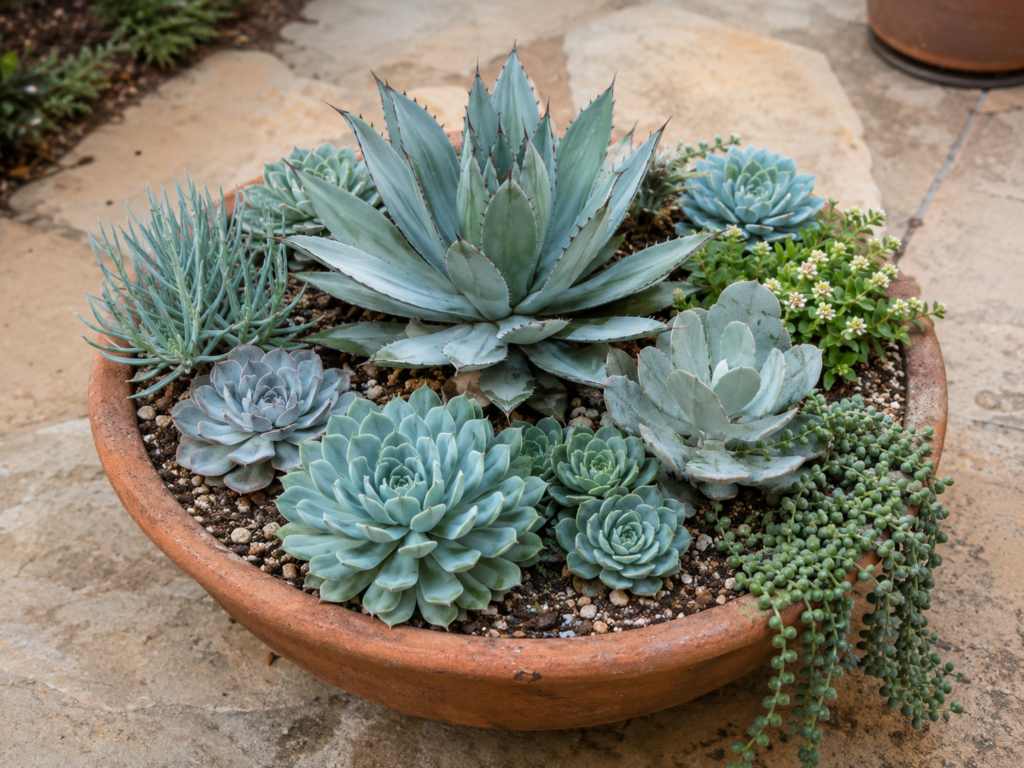
The best backyard succulent planter ideas combine plants with similar light, watering, temperature, and seasonal requirements. Compare mature height, spread, and growth speed before purchase. A small architectural plant may eventually dominate the arrangement, while an aggressive spreader can cover slower rosettes.
Build the design with one upright anchor, several compact cluster plants, and one restrained trailing element. This succulent version of the established thriller-filler-spiller formula creates hierarchy without overcrowding. Leave visible soil for airflow, offsets, and future growth.
Five Ready-to-Plant Succulent Combinations
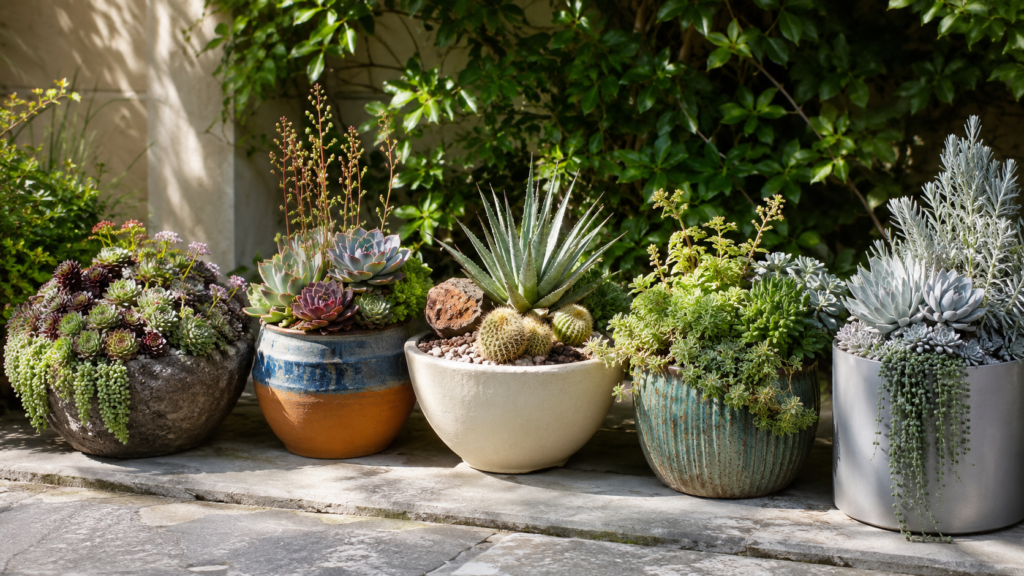
These combinations are starting frameworks. Confirm local hardiness, toxicity, rainfall tolerance, and mature dimensions before planting.
Cold-Hardy Patio Bowl
Use a frost-resistant container, a locally hardy focal succulent, compact Sempervivum-type rosettes, and low hardy Sedum. Protect the planter from prolonged winter saturation.
Mediterranean Courtyard Pot
Combine a climate-suitable Aloe- or Aeonium-type anchor with compact rosettes and a trailing Sedum. Use this design in mild conditions or where winter protection is available.
Hot and Dry Planter
Choose a locally appropriate Agave-type anchor, heat-tolerant clusters, and a drought-tolerant trailer. Use a broad pale container away from reflective walls.
Bright Partial-Shade Pot
Select an upright plant and compact varieties documented for morning sun or bright shade. Watch for stretched growth, which indicates insufficient light.
Modern Silver Bowl
Combine one blue-grey anchor with silver rosettes and a controlled blue-green trailer. Pale concrete, ceramic, or fibreglass supports the clean architectural effect.
How to Plant an Outdoor Succulent Planter
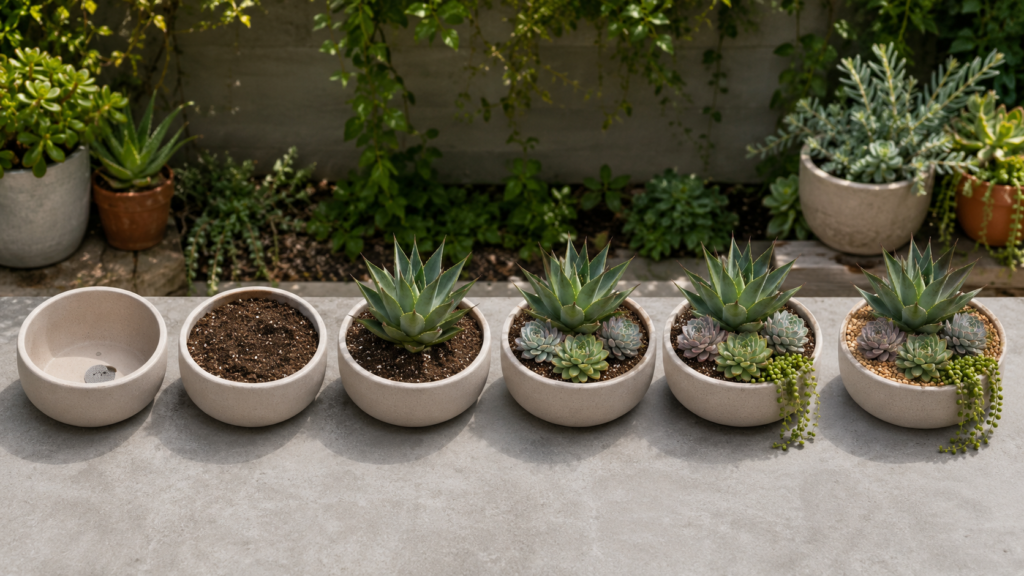
First evaluate sunlight, heat, wind, rain, and winter exposure. Select a container that suits the plants’ mature dimensions and has clear drainage holes. Cover large holes with mesh, then add a fast-draining succulent mix.
Position the anchor plant first, usually slightly off-centre. Add compact plants according to mature width, followed by trailing growth near selected edges. Keep crowns at their original depth and avoid burying leaves. Fill around roots gently without compressing the mix heavily.
Apply a thin mineral top dressing while leaving an area where moisture can be checked. Water according to plant condition, allow excess water to drain, and protect newly planted succulents from sudden intense sun. Keep every plant accessible for future division or replacement.
Soil, Drainage and Watering Essentials
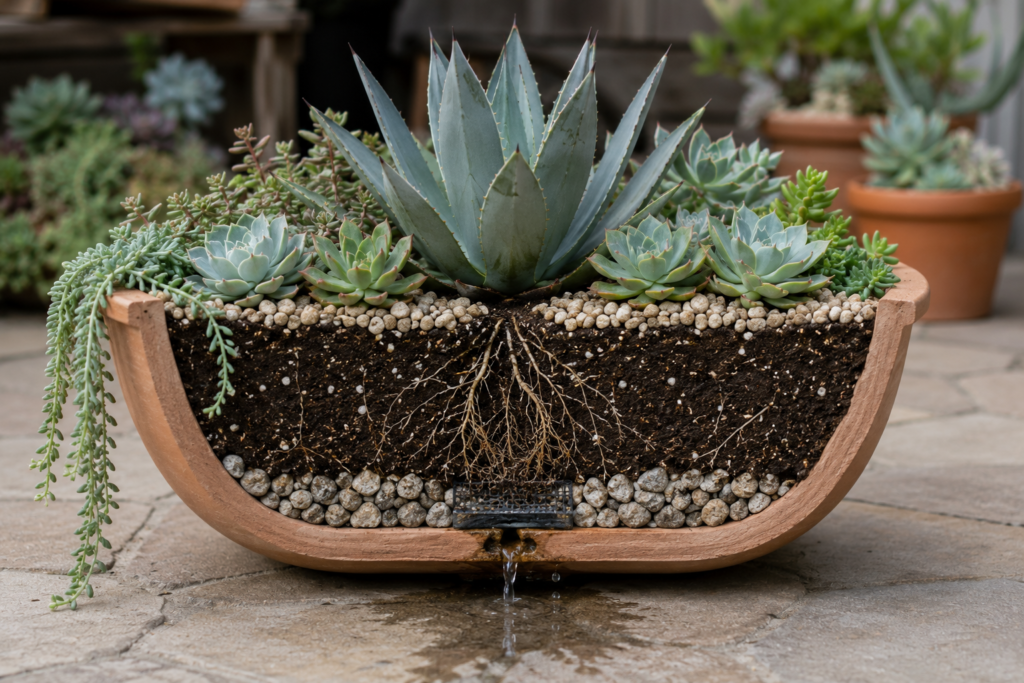
Use a fast-draining succulent container mix because ordinary backyard soil may compact and retain moisture unpredictably. Drainage holes provide a direct exit for rain and irrigation; a layer of stones inside a sealed pot does not perform the same function.
Water thoroughly when the selected plants need moisture, then allow the root zone to dry appropriately. Frequency changes with temperature, rainfall, wind, pot size, material, and season. Check below decorative gravel rather than judging only the visible surface.
During prolonged rain, move portable planters beneath bright shelter, raise heavy pots on feet, and empty trays. Soft translucent leaves, dark stem bases, persistent wetness, or unpleasant odour indicate that the roots and drainage need immediate inspection.
Backyard Succulent Planter Ideas by Budget
Low-budget choices include broken pots, crates, cinder blocks, nursery pots, second-hand containers, and propagated offsets. Mid-range options include terracotta bowls, wooden troughs, galvanized tubs, resin pots, wall planters, and wheeled platforms. Premium projects may use concrete, custom metal, hardwood, designer collections, or professionally built vertical systems.
At every price level, spend first on a functional container, correct growing medium, healthy compatible plants, and structural stability. Decorative ornaments, extra varieties, and matching secondary pots can be added later.
Common Succulent Planter Mistakes
Avoid choosing plants by colour before care requirements, using sealed containers, relying on bottom gravel, combining conflicting water needs, exposing nursery plants to sudden harsh sun, overcrowding, using dense garden soil, watering lightly but frequently, ignoring mature size, neglecting winter protection, using unsafe recycled materials, or hiding the soil beneath thick top dressing.
When several plants show the same problem, inspect the shared environment first. Stretched growth usually indicates insufficient light; bleached patches suggest sudden sun stress; soft leaves or dark stem bases often point to excess moisture. Correct the cause rather than treating each plant separately.
How to Keep the Arrangement Attractive as It Grows
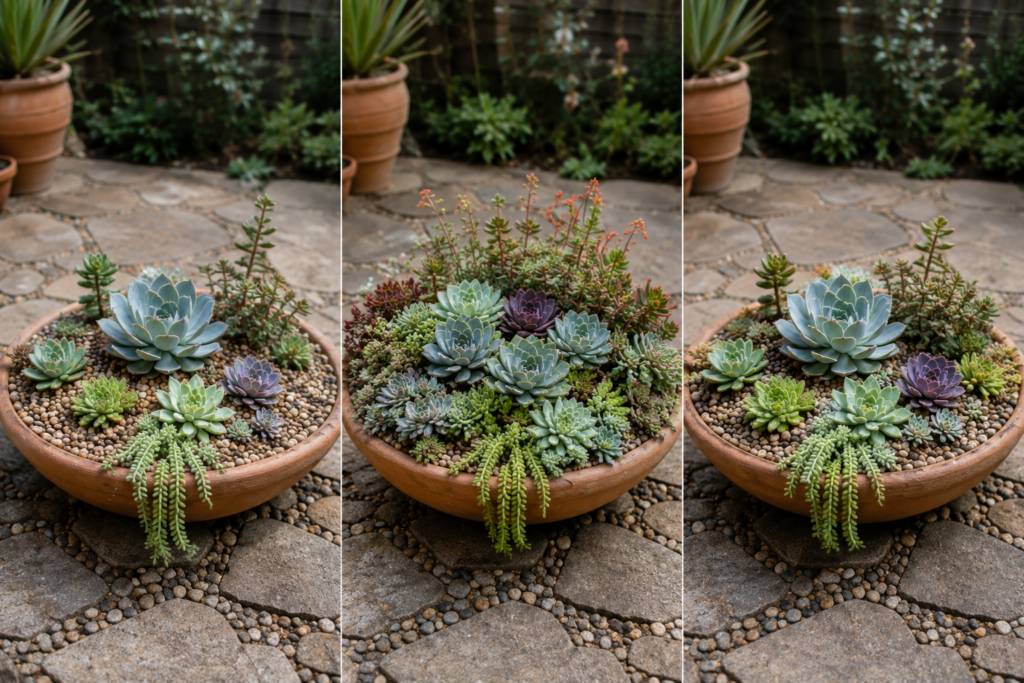
During the first month, confirm drainage and light, remove dry leaves, inspect for pests, and correct buried crowns. Every few months, divide offsets, remove crowding, rotate uneven growth when appropriate, and check container condition.
Before wet or cold seasons, move tender pots, clear drainage holes, and inspect wood, metal, wheels, and supports. Redesign when the focal plant becomes too large, roots fill the container, plants develop conflicting needs, drainage slows, or the planter becomes unstable.
Final Backyard Succulent Planter Checklist
Before planting, confirm suitable light, rain exposure, stable placement, functional drainage, weather-resistant material, and manageable filled weight. Use compatible plants, fast-draining mix, and enough space for mature growth.
Create one clear anchor, compact supporting clusters, and a controlled trailing element. Ensure every plant remains reachable and establish a plan for heavy rain, frost, and summer heat. After planting, water appropriately and verify that excess moisture exits freely.
Plan Your Backyard Succulent Container
Record the available width and depth, morning and afternoon sunlight, rainfall, winter minimum, planter material, drainage method, filled weight, and whether the container must move. List the anchor plant, compact companions, trailing plant, expected mature dimensions, watering access, weather protection, maintenance level, and budget.
Score the finished plan for climate fit, drainage, mobility, mature-size fit, and maintenance. Modify any design that scores below five before purchasing plants.
Frequently Asked Questions
What Are the Best Succulents for Outdoor Planters?
Choose varieties suited to local sunlight, rainfall, and winter temperatures. Verify mature size, hardiness, and watering needs rather than selecting by appearance alone.
Do Outdoor Succulent Planters Need Drainage Holes?
Yes. Drainage holes let irrigation and rain leave the root zone. Gravel inside a sealed container does not provide equivalent protection.
How Many Succulents Fit in One Container?
The number depends on planter width and mature plant size. Leave visible gaps so plants can expand without immediate crowding.
What Soil Is Best for Outdoor Succulent Planters?
Use a fast-draining cactus or succulent container mix. Ordinary garden soil may compact and retain excessive moisture inside pots.
How Often Should Outdoor Succulents Be Watered?
Water when the growing medium has dried appropriately for the selected plants. Frequency varies with season, rainfall, sunlight, pot size, and material.
Can Succulent Planters Survive Heavy Rain?
Yes, when drainage remains clear, the mix drains quickly, and airflow is good. Move portable pots under shelter during prolonged storms.
Do Outdoor Succulents Need Full Sun?
Not all do. Some prefer morning sun or partial afternoon shade, while sudden harsh exposure can scorch greenhouse-grown plants.
Can Planters Stay Outside During Winter?
They can when both plants and containers suit local winter conditions. Move frost-sensitive arrangements into bright protection before freezing weather.
Conclusion
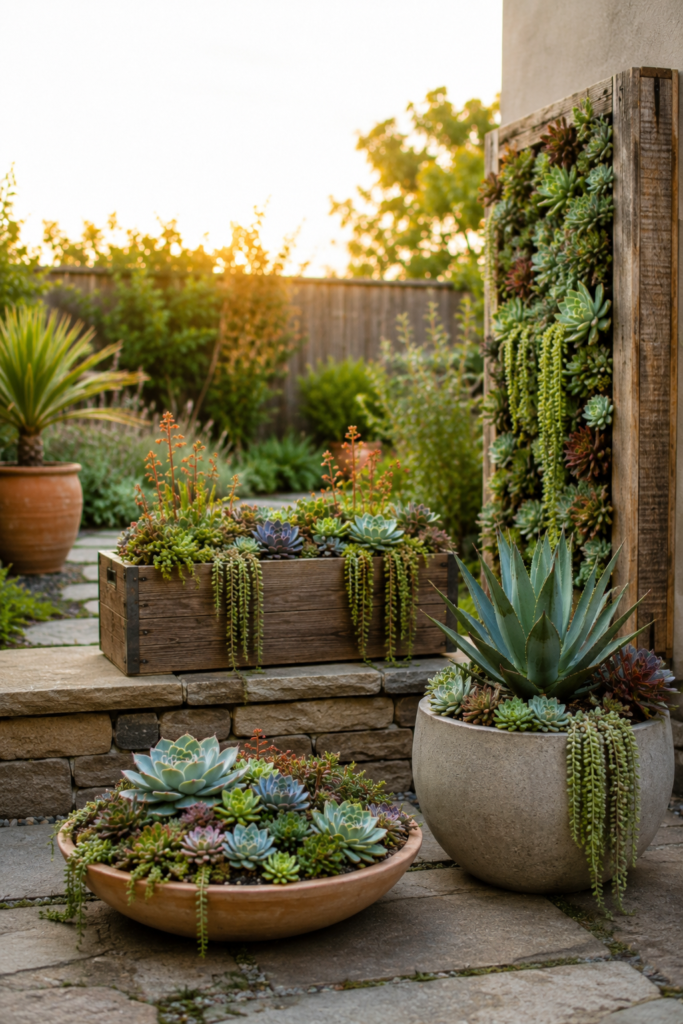
The best backyard succulent planter ideas combine appropriate scale, climate fit, drainage, compatible plants, and realistic maintenance. Large bowls and troughs suit open spaces, while walls, railing boxes, and hanging baskets solve compact layouts.
Choose the location first, match plant needs before colours, leave room for growth, and plan for rain, frost, or heat. A planter that remains easy to inspect, move, and revise will provide more lasting value than a crowded design created only for immediate visual impact.
Myra is the founder and lead writer of Backyard Planter Ideas, where she shares practical, well-researched guidance on planter design, plant selection, and outdoor styling. Her goal is to help homeowners create attractive, functional garden spaces with clear, reliable, and easy-to-apply advice.