
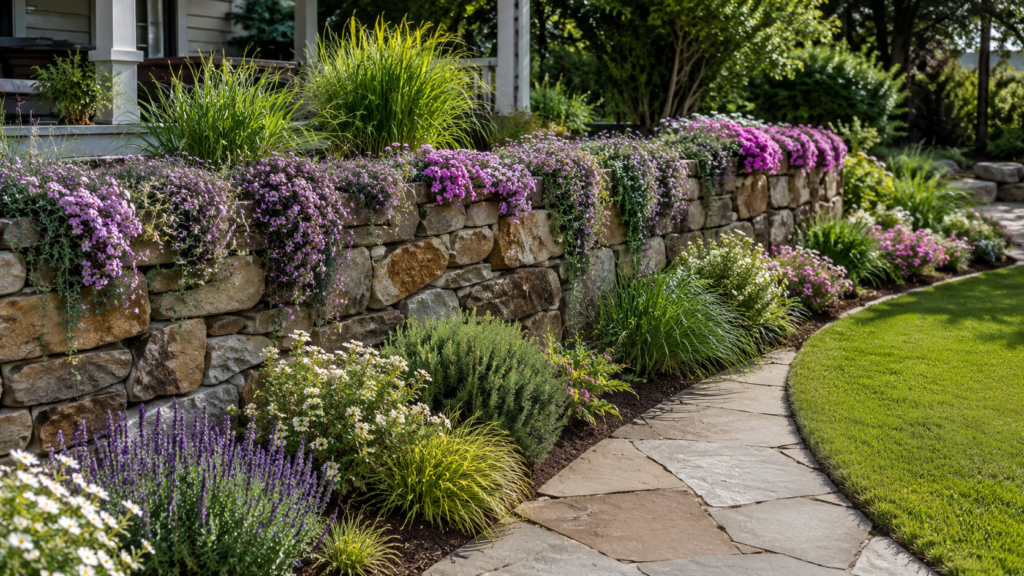
The best backyard retaining wall planting ideas combine trailing plants along the upper edge, compact perennials or shrubs in the retained bed, and lower-growing plants at the base. Choose plants according to sunlight, usable soil depth, drainage, mature spread and root behavior. Keep drain outlets visible and leave enough open space to inspect the wall.
A successful retaining wall garden should soften hard materials without hiding structural problems. The strongest designs use a limited plant palette, repeat it deliberately and match every plant to a defined wall zone.
Quick Plant Selector
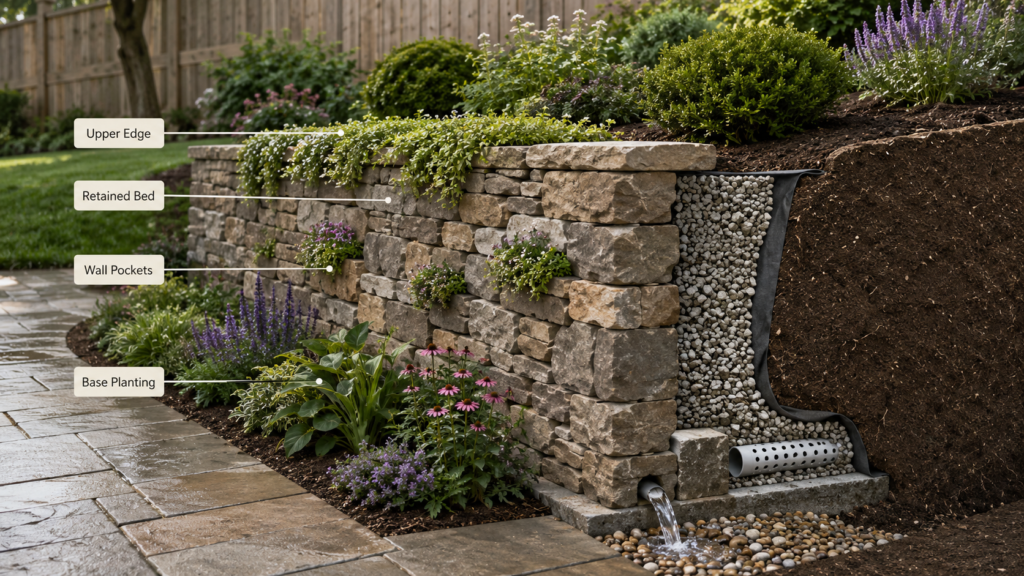
Retaining wall conditions can change within a few feet. The wall top may be sunny, windy and dry, while the base may be cooler, shaded or affected by runoff. Select plants according to their exact location rather than treating the entire area as one border.
| Wall zone | Best plant habit | Useful plant groups | Main concern |
|---|---|---|---|
| Upper edge | Trailing or spreading | Thyme, sedum, creeping phlox | Heat and dry soil |
| Upper bed | Compact and upright | Salvia, grasses, dwarf shrubs | Mature size |
| Wall pockets | Small and slow-growing | Alpines, dianthus, sempervivum | Limited soil |
| Lower bed | Layered and adaptable | Ferns, heuchera, sedges | Shade and runoff |
| Narrow base | Upright and clumping | Carex, compact salvia | Restricted width |
| Containers | Controlled-root plants | Herbs, annuals, dwarf grasses | Watering and weight |
Before buying plants, confirm:
- The exact planting zone
- Mature height and width
- Sunlight and reflected heat
- Soil depth and drainage
- Root, runner or rhizome behavior
- Maintenance and irrigation needs
A dependable starting formula is one structural plant, one flowering perennial and one low ground cover.
What Should You Plant?
Plant compact species that suit their exact position around the retaining wall. Plants at the top often need drought, wind and heat tolerance. Plants at the bottom may need shade tolerance, stronger foliage interest or the ability to handle occasional runoff.
Upper Edge
Use low plants that soften the wall without hiding it completely. Creeping thyme, low sedum, creeping phlox, candytuft and selected campanulas can work where the climate and drainage are suitable.
Retained Bed
The soil behind the wall may support perennials, grasses and compact shrubs, but not all visible material is ordinary garden soil. Engineered walls may contain drainage aggregate, compacted backfill or buried reinforcement.
Avoid deep digging when the construction is unknown. Use modest plants or containers until the structural planting area is understood.
Wall Face
Genuine dry-stone walls may contain stable crevices suitable for small alpines, thyme or sempervivum. Do not fill ordinary block joints with soil because they may support drainage or movement.
Lower Bed
The base may be shaded, narrow, hot or periodically damp. Useful choices include ferns, heuchera, sedges, hardy geraniums, salvia and compact shrubs.
Check the Wall First
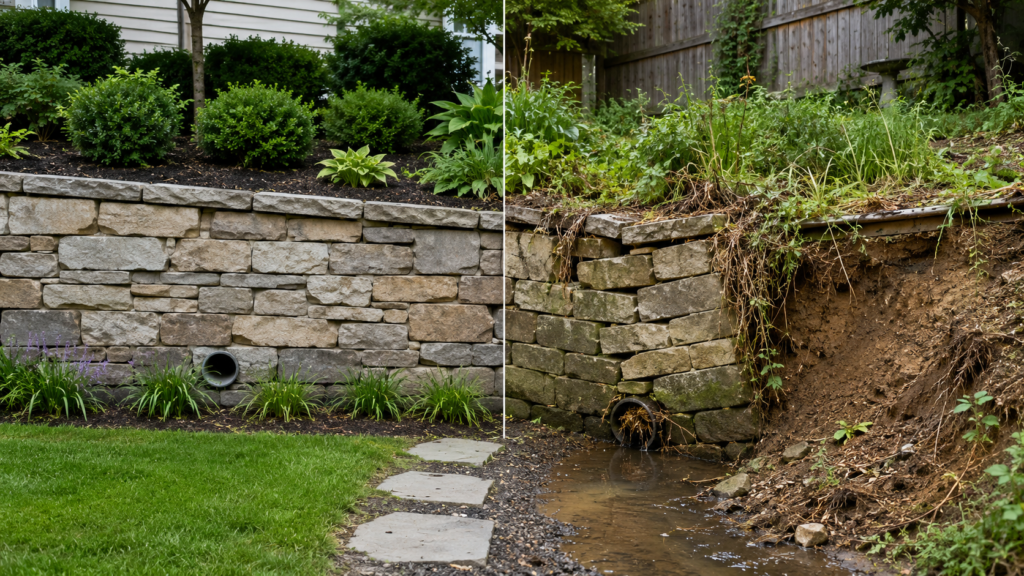
Inspect the retaining wall before adding plants, soil, irrigation or heavy containers. Planting can improve appearance, but it cannot repair movement, poor drainage or unstable construction.
Look along the wall from both ends and check for:
- Leaning or bulging sections
- Large or widening cracks
- Separated blocks or courses
- Soil washing through joints
- Standing water
- Persistent seepage
- Sinking soil above the wall
- Blocked drain outlets
- Movement near steps or corners
Locate weep holes, drain outlets, gravel zones and visible irrigation lines. Watch how water behaves after heavy rain. Downspouts, leaking irrigation and runoff from paving should not empty into the retained bed.
A low decorative wall and a high engineered wall require different levels of caution. Obtain site-specific advice when the wall supports a driveway, building, pool or steep slope, or when reinforcement is unknown.
Important: Plants should decorate a stable retaining wall, not conceal cracks, movement or drainage failure.
Planting by Wall Type
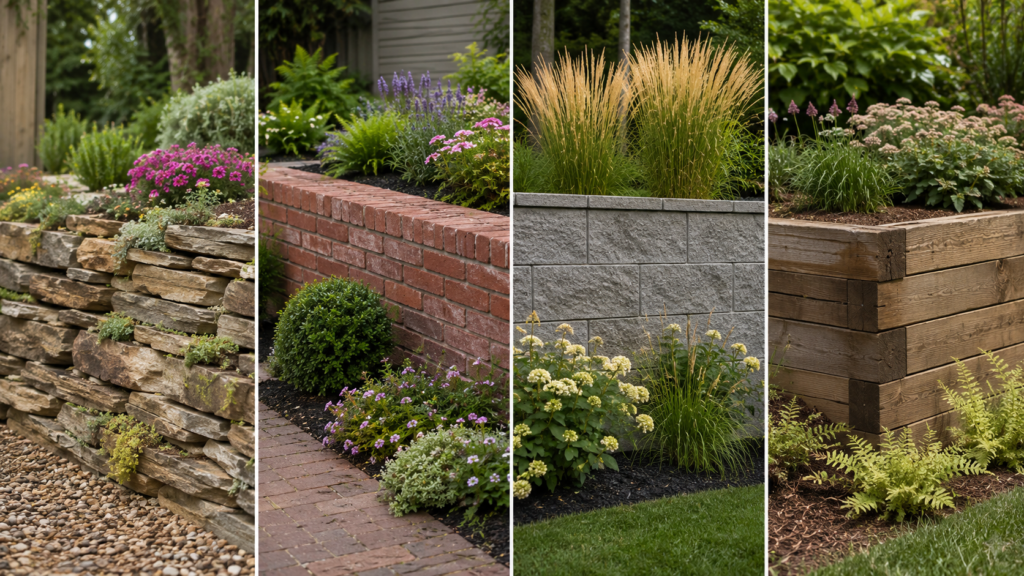
The wall material affects where plants can grow and how moisture should be managed. Identify the wall type before filling joints, installing climbers or digging behind it.
| Wall type | Best planting approach | Avoid |
|---|---|---|
| Dry-stone | Small plants in stable crevices and along the top | Removing supporting stones |
| Mortared stone | Beds above or below | Forcing soil into mortar gaps |
| Brick | Compact borders and independent trellises | Constant moisture against damaged masonry |
| Concrete block | Upper and lower beds based on wall plans | Disturbing geogrid or gravel |
| Poured concrete | Repeated grasses, shrubs and containers | Drilling without assessment |
| Timber | Lightweight planting with controlled irrigation | Persistently wet soil |
| Gabion | Beds above, below or in designed pockets | Packing soil into structural rock fill |
| Plantable wall | Use designated cells and irrigation | Oversized plants |
The condition of the wall matters as much as the material. A sound brick wall may support an attractive border nearby, while deteriorating timber or cracked masonry should remain open for repair and inspection.
Use the WALL Fit Method
The WALL Fit Method helps determine whether a plant truly belongs beside a retaining wall.
W — Wall Position
Identify whether the plant will grow on the upper edge, in the retained bed, inside a designed pocket, at the base or in a container.
A — Available Soil
Measure usable depth and width. Check whether the planting area contains ordinary soil, compacted backfill, gravel or existing roots.
L — Light and Local Climate
Observe morning and afternoon light, reflected heat, wind, humidity, winter cold and seasonal rainfall.
L — Long-Term Growth
Check mature height, width, roots, runners, pruning needs and water requirements. Nursery-pot size is not a reliable guide to future fit.
| Factor | 1 point | 3 points | 5 points |
|---|---|---|---|
| Position | Poor match | Acceptable | Ideal |
| Soil | Inadequate | Manageable | Well suited |
| Climate | Marginal | Generally suitable | Reliable locally |
| Mature size | Too large | Needs control | Naturally fits |
| Maintenance | Frequent work | Seasonal care | Minimal care |
A score of 21–25 indicates a strong candidate. Plants scoring 16–20 may work with adjustments. Replace plants below 16.
Best Plants for Wall Tops
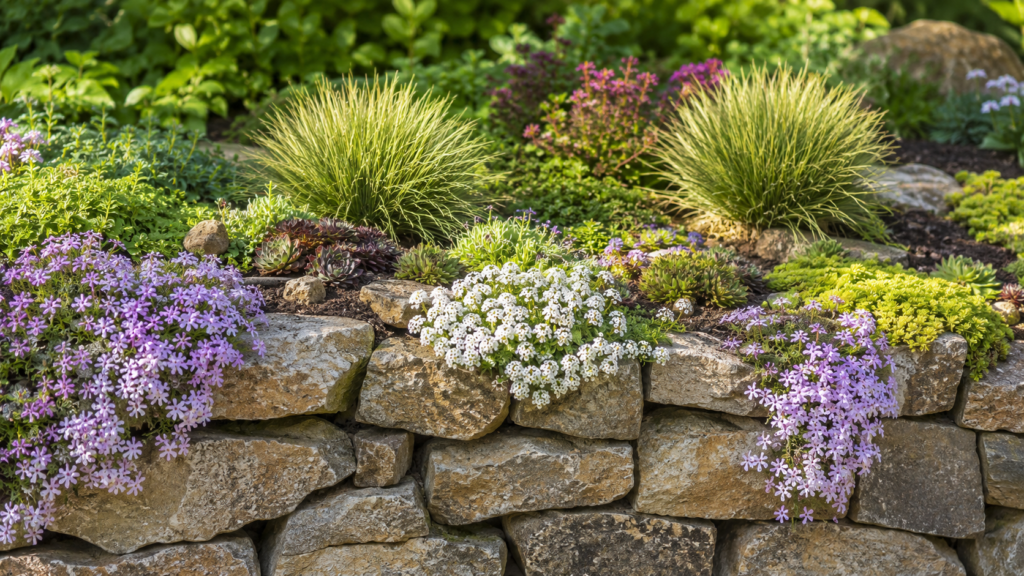
Wall-top plants should tolerate exposure, drainage and restricted soil. Use trailing plants at the visible edge and upright accents slightly farther back.
Creeping Thyme
Creeping thyme forms a low aromatic mat and suits sunny, well-drained sites. It works well where a soft edge is needed without tall growth.
Sedum
Low sedums suit shallow, sunny beds and provide foliage texture outside the flowering season. Select controlled forms that will not overwhelm smaller plants.
Creeping Phlox and Candytuft
Creeping phlox creates a flowing spring display, while candytuft forms a tidier mound. Choose phlox for an informal wall and candytuft for a neater edge.
Campanula, Sempervivum and Dianthus
Small campanulas can trail through suitable dry-stone crevices. Sempervivum works in gritty soil, while compact dianthus provides flowers and silvery foliage.
Trailing Rosemary and Grasses
Trailing rosemary works in mild climates and edible gardens. Compact grasses add movement and suit contemporary walls.
A practical 10-foot wall combination is:
- Five creeping thyme plants
- Three compact flowering perennials
- Two small ornamental grasses
Best Plants for Wall Bases
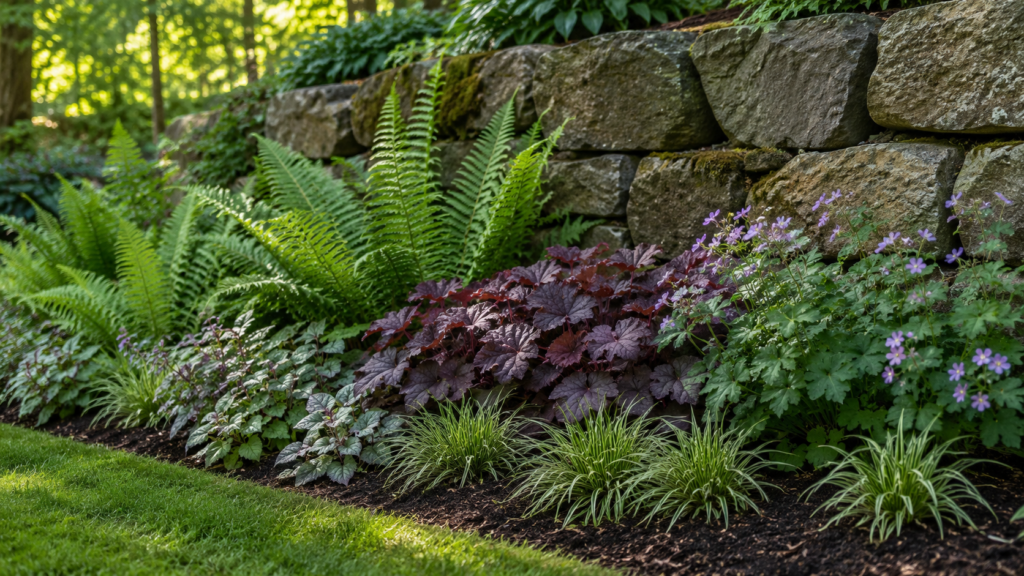
The wall base may receive shade, heat or occasional runoff. Observe the site before choosing plants and correct persistent standing water first.
Heuchera
Heuchera provides compact foliage color in partial shade. It works well between ferns, grasses and small shrubs.
Ferns
Ferns soften stone, concrete and timber walls. Match the species to the actual moisture level because some prefer damp shade while others tolerate drier conditions.
Carex and Sedges
Clumping sedges provide fine texture in narrow or shaded beds. They are often easier to control than spreading grasses.
Salvia and Hardy Geraniums
Salvia suits sunny, well-drained wall bases. Hardy geraniums form rounded mounds but vary greatly in mature spread.
Liriope and Hydrangeas
Clumping liriope can create an orderly border where it is locally suitable. Compact hydrangeas work only where the bed has enough width and moisture.
Native Perennials
Regional native plants can support wildlife and improve local adaptability, but they still need to match the wall’s light and soil.
Choose:
- Ferns and heuchera for cool shade
- Salvia and compact grasses for sun
- Sedges for narrow beds
- Hydrangeas for wider, moisture-suitable beds
- Native plants for ecological value
21 Backyard Retaining Wall Planting Ideas
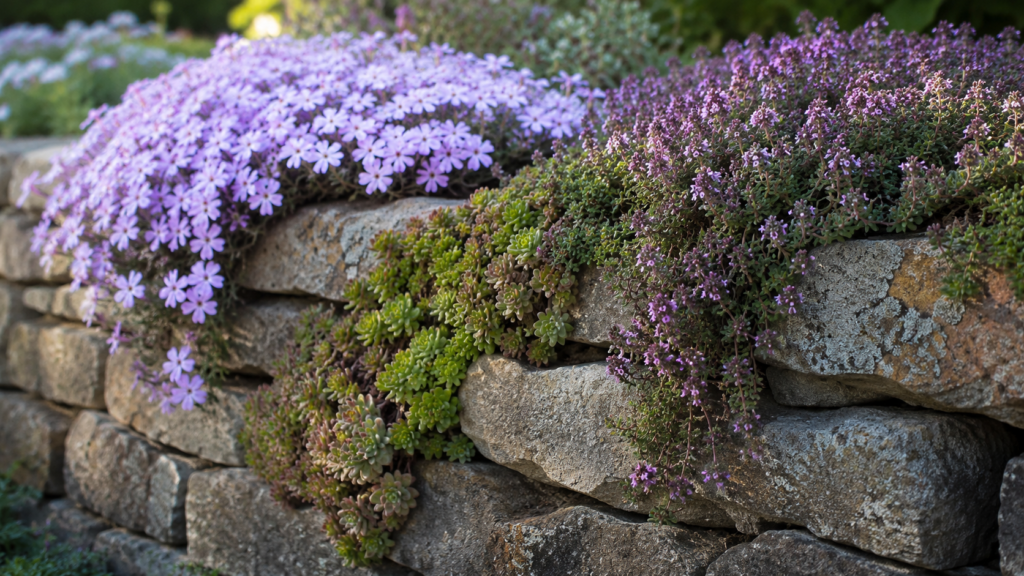
These ideas can be adapted to stone, concrete, brick, timber and block walls. Choose the concept that solves the main problem rather than copying a planting style that does not suit the site.
1. Create a Cascading Flower Edge
Plant creeping phlox, thyme or another controlled trailing perennial along selected upper sections. Repeat one flower color across the wall and keep drains and steps clear.
Best for: Low stone or block walls
Maintenance: Light trimming
2. Add Evergreen Spillers
Combine flowering plants with evergreen or semi-evergreen spillers such as low sedum or trailing rosemary in suitable climates. This prevents the wall from looking bare outside the flowering season.
Best for: Walls visible year-round
Caution: Check winter hardiness
3. Layer Shrubs, Perennials and Ground Covers
Place compact shrubs at the rear, flowering perennials in the middle and ground covers near the edge. Repeat one combination instead of changing plants every few feet.
Best for: Wide retained beds
Maintenance: Seasonal pruning and division
4. Use Ornamental Grasses
Compact grasses complement the lines of modern walls and add movement. Use one variety in repeated groups with a restrained ground cover.
Best for: Contemporary gardens
Caution: Avoid oversized or invasive forms
5. Build a Rock Garden
Use gravel mulch, small stones, sedum, sempervivum, thyme and dianthus in a sunny, fast-draining bed. Keep gravel away from drainage openings.
Best for: Hot, shallow wall tops
Maintenance: Light weeding
6. Add a Pollinator Strip
Combine early-, mid- and late-season flowers above or below the wall. Use regional nectar plants with compatible water needs.
Best for: Wildlife gardens
Decision: Prioritize local species
7. Grow Herbs Along the Ledge
Use thyme, oregano, chives, sage or compact rosemary in clean, sunny soil. Keep mint in a container so it does not spread through the bed.
Best for: Walls near outdoor kitchens
Caution: Confirm soil safety
8. Trail Strawberries Over a Low Wall
Strawberries add edible fruit and soft trailing growth. Direct runners away from drains and use mulch to keep fruit clean.
Best for: Kitchen-garden walls
Maintenance: Feeding and runner control
9. Create a Fern Garden
Combine ferns, heuchera and sedges for a foliage-led design in shade. Match the fern to the moisture level rather than assuming every shaded base is damp.
Best for: Shaded stone or timber walls
Maintenance: Remove damaged fronds
10. Add Tropical Foliage
Use compact palms, ferns, gingers or colorful foliage plants in warm climates. Keep vigorous rhizomes away from narrow structural beds.
Best for: Warm, humid gardens
11. Build a Cottage Border
Combine hardy geraniums, salvia, dianthus, bulbs and gentle trailing plants. Repeat one foliage plant and one flower color to prevent visual clutter.
Best for: Brick and natural stone
Maintenance: Moderate
12. Keep Concrete Minimal
Use repeated grasses, rounded shrubs or sculptural succulents with visible concrete between groups. Negative space makes the wall and plants feel intentional.
Best for: Modern patios
Caution: Consider reflected heat
13. Add Privacy Plants
Use compact upright shrubs or grasses behind the wall where the retained bed is broad enough. Space by mature width, not nursery size.
Best for: Upper terraces
Caution: Confirm reinforcement first
14. Frame Wall Steps
Place matching low groups on both sides of retaining-wall steps. Keep taller plants farther from the tread edges.
Best for: Tiered yards
Caution: Avoid plants that flop onto steps
15. Follow a Curved Wall
Repeat groups of three or five plants along the curve. Position taller accents in wider areas and trailing plants at prominent edges.
Best for: Curved stone or block walls
Decision: Avoid rigid straight rows
16. Plant a Narrow Base Border
Use upright, compact plants in beds 12 to 24 inches wide. Sedges, compact salvia and dwarf grasses are easier to manage than spreading shrubs.
Best for: Small yards
Maintenance: Low with correct spacing
17. Use Native Plants
Choose regional ground covers, compact perennials and small shrubs adapted to local conditions. Native does not automatically mean drought-tolerant or non-spreading.
Best for: Ecological gardens
Decision: Match each plant to the microclimate
18. Plant Dry-Stone Crevices
Use small alpines, thyme, saxifrage or sempervivum in stable crevices. Never remove supporting stones or force large root balls into gaps.
Best for: Genuine dry-stone walls
Caution: Do not plant ordinary engineered joints
19. Add Containers
Containers provide controlled soil and roots where digging is restricted. Use broad, stable pots and remember that wet containers become heavy.
Best for: Rentals and uncertain soil
20. Combine Plants With Lighting
Use low-voltage lighting to reveal wall texture and plant shape. Keep fixtures and cables accessible and avoid blind excavation behind reinforced walls.
Best for: Patios and entertaining areas
Maintenance: Clean lenses and trim foliage
21. Create Four-Season Interest
Combine spring bulbs, summer flowers, autumn grasses and evergreen structure. The goal is continuous form and texture rather than constant flowering.
Best for: Walls visible from indoor rooms
Decision: Leave space for mature growth
Plants for Different Conditions
Retaining walls create microclimates. Orientation, height and material can change heat, shade, wind and soil moisture within a small area.
| Condition | Useful plant qualities | Possible plant groups |
|---|---|---|
| Full sun | Heat and drainage tolerance | Thyme, sedum, salvia |
| Partial shade | Flexible light needs | Heuchera, geranium, carex |
| Dry shade | Root competition tolerance | Selected ferns and sedges |
| Hot wall | Small, waxy or succulent leaves | Herbs and dryland plants |
| Damp base | Moisture tolerance | Selected ferns and carex |
| Windy top | Compact flexible growth | Ground covers and grasses |
Drought-tolerant plants still require regular watering during establishment. In shade, determine whether the soil is dry or moist. At damp wall bases, correct persistent saturation before planting.
Plants for Your Climate
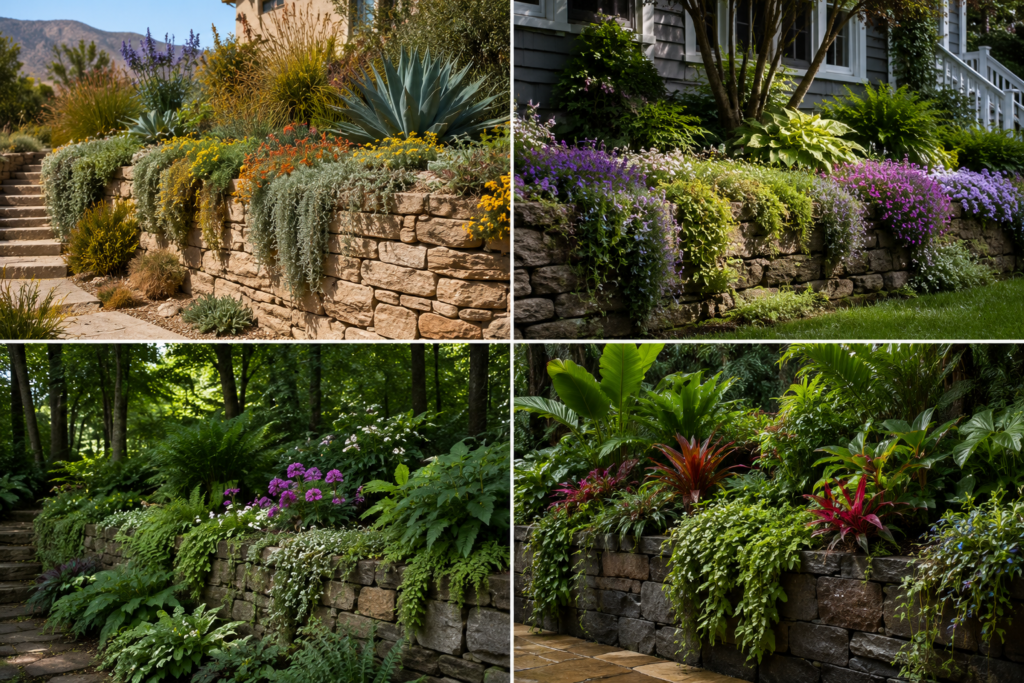
Use local plants that perform the same design function rather than forcing one species into every region.
| Design role | Hot and dry | Cool temperate | Humid | Mild Mediterranean | Tropical |
|---|---|---|---|---|---|
| Trailing edge | Thyme, low sedum | Creeping phlox | Campanula-type ground cover | Trailing rosemary | Regional trailing plant |
| Structure | Dryland shrub | Compact conifer or grass | Sedge or compact shrub | Lavender or rosemary | Compact foliage plant |
| Shaded base | Dry-shade sedge | Fern or heuchera | Fern or moisture-adapted sedge | Tough shade perennial | Tropical fern |
| Wall pocket | Succulent | Hardy alpine | Small rock plant | Thyme or dianthus | Regional lithophyte |
| Privacy | Upright shrub | Compact evergreen | Hydrangea or grass | Narrow evergreen shrub | Compact palm or foliage shrub |
Check local minimum temperatures, summer heat, humidity, rainfall and invasive-species guidance. Coastal, fire-prone and high-rainfall areas may also require specialized local planting rules.
Three Planting Layouts
Plan for the garden’s third year rather than its first month. New beds may look sparse initially, but correct spacing reduces crowding and replacement later.
10-Foot Low Wall
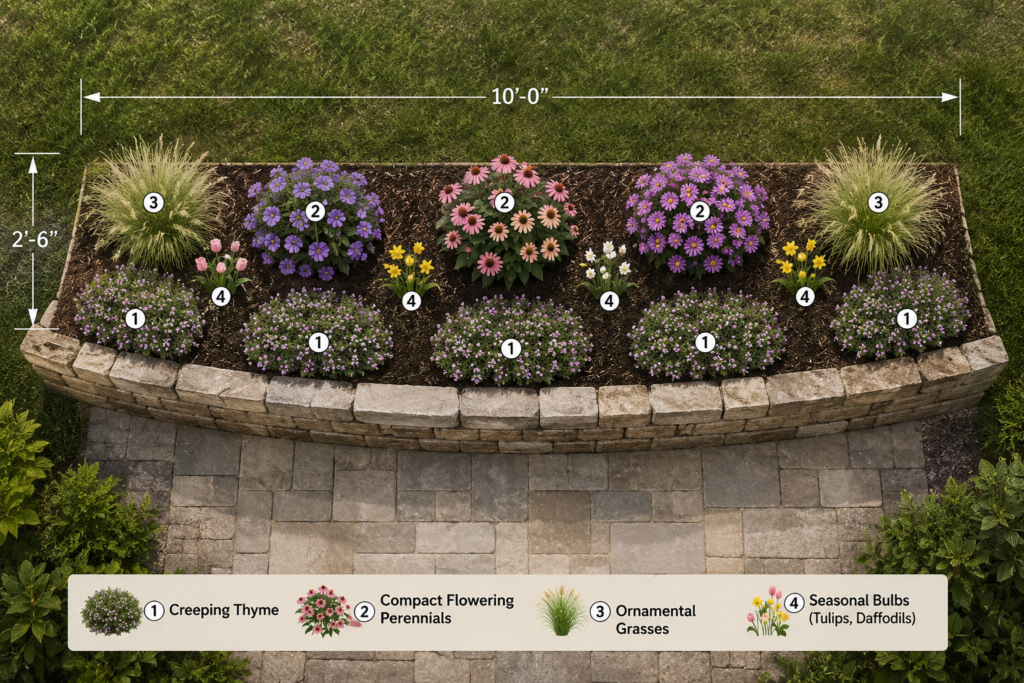
Use:
- Five creeping thyme plants
- Three compact perennials
- Two small grasses
- Six seasonal bulbs
Place grasses near both ends, perennials through the center and ground covers along the edge.
20-Foot Tiered Wall
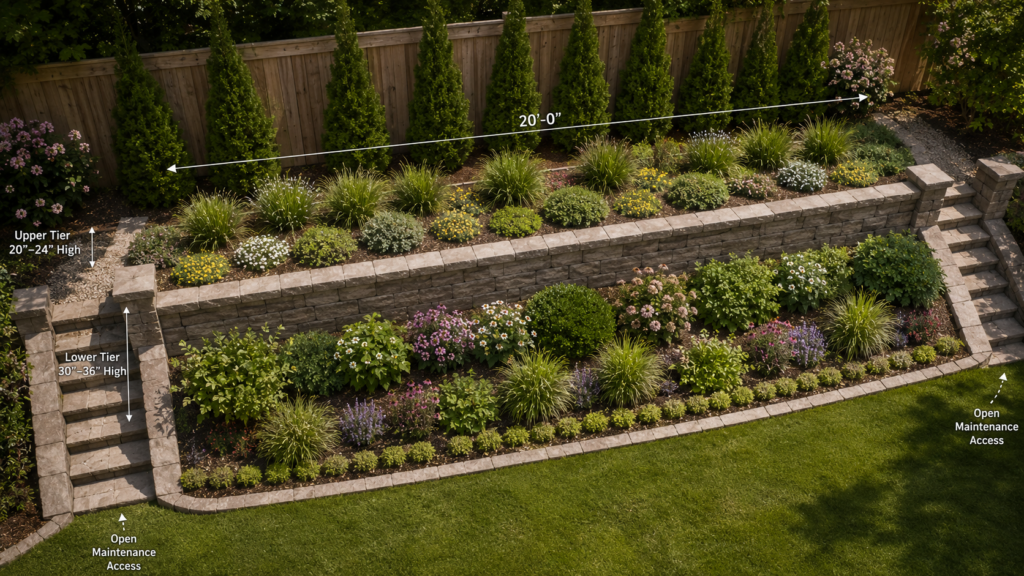
Use nine ground covers, five perennials and three grasses on the upper tier. Add three compact shrubs, five perennials and seven edging plants below.
Repeat the same combination across both halves and leave maintenance access at each end.
30-Foot Privacy Wall
Use five upright shrubs, ten flowering perennials, fifteen ground covers and five grass or evergreen accents.
Space shrubs by mature width and leave at least three inspection gaps near drains, corners or changes in level.
Safe Plant Sizes
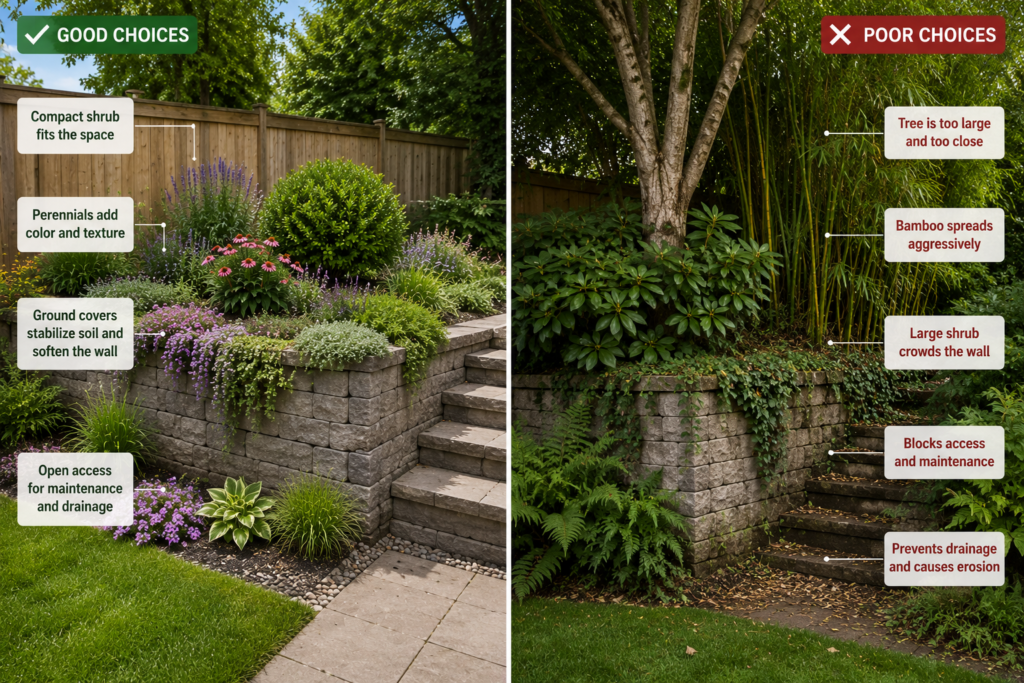
A plant is too large when its mature width exceeds the usable bed, its root ball requires excavation into structural backfill or its irrigation needs conflict with the wall’s drainage plan.
| Plant class | Relative concern | Best decision |
|---|---|---|
| Alpine or succulent | Low | Use in shallow, drained soil |
| Ground cover | Low to moderate | Control runners |
| Herbaceous perennial | Low | Match width to bed |
| Compact grass | Low to moderate | Check clump diameter |
| Small shrub | Moderate | Confirm root space |
| Large shrub | Moderate to high | Avoid narrow beds |
| Small tree | High | Obtain site-specific advice |
| Large tree | Very high | Relocate unless professionally planned |
Choose naturally compact plants instead of relying on heavy annual pruning to force large plants into restricted spaces.
Plants to Avoid
Avoid plants whose mature size, water use or spreading habit conflicts with the wall.
Large Trees
Large trees need extensive root space and are poor choices for narrow retained beds.
Running Bamboo
Running bamboo spreads through underground rhizomes and can move beyond the intended bed.
Aggressive Ground Covers
Fast-spreading ground covers may block drains or escape into adjoining beds. Check regional invasive-species guidance.
High-Water Plants
Plants requiring constant irrigation may keep retained soil wetter than necessary.
Heavy Climbers
Heavy vines can hide cracks and make maintenance difficult. Use an independent trellis where appropriate.
Oversized Shrubs
Large shrubs may cover the wall and require constant pruning. Select naturally compact cultivars instead.
Plant Without Blocking Drainage
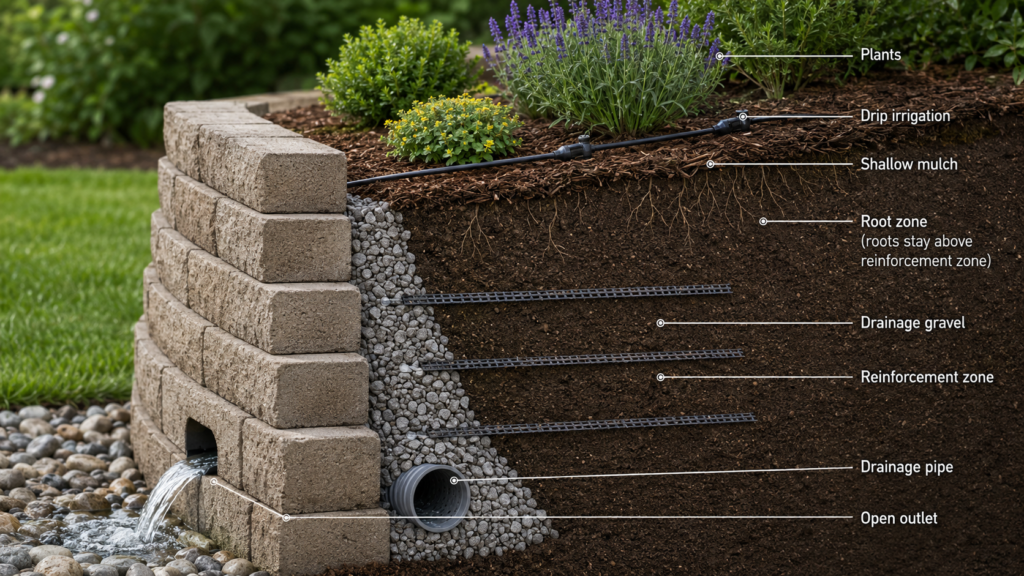
Planting should support healthy roots without keeping structural backfill saturated.
- Inspect the wall. Photograph its present condition.
- Mark drainage areas. Locate outlets, gravel, pipes and known reinforcement.
- Measure usable soil. Do not assume every visible layer is plantable.
- Select mature sizes. Space plants according to future width.
- Dig conservatively. Avoid removing large areas of compacted material.
- Keep outlets open. Leave permanent gaps around drains and weep holes.
- Use drip irrigation. Deliver water directly to root zones.
- Apply mulch lightly. Keep it away from drains and plant crowns.
- Water during establishment. Reduce frequency as roots expand.
- Inspect after rain. Check for erosion, blocked outlets and standing water.
Decision clarity: Stop and obtain site-specific advice if planting requires moving drainage gravel, cutting reinforcement or significantly changing the grade.
Common Planting Mistakes
Most retaining wall planting problems come from choosing plants for immediate appearance instead of mature size, drainage and maintenance access.
Avoid:
- Planting shrubs too closely for their mature width
- Blocking drains with mulch, leaves or trailing stems
- Mixing plants with incompatible water needs
- Filling joints that were not designed as planting pockets
- Covering the wall and losing inspection access
Before planting, confirm that every drain remains reachable, every plant fits at maturity and the wall can still be inspected after several growing seasons.
Retaining Wall Plant FAQs
What Are the Best Plants for the Top of a Retaining Wall?
Creeping thyme, low sedum, creeping phlox, candytuft and compact grasses work well in suitable climates. Choose plants that tolerate sunlight, wind and fast-draining soil.
What Should You Plant at the Bottom of a Retaining Wall?
Use compact perennials, ferns, sedges or small shrubs suited to the base conditions. Choose heuchera for partial shade and salvia or grasses for sun.
What Are the Best Cascading Plants for Retaining Walls?
Creeping thyme, creeping phlox, low sedum and selected campanulas are useful choices. Keep growth away from drains, steps and inspection points.
Which Plants Need the Least Maintenance?
Thyme, sedum, compact sedges, small grasses and locally reliable native perennials are usually easy to manage when correctly placed.
What Can Grow in Shallow Soil Above a Wall?
Use alpines, sempervivum, creeping thyme or low sedum. Choose containers when digging could disturb drainage gravel or reinforcement.
Can Tree Roots Damage a Retaining Wall?
Large roots may create problems in restricted soil or where they conflict with drainage and reinforcement. Seek site-specific advice before planting trees.
How Far Should Shrubs Be From the Wall?
There is no universal distance. Base spacing on mature width, root behavior, usable soil and wall construction.
Can You Plant Inside Retaining Wall Blocks?
Only plant inside blocks designed with planting cells. Do not fill ordinary joints that may support drainage or movement.
How Should You Water Wall-Top Plants?
Use drip irrigation or individual emitters near each root zone. Avoid repeatedly soaking the entire retained bed.
How Do You Keep Drains Clear?
Leave open gaps around outlets and weep holes. Trim trailing plants and remove leaves, mulch or soil after storms.
Can Mulch Be Used?
Yes. Apply mulch in a shallow layer and keep it away from drains, wall caps and plant crowns.
Can Plants Stabilize a Retaining Wall?
Plants may reduce minor surface erosion, but they cannot repair a leaning, cracked or poorly drained retaining wall.
How Do You Soften Concrete?
Use repeated groups of trailing plants, compact grasses and rounded shrubs. Leave some concrete visible for visual balance and easy inspection.
Can Vegetables Grow Above the Wall?
Yes, provided the soil is deep, clean and suitable for growing food. Compact herbs and strawberries are usually the easiest options.
Should Wall Plants Be Drought Tolerant?
Plants along the upper edge often benefit from drought tolerance because the soil may dry quickly. Plants at the base may need different moisture conditions.
Should Plants Cover the Entire Wall?
No. Dense planting can hide cracks, drains and structural movement. Keep selected sections of the wall visible.
What Is the Easiest Layout?
Combine one compact structural plant, one repeated flowering perennial and one low ground cover. Select plants with similar sunlight and water requirements.
Methodology and Sources
This guide evaluates retaining wall planting ideas according to wall position, soil depth, sunlight, mature plant size, moisture requirements, maintenance access and regional suitability.
Before purchasing plants, verify their botanical identity, mature dimensions, hardiness and invasive status through reliable sources such as:
- University horticultural extension services
- Botanical gardens
- Regional native-plant organizations
- Official invasive-species databases
- Retaining wall plans and manufacturer guidance
- Qualified landscape or structural professionals
This guide does not diagnose retaining wall failure. Visible movement, major cracking, soil loss or persistent saturation should be assessed before planting.
Final Planting Checklist
Successful backyard retaining wall planting begins with the wall rather than the plant list. Confirm that the wall is stable, its drainage works and the planting area contains usable soil.
Use the WALL Fit Method:
- Wall position
- Available soil
- Light and climate
- Long-term growth
Before purchasing plants, confirm that:
- Drain outlets remain visible.
- Reinforcement will not be disturbed.
- Mature plant widths fit the available bed.
- Nearby plants have compatible water needs.
- Access remains open for inspection and maintenance.
- Local invasive-species restrictions have been checked.
The strongest retaining wall gardens do not hide every block or fill every available inch. They soften selected edges, frame the wall and connect different backyard levels with plants that remain suitable as they mature.

Myra is the founder and lead writer of Backyard Planter Ideas, where she shares practical, well-researched guidance on planter design, plant selection, and outdoor styling. Her goal is to help homeowners create attractive, functional garden spaces with clear, reliable, and easy-to-apply advice.