
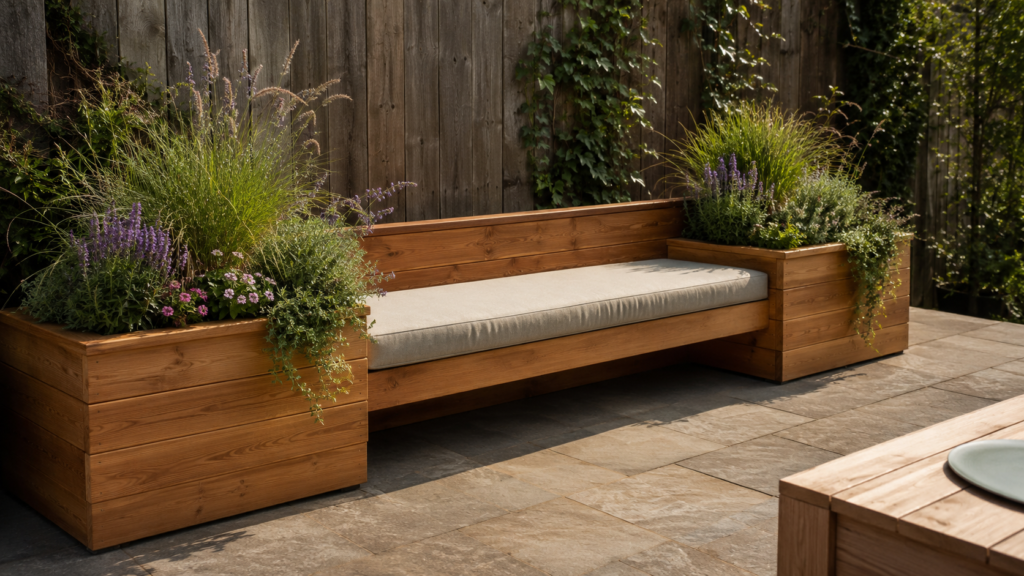
A backyard planter bench combines outdoor seating with one or more planting containers in a single structure. The most successful designs use a comfortable seat height, a separate load-bearing frame, controlled drainage, weather-resistant materials, and plants that stay clear of people using the bench.
These backyard planter bench ideas combine practical seating with planting space for patios, decks, fences, corners, and compact gardens.
Straight, corner, modular, privacy-screen, storage, raised-bed, and masonry designs can all work well. The right choice depends on available space, expected seating capacity, planting needs, climate, maintenance, and whether the structure must remain movable.
Best Backyard Planter Bench Ideas
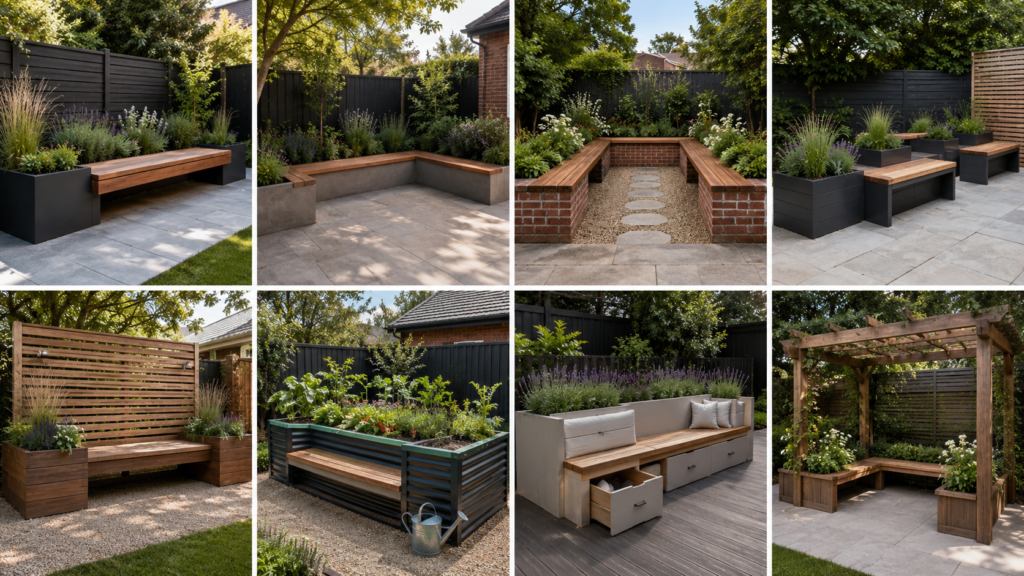
A straight bench between two independent planters is the best all-around option for most backyards. It is easier to build, drain, repair, and replant than a large permanent structure. An L-shaped design works better in an unused corner, while a modular planter bench suits renters or patios that change frequently.
The most useful backyard planter bench ideas solve a specific problem, such as limited seating, poor privacy, unused corners, or insufficient planting space.
Choose the design according to the main problem it must solve:
| Main priority | Best design |
|---|---|
| Simple DIY project | Straight planter bench |
| Small corner | L-shaped bench |
| Privacy | Trellis or screen bench |
| Flexible layout | Modular bench |
| Entertaining | U-shaped bench |
| Low maintenance | Composite or masonry bench |
| Herb growing | Kitchen-side herb bench |
| Traditional yard | Brick planter bench |
| Modern yard | Concrete or floating bench |
| Storage | Bench with isolated dry storage |
Use these quick rules:
- Choose a straight bench for simplicity.
- Choose an L-shaped bench for unused corners.
- Choose a modular bench when future movement matters.
- Choose a privacy bench when screening is the main goal.
- Choose masonry only when the layout is permanent.
- Choose storage only when it can remain separate from soil and drainage.
Planter Bench Dimensions
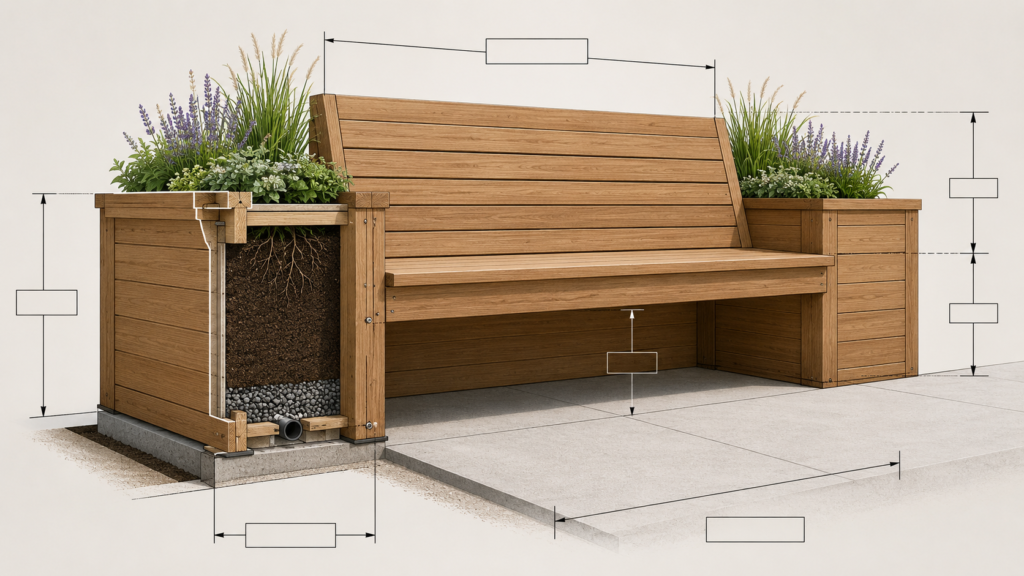
Comfort depends on seat height, depth, back support, planter width, and available legroom. The following figures are useful planning ranges rather than universal construction requirements.
Comfort is one of the most important considerations when comparing backyard planter bench ideas, because attractive seating will be underused if it is too high, deep, or narrow.
| Component | Practical range |
|---|---|
| Seat height | 17–19 in / 43–48 cm |
| Seat depth | 18–22 in / 46–56 cm |
| Width per person | 22–24 in / 56–61 cm |
| Two-person seat | 48–60 in / 122–152 cm |
| Three-person seat | 66–78 in / 168–198 cm |
| Backrest above seat | 14–20 in / 36–51 cm |
| Planter width | 14–24 in / 36–61 cm |
| Preferred walkway | 36 in / 91 cm |
Before building, test the proposed height and depth with an existing chair or temporary boards. Include cushion thickness in the final measurement.
A comfortable planter bench should allow users to:
- Rest both feet on the ground
- Stand without excessive effort
- Lean against the backrest naturally
- Keep elbows clear of planter walls
- Sit without plants touching their face or shoulders
- Leave enough space for others to walk past
The seat should transfer weight through posts, framing, brackets, masonry, or another dedicated support system. Decorative planter panels should not be assumed to carry human loads.
Example 8 × 6-Foot Patio Layout
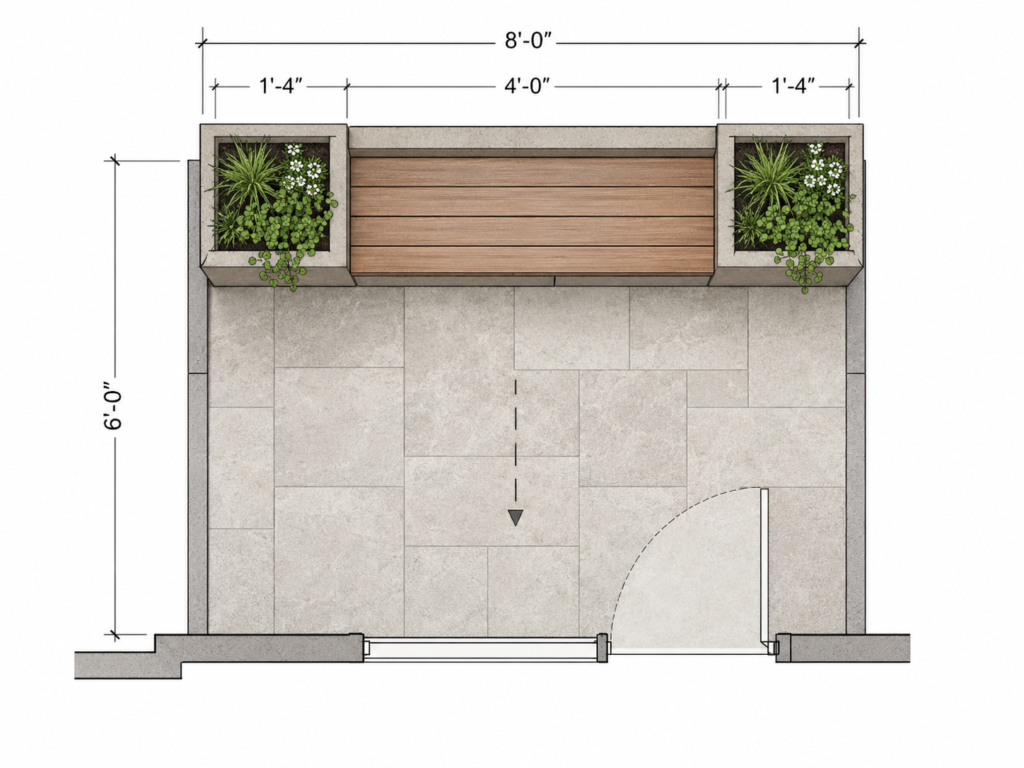
Compact backyard planter bench ideas work best when the planters, seat, door swing, and walking route are measured together.
A compact 8 × 6-foot patio can hold a two-person planter bench with:
- A 48-inch seat
- Two 16-inch planters
- An 18–20-inch seat depth
- A 17–19-inch seat height
- A preferred 36-inch clear route
- Drainage directed away from doors and walkways
Mark the full footprint before installation and test door swing, legroom, and circulation. A shorter bench with healthy planter volume is better than a longer seat connected to boxes that are too shallow.
21 Backyard Planter Bench Ideas
These backyard planter bench ideas include movable DIY options, space-saving corner layouts, privacy designs, storage benches, and permanent masonry installations.
1. Straight Bench Between Two Planters
This is the simplest and most versatile layout. It works beside a fence, patio edge, wall, or garden path. Build the seat on its own frame and use the planters as separate connected units. Compact herbs, annuals, sedges, and low evergreens work well.
2. L-Shaped Corner Planter Bench
An L-shaped bench turns an unused corner into a defined seating area. Place taller plants in the internal corner and shorter plants near the open ends. Leave access for fence repairs, drainage, and cleaning.
Explore related backyard corner planter ideas before making the structure permanent.
3. U-Shaped Conversation Bench
A U-shaped bench creates a social area around a table, fire feature, or open central space. It supports face-to-face seating but requires more room. Keep one side open for circulation, serving, and cleaning.
4. Fence-Line Planter Bench
A fence-line bench preserves open lawn or patio space in a narrow backyard. Use independent structural support rather than relying on the fence. Leave enough room for airflow, drainage, staining, and future repairs.
Use mature plant dimensions when selecting the best plants along a backyard fence.
5. Deck-Edge Planter Bench
A deck-edge bench softens the platform perimeter and reduces the need for freestanding chairs. Confirm that the deck can support the bench, wet growing medium, retained water, mature plants, and users.
Compare the design with other backyard deck planter ideas before building.
6. Raised-Bed Bench
A wide ledge added to a raised garden bed creates occasional seating for gardening breaks, tool placement, or child supervision. Add a backrest if the seat will be used for longer periods. Keep irrigation and soil behind a proper liner.
7. Privacy-Screen Planter Bench
This design combines seating with a vertical screen, trellis, or slatted panel. It suits overlooked patios and neighboring windows. Tall screens must be anchored correctly because wind pressure can make lightweight structures unstable.
8. Pergola Planter Bench
A pergola planter bench creates shade and supports climbing plants. Use deep planters and plants suited to the local climate. Pergola posts need their own structural support rather than relying on thin planter walls.
9. One-Person Planter Bench
A compact one-person bench works on balconies, courtyards, and narrow patios. A seat width of about 24–30 inches usually feels comfortable. Use one simple planting arrangement rather than crowding several species into a small box.
10. Modular Planter Bench
Modular planter boxes connected by removable seat boards can form a straight line, corner, or separate stools. This design is easy to move, repair, and reconfigure.
When seating is not essential, DIY outdoor plant stand ideas may provide a simpler solution.
11. Planter Bench With Storage
A storage bench can hold cushions, small tools, or outdoor games. The dry compartment must remain fully separate from soil, irrigation, and drainage. Use exterior-rated hinges, ventilation, and a supported lid.
12. Herb Planter Bench
Place an herb planter bench near a grill, back door, or outdoor kitchen. Rosemary, thyme, sage, parsley, chives, and seasonal basil are useful choices. Keep mint inside a separate pot so it cannot spread through the entire planter.
13. Edible Planter Bench
Strawberries, lettuce, compact peppers, parsley, and dwarf tomatoes can grow in an edible planter bench. Use container growing mix and keep edible plants away from roof runoff, pets, treated surfaces, and heavy foot traffic.
14. Pollinator-Friendly Bench
Lavender, thyme, compact salvia, calendula, catmint, and local native flowers can support pollinators. Place the busiest blooms behind or beside the seat rather than directly beside users’ faces and hands.
15. Concrete Planter Bench
Concrete creates a strong modern feature and pairs well with gravel, large paving, evergreen shrubs, and ornamental grasses. Because it is heavy and difficult to alter, confirm dimensions, drainage, and foundations before construction.
16. Brick Planter Bench
Brick suits traditional homes, courtyards, and existing masonry. Use a moisture barrier between soil and structural surfaces and direct runoff away from visible brickwork.
Review related backyard brick planter ideas when matching walls or paving.
17. Corten Steel and Timber Bench
Weathering steel planters with timber seating create a modern industrial look. Steel walls provide more internal planting space than thick masonry, but early rust-colored runoff can stain light paving. Use folded or capped edges near users.
18. Cedar Planter Bench
Cedar is attractive, lightweight, and easy to work with. Keep soil away from structural boards, protect cut ends, and use exterior-rated fasteners. Apply a finish to preserve the color or allow the wood to weather naturally.
19. Composite Planter Bench
Composite boards require less routine refinishing than natural timber. They work well for seats, cladding, and backrests, but many products still need a structural frame beneath them. Follow the manufacturer’s span and fastening guidance.
20. Curved Planter Bench
A curved bench can wrap around a tree, sculpture, water feature, or circular bed. Leave room for tree trunk growth, roots, airflow, and water movement. A partial arc is often more practical than a full circle.
21. Floating Planter Bench
A floating bench hides its supports to create a clean modern appearance. Concealed steel framing or reinforced masonry may be required. Leave enough space beneath the seat for cleaning and inspection.
Best Planter Bench Materials
The best material depends on appearance, climate, cost, maintenance, and structural needs.
| Material | Main advantage | Main limitation |
|---|---|---|
| Cedar | Attractive and easy to work | Needs maintenance |
| Treated timber | Economical structural material | Requires suitable fasteners |
| Composite | Low surface maintenance | Higher cost |
| Brick | Stable and traditional | Difficult to alter |
| Concrete | Durable and modern | Heavy |
| Weathering steel | Slim and distinctive | May stain |
| Powder-coated metal | Strong, compact profile | Finish can chip |
| Stone | Long-lasting | Expensive and heavy |
The best materials for backyard planter bench ideas depend on local weather, maintenance expectations, structural needs, and whether the bench will remain permanent.
Use cedar for natural DIY projects, treated timber for framing, composite for lower maintenance, and masonry for permanent installations.
Good detailing matters more than material alone. Keep wet soil away from timber, protect cut ends, use exterior fasteners, and avoid places where water can remain trapped.
Drainage and Planter Depth
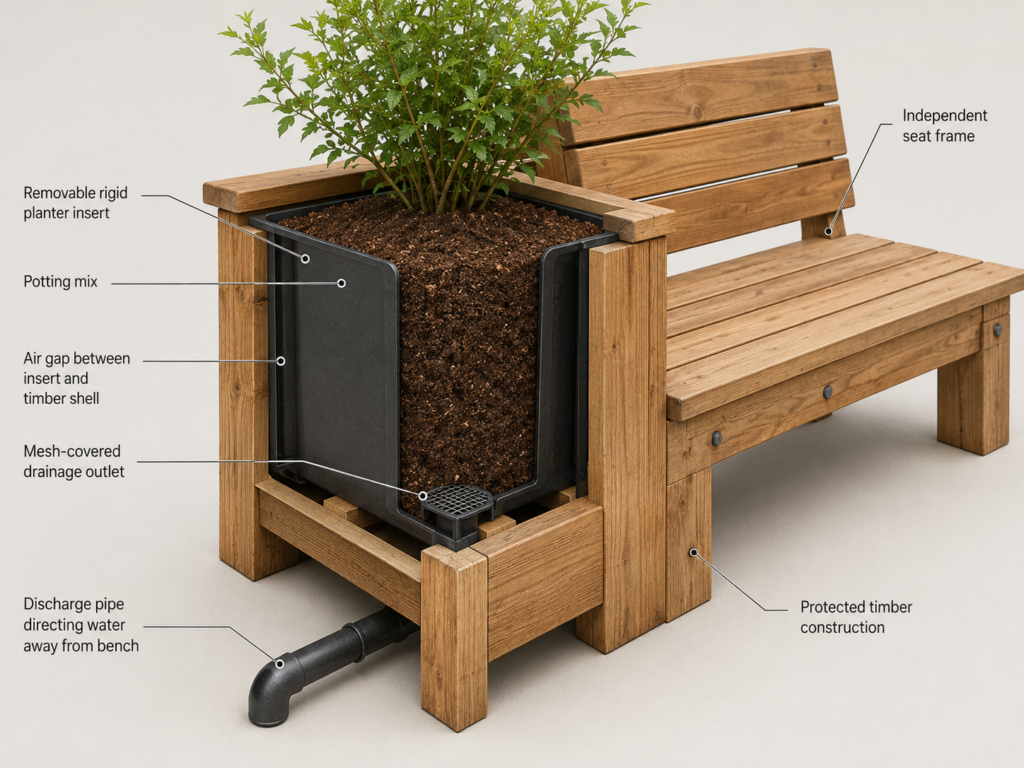
Drainage protects both the plants and the structure. A planter bench should include a removable insert or liner, openings at the lowest points, mesh over large outlets, and a controlled route for discharged water.
Successful backyard planter bench ideas keep drainage water away from the seat frame, storage compartment, walls, and walking surfaces.
Do not use gravel as a substitute for drainage holes. Gravel reduces root space and does not solve a sealed planter.
| Planting system | Maintenance | Moisture risk |
|---|---|---|
| Removable pots | Very easy | Low |
| Rigid inserts | Easy | Low |
| Fully lined box | Moderate | Medium |
| Reservoir planter | Moderate | Medium |
| Soil against structural wood | Difficult | High |
For most wooden benches, rigid or removable inserts are the safest choice.
Planter depth should match the plants:
| Plant group | Suggested depth |
|---|---|
| Annuals and succulents | 8–10 in |
| Herbs and small flowers | 10–12 in |
| Strawberries and lettuce | 10–14 in |
| Perennials | 12–18 in |
| Ornamental grasses | 16–20 in |
| Small shrubs | 18–24+ in |
Total soil volume matters as much as depth. A slightly wider planter usually holds moisture more reliably than a narrow, deep box.
Best Plants for Planter Benches
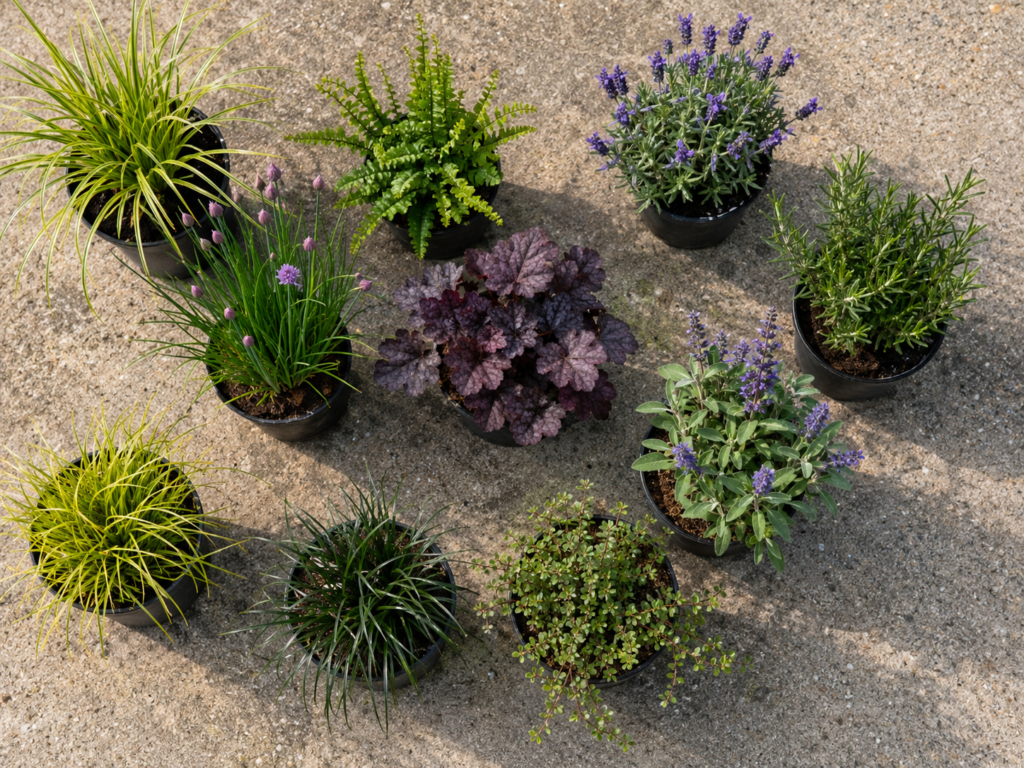
Plants beside seating should remain compact, soft, manageable, and relatively tidy. Planter-bench planting follows many of the same grouping principles used in backyard ideas with potted plants, but the plants must stay especially clear of users.
Plants used in backyard planter bench ideas should remain compact, non-thorny, container-friendly, and manageable at their mature size.
Good choices include:
- Heuchera
- Dwarf mondo grass
- Compact sedges
- Small ferns
- Creeping thyme
- Rosemary
- Lavender
- Chives
- Compact salvia
- Strawberries
- Clumping ornamental grasses
- Columnar shrubs
Use low plants near armrests, medium-height plants at the planter ends, and taller plants behind the backrest.
A simple planting formula is:
- One upright structural plant
- One rounded filler
- One restrained trailing plant
Avoid thorny roses, sharp grasses, spiny succulents, aggressive mint, staining fruit, toxic plants in family yards, and shrubs that will eventually cover the seat.
Match plants to the exact site:
- Use drought-tolerant plants in hot full sun.
- Use low flexible plants on windy decks.
- Use ferns and foliage plants in shade.
- Use container-hardy plants in cold climates.
- Use open planting and good airflow in humid areas.
- Use salt-tolerant plants and corrosion-resistant hardware near coasts.
Build a Simple Planter Bench
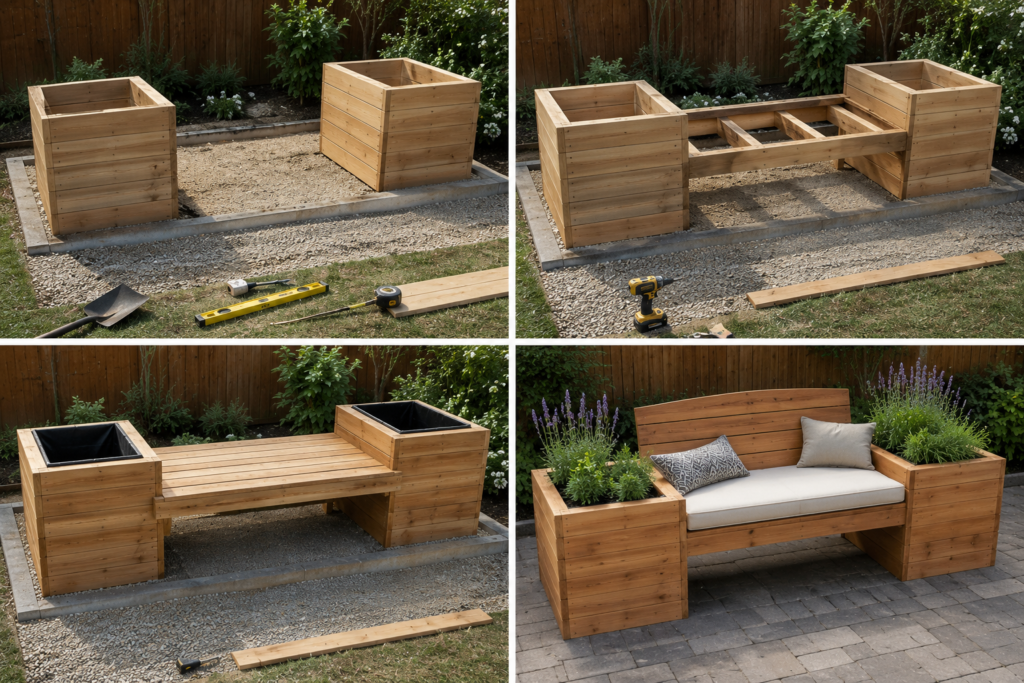
This is a planning sequence rather than an engineered construction plan.
- Measure the complete site, including walkways and mature plant spread.
- Choose a load-bearing support system.
- Prepare a firm, level base.
- Build the planter shells with room for inserts and drainage.
- Build the independent seat frame.
- Install liners, outlets, and discharge pipes.
- Add the seat and backrest.
- Test stability and drainage.
- Add container mix and plants.
Reclaimed timber can reduce costs, but it must be structurally sound and suitable for outdoor exposure. Review DIY pallet planter ideas before using reclaimed boards.
Build the bench yourself when it is freestanding, ground-level, modest in size, and based on a proven plan. Hire professional help for elevated decks, balconies, masonry, retaining structures, tall screens, pergolas, lighting, plumbing, or attachments to a building.
Cost and Build-or-Buy Decision
Planter bench cost depends on material, length, foundations, labor, drainage, storage, irrigation, and planting.
The cost of backyard planter bench ideas varies according to bench length, planter volume, materials, foundations, drainage, and professional labor.
| Project type | Relative cost |
|---|---|
| Basic timber bench | Low |
| Modular bench | Low |
| Prefabricated bench | Low–medium |
| Cedar custom bench | Medium |
| Composite bench | Medium–high |
| Brick or block bench | Medium–high |
| Custom metal bench | High |
| Concrete bench | High |
Build when custom dimensions and design control matter. Buy when quick installation, predictable parts, and a stated seating capacity are more important.
Before buying, check:
- Usable seat width
- Finished seat height
- Internal planter dimensions
- Drainage-hole position
- Frame material
- Published seating capacity
- Assembly requirements
- Empty and filled weight
- Warranty
- Replacement parts
Do not rely only on product photographs. Compare written specifications with the marked space in your backyard.
Safety and Common Mistakes
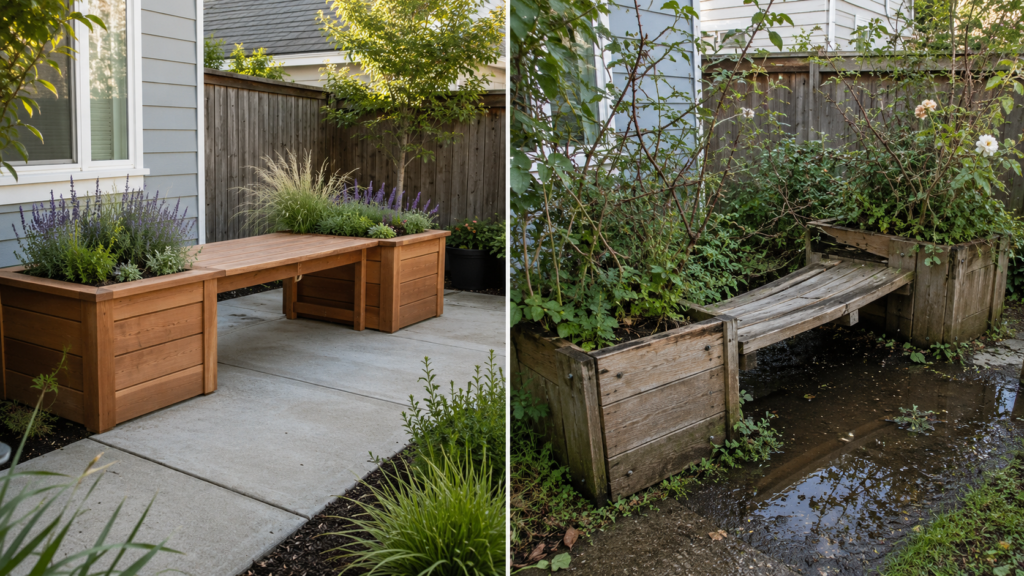
A safe planter bench needs a level base, a strong frame, smooth edges, clear walkways, and controlled drainage.
Use:
- Independent seat support
- Rounded corners
- Exterior-rated fasteners
- Non-slip surrounding surfaces
- Secure storage lids
- Clear irrigation routes
- Plants kept away from faces and paths
- Stable armrests where needed
Common mistakes include:
| Mistake | Better approach |
|---|---|
| Soil touches timber | Use an insert or liner |
| No drainage outlet | Add accessible holes |
| Seat relies on thin planter walls | Build a separate frame |
| Seat is too high or deep | Test dimensions first |
| Planters are too narrow | Increase soil volume |
| Plants are chosen while small | Check mature size |
| Storage shares wet space | Isolate the compartment |
| Drainage crosses paving | Redirect runoff |
| Deck capacity is ignored | Confirm structural support |
| No cleaning access | Add removable panels |
Before construction, confirm that every drain can be cleaned, every wet component can dry, the seat can be repaired separately, and mature plants will remain clear of users.
Planter Bench Maintenance
Inspect the planter bench several times each year.
Spring
Clean drainage outlets, tighten fasteners, inspect liners, refresh potting mix, and refinish exposed timber where needed.
Summer
Check moisture frequently, keep drains open, prune plants away from the seat, and watch for hot metal or dark surfaces.
Autumn
Remove leaves from gaps, clean hinges, store cushions, and repair damaged finishes.
Winter
Protect vulnerable plants, drain irrigation lines in freezing climates, prevent standing water, and keep storage compartments dry.
Final Planning Checklist
Before committing to any backyard planter bench ideas, confirm the seat dimensions, structural support, planter depth, drainage route, and mature plant size.
Before building or buying, confirm:
- The site has been measured.
- Doors and walkways remain clear.
- The seat height and depth are comfortable.
- The structure can support users and wet soil.
- The planters provide enough root volume.
- Drainage moves away from the seat.
- Soil remains separated from structural timber.
- Plants suit the climate and mature space.
- Maintenance access remains available.
- The full project cost has been calculated.
Do not begin a permanent installation until the drainage route, structural support, finished seat height, and planter volume are settled.
Backyard Planter Bench Ideas FAQs
What is a planter bench?
A planter bench combines outdoor seating with one or more planting containers. The seat should have its own structural support while the planter manages soil and drainage.
What is the best design for a small backyard?
A straight bench between two compact planters is usually the best option. It preserves circulation and is easier to build and repair.
How tall should a planter bench be?
A finished seat height of about 17–19 inches suits many adults. Include cushion thickness in the measurement.
How deep should the seat be?
A depth of about 18–22 inches works for most benches. Deeper seats usually need cushions or better back support.
How deep should the planters be?
Use 10–12 inches for herbs and annuals, 12–18 inches for perennials, and 18–24 inches or more for small shrubs.
Does a planter bench need drainage holes?
Yes. Drainage holes allow excess water to leave and should direct runoff away from timber, storage, walls, and walkways.
Can planter boxes support the seat?
Only boxes designed for human loads should support seating. Most DIY benches should use a separate load-bearing frame.
What plants work best?
Choose compact, non-thorny plants such as heuchera, thyme, rosemary, lavender, sedges, chives, or small ferns.
Can a planter bench go on a deck?
Yes, but only after confirming the deck can support the bench, wet soil, plants, retained water, and users.
Is it better to build or buy?
Build when custom dimensions matter. Buy when faster installation, predictable assembly, and a stated capacity are more important.
Conclusion
The best backyard planter bench ideas combine comfortable seating, healthy planting space, reliable drainage, and manageable maintenance.
A simple straight bench with removable planter inserts will often perform better than a complicated permanent design. When structure, drainage, planting, and maintenance are planned together, a planter bench can add useful seating, greenery, privacy, and visual structure without wasting backyard space.

Myra is the founder and lead writer of Backyard Planter Ideas, where she shares practical, well-researched guidance on planter design, plant selection, and outdoor styling. Her goal is to help homeowners create attractive, functional garden spaces with clear, reliable, and easy-to-apply advice.