
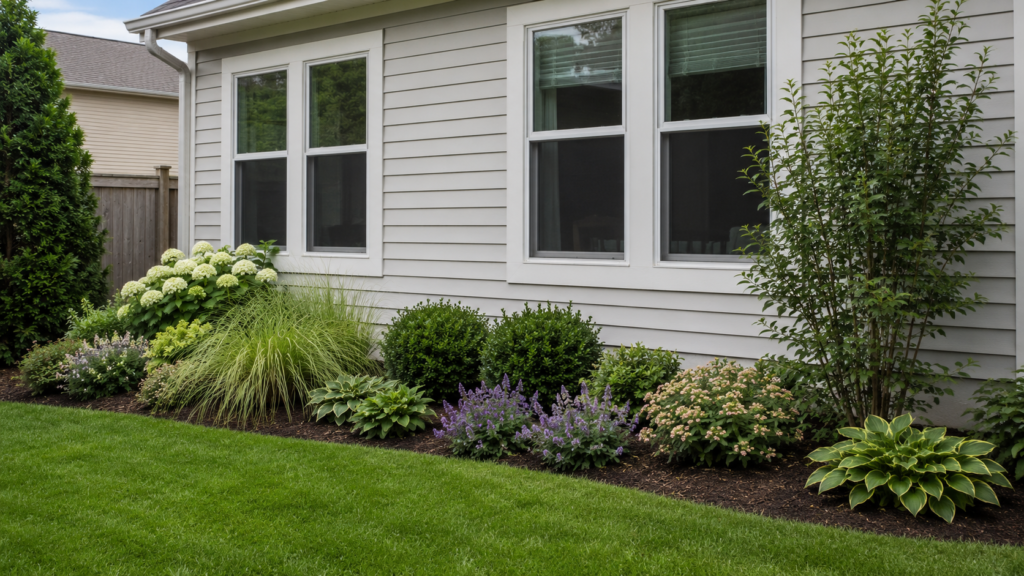
The best backyard foundation planting ideas soften the house while protecting drainage, windows, utilities, access, and maintenance space. Start with water movement and mature plant size, then choose shrubs, grasses, perennials, groundcovers, and seasonal plants suited to the sunlight, soil, climate, and available bed depth.
Foundation planting is landscaping placed directly beside a building. In a backyard, it can connect the house to lawns, patios, paths, privacy planting, and surrounding garden beds.
A successful foundation bed should still work after the plants mature. It should not block windows, hide drainage components, interfere with utilities, trap moisture against the building, or require constant corrective pruning.
Use this planning order:
drainage → building access → bed depth → mature plant size → sunlight → structural plants → supporting plants → edging → irrigation → maintenance
Design for the mature garden and the functioning house, not for the empty space visible on planting day.
Best Backyard Foundation Planting Ideas
The best layout depends on the house and the space beside it. A deep wall facing open lawn can support layered planting, while a narrow passage may only support one compact row. Blank walls can handle more height, but plants beneath windows should usually stay low.
Before choosing a design, check:
- available bed depth;
- mature plant width;
- windows and doors;
- downspouts;
- utilities;
- sunlight;
- drainage;
- maintenance access.
1. Create a Layered Foundation Border
Use low flowers or groundcovers along the front edge, medium perennials or compact shrubs behind them, and taller structural plants where the wall has enough height.
A practical arrangement is:
house → structural plants → medium plants → low edge → lawn
Avoid rigid rows. Slight overlap between groups creates a more natural appearance.
Best for: medium and deep foundation beds.
2. Keep Plants Low Beneath Windows
Measure from the planting level to the bottom of the windowsill before selecting plants. Use naturally compact shrubs, grasses, perennials, or groundcovers.
Also check mature width. A low shrub can still spread across a path or press against the wall.
Keep windows accessible for cleaning, painting, screens, repairs, and inspection.
Choose plants that naturally fit below the window instead of relying on repeated pruning.
3. Repeat Compact Shrubs
Instead of planting one continuous hedge, repeat compact shrubs with deliberate gaps.
Those gaps can contain:
- flowers;
- grasses;
- bulbs;
- utilities;
- maintenance access.
Repeated shrubs create visual rhythm while allowing each plant to retain a more natural shape.
4. Combine Evergreen Structure With Seasonal Flowers
Use evergreen or persistent shrubs where suitable to create year-round structure, then add flowering perennials, bulbs, grasses, or groundcovers.
The structural plants should keep the bed organized when seasonal flowers disappear.
For an international garden, choose evergreen plants locally rather than assuming the same species performs well everywhere.
5. Use Foliage Along Shaded Walls
A shaded foundation wall does not need to depend on flowers.
Combine locally suitable foliage plants with contrasting:
- leaf size;
- texture;
- height;
- shape.
Ferns, sedges, shade-tolerant shrubs, broad-leaved perennials, and low groundcovers can create strong structure.
Remember that shaded walls beneath roof overhangs may also be unusually dry.
6. Use Compact Flowering Shrubs Below Wide Windows
Wide windows often look better with two or three compact flowering shrubs rather than one large plant centered beneath the glass.
Choose plants according to mature dimensions and add lower plants toward the bed edge.
This creates seasonal color without blocking views or forcing repeated pruning.
7. Combine Groundcovers With Small Shrubs
Shallow foundation beds often work better with fewer layers.
Try:
small shrub groups → low groundcover → lawn or path
The shrubs provide structure while the groundcover visually connects the planting.
Check spread rate and local invasive status before using vigorous groundcovers.
8. Use Ornamental Grasses as Vertical Accents
Grasses can add movement and height without using as much horizontal space as broad shrubs.
Use them beside blank walls, near corners, or between structural shrubs.
Check mature height, width, seasonal appearance, and invasiveness before planting.
9. Anchor a Blank Wall With One Structural Shrub
A large uninterrupted wall often benefits from one stronger plant form.
Use an appropriately scaled shrub as the main anchor, then connect it to the rest of the bed with smaller repeated plants.
Do not use an oversized shrub simply because the wall looks empty.
10. Add Height at a House Corner
House corners often benefit from a taller plant because they visually connect two walls.
Use a narrow shrub, small multi-stem plant, or another vertical form, then step the planting down toward windows, patios, or paths.
Check roof clearance, mature spread, gutters, and utilities first.
11. Use a Small Tree Only Where Space Allows
A small tree can visually connect the house to the wider backyard, but it needs more space than an ordinary foundation shrub.
Consider:
- mature canopy;
- root space;
- utilities;
- roof clearance;
- soil;
- drainage;
- wind.
If the bed cannot support the tree at maturity, move it farther into the yard.
12. Add a Freestanding Trellis
A freestanding trellis works well where vertical interest is needed but horizontal planting space is limited.
Leave enough access for pruning and wall maintenance.
Choose climbing plants according to mature weight, growth habit, invasiveness, climate, and maintenance needs.
13. Use a Single-Layer Narrow Bed
A narrow passage should not imitate a deep mixed border.
Use one compact planting layer:
compact shrub → low flowers → open space → repeat
This protects walking space and reduces future pruning.
14. Leave Gaps Around Utilities
Meters, taps, outlets, drains, cleanouts, and utility boxes need usable access.
Create deliberate openings instead of hiding every feature with permanent plants.
A simple pattern is:
shrub → flowers → utility gap → flowers → shrub
Movable containers can provide color where permanent access is important.
15. Screen Equipment Without Blocking It
Air-conditioning units, heat pumps, vents, and other equipment may require specific airflow and servicing space.
Follow the manufacturer’s clearance requirements rather than using a generic planting distance.
Place shrubs, containers, or screens outside the functional service zone.
Screen the view, not the equipment’s function.
16. Use Containers Where Permanent Planting Is Impractical
Containers work well around doors, patios, paved walls, rented properties, and utility areas.
They can also help test how much plant mass a wall needs before permanent planting is installed.
Containers usually need more frequent watering than in-ground beds.
17. Keep Downspouts Open
Map downspouts before planting permanent shrubs.
Do not place plants where roof water needs to discharge or where extensions need access.
After significant rain, check for:
- blocked outlets;
- erosion;
- displaced mulch;
- pooling;
- disconnected extensions.
Drainage should determine the planting gap.
18. Add a Gravel Maintenance Strip
A narrow gravel or mineral strip can create separation between plants and the wall.
It may provide:
- easier inspection;
- maintenance access;
- cleaner wall separation;
- a simple modern appearance.
Gravel does not fix poor grading or drainage by itself.
19. Add Access Behind Deep Beds
Deep foundation borders can become difficult to maintain when plants mature.
Where space allows, add discreet:
- stepping stones;
- mulch paths;
- access gaps;
- openings between shrubs.
These provide access to windows, downspouts, walls, and the rear sides of plants.
20. Group Plants With Similar Water Needs
Plants growing beside each other should ideally have compatible moisture requirements.
Grouping plants by water needs makes irrigation easier and reduces unnecessary watering near the building.
Avoid combining very thirsty plants with drought-adapted plants if they share the same irrigation zone.
21. Repeat a Low-Maintenance Plant Palette
One of the simplest long-term foundation designs uses fewer plant types repeatedly.
Choose:
- one or two structural plants;
- one medium flowering or foliage plant;
- one low edging plant;
- optional seasonal accents.
Repeated planting creates stronger visual rhythm and makes maintenance more predictable.
What to Check Before Foundation Planting
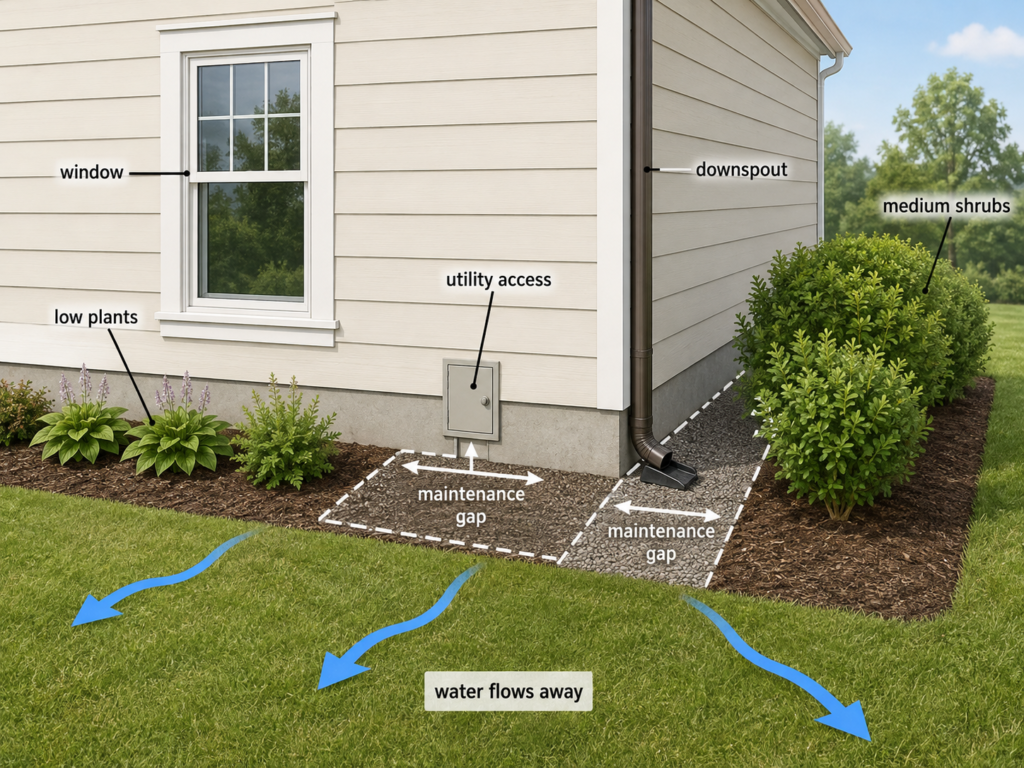
Inspect the house before choosing plants. Windows, doors, utilities, equipment, drainage components, and circulation all reduce the space available for permanent planting.
Check:
- roof runoff;
- ground drainage;
- window height;
- doors;
- utilities;
- equipment;
- actual sunlight;
- soil drainage;
- bed depth;
- mature plant dimensions;
- irrigation;
- maintenance access.
Observe the area during significant rain whenever possible. Water movement that is invisible in dry weather may reveal drainage problems.
Determine the available mature footprint first, then select plants that naturally fit it.
How Far Should Plants Be From the House?
There is no universal plant-to-house distance suitable for every shrub, tree, building, climate, soil, foundation, or pest environment.
A useful planning principle is:
building clearance + approximately half the mature plant width = preliminary plant-center position
This is a landscape-planning method, not a universal building rule.
If a shrub matures to 4 feet wide, approximately 2 feet of its spread extends from the center toward the wall. Additional room may be needed for inspection, airflow, pruning, or local requirements.
Ask:
- Will the mature plant touch the wall?
- Can someone reach behind it?
- Will it block windows?
- Will utilities remain accessible?
- Does the foundation need visible inspection space?
Plan from mature size, not nursery size.
Foundation Planting Drainage and Runoff
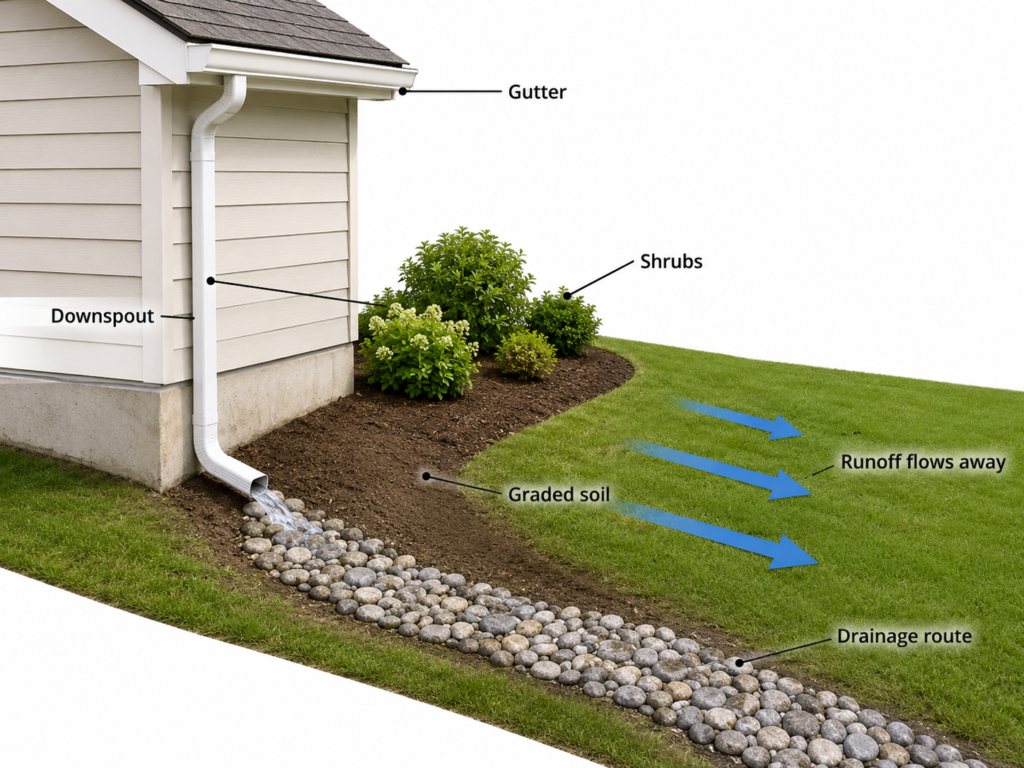
Foundation planting should work with the property’s drainage system.
Gutters, downspouts, grading, soil, paths, patios, and drains determine how water moves. Decorative planting should fit around those systems.
During rain, check:
- where downspouts discharge;
- whether gutters overflow;
- whether water moves away from the wall;
- where soil stays saturated;
- whether mulch washes;
- whether paving directs water toward the house.
Do not create a shallow basin against the building by adding excessive soil, raised edging, or other materials that redirect water.
Gravel can provide maintenance access, but it does not automatically correct drainage.
Solve water movement first. Plant afterward.
How to Test Soil Drainage
Soil drainage and foundation drainage are different issues.
A horticultural soil test can help determine whether roots are likely to remain in poorly drained soil. It does not diagnose structural foundation drainage.
A simple landscape drainage test can involve filling a test hole with water and observing how quickly it drains.
Also observe the site during real rain for:
- pooling;
- slow-draining soil;
- erosion;
- saturated areas;
- gutter overflow;
- runoff from patios.
If water consistently collects against the house, investigate the larger drainage issue before installing permanent planting.
How to Choose Foundation Plants
Choose plant roles first and individual species second.
A foundation bed may need:
- structural shrub;
- compact flowering shrub;
- upright accent;
- ornamental grass;
- medium perennial;
- low groundcover;
- climber.
Then select species according to:
- climate;
- rainfall;
- irrigation;
- sunlight;
- soil;
- wind;
- mature dimensions;
- invasive-species rules.
House walls also create microclimates. One section may be shaded and dry under an overhang while another receives reflected heat or concentrated water from a downspout.
Copy the spatial logic from inspiration photos, then choose the actual plants locally.
Best Plants for Foundation Beds
Common foundation planting roles can be filled by many different plants.
Examples include:
- compact evergreen structure: locally suitable compact evergreen shrubs;
- flowering shrub: compact flowering varieties;
- shade foliage: ferns, sedges, and foliage perennials;
- sunny perennials: locally suitable flowering perennials;
- vertical texture: ornamental grasses;
- low edge: compact groundcovers or low perennials.
Before buying, verify:
- cultivar name;
- mature height;
- mature width;
- sunlight;
- drainage;
- water needs;
- invasive status.
Different cultivars of the same plant can have very different mature sizes.
How to Arrange Foundation Plants
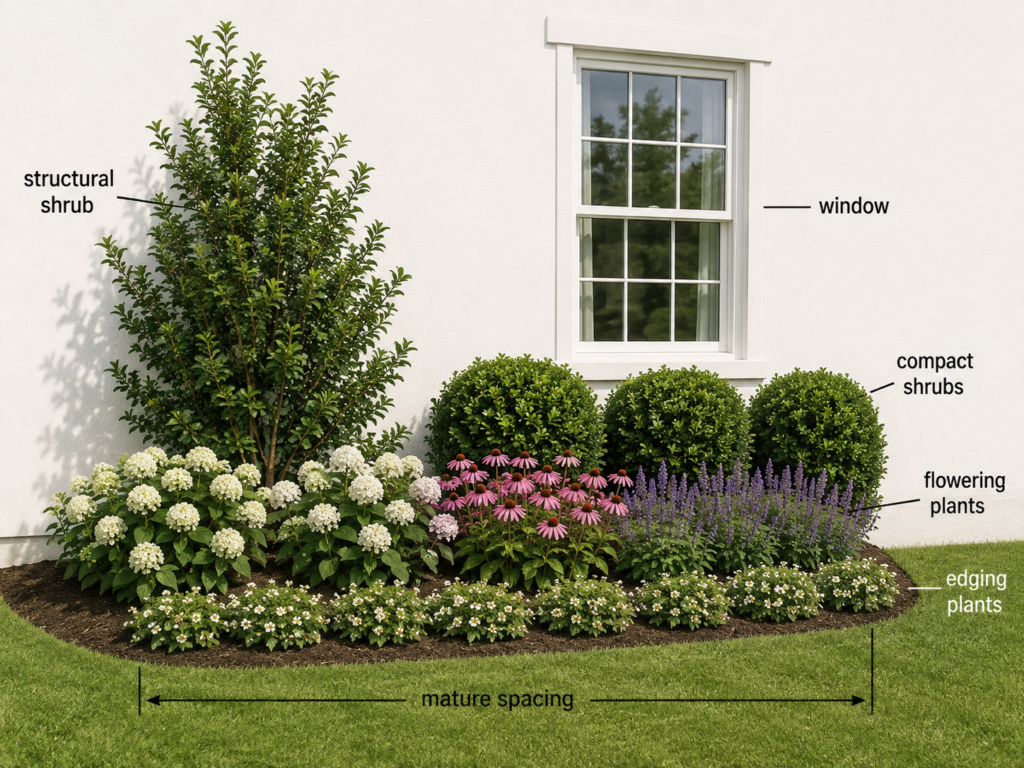
Arrange plants according to mature size and architecture.
For a blank wall:
house → structural plants → medium groups → low edge
Below a window:
house → compact planting → low edge
At a corner:
taller anchor → medium transition → low planting
For a narrow bed:
house → one compact layer → path
Use repeated groups instead of scattering unrelated plants.
Leave deliberate gaps so plants have room to mature and maintenance routes remain open.
Professional-looking foundation planting usually depends more on repetition, proportion, and mature spacing than on using many species.
Planting Around Windows, Doors, and Utilities
Treat windows, doors, paths, patios, utilities, and equipment as fixed parts of the design.
Keep plants low beneath important windows.
Allow room around doors and narrow paths.
Avoid thorny or wide-spreading plants where people regularly walk.
Keep meters, taps, outlets, and service equipment accessible.
Mechanical equipment may have specific airflow and servicing requirements, so follow manufacturer guidance.
If an area is too narrow or heavily used for permanent planting, leaving it open or using movable containers may be better.
Access should outrank concealment.
When Not to Plant Near the Foundation
Planting is not always the correct immediate solution.
Consider leaving an area unplanted when:
- water pools beside the house;
- basement or crawlspace moisture is unresolved;
- drainage repairs are planned;
- utilities require clear access;
- mechanical equipment occupies the area;
- the passage is extremely narrow;
- local termite rules require inspection space;
- wildfire rules require vegetation-free zones;
- excavation is planned.
“Do not plant yet” is a valid landscape decision.
Year-Round Foundation Planting Ideas
Foundation planting should not depend entirely on flowers.
Use a mixture of:
- structural shrubs;
- persistent foliage where suitable;
- grasses;
- flowering plants;
- groundcovers;
- bulbs;
- seed heads;
- interesting stems or bark.
Start with the structural framework and add seasonal color afterward.
Use plant form to support the architecture. Rounded plants can soften rigid walls, while upright plants can emphasize corners.
Design the non-flowering version first. Then add seasonal highlights.
Low-Maintenance Foundation Planting Ideas
Low maintenance begins with plants that naturally fit the site.
Reduce future work by:
- using correct mature dimensions;
- choosing plants for actual sunlight;
- grouping similar water needs;
- repeating fewer species;
- keeping bed shapes simple;
- preserving access;
- avoiding aggressive spreaders.
Constant pruning should not be required simply to preserve windows or paths.
Choose plants that fit without correction.
Foundation Planting Mistakes to Avoid
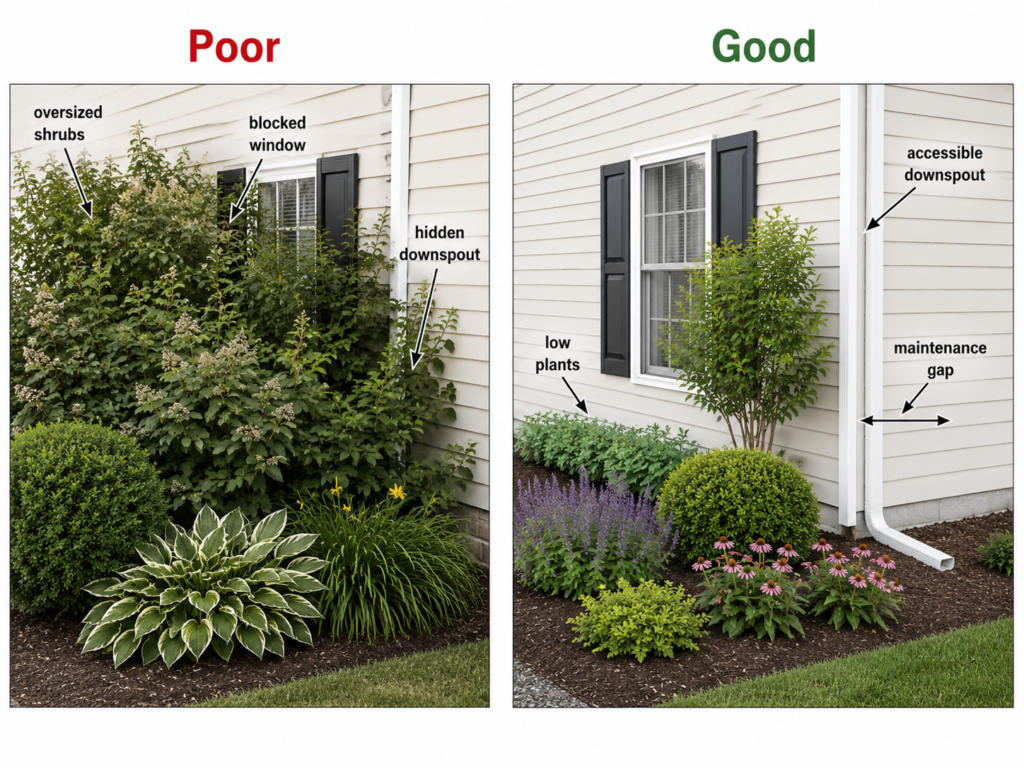
The biggest mistake is planning around nursery size instead of mature size.
Avoid:
- shrubs too close to the wall;
- blocked windows;
- hidden downspouts;
- inaccessible utilities;
- poor drainage;
- excessive soil against the house;
- incompatible water needs;
- too many unrelated species;
- overcrowded narrow beds;
- no maintenance gaps;
- constant corrective pruning;
- unsuitable climbers;
- treating gravel as a drainage repair.
A good foundation bed should become easier to understand as it matures, not more difficult to control.
How to Install a Foundation Bed
Use this sequence:
- Measure the wall.
- Measure usable bed depth.
- Mark windows and doors.
- Mark utilities and equipment.
- Mark downspouts.
- Observe sunlight.
- Observe drainage.
- Check local requirements.
- Mark the bed edge.
- Mark mature plant footprints.
- Test maintenance access.
- Prepare the planting area.
- Position structural plants.
- Add supporting groups.
- Recheck clearance.
- Plant correctly.
- Water for establishment.
- Mulch appropriately.
- Inspect after significant rain.
Use temporary markers to represent mature shrub dimensions before digging.
Moving a marker is easy. Moving an established oversized shrub later is not.
Foundation Bed Rain-and-Spacing Test
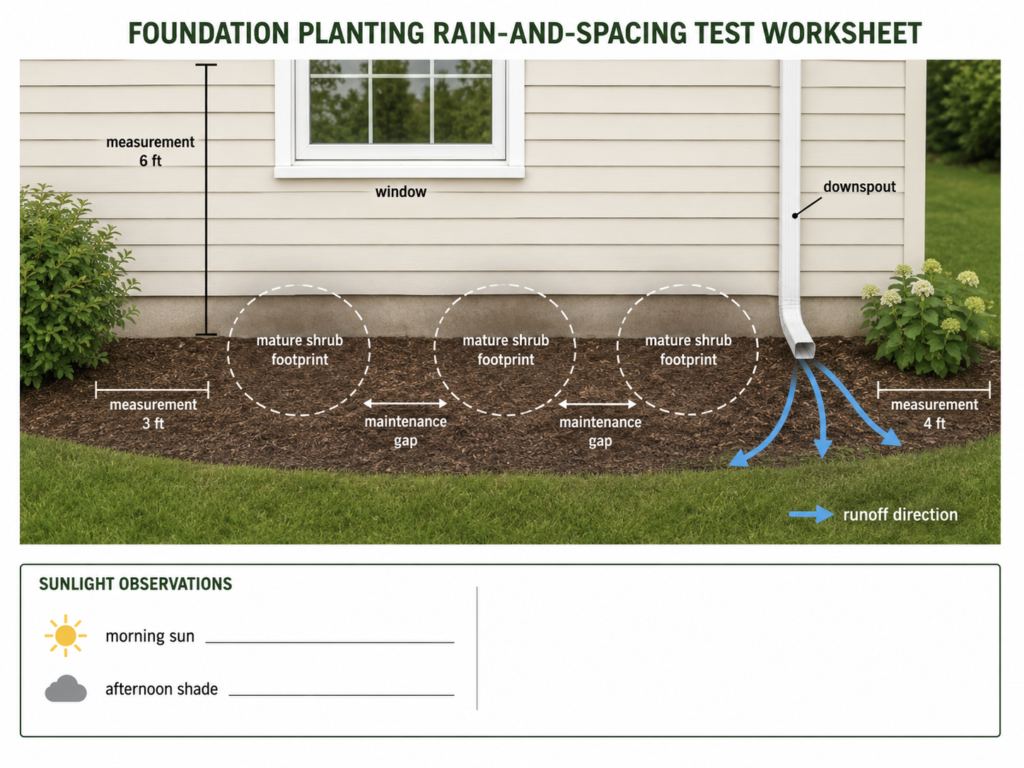
Before permanent installation, record:
- wall length;
- bed depth;
- windows;
- utilities;
- downspouts;
- mature plant footprints;
- sunlight;
- drainage direction.
Use rope, stakes, cardboard, or temporary containers to represent mature plants.
Then test whether you can still:
- clean windows;
- reach taps;
- inspect downspouts;
- maintain equipment;
- walk nearby paths.
Observe the area during significant rain and revise the layout before planting if necessary.
Foundation Planting Planning Checklist
Before buying plants, record:
- wall length;
- bed depth;
- lowest windowsill;
- doors;
- downspouts;
- taps;
- utilities;
- equipment;
- sunlight;
- runoff direction;
- wet areas;
- maintenance gaps;
- maximum plant height;
- maximum plant width.
For each structural plant, verify:
- mature height;
- mature width;
- sunlight;
- soil needs;
- water needs;
- proposed position.
Plan the wall before buying plants.
Our Foundation Planting Methodology
At backyardplanterideas.online, foundation planting is evaluated as both landscape design and house-adjacent planning.
We consider:
- drainage;
- roof runoff;
- foundation clearance;
- mature size;
- windows;
- utilities;
- equipment;
- sunlight;
- soil;
- water needs;
- architecture;
- maintenance;
- seasonal structure;
- local plant suitability.
Our planning sequence is:
protect the building → understand the site → map mature footprints → establish structure → choose plants locally
Plant examples are illustrations rather than universal prescriptions because climate, cultivars, soil, rainfall, pests, and local requirements vary.
The best foundation bed is the one that still works when every plant reaches mature size.
About the Author
Myra Sheikh — Founder, Backyard Planter Ideas
Myra Sheikh writes about practical backyard layouts, plant beds, raised planters, privacy planting, small-space gardening, and organizing residential planting around mature size, access, and maintenance.
At backyardplanterideas.online, the goal is to provide transferable layout principles that readers can adapt to their climate, property, and local plant choices.
Backyard Foundation Planting Ideas FAQs
What are the best plants for backyard foundation planting?
The best plants fit the available mature space, sunlight, soil, drainage, climate, and maintenance level. Choose the plant role first, then select locally suitable species.
How far should shrubs be planted from the house?
There is no universal distance. Allow room for mature plant width plus the clearance needed for inspection, pruning, utilities, drainage, and maintenance.
Should foundation shrubs touch the house?
Foundation shrubs should generally remain clear of the building at maturity. This keeps inspection, pruning, drainage work, and maintenance easier.
What should you plant below windows?
Use compact shrubs, grasses, perennials, or groundcovers that naturally remain below the windowsill and fit the available width.
Can foundation planting cause moisture problems?
Poorly planned beds can contribute to moisture problems if grading, roof runoff, irrigation, or soil conditions allow water to remain beside the building.
Is gravel good around a foundation?
Gravel can create a useful maintenance or inspection strip, but it does not correct poor grading or drainage by itself.
What can you plant along a shaded house wall?
Use locally suitable shade-tolerant shrubs, foliage plants, ferns, sedges, perennials, or groundcovers. Check whether roof overhangs also make the soil dry.
Are evergreen shrubs best for foundation beds?
Evergreens can provide year-round structure, but the entire bed does not need to be evergreen. Combining them with grasses, perennials, and seasonal flowers creates more variety.
How do you make foundation planting low maintenance?
Choose plants that naturally fit the mature space and growing conditions. Use fewer repeated plant types and preserve good maintenance access.
Should you design the bed or choose plants first?
Design the bed first. Determine drainage, dimensions, windows, utilities, sunlight, access, and mature-size limits before choosing individual species.
What to Plan After Foundation Planting
Foundation planting should connect to the wider backyard rather than remain isolated beside the house.
Coordinate it with:
- Backyard Plant Bed Ideas for layering and border structure;
- Backyard Plant Ideas for plant selection;
- Backyard Tree Planting Ideas for tree placement;
- Backyard Privacy Planter Ideas for screening;
- Side Yard Planter Ideas for narrow spaces;
- Raised Backyard Planter Ideas for raised structures.
The complete sequence is:
whole-yard layout → drainage → foundation bed → mature plant structure → plant selection → installation → inspection → maintenance
Begin with:
Where does water go? What must remain accessible? How much mature space exists? What conditions does the wall create?
The best backyard foundation planting connects the house to the landscape while continuing to work when every plant reaches mature size.

Myra is the founder and lead writer of Backyard Planter Ideas, where she shares practical, well-researched guidance on planter design, plant selection, and outdoor styling. Her goal is to help homeowners create attractive, functional garden spaces with clear, reliable, and easy-to-apply advice.