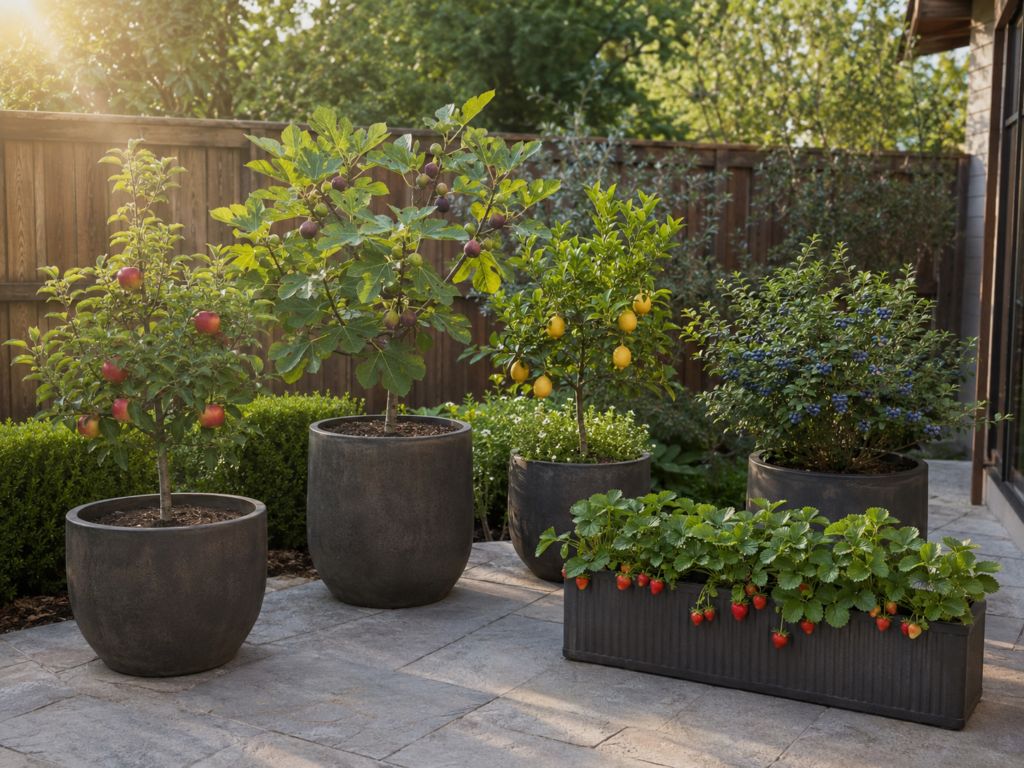
A backyard container orchard is a planned collection of compact fruit trees, berry shrubs, vines, and strawberries grown mainly in pots. It can work on a patio, deck, paved courtyard, rental property, narrow side yard, or unused backyard corner.
The best container orchard matches each plant to the climate, sunlight, pollination needs, container size, and maintenance routine. Start with three to five plants, choose fruits that ripen at different times, and plan watering and winter protection before buying trees.
Backyard Container Orchard Ideas in 60 Seconds
Choose your orchard layout according to the hardest limit in your backyard. Space, sunlight, winter temperature, and mobility should guide the decision before appearance.
| Your situation | Best starting layout | Suggested combination |
|---|---|---|
| Less than 50 sq ft | Three-pot triangle | Compact tree, blueberry, strawberries |
| Narrow side yard | Fence-line or espalier row | Columnar apples or trained pears |
| Sunny courtyard | Four-corner orchard | Four compact trees |
| Rental property | Grow bags or lightweight pots | Self-fertile tree and berries |
| Cold winter climate | Hardy trees plus rolling citrus | Apples or pears with movable citrus |
| Hot paved patio | Grouped insulated pots | Fig, pomegranate, or citrus |
| Privacy needed | Trained edible screen | Espalier fruit or grapevine |
| Beginner gardener | Three-plant orchard | Self-fertile tree, second fruit, and berries |
Before choosing, confirm:
- The site receives enough direct sunlight.
- Water is available nearby.
- Containers will not block paths or doors.
- Pollination partners are compatible.
- The surface can support filled pots.
- Tender plants have a winter location.
Container orchard layouts
What Is a Backyard Container Orchard?
A backyard container orchard is an edible garden where fruiting plants grow in movable or semi-permanent pots instead of open ground. It may include dwarf fruit trees, compact rootstocks, berry shrubs, strawberries, and trained vines.
An orchard does not need dozens of trees. One self-fertile fig, one blueberry shrub, and one strawberry trough can create a productive three-layer orchard.
Container orchards are useful when the backyard is paved, the ground soil is poor, the gardener is renting, or tender fruit needs seasonal protection. They offer greater control over soil, drainage, water, and location.
The trade-off is that roots cannot search the surrounding ground for moisture or nutrients. Watering, feeding, drainage, and root care therefore require closer attention.
Is Your Backyard Suitable?
Most fruit trees need a sunny position, reliable water, free drainage, and some protection from strong wind. Observe the space during the growing season because morning sun may be followed by afternoon shade.
Check these conditions:
- Sunlight: Most fruit trees crop best with several hours of direct light.
- Water: A hose, tap, tank, or drip line should be nearby.
- Wind: Strong wind dries pots and may overturn top-heavy trees.
- Drainage: Water must leave the container and surrounding surface.
- Weight: Large wet pots can be extremely heavy on decks and balconies.
Test the layout with empty containers. Walk between them, open doors, move furniture, and imagine watering every plant. A layout that already feels crowded will become harder to manage as the canopies grow.
Choose the Right Orchard Layout
Choose the layout according to the backyard shape, container width, controlled canopy size, and main walking route. Doors, drains, steps, taps, furniture, and storage areas must remain accessible.
A good layout should allow you to:
- Reach every plant for watering and pruning.
- Access drainage holes and irrigation lines.
- Move tender plants when needed.
- Prevent mature branches from blocking paths.
- Stop one tree from heavily shading another.
Keep plants with different growing needs in separate pots. Blueberries, for example, usually require acidic growing medium that may not suit nearby figs, citrus, or apples.
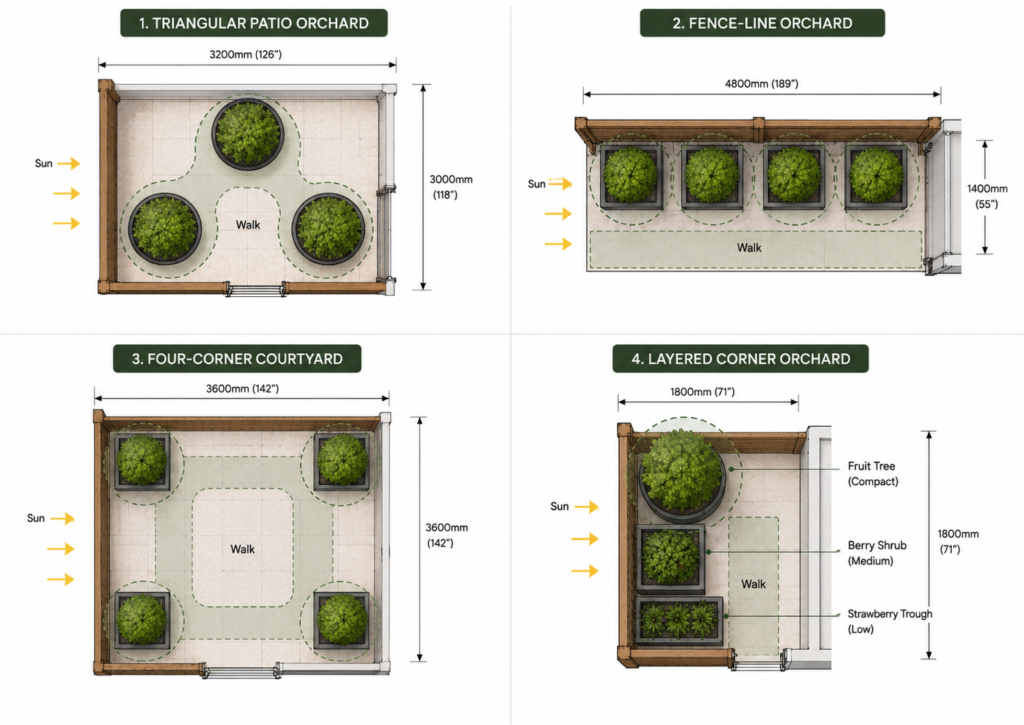
Four Measured Orchard Plans
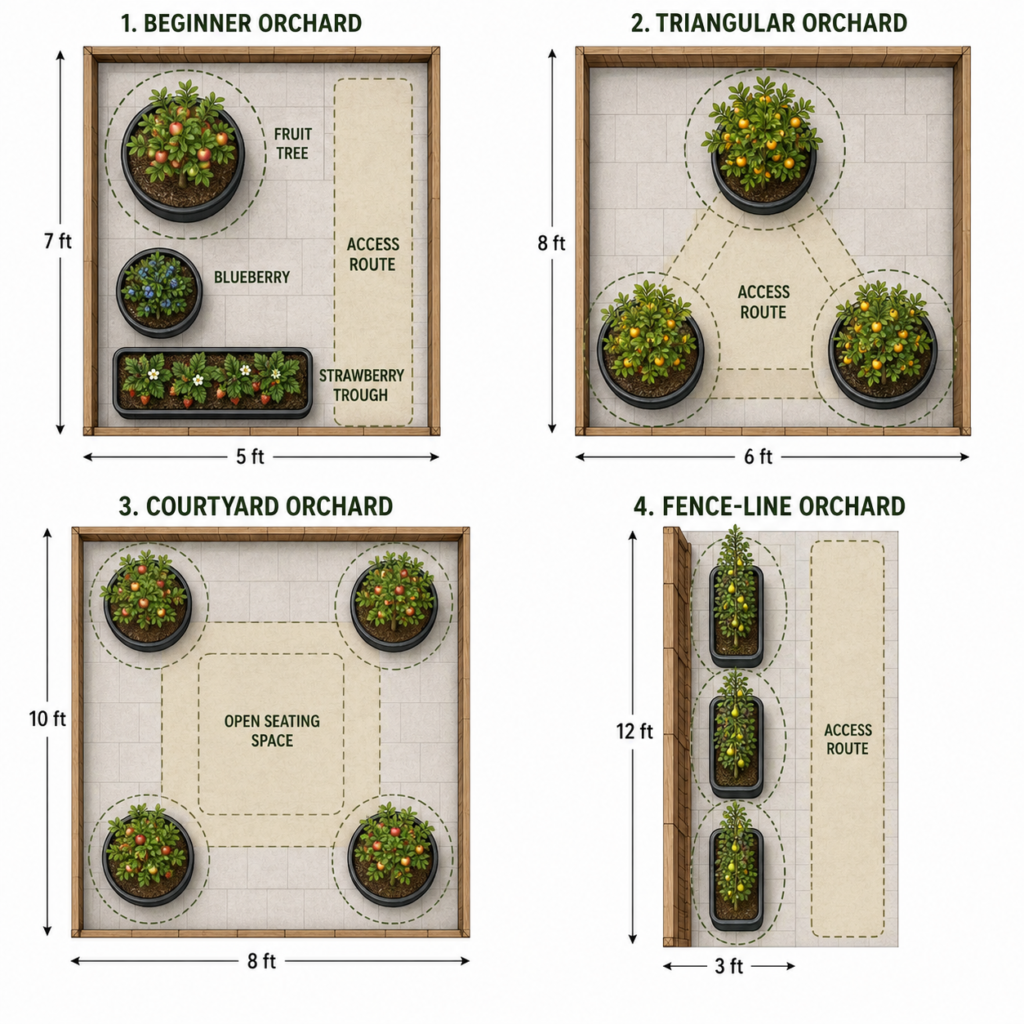
These measurements are planning references. Adjust them for the actual container diameter, canopy width, and access route.
5 × 7 ft Beginner Orchard
Place one self-fertile tree at the back, one berry shrub at a front corner, and one strawberry trough along the open edge. Keep the centre clear.
6 × 8 ft Three-Tree Orchard
Use a triangle with one taller rear tree and two lower plants in front. This works for two compatible apples with berries or a fig, citrus, and blueberry group.
8 × 10 ft Courtyard Orchard
Place four pots near the corners and leave the centre open for seating or dining. Matching containers create a more formal appearance.
3 × 12 ft Narrow Orchard
Arrange three columnar or trained trees along a sunny boundary. Leave airflow behind the pots and a clear path in front.
17 Backyard Container Orchard Ideas
1. Three-Tree Patio Orchard
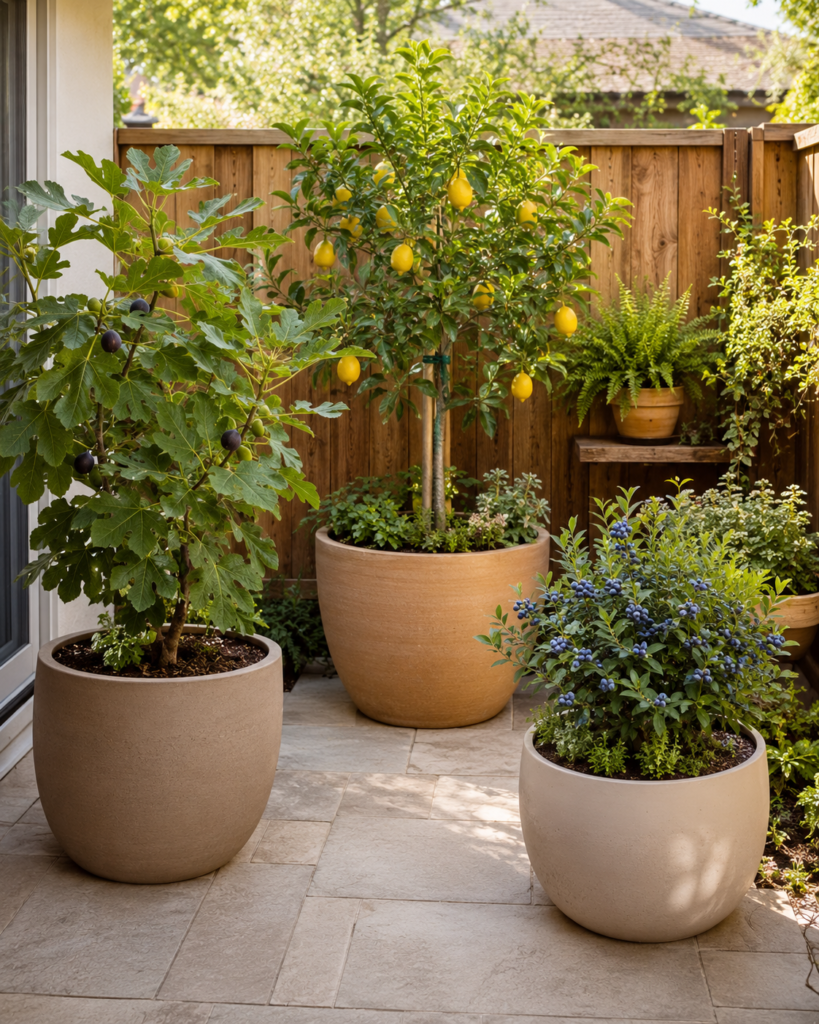
Arrange three containers in a loose triangle, with the tallest tree at the back. Combine different heights and harvest periods, such as citrus, fig, and blueberry. Leave enough room to inspect, prune, and water each plant.
2. Fence-Line Orchard
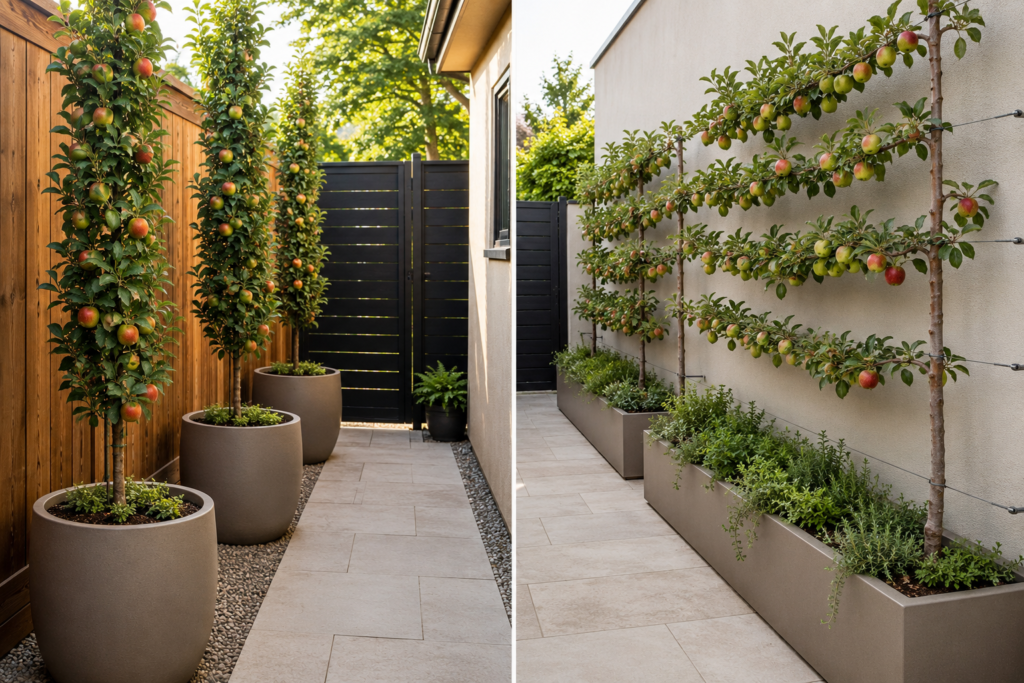
Place compact fruit trees in a straight or staggered row along a sunny boundary. Columnar apples, trained pears, compact figs, and blueberries work well. Leave space behind the pots for airflow and maintenance.
3. Espalier Fruit Wall
Train apples or pears horizontally against strong wires. Suitable cherries, peaches, figs, or plums may be fan-trained. Use a broad pot, permanent support, soft ties, and enough wall clearance for airflow.
4. Rolling Citrus Orchard
Grow lemons, limes, kumquats, or calamondins on outdoor-rated wheeled platforms. Use locking wheels and confirm the load capacity. Plan a bright, frost-protected winter position before purchasing the tree.
5. Pollination-Pair Orchard
Place two compatible cultivars beside a bench, path, or doorway. Confirm whether each tree is self-fertile and whether their flowering periods overlap. Two unrelated fruit types will not pollinate each other.
6. Columnar Apple Lane
Arrange three or five narrow apple trees beside a path or fence. Confirm that the cultivar is truly columnar rather than only dwarf. Include compatible pollination partners and stable containers.
7. Half-Barrel Fig Orchard
A timber half-barrel gives a fig useful root volume and strong visual weight. Drill several drainage holes and position the barrel before filling because it will become difficult to move.
8. Fruit Tree and Berry Orchard
Create layers with a compact tree above, a berry shrub in the middle, and strawberries at the front. Keep each crop in its own pot so soil, water, and feeding can be managed separately.
9. Harvest-Season Orchard
Choose fruits that ripen at different times. Combine early strawberries, mid-season blueberries, later figs or apples, and suitable citrus. Avoid creating one large harvest unless you plan to preserve or share it.
10. Four-Corner Courtyard Orchard
Place one container in each courtyard corner and keep the centre open. Use four matching trees or two compatible pollination pairs. Check each corner separately for sunlight, heat, wind, and frost.
11. Edible Privacy Screen
Use espalier apples, trained pears, grapevines, compact citrus, or narrow figs to soften a view. Build a strong support and remember that deciduous fruit provides seasonal rather than year-round privacy.
12. Backyard Corner Orchard
Place the tallest tree at the back, a medium berry shrub slightly forward, and strawberries near the edge. Check whether the corner collects runoff, heat, leaves, or stagnant air.
13. Kitchen-Door Fruit Garden
Grow frequently used fruits close to the kitchen. Lemon, lime, fig, strawberry, blueberry, and compact grapes are practical choices. Keep branches and fallen fruit away from the doorway.
14. Hot-Climate Orchard
Use pale, insulated, timber, or double-pot containers to protect roots from heat. Add mulch, drip irrigation, and airflow. Figs, pomegranates, citrus, olives, and suitable grapes may work well.
15. Cool-Climate Movable Orchard
Keep hardy apples or pears outside with root protection while tender citrus remains movable. Group or insulate exposed pots and provide a bright, frost-free winter position for sensitive plants.
16. Renter-Friendly Grow Bag Orchard
Use large, durable grow bags with strong handles and reliable irrigation. They are affordable and easy to relocate when empty, but they dry faster than rigid containers.
17. Formal Orchard with Matching Pots
Repeat one planter style in pairs, rows, or four-corner layouts. Keep spacing even, align pot rims, and hide irrigation lines. Select trees with similar growth habits to maintain visual balance.
Best Fruit Trees and Plants
The best fruit is one that matches the climate, available sunlight, pollination plan, and long-term container capacity.
| Fruit | Container suitability | Key decision |
|---|---|---|
| Apple | Very good on suitable rootstock | Often needs a compatible partner |
| Pear | Good with controlled growth | Pollination and support matter |
| Cherry | Good with compact growth | Choose self-fertile or compatible pair |
| Plum | Good with suitable cultivar | Check climate and pollination |
| Peach or nectarine | Good in suitable regions | Protect blossom from frost |
| Fig | Excellent | Needs a large, stable pot |
| Lemon or lime | Excellent with protection | May need winter mobility |
| Pomegranate | Good in warm climates | Needs enough heat to ripen |
| Olive | Good in sunny mild areas | Avoid severe cold and wetness |
| Blueberry | Excellent | Requires acidic growing medium |
| Strawberry | Excellent | Useful lower layer |
| Grape | Good with strong support | Requires regular pruning |
Select fewer fruits that genuinely suit the site rather than forcing popular plants into poor conditions.
Climate Planning
Climate affects flowering, fruit set, disease pressure, water demand, and winter survival. Use regional growing information when selecting cultivars.
Check:
- Winter chill requirements
- Minimum winter temperature
- Late frost risk
- Summer heat
- Humidity
- Rainfall
- Wind exposure
- Growing-season length
High-chill fruit may perform poorly in mild winters. Tender citrus may fail where no frost protection exists. Dark pots may overheat in hot climates, while exposed container roots may freeze in cold regions.
Fruit-Tree Decision Matrix
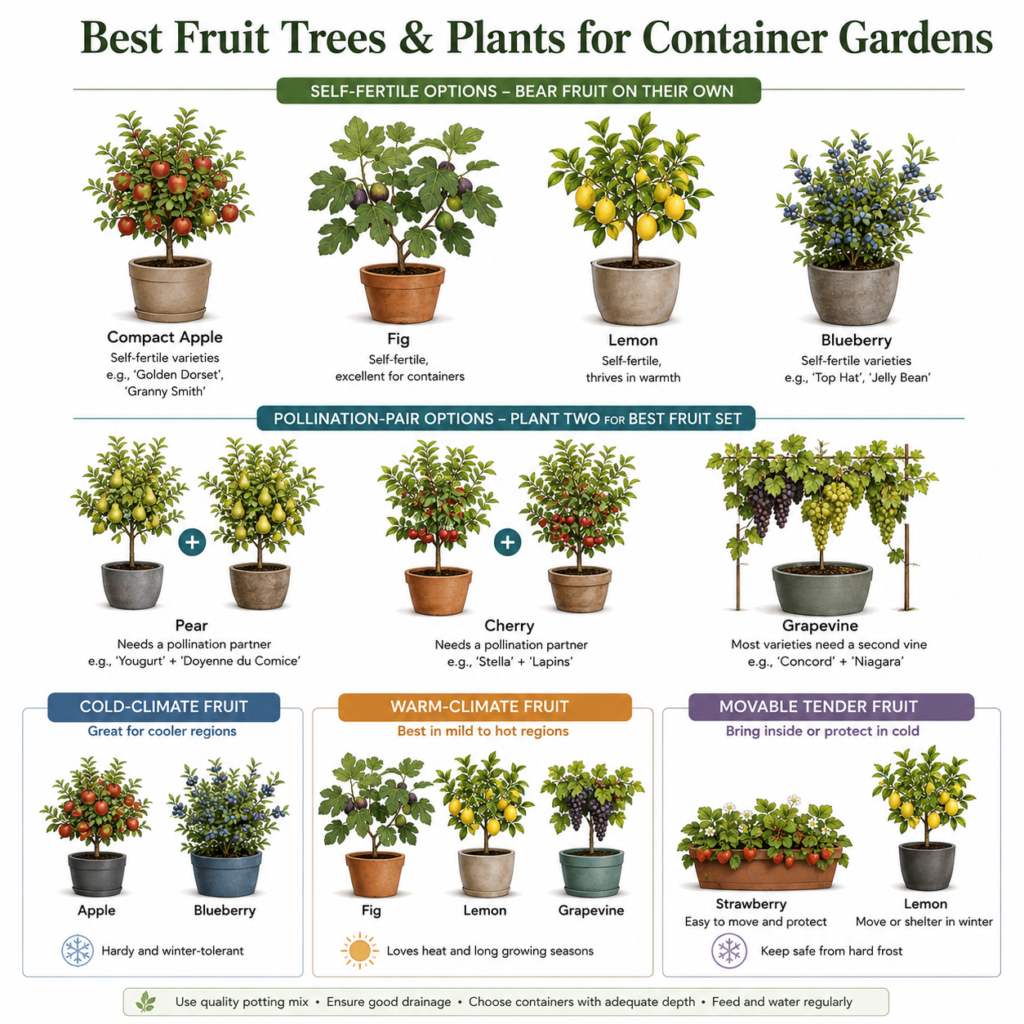
| Fruit | Growth control | Pollination | Main climate issue | Mobility |
|---|---|---|---|---|
| Apple | Rootstock or columnar form | Often needs partner | Chill and blossom frost | Semi-permanent |
| Pear | Rootstock and training | Often needs partner | Chill and wind | Usually fixed |
| Cherry | Compact rootstock | Self-fertile or pair | Frost and birds | Semi-permanent |
| Fig | Pruning and root control | Depends on type | Cold roots and low heat | Semi-permanent |
| Lemon | Pruning | Cultivar-dependent | Frost and winter light | Mobile |
| Blueberry | Naturally compact | Second cultivar may help | pH and drying | Mobile |
| Grape | Pruning | Cultivar-dependent | Hardiness and disease | Fixed |
Use self-fertile fruit in limited spaces, compatible pairs for many apples and pears, and movable containers for tender plants.
Space Requirements
A small orchard can begin in approximately 1.5 × 2 metres, but the real requirement depends on pot width, canopy spread, supports, and access.
Allow room for:
- Container diameter
- Controlled canopy growth
- Watering and pruning
- Irrigation tubing
- Seasonal movement
- Fallen-fruit collection
Never use every centimetre of floor space. A service gap can determine whether the orchard remains manageable after several years.
Container Size
Young trees should usually move through progressively larger pots rather than going directly into an oversized container.
A pot that is too small:
- Dries quickly
- Restricts roots
- Loses nutrients faster
- Becomes unstable
- Causes greater temperature changes
An oversized pot around a small rootball may stay wet unevenly. Choose a broad, stable container based on the tree’s controlled future size, not only its nursery size.
Container Materials
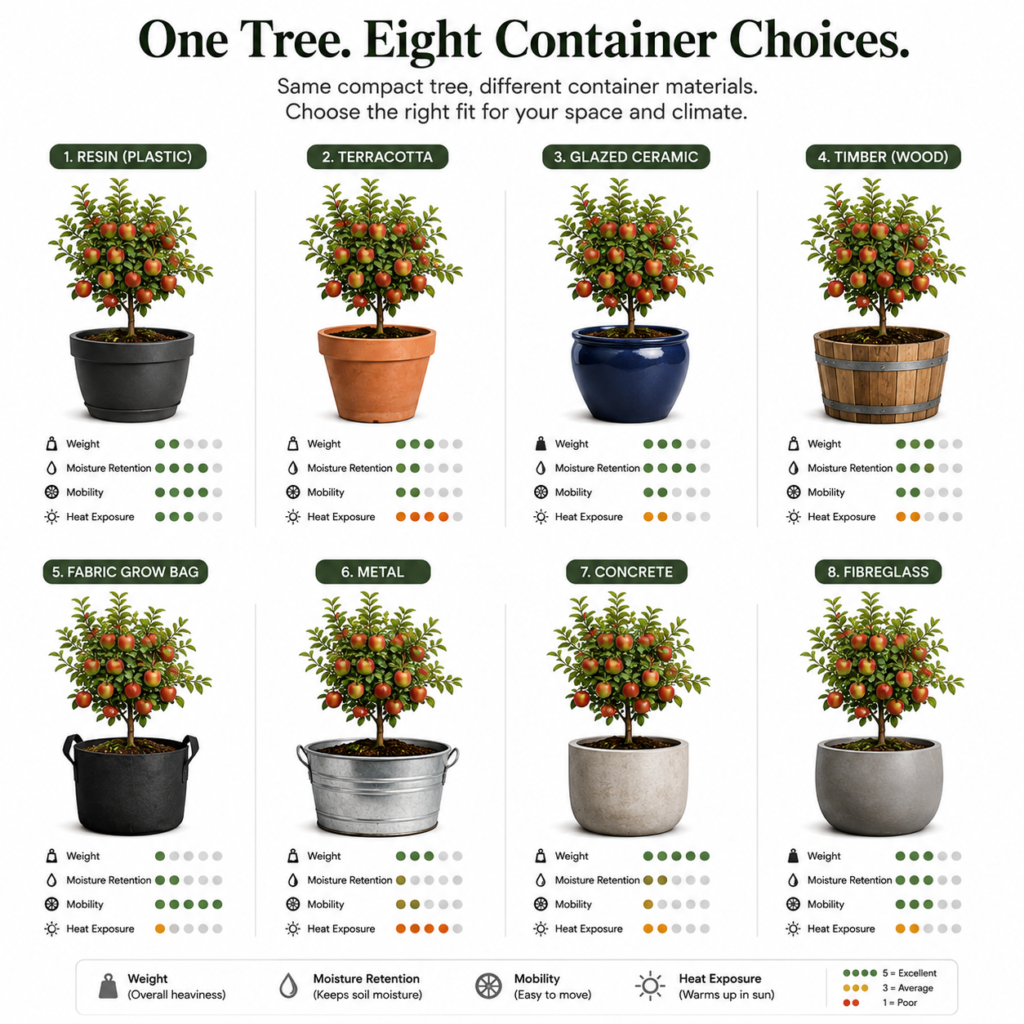
Plastic and resin are lightweight and retain moisture. Terracotta is stable but dries faster. Timber offers insulation but eventually decays. Fabric grow bags are portable but need frequent watering. Concrete is stable but difficult to move.
Every growing container needs clear drainage holes. Decorative pots without holes should only be used as covers around drained inner containers.
Use lighter materials for trees needing winter movement and heavier materials for permanent exposed positions.
Growing Medium
Use a structured container mix that holds moisture while allowing excess water and air to move through the root zone.
Avoid filling pots entirely with dense garden soil. It may compact, drain poorly, and become extremely heavy.
Blueberries need acidic growing medium. Keep the trunk and graft union above the surface, and refresh part of the mix as the tree matures.
Planting
Before planting, confirm the cultivar, rootstock, pollination needs, pot, and support.
- Check drainage holes.
- Position the heavy pot.
- Add growing medium to the correct level.
- Remove the nursery pot carefully.
- Loosen congested outer roots gently.
- Keep the tree upright and the graft above the surface.
- Backfill without heavy compaction.
- Install support.
- Water thoroughly.
- Add shallow mulch away from the trunk.
Label the cultivar and rootstock and record the planting date.
Watering
Check moisture below the surface and water deeply when the active root zone begins drying. Do not follow one fixed weekly schedule.
Heat, wind, pot size, container material, crop load, and root congestion all change watering demand.
Drip irrigation is useful for several pots, but emitters should be adjustable and checked regularly. Never leave containers standing in stagnant water.
Feeding
Container plants lose nutrients through watering, so they normally require plant-specific feeding. Measure the product, follow its instructions, and record each application.
Do not assume yellow leaves always indicate hunger. Poor drainage, incorrect pH, root damage, and cold conditions can cause similar symptoms.
Too much nitrogen may create leafy growth while reducing flowering and fruiting.
Pruning
Pruning controls height, width, light, airflow, and balance. Remove dead, damaged, crossing, or badly positioned branches, as well as growth below the graft.
Do not use one pruning calendar for every fruit. Apples, cherries, peaches, figs, citrus, grapes, and blueberries produce fruit on different types of wood.
Confirm the plant’s fruiting habit before making major cuts.
Pollination
Record whether each cultivar is self-fertile, which pollination partner it needs, and when both trees flower.
Improve pollination by:
- Growing flowers nearby
- Avoiding unnecessary insecticide during bloom
- Protecting blossom from strong wind
- Maintaining consistent watering
- Confirming flowering overlap
Poor fruit set may still result from frost, rain, low insect activity, immaturity, or incorrect pruning.
Seasonal Calendar
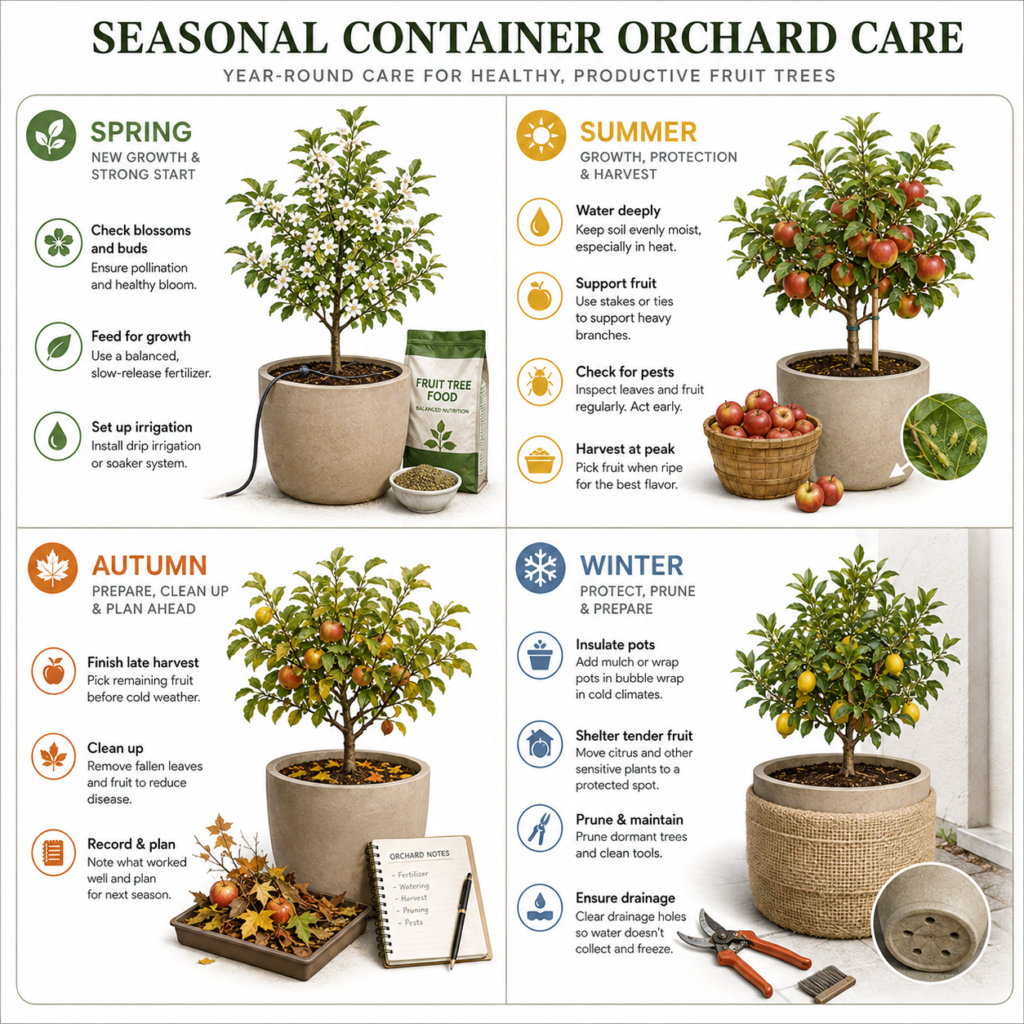
Late Winter and Spring
- Inspect pots and supports.
- Repot scheduled plants.
- Complete suitable pruning.
- Prepare irrigation.
- Monitor flowers and frost.
- Begin feeding when appropriate.
Summer
- Check moisture frequently.
- Adjust emitters.
- Support fruit-heavy branches.
- Watch for pests and heat stress.
- Harvest promptly.
Autumn and Winter
- Remove fallen fruit.
- Record crop quality.
- Reduce feeding where appropriate.
- Protect exposed roots and tender plants.
- Keep drainage holes clear.
Problems, Causes, and Fixes
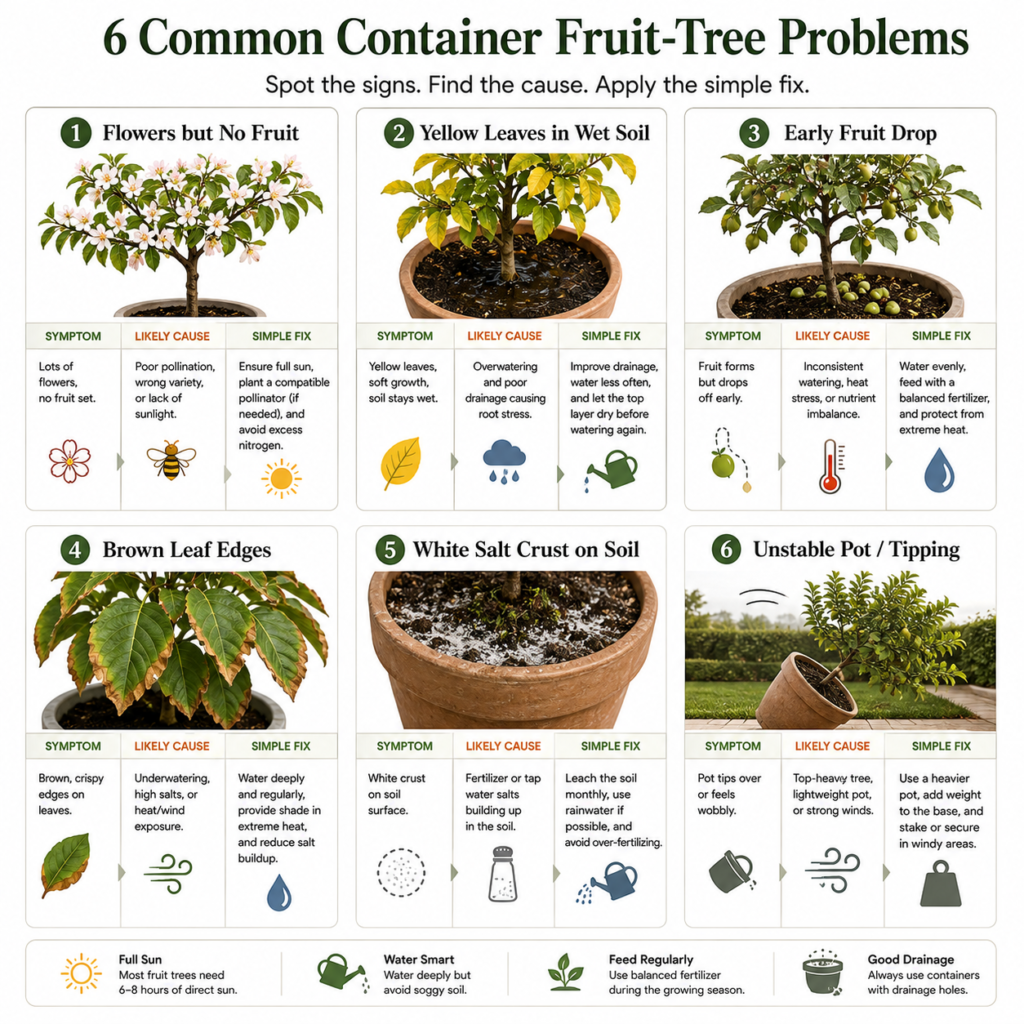
| Symptom | Likely cause | First action |
|---|---|---|
| Flowers but no fruit | Pollination, frost, or weather | Check compatibility |
| Yellow leaves in wet soil | Poor drainage or root stress | Inspect the root zone |
| Fruit drops early | Irregular watering or excess crop | Stabilise moisture |
| White crust on mix | Salt buildup | Review feeding and water |
| Pot falls in wind | Weak support or narrow base | Improve stability |
| Many leaves, few flowers | Excess nitrogen or poor light | Review feeding and position |
| Pale blueberry leaves | Incorrect pH | Test the growing medium |
Diagnose one issue at a time instead of adding water and fertiliser together.
Seven Common Mistakes
- Choosing a standard-sized tree.
- Ignoring pollination requirements.
- Using a pot that is too small.
- Blocking drainage holes.
- Filling pots with dense garden soil.
- Treating every fruit the same.
- Starting with too many plants.
Begin with three to five plants and observe them for a complete growing season before expanding.
When an Orchard Is Not Suitable
A container orchard may not be suitable when:
- The site is heavily shaded.
- Water access is poor.
- Drainage cannot be managed.
- Deck or balcony strength is uncertain.
- Tender plants have no winter shelter.
- Regular summer care is unrealistic.
- Large containers would block access.
A smaller alternative may be one self-fertile tree, one blueberry pot, or a strawberry trough.
What You Need to Start
Essential items include:
- Climate-suitable compact tree
- Pollination partner where needed
- Stable draining container
- Structured growing medium
- Stake or training support
- Soft ties
- Mulch
- Watering system
- Plant label
- Suitable fertiliser
- Clean pruning tools
- Winter protection where needed
Record the cultivar, rootstock, flowering period, harvest time, pot size, watering method, and winter location.
Starter Plans
Beginner Plan
One self-fertile tree, one fruit with a different harvest period, and one berry or strawberry container.
Apple Plan
Two compatible apple cultivars on suitable rootstocks, stable pots, and pollinator flowers nearby.
Warm-Climate Plan
One fig, one pomegranate, one citrus, and strawberries.
Cold-Climate Plan
A hardy apple or pear pair, movable citrus, and a blueberry in acidic growing medium.
Rental Plan
Lightweight pots or grow bags, detachable irrigation, and portable supports.
Planning Worksheet
Record for each plant:
- Cultivar and rootstock
- Self-fertility
- Pollination partner
- Flowering and harvest period
- Controlled width
- Pot size and material
- Growing medium
- Daily sunlight
- Watering method
- Support
- Winter location
- Main household use
At the end of the season, mark each plant as keep, modify, replace, or expand.
Planning Checklist
Proceed only when:
- Sunlight is adequate.
- Climate suitability is confirmed.
- Pollination needs are understood.
- Containers drain freely.
- Water is available.
- Plants remain accessible.
- Winter protection is realistic.
- The household will use the fruit.
- Long-term care is manageable.
How This Guide Was Created
This guide organises backyard container orchard ideas around practical decisions: space, sunlight, climate, pollination, root volume, watering, mobility, access, and harvest timing.
The measurements and layouts are planning frameworks rather than guarantees. Cultivar performance changes by region, rootstock, winter chill, summer heat, humidity, and local disease pressure.
Confirm important plant-level decisions with regional horticultural guidance or a reputable local nursery.
Backyard Container Orchard FAQs
Can fruit trees live permanently in containers?
Many compact trees can remain in pots for years with regular watering, feeding, pruning, and root care. They may eventually need a larger container or refreshed growing medium.
What is the easiest fruit tree to grow in a pot?
A self-fertile fig or compact citrus is often practical where the climate suits it. The easiest option is the one that matches local winter conditions and watering capacity.
Do you need two fruit trees?
Some cultivars need a compatible partner, while self-fertile varieties can produce alone. Check the exact cultivar before buying.
How often should potted fruit trees be watered?
Water according to moisture below the surface rather than a fixed schedule. Heat, wind, crop load, and container size affect the frequency.
Can a container orchard grow on a deck?
Yes, when the deck can safely support wet pots, growing medium, plants, and irrigation water. Wind and drainage runoff must also be considered.
Can a small orchard produce useful fruit?
Yes. Three to five healthy plants can provide a practical seasonal harvest when their ripening periods are spread across the season.
Final Orchard Plan
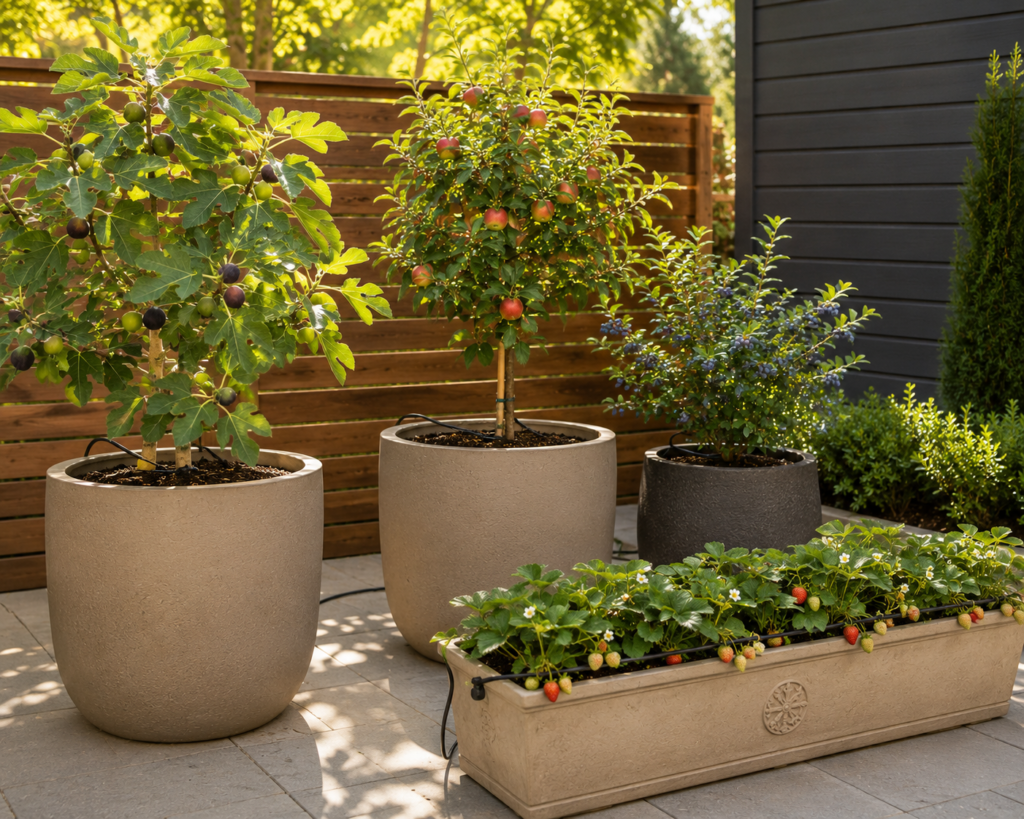
Start with one self-fertile tree suited to the climate, one second fruit with a different harvest period, and one berry or strawberry container.
Use stable pots, reliable drainage, plant-specific growing medium, and a realistic watering system. Record flowering, pollination, watering demand, pest pressure, fruit quality, and winter performance for one complete year.
Expand only after the original plants remain healthy and manageable.
A successful backyard container orchard is not defined by the number of trees. It is defined by how well every plant fits the climate, available space, pollination plan, root volume, watering routine, and long-term capacity of the gardener.
Myra is the founder and lead writer of Backyard Planter Ideas, where she shares practical, well-researched guidance on planter design, plant selection, and outdoor styling. Her goal is to help homeowners create attractive, functional garden spaces with clear, reliable, and easy-to-apply advice.