
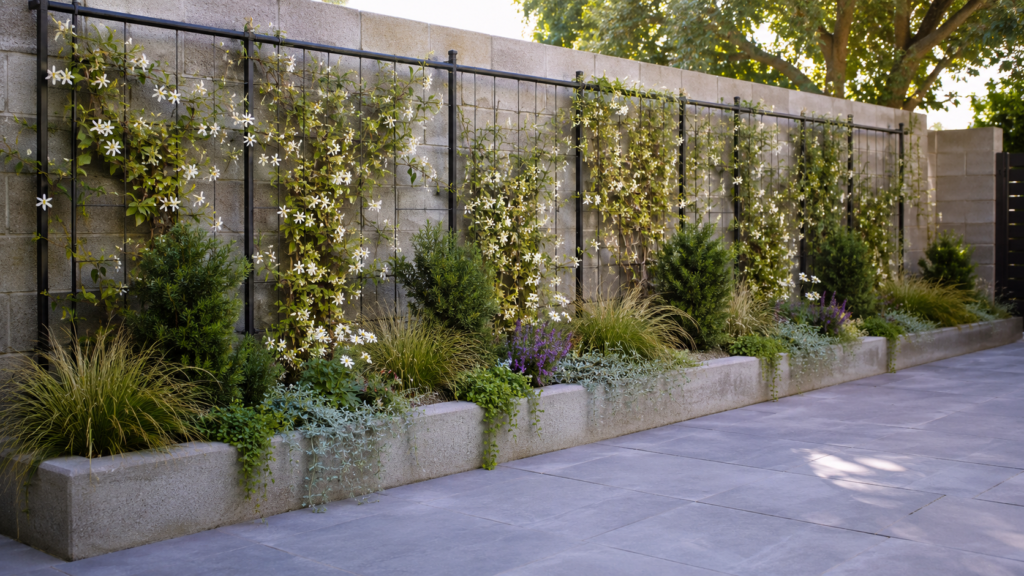
The best backyard block wall plant ideas combine a suitable growing system with plants that match the wall’s sunlight, heat, soil, and available space. Climbers work well in narrow areas, raised beds improve poor soil, and large containers introduce greenery where there is no open ground. These backyard block wall plant ideas can improve privacy, color, and visual depth without creating an overcrowded garden.
A successful design should improve privacy, color, and visual depth without hiding wall damage or creating constant pruning work. For most backyards, the strongest combination is one vertical plant, one compact structural plant, and repeated lower-growing plants with similar water needs.
Quick Backyard Block Wall Plant Ideas
Use a freestanding trellis with a narrow raised planter or two large troughs when you want a flexible, wall-safe solution. Add one manageable climber for height, one compact shrub or ornamental grass for structure, and one groundcover or trailing plant to soften the base.
Choose direct wall training only when the masonry is sound. Hot walls need heat-tolerant plants and deeper soil, while shaded walls need foliage plants that can tolerate the dry conditions often found beside masonry. The most effective backyard block wall plant ideas balance plant coverage with wall safety, root space, and realistic maintenance.
Choose Your Setup in 30 Seconds
| Backyard condition | Best starting setup |
|---|---|
| Narrow soil strip | Climber on wires or a slim trellis |
| No open soil | Large trough planters |
| Old or cracked wall | Freestanding planter and trellis |
| Hot afternoon wall | Deep raised bed with drought-tolerant plants |
| Shaded wall | Foliage border with a shade-tolerant climber |
| Year-round privacy | Evergreen shrub plus flowering climber |
| Rental property | Movable containers and modular trellis |
| Retaining wall | Cascading plants from an existing upper bed |
| Small seating area | Planter bench with compact climber |
| Premium focal point | Irrigated freestanding living wall |
Choose the planting system first. Select individual plants afterward according to climate, mature size, sunlight, and local restrictions.
Block Wall Types and Terms
Concrete block, cinder block, and CMU are often used as overlapping terms. CMU means concrete masonry unit, while “cinder block” is a common informal name. In this guide, backyard block wall includes boundary walls, garage walls, house walls, retaining walls, and decorative masonry dividers.
Wall function matters. A retaining wall may contain drainage openings, a building wall needs clearance around foundations and utilities, and a shared wall may not be suitable for drilling. When construction, ownership, or condition is uncertain, keep the planting system independent.
Five Block Wall Planting Rules
- Inspect the wall first. Repair loose mortar, growing cracks, leaning sections, or drainage problems.
- Choose by mature size. A small nursery plant can become much wider and heavier.
- Match the support to the plant. Tendrils need fine supports, twining vines need wires, and roses need tying.
- Improve the root zone. Wall-side soil is often shallow, compacted, or unusually dry.
- Check local suitability. Confirm hardiness, water needs, toxicity, and invasive status.
A moderate-growing plant that fits naturally is usually more useful than a fast vine that requires constant pruning.
Check Your Backyard Block Wall
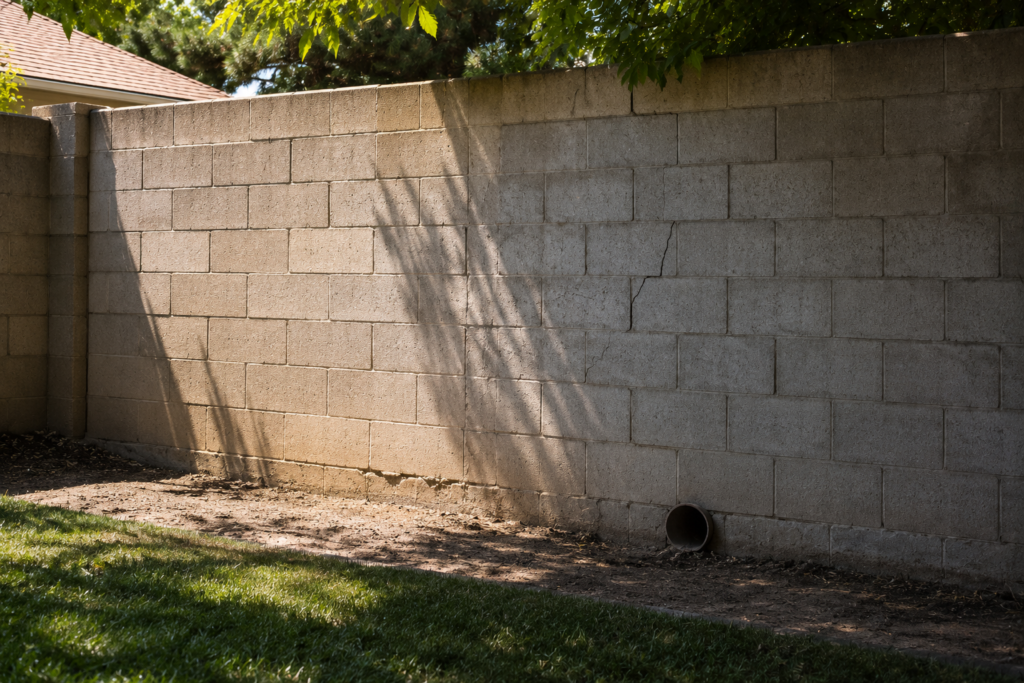
Observe the wall for a full day before purchasing plants. Record direct sunlight, afternoon heat, shade, wind exposure, soil moisture, planting width, and drainage. Masonry can reflect heat, block rainfall, and create conditions unlike the rest of the backyard.
Inspect the wall for:
- Expanding cracks
- Loose blocks
- Crumbling mortar
- Leaning sections
- Damp patches
- Mineral deposits
- Blocked drainage openings
- Movement in nearby soil
Do not use plants to hide structural defects. Check the ground for footings, rubble, compaction, poor drainage, and limited depth. If the root zone is unsuitable, use a raised bed or container.
A wall-mounted support is appropriate only when the masonry is sound. A freestanding system is safer for cracked, shared, structural, or difficult-to-inspect walls.
21 Backyard Block Wall Plant Ideas at a Glance
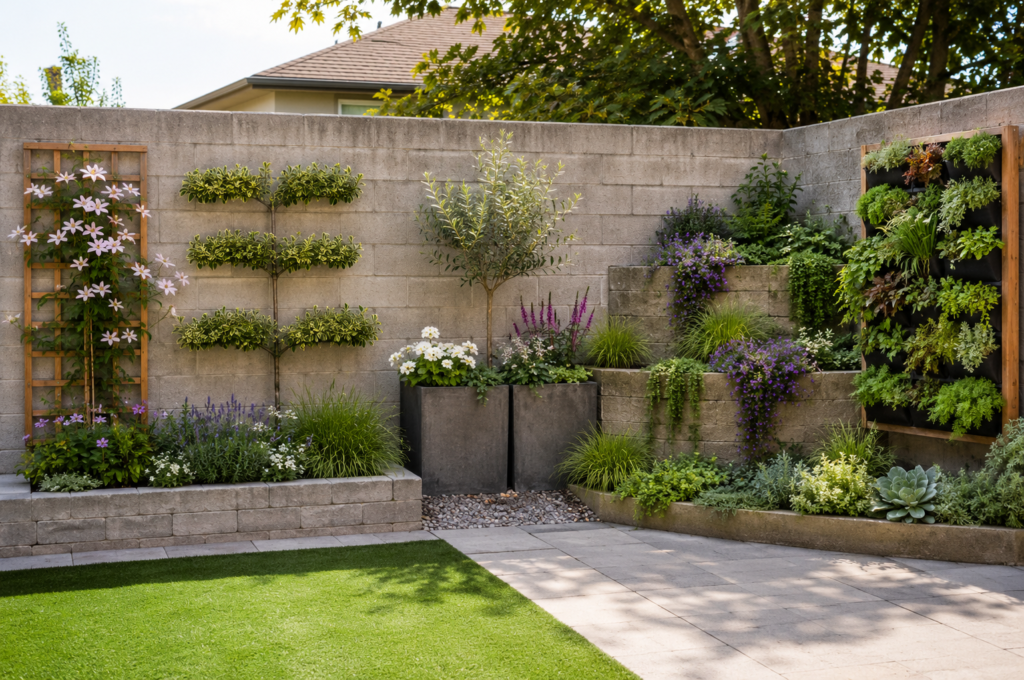
The following backyard block wall plant ideas include solutions for sunny walls, shaded areas, paved yards, narrow spaces, and retaining walls.
| No. | Plant idea | Best use |
|---|---|---|
| 1 | Star jasmine on wires | Fragrant evergreen coverage |
| 2 | Clematis on fine mesh | Seasonal flowers |
| 3 | Climbing rose on horizontal wires | Traditional garden style |
| 4 | Honeysuckle on freestanding trellis | Fragrance and wildlife value |
| 5 | Wall-trained pyracantha | Privacy and berries |
| 6 | Compact wall-trained shrub | Controlled permanent greenery |
| 7 | Espalier fruit tree | Edible narrow garden |
| 8 | Narrow raised planter | Poor or restricted soil |
| 9 | Layered shrub and perennial border | Full landscaped appearance |
| 10 | Mediterranean-style border | Hot and dry walls |
| 11 | Shaded foliage border | Cool or sheltered walls |
| 12 | Large containers | Patios and paved areas |
| 13 | Long trough planters | Narrow concrete strips |
| 14 | Modular planters | Rentals and flexible layouts |
| 15 | Planter bench with trellis | Seating and screening |
| 16 | Trailing plants above the wall | Retaining-wall softness |
| 17 | Creeping groundcovers | Low wall-edge coverage |
| 18 | Ornamental grasses above the wall | Movement and texture |
| 19 | Freestanding living wall | Maximum vertical greenery |
| 20 | Hanging planters on a rail | Seasonal displays |
| 21 | Purpose-built block modules | Herbs, flowers, and succulents |
The strongest wall gardens combine two or three ideas. A climber may cover the upper wall, while repeated perennials and groundcover create a finished base.
Plant Palettes for All 21 Ideas
| Ideas | Suggested palette |
|---|---|
| 1–4: Climbers | One climber, compact evergreen or grass, and low groundcover |
| 5–7: Wall-trained plants | Trained shrub or fruit tree with bulbs, herbs, or perennials |
| 8–11: Raised borders | Narrow structural plant, repeated flowers, and groundcover |
| 12–15: Containers | Dwarf shrub or compact tree, seasonal flowers, and trailing plant |
| 16–18: Wall-top planting | Clump-forming grass, repeated flowers, and cascading plant |
| 19–21: Vertical systems | Small plants with similar light, root depth, and water needs |
Before combining plants, confirm that they share suitable sunlight and irrigation requirements. Check mature width, planter depth, pruning access, thorns, fruit drop, toxicity, and invasive status.
Three repeated compatible species usually look more professional than many unrelated plants with conflicting care needs.
Climbing Plants for Block Walls
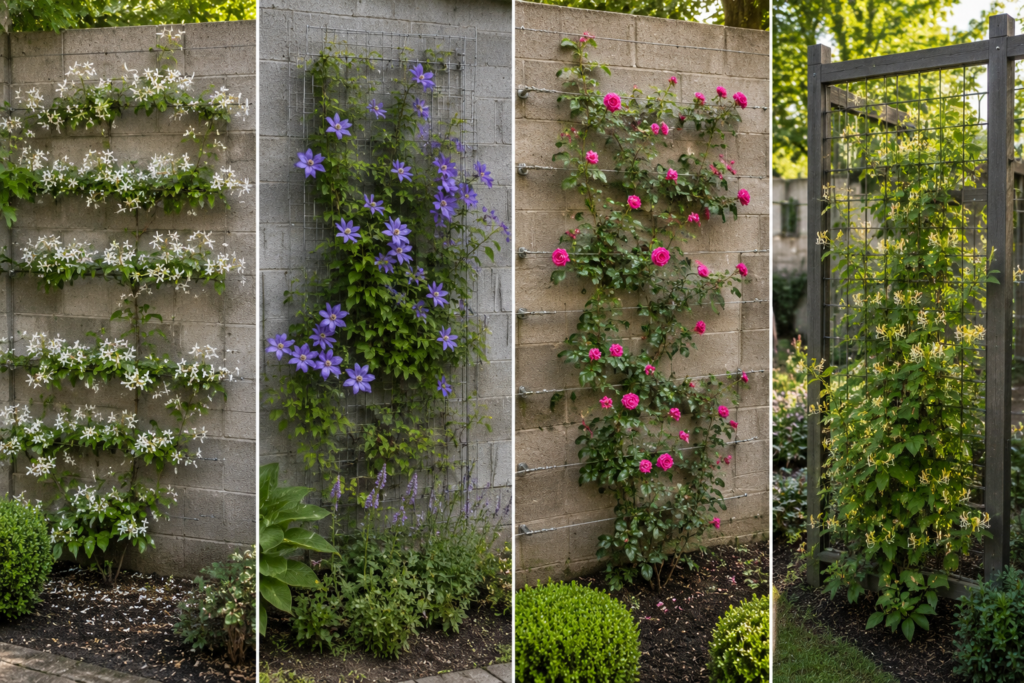
1. Star Jasmine on Wires
Star jasmine suits warm, sheltered walls and provides glossy foliage with fragrant white flowers. Train new growth horizontally across wires or a slim trellis for even coverage.
It works well near seating and dining areas. Choose a hardier climber where winters are too severe for the selected variety.
2. Clematis on Fine Mesh
Clematis uses leaf stalks to grip narrow supports, making fine wire or mesh more effective than thick posts.
Choose a variety according to mature size, flowering season, sunlight, climate, and pruning group. Pair it with a compact evergreen shrub if you want structure when the clematis is dormant.
3. Climbing Rose on Horizontal Wires
A climbing rose creates strong seasonal color but requires tying and pruning. Train the main stems horizontally or diagonally to spread flowers across the wall.
Keep thorny stems away from walkways, gates, play areas, and seating zones.
4. Honeysuckle on a Freestanding Trellis
Honeysuckle adds fragrance, flowers, and wildlife value. A separate trellis improves airflow and keeps stems away from the masonry.
Check the exact species because mature size and invasive potential vary considerably.
Choose star jasmine for evergreen fragrance, clematis for decorative flowers, climbing roses for traditional character, and suitable honeysuckle for wildlife interest.
Wall Shrubs and Espalier Ideas
5. Wall-Trained Pyracantha
Pyracantha provides dense foliage, flowers, berries, and privacy. Many varieties have thorns, so avoid placing them beside children’s areas or narrow walkways.
Train branches across horizontal wires and check mature size, disease resistance, and berry production before selecting a cultivar.
6. Compact Wall-Trained Shrub
Camellia, euonymus, cotoneaster, ceanothus, or another locally adapted shrub can provide permanent structure. Select according to soil, climate, wall aspect, and mature spread.
Add bulbs, herbs, or compact perennials below the shrub while the main framework develops.
7. Espalier Fruit Tree
Espalier apples, pears, figs, citrus, or other suitable fruit trees combine food production with a narrow architectural shape.
They require tying, formative pruning, suitable rootstock, and appropriate pollination. Choose this method only when long-term training is realistic.
Raised Beds and Layered Borders
8. Narrow Raised Planter
A raised planter improves shallow, compacted, or rubble-filled soil. Keep it independent from the wall and provide adequate drainage.
Timber creates a natural appearance, rendered masonry looks permanent, and metal provides a contemporary edge. Install irrigation before filling the planter.
9. Tall–Medium–Low Border
Place a climber or narrow shrub at the back, repeated perennials or grasses in the middle, and groundcover at the front.
This arrangement creates depth and hides bare stems. Repeat plants rather than using a different variety in every position.
10. Mediterranean-Style Border
Hot, well-drained walls may suit:
- Lavender
- Rosemary
- Thyme
- Salvia
- Santolina
- Compact grasses
- Drought-tolerant succulents
Use a limited color palette and repeated foliage textures. These plants still need regular watering while establishing.
11. Shaded Foliage Border
Ferns, heuchera, carex, liriope, compact hydrangeas, and shade-tolerant groundcovers create interest through contrasting leaves.
Check soil moisture because a shaded wall may remain dry when masonry blocks rainfall.
Ideas When There Is No Open Soil
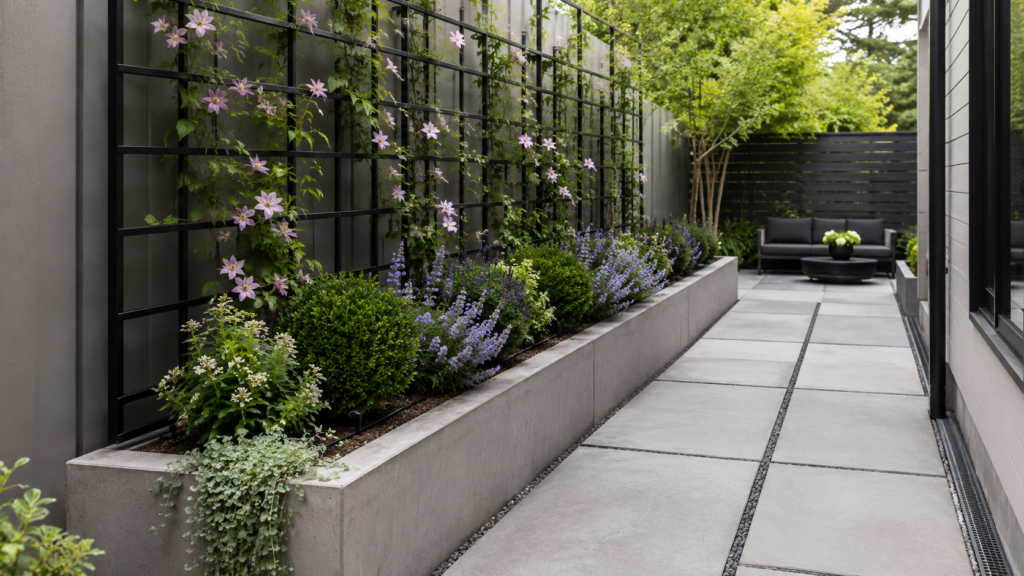
12. Large Containers
A few large containers look more deliberate than many small pots and provide more stable moisture and root space.
Use dwarf shrubs, compact trees, grasses, or perennials to frame gates, seating areas, corners, and changes in wall height.
13. Long Trough Planters
Troughs create a continuous border in a narrow paved yard. Combine one upright plant, repeated flowers, and one trailing plant.
Raise the planter slightly so drainage holes remain open.
14. Freestanding Modular Planters
Modular systems suit rentals and flexible layouts. Use deeper lower modules for larger roots and shallow upper pockets for herbs, flowers, strawberries, or succulents.
Stabilize the frame against wind and account for the weight of wet growing media.
15. Planter Bench with Trellis
A planter bench combines seating, vertical planting, and screening in one compact feature.
Use non-thorny, low-mess plants and avoid vigorous vines that will require frequent cutting around users.
Cascading and Retaining-Wall Ideas
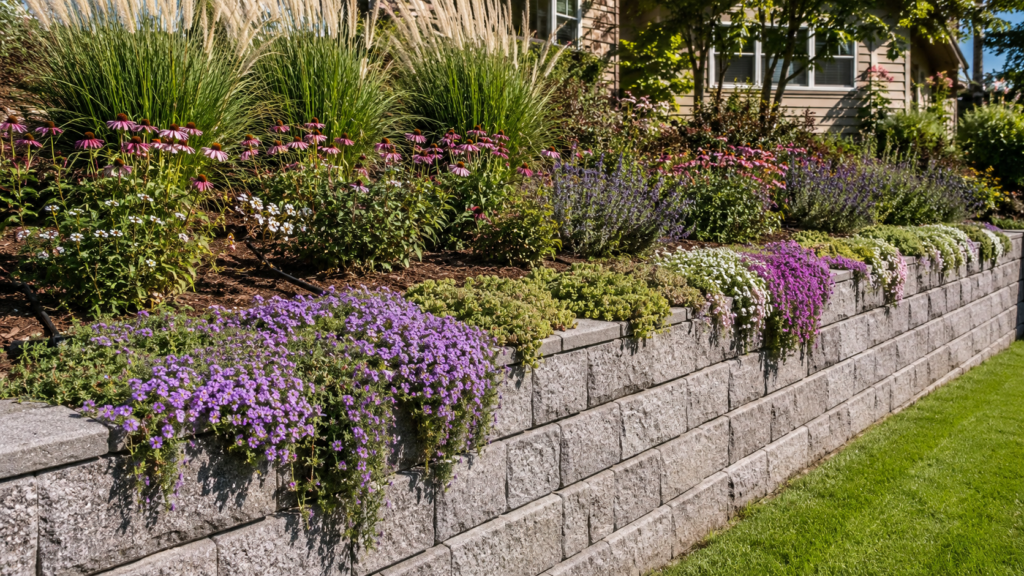
16. Trailing Flowers Above the Wall
Verbena, bacopa, dichondra, petunias, and trailing pelargoniums soften an upper edge quickly. They provide strong seasonal color but require regular watering and trimming.
17. Creeping Groundcovers
Sedum, creeping thyme, erigeron, ajuga, and suitable native groundcovers create lower permanent coverage. Match plants to sunlight, drainage, and soil depth.
Avoid aggressive groundcovers that spread beyond the intended area.
18. Ornamental Grasses Above the Wall
Clump-forming grasses add movement and contrast with solid masonry. Position them far enough from the edge that foliage does not block paths below.
Combine one grass with repeated flowers and a cascading groundcover.
Use only an existing safe planting bed or purpose-built planter above a retaining wall. Do not fill structural cavities.
Vertical and Hanging Garden Ideas
19. Freestanding Living Wall
A freestanding living wall keeps plant weight off the masonry. Group plants with similar sunlight, root depth, and irrigation needs.
Living walls create strong visual impact but require watering, feeding, pruning, drainage management, and plant replacement.
20. Hanging Planters on a Rail
Use an engineered rail or freestanding frame instead of random wall hooks.
Upper containers receive more heat and wind, so place tougher plants higher. Use lightweight growing media and manage drainage carefully.
21. Purpose-Built Block Modules
Decorative planter blocks can hold herbs, strawberries, flowers, and succulents. Ensure every pocket remains accessible for watering.
Do not use cavities in a structural wall unless it was designed for planting.
Best Plants by Climate and Sun Exposure
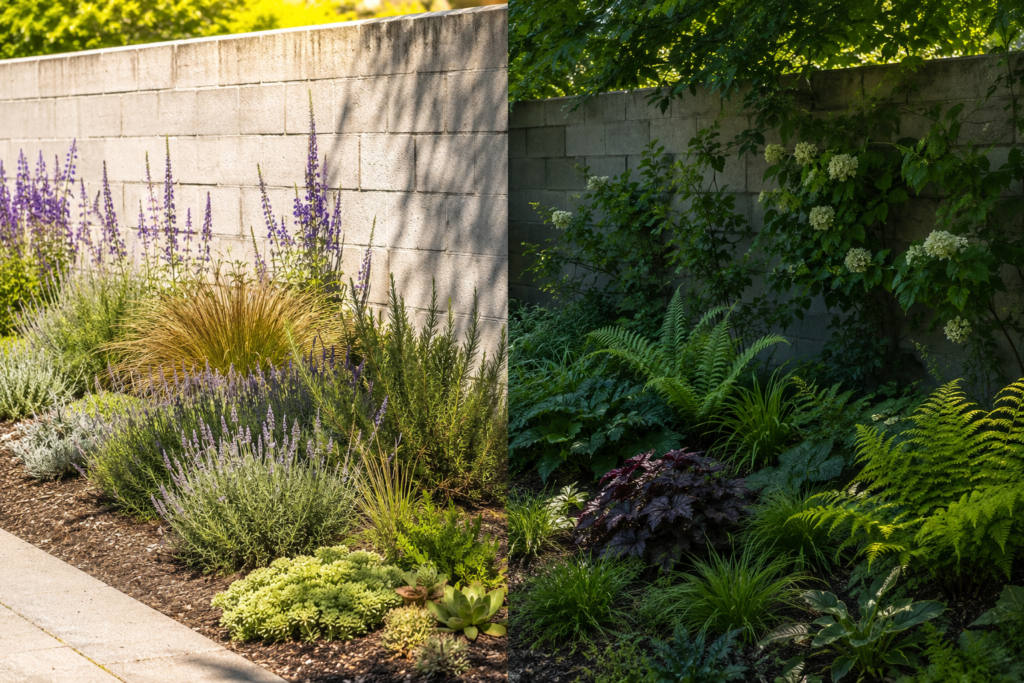
The best backyard block wall plant ideas vary according to temperature, rainfall, reflected heat, humidity, and winter conditions.
| Condition | Useful plant direction |
|---|---|
| Hot and dry | Lavender, rosemary, thyme, sedum, and drought-tolerant grasses |
| Warm and humid | Star jasmine, mandevilla, passionflower, and open-growing foliage |
| Temperate sun | Clematis, climbing rose, pyracantha, and espalier fruit |
| Cool or frost-prone | Hardy clematis, suitable honeysuckle, and espalier apple |
| Cool shade | Ferns, heuchera, climbing hydrangea, and shade groundcovers |
| Paved area | Dwarf shrubs, herbs, annual climbers, and compact grasses |
Also assess reflected heat, wind, soil depth, rainfall, humidity, and winter exposure. Choose plants for environmental fit first and decorative color second.
Choose Plants for Privacy, Color, or Low Maintenance
For year-round privacy, combine an evergreen shrub or climber with one flowering plant and lower foliage. Permanent structure is more reliable than one extremely fast vine.
For seasonal color, select plants with different flowering periods. A spring shrub, summer climber, and autumn foliage plant can extend interest.
For low maintenance, choose plants that fit at maturity, grow moderately, and share similar water needs. Use drip irrigation and repeat the same groundcover.
For wildlife, prioritize locally appropriate plants that provide nectar, pollen, berries, or shelter without becoming invasive.
Install a Trellis Without Damaging the Wall
Install the trellis before planting. Inspect the masonry and estimate the plant’s mature weight. Fine mesh suits clematis, wires suit twining vines, horizontal supports suit climbing roses, and woody climbers need stronger frames.
Leave space between the support and wall for airflow, tying, pruning, and inspection. Plant beyond the driest area at the wall base where possible and angle young stems toward the support.
Keep growth away from:
- Roofs and gutters
- Windows and vents
- Lights and cables
- Gates
- Neighboring structures
Use wall-mounted supports only on sound masonry. Choose a freestanding trellis for old, cracked, shared, or structural walls.
Soil, Irrigation, and Mulch
Remove weeds and rubble, loosen the planting area, and test drainage. Use a raised bed where the original soil is shallow, restricted, or poorly drained.
Drip irrigation works well in narrow beds and container rows. Group plants by watering needs and adjust irrigation for heat, wind, rainfall, soil type, container size, and plant maturity.
Mulch reduces evaporation and weeds, but keep it away from stems and crowns. Direct planter runoff away from foundations and visible wall surfaces.
Plants and Methods to Avoid
Avoid:
- Self-clinging vines on damaged masonry
- Heavy vines on weak lattice
- Invasive climbers
- Broad shrubs in narrow passages
- Tiny pots on hot walls
- Plants with conflicting water needs
- Soil inside structural cavities
- Thorny plants beside seating
- Large trees near foundations
- Supports that prevent wall inspection
Also avoid plants that need constant restriction. A moderate plant on a suitable support will create less work and fewer structural concerns.
Choose the Right Planting Setup
Compare these backyard block wall plant ideas according to available soil, desired coverage, maintenance level, and wall condition.
| Priority | Best option |
|---|---|
| Lowest cost | Annual climber on removable mesh |
| Fastest improvement | Large containers with established plants |
| Long-term privacy | Evergreen shrub plus restrained climber |
| No soil | Trough planters or modular frame |
| Old wall | Freestanding planter and trellis |
| Hot wall | Deep raised bed |
| Small yard | Slim trough and narrow trellis |
| Rental property | Movable containers |
| Edible garden | Espalier fruit tree and herbs |
| Low maintenance | Compact shrubs, perennials, and drip irrigation |
For most backyards, use one freestanding trellis, one manageable climber, one narrow planter, one compact structural plant, and repeated lower-growing plants.
Cost, Coverage Speed, and Maintenance
| Setup | Cost | Visual impact | Maintenance |
|---|---|---|---|
| Annual climber | Low | Fast but seasonal | Replant annually |
| Perennial climber | Low–medium | Gradual | Train and prune |
| Large containers | Medium | Immediate | Water frequently |
| Raised border | Medium–high | Strong | Seasonal care |
| Espalier fruit tree | Medium | Slow | Skilled pruning |
| Living wall | High | Immediate | High maintenance |
A low installation cost may create more long-term work. Select the setup whose watering and pruning requirements fit your routine.
Block Wall Planting Scorecard
| Setup | Wall safety | Privacy | Fast impact | Low maintenance |
|---|---|---|---|---|
| Wall-mounted climber | 3 | 4 | 3 | 3 |
| Freestanding trellis | 5 | 4 | 3 | 3 |
| Raised border | 5 | 4 | 4 | 4 |
| Large containers | 5 | 3 | 5 | 2 |
| Living wall | 4 | 4 | 5 | 1 |
| Espalier fruit tree | 4 | 2 | 1 | 2 |
The scores are editorial planning aids from 1 to 5. Freestanding trellises provide the strongest overall balance of wall safety, privacy, and flexibility.
Three Sample Block Wall Layouts
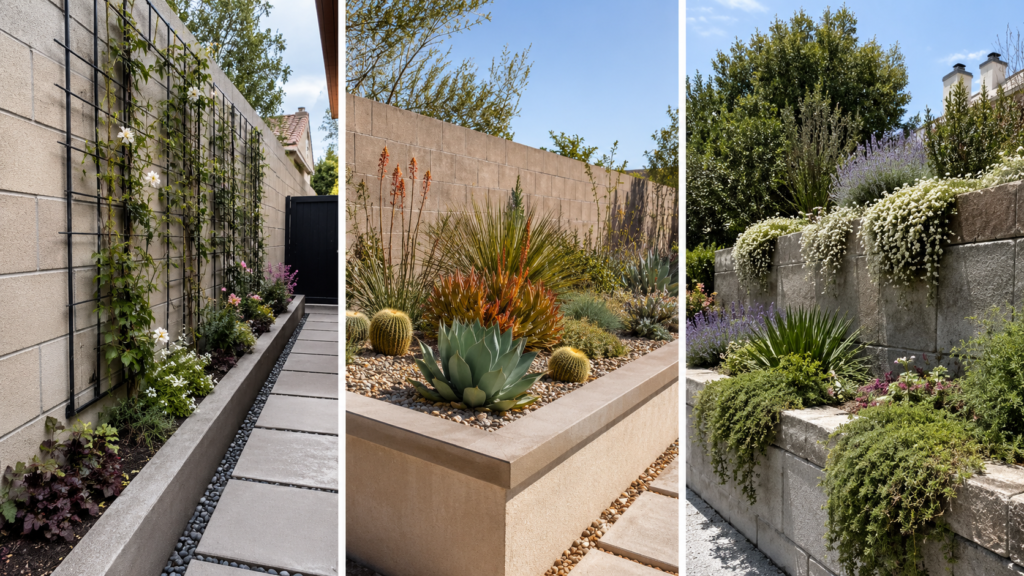
Narrow Paved Yard
Use one long trough, a freestanding trellis, one moderate climber, repeated compact flowers, and one trailing plant. This preserves walkway width and wall access.
Hot Sunny Wall
Use an independent raised bed, one narrow heat-tolerant shrub, repeated drought-tolerant perennials, groundcover, mulch, and drip irrigation.
Retaining Wall
Place grasses farther from the edge, flowering plants through the middle, and trailing plants near the top. Keep runoff away from the wall face and maintain access from above.
How We Selected These Ideas
The ideas were evaluated according to wall safety, mature plant size, climate adaptability, soil availability, irrigation, pruning access, privacy, and small-space usefulness.
Planting systems and plant species were considered separately because a suitable plant can still fail in the wrong support or root zone. Confirm final choices with a local nursery, horticultural adviser, botanical garden, or landscape professional.
Block Wall Planning Checklist
Before buying plants, confirm:
- Wall type and condition
- Permission to drill
- Sunlight and reflected heat
- Soil depth and drainage
- Available planting width
- Irrigation access
- Mature plant size
- Climbing method
- Support strength
- Local invasive status
- Pruning access
- Clearance from paths, windows, and utilities
A well-matched design may take longer to fill the wall but will require fewer replacements and less corrective maintenance.
Backyard Block Wall Plant FAQs
What are the best plants for a backyard block wall?
Good options include star jasmine, clematis, climbing roses, pyracantha, lavender, ornamental grasses, ferns, sedum, and compact groundcovers. Choose according to climate and sunlight.
What is the fastest way to cover a block wall?
Use an established climber on a freestanding trellis with large containers or a narrow border below it. Annual vines grow quickly, while perennial climbers last longer.
Which plants provide year-round privacy?
Evergreen climbers and narrow evergreen shrubs provide the best screening. Combine permanent foliage with one flowering plant and lower greenery.
What can I plant beside a hot wall?
Choose lavender, rosemary, thyme, salvia, sedum, bougainvillea, or drought-tolerant grasses where locally suitable.
What grows beside a shaded wall?
Ferns, heuchera, carex, liriope, climbing hydrangea, and selected clematis can work. Check moisture because shaded soil may still be dry.
How can I hide a wall without open soil?
Use large containers, long troughs, modular planters, or a freestanding living-wall frame.
Can climbers damage a block wall?
Climbers may enter existing cracks and weak joints. Use a separate trellis when the wall’s condition is uncertain.
What is the lowest-maintenance option?
Use compact shrubs, repeated perennials, groundcover, mulch, and drip irrigation. A simple raised border is easier than a living wall.
Can plants grow inside block holes?
Only use purpose-built planter blocks with proper drainage. Do not fill structural cavities unless the wall was designed for planting.
What is best for a small backyard?
A slim trough with a freestanding trellis works well. Add one moderate climber and repeated compact plants.
How do I create a professional look?
Use a climber or narrow shrub for height, repeated plants in the middle, and groundcover at the front. Limit the palette and repeat colors.
Final Takeaway
The best backyard block wall plant ideas respond to the site instead of trying to hide concrete as quickly as possible. Check the wall, sunlight, heat, soil, drainage, and maintenance access before selecting plants. The right backyard block wall plant ideas should fit the site naturally instead of covering the masonry as quickly as possible.
For most homeowners, the strongest solution is a freestanding trellis with a narrow raised planter or large troughs, one manageable climber, one compact structural plant, and repeated lower-growing plants.

Myra is the founder and lead writer of Backyard Planter Ideas, where she shares practical, well-researched guidance on planter design, plant selection, and outdoor styling. Her goal is to help homeowners create attractive, functional garden spaces with clear, reliable, and easy-to-apply advice.