The best backyard herb planter provides reliable drainage, sufficient root space, suitable sunlight, and easy access for harvesting. These backyard herb planter ideas work for small patios, large yards, rental homes, outdoor kitchens, and accessible gardens. Most culinary herbs perform best with around six hours of direct sunlight, although parsley, chives, and mint can tolerate some shade. Use container potting mix instead of dense garden soil, group herbs with similar moisture needs, and keep spreading plants such as mint in separate pots.
Backyard Herb Planter Ideas at a Glance
The right planter depends on your available space, climate, mobility needs, and preferred herbs. A vertical planter works well in a narrow yard, while individual pots offer better control over watering and sunlight. Raised planters improve accessibility, and heavy containers provide stability in exposed locations.
| Main priority | Best planter idea | Main benefit |
|---|---|---|
| Beginner-friendly | Individual pot cluster | Easy to manage separately |
| Small footprint | Vertical herb wall | Uses wall space |
| Narrow patio | Tiered ladder planter | Adds several growing levels |
| Limited mobility | Waist-height planter | Reduces bending |
| Rental property | Wheeled planter | Easy to relocate |
| Frequent cooking | Kitchen-door station | Simplifies harvesting |
| Mixed herbs | Mediterranean trough | Groups compatible plants |
| Decorative display | Terracotta pot cluster | Combines style and control |
| Rainy climate | Elevated trough | Improves drainage |
| Windy yard | Concrete planter | Provides stability |
Compare these backyard herb planter ideas by space, mobility, drainage, and maintenance before choosing a permanent design.
Before choosing, consider:
- Available width, height, and walking space
- Direct sunlight and afternoon heat
- Herb size and water requirements
- Water access and drainage
- Seasonal movement
- Daily harvesting convenience
The best planter is not necessarily the largest. It is the one you can water, reach, and maintain consistently.
How We Evaluated These Backyard Herb Planter Ideas
These ideas were evaluated for space efficiency, drainage, plant compatibility, maintenance, accessibility, mobility, climate exposure, and mature herb size. Each design should solve a practical backyard problem rather than provide visual interest alone.
Every planter has trade-offs. Hanging baskets save floor space but dry quickly. Stone planters resist wind but are difficult to move. Large raised beds provide more soil volume but may not suit renters or changing sunlight.
The strongest options provide:
- Clear drainage
- Enough mature root space
- Convenient harvesting
- Stable construction
- Suitable sunlight
- Manageable watering needs
- Separation for aggressive herbs
Choose the design whose limitations fit your routine. A high-maintenance planter can still work when it is beside the kitchen, while a low-maintenance planter may fail if it sits in deep shade.
How to Choose the Right Backyard Herb Planter
Observe the proposed location before purchasing a planter. Check it in the morning, at midday, and in the afternoon to understand sunlight, reflected heat, wind, and shade. Also note where water collects and how often you pass the area.
Plan for mature plants rather than young transplants. Rosemary, fennel, and lovage can quickly outgrow containers that initially appear spacious.
Questions to Answer Before Selecting a Planter
- How much direct sunlight does the area receive?
- Which herbs will you harvest regularly?
- Do those herbs need similar moisture?
- Can excess water drain safely?
- Will the planter need to move?
- Can you reach every section comfortably?
- Is the structure stable in wind?
- Will mature foliage block a path?
- Does the material suit your climate?
| Backyard condition | Suitable planter |
|---|---|
| Small courtyard | Vertical or tiered planter |
| Large open yard | Raised rectangular bed |
| Rental property | Portable pot cluster |
| Hot, dry area | Large light-colored pot |
| Rainy location | Elevated trough |
| Limited mobility | Waist-height planter |
| Outdoor kitchen | Narrow culinary planter |
Match the Planter to Mature Herb Size
Thyme, chives, and compact oregano need less root space than rosemary, fennel, or large sage plants. Leave visible gaps between young herbs so roots and foliage can expand without severe competition.
Place tall herbs behind shorter plants in rectangular planters. In containers accessible from all sides, taller herbs may sit near the center, provided they do not shade the entire arrangement.
Mixed Planter or Separate Pots?
Separate pots offer better control over watering, sunlight, soil volume, and seasonal movement. They are the safest option for beginners and for herbs with different growing needs.
Mixed planters work when plants share similar conditions. Rosemary, thyme, sage, oregano, and marjoram suit a sunny, free-draining planter. Basil, parsley, and chives can share a container that receives more consistent moisture.
Grow mint, lemon balm, fennel, lovage, and mature rosemary separately.
Backyard Herb Planter Size Guide
Planter size should reflect mature root growth, not the size of the plant when purchased. Small pots dry quickly and restrict roots, while oversized containers can become difficult to move.
| Herb or group | Suggested starting size | Key consideration |
|---|---|---|
| Thyme | 15 cm / 6 in wide | Avoid wet soil |
| Chives | Small to medium pot | Divide crowded clumps |
| Basil | Medium pot | Needs regular moisture |
| Parsley | Medium, deep pot | Protect from severe drying |
| Tarragon | 20 cm / 8 in | Requires drainage |
| Mixed herb trough | About 20 cm / 8 in deep | Use compatible herbs |
| Rosemary | Around 30 cm / 12 in | Repot as it matures |
| Mint | Separate medium pot | Controls spreading |
| Fennel or lovage | Large individual pot | Needs stability |
Choose a larger planter when several herbs will share the soil, the location is hot or windy, or daily watering is difficult. When uncertain, use fewer plants and more soil volume.
25 Backyard Herb Planter Ideas
The following backyard herb planter ideas are grouped into space-saving, accessible, decorative, and culinary designs.
Space-Saving Backyard Herb Planter Ideas
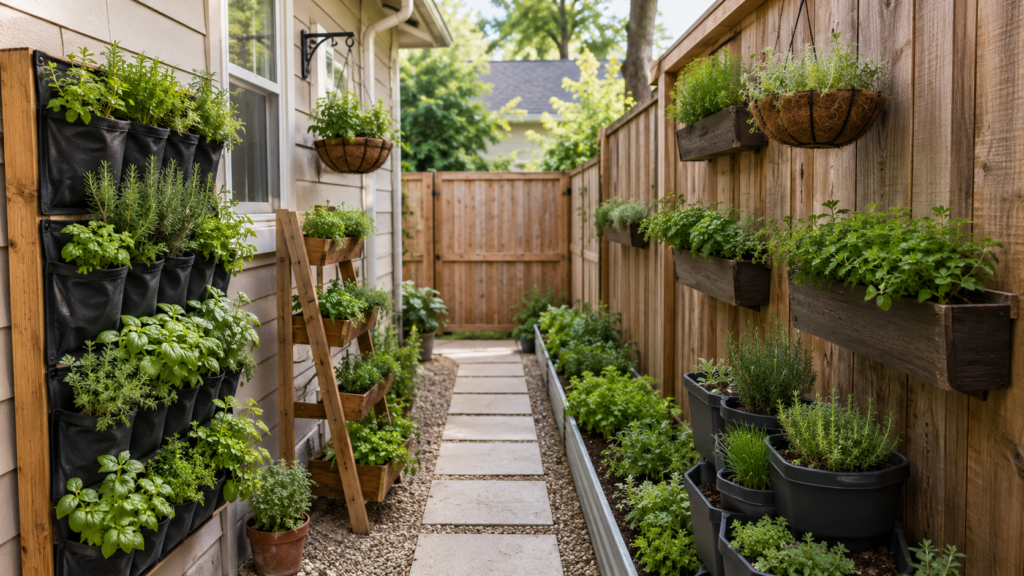
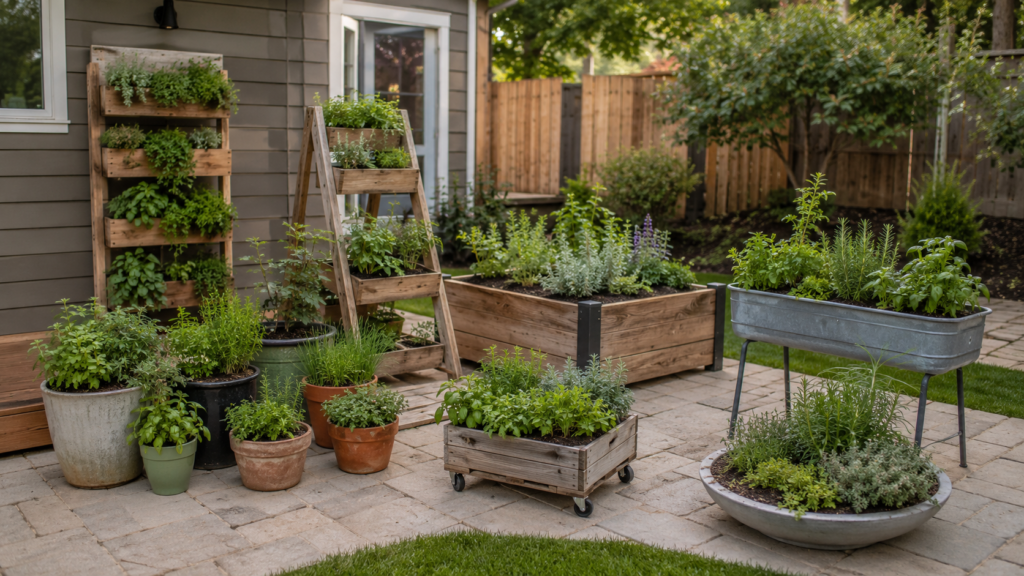
1. Vertical Wooden Herb Wall
A vertical wall turns a fence or shed into productive growing space. Removable pots are easier to manage than one connected soil system because each herb retains a separate root zone.
Use thyme, oregano, chives, parsley, and compact basil. Check upper pots frequently because they often dry faster.
2. Tiered Ladder Planter
A ladder planter holds individual pots on several shelves. It provides vertical capacity without permanent wall installation and can often be repositioned.
Place heavy pots on lower levels for stability. Keep tall rosemary or sage from shading smaller herbs.
3. Fence-Mounted Herb Boxes
Fence boxes preserve ground space and keep herbs near harvesting height. Use separate boxes for dry-loving and moisture-loving groups.
Confirm that the fence can support the full wet weight. Avoid large woody herbs in shallow boxes.
4. Hanging Basket Herb Garden
Hanging baskets work above patios and pergolas. Trailing thyme, oregano, parsley, and compact basil are suitable choices.
Install baskets within comfortable reach and away from seating or walkways. Expect more frequent watering in hot or windy weather.
5. Stackable Herb Planter
Stackable planters hold several herbs within a small footprint. Different pockets may receive unequal sunlight and water, so rotate the planter when possible.
Use thyme and oregano near the top, chives and basil in the middle, and parsley lower down. Keep mint separate.
6. Narrow Walkway Herb Trough
A narrow trough fits beside a wall, path, railing, or kitchen entrance. It provides more soil volume than small pots without blocking movement.
Use one compatible group and position tall herbs toward the rear. Leave space for mature foliage.
Raised and Accessible Herb Planter Ideas
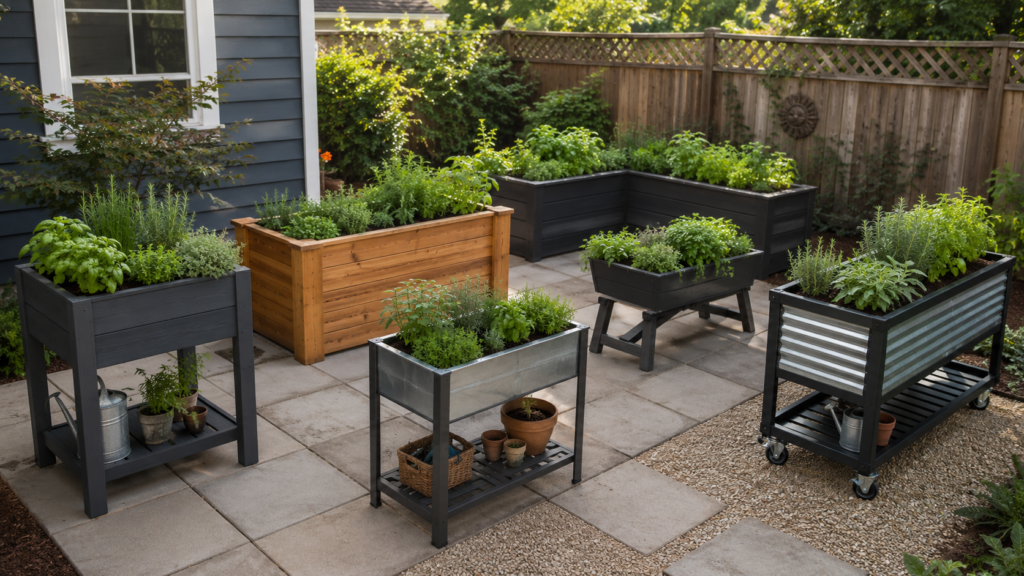
7. Waist-Height Raised Herb Planter
A waist-height planter reduces bending and makes harvesting easier. Its height should suit the main gardener, while its width should allow comfortable reach.
Divide the planter into moisture zones or use removable pots inside the structure.
8. Cedar Herb Planter Box
A cedar planter provides a natural appearance and can be customized to fit a patio, deck, or corner.
Use container potting mix and plan drainage carefully. Separate Mediterranean herbs from basil, parsley, and chives.
9. Raised Herb Planter With Storage Shelf
A lower shelf can hold clean pots, labels, gloves, and hand tools. This keeps essential supplies near the herbs.
Direct drainage away from the shelf and ensure the growing box has independent structural support.
10. L-Shaped Corner Herb Planter
An L-shaped planter uses an awkward corner and creates two planting zones.
Place rosemary, thyme, sage, and oregano in the sunnier arm. Use the other side for basil, parsley, and chives. Keep mint in a separate pot.
11. Herb Planter With Built-In Seating
A planter bench combines herbs with backyard seating. The seat and planter should have separate structural support.
Choose compact herbs near the seat and direct drainage away from cushions and walking surfaces.
12. Mobile Raised Planter on Wheels
A wheeled planter can follow changing sunlight or move into shelter during severe weather.
Use locking outdoor casters and keep the planter compact enough to move safely across a level surface.
Decorative Backyard Herb Planter Ideas
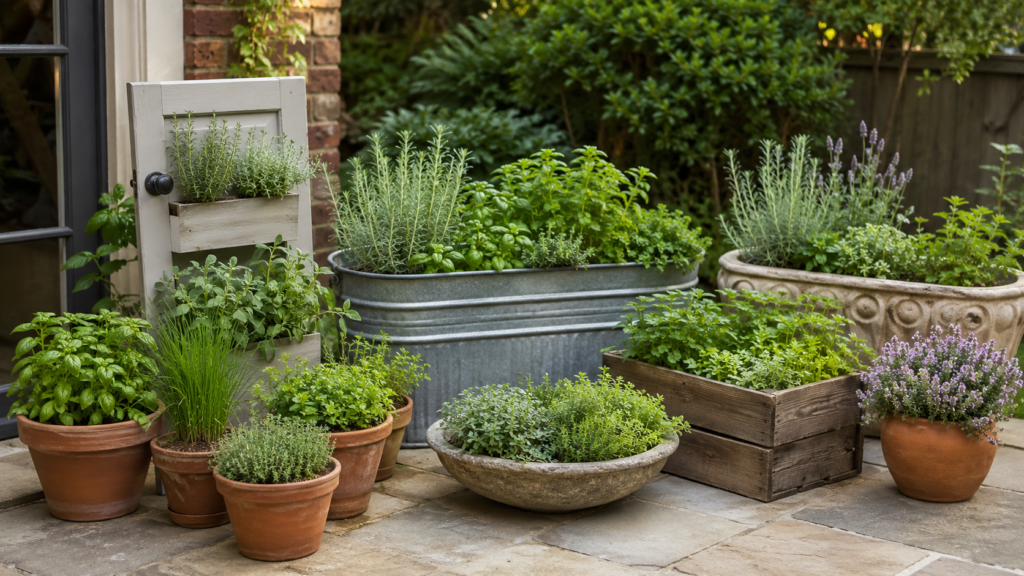
13. Terracotta Pot Cluster
Terracotta pots create a coordinated display while keeping herbs separate. Use several pot sizes and arrange the largest at the rear.
Terracotta dries relatively quickly, making it suitable for rosemary, thyme, and sage. Basil and parsley may need closer watering attention.
14. Galvanized Trough Herb Planter
A galvanized trough creates a farmhouse or modern-rustic feature. Its long form works well for Mediterranean herbs.
Add several drainage holes and avoid placing a small metal container against a highly reflective wall.
15. Reclaimed Wooden Crate Herb Garden
A clean reclaimed crate can hold several individual pots and create a rustic appearance.
Avoid wood with an unknown chemical history. Raise the crate slightly so drainage and airflow can reach the base.
16. Stone or Concrete Herb Bowl
A stone or concrete bowl provides stability in windy locations. It is best suited to compact herbs such as thyme, oregano, marjoram, and small sage varieties.
Choose the location before filling because the completed container will be difficult to move.
17. Circular Herb Planter
A circular planter creates a central feature that can be approached from several sides.
Use wedge-shaped planting zones. A rosemary or sage plant can provide height, with oregano and thyme near the outer edge.
18. Rustic Wheelbarrow Herb Planter
A wheelbarrow planter creates a movable seasonal display. It is best for annual or compact herbs such as basil, parsley, cilantro, chives, and thyme.
Add drainage holes and stabilize the supports before filling.
19. Herb Planter Around a Patio Post
A planter around a patio or pergola post integrates herbs into an existing structure.
Use a removable inner pot so moisture does not remain against the post. Select herbs according to the actual shade pattern.
Functional Culinary Herb Planter Ideas
20. Kitchen-Door Herb Station
A kitchen-door station should contain the herbs you use most often. Individual pots on a narrow stand offer the easiest control.
Use rosemary, basil, parsley, thyme, chives, and seasonal cilantro where sunlight is suitable.
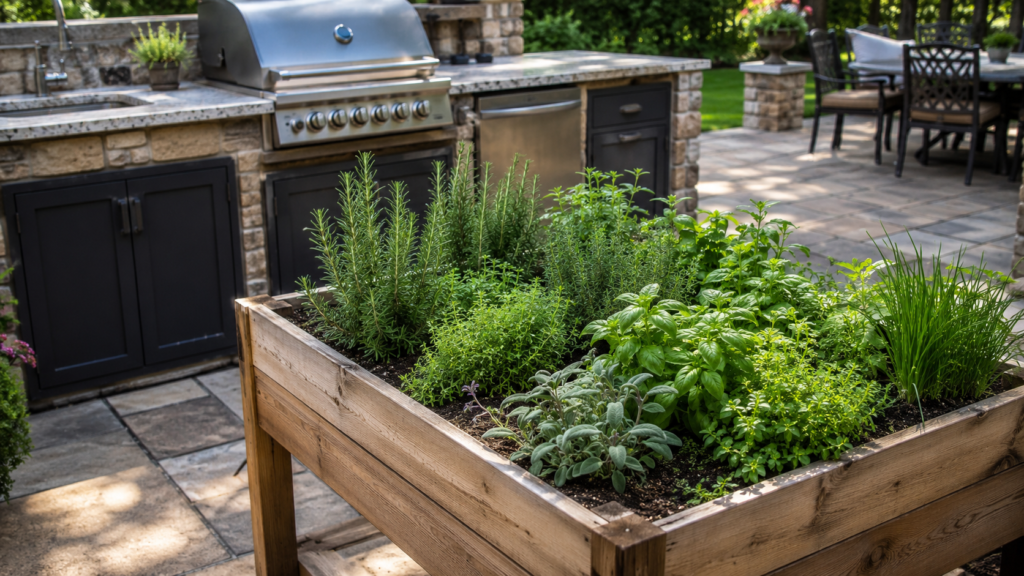
21. Outdoor-Grill Herb Planter
A grill-side planter keeps rosemary, thyme, oregano, sage, and chives close to outdoor cooking areas.
Place it away from open flames, grease, smoke concentration, and busy foot traffic.
22. Mediterranean Herb Trough
A Mediterranean trough is one of the most reliable mixed herb planters. Rosemary, thyme, sage, oregano, marjoram, and winter savory share similar light and drainage needs.
Use a free-draining mix and avoid adding mint or moisture-loving herbs.
23. Salsa Herb Planter
A salsa planter focuses on cilantro, chives, and parsley. Grow cilantro in small repeated batches because it may flower quickly in warm weather.
Grow tomatoes and peppers in separate, larger containers.
24. Tea and Fragrance Herb Planter
A tea and fragrance cluster may include mint, lemon balm, chamomile, and lavender.
Keep these herbs in separate but coordinated pots because their moisture requirements differ. Confirm plant identity before using leaves or flowers in drinks.
25. Pollinator-Friendly Flowering Herb Planter
Allow selected oregano, thyme, chives, sage, basil, or dill plants to flower while continuing to harvest others.
Use sage for structure, oregano and chives in the middle, thyme near the edge, and dill for seasonal height.
Should You Buy or Build a Backyard Herb Planter?
Buying is usually better when speed, portability, and simple installation matter most. Ready-made planters may include wheels, shelves, liners, or self-watering features.
Building offers more control over size, height, drainage, accessibility, and design.
| Factor | Buy | Build |
|---|---|---|
| Setup time | Fast | Requires planning |
| Skill | Low | Moderate to advanced |
| Custom sizing | Limited | Excellent |
| Portability | Often included | Must be designed |
| Accessibility | Standard heights | Customizable |
| Best for | Beginners and renters | Custom spaces |
Buy when standard dimensions fit and you need a quick setup. Build when the backyard has unusual dimensions, specific accessibility needs, or a custom drainage route.
A hybrid option uses a custom outer frame with removable commercial pots inside.
Which Herbs Grow Well Together in a Planter?
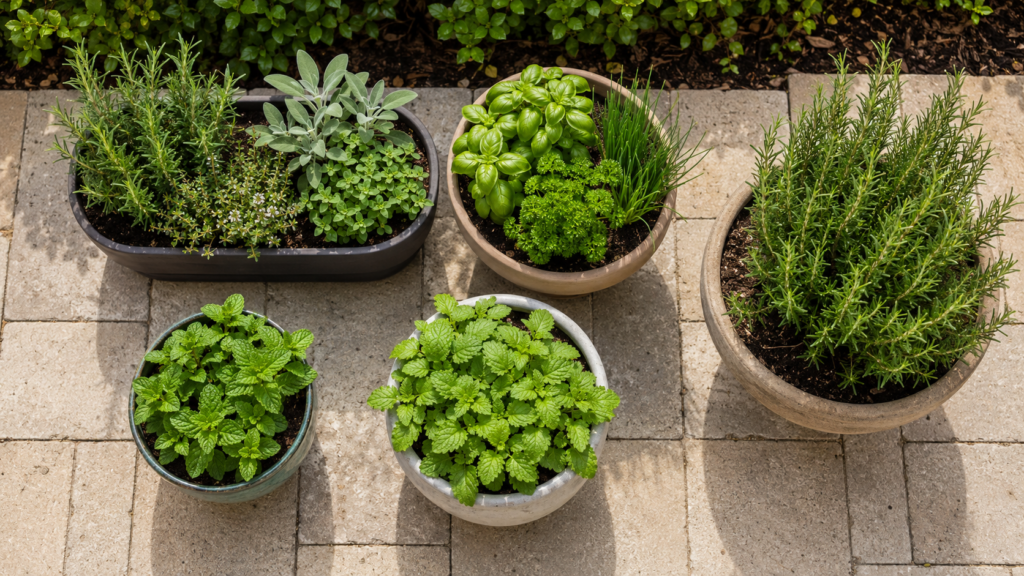
Herbs grow well together when they share sunlight, moisture, drainage, and root-space needs.
Reliable Herb Combinations
| Group | Herbs |
|---|---|
| Mediterranean | Rosemary, thyme, sage, oregano, marjoram |
| Moist culinary | Basil, parsley, chives |
| Partial sun | Parsley, chives, contained mint |
| Pollinator | Oregano, thyme, sage, chives |
Herbs That Should Usually Grow Separately
Grow mint, lemon balm, fennel, lovage, and mature rosemary independently. These herbs may spread aggressively, become too large, or require different watering conditions.
How to Test Whether Herbs Are Compatible
Ask whether every herb can be watered at roughly the same time. If basil repeatedly wilts while rosemary remains wet, the plants should not share a container.
Also compare mature height, root spread, drainage needs, winter care, and harvesting frequency.
Best Planter Materials for Outdoor Herbs
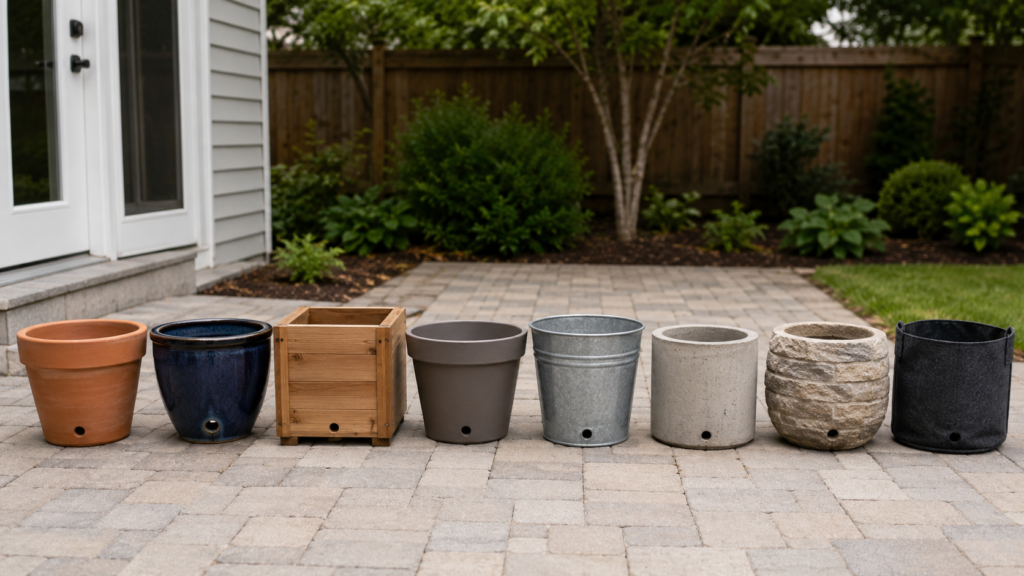
Material affects moisture, weight, temperature, portability, and durability.
Outdoor Herb Planter Material Comparison
| Material | Main advantage | Main limitation |
|---|---|---|
| Terracotta | Good moisture release | Dries quickly |
| Glazed ceramic | Retains moisture | Heavy |
| Wood | Customizable | Needs maintenance |
| Plastic or resin | Light and affordable | May tip |
| Metal | Strong appearance | Can become hot |
| Concrete or stone | Stable | Difficult to move |
| Fabric | Portable and ventilated | Dries rapidly |
Match the Material to Your Main Challenge
- Choose terracotta for dry-loving herbs.
- Choose resin or glazed ceramic when pots dry too quickly.
- Choose wood for custom raised designs.
- Choose stone or concrete in windy locations.
- Choose plastic or fabric when mobility matters.
- Use metal only where root-zone heat can be controlled.
Which Material Is Best for Your Climate?
Hot climates benefit from large, light-colored containers. Wet climates require elevation and open drainage. Windy locations need heavy or broad-based planters, while frost-prone areas benefit from portable, weather-resistant containers.
Where to Place a Backyard Herb Planter
Place the planter where herbs receive appropriate sunlight, water drains safely, and harvesting remains convenient.
Backyard Herb Planter Placement Score
| Factor | 0 points | 1 point | 2 points |
|---|---|---|---|
| Sunlight | Unsuitable | Usable | Matches herbs |
| Kitchen access | Distant | Moderate | Convenient |
| Water access | Difficult | Manageable | Easy |
| Drainage | Water pools | Partial runoff | Free draining |
| Exposure | Severe | Partly protected | Sheltered |
A location scoring 7–10 points is generally a strong option.
How to Improve a Low-Scoring Location
- Use movable pots.
- Select herbs suited to the available light.
- Raise containers to improve drainage.
- Choose larger planters in hot areas.
- Add wind protection without blocking sunlight.
- Improve access to water.
Locations to Avoid
Avoid downspouts, mechanical exhaust, unstable walls, busy paths, intense reflected heat, deep water-collecting areas, and locations that are difficult to reach.
Climate and Weather Risk Guide for Backyard Herb Planters
Climate Risk Comparison
| Condition | Main risk | Better choice |
|---|---|---|
| Hot and dry | Rapid drying | Large light-colored planter |
| Hot and humid | Wet roots | Open, ventilated planter |
| Rainy | Saturation | Elevated trough |
| Windy | Tipping | Low stone or concrete planter |
| Frost-prone | Root and pot damage | Movable resistant container |
| Partial sun | Weak sun-loving herbs | Individual movable pots |
Practical Climate Adjustments
- Increase soil volume in hot or windy conditions.
- Raise pots so drainage holes remain open.
- Protect tender herbs from severe afternoon heat.
- Move containers away from roof runoff.
- Shelter cold-sensitive herbs before frost.
- Check hanging and wall-mounted planters frequently.
Climate Decision Rule
Choose the planter whose main climate risk is easiest to control. Heavy planters provide stability but little mobility, while lightweight containers offer flexibility but require wind protection.
Compare All 25 Backyard Herb Planter Ideas
| Planter type | Space use | Mobility | Care level |
|---|---|---|---|
| Vertical wall | Very efficient | Fixed | High |
| Ladder planter | Efficient | Semi-mobile | Medium |
| Fence boxes | Very efficient | Fixed | High |
| Hanging baskets | Very efficient | Semi-mobile | High |
| Stackable planter | Very efficient | Mobile | Medium-high |
| Narrow trough | Efficient | Semi-mobile | Medium |
| Waist-height planter | Moderate | Fixed | Medium |
| Cedar box | Moderate | Fixed | Medium |
| Planter with shelf | Efficient | Semi-mobile | Medium |
| L-shaped planter | Moderate | Fixed | Medium |
| Planter bench | Efficient | Fixed | Medium |
| Wheeled planter | Moderate | Mobile | Medium |
| Terracotta cluster | Flexible | Mobile | Medium-high |
| Galvanized trough | Moderate | Semi-mobile | Medium |
| Crate planter | Flexible | Mobile | Medium |
| Concrete bowl | Moderate | Fixed | Low-medium |
| Circular planter | Large | Fixed | Medium |
| Wheelbarrow planter | Flexible | Mobile | Medium |
| Patio-post planter | Efficient | Fixed | Medium |
| Kitchen-door station | Efficient | Mobile | Medium |
| Grill-side planter | Efficient | Semi-mobile | Medium |
| Mediterranean trough | Moderate | Semi-mobile | Low-medium |
| Salsa planter | Flexible | Mobile | Medium |
| Tea herb cluster | Flexible | Mobile | Medium |
| Pollinator planter | Moderate | Semi-mobile | Medium |
Choose two or three ideas that fit the available space, remove those that conflict with the climate, and select the simplest remaining design.
How to Set Up a Backyard Herb Planter
Step-by-Step Herb Planter Setup
- Assess sunlight, wind, and rain.
- Choose a planter sized for mature herbs.
- Confirm drainage holes are open.
- Add container potting mix.
- Group compatible herbs.
- Arrange plants by mature height.
- Plant at the existing soil level.
- Water until excess moisture drains.
- Add labels.
- Monitor soil rather than following a fixed schedule.
- Harvest regularly.
- Adjust the setup seasonally.
Real-World Setup Improvements
Use removable pots for mint and other aggressive herbs. Raise containers slightly above paving when drainage holes could become blocked. Use automatic irrigation only when every herb has similar moisture requirements.
First Two-Week Monitoring Checklist
- Confirm water exits the planter.
- Compare sunny and shaded moisture levels.
- Watch for excessive shading.
- Check stability after watering.
- Move vigorous herbs early.
- Adjust watering to actual soil conditions.
- Inspect leaves for wilting or yellowing.
Common Backyard Herb Planter Mistakes
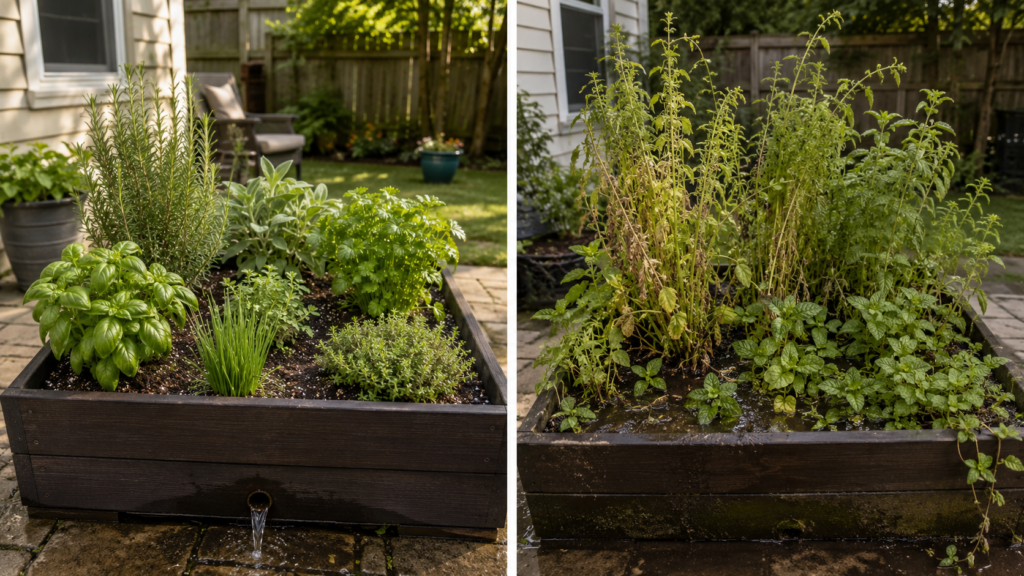
Major Mistakes to Avoid
- Combining incompatible herbs
- Blocking drainage
- Using dense garden soil
- Choosing undersized pots
- Planting mint in shared soil
- Overcrowding
- Providing insufficient light
- Watering every pot identically
- Overfertilizing
- Ignoring mature plant size
Symptom, Cause, and Correction
| Symptom | Possible cause | Correction |
|---|---|---|
| Yellow leaves | Wet soil | Improve drainage |
| Wilting in wet mix | Root stress | Inspect roots |
| Crisp edges | Heat or drying | Relocate or monitor |
| Weak growth | Low light | Move to brighter area |
| Crowded roots | Small container | Repot |
| One herb dominates | Incompatible growth | Separate plants |
When to Separate Herbs
Separate plants when caring for one repeatedly damages another. Individual pots often provide better control than continuously adjusting a mixed container.
Best Backyard Herb Planter by Situation
Situation-Based Recommendation Matrix
| Situation | Best planter |
|---|---|
| Beginner | Separate pots |
| Small backyard | Ladder or vertical planter |
| Frequent cook | Kitchen-door station |
| Hot climate | Large light-colored pot |
| Wet climate | Elevated trough |
| Limited mobility | Waist-height planter |
| Rental | Mobile planter |
| Low maintenance | Mediterranean trough |
| Decorative priority | Terracotta cluster |
| Windy location | Concrete planter |
Best Choice for Beginners
Start with three or four separate pots. Use one woody herb, one leafy herb, one compact perennial, and mint in its own container.
Best Choice for High Culinary Yield
Use a raised planter near the kitchen. Divide Mediterranean herbs from basil, parsley, and chives, and keep mint separate.
Best Choice for Small Backyards
Choose a ladder planter with removable pots. It provides vertical capacity without permanent construction.
Best Choice for Visual Impact
Arrange coordinated pots in three heights. Use rosemary as the tall feature, sage or basil in the middle, and thyme near the front.
Regional Growing Note: Adjust sunlight, watering, frost protection, and winter care according to local climate and the exact herb variety. Check regional invasive-species guidance before planting vigorous herbs.
FAQs
What is the best planter for herbs outdoors?
Choose a planter with enough root space, clear drainage holes, and dimensions suited to mature herbs. Individual pots offer the greatest control.
Do herb planters need full sun?
Most culinary herbs perform best with around six hours of direct sunlight. Parsley, chives, and mint can tolerate some shade.
How deep should a herb planter be?
A mixed planter should usually provide about 20 cm or 8 inches of usable depth. Large woody herbs need deeper individual pots.
Do herb planters need drainage holes?
Yes. Drainage holes prevent water from remaining around the roots and reduce the risk of decline.
What soil should be used?
Use loose container potting mix. Dense garden soil may compact and restrict drainage.
Can several herbs share one planter?
Yes, when they require similar sunlight, moisture, drainage, and root space.
Which herbs grow well together?
Rosemary, thyme, sage, oregano, and marjoram work well together. Basil, parsley, and chives form another useful group.
Should mint be planted separately?
Yes. Mint spreads quickly and can dominate neighboring herbs.
How often should outdoor herbs be watered?
Water according to soil moisture, weather, plant type, and container size rather than a fixed schedule.
Why are my herbs dying?
Common causes include blocked drainage, excessive watering, insufficient sunlight, compacted soil, and overcrowding.
Can planters stay outside in winter?
Some perennial herbs can remain outside in suitable climates, but tender herbs and exposed roots may need protection.
Is a raised planter better than separate pots?
Raised planters offer more soil and easier access. Separate pots provide better control over individual herbs.
Final Thoughts
The best backyard herb planter ideas combine healthy growing conditions with a layout that fits your daily routine.
A successful backyard herb planter fits the location, climate, herbs, and gardener. Select the location before buying the planter, provide reliable drainage, use container potting mix, and allow space for mature roots and foliage.
Separate pots are the safest starting point for most gardeners. Move to a raised, vertical, or mixed planter after learning how different herbs respond to your backyard.
Choose vertical designs for limited space, mobile planters for changing sunlight, raised structures for accessibility, and individual pots when herb compatibility is uncertain.
Myra is the founder and lead writer of Backyard Planter Ideas, where she shares practical, well-researched guidance on planter design, plant selection, and outdoor styling. Her goal is to help homeowners create attractive, functional garden spaces with clear, reliable, and easy-to-apply advice.