
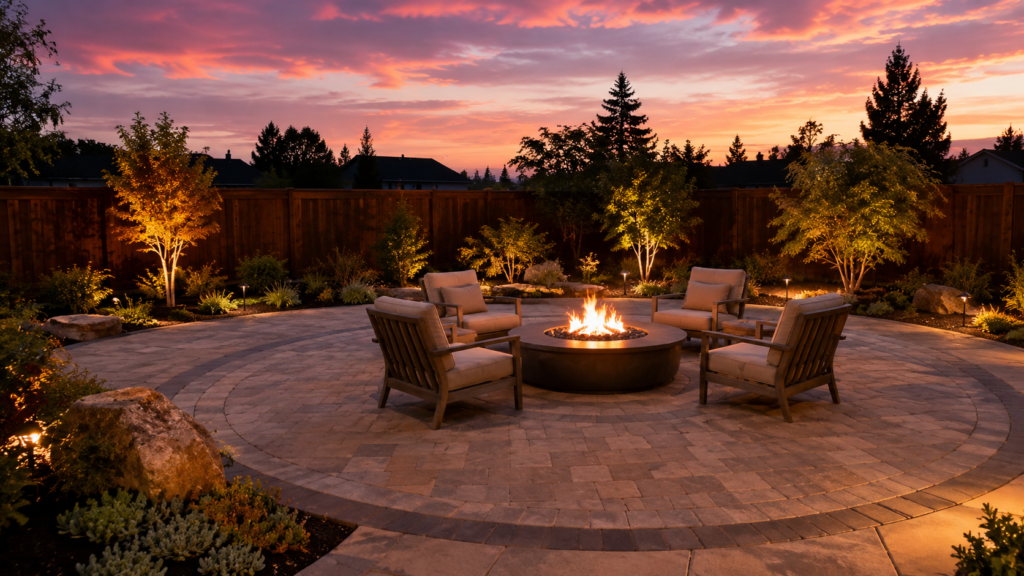
People searching for backyard fire pit landscaping ideas with safe plants usually need lower-flammability plants that are properly positioned and maintained—not plants that cannot burn. The safest design places the fire on an approved noncombustible surface, preserves open seating and walking space, and begins permanent planting beyond the active gathering area.
No plant is completely fireproof. Plant moisture, resin content, mature size, seasonal condition, spacing, and maintenance all affect suitability. Always follow the fire-pit manufacturer’s instructions, local fire rules, and current burn restrictions before choosing a location or building the surrounding landscape.
Safety distinction: Fire-smart landscaping principles help evaluate vegetation, mulch, spacing, and maintenance. They do not determine the required clearance for a specific fire pit. Appliance instructions and local regulations take priority.
Which Fire Pit Landscape Idea Fits Your Backyard?
Choose the design according to the yard’s main limitation. Small yards are usually controlled by clearance, slopes by stability and drainage, and dry climates by plant condition and fuel volume.
| Yard condition | Best starting idea | Planting approach |
|---|---|---|
| Small yard | Compact gas fire-table patio | Two restrained outer beds |
| Large yard | Wide gravel circle | Separated plant islands |
| Modern yard | Concrete or large pavers | Geometric low planting |
| Rustic yard | Flagstone gathering area | Informal perennial groups |
| Sloped yard | Terraced stone layout | Widely spaced plants |
| Family yard | Open paved circle | Low, rounded plants |
| Dry climate | Rock-garden layout | Sparse succulents |
| Low-maintenance yard | Pavers and raised planters | Compact, low-litter plants |
Choose the appliance first, confirm clearance, measure occupied chairs, preserve an exit, select the surface, and add plants only after the active area fits.
Start With Three Fire Pit Planting Bands
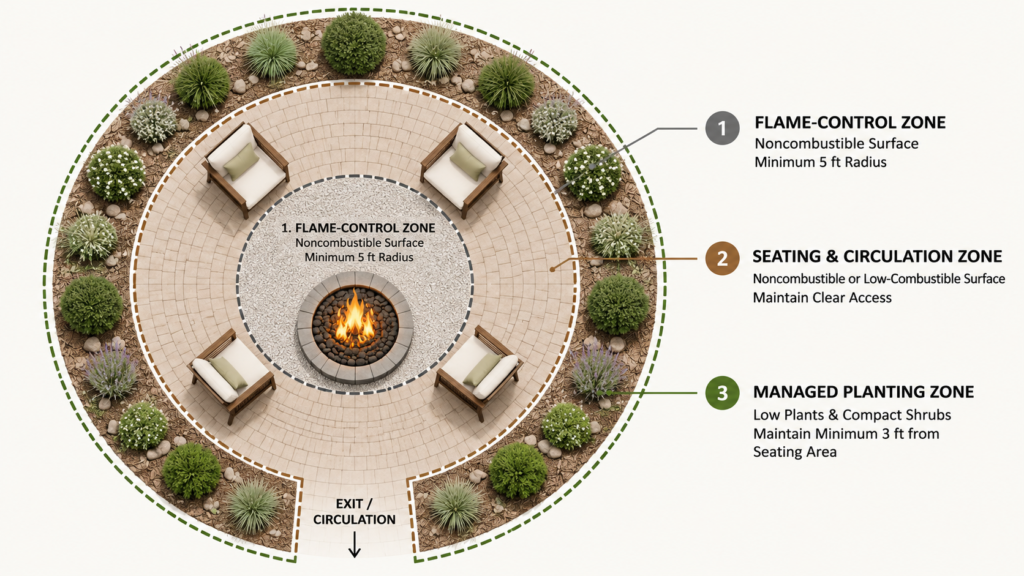
A practical fire pit landscape uses three bands.
| Band | Purpose | Best treatment |
|---|---|---|
| Flame-control band | Separates the fire from combustible material | Approved stone, brick, pavers, concrete, or mineral surface |
| Seating and circulation band | Supports chairs and movement | Stable paving or compacted gravel |
| Managed planting band | Adds greenery outside active use | Separated beds, planters, or containers |
Flame-Control Band
Keep the immediate fire area free from plants, bark, weeds, stored wood, trailing stems, and dry debris. Its width depends on the appliance and installation instructions.
Seating and Circulation Band
Allow space for chairs in use, including room behind them when pulled backward. Keep one direct exit open so guests never need to pass close to the flame.
Managed Planting Band
Begin permanent planting beyond the chairs and main walking route. Use separated groups rather than a continuous ring, and size every plant according to its mature spread.
Best Backyard Fire Pit Landscaping Ideas
The following backyard fire pit landscaping ideas cover hardscape materials, plant placement, small-yard solutions, family layouts, and low-maintenance designs.
7 Hardscape Ideas for a Safer Fire Pit Area
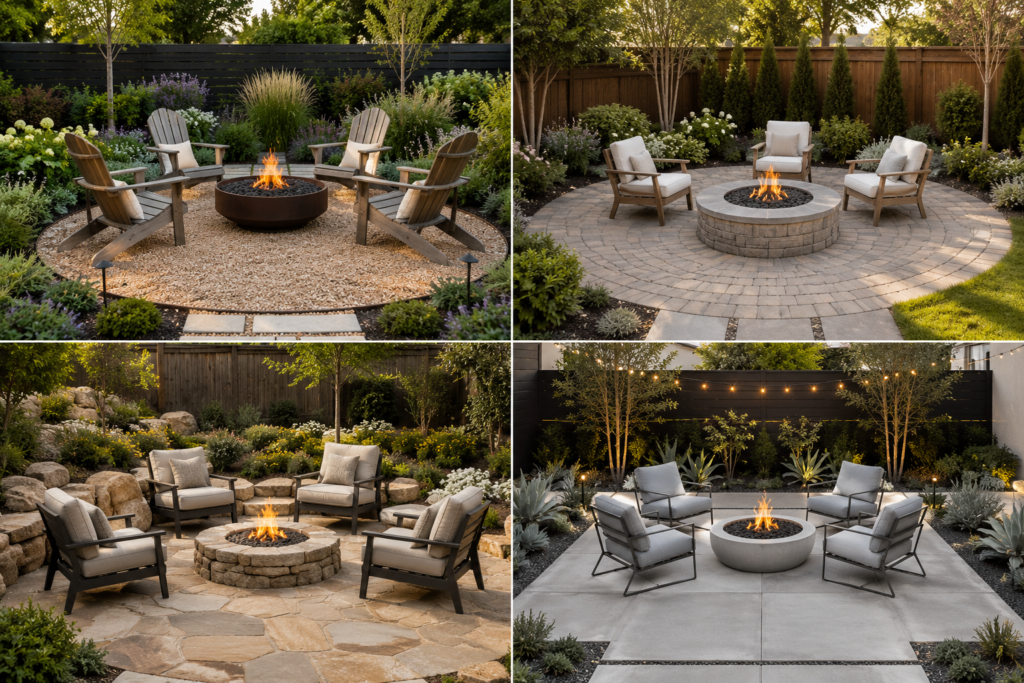
Hardscape creates clear separation, supports furniture, and makes debris easier to remove.
1. Build a Wide Gravel Fire Pit Circle
A gravel circle suits informal yards and flexible seating. Install angular gravel over a compacted base so chairs remain stable. Add edging to stop gravel from spreading and keep the surface free from leaves, weeds, and needles.
2. Frame the Area With Stone Pavers
Pavers provide a stable, sweepable surface. Extend them beneath the complete seating arrangement rather than installing a narrow ring around the bowl. Soften the perimeter with separated low plants outside the chairs.
3. Build a Rock Garden With Planting Islands
Use boulders and mineral gaps to divide plants into manageable groups. Combine one structural plant, one flowering perennial, and one low groundcover in each island. Keep visible stone between the groups.
4. Use Raised Masonry Planters
Brick, stone, or block planters contain soil and prevent spreading plants from entering the patio. Keep foliage behind the planter edge and choose compact plants that fit without constant pruning.
5. Design a Modern Concrete Fire Pit Garden
Use broad concrete pads, straight bed lines, and a limited plant palette. Repeat a few compact plants in geometric groups and leave open space between them. The uncluttered layout improves both appearance and circulation.
6. Create a Rustic Flagstone Gathering Area
Large flagstones create a natural look while supporting chairs more securely than small uneven pieces. Fill wide joints with mineral material instead of bark and use boulders or deciduous shrubs for structure.
7. Create a Fire Pit Destination With a Stone Path
A stable path gives guests a clear route to the fire pit. Use non-slip paving, side lighting, and low plants set back from the edge. The path should enter an open side of the seating area.
Backyard Fire Pit Landscaping Ideas With Safe Plants
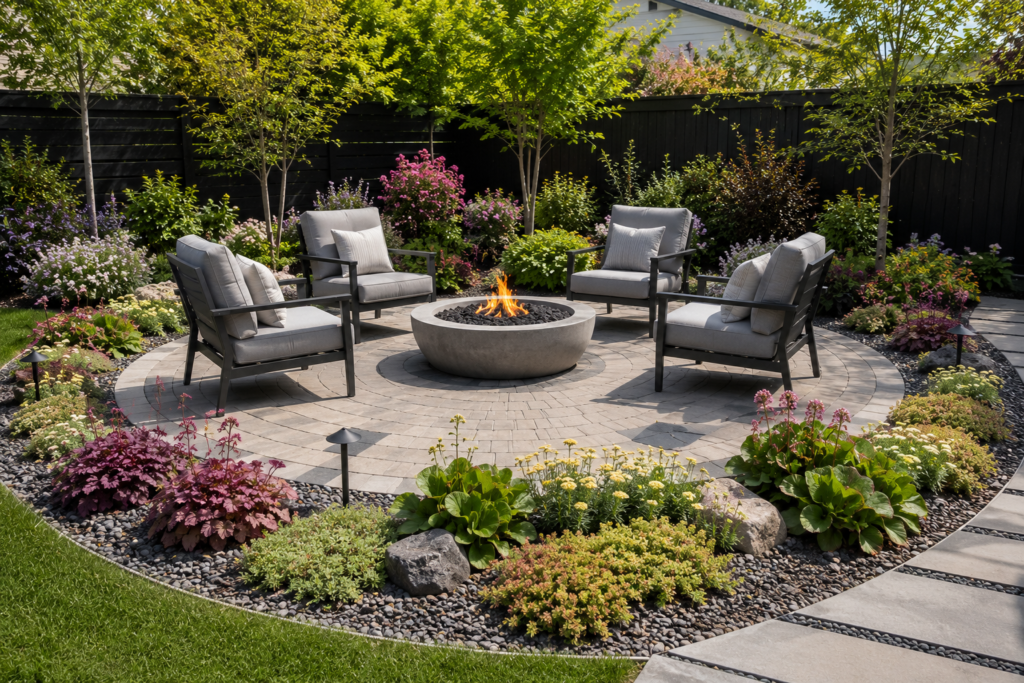
Safer planting uses compact, healthy, low-litter plants in separated outer beds.
8. Add a Low Succulent Border
Sedum, hens and chicks, and other locally suitable succulents can add texture with limited height. Keep them outside the active area, remove dry flower stalks, and place sharp agaves or cacti away from paths.
9. Use Sedum Beyond the Seating Edge
Sedum works well at the front of outer beds because it stays low. Thin spreading varieties before they enter gravel, and cut back dry stems from upright varieties before regular fire-pit use.
10. Plant Compact Yarrow in Managed Groups
Yarrow provides flowers in sunny sites but should be planted in small clusters rather than a continuous meadow. Choose compact varieties, deadhead spent flowers, and remove dry seasonal stems.
11. Create a Coral-Bell Shade Border
Coral bells offer colorful foliage in partially shaded outer beds. Keep them adequately watered, clear dead leaves from the crown, and never position the fire beneath a tree merely to accommodate shade plants.
12. Use Groundcovers Between Large Rocks
Low groundcovers can soften rock-garden edges when contained in small pockets. Prevent them from forming a continuous carpet toward the fire or spreading beneath chairs and paths.
13. Add Small Deciduous Shrubs for Structure
Compact deciduous shrubs can provide height, flowers, and seasonal color without relying on dense evergreen screens. Leave space between plants and select species that fit naturally at maturity.
14. Add Movable Containers Outside the Seating Ring
Containers add flexible color and can be moved when plants become dry or additional space is needed. Use broad, stable pots and keep trailing foliage away from chairs and walkways.
7 Fire Pit Layouts for Different Backyards
The layout should match the property’s size, terrain, climate, and users.
15. Landscape a Small Backyard Fire Pit
A small yard needs fewer features, not reduced clearances. Consider an approved compact gas fire table, limited seating, one open route, and two small outer beds.
16. Build a Family-Friendly Fire Pit Layout
Use stable furniture, open sightlines, and a clear walking loop. Avoid thorny or spiky plants beside paths, and keep toys, cushions, and stored firewood outside the active area.
17. Create a Low-Maintenance Xeriscape Fire Pit Area
Combine stone, gravel, widely spaced succulents, and compact perennials. Avoid dense masses of dry grass, rosemary, or woody lavender immediately behind seating. Use drip irrigation to keep selected plants healthy.
18. Use a Gas Fire Table in a Planted Patio
A gas fire table produces less ash and no burning logs, making it easier to integrate into some compact patios. Keep controls accessible and position plants behind seating or in raised outer beds.
19. Add a Curved Planting Bed Behind Seating
A curved bed can repeat the shape of the fire pit while using the seating band as separation. Make the bed deep enough for mature plants and leave breaks for access and drainage.
20. Landscape a Fire Pit on a Slope
Create a level terrace with stable retaining materials and effective drainage. Prevent soil or plant debris from washing onto the fire area, and keep vegetation separated along the slope.
21. Create a Four-Season Fire Pit Garden
Build year-round interest with stone, masonry, lighting, deciduous branching, and containers. Avoid relying on dry ornamental grasses or dense evergreens beside the fire for winter structure.
Which Fire Pit Design Should You Choose?
Choose the layout that solves the yard’s main practical problem.
| Priority | Best design |
|---|---|
| Lowest maintenance | Pavers with raised planters |
| Lower installation complexity | Compacted gravel circle |
| Small yard | Compact gas fire table |
| Family circulation | Open paved circle |
| Modern appearance | Concrete with geometric beds |
| Natural appearance | Flagstone and plant islands |
| Dry climate | Rock garden with sparse succulents |
| Sloped property | Professionally built terrace |
The best backyard fire pit landscaping ideas solve the yard’s main limitation before adding decorative planting or furniture.
Reject any design that depends on crowded furniture, undersized paths, overhanging plants, or reduced appliance clearance.
How Much Clearance Does a Fire Pit Need?
There is no universal clearance that suits every fire pit. Required distances depend on the appliance, fuel, flame height, installation, local rules, and nearby combustible materials.
Check the complete space:
- Structures, fences, sheds, and furniture
- Grass, mulch, decking, and artificial turf
- Tree branches, eaves, pergolas, and covers
- Prevailing wind
- Mature plant spread
- Fuel and firewood storage
Measure plants according to their mature width, not their size at purchase. Increase separation when the pit burns wood, the site is windy, or surrounding vegetation becomes very dry.
What Makes a Plant Safer Near a Fire Pit?
A better candidate has moisture-rich foliage, low resin or volatile-oil content, limited dry litter, and a compact form.
Prioritize plants with:
- Broad or fleshy leaves
- Open branching
- Low resin and pitch
- Limited needle, bark, or leaf shedding
- Manageable height and width
- Simple maintenance
- Strong adaptation to the site
Do not assume that native, drought-tolerant, or pollinator-friendly plants are automatically suitable. Evaluate every plant during its driest season.
Fire Pit Plant Suitability Score
Score each candidate from zero to two in five categories.
| Attribute | 0 | 1 | 2 |
|---|---|---|---|
| Leaf moisture | Dry or needle-like | Moderate | Fleshy or moisture-rich |
| Oil and resin | High | Moderate | Low |
| Dead material | Heavy buildup | Seasonal cleanup | Limited buildup |
| Mature form | Dense or spreading | Manageable | Compact and open |
| Maintenance | Difficult | Regular care | Easy |
8–10: Better candidate for the outer planting zone.
5–7: Conditional; use farther away and maintain carefully.
0–4: Poor choice near the fire pit.
The score can decline when a plant becomes stressed, overgrown, woody, or filled with dead material.
Fire Pit Plant Suitability Score Examples
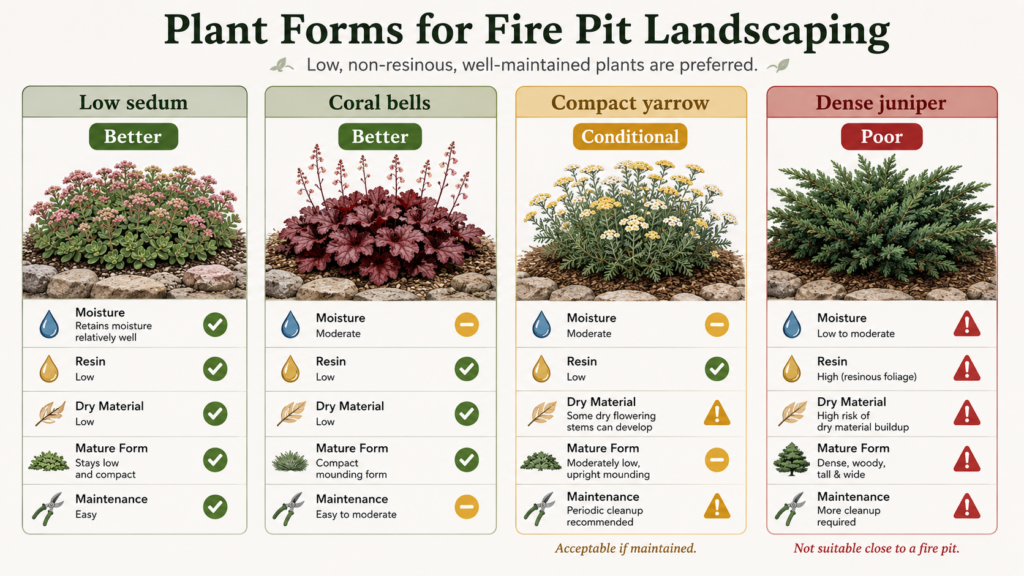
| Plant form | Score | Planning result |
|---|---|---|
| Low sedum | 9 | Better candidate |
| Coral bells | 9 | Better in suitable shade |
| Bergenia | 9 | Better where climate-suitable |
| Compact yarrow | 6 | Conditional |
| Woody lavender | 3 | Poor close to fire |
| Tall dry grass | 1 | Keep well away |
| Dense juniper | 1 | Poor near-fire choice |
These scores illustrate the method; they are not laboratory flammability ratings.
Best Types of Plants for Fire Pit Landscapes
| Function | Possible choices | Main caution |
|---|---|---|
| Low edging | Sedum, hens and chicks, bergenia | Remove dry growth |
| Flowering layer | Yarrow, iris, allium, coreopsis | Deadhead and divide |
| Shade foliage | Coral bells, bergenia | Maintain moisture |
| Groundcover | Low sedum, sea thrift, moss phlox | Prevent continuous mats |
| Structural layer | Compact deciduous shrubs | Allow mature width |
| Containers | Seasonal foliage and flowers | Move when dry |
Choose naturally compact, locally adapted plants that remain easy to inspect and prune.
How to Choose Safer Plants for Your Climate
One plant list cannot suit every region. Use the plant characteristics in this guide to compare species recommended by local horticultural or fire-safety authorities.
| Climate | Prioritize | Avoid nearby |
|---|---|---|
| Cold winter | Compact perennials with clean dormancy | Large dry crowns |
| Mild temperate | Deciduous shrubs and low-litter plants | Dense evergreen hedges |
| Hot and dry | Fleshy plants with mineral gaps | Oily shrubs and dry grasses |
| Humid subtropical | Compact, non-invasive foliage | Vines and thickets |
| Tropical | Low-volume, low-litter plants | Bamboo and dry palm fronds |
| Windy coastal | Low plants with strong stems | Fine dry foliage |
Check hardiness, mature size, irrigation needs, invasive status, seasonal dieback, and litter production before planting.
Plants to Avoid Close to a Fire Pit
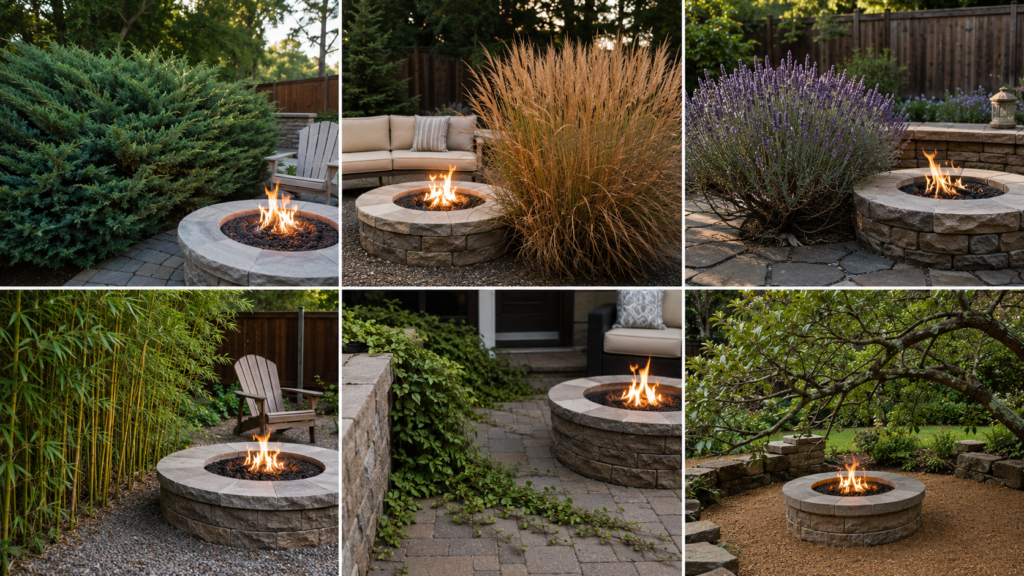
Avoid placing these plants close to the active area:
Resinous Conifers
Junipers, pines, firs, and spruces may contain pitch, oils, or resin and often retain dead interior material.
Dry Ornamental Grasses
Dormant grasses can create large quantities of fine, dry fuel and may lean toward seating.
Aromatic Woody Herbs
Lavender, rosemary, and some sages contain aromatic oils and can become woody with age.
Bamboo and Reed-Like Plants
Bamboo produces dry leaves and canes and may spread into paths.
Trailing Vines
Vines can cross zone boundaries, climb structures, and collect debris.
Dense Evergreen Hedges
Continuous hedges can block exits, trap litter, and form an uninterrupted vegetation line.
Low Tree Branches
Choose an open site instead of trying to manage a fire pit beneath a growing canopy.
Which Ground Surface Is Best Around a Fire Pit?
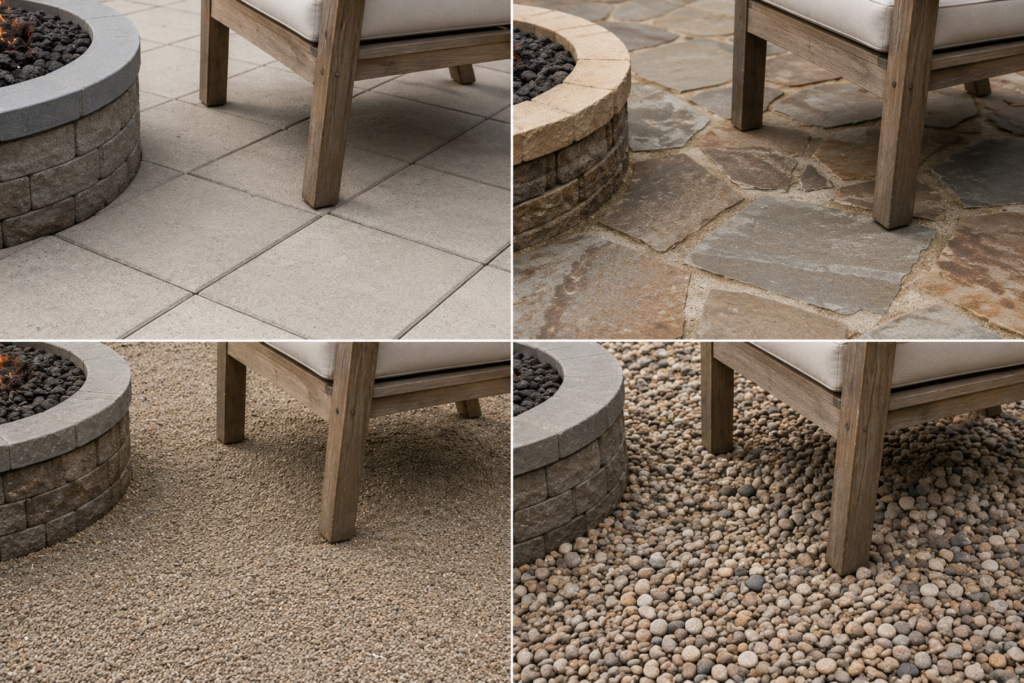
| Surface | Practical assessment |
|---|---|
| Concrete | Stable and easy to clean when approved |
| Brick | Stable but joints need cleaning |
| Natural stone | Durable when installed level |
| Concrete pavers | Versatile and repairable |
| Crushed gravel | Useful over a compacted base |
| Pea gravel | Shifts and traps debris |
| Lawn | Keep outside the active area |
| Wood decking | Requires an approved protective system |
| Artificial turf | May melt or deform |
Surface warning: Noncombustible does not automatically mean suitable beneath every appliance. Heat may stain, crack, or damage concrete, stone, or pavers when the installation is incorrect.
Confirm the approved base, ventilation, heat shield, and installation materials before construction.
Wood-Burning vs Gas Fire Pits for Planted Yards
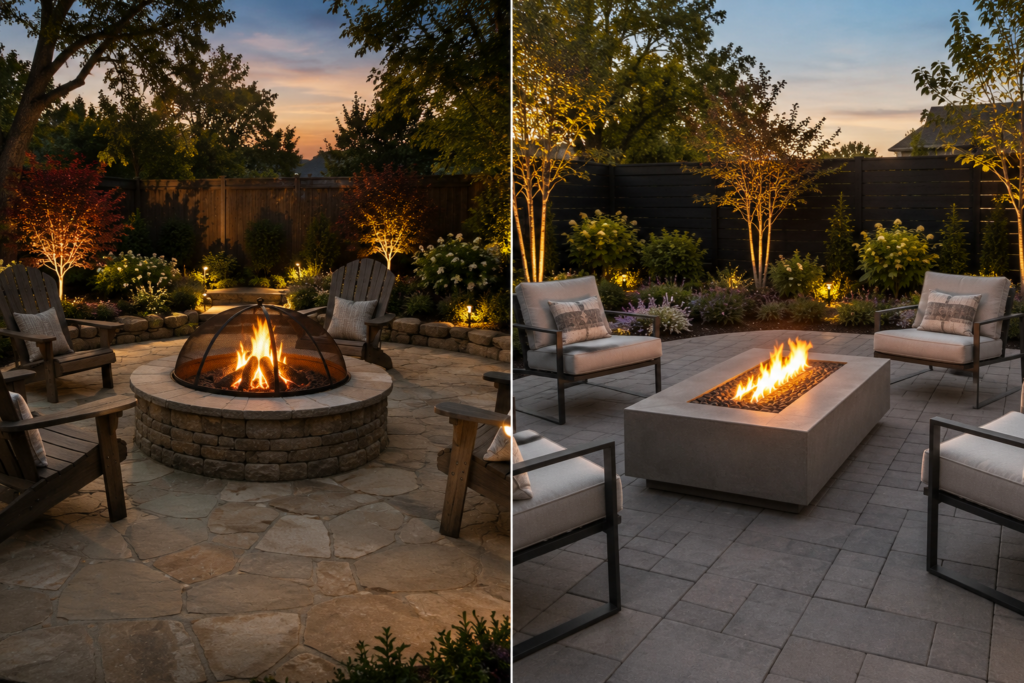
| Factor | Wood-burning | Gas |
|---|---|---|
| Sparks and embers | Possible | No burning logs |
| Smoke | Usually higher | Usually lower |
| Cleanup | Ash removal | Limited residue |
| Fuel storage | Firewood | Gas line or cylinder |
| Small-yard use | More difficult | Often easier |
| Installation | Varies | May require a professional |
| Shutdown | Must be extinguished fully | Controlled shutoff |
Choose wood for a larger open yard where smoke, fuel storage, and local rules are manageable. Choose gas when a more controlled footprint and lower cleanup are priorities.
Three Measured Fire Pit Layouts
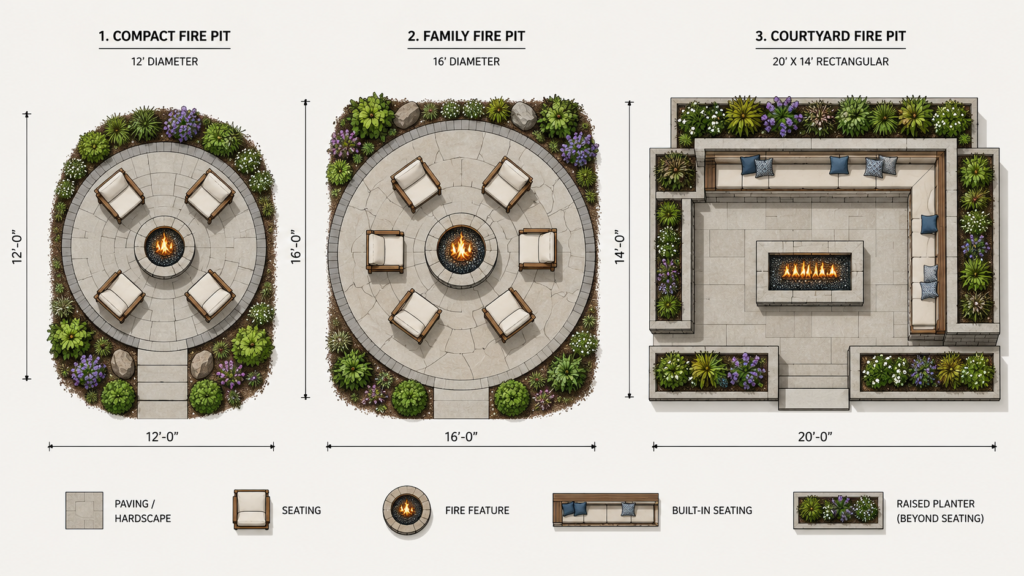
These dimensions are planning examples, not universal clearance rules.
Measured backyard fire pit landscaping ideas help homeowners see whether the appliance, chairs, paths, and mature plants will fit comfortably.
Compact 12-Foot Circular Layout
Use a compact fire feature, four modest chairs, one open entrance, and planting beyond the complete hardscape.
16-Foot Family Layout
Allow five or six chairs, space behind seating, a broad path, and low outer planting.
Rectangular Courtyard Layout
Position a gas fire table along the central axis, use built-in seating on one side, and keep the opposite side open for circulation.
Test the Fire Pit Layout Before Construction
Mark the proposed layout with rope or paint and place the actual chairs inside it.
Test whether:
- Chairs can move backward.
- People can walk behind them.
- The exit remains open.
- Planting begins beyond active use.
- No branches or structures hang overhead.
- Fuel and cushions have separate storage.
Enlarge or relocate the design when it only works with perfectly aligned furniture.
How to Maintain Plants Around a Fire Pit
Before each use, remove leaves, needles, weeds, dry stems, leaning branches, cushions, and misplaced containers.
Seasonal priorities include:
- Spring: prune damage, divide spreading plants, and test irrigation.
- Summer: monitor drought stress and remove spent flowers.
- Autumn: clear fallen leaves and cut back dry growth.
- Winter: remove dormant stems near the fire.
- Annually: compare mature plant size with the original plan.
Move or replace plants that repeatedly enter the seating zone or become difficult to maintain.
Common Fire Pit Landscaping Mistakes
Avoid:
- Planting directly beside the bowl
- Calling plants fireproof
- Choosing plants only by appearance
- Ignoring mature size
- Using bark mulch in the active area
- Positioning the pit beneath a tree
- Surrounding seating with dry grasses
- Blocking the exit
- Ignoring wind
- Storing firewood beside the pit
- Allowing debris to collect in gravel
- Copying online photographs without checking local rules
A successful layout remains open, cleanable, and functional after plants mature and chairs move.
Final Fire Pit Landscaping Safety Checklist
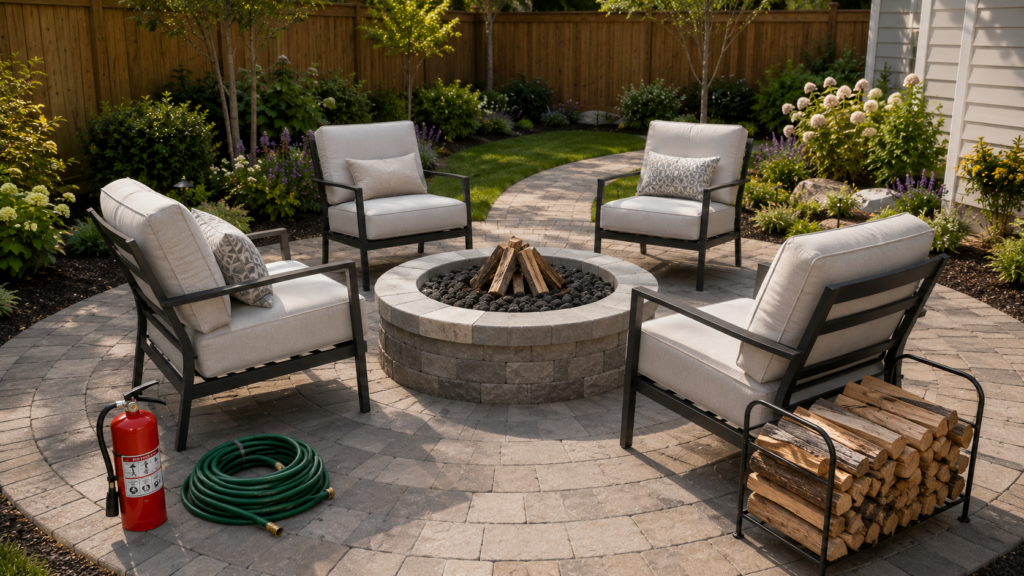
Before use, confirm that:
- The fire is permitted.
- Current restrictions have been checked.
- Required clearances are met.
- The base is approved and stable.
- Overhead space is clear.
- Chairs and exits remain open.
- Plants are healthy and maintained.
- Dry debris has been removed.
- Wind conditions are acceptable.
- Extinguishing equipment is available.
- The fire will remain attended.
- The fire can be fully extinguished.
Do not light the fire when regulations are uncertain, wind is increasing, or surrounding vegetation is extremely dry.
Methodology and Safety Sources
This guide evaluates each idea according to four requirements: noncombustible separation, usable circulation, plants outside the active zone, and realistic long-term maintenance.
The Plant Suitability Score compares moisture, resin, dead material, mature form, and maintenance difficulty. It is an editorial framework, not a legal clearance system or laboratory fire rating.
Recommendations should be checked against:
- Fire-pit manufacturer instructions
- Local fire authorities
- Current burn restrictions
- National fire-safety guidance
- Regional university extension or horticultural sources
FAQs
What plants are safest around a backyard fire pit?
Choose compact, moisture-rich, low-resin plants that produce little dry litter. Keep them beyond the seating and circulation zone.
How far should plants be from a fire pit?
Follow the appliance’s required clearance and measure to the plant’s mature spread. Permanent plants should also remain beyond occupied chairs.
Can a fire pit sit on gravel?
Yes, when the manufacturer permits it and the gravel is installed over a stable base. Keep it free from dry debris.
Can a fire pit be placed on grass?
Avoid direct placement on grass unless the appliance is specifically approved for it. An approved noncombustible base is usually better.
Can you put a fire pit under a tree?
No. Overhanging branches and falling debris create avoidable hazards.
Are succulents safe around a fire pit?
Succulents may suit outer beds, but they can still burn or produce dry stalks. Keep them away from direct heat.
Are ornamental grasses safe near a fire pit?
Tall grasses are poor near-fire choices because they create fine, dry material. Use them in distant beds.
Is lavender safe around a fire pit?
Lavender can become woody and contains aromatic oils. Plant it farther away and remove dry interior growth.
Is gas safer than wood-burning?
Gas usually produces no wood ash or embers, but it still creates open flame and heat. Installation and clearance remain essential.
What is the best small-yard layout?
A compact approved gas fire table on paving with limited seating and restrained outer planting is often the most practical choice.
What plants should be avoided?
Avoid resinous conifers, dry grasses, bamboo, dense hedges, vines, and woody aromatic shrubs close to the fire.
Does fire-resistant mean fireproof?
No. Every plant can burn. Spacing, moisture, pruning, and debris removal remain important.
Create a Beautiful Fire Pit Garden Without Crowding the Flame
A strong fire pit design starts with the appliance, required clearance, stable hardscape, and comfortable circulation. Plants come last and belong beyond the active gathering zone.
Choose compact, locally suitable plants with limited litter, preserve mineral gaps between groups, and review mature growth every year. Broad hardscape, well-positioned seating, masonry, lighting, and restrained planting can create an attractive backyard destination without surrounding the flame with vegetation.

Myra is the founder and lead writer of Backyard Planter Ideas, where she shares practical, well-researched guidance on planter design, plant selection, and outdoor styling. Her goal is to help homeowners create attractive, functional garden spaces with clear, reliable, and easy-to-apply advice.