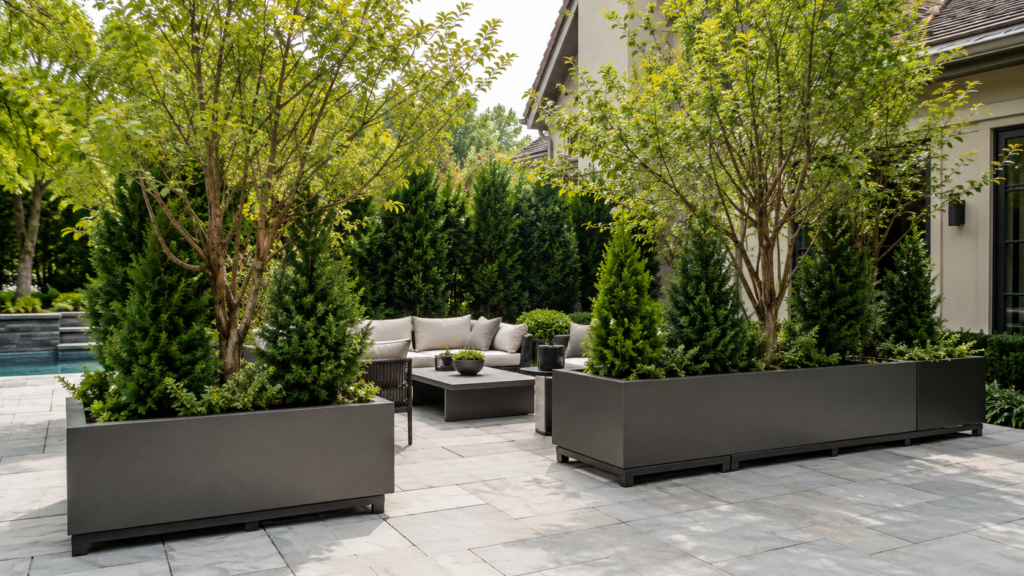
Large backyard planter ideas for trees and privacy can screen patios, fences, hot tubs, dining spaces, and seating areas without permanent in-ground planting. Compact evergreen trees, multi-stem specimens, and pleached canopies work best when positioned directly within the unwanted sightline and planted in broad, stable containers.
Choose the tree first, then match it with a planter that supports its rootball, mature canopy, drainage needs, and filled weight. Troughs suit boundaries; broad square planters and clusters suit patios and outdoor rooms.
| Privacy problem | Best planter arrangement | Suitable tree form |
|---|---|---|
| Window above a fence | Structural trough | Pleached or clear-stem tree |
| Exposed patio edge | Repeated rectangular planters | Narrow evergreen |
| Open backyard corner | Three-planter cluster | Multi-stem tree |
| Hot tub or dining area | Staggered enclosure | Dense evergreen |
| Rental backyard | Movable planters | Compact slow-growing tree |
| Seasonal shade and privacy | Large individual pots | Deciduous ornamental |
Best Large Tree Planter Choices at a Glance
The best large planter is wide, stable, weather-resistant, and proportionate to the rootball. Broad containers usually provide better root space and wind resistance than tall decorative pots.
- Year-round privacy: Broad containers with compact evergreens
- Privacy above a fence: Reinforced troughs with pleached trees
- Patio screening: Three staggered multi-stem trees
- Narrow boundaries: Repeated rectangular planters
- Windy locations: Low concrete, stone, or composite planters
- Rental yards: Fiberglass planters with compact trees
- Seasonal color: Deciduous ornamentals or dwarf fruit trees
- Layered privacy: Clear-stem trees with compact shrubs
For most backyards, a compact evergreen in a broad planter offers reliable coverage and stability. The best large backyard planter ideas for trees and privacy match the tree’s canopy, root space, planter weight, and screening height to one clearly identified sightline.
What View Does Your Privacy Planter Need to Block?
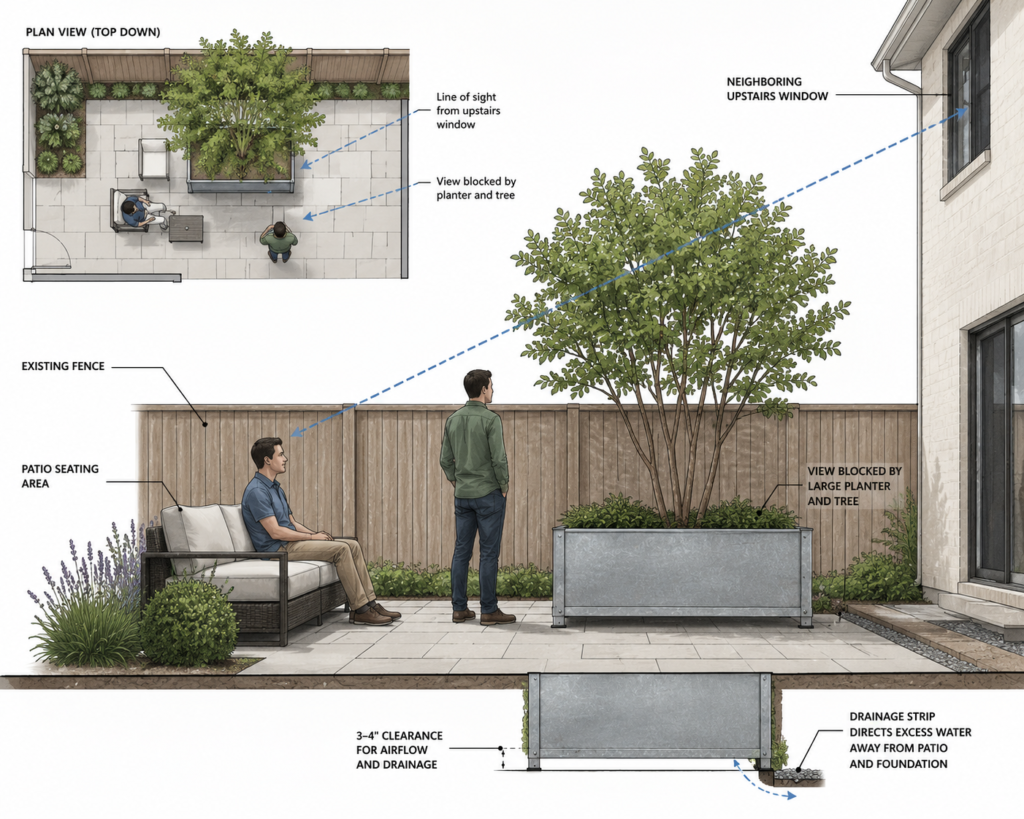
Identify the view before choosing a tree. One upstairs window, side gate, balcony, or dining area may be the real problem—not the entire fence line.
Check the sightline while seated and standing. A planter near the seating area may work better than a taller tree at the boundary.
Record:
- Width of the exposed view
- Height of the current fence or wall
- Additional height required
- Seated and standing sightlines
- Need for winter privacy
- Daily sunlight
- Wind exposure
- Maximum planter footprint
- Maintenance access
Test height and position with stakes, cardboard, or temporary fabric before buying.
What Size Planter Does a Privacy Tree Need?
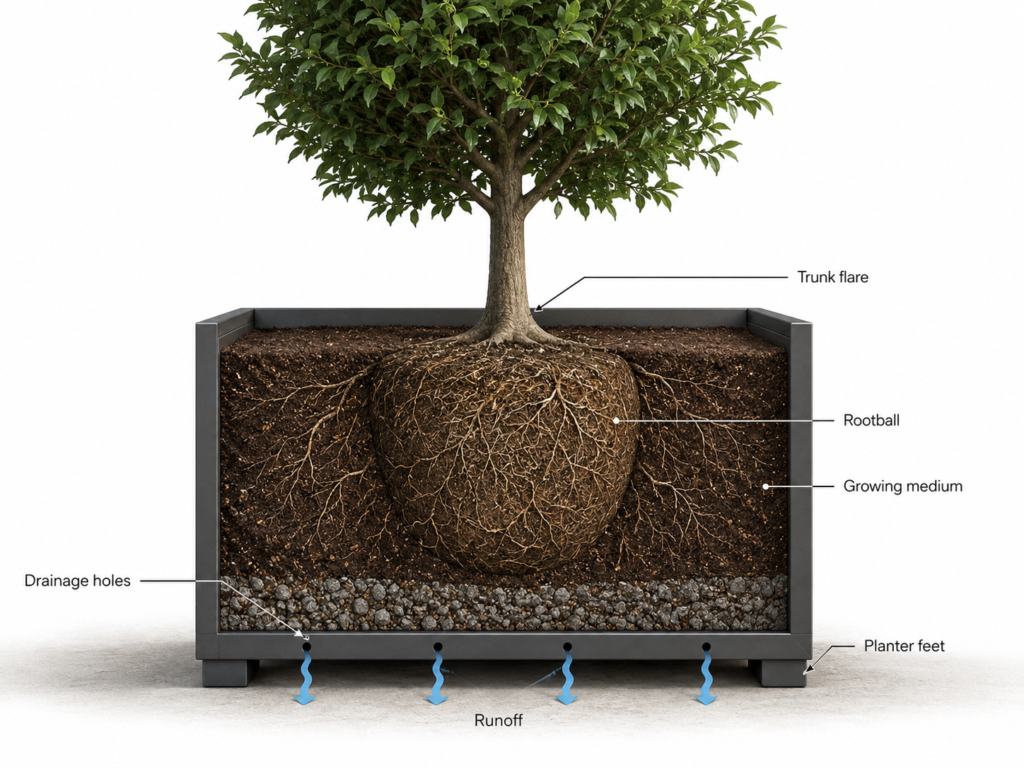
A privacy tree needs a planter wider than its rootball, deep enough to maintain the original planting level, and broad enough to stabilize the canopy. Internal dimensions matter more than decorative exterior size.
Avoid planting a small tree directly in an oversized container; unused growing medium may stay wet for too long.
| Tree form | Suitable planter form | Main concern |
|---|---|---|
| Young compact tree | Wide round or square pot | Excess wet soil |
| Narrow evergreen | Heavy cube or trough | Wind stability |
| Multi-stem tree | Extra-wide planter | Lateral root space |
| Dwarf fruit tree | Broad round container | Rootstock suitability |
| Pleached tree | Reinforced trough | Wind load |
| Tree-form shrub | Broad square planter | Shape maintenance |
Measure the rootball, canopy width, base, filled weight, and repotting access. Position the empty container before adding soil.
17 Large Backyard Planter Ideas for Trees and Privacy
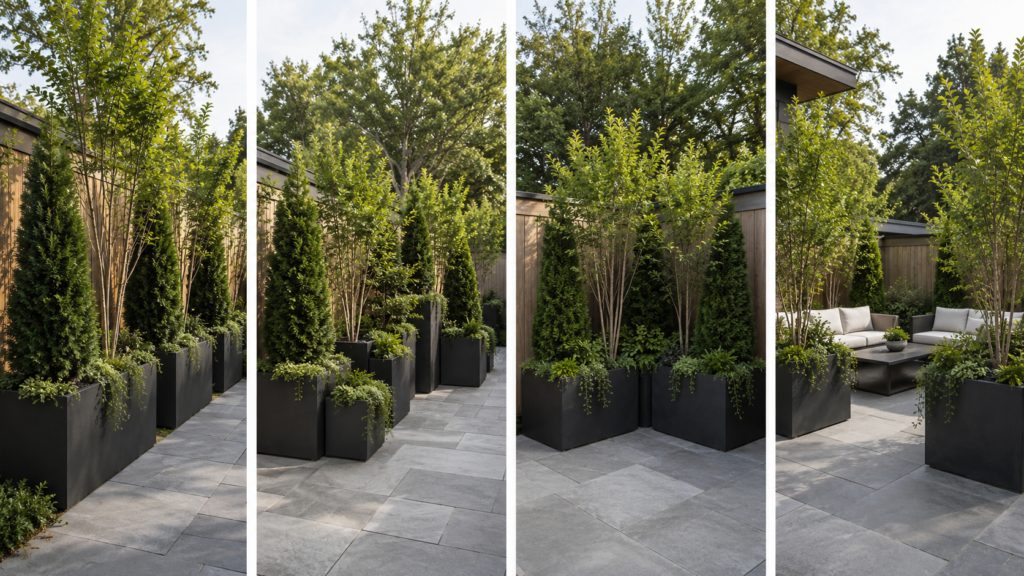
These 17 large backyard planter ideas for trees and privacy cover boundaries, corners, seating areas, decks, hot tubs, and flexible patio layouts. These ideas cover boundaries, corners, seating areas, decks, hot tubs, and flexible patios. Adapt each to mature canopy, roots, climate, and maintenance needs.
1. Line a Fence With Rectangular Planters
Long troughs create a clean privacy line beside fences and paved boundaries where digging is not possible. Use compact upright evergreens spaced by mature canopy width.
- Best use: Continuous boundary screening
- Main risk: Root competition and poor fence access
2. Frame a Patio Entrance With Matching Trees
Place matching trees beside a patio entrance, staircase, or path to define the outdoor room and block diagonal views. Keep the opening wide enough for furniture and comfortable movement.
- Best use: Formal entrances and partial screening
- Main risk: Canopies narrowing the passage
3. Stagger Privacy Planters Instead of Building a Solid Row
Staggered planters overlap visually, block diagonal views, and create more depth than a rigid row. Leave enough room to reach every container.
- Best use: Angled views
- Main risk: Inaccessible rear containers
4. Build a Large Corner Privacy Cluster
Close an exposed corner with one broad multi-stem tree and two smaller evergreen companions arranged in a loose triangle. Repeat the planter material for cohesion.
- Best use: Overlooked corners
- Main risk: Overcrowding
5. Surround a Seating Nook With Four Tree Planters
Four planters around a dining or lounge area can create a private outdoor room with shorter trees than boundary screening requires. Keep branches away from furniture, lighting, umbrellas, and paths.
- Best use: Dining and conversation areas
- Main risk: Obstructed circulation
6. Use Multi-Stem Trees for Broader Coverage
Multi-stem trees provide wider, softer coverage for a broad neighboring window. Use a broad planter that supports lateral roots and balances the canopy.
- Best use: Natural filtered privacy
- Main risk: Insufficient planter width
7. Grow Pleached Trees in Structural Troughs
Pleached trees create a flat, elevated foliage panel above a fence. They need strong troughs, secure support, regular pruning, and reliable irrigation.
- Best use: Above-fence privacy
- Main risk: Wind load
8. Combine One Tree With Evergreen Shrubs
Compact evergreen shrubs can fill the gap below a clear-stem tree while its canopy blocks higher views. Combine plants with similar water, light, and soil needs.
- Best use: Full-height screening
- Main risk: Root competition
9. Add Tree Planters to a Built-In Bench
Planters at one or both ends of a bench combine seating and screening in a small footprint. Reinforce the walls and direct drainage away from the structure.
- Best use: Multifunctional spaces
- Main risk: Moisture damage
10. Raise the Planter to Lift the Canopy
A raised planter can lift foliage above a tall fence without an excessively tall tree. Use a reinforced base and keep the tree reachable for care.
- Best use: Elevated sightlines
- Main risk: Excessive structural load
11. Create Movable Privacy With Lightweight Planters
Fiberglass and composite containers suit rentals, flexible patios, and tender trees that need shelter. Remember that even a lightweight pot becomes heavy when filled.
- Best use: Seasonal or temporary screening
- Main risk: Underestimating filled weight
12. Anchor an Exposed Patio With Concrete Cubes
Concrete cubes resist movement and suit upright evergreens or topiary. Confirm delivery access and surface capacity before installation.
- Best use: Permanent modern patios
- Main risk: Difficult relocation
13. Use Self-Watering Planters in Hot Locations
A reservoir planter can reduce moisture swings in hot sites. Choose one designed for woody plants with a working overflow, and inspect it during heavy rain and heat.
- Best use: Hot patios
- Main risk: Waterlogging from blocked overflow
14. Build Cedar Planter Boxes Along a Deck
Custom timber boxes can match decks and fit spaces standard containers cannot. Use reinforcement, exterior-grade fasteners, and internal drainage.
- Best use: Integrated deck designs
- Main risk: Soil pressure and wood decay
15. Screen a Hot Tub With Narrow Upright Trees
Narrow evergreens can screen a hot tub without a wide hedge. Keep steps, covers, pumps, and service panels accessible, and avoid messy trees.
- Best use: Recreational privacy
- Main risk: Plant debris around equipment
16. Create a Container Orchard Privacy Screen
Dwarf fruit trees provide flowers, crops, and seasonal screening. Apples on suitable rootstocks, figs, citrus, and pomegranates may work, but most temperate options lose winter foliage.
- Best use: Edible summer screening
- Main risk: Seasonal leaf loss
17. Add Seasonal Underplanting Beneath Permanent Trees
Trailing plants, bulbs, herbs, and compact grasses can soften the soil surface. Use shallow-rooted companions with compatible moisture needs and keep the trunk visible.
- Best use: Softer planter edges
- Main risk: Incompatible watering
Best Trees for Large Privacy Planters
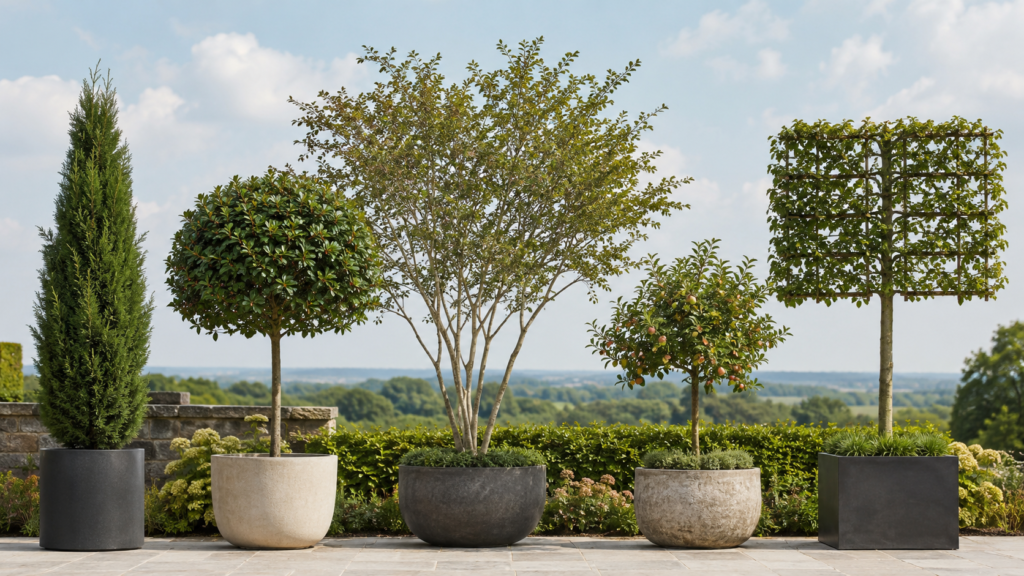
The best privacy trees stay compact, tolerate restricted roots, suit the climate, and carry foliage at the required height. “Small” or “dwarf” does not guarantee long-term container suitability.
| Tree or form | Privacy value | Evergreen? | Main limitation |
|---|---|---|---|
| Bay laurel | Dense shaped screen | Yes | Frost sensitivity |
| Yew topiary | Formal dense screen | Yes | Toxic plant parts |
| Compact arborvitae | Narrow vertical screen | Yes | Can become top-heavy |
| Dwarf conifer | Upright year-round screen | Yes | Cultivar sizes vary |
| Japanese holly | Compact coverage | Yes | Slow growth |
| Camellia standard | Flowering screen | Yes | Specific soil needs |
| Podocarpus | Warm-climate privacy | Yes | Poor cold tolerance |
| Japanese maple | Filtered ornamental screen | No | No winter foliage |
| Olive | Open Mediterranean screen | Usually | Limited frost tolerance |
| Pomegranate | Broad seasonal screen | Usually no | Winter leaf loss |
| Dwarf apple or pear | Edible seasonal screen | No | Pollination and pruning |
| Citrus | Evergreen edible screen | Yes | Cold sensitivity |
Confirm mature size, hardiness, light, water demand, toxicity, and invasive status. Prefer named cultivars.
Which Privacy Trees Suit Your Climate and Sunlight?
Container roots experience stronger temperature and moisture changes than roots in open ground. Match the tree to both the regional climate and the planter’s microclimate.
| Climate | Suitable tree categories | Main challenge |
|---|---|---|
| Cold winter | Dwarf conifers, yew, hardy deciduous trees | Root freezing |
| Cool temperate | Holly, Japanese maple, fruit trees | Frost and waterlogging |
| Mild maritime | Bay, camellia, holly | Wind and persistent moisture |
| Mediterranean | Olive, fig, pomegranate, citrus | Heat and rapid drying |
| Humid subtropical | Camellia, podocarpus, citrus | Humidity and drainage |
| Tropical | Compact palms and tropical trees | Heavy rain and vigorous growth |
| Arid | Olive and drought-tolerant forms | Root heat and salt buildup |
Measure sunlight at the final location; poor light thins foliage, while reflected heat can scorch shade-tolerant trees.
Evergreen, Deciduous, or Pleached Trees?
Evergreens provide year-round privacy; deciduous trees add seasonal shade and color; pleached trees create formal screening above fences.
| Tree form | Privacy level | Maintenance | Best use |
|---|---|---|---|
| Evergreen | High year-round | Medium | Permanent screening |
| Deciduous | Seasonal | Low–medium | Summer privacy |
| Pleached | Elevated | High | Above-fence views |
| Multi-stem | Filtered | Medium | Natural broad coverage |
| Tree-form shrub | Dense and compact | Medium | Small patios |
Choose evergreens for continuity, deciduous trees for seasonal interest, and pleached trees for elevated screening.
Which Planter Material Works Best for Trees?
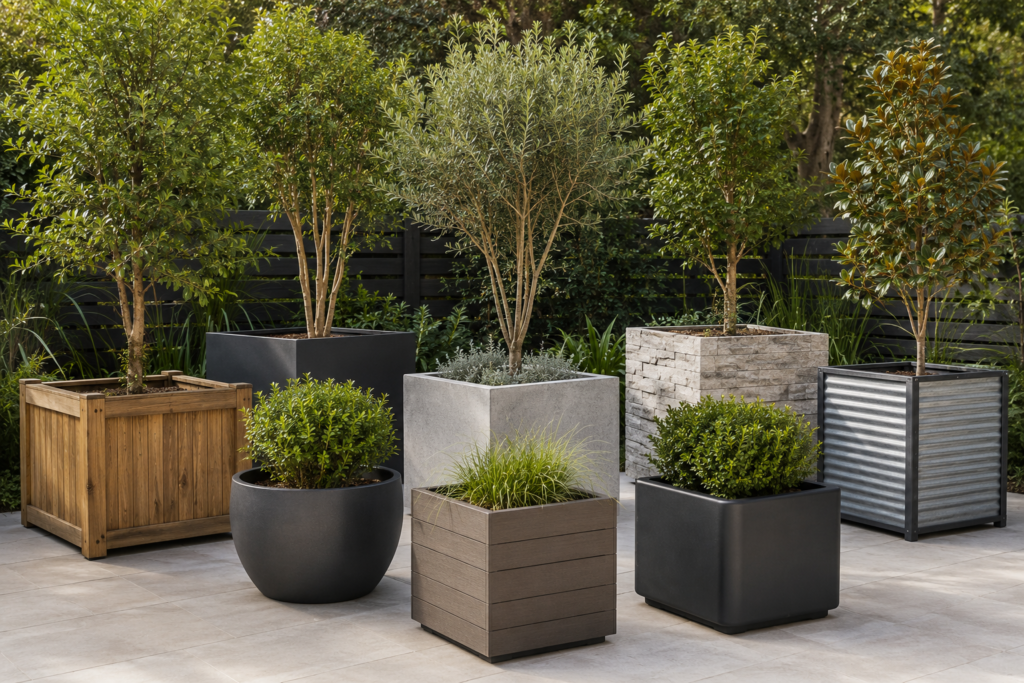
Planter material determines weight, mobility, insulation, and care.
| Material | Main advantage | Main limitation | Best use |
|---|---|---|---|
| Wood | Customizable and insulated | Requires moisture protection | Decks and built-ins |
| Fiberglass | Lightweight and durable | Higher purchase cost | Flexible patios |
| Concrete | Stable and permanent | Difficult to move | Windy sites |
| Stone | Durable and insulated | Very heavy | Traditional landscapes |
| Metal | Modern appearance | Can overheat | Sheltered patios |
| Composite | Low maintenance | Variable quality | Long-term screens |
| Heavy plastic | Affordable and movable | Less structural strength | Rentals |
Use concrete for exposed sites, fiberglass for flexibility, wood for custom work, and composite for easier care.
Drainage and Soil for Container Trees
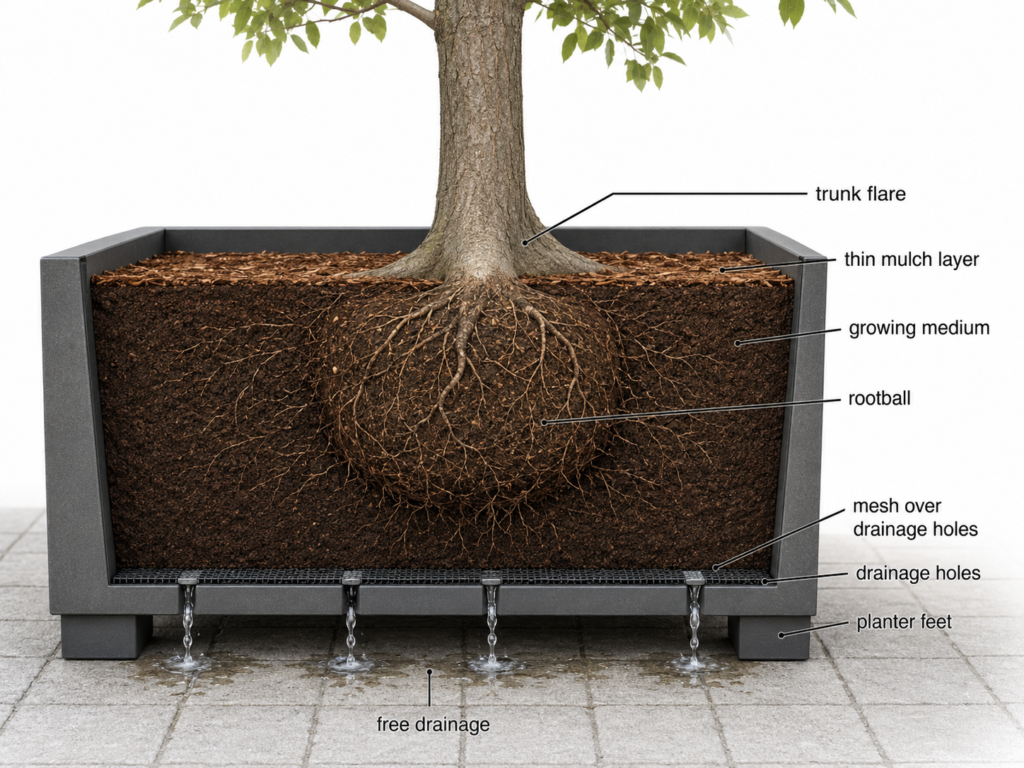
Large tree planters need drainage holes and stable growing medium; garden soil can compact and drain poorly.
- Position the empty planter.
- Confirm all drainage holes are open.
- Raise the base slightly if paving blocks the outlets.
- Cover large holes with permeable mesh.
- Add growing medium beneath the rootball.
- Set the tree at its original soil level.
- Fill around the rootball without overcompacting.
- Water thoroughly and confirm drainage.
- Add mulch without touching the trunk.
- Recheck the level after settling.
Do not seal drainage holes, bury the trunk flare, or rely on gravel to fix a container with no outlet.
How Should You Arrange Tree Planters for Privacy?
Place planters where they interrupt the unwanted view most efficiently. A nearby tree may outperform a taller tree at the boundary.
- Straight rows for narrow fences
- Staggered groups for diagonal views
- Clusters for patios and corners
- Lower shrubs beneath clear canopies
- Visual canopy overlap without root crowding
- Maintenance gaps behind boundary planters
Test empty containers or cardboard templates, then check gates, paths, drainage, sunlight, and irrigation. Testing empty containers from the main viewing position helps turn large backyard planter ideas for trees and privacy into an effective screen rather than a decorative row.
Three Measured Backyard Privacy Layouts
The following measured large backyard planter ideas for trees and privacy provide starting layouts for an 8-foot section, a 12-foot seating area, and a 20-foot boundary.
Compact 8-Foot Privacy Section
Use two broad planters or one structural trough to block a single window or patio edge.
- Two narrow evergreens
- About 4 feet of useful coverage per tree
- Optional lower shrubs
- Clear maintenance access
12-Foot Seating-Area Screen
Use three planters in a shallow triangle behind a dining or lounge area.
- Center planter slightly behind
- Outer planters moved forward
- Multi-stem or compact evergreen trees
- Access between containers
20-Foot Boundary Screen
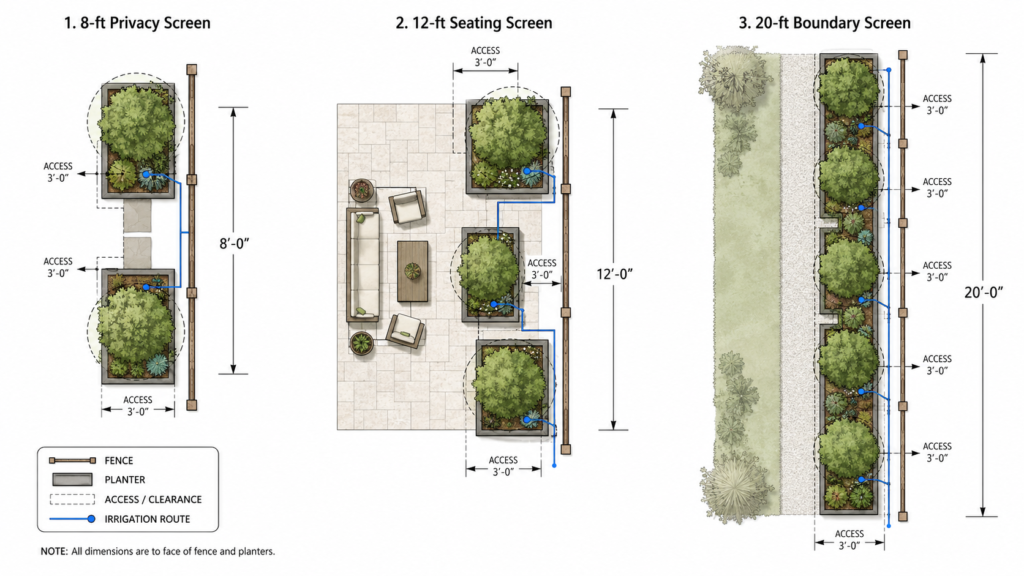
Use four or five substantial planters or repeated troughs.
- Narrow evergreens or pleached trees
- Lower shrubs beneath clear trunks
- Dedicated drip irrigation
- Access at both ends
- Spacing based on mature canopy width
How Many Tree Planters Do You Need for Privacy?
Estimate tree quantity by dividing the exposed width by one tree’s useful mature canopy width.
Number of trees = screen width ÷ effective canopy width
| Screen width | Canopy width per tree | Starting estimate |
|---|---|---|
| 8 feet | 4 feet | 2 trees |
| 10 feet | 3 feet | 4 trees |
| 12 feet | 4 feet | 3 trees |
| 16 feet | 4 feet | 4 trees |
| 20 feet | 5 feet | 4 trees |
Round upward for young trees, open foliage, diagonal views, or winter leaf loss. Never crowd roots for instant privacy.
How Do You Stop Tree Planters From Blowing Over?
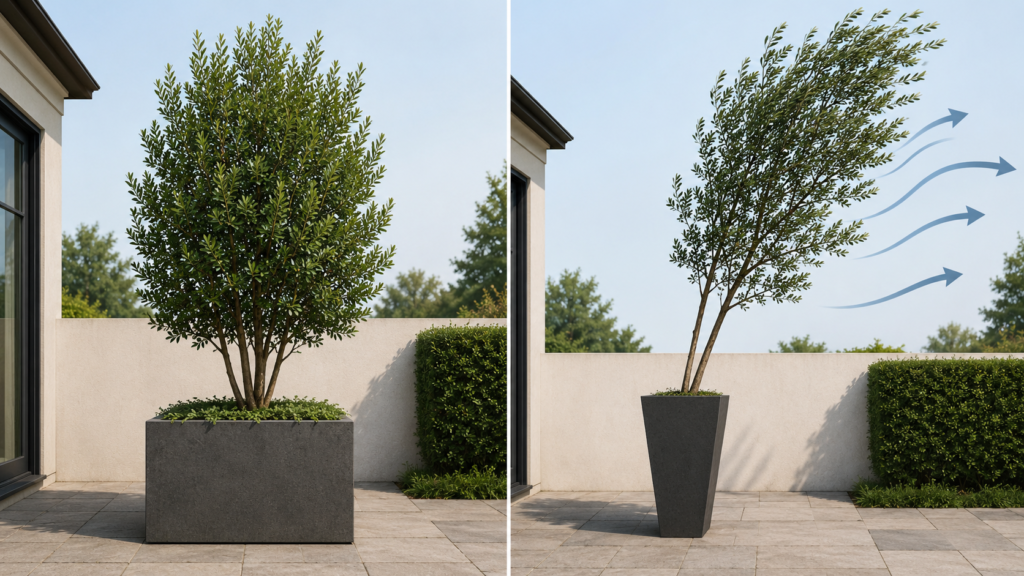
Use a wide, heavy container; tall tapered pots can become unstable beneath a dense canopy.
- Choose compact trees
- Keep the canopy balanced
- Avoid excessive top growth
- Shelter exposed planters
- Support pleached frames independently
- Check trees after storms
- Place containers before filling
Planters on decks, balconies, rooftops, or raised platforms may require structural assessment. Never add random ballast inside the root zone.
How Do You Water and Feed Potted Privacy Trees?
Check below the surface and water deeply through the full rootball; light daily splashes may leave the center dry.
- Increase checks during heat and wind
- Reduce irrigation during rainy periods
- Use adjustable drip emitters
- Keep drainage holes open
- Feed according to species and season
- Avoid fertilizing severely stressed trees
Repeated watering removes nutrients, so feed according to tree type, growth rate, and season.
Protect Potted Trees From Heat and Frost
Container roots heat and freeze faster than in-ground roots.
In hot climates:
- Use light-colored or insulated planters
- Avoid reflective walls
- Apply a moderate mulch layer
- Increase moisture checks
- Provide temporary afternoon shade where suitable
In cold climates:
- Choose trees with extra hardiness
- Use larger containers
- Group planters in sheltered positions
- Insulate suitable pots
- Protect roots from drying wind
- Avoid waterlogging before frost
Choose a tree suited to the local climate instead of relying on yearly protection.
When Should You Repot or Root-Prune a Container Tree?
Repot when roots circle, drainage slows, growth weakens, or the tree becomes unstable.
Warning signs include:
- Roots emerging from drainage holes
- Water running straight through
- Water standing on the surface
- Smaller leaves
- Repeated wilting
- Soil shrinking from the planter walls
- Weak annual growth
Move suitable trees into larger containers or root-prune and refresh the medium where appropriate. Use professional help for large or valuable specimens.
Common Large Privacy Planter Mistakes
Avoid:
- Choosing a vigorous full-sized tree
- Using a narrow top-heavy planter
- Blocking drainage holes
- Planting a tiny rootball in too much wet soil
- Selecting by appearance alone
- Expecting instant dense privacy
- Ignoring gaps below the canopy
- Combining plants with conflicting water needs
- Blocking maintenance access
- Moving the container after filling
- Placing heavy planters on an unchecked deck
Strong designs use compact cultivars, accessible drainage, and room for mature growth and repotting.
When Should You Avoid Using Trees in Large Planters?
Avoid tree planters when weight, drainage, irrigation, wind, or future maintenance cannot be managed safely.
Choose another solution when:
- Structural capacity is unknown
- Drainage may damage nearby surfaces
- Summer watering will be irregular
- Wind exposure is severe
- Only full-sized trees are available
- Repotting access is impossible
- In-ground planting is easier
- A trellis would solve the view
- Dense lower screening matters more than height
Alternatives include tall shrubs, climber-covered trellises, narrow hedges, panels, and in-ground trees.
Cost and Maintenance by Planter Type
| Planter type | Cost level | Maintenance | Best use |
|---|---|---|---|
| DIY wood | Low–medium | Medium–high | Custom installations |
| Heavy plastic | Low–medium | Low | Rental yards |
| Fiberglass | Medium–high | Low | Flexible patios |
| Concrete | High | Low | Permanent windy sites |
| Stone | High–premium | Low | Traditional designs |
| Metal | High | Medium | Modern sheltered areas |
| Self-watering | High | Medium | Hot patios |
| Masonry | Premium | Medium | Permanent built-ins |
Budget for the tree, soil, drainage, delivery, irrigation, pruning, repotting, and replacement. The cheapest planter may not have the lowest lifetime cost.
Should You Choose Trees, Tall Shrubs, or a Trellis?
| Solution | Best use | Main advantage | Main limitation |
|---|---|---|---|
| Container tree | Above-fence privacy | Elevated canopy | Weight and root care |
| Tall shrub | Lower-level privacy | Dense foliage | Wider footprint |
| Pleached tree | Flat upper screen | Precise coverage | High maintenance |
| Trellis | Narrow spaces | Small footprint | Requires support |
| Tree plus shrubs | Full-height privacy | Layered coverage | Root competition |
| Screen panel | Immediate privacy | No establishment time | Less natural appearance |
Choose trees for height, shrubs for dense lower coverage, and trellises where space or load capacity is limited.
Final Large Planter Selection Checklist
Use this checklist to compare large backyard planter ideas for trees and privacy before purchasing containers, trees, growing medium, or irrigation equipment.
Confirm:
- Exact view to block
- Required width and height
- Evergreen or seasonal privacy
- Climate and sunlight
- Wind exposure
- Rootball dimensions
- Mature canopy width
- Planter internal size
- Stable base
- Open drainage holes
- Safe runoff route
- Filled weight
- Supporting-surface strength
- Irrigation access
- Pruning access
- Repotting plan
- Gate and utility clearance
Choose the sightline first, the tree second, and the planter third.
FAQs
Can a Tree Live Permanently in a Large Planter?
Compact trees can remain in planters for years with watering, feeding, pruning, and periodic root care.
What Size Planter Does a Privacy Tree Need?
Choose a planter wider than the rootball and broad enough to stabilize the canopy. Increase size gradually.
Which Evergreens Grow Best in Large Pots?
Compact arborvitae, yew, holly, bay, dwarf conifers, and podocarpus may work when matched to the climate.
Can Arborvitae Grow in a Planter?
Compact arborvitae can grow in well-drained large planters; vigorous varieties may become top-heavy.
Are Trees or Shrubs Better for Privacy?
Trees screen above fences; tall shrubs provide denser lower privacy.
How Many Potted Trees Do You Need?
Divide the exposed width by one tree’s useful mature canopy width, then round upward.
How Far Apart Should Planters Be?
Base spacing on mature canopy width and leave room for airflow, watering, and pruning.
Do Tree Planters Need Drainage Holes?
Yes. Open drainage holes release excess water and reduce root problems.
How Often Should Potted Trees Be Watered?
Check below the surface and water deeply as needed; heat, wind, and planter size affect frequency.
How Do You Stop Planters From Blowing Over?
Use broad, heavy containers, compact trees, balanced canopies, and shelter.
Can Tree Planters Sit on a Deck?
Only when the deck supports the full wet weight and drainage cannot damage it.
Is a Trellis Better Than a Tree?
A trellis suits narrow or weight-restricted spaces; a tree suits elevated screening.
Editorial Methodology and Sources
This guide evaluates privacy planters by root habit, mature canopy, climate, drainage, wind stability, maintenance, and access.
- Container compatibility
- Evergreen or seasonal coverage
- Mature container growth
- Sunlight and wind exposure
- Water demand
- Planter stability
- Repotting access
- Sightline efficiency
- Suitability for international readers
References and Further Reading
Verify cultivar size, hardiness, toxicity, and invasive status through horticultural societies, university extensions, botanical gardens, plant databases, and structural professionals where required.
Myra is the founder and lead writer of Backyard Planter Ideas, where she shares practical, well-researched guidance on planter design, plant selection, and outdoor styling. Her goal is to help homeowners create attractive, functional garden spaces with clear, reliable, and easy-to-apply advice.