
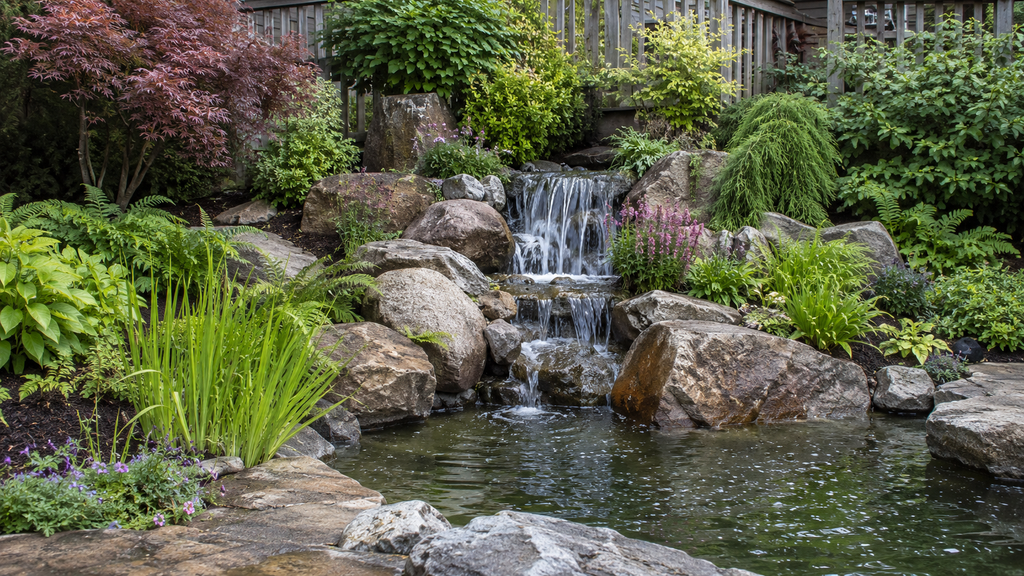
The best ideas for a backyard waterfall area with plants use greenery to frame moving water without hiding it. The most reliable approach is to divide the landscape into four zones: waterline, splash edge, transition bed, and backdrop. Then choose plants according to actual soil moisture, sunlight, mature size, and the role they perform around the waterfall.
A well-planted waterfall should still show plenty of water and stone. Low plants belong near important cascades, medium foliage can soften the sides, and taller grasses or shrubs should sit farther back. Pondless waterfalls also need clear pump and reservoir access, while waterfalls flowing into ponds may support marginal or aquatic plants where the water conditions are suitable.
How to Arrange Plants Around a Backyard Waterfall
Arrange plants according to their growing conditions rather than simply how close they are to visible water. A plant only a foot from a lined cascade may sit in dry soil, while another farther away may occupy a low area that stays moist. Check the root-zone moisture, sunlight, drainage, and mature plant size before choosing species.
Protect the waterfall’s main viewing angle first. Keep the foreground relatively low, use medium foliage along the sides, and place taller plants toward the rear. This gives the feature depth without allowing mature vegetation to cover the cascade.
Before planting, identify:
- The main view from the patio, house, or seating area
- Wet, moist, normally drained, and dry planting pockets
- Direct sunlight hours
- Pump, liner, filter, and reservoir access
- Mature height and width of each plant
- Rocks that should remain visible
- A practical maintenance route
Design around mature plant size rather than nursery size. A small shrub may eventually cover an upper waterfall, while a large grass can overwhelm a compact feature.
A useful layout is:
low plants near the water + medium foliage along the sides + taller plants behind + visible rock between plant groups.
4-Zone Backyard Waterfall Planting Method
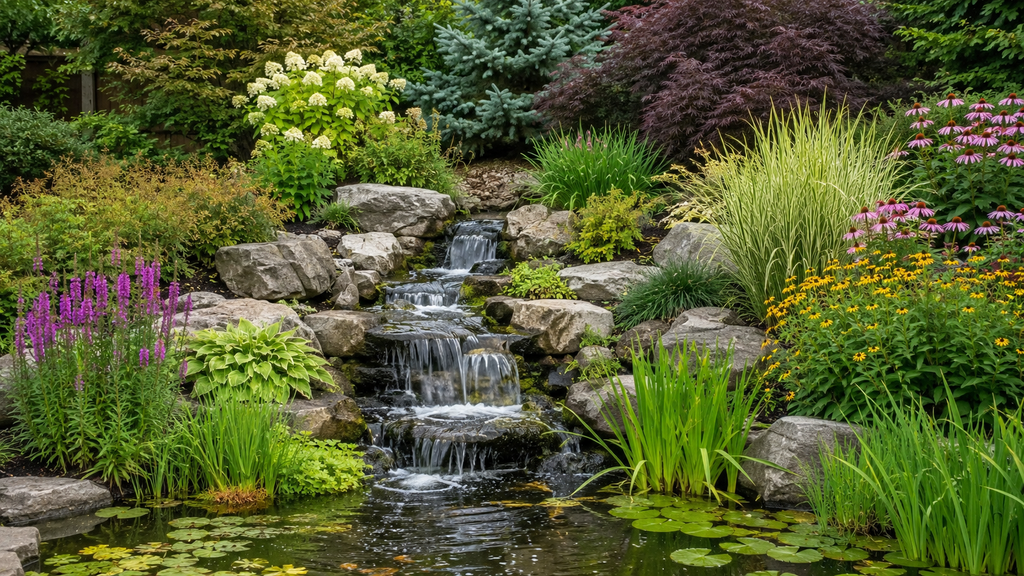
The 4-Zone Backyard Waterfall Planting Method makes plant selection easier by separating the feature into four environments. It prevents the common mistake of treating every position around a waterfall as equally wet.
Zone 1: Waterline
The waterline includes pond margins or shallow areas where roots may remain saturated or submerged. True marginal and aquatic plants belong here.
Depending on local suitability, options may include:
- Sedges
- Rushes
- Suitable iris species
- Native marginal grasses
- Water lilies in appropriate ponds
- Submerged or floating aquatic plants
Different aquatic plants need different water depths, so do not treat every “pond plant” the same. Always check whether a species is invasive or restricted in your region.
Zone 2: Splash Edge
The splash edge sits beside moving water. It may receive spray or increased humidity without remaining continuously wet.
Useful choices can include:
- Compact ferns in suitable shade
- Low sedges
- Moisture-tolerant foliage plants
- Controlled groundcovers
- Small perennials
Keep these plants relatively low around the most attractive waterfall drops.
Zone 3: Transition Bed
The transition bed links the water feature with the rest of the garden. It usually behaves like a normal planting bed and offers the widest choice.
Depending on climate and light, it may contain:
- Ornamental grasses
- Hostas
- Heucheras
- Astilbes
- Flowering perennials
- Compact shrubs
- Groundcovers
Repeat plants in groups rather than using a different species in every gap.
Zone 4: Backdrop
The backdrop provides the tallest planting layer. It can hide fences, soften walls, create privacy, and give the waterfall visual depth.
Use appropriately sized:
- Clumping grasses
- Compact shrubs
- Evergreens
- Small structural trees
Check mature size carefully. Backdrop plants should frame the waterfall rather than eventually grow across it.
5 Plant Roles Around a Backyard Waterfall
Plants should have a clear purpose instead of simply filling empty space. Five useful roles are Anchor, Frame, Seam, Accent, and Water-Edge Functional Plant.
- Anchor: Provides height or structural weight behind the feature
- Frame: Directs attention toward the main cascade
- Seam: Softens the transition between rocks, gravel, and soil
- Accent: Adds controlled color or seasonal interest
- Water-Edge Functional Plant: Occupies genuine wet or aquatic conditions
The four zones explain where a plant belongs, while these roles explain why it belongs there. A tall grass may act as an Anchor behind the upper fall, while low sedges beside the rocks act as Frames or Seams.
Avoid turning every plant into an Accent. Too many bold flowers, large leaves, or unusual colors can make the planting compete with the water.
Woodland Backyard Waterfall Ideas With Plants
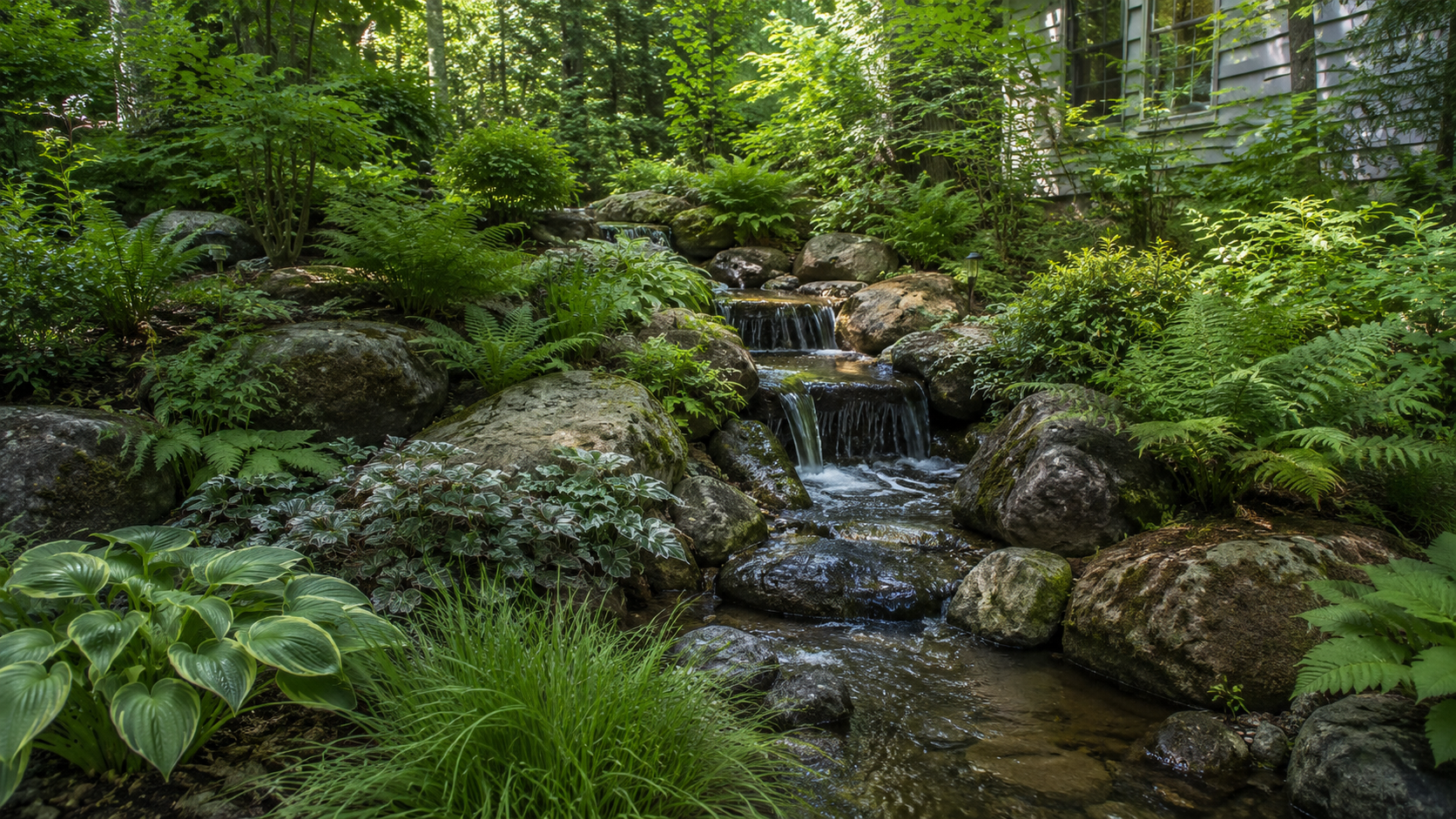
Woodland waterfall planting works especially well around irregular rocks, shaded corners, and mature trees. Use foliage texture and plant layers rather than relying heavily on flowers.
1. Surround a Rock Waterfall With Ferns
Ferns soften large rocks and create a natural woodland effect. Use repeated groups instead of placing one fern beside every boulder.
Place taller ferns around the upper sides and smaller types near lower rocks. Keep enough space open so the main cascade remains visible.
2. Layer Hostas Behind Smaller Ferns
Hostas add broad foliage that contrasts with fine fern fronds. Place smaller ferns toward the foreground and larger hostas farther back.
Because mature hostas can become wide, keep them far enough from the cascade that they will not cover it after several growing seasons.
3. Plant Selected Pockets Between Boulders
A few planted rock pockets can make a constructed waterfall look more established.
Use compact ferns, small sedges, or suitable shallow-rooted groundcovers, but do not fill every gap. Visible stone is essential to keeping the feature natural-looking.
Avoid large woody plants close to liners or plumbing.
4. Create a Native Streambank Look
Use locally appropriate plants to imitate vegetation that could naturally grow beside a stream in your region.
Possible groups include:
- Native sedges
- Rushes
- Moisture-tolerant wildflowers
- Ferns
- Grasses
- Compact shrubs
- Native groundcovers
Using locally suitable plants gives the waterfall a stronger connection with the surrounding landscape.
Small and Pondless Waterfall Plant Ideas
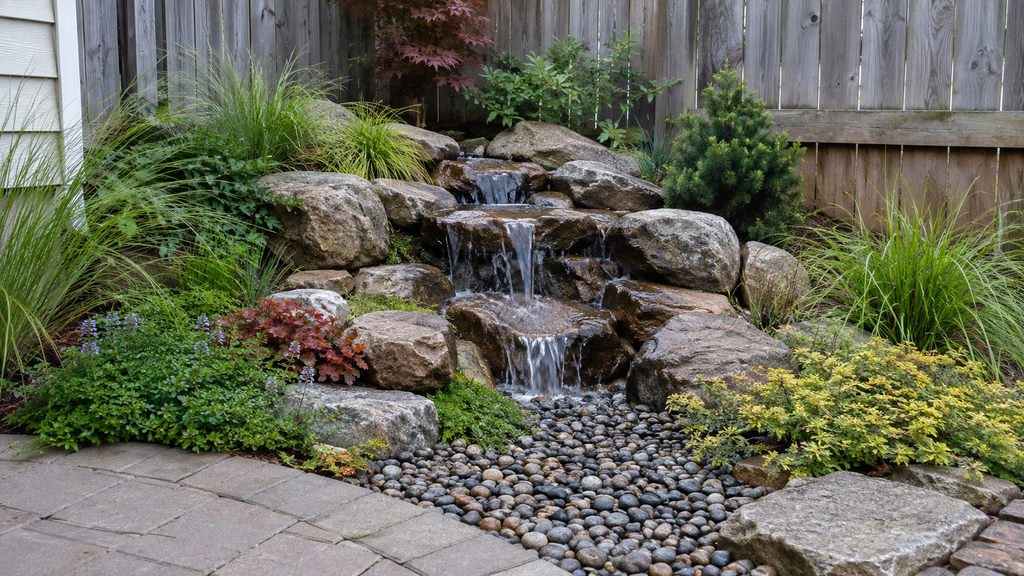
Small and pondless waterfalls need restrained planting because large plants can quickly overwhelm the feature. Pondless designs also hide mechanical components beneath gravel, so access should influence plant placement.
5. Frame a Small Corner Waterfall
A backyard corner is ideal for a compact cascade because fences or walls already provide a backdrop.
Use one taller backdrop plant, several medium foliage groups, one repeated low plant, and visible rock around the water.
An asymmetrical arrangement usually looks more natural than centering identical plants on both sides.
6. Use Grasses Around a Pondless Waterfall
Ornamental grasses add movement that complements flowing water.
Place taller grasses toward the rear and compact grasses or sedges closer to the lower rocks. Keep the hidden reservoir and pump vault accessible rather than planting densely over them.
7. Soften Rock Edges With Groundcovers
Groundcovers can create a living transition between waterfall rocks and garden soil.
Plant them along outer stone edges rather than inside the active channel. Choose species according to actual sunlight, moisture, growth habit, and regional invasive status.
Allow foliage to overlap selected rocks, but trim it before the stone structure disappears.
8. Add Containers Where Soil Space Is Limited
Containers are useful beside patios, courtyards, paving, or areas where liners prevent digging.
They can be moved when accessing equipment, cleaning the feature, replacing plants, or protecting tender plants.
Choose containers that visually support the waterfall rather than creating a separate display.
Sunny Waterfall Ideas With Plants and Flowers
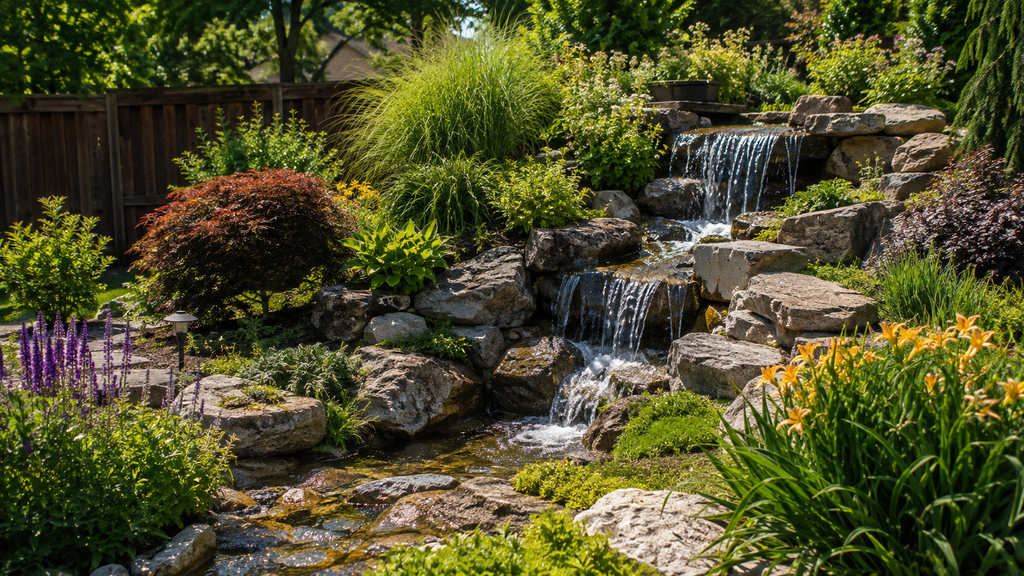
Sunny waterfalls can use grasses, flowering perennials, upright foliage, and low groundcovers. However, nearby soil may still be surprisingly dry if the water is contained by a liner.
9. Add Upright Foliage Near the Water
Iris-like foliage and sedges provide strong vertical lines beside horizontal rocks.
Place taller foliage toward the side of the feature and use lower plants closer to the foreground. Only use marginal plants in genuinely wet conditions.
10. Use Flowering Perennials in Repeated Groups
Flowers should accent the waterfall rather than form a continuous ring around it.
Choose two or three compatible flowering plants and repeat them through the transition bed. Limiting the color palette keeps the water as the focal point.
11. Add Fine-Textured Ornamental Grasses
Grasses and moving water work well together because both create motion.
Use low sedges near the waterfall, medium grasses through the transition bed, and taller clumps behind the upper cascade. Avoid blocking pump or pond access.
12. Create a Pollinator-Friendly Border
Use locally suitable flowering plants in the transition bed rather than directly beside every rock.
Choose plants with different bloom periods where possible and keep heavily visited flowers away from narrow paths or seating if frequent insect activity could become inconvenient.
Backyard Waterfall Ideas With Plants by Style
The same waterfall can look woodland, tropical, modern, cottage-inspired, or Japanese-inspired depending on plant form and spacing.
13. Create a Japanese-Inspired Waterfall
Use restraint, asymmetry, visible stone, and a small number of carefully placed plants.
Suitable forms include:
- One structural shrub or small tree
- Fine grasses
- Ferns
- Compact evergreen foliage
- Low groundcovers
Avoid mirrored planting on both sides. Negative space is part of the design.
14. Build a Tropical-Looking Waterfall
Tropical-style planting relies on bold foliage and layered heights.
Use broad leaves behind the feature, medium foliage around the sides, and smaller plants closer to the rocks. In colder climates, hardy plants with tropical-looking foliage or movable containers can create the same effect.
15. Plant a Modern Waterfall With Repetition
Modern waterfalls generally look better with fewer plant types.
A simple palette might include:
- One architectural grass
- One compact evergreen
- One low groundcover
Repeat plants in deliberate groups rather than using many unrelated species.
16. Create a Cottage Waterfall Garden
Cottage planting can contain more flowers but still needs structure.
Use low flowers near paths, medium perennials at the sides, grasses for texture, and taller shrubs or flowers farther back. Keep the main cascade visible and repeat key plants throughout the area.
Functional Backyard Waterfall Planting Ideas
Plants can make a waterfall more useful by framing seating, guiding paths, creating privacy, and improving nighttime views.
17. Add Seating Facing the Waterfall
Place seating where the main cascade can be seen clearly rather than as close to the water as possible.
Keep foreground plants low and use taller foliage around the sides or rear to create enclosure. Also consider waterfall sound because a strong cascade can feel much louder at close range.
18. Run a Path Beside the Waterfall
A garden path lets people experience the feature from several angles.
Use low plants near the walking edge and taller plants farther back. A well-designed path can also double as maintenance access to the pond, pump, or upper waterfall.
19. Use Plants for Privacy
Place taller grasses, shrubs, or evergreens behind the waterfall to soften fences, neighboring views, or utility areas.
Use the tallest plants at the rear and gradually reduce height toward the water so the feature remains open rather than enclosed.
20. Combine Plants With Landscape Lighting
Highlight selected elements instead of illuminating the entire area equally.
Focus on:
- The main falling water
- One attractive plant or small tree
- A pathway or seating edge
Keep lighting fixtures and cables accessible for future maintenance.
21. Build a Dry-to-Wet Plant Gradient Into a Pond
Where a waterfall flows into a pond, use a gradual transition:
backdrop plants → transition bed → moist edge → marginal plants → aquatic plants → open water.
This creates a more natural appearance than planting a continuous ring around the pond.
Keep enough open water visible so the feature does not become visually overgrown.
Display vs Service Side Planting
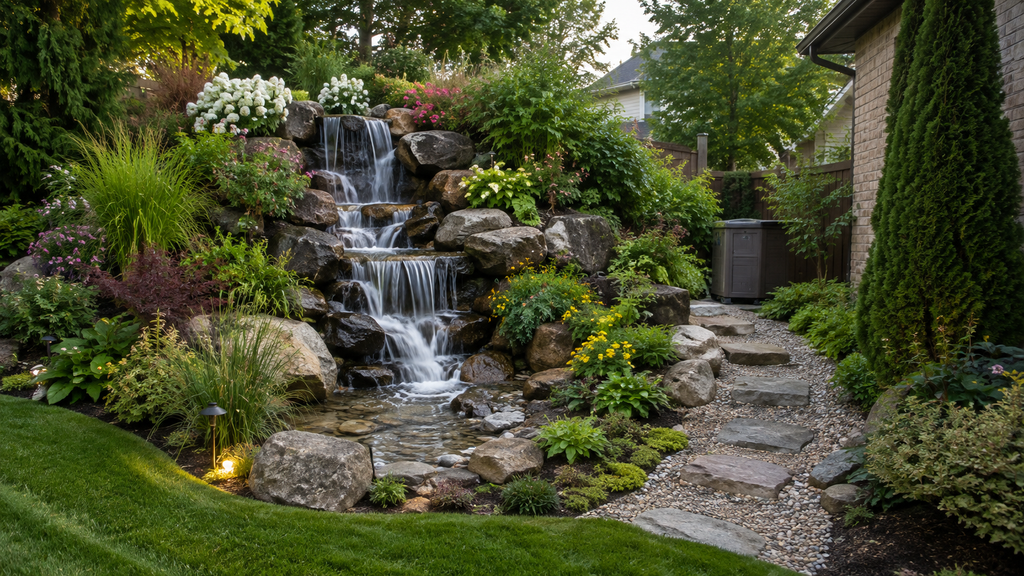
Do not plant every side of the waterfall with equal density. The display side should provide the strongest visual composition, while the service side should allow access to equipment.
Use the display side for:
- Layered foliage
- Flowering accents
- Rock-softening plants
- Privacy planting
- Strong cascade framing
Keep the service side simpler so you can reach:
- Pumps
- Filters
- Valves
- Lighting
- Electrical components
- Pondless reservoirs
- Important liner edges
Low plants, stepping stones, and movable containers can conceal a service route without blocking it.
Best Plants for Each Waterfall Zone
The best plants depend on both their physical location and their visual role.
- Waterline: Aquatic or marginal plants where appropriate
- Splash edge: Low Frames and Seam plants
- Transition bed: Grasses, perennials, compact shrubs, and Accents
- Backdrop: Anchors such as taller grasses, shrubs, or evergreens
For shade, emphasize ferns, hostas, woodland perennials, and shade-tolerant sedges. For full sun, use sun-tolerant grasses, flowers, shrubs, and groundcovers. For consistently moist soil, choose wet-soil plants rather than ordinary garden species.
If the soil beside the waterfall is normally drained, use conventional landscape plants even if visible water is nearby.
How to Blend Plants With Waterfall Rocks
Make a backyard waterfall look natural by letting water and stone establish the structure first. Then add plants where vegetation would realistically appear.
Use this sequence:
- Identify the strongest waterfall drop.
- Keep the front of it open.
- Add a larger plant group on one side.
- Add a smaller balancing group on the other.
- Place low plants around selected rocks.
- Repeat a few plant types elsewhere.
- Leave visible stone between plants.
Avoid perfect symmetry and do not cover every rock. A few partially hidden stones look established, while a completely covered waterfall can look overgrown.
Before planting, temporarily place nursery pots around the feature and view them from the main seating area. Move anything that hides too much of the cascade.
Plants to Avoid Around Backyard Waterfalls
Avoid plants that become invasive, oversized, difficult to control, or incompatible with the site’s moisture.
Be cautious with:
- Locally invasive aquatic plants
- Aggressive spreaders
- Oversized shrubs
- Heavy leaf-dropping plants directly over small ponds
- Large woody roots near liners
- Plants that block maintenance access
- Plants whose moisture requirements do not match the soil
A plant that looks attractive at purchase can still be unsuitable once it reaches mature size.
Always verify aquatic plant names and local invasive status. Never release unwanted pond plants into natural waterways.
Why Your Waterfall Planting Looks Wrong
Most waterfall planting problems come from scale, visibility, repetition, or incorrect placement.
If the waterfall disappears, foreground plants are probably too tall. If the area looks chaotic, there may be too many unrelated species. If the waterfall suddenly looks smaller, surrounding foliage may be oversized.
Common fixes include:
- Move tall plants backward
- Repeat fewer plant varieties
- Restore visible rock
- Reduce excessive flower color
- Reopen service access
- Add low plants only where rock-to-soil transitions look artificial
- Match wilting plants to actual soil moisture
Fix the largest visual problem first rather than adding more plants.
The waterfall should remain the main focal point. If the plants attract attention before the moving water, simplify the planting.
Backyard Waterfall Planting Mistakes
The most common mistake is trying to make a new waterfall landscape look fully mature immediately. Young plants need space to grow.
Avoid these problems:
Overplanting
Too many plants quickly cover rocks and create excessive maintenance.
Hiding the Main Cascade
Keep tall foliage outside the strongest viewing corridor.
Assuming Every Area Is Wet
Liners may keep surrounding soil completely dry.
Ignoring Mature Size
Plan for mature width and height instead of filling empty first-year spaces.
Filling Every Rock Gap
Exposed stone creates contrast and keeps the waterfall readable.
Allowing Loose Material to Wash Into the Water
Secure soil and mulch on slopes where heavy rain could carry material into the feature.
Forgetting Maintenance Access
Leave a route to pumps, filters, lights, valves, and pond edges.
Ignoring Local Aquatic Plant Rules
Always check whether water-garden plants are invasive or restricted in your region.
Low-Maintenance Backyard Waterfall Planting
A low-maintenance waterfall uses fewer plant types, adequate spacing, controlled growth habits, and clear access.
A simple planting formula is:
- One backdrop plant type
- One repeated medium plant
- One low edge plant
- One seasonal Accent
- Aquatic plants only where genuine water conditions exist
Group plants with similar sunlight and moisture needs. Choose clumping or manageable plants where possible, especially around small waterfalls and pondless reservoirs.
Leave more space than seems necessary when plants are young. It is easier to add another plant later than remove several mature plants growing around liners and rocks.
Review the waterfall throughout the growing season. If one plant repeatedly needs severe pruning just to keep the water visible, it is probably in the wrong location.
Backyard Waterfall Ideas With Plants FAQs
What are the best plants around a backyard waterfall?
Choose plants according to sunlight, soil moisture, climate, and mature size. Ferns, sedges, ornamental grasses, flowering perennials, compact shrubs, and groundcovers can all work in suitable zones.
Do plants around a waterfall need wet soil?
No. A lined waterfall can leave nearby soil normally drained or dry. Check moisture at root depth before choosing plants.
What should I plant closest to a waterfall?
Use low, controlled plants such as suitable sedges, small ferns, or groundcovers. Keep taller foliage away from the main cascade.
What is the best waterfall planting layout?
Use four zones: waterline, splash edge, transition bed, and backdrop. Keep the lowest plants near visible water and the tallest plants farther back.
Can plants grow directly in a backyard waterfall?
Only true aquatic or marginal plants suited to those water conditions should grow directly in water. Ordinary landscape plants should remain outside the active channel.
What can I plant around a pondless waterfall?
Use grasses, sedges, compact shrubs, ferns, perennials, and groundcovers while preserving access to the hidden pump and reservoir.
How do you make a waterfall look natural with plants?
Use irregular plant groups, repeated species, different heights, visible stone, and controlled asymmetry rather than planting a continuous ring around the feature.
Are ferns good around waterfalls?
Yes, where shade, climate, and moisture conditions suit them. Their fine foliage softens rocks without overpowering moving water.
Are ornamental grasses good around waterfalls?
Yes. Grasses add movement and structure. Use shorter grasses toward the front and taller clumps toward the backdrop.
What should I plant behind a waterfall?
Use climate-appropriate grasses, compact shrubs, evergreens, or small trees that frame the feature without covering the upper cascade.
What should I plant around a sunny waterfall?
Choose sun-tolerant grasses, perennials, shrubs, sedges, and groundcovers according to actual soil moisture.
What can I plant around a shaded waterfall?
Ferns, hostas, woodland perennials, shade-tolerant sedges, and suitable groundcovers can provide strong foliage texture.
Are native plants good around waterfalls?
Yes. Locally native sedges, grasses, ferns, shrubs, and wet-soil plants can help the waterfall blend into its surrounding landscape.
How close should plants be to a waterfall?
Spacing depends on mature size, root behavior, soil moisture, liner position, and maintenance access rather than one fixed distance.
How many plant types should I use?
Four to seven main plant types are often enough for a small or medium waterfall. Repetition usually creates a stronger design than maximum variety.
How do I keep plants from hiding the waterfall?
Keep foreground foliage low, place medium plants along the sides, and use the tallest plants behind the feature.
What plants should I avoid around a waterfall?
Avoid invasive species, aggressive spreaders, oversized shrubs, moisture-mismatched plants, and anything that blocks equipment access.
Why do plants wilt even when the waterfall is nearby?
The surrounding soil may remain dry because the liner keeps water inside the waterfall channel. Check soil moisture at root depth.
Why does my waterfall look too busy?
Too many plant types, colors, or oversized leaves can create clutter. Simplify the palette and restore visible rock.
Should both sides of a waterfall be planted the same?
No. Use the display side for richer planting and keep the service side more accessible for pumps, filters, liners, and lighting.
What is the easiest low-maintenance waterfall planting plan?
Use one backdrop plant, one repeated medium plant, one low edge plant, and one controlled seasonal accent while preserving equipment access.

Myra is the founder and lead writer of Backyard Planter Ideas, where she shares practical, well-researched guidance on planter design, plant selection, and outdoor styling. Her goal is to help homeowners create attractive, functional garden spaces with clear, reliable, and easy-to-apply advice.