
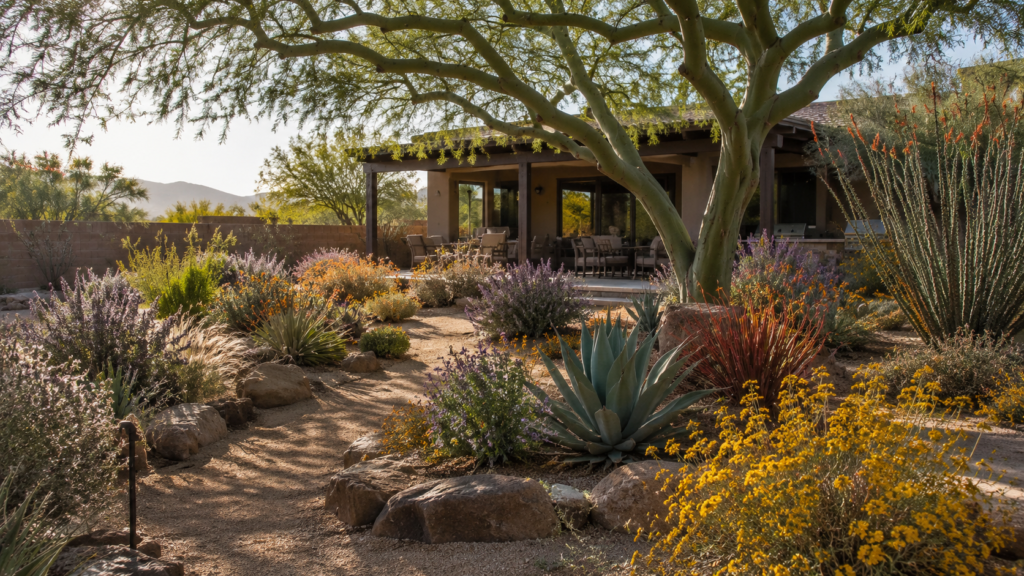
The best Arizona backyard plant ideas combine heat tolerance, low water needs, mature-size compatibility, and the ability to handle demanding desert conditions. Palo verde, desert willow, Texas sage, brittlebush, red yucca, agave, ocotillo, desert marigold, and other desert-adapted plants can provide shade, privacy, flowers, wildlife habitat, and year-round structure without creating a high-water landscape.
Arizona is not one uniform growing environment. Phoenix, Tucson, Yuma, Prescott, Flagstaff, and other communities differ significantly in elevation, winter temperatures, summer heat, rainfall, and growing-season length. A plant that thrives in Phoenix may struggle with winter cold in northern Arizona.
This guide focuses primarily on hot, dry, low-desert Arizona backyards while covering the climate, soil, watering, placement, and maintenance factors that help you choose the right plants.
What Makes a Good Arizona Backyard Plant?
A good Arizona backyard plant should tolerate local heat while fitting the exact planting location. Drought tolerance is important, but sun exposure, reflected heat, soil drainage, winter temperatures, mature size, irrigation, thorns, and landscape purpose also affect long-term success.
An agave may tolerate extreme heat but become dangerous beside a narrow walkway. A large Texas sage may survive easily but create constant pruning work where only a small shrub fits.
Before choosing a plant, check:
- Direct sun and afternoon exposure
- Reflected heat from walls, pavement, gravel, and pool decks
- Soil drainage and possible caliche
- Mature height and width
- Established water requirements
- Cold tolerance for your Arizona location
- Thorns, spines, or sharp foliage
- The job the plant needs to perform
The best rule is simple: choose the planting location first, then choose a plant that naturally fits it.
How Does Arizona Climate Affect Plant Choice?
Arizona plant selection should always account for elevation and winter temperature. Phoenix and Yuma are dominated by extreme low-desert heat, while Prescott and Flagstaff require much greater attention to winter hardiness.
| Location | Main challenge | Priority |
|---|---|---|
| Phoenix | Extreme heat and reflected heat | Heat tolerance |
| Tucson | Heat plus colder winter nights | Heat and cold tolerance |
| Yuma | Prolonged extreme heat | Maximum heat tolerance |
| Prescott | Drought plus freezing weather | Cold hardiness |
| Flagstaff | Cold winters and short season | Winter survival |
This is why “Arizona native” does not automatically mean suitable everywhere in Arizona. Native plants come from different elevations and ecosystems.
Likewise, drought tolerant does not always mean Phoenix heat tolerant.
At higher elevations, freezing temperatures may eliminate plants that otherwise handle drought very well.
What Are the Best Arizona Backyard Plant Ideas?
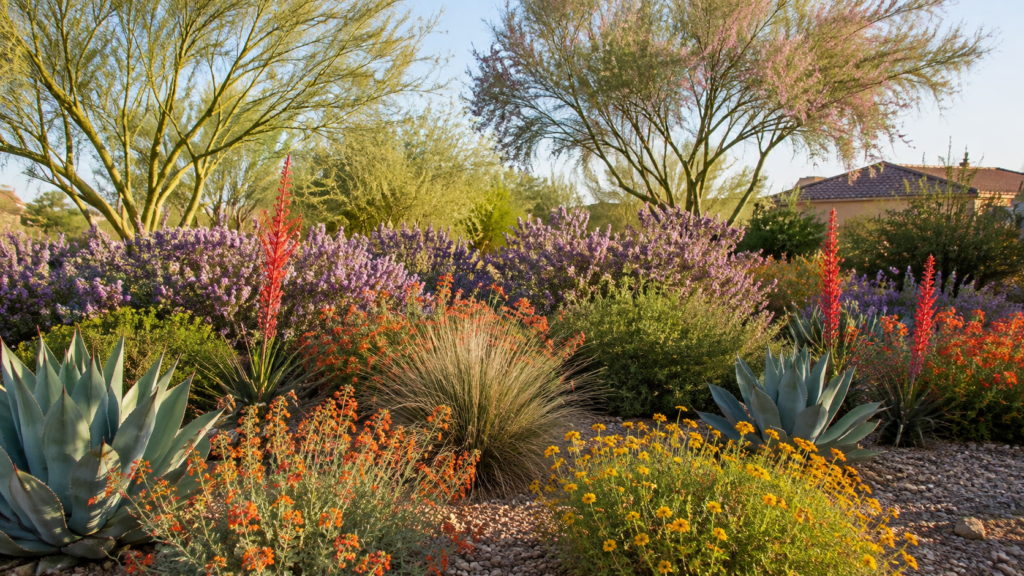
A balanced Arizona backyard should contain several plant forms rather than only cactus, shrubs, or gravel.
Trees provide shade and scale. Shrubs create privacy and structure. Flowers add seasonal color and pollinator value. Grasses introduce movement. Agaves, cacti, desert spoon, and ocotillo provide architectural form.
Use the following 25 plants as a shortlist rather than a requirement to plant everything.
| Plant | Type | Best use |
|---|---|---|
| Blue palo verde | Tree | Filtered shade |
| Foothills palo verde | Tree | Native desert structure |
| Desert willow | Tree | Flowers and light shade |
| Desert ironwood | Tree | Long-term shade |
| Velvet mesquite | Tree | Broad shade |
| Texas sage | Shrub | Privacy and flowers |
| Baja fairy duster | Shrub | Hummingbirds |
| Brittlebush | Shrub | Yellow flowers |
| Creosote bush | Shrub | Natural desert landscape |
| Jojoba | Shrub | Evergreen screening |
| Chuparosa | Shrub | Hummingbirds |
| Fourwing saltbush | Shrub | Screening and habitat |
| Globe mallow | Flowering perennial | Orange flowers |
| Desert marigold | Perennial | Yellow foreground color |
| Blackfoot daisy | Perennial | Borders |
| Desert zinnia | Perennial | Native flower garden |
| Firecracker penstemon | Perennial | Red flowers |
| Red yucca | Accent | Flowers and structure |
| Desert spoon | Accent | Architectural form |
| Parry’s agave | Succulent | Sculptural focal point |
| Saguaro | Cactus | Iconic specimen |
| Engelmann’s prickly pear | Cactus | Habitat and accent |
| Ocotillo | Accent shrub | Vertical structure |
| Deer grass | Grass | Movement |
| Sideoats grama | Grass | Natural meadow texture |
A smaller repeated palette usually looks better and requires less maintenance than planting one of every species.
What Are the Best Arizona Shade Trees?
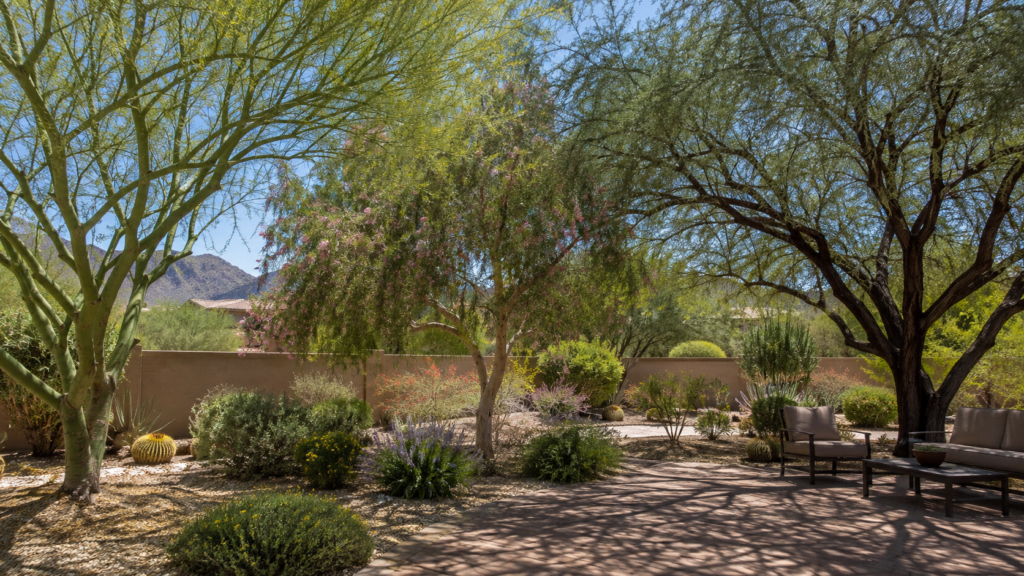
Shade trees can make patios, seating areas, walls, and surrounding planting beds more comfortable.
1. Blue Palo Verde
Blue palo verde (Parkinsonia florida) provides filtered shade, green bark, and bright yellow spring flowers. It works well over desert shrubs, flowers, and grasses.
Give it enough space for its mature canopy instead of planting it too close to walls or narrow passages.
2. Foothills Palo Verde
Foothills palo verde (Parkinsonia microphylla) has a natural Sonoran Desert appearance. Its open canopy works well with creosote, agave, cactus, desert marigold, and native grasses.
Choose it when regional character and filtered shade matter more than dense canopy.
3. Desert Willow
Desert willow (Chilopsis linearis) combines flowers with light shade. Its trumpet-shaped blooms make it useful near patios and hummingbird gardens.
It is a strong choice when you want a flowering tree rather than a heavier desert canopy.
4. Desert Ironwood
Desert ironwood (Olneya tesota) is a long-term native tree suited to larger landscapes.
Use it where there is plenty of room and where habitat, shade, and native desert character are priorities.
5. Velvet Mesquite
Velvet mesquite (Prosopis velutina) can provide broad shade but needs significant space.
Consider thorns, pods, branch structure, and pedestrian movement before planting it near patios or narrow paths.
How Do Monsoons Affect Arizona Trees?
Arizona trees should be selected for structure as well as drought tolerance. Monsoon winds can expose weaknesses caused by poor branch development, improper pruning, bad staking, heavy canopies, or poorly established roots.
Before monsoon season:
- Remove dead or damaged branches
- Avoid topping trees
- Check young-tree stakes and ties
- Maintain balanced canopy structure
- Avoid excessive pruning that exposes trunks to sun
- Inspect branches near roofs and utilities
The best long-term strategy is correct planting, good branch structure, appropriate irrigation, and enough room for the canopy to develop naturally.
Which Arizona Shrubs Handle Heat Best?
Shrubs provide privacy, flowers, screening, and habitat without requiring the space of large trees.
6. Texas Sage
Texas sage (Leucophyllum frutescens) handles heat well and produces gray-green foliage and purple-to-pink flowers.
Choose a cultivar whose mature size fits the location so repeated shearing is unnecessary.
7. Baja Fairy Duster
Baja fairy duster (Calliandra californica) is an excellent hummingbird shrub with bright red flowers.
Use it near patios, windows, pollinator gardens, or beneath taller desert trees.
8. Brittlebush
Brittlebush (Encelia farinosa) combines silver foliage with yellow flowers.
It is ideal for sunny naturalistic beds and pairs well with palo verde, agave, and ocotillo.
9. Creosote Bush
Creosote bush (Larrea tridentata) creates an authentic Sonoran Desert appearance.
Give it space to retain its natural form rather than forcing it into a clipped hedge.
10. Jojoba
Jojoba (Simmondsia chinensis) provides evergreen structure and works well for informal screening.
It is especially useful behind seasonal flowers.
11. Chuparosa
Chuparosa (Justicia californica) produces red-to-orange tubular flowers that attract hummingbirds.
Place it where wildlife activity can be enjoyed from a patio or window.
12. Fourwing Saltbush
Fourwing saltbush (Atriplex canescens) provides silvery foliage, screening, and habitat value.
It works best where its mature width has room to develop.
Which Arizona Flowers Thrive in Heat?
Low-water Arizona landscapes can still contain plenty of seasonal color.
13. Globe Mallow
Globe mallow (Sphaeralcea ambigua) produces warm orange and apricot flowers.
Use several plants together around boulders, shrubs, or slopes for greater visual impact.
14. Desert Marigold
Desert marigold (Baileya multiradiata) provides bright yellow flowers and silvery foliage.
Its low form makes it useful along bed edges and beneath taller plants.
15. Blackfoot Daisy
Blackfoot daisy (Melampodium leucanthum) works well along rock gardens and sunny borders.
Its small white flowers soften the heavier appearance of agaves and cacti.
16. Desert Zinnia
Desert zinnia (Zinnia acerosa) is a compact native flower suited to naturalistic desert gardens.
Use it where its small blooms can be viewed closely.
17. Firecracker Penstemon
Firecracker penstemon (Penstemon eatonii) produces vertical red flower spikes and attracts hummingbirds.
It pairs well with desert marigold, fairy duster, red yucca, and desert willow.
Which Desert Accent Plants Work Best?
Architectural plants add structure even when the garden is not flowering.
18. Red Yucca
Red yucca (Hesperaloe parviflora) forms narrow fountain-like foliage with tall flowering stalks.
It works well with grasses, Texas sage, and agave.
19. Desert Spoon
Desert spoon (Dasylirion wheeleri) creates strong sculptural form.
Its sharp foliage means it should be kept away from narrow walkways and children’s areas.
20. Parry’s Agave
Parry’s agave (Agave parryi) provides a compact blue-gray rosette.
Use it as a focal point where its sharp leaf tips will not interfere with people or pets.
21. Saguaro
Saguaro (Carnegiea gigantea) is Arizona’s most iconic desert specimen.
Give it open space and obtain plants through legitimate sources rather than collecting wild specimens.
22. Engelmann’s Prickly Pear
Engelmann’s prickly pear (Opuntia engelmannii) provides flowers, fruit, wildlife value, and strong desert form.
Keep it away from pool decks, seating areas, and narrow paths because of spines and glochids.
23. Ocotillo
Ocotillo (Fouquieria splendens) provides tall vertical structure and seasonal red flowers.
It works well with brittlebush, agave, palo verde, and low desert flowers.
Which Arizona Grasses Handle Dry Conditions?
Grasses soften desert landscapes and add movement.
24. Deer Grass
Deer grass (Muhlenbergia rigens) forms substantial clumps of fine foliage.
Use it beside boulders, between architectural plants, or beneath desert trees.
25. Sideoats Grama
Sideoats grama (Bouteloua curtipendula) creates a natural grassland effect.
It works best in informal plantings with native flowers and shrubs rather than as a lawn substitute.
Where Should You Plant in an Arizona Backyard?
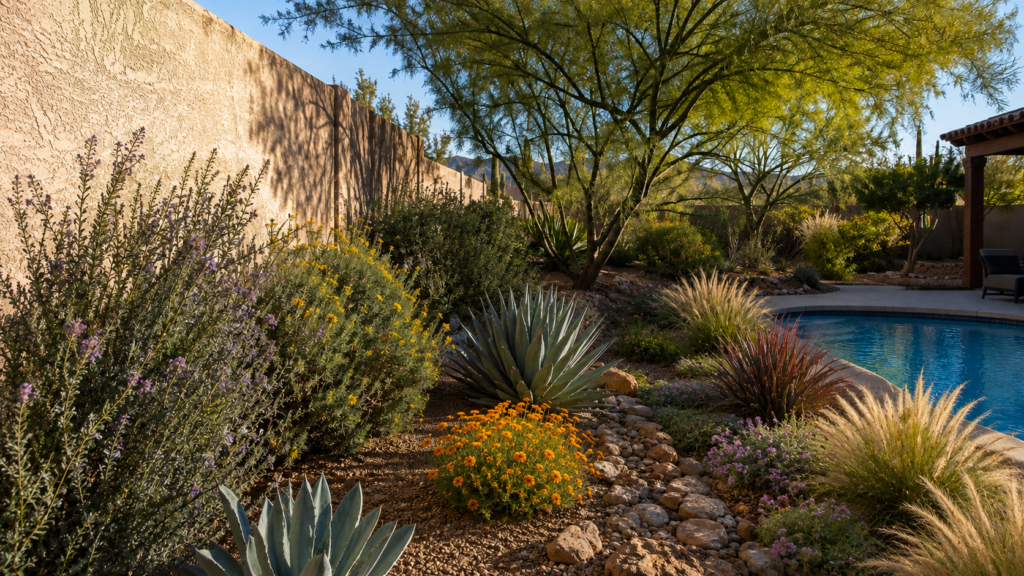
Different parts of the same backyard can create different growing conditions. A west-facing wall may produce severe reflected heat, while a nearby tree canopy creates filtered shade.
| Location | Main challenge | Plants to consider |
|---|---|---|
| West wall | Reflected heat | Creosote, brittlebush, Texas sage, desert spoon |
| Full sun | Long exposure | Palo verde, agave, ocotillo, desert marigold |
| Patio | Comfort and shade | Desert willow, palo verde, flowering shrubs |
| Pool area | Heat and barefoot traffic | Non-spiny, manageable plants |
| Property boundary | Privacy | Texas sage, jojoba, saltbush |
| Pollinator zone | Flower resources | Fairy duster, chuparosa, penstemon, red yucca |
Do not treat “full sun” and “reflected heat” as identical conditions.
Near pools and walkways, safety should come before appearance. Avoid cactus, prickly pear, sharp agaves, or desert spoon where people regularly pass.
How Should You Prepare Arizona Soil?
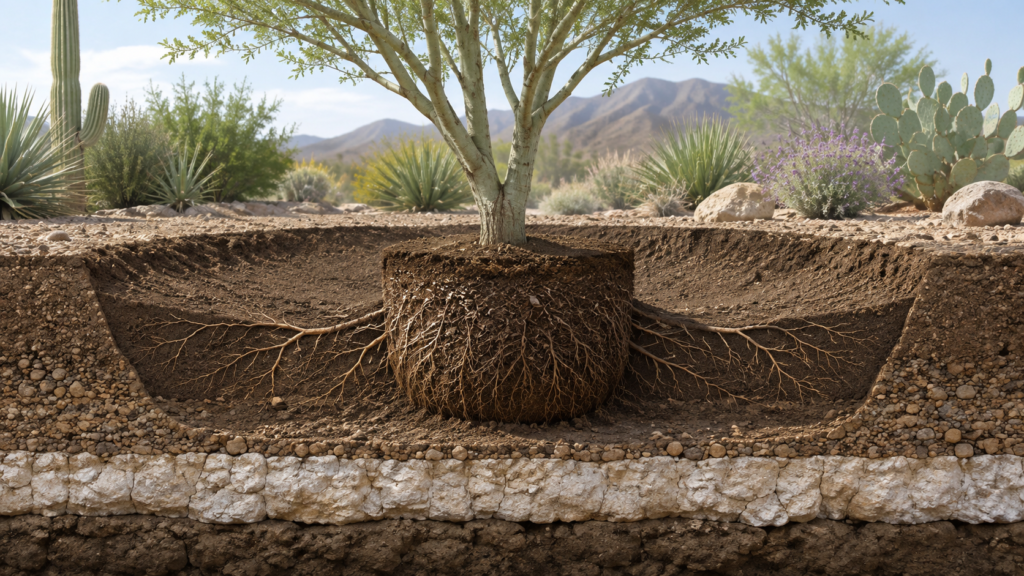
Many desert plants do not need heavily amended planting holes. Correct drainage and planting depth are often more important.
For trees and shrubs:
- Avoid planting too deeply
- Keep the root ball near or slightly above finished grade
- Use a broad planting area
- Avoid creating a pocket of dramatically different soil
- Check for compaction or caliche
- Keep mulch away from trunks and crowns
What is caliche?
Caliche is soil hardened by calcium carbonate.
Severe caliche can restrict roots and prevent water from draining properly.
A simple drainage test can help:
- Dig a hole about one foot deep.
- Fill it with water.
- Refill after it drains.
- Check again after about 24 hours.
Persistent standing water suggests a drainage problem.
How Should You Combine Arizona Desert Plants?
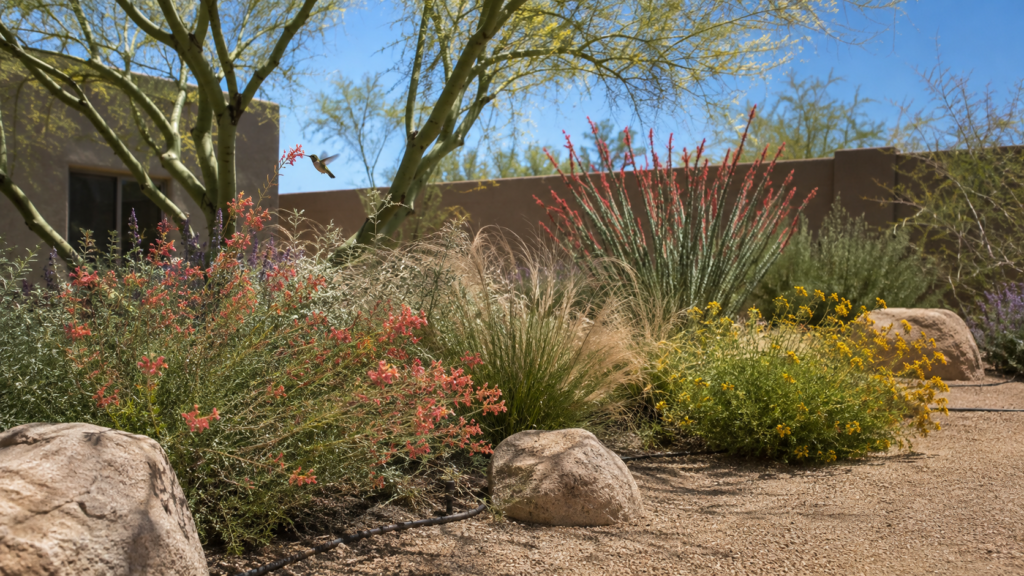
Arizona landscapes look more intentional when plants are repeated in layers.
Use:
- Trees for upper structure
- Shrubs for the middle layer
- Flowers for seasonal color
- Grasses for texture
- Agaves or cactus for accents
Reliable combinations include:
Sonoran pollinator garden: Blue palo verde + fairy duster + chuparosa + red yucca + desert marigold.
Modern xeriscape: Desert willow + Texas sage + Parry’s agave + deer grass + blackfoot daisy.
Natural desert garden: Foothills palo verde + creosote + brittlebush + ocotillo + sideoats grama.
Avoid planting one of every species. Repeating compatible plants creates stronger design and easier irrigation.
When Should You Plant in Arizona?
Fall and early spring are often easier planting periods in low-desert Arizona because plants can establish roots before extreme summer heat.
| Season | General low-desert suitability |
|---|---|
| Fall | Excellent |
| Mild winter | Good for hardy plants |
| Early spring | Good |
| Late spring | Increasing stress |
| Peak summer | Highest establishment stress |
Higher-elevation areas require different timing because frost and winter cold become more important.
How Often Should Arizona Plants Be Watered?
New drought-tolerant plants require more frequent irrigation than established plants. As roots grow, watering should generally become deeper and less frequent.
Typical target depths are roughly:
- 6–12 inches for small plants
- 12–24 inches for shrubs
- 18–36 inches for trees
Do not rely only on irrigation runtime. Emitter output, soil type, plant size, weather, and slope affect how much water reaches the roots.
Established desert plants usually should not receive shallow daily watering. Drought-tolerant plants can also be overwatered, especially in poorly drained soil.
What Arizona Planting Mistakes Should You Avoid?
The most common problems include:
- Planting too close together
- Ignoring mature plant size
- Treating reflected heat like ordinary full sun
- Putting sharp plants near walkways
- Using one irrigation schedule for every plant
- Overwatering established desert plants
- Keeping emitters too close to trunks
- Constantly shearing oversized shrubs
- Ignoring poor drainage or caliche
A sparse-looking new desert landscape usually fills in over time. Do not solve temporary empty space by overcrowding plants.
Are Arizona Native Plants Protected?
Some Arizona native plants are regulated.
Wild saguaros and other protected native plants should not be removed or transported without checking current Arizona Department of Agriculture requirements.
Depending on the situation, rules may involve:
- Landowner authorization
- Tags
- Permits
- Notices
- Transportation requirements
For ordinary landscaping, purchase plants through reputable nurseries or legitimate salvage sources.
Which Arizona Plants Are Best by Purpose?
| Goal | Strong choices |
|---|---|
| Shade | Palo verde, desert willow, mesquite |
| Privacy | Texas sage, jojoba, saltbush |
| Hummingbirds | Fairy duster, chuparosa, red yucca, penstemon |
| Yellow flowers | Brittlebush, desert marigold |
| Orange flowers | Globe mallow |
| Modern style | Agave, desert spoon, red yucca |
| Native desert look | Creosote, palo verde, ocotillo, saguaro |
| Movement | Deer grass, sideoats grama |
| Extreme sun | Creosote, brittlebush, desert spoon, agave |
Choose by function first:
- What problem does the plant need to solve?
- What environmental stress exists there?
- Which plants satisfy both?
What Is Arizona Xeriscaping?
Xeriscaping is water-efficient landscaping, not simply covering the yard with rocks.
A well-designed Arizona xeriscape can contain shade trees, flowering shrubs, perennials, grasses, agaves, cacti, mulch, efficient drip irrigation, and rainwater harvesting.
Plants provide benefits that bare gravel cannot, including shade, privacy, habitat, seasonal color, and structure.
The goal is to choose appropriate plants and use water efficiently.
What Grows Best in Northern Arizona?
Northern and high-elevation Arizona require different plant choices than Phoenix or other low-desert areas.
Homeowners in Prescott, Flagstaff, and colder locations should evaluate:
- Winter minimum temperature
- Frost frequency
- Elevation
- Snow exposure
- Growing-season length
- Summer heat
- Soil drainage
A plant can be drought tolerant and still lack sufficient cold hardiness.
How Do You Build a Low-Maintenance Arizona Backyard?
Low maintenance comes from correct design, not from buying plants labeled maintenance-free.
Start with:
- One or two structural trees
- Two or three shrub species
- Two or three flowering species
- One ornamental grass
- One or two architectural accents
Repeat those plants instead of continually adding new species.
Keep spiny plants away from traffic, leave mature spacing, group plants with similar water requirements, and locate shade where people use the yard.
How Do You Choose the Best Arizona Backyard Plants?
Before buying any plant, ask:
- Will it survive the local summer and winter climate?
- Can it tolerate this exact sun or reflected-heat exposure?
- Will its mature size fit?
- Does its water requirement match nearby plants?
- Does it serve a clear backyard purpose?
- Is it safe around people and pets?
For hot low-desert Arizona, a practical starting palette could include blue palo verde, desert willow, Texas sage, fairy duster, brittlebush, globe mallow, desert marigold, red yucca, deer grass, and carefully positioned agave or cactus.
A successful Arizona backyard should use desert strengths—sun, dramatic plant forms, seasonal flowers, native wildlife, and water-wise species—to create a landscape that is attractive, functional, and realistic to maintain.
Arizona Backyard Plant Ideas FAQs
What are the easiest plants to grow in Arizona?
Palo verde, Texas sage, brittlebush, desert marigold, red yucca, jojoba, and desert spoon are strong low-maintenance choices when matched to the correct location.
What plants survive full Arizona sun?
Creosote, brittlebush, palo verde, ocotillo, desert spoon, agave, desert marigold, and prickly pear tolerate intense sun. Reflected heat may require stricter plant selection.
What is the best Arizona shade tree?
Palo verde, desert willow, mesquite, and desert ironwood are strong options. Choose according to mature space, canopy type, thorns, and litter.
Which Arizona plants attract hummingbirds?
Baja fairy duster, chuparosa, red yucca, firecracker penstemon, and desert willow are excellent hummingbird plants.
Do drought-tolerant Arizona plants need irrigation?
Yes. Newly planted desert plants need establishment irrigation. Mature plants generally require deeper and less frequent watering.
When should you plant in Arizona?
Fall and early spring are often easier planting periods in the low desert. High-elevation areas need different timing because of frost and winter temperatures.
What plants handle Arizona reflected heat?
Texas sage, creosote, brittlebush, red yucca, and desert spoon are strong candidates for severe sunny locations.
Can Arizona plants grow in caliche?
Some can, but dense caliche can restrict roots and drainage. Test the planting location before installing large or expensive plants.
Can I move a wild saguaro into my backyard?
Do not move a wild saguaro without checking current Arizona Department of Agriculture requirements for protected native plants.
Is xeriscaping just rocks and cactus?
No. Xeriscaping can include shade trees, flowers, grasses, shrubs, succulents, mulch, and efficient irrigation while keeping water use low.
How We Researched These Arizona Backyard Plant Ideas
This guide focuses primarily on hot, low-desert Arizona and uses Arizona-specific horticultural principles for plant selection, climate, irrigation, soil, and native-plant considerations.
Key factors include heat and drought performance, mature size, reflected heat, water requirements, elevation, winter temperatures, soil drainage, caliche, safety, and landscape function.
Always confirm plant suitability for your exact Arizona location, soil, exposure, and irrigation conditions before planting.

Myra is the founder and lead writer of Backyard Planter Ideas, where she shares practical, well-researched guidance on planter design, plant selection, and outdoor styling. Her goal is to help homeowners create attractive, functional garden spaces with clear, reliable, and easy-to-apply advice.