
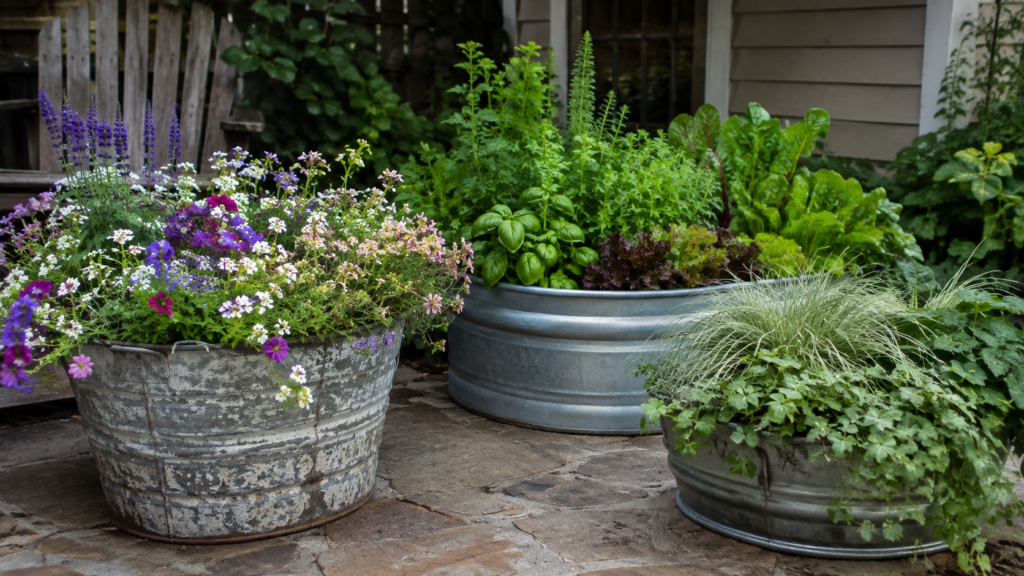
The best galvanized tub planter ideas include mixed flower tubs, herb gardens, vegetable stock tanks, succulent displays, shade planters, privacy screens, and statement plants. Choose the design according to tub depth, sunlight, mature root size, drainage, climate, and how often you can realistically water and maintain the container.
Galvanized tubs suit cottage, farmhouse, rustic, and modern outdoor spaces because their silver-gray finish provides a neutral background for plants. A weathered washtub overflowing with flowers can soften a patio, while a long galvanized stock tank can create a practical raised planter beside a fence or seating area.
A good galvanized planter needs more than attractive plants. Proper drainage, suitable potting mix, enough root space, compatible plants, and thoughtful placement all determine whether the container remains healthy through the season.
What Are the Best Galvanized Tub Planter Ideas?
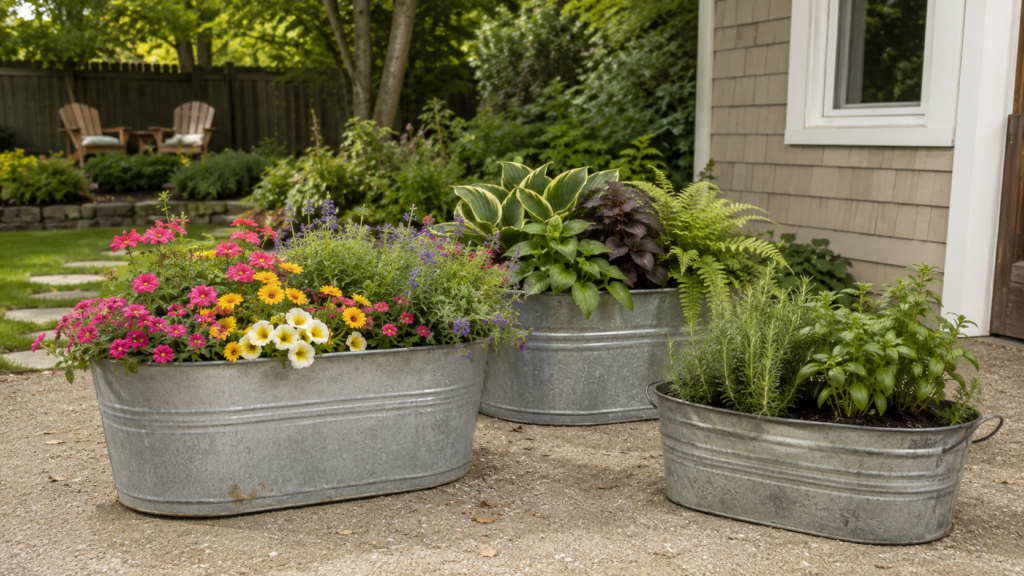
The best design depends on what you want the planter to do. Wide washtubs work well for flowers, herbs, and foliage combinations, while deeper stock tanks are better for vegetables, ornamental grasses, privacy plants, and larger root systems.
Before choosing a design, consider:
- sunlight and afternoon heat;
- tub depth and width;
- mature plant size;
- ornamental versus edible use;
- seasonal versus permanent planting;
- watering and maintenance requirements.
1. Create a Cottage-Style Flower Tub
A cottage-style flower tub softens the industrial appearance of galvanized metal.
Combine plants with different heights rather than arranging everything evenly. Use a taller plant in the center or rear, medium-height flowers through the middle, and trailing plants around the rim.
Suitable options may include petunias, calibrachoa, geraniums, verbena, lobelia, alyssum, coleus, and other locally appropriate container plants.
For a more balanced display:
- repeat two or three colors;
- include foliage as well as flowers;
- allow trailing plants to soften the rim;
- leave room for mature growth;
- combine plants with similar light and water needs.
A slightly weathered tub works especially well for this relaxed style.
2. Use the Thriller, Filler, and Spiller Formula
The classic thriller, filler, and spiller method gives a galvanized tub clear visual structure.
The thriller provides height, the fillers create fullness, and the spillers trail over the rim. Ornamental grass, salvia, or another upright plant can serve as the thriller, while compact flowers or foliage plants fill the center and trailing varieties soften the edge.
Put the thriller near the center if the planter is viewed from all sides. Place it toward the back if the tub sits against a wall or fence.
The goal is not to use as many plants as possible. A successful arrangement has clear height, middle growth, trailing interest, and enough space for plants to mature.
3. Turn a Galvanized Tub Into an Herb Garden
A medium galvanized tub can become a useful kitchen herb garden.
Possible herbs include basil, parsley, chives, thyme, oregano, cilantro, and rosemary where the climate suits it. Keep frequently harvested herbs near the edge and taller herbs toward the rear or center.
Group herbs according to moisture needs. Thyme, oregano, and rosemary generally prefer excellent drainage, while basil and parsley often appreciate more regular moisture.
Mint can spread aggressively, so grow it in its own inner pot if you want to include it in the same tub.
Place an herb planter near the kitchen or outdoor cooking area so harvesting remains convenient.
4. Make a Small Salad Garden
Shallow and medium galvanized tubs are useful for compact edible crops such as lettuce, spinach, arugula, Asian greens, parsley, and chives.
This type of planter works especially well on patios or balconies where an in-ground vegetable bed is not practical.
For longer production:
- harvest outer leaves where appropriate;
- sow or transplant in smaller batches;
- replace crops that bolt as temperatures rise;
- keep the growing medium evenly moist;
- use clean potting mix suitable for edible crops.
Leafy vegetables can also tolerate less direct sun than many fruiting vegetables, making them useful for sites with morning sun and some afternoon shade.
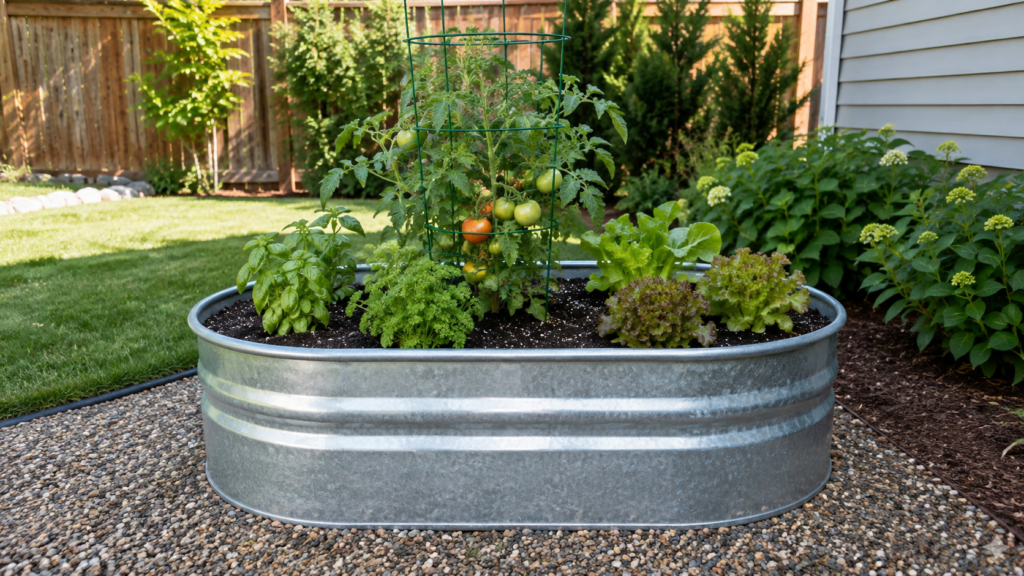
5. Grow Tomatoes and Herbs Together
A deep galvanized stock tank can support tomatoes and lower-growing herbs if it provides enough root volume.
Use compact or container-friendly tomato varieties where space is limited, and install a cage or stake at planting time.
Do not fill every open area with herbs. Tomatoes still need root space, airflow, nutrients, and moisture.
Before planting, confirm that:
- the site receives strong sunlight;
- the tub is deep enough;
- plant support is stable;
- herbs will not crowd the tomato;
- the container is easy to reach for watering and harvesting.
Position the stock tank before filling because it will become very heavy once watered.
6. Build a Low-Maintenance Succulent Tub
A shallow galvanized washtub can create an attractive succulent display where the chosen species suit local conditions.
Combine upright forms, rosettes, and trailing plants instead of using many unrelated varieties.
Succulents need fast drainage, so use an appropriate succulent mix and functioning drainage holes.
Avoid adding a deep gravel layer as a substitute for drainage. The growing medium and drainage openings are more important.
In wet climates, some succulents may benefit from protection from prolonged rainfall.
7. Make a Shady Galvanized Tub Garden
Galvanized tubs also work in shade.
Possible plants include hostas, begonias, coleus, ferns, heuchera, impatiens, and trailing shade plants suited to your climate.
Shade arrangements benefit from contrasting foliage rather than relying only on flowers. Combine broad leaves, fine textures, upright plants, and trailing forms.
Because shaded tubs may dry more slowly, check the growing medium before watering rather than following the same routine used for sunny containers.
8. Create a Pollinator-Friendly Tub
A large galvanized tub can become a small pollinator garden where an in-ground flower bed is not possible.
Choose regionally appropriate flowering plants and combine varieties with overlapping bloom periods.
Flowering herbs such as thyme, oregano, chives, and basil can also attract pollinators.
Place the tub in a sunny location and avoid frequent pesticide use around it.
9. Use Ornamental Grass as a Focal Point
A single ornamental grass can create a clean, architectural look.
This style works well beside modern patios, fences, entrances, or outdoor seating areas.
Choose a grass according to mature height and width. Tall plants need enough root volume and a stable container.
Consider wind exposure, winter hardiness, and whether the grass may eventually need dividing.
10. Make a Privacy Planter
A long galvanized stock tank can provide partial screening beside patios, hot tubs, seating areas, or boundaries.
Use upright ornamental grasses, narrow shrubs, or other container-compatible plants suited to your climate.
Choose a deep container and allow enough room for mature width. Avoid overcrowding plants simply to create immediate privacy.
11. Plant One Statement Shrub
A galvanized tub can also hold one carefully selected shrub or architectural plant.
Compact shrubs and dwarf conifers work particularly well near entrances, gates, patios, or stairs.
Check mature size before planting. A shrub that looks small at the nursery may eventually become too large for the tub.
Permanent container shrubs may also need winter protection or extra heat management depending on climate.
12. Group Different-Sized Galvanized Tubs
Grouping several tubs creates a larger display without requiring one enormous planter.
Try:
- one taller tub with an architectural plant;
- one medium tub with flowers;
- one smaller tub with herbs or trailing foliage.
Arrange them in a loose triangle rather than a straight line.
This works well beside porch steps, sheds, walls, and fence corners.
13. Put an Old Washtub on a Stand
An old galvanized washtub can become a stronger feature when raised on a sturdy outdoor stand.
The extra height makes planting, harvesting, and maintenance easier and can also improve drainage clearance.
Make sure the support is weather-resistant, stable, level, and strong enough to hold wet potting mix.
14. Use Matching Tubs Beside an Entrance
A matching pair of galvanized tubs can frame a doorway, garden gate, or walkway.
Repeat the same plant colors and heights to create balance.
If the two sides receive different amounts of sunlight, use different plant species with similar colors or forms rather than forcing identical plants into unsuitable conditions.
15. Use a Long Stock Tank Along a Fence
A long stock tank works well in narrow spaces because it creates plenty of planting area without projecting far into the yard.
Use it for flowers, herbs, vegetables, grasses, or mixed foliage.
Leave enough room behind the tub for drainage checks, fence maintenance, pruning, and airflow.
16. Create a Seasonal Galvanized Tub
A galvanized tub can remain in place while the planting changes through the year.
Spring may feature bulbs and cool-season flowers, summer can shift to heat-tolerant plants, and autumn can emphasize foliage and grasses.
Keeping one permanent structural plant and replacing only seasonal fillers can reduce cost and maintenance.
Which Galvanized Tub Planter Idea Is Best?
Choose according to light, available space, plant size, maintenance, and purpose.
| If you want… | Best planting direction | Tub style |
|---|---|---|
| Maximum color | Mixed annual flowers | Large washtub |
| Cottage style | Flowers and trailing foliage | Weathered tub |
| Low maintenance | Succulents | Shallow tub |
| Herb garden | Culinary herbs | Medium tub |
| Vegetable growing | Compact vegetables | Deep stock tank |
| Shade interest | Foliage plants | Broad tub |
| Privacy | Tall grasses or shrubs | Deep rectangular tank |
| Focal point | One shrub or grass | Oversized tub |
Choose by sunlight first, mature plant size second, and maintenance level third.
What Size Galvanized Tub Is Best?
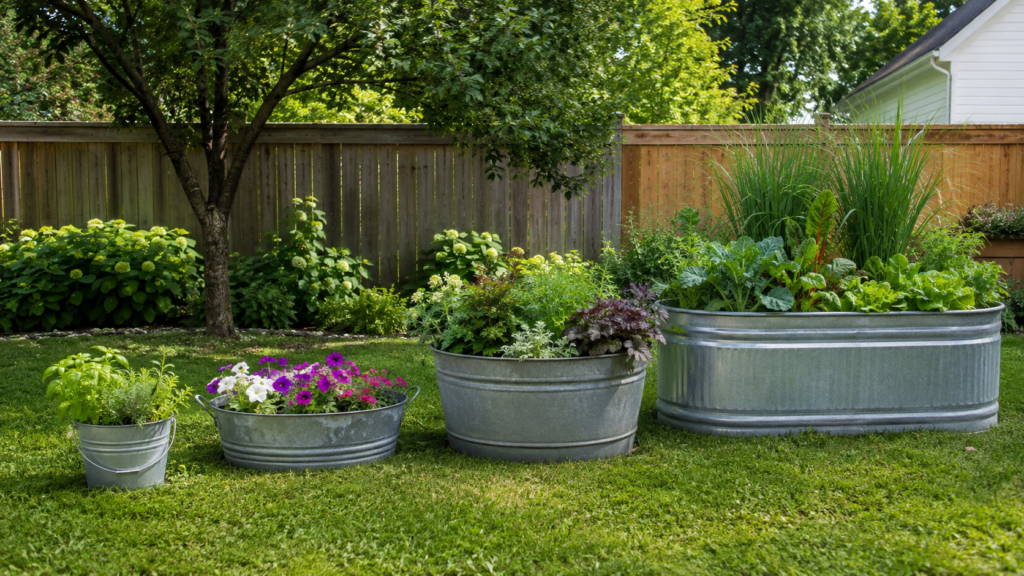
Tub size should match the mature root system rather than the current nursery pot.
Small buckets suit single herbs and compact flowers. Shallow washtubs are useful for succulents, greens, and seasonal flowers. Medium tubs work for herbs and mixed plantings, while deep tubs and stock tanks provide more root room for vegetables, shrubs, and grasses.
| Tub type | Best uses | Main limitation |
|---|---|---|
| Small bucket | Herbs, annuals | Dries quickly |
| Shallow washtub | Succulents, greens | Limited depth |
| Medium tub | Herbs, flowers | Heavy when wet |
| Deep tub | Vegetables, grasses | More soil required |
| Stock tank | Vegetables, screening | Difficult to move |
Choose the smallest tub that still provides enough mature root space.
How Much Sun Does a Galvanized Tub Need?
Light requirements depend on the plants, but tub size also affects how the container performs in sun.
Small metal containers can heat and dry quickly in intense afternoon sun, while larger tubs usually provide more soil volume and a larger moisture reserve.
Consider:
- actual hours of direct sun;
- morning versus afternoon exposure;
- heat reflected from walls or paving;
- summer rather than spring conditions;
- how often you can water.
A shaded porch is better suited to foliage plants, while full-sun vegetables usually benefit from a deeper tub in a bright location.
New or Vintage Galvanized Tub?
Choose a new galvanized tub when predictable condition, known material history, or edible growing matters most.
Choose vintage when aged character is the main goal and the container will primarily hold ornamental plants.
Before buying, inspect:
- depth and width;
- bottom condition;
- seams;
- drainage holes;
- sharp edges;
- heavy corrosion;
- previous use.
For edible crops, a known modern container is generally the clearer choice.
How Do You Make a Galvanized Tub Planter?
1. Choose the Final Location
Consider sunlight, access to water, runoff, walking space, and reflected heat.
2. Inspect the Tub
Check for sharp edges, damaged seams, severe corrosion, and unknown residues.
3. Add Drainage Holes
Outdoor soil-filled tubs need multiple openings so excess water can escape.
4. Keep the Holes Clear
Use mesh over unusually large openings if necessary.
5. Elevate the Tub if Needed
Pot feet can prevent bottom holes from being blocked by paving.
6. Add Potting Mix
Use quality container mix rather than dense garden soil.
7. Arrange Plants First
Set nursery pots in position before planting so you can adjust spacing.
8. Plant at the Correct Depth
Keep plants close to the depth at which they were growing in their nursery pots.
9. Water Thoroughly
Water until excess moisture exits freely.
How Do You Test a Galvanized Tub Planter?
Before fully filling a large tub, test its drainage.
Put the empty container in its final position, make sure it is level, and pour water into several areas. Water should leave through more than one drainage opening rather than collecting at one end.
Add a small amount of potting mix and water again. Correct pooling, blocked drainage, or stability problems before filling the tub completely.
How Many Drainage Holes Does a Galvanized Tub Need?
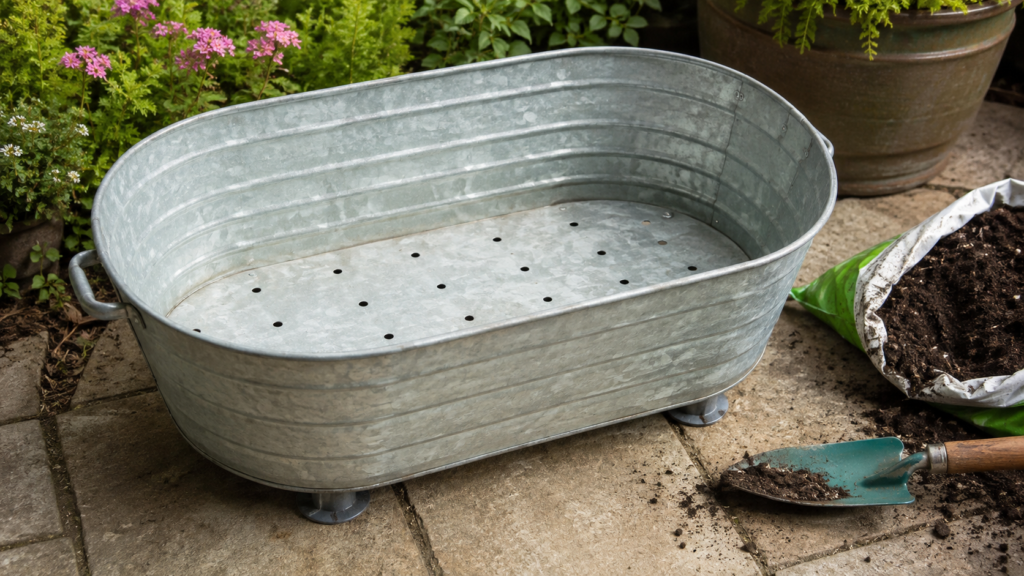
There is no fixed number because tub size, hole diameter, rainfall, and growing medium vary.
Use several drainage openings distributed across the base so excess water can escape from different parts of the container.
Make sure:
- holes remain unobstructed;
- the tub is not sitting flat over them;
- water does not pool in one end;
- the growing medium drains properly.
Should You Put Gravel in the Bottom?
No. Gravel is not a substitute for proper drainage holes and suitable potting mix.
It also adds unnecessary weight to a large planter.
Should You Line a Galvanized Tub?
A liner is not always necessary.
Use one when you want to protect a valuable vintage tub, create a removable seasonal planting, or add an extra barrier for a particular use.
Any liner must still allow water to drain.
Mesh over large drainage holes is often enough when the goal is simply preventing soil loss.
What Soil Is Best for a Galvanized Tub?
Use quality container potting mix rather than garden soil alone.
Container roots need a growing medium that holds moisture while still providing air and drainage.
Choose the mix according to plant type:
- general container mix for flowers;
- edible-container mix for vegetables;
- fast-draining mix for succulents;
- durable container medium for shrubs.
Compost can be included, but it should not usually make up the entire growing medium.
What Plants Are Best for Galvanized Tubs?
Choose plants according to light, root demand, climate, and moisture requirements.
Good options include:
- annual flowers;
- herbs;
- leafy greens;
- compact vegetables;
- succulents;
- ornamental grasses;
- compact shrubs;
- regionally suitable pollinator plants.
Match plants sharing one tub by water requirements. Avoid combining drought-tolerant and moisture-loving plants in the same root zone.
Also check mature size. Nursery plants may become several times larger by the end of the season.
Do Galvanized Tub Planters Get Too Hot?
They can become hot in intense sunlight, especially when small or surrounded by heat-reflective surfaces.
Reduce heat stress by:
- choosing a larger tub;
- keeping the root zone adequately moist;
- adding mulch where suitable;
- providing afternoon shade when appropriate;
- raising the container from very hot paving.
Heat management is more important during extreme weather than during mild spring conditions.
Are Galvanized Tubs Safe for Vegetables?
Modern galvanized steel is commonly used in raised beds and garden containers.
For edible crops, use a tub from a known source, clean growing media, normal plant-friendly soil conditions, and functioning drainage.
Avoid vintage containers with unknown previous uses, especially if they may have held chemicals, fuel, pesticides, or industrial materials.
If you prefer extra separation, use a suitable inner growing container without blocking drainage.
How Long Do Galvanized Tubs Last?
There is no single lifespan for every galvanized tub.
Durability depends on:
- coating quality;
- scratches;
- standing moisture;
- corrosion;
- soil conditions;
- product quality;
- climate.
Minor weathering is mainly cosmetic. Severe rust, weak seams, holes, or an unstable base are signs that repair or replacement may be needed.
How Do You Maintain a Galvanized Tub Planter?
Container plants change as they grow, so regular maintenance keeps the tub balanced.
Check soil moisture rather than watering automatically. Remove damaged foliage, trim aggressive plants, replace failed seasonal plants, and fertilize according to plant needs.
Inspect drainage holes periodically, especially if the tub begins staying wet for longer than usual.
Clean the outside gently if you prefer a tidy finish, or allow natural weathering if it suits the garden style.
What Galvanized Tub Planter Mistakes Should You Avoid?
Avoid these common problems:
- no drainage holes;
- using gravel instead of fixing drainage;
- filling the tub with dense garden soil;
- choosing plants before checking sunlight;
- overcrowding;
- mixing incompatible plants;
- ignoring heat;
- filling the tub before positioning it;
- forgetting mature root size;
- ignoring runoff;
- using an unknown tub for edible crops.
The best planning sequence is:
location → purpose → plant type → root requirement → tub size → final design
What Should You Check Before Planting a Galvanized Tub?
Before planting, confirm:
- The tub is large enough for mature plants.
- The light conditions suit the plants.
- Drainage holes work.
- Bottom holes are not blocked.
- The final location is chosen.
- Container potting mix is being used.
- Plants have compatible water needs.
- Mature spacing is adequate.
- Tall plants have support.
- Heat exposure has been considered.
- Water runoff will not cause a problem.
- The tub’s history is known for edible growing.
Galvanized Tub Planter FAQs
Do galvanized tubs make good planters?
Yes. They work well for flowers, herbs, vegetables, succulents, and foliage plants when they have proper drainage, suitable potting mix, enough root space, and suitable light.
What can you plant in a galvanized tub?
You can grow annual flowers, herbs, leafy greens, compact vegetables, succulents, grasses, and some small shrubs. Match the plants to tub depth and sunlight.
Do galvanized tubs need drainage holes?
Yes. Drainage holes allow excess rain and irrigation water to escape and reduce the risk of waterlogged roots.
Should you line a galvanized tub?
Not always. A liner is mainly useful for protecting vintage tubs, creating removable plantings, or adding extra separation.
Can galvanized tubs grow vegetables?
Yes, when you use a modern tub of known origin, clean growing medium, enough root space, and proper drainage.
Do galvanized planters get too hot?
They can become hot in intense sun. Larger soil volume, moisture management, mulch, and afternoon shade where necessary can reduce stress.
How deep should a galvanized planter be?
Depth depends on the plants. Shallow tubs suit greens and small flowers, while vegetables, shrubs, and grasses usually need more root depth.
Will galvanized tubs rust?
They can weather and eventually corrode as the protective coating becomes damaged or worn. Minor surface aging is mostly cosmetic.
Which Galvanized Tub Planter Ideas Work Best?
The best galvanized tub planter ideas are the ones matched to the location, plant size, and purpose.
Use shallow tubs for small plants, deeper stock tanks for vegetables or larger root systems, and broad washtubs for flowers, herbs, and mixed seasonal displays.
For visual impact, good choices include cottage-style flowers, ornamental grasses, matching entrance tubs, and grouped containers. For practical use, consider herb gardens, salad tubs, vegetable planters, privacy screens, and pollinator plantings.
The galvanized tub itself is only the container. Drainage, root space, light, potting mix, water, heat management, and plant compatibility determine whether the finished planter remains healthy.
The simplest rule is:
Choose the site first, choose the tub second, and choose the plants last.

Myra is the founder and lead writer of Backyard Planter Ideas, where she shares practical, well-researched guidance on planter design, plant selection, and outdoor styling. Her goal is to help homeowners create attractive, functional garden spaces with clear, reliable, and easy-to-apply advice.