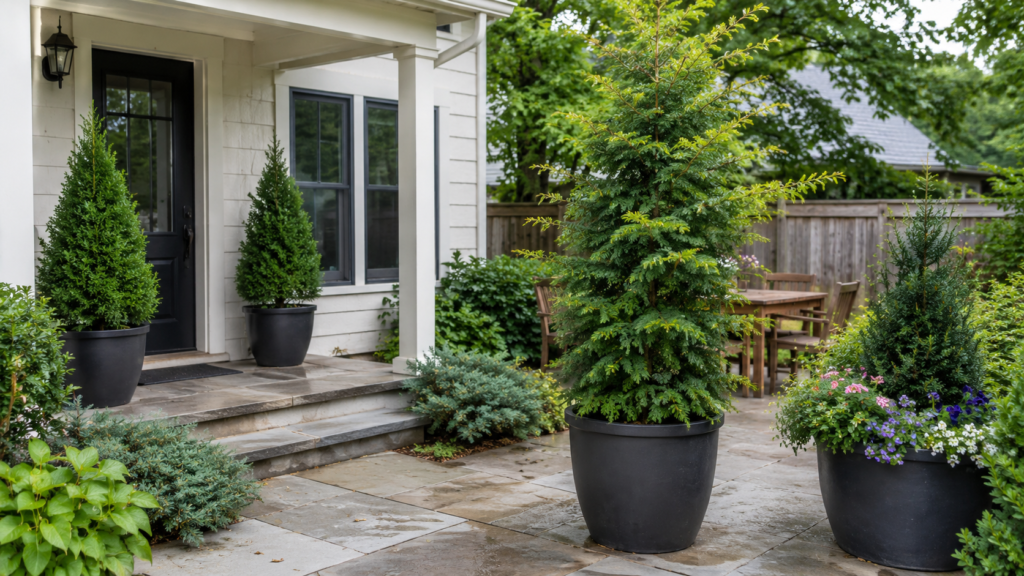
Evergreen planter ideas work best when the plant, container, location, and long-term care requirements are planned together. Choose an evergreen for its mature size, sunlight needs, root space, climate suitability, and growth habit, then place it in a stable planter with reliable drainage.
Evergreens provide structure when seasonal flowers fade. Two matching plants can frame an entrance, one compact conifer can anchor a patio, and a permanent evergreen can serve as the backbone of a planter that changes through the seasons.
The most important rule is simple: choose the plant before choosing the decorative planter. A small nursery evergreen may eventually become too tall, wide, root-bound, or unstable.
Use this planning order:
location → growing conditions → evergreen → mature size → root space → planter → companion plants → maintenance
This guide focuses on living evergreens rooted in containers. Temporary winter arrangements made with cut evergreen branches are different and need different care.
Best Evergreen Planter Ideas
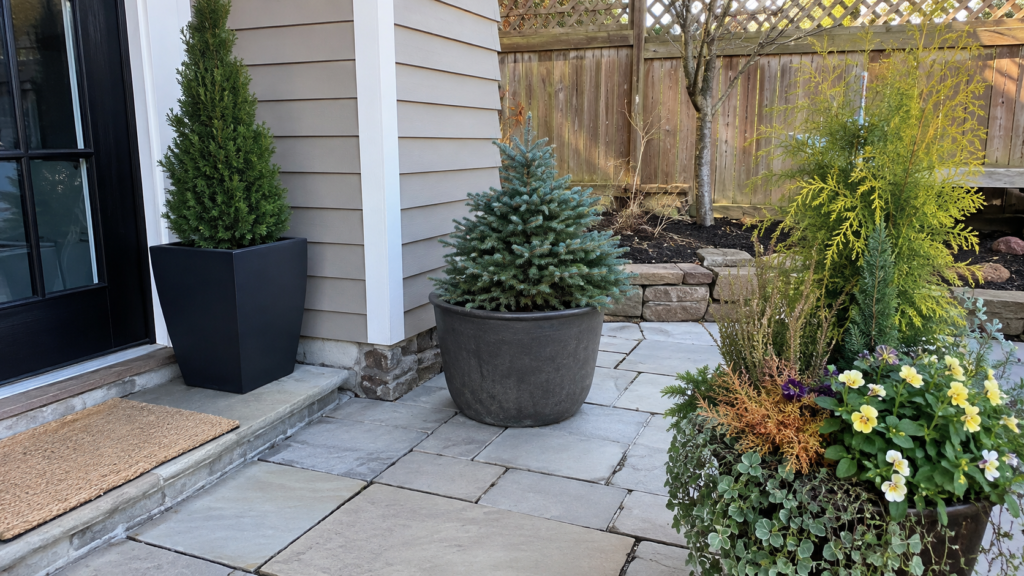
The best evergreen planter ideas solve a practical design problem while remaining manageable as the plant matures. Formal entrances may benefit from matching evergreens, while larger patios often need one strong focal planter. Small porches need compact plants, and windy areas need sturdier evergreens in broad stable containers.
Consider mature width, root volume, exposure, watering needs, and container scale rather than judging a planter only by how it looks on planting day.
1. Frame a Front Door With Matching Evergreens
Two matching evergreen planters create symmetry and year-round structure.
Keep mature foliage clear of:
- door swings;
- locks and handles;
- lights;
- handrails;
- stairs;
- narrow paths.
Compact conifers, rounded shrubs, and suitable topiary forms work well where the climate supports them.
2. Use a Dwarf Conifer as a Patio Focal Point
One substantial evergreen often creates more impact than several small pots.
Good positions include:
- an empty patio corner;
- beside seating;
- near a dining area;
- at the end of a sightline.
Remember that dwarf does not mean permanently tiny. Check the exact cultivar’s mature height and width.
3. Pair an Evergreen With Seasonal Flowers
Use the evergreen as permanent structure and rotate smaller plants around it.
Possible companions include spring bulbs, summer annuals, seasonal foliage, and trailing plants. Choose varieties with similar sunlight and moisture needs.
4. Create a Boxwood or Topiary Planter
Boxwood and other suitable clipped evergreens can give entrances, patios, and gates a formal appearance. Keep surrounding planting simple so the evergreen remains the focal point.
5. Use Compact Juniper for Texture
Junipers may be upright, spreading, mounding, or trailing. Their blue-green or gray-green foliage adds texture without relying on flowers. Check the exact growth habit before planting.
6. Plant a Dwarf Spruce for Structure
Compact spruce cultivars can provide strong vertical form in larger containers near entrances, patios, and formal garden spaces.
7. Group Evergreens at Different Heights
Use one taller focal evergreen, one medium companion, and one lower or spreading plant. Repeat planter material, foliage tone, or container shape to connect the group.
8. Use a Low Evergreen in a Wide Planter
A broad, low evergreen works well below windows, beside seating, or where a taller plant would block views. Wide containers can also improve stability.
9. Add Trailing Plants Around an Evergreen
Trailing plants soften the planter rim. Use them sparingly and keep stems away from paths, doors, and drainage outlets.
10. Create a Mixed-Foliage Evergreen Container
Combine different foliage textures and forms while keeping sunlight, moisture, and mature size compatible.
11. Use Evergreen Planters for Privacy
Upright evergreens can provide screening around patios or seating areas.
Check:
- mature height;
- root volume;
- planter weight;
- wind exposure.
Several moderate-sized plants may be more practical than one oversized evergreen.
12. Refresh Evergreen Planters Through the Seasons
Keep the evergreen permanent and replace only surrounding seasonal plants. This provides changing color without repeatedly disturbing the main root system.
Which Evergreen Suits Your Space?
Choose the evergreen according to the location before deciding on decorative style. A sheltered doorway, hot patio, windy balcony, shaded porch, and open garden corner all create different conditions.
| Location or Goal | Good Starting Idea | Main Check |
|---|---|---|
| Front door | Matching compact evergreens | Mature width |
| Open patio | One focal evergreen | Scale |
| Narrow porch | Upright compact evergreen | Clearance |
| Balcony | Dwarf evergreen | Weight and wind |
| Sunny site | Sun-tolerant compact conifer | Heat and water |
| Partial shade | Suitable broadleaf evergreen | Light |
| Windy site | Compact evergreen in broad planter | Stability |
| Privacy | Upright evergreens | Root volume |
| Seasonal display | Evergreen with replaceable plants | Compatibility |
| Low maintenance | Evergreen-only planter | Local suitability |
Before buying, check direct sun, wind, mature width, drainage, watering access, and whether mature foliage could block doors or paths.
A plant matched to its location is easier to maintain than one that constantly needs corrective watering, pruning, or repositioning.
Best Evergreens for Planters
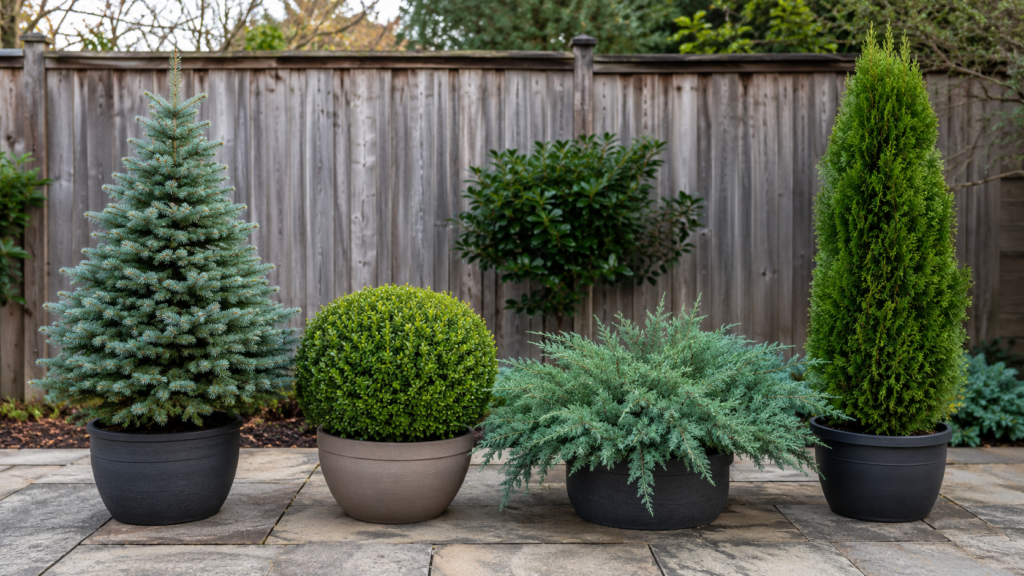
The best evergreens for containers are usually compact, relatively slow-growing, suited to local conditions, and capable of remaining healthy within limited root space.
Because this guide is global, treat these as examples rather than universal recommendations.
| Evergreen Type | Typical Form | Best Use | Main Check |
|---|---|---|---|
| Dwarf spruce | Conical/upright | Entrances and focal points | Mature size |
| Dwarf pine | Compact/spreading | Patios and large pots | Sun and drainage |
| Juniper | Upright/spreading | Modern planters | Growth habit |
| Arborvitae | Upright/globe | Entrances and privacy | Root space |
| Boxwood | Rounded/topiary | Formal displays | Climate |
| False cypress | Upright/textural | Mixed containers | Cultivar size |
| Holly | Upright/rounded | Structural planters | Local suitability |
| Broadleaf evergreens | Variable | Shade or mixed displays | Species needs |
Dwarf conifers can be excellent container plants, but dwarf does not mean miniature forever. Always check mature dimensions.
Compact arborvitae can work where vertical structure is needed, boxwood can suit formal arrangements, and junipers can provide upright or spreading forms. Broadleaf evergreens are another option where locally suitable.
Evergreens for Sun or Shade
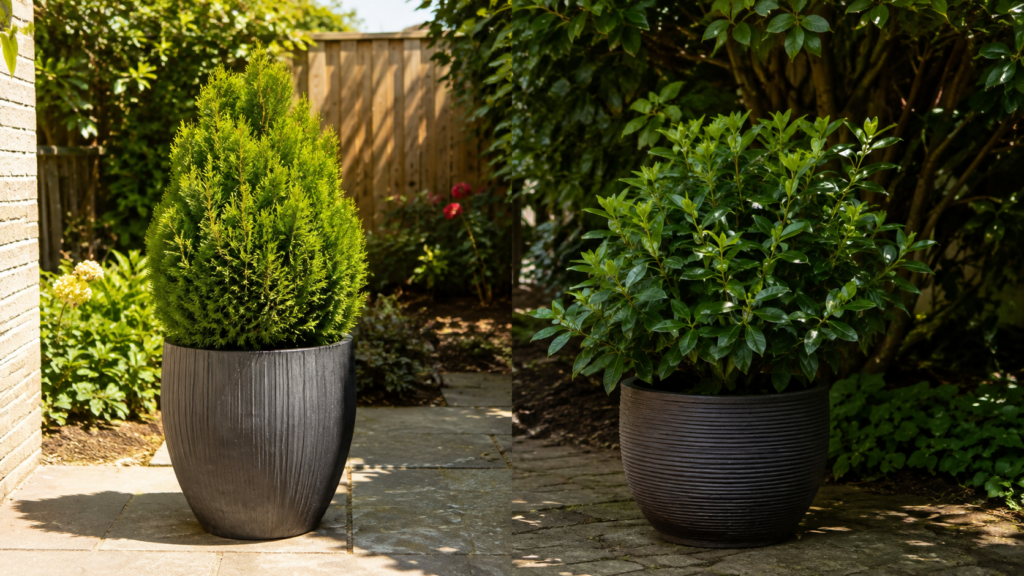
Light should influence plant choice before you buy. A supposedly sunny location may receive gentle morning sun, intense afternoon exposure, or reflected heat from walls and paving.
| Exposure | Evergreen Type to Consider | Main Check |
|---|---|---|
| Full sun | Suitable dwarf conifers or sun-tolerant shrubs | Heat and watering |
| Morning sun | Adaptable compact evergreen | Afternoon conditions |
| Partial shade | Suitable broadleaf evergreen | Cultivar needs |
| Bright shade | Shade-tolerant evergreen | Actual light |
| Reflected heat | Heat-tolerant compact evergreen | Root-zone temperature |
| Windy exposure | Compact sturdy evergreen | Moisture loss and stability |
Check direct-sun hours, morning versus afternoon exposure, reflected heat, summer temperature, wind, and cultivar-specific light requirements.
Use:
observe exposure → identify heat and wind → choose evergreen → verify cultivar requirements
Living vs Cut Evergreen Planters
A living evergreen planter contains a rooted plant that continues growing. A cut evergreen planter uses harvested branches for temporary decoration.
Living evergreens need:
- root space;
- growing medium;
- drainage;
- water;
- suitable light;
- climate compatibility.
Cut winter arrangements may use pine, fir, spruce, juniper, decorative twigs, cones, and berries.
Choose a living evergreen for long-term structure and cut greenery for temporary seasonal decoration.
Evergreen and Seasonal Plant Combinations
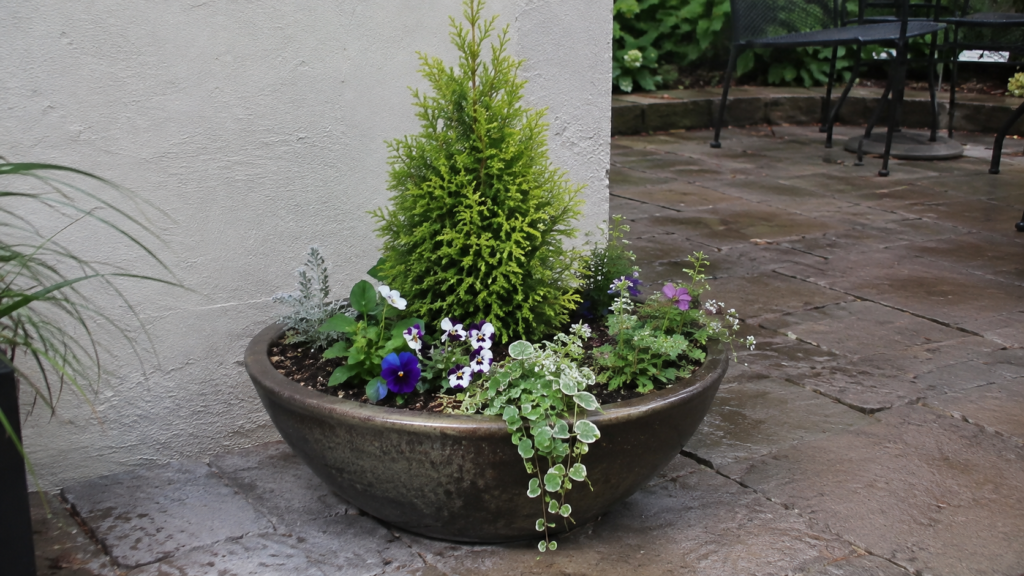
A practical mixed planter uses the evergreen as the permanent backbone and surrounding plants as replaceable seasonal layers.
Use:
- Permanent structure: evergreen.
- Seasonal filler: flowers or foliage.
- Optional spiller: trailing plant.
Spring can include bulbs or cool-season flowers, summer can use compatible annuals, and fall can introduce seasonal foliage. In winter, the evergreen itself may provide enough interest.
Avoid overcrowding. Choose companions according to sunlight, moisture needs, vigor, and mature spread.
Use:
evergreen first → compatible companions second → decorative details last
What Size Planter Do Evergreens Need?
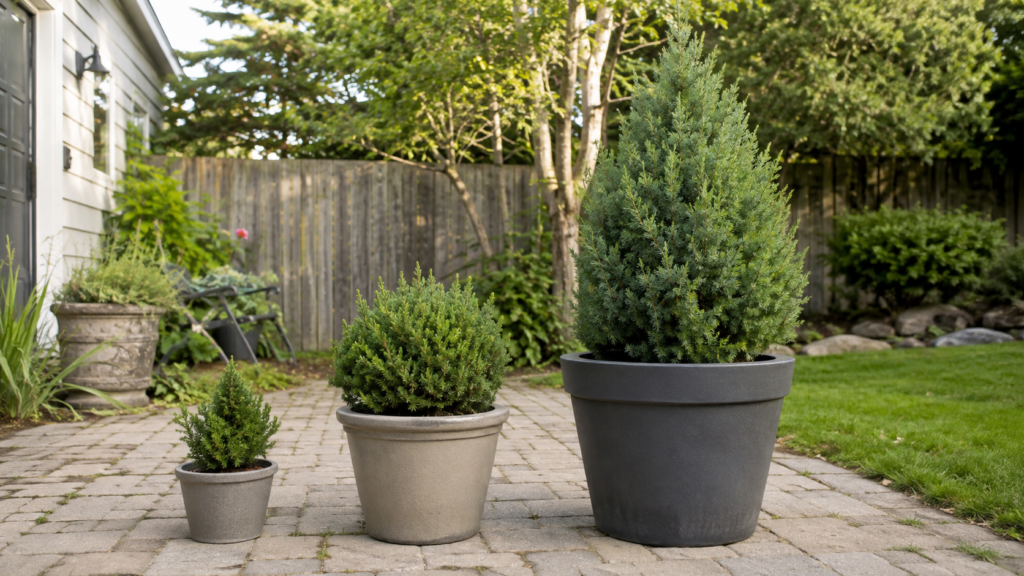
There is no single planter size for every evergreen. Choose according to the root ball, mature dimensions, expected root growth, final weight, and stability.
Measure:
- opening width;
- usable internal depth;
- base width;
- overall height.
Do not judge capacity by exterior height alone. A tall urn may have a shallow planting bowl.
Before buying:
- Measure the root ball.
- Check mature size.
- Measure usable depth.
- Check opening width.
- Consider final weight.
- Evaluate stability.
Choose the smallest planter that still provides sufficient root space and moisture buffering.
Best Planter Materials for Evergreens
No planter material is best everywhere. Choose according to stability, portability, climate, winter exposure, and mature plant size.
| Material | Main Advantage | Main Consideration |
|---|---|---|
| Terracotta | Traditional look | Porous and climate-sensitive |
| Resin/fiberglass | Lightweight | May need extra stability |
| Cast stone/concrete | Heavy and stable | Difficult to move |
| Metal | Modern appearance | Can heat in strong sun |
| Wood | Natural look | Weathering |
| Ceramic | Decorative variety | Frost limits vary |
Check drainage, base width, weight, usable depth, outdoor rating, and frost guidance before buying.
Narrow-necked urns can also make mature root balls difficult to remove.
Use:
evergreen size → location → stability → climate → material → decorative style
Where Should You Place Evergreen Planters?
Place evergreen planters where they improve the space without blocking movement or making maintenance difficult.
Good locations include:
- front doors;
- gates;
- patio corners;
- seating areas;
- courtyards;
- broad landings;
- suitable balconies.
Before filling, check sunlight, wind, reflected heat, walking clearance, watering access, and drainage runoff.
A useful test is to place the empty container in position, walk around it, open nearby doors, and move furniture. Large filled planters can be difficult to relocate later.
Do Evergreen Planters Need Drainage?
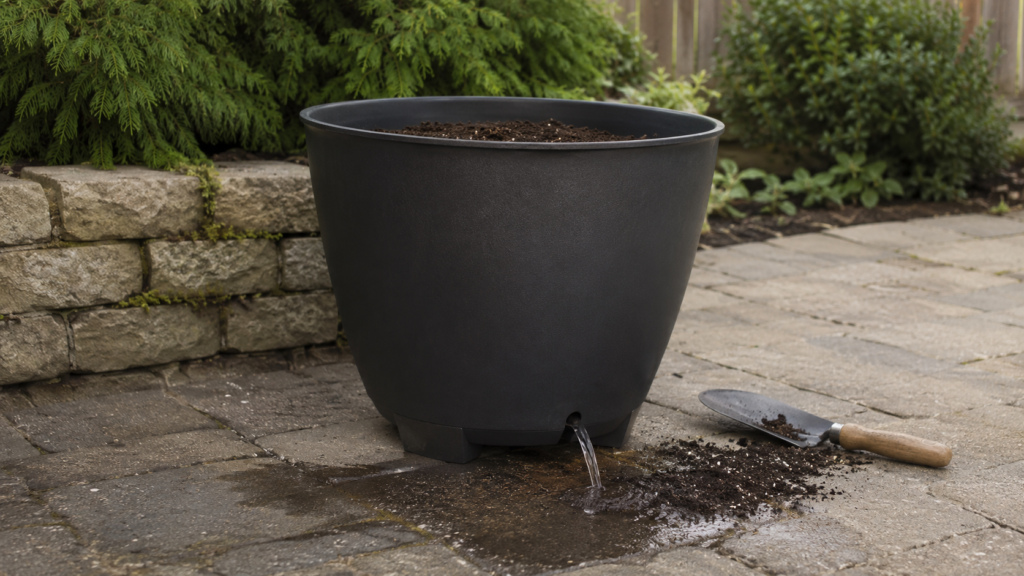
Yes. Living evergreen planters need functioning drainage so excess rain and irrigation can escape.
Good drainage requires:
- open drainage holes;
- suitable growing medium;
- unobstructed outlets;
- safe runoff.
Do not rely on gravel as a substitute for drainage holes.
Before planting:
- Place the empty planter.
- Add water.
- Watch where it exits.
- Check whether the outlet is blocked.
- Confirm runoff is safe.
Use:
water enters → moves through the root zone → leaves safely
Best Soil for Evergreen Planters
Use growing medium designed for containers rather than dense garden soil.
A suitable mix should provide:
- drainage;
- aeration;
- moisture retention;
- root support.
Exact requirements vary by evergreen, so avoid one universal mix.
Leave space below the rim for watering and avoid burying the root crown too deeply.
For deep decorative planters, check usable depth, root requirements, drainage, final weight, and any manufacturer-approved insert before filling the entire container with soil.
Do Evergreen Planters Need Fertilizer?
Evergreen planters may need supplemental nutrients, but fertilizer should not be applied automatically.
A weak or browning plant may instead have problems with watering, drainage, roots, heat, or exposure.
Before feeding, check:
- species or cultivar;
- age of growing medium;
- recent growth;
- foliage condition;
- root congestion;
- moisture and drainage;
- product instructions.
Use:
check condition → check moisture and drainage → inspect roots → consider soil age → fertilize if appropriate
How Should You Water Evergreen Planters?
Water according to actual root-zone moisture rather than a fixed schedule.
Water demand changes with:
- planter size;
- plant maturity;
- sunlight;
- temperature;
- wind;
- rainfall;
- growing medium;
- container material.
Check below the surface because deeper soil may still be moist.
When watering is needed, moisten the root zone evenly and allow excess water to drain.
Evergreens may also need moisture monitoring during winter because foliage can continue losing water. Adjust according to local temperatures, rainfall, and whether the root zone is frozen.
Why Is My Potted Evergreen Turning Brown?
Browning is a symptom, not a diagnosis.
Possible causes include:
- drought;
- excessive moisture;
- blocked drainage;
- root congestion;
- heat;
- winter desiccation;
- pests or disease;
- normal older-foliage shedding.
Use this diagnostic sequence:
browning pattern → moisture → drainage → exposure → roots → pests/disease → plant-specific behavior
Older inner foliage may be normal shedding, while new growth browning deserves closer investigation. Do not automatically add fertilizer or water without identifying the likely cause.
Can Evergreen Planters Survive Winter?
Some can, but winter survival depends on more than whether the plant itself is hardy. Container roots are more exposed to temperature changes than roots in the ground.
Check:
- plant hardiness;
- local temperatures;
- root exposure;
- drainage;
- moisture;
- wind;
- planter material;
- freeze-thaw conditions.
Check manufacturer guidance for planter winter suitability.
Ask:
Can the plant survive the winter?
Can its roots and planter survive that winter above ground?
How Do You Keep Evergreen Planters Stable?
Tall evergreens catch more wind as they grow.
Check:
- base width;
- filled weight;
- mature plant height;
- canopy width;
- wind exposure;
- surface level.
A broad, substantial planter is usually better for a tall evergreen than a narrow lightweight pot.
Avoid unstable planters near stairs, glass doors, seating areas, or uneven surfaces.
For exposed sites, prefer:
broader planter + compact evergreen
rather than:
narrow planter + very tall evergreen
When Should You Repot an Evergreen?
Signs that an evergreen may need attention include:
- dense circling roots;
- roots emerging heavily from drainage holes;
- rapid drying;
- declining growth;
- reduced soil volume;
- increasing instability.
Options include moving to a larger planter, appropriate root management, refreshing the growing medium, or transplanting into the landscape.
A larger pot is not always the only solution. Some established plants may remain in the same container longer with suitable root management and fresh growing medium.
Evergreen Planter Mistakes to Avoid
Avoid:
- choosing by nursery size;
- assuming dwarf means tiny;
- choosing the planter before the plant;
- ignoring drainage;
- using dense garden soil;
- overcrowding;
- mixing incompatible plants;
- ignoring wind;
- assuming evergreen means winter-proof;
- forgetting final weight;
- blocking paths;
- neglecting winter moisture;
- forgetting future repotting.
The best planter remains practical several seasons after planting.
How Do You Test an Evergreen Planter?
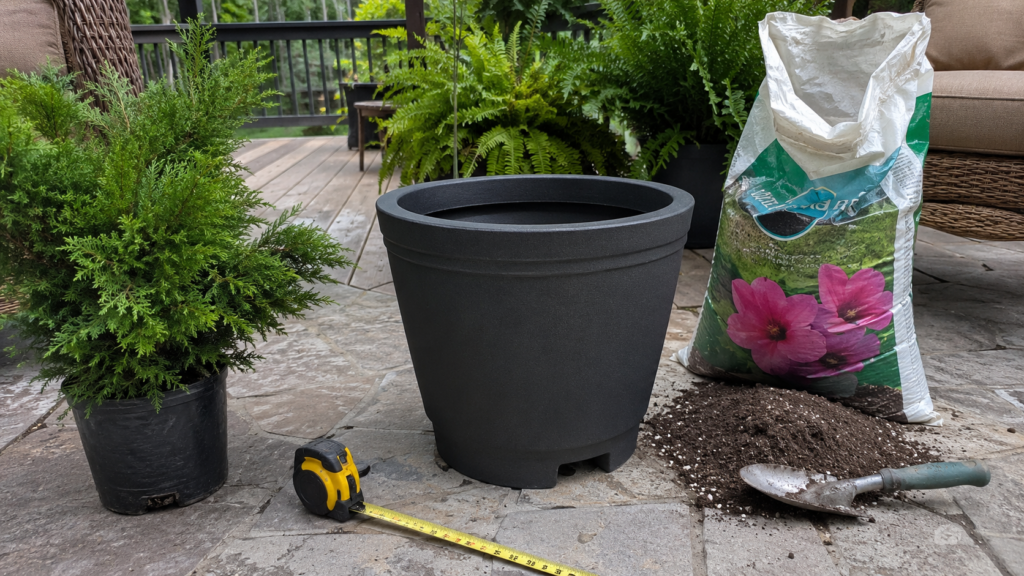
Testing before planting can prevent expensive mistakes and create useful first-hand evidence later.
- Position the empty planter.
- Measure opening width, usable depth, and base width.
- Test drainage with water.
- Observe actual sunlight.
- Check wind exposure.
- Note reflected heat.
- Research the exact evergreen.
- Compare mature size with available space.
- Plant and photograph.
- Track watering and visible stress.
- Photograph again later.
| Check | Record |
|---|---|
| Opening | Actual width |
| Root space | Usable depth |
| Drainage | Outlet position |
| Sun | Approximate hours |
| Exposure | Wind and heat |
| Evergreen | Exact cultivar |
| Mature size | Expected dimensions |
| Water | Actual frequency |
| Day 1 | Photo |
| Follow-up | Photo |
| Result | Growth or problems |
Only use phrases such as “we tested,” “we measured,” or “after three months” when those observations have actually been documented.
What Should You Check Before Buying?
Before buying, confirm that the plant, container, location, and maintenance requirements work together.
| Check | Question |
|---|---|
| Plant identity | What is the exact cultivar? |
| Mature size | How tall and wide will it become? |
| Growth habit | Upright, rounded, or spreading? |
| Light | Does the location match? |
| Root space | Is there enough usable volume? |
| Opening | Can the root ball eventually be removed? |
| Drainage | Are outlets functional? |
| Base | Is it stable? |
| Material | Is it climate suitable? |
| Water | Is maintenance practical? |
| Winter | Can plant and pot tolerate conditions? |
| Final weight | Can it be positioned safely? |
| Future | Repot, transplant, or replace? |
Also measure the route to the final location.
Use:
location → exact evergreen → mature size → root requirements → planter → drainage → maintenance
Which Evergreen Planter Is Best?
The best evergreen planter is one that remains healthy and proportionate as the plant matures.
Choose:
- Formal entrance: matching compact evergreens.
- Open patio: one substantial dwarf conifer.
- Seasonal display: evergreen with replaceable flowers.
- Small porch: narrow compact evergreen.
- Wide planter: spreading evergreen.
- Privacy: appropriately sized upright evergreen.
- Low maintenance: evergreen-only planting.
- Windy site: compact evergreen in a broad stable planter.
Do not ask only, “Which planter looks best today?”
Ask, “Which combination will still be healthy, stable, and manageable several years from now?”
FAQs About Evergreen Planter Ideas
What are the best evergreen planter ideas?
Good choices include matching entrance evergreens, dwarf conifer focal planters, compact junipers, topiary planters, and evergreens mixed with seasonal flowers.
Which evergreen stays small in a planter?
Dwarf and slow-growing cultivars usually remain manageable longer. Always check mature height and width.
Can evergreens live permanently in pots?
Some compact evergreens can remain in containers for years with enough root space, drainage, suitable soil, and proper care.
What size planter does an evergreen need?
Choose according to root-ball size, mature dimensions, stability, usable depth, and drainage.
Do evergreen planters need drainage holes?
Yes. Functioning drainage holes allow excess water to escape the root zone.
Can evergreen planters survive winter?
Some can, depending on plant hardiness, root exposure, moisture, wind, temperatures, and planter material.
What can you plant around a potted evergreen?
Use compatible seasonal flowers, bulbs, foliage plants, or trailers with similar light and moisture needs.
How do you stop an evergreen planter from tipping?
Use a level surface and a planter with enough base width and filled weight for the plant’s mature height.
Final Tips for Evergreen Planters
Before planting:
- measure the space;
- observe sunlight;
- check wind and heat;
- choose the exact cultivar;
- confirm mature size;
- measure usable planter depth;
- confirm drainage;
- use suitable growing medium;
- consider winter exposure;
- position heavy planters before filling;
- keep paths clear;
- make watering convenient.
For mixed planting:
permanent evergreen + compatible seasonal filler + optional trailer
For plant selection:
mature size + root space + exposure + climate
For planter selection:
usable depth + opening width + drainage + stability + final weight
For long-term success:
right location + right evergreen + right planter + reliable drainage + practical maintenance
The best evergreen planter remains healthy, stable, proportionate, attractive, and realistic to maintain as it grows.
Evergreen Planter Sources
Support technical claims with reputable horticultural references, including university Extension programs, botanical gardens, recognized horticultural organizations, plant breeders, reputable nurseries, and planter manufacturers.
Prioritize authoritative references for drainage, growing media, fertilizer, watering, winter care, root management, hardiness, cultivar dimensions, and frost resistance.
Keep first-hand experience separate from research. Only use claims such as “we tested,” “we measured,” or “after three months” when those observations have genuinely been completed and documented.
Myra is the founder and lead writer of Backyard Planter Ideas, where she shares practical, well-researched guidance on planter design, plant selection, and outdoor styling. Her goal is to help homeowners create attractive, functional garden spaces with clear, reliable, and easy-to-apply advice.