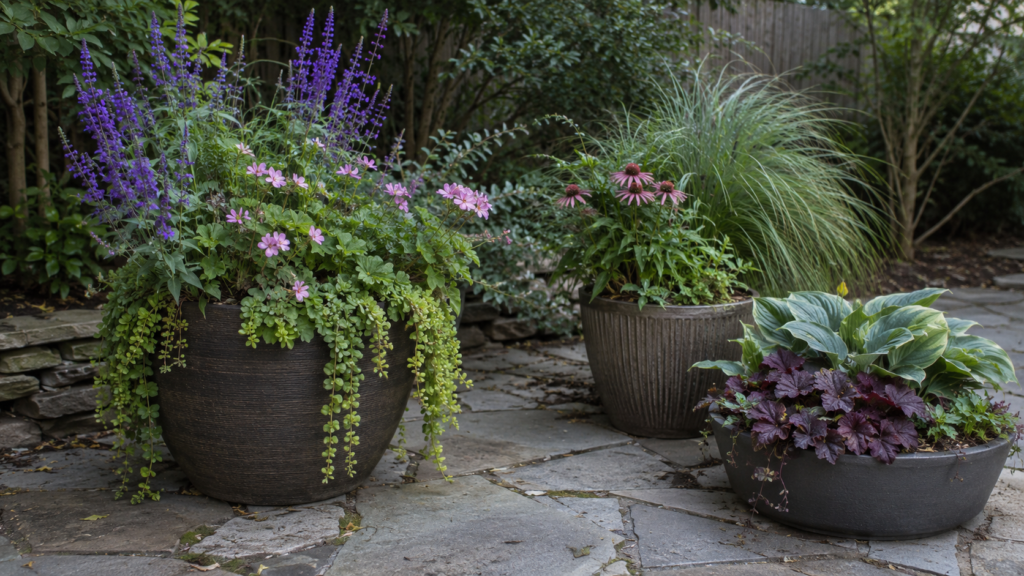
Perennial planter ideas work best when plants are matched by sunlight, moisture, mature size, root space, and climate—not simply by flower color. Good combinations can return for years, provide changing seasonal interest, and reduce annual replanting when the planter has reliable drainage, suitable potting mix, and enough room for roots.
Perennial containers work well on patios, porches, balconies, beside garden paths, near entrances, and in small backyards. Unlike annual displays that are replaced each season, perennial planters need to work after the plants mature, roots expand, and weather conditions change.
The best planning order is simple:
Location → light → moisture → planter size → plant compatibility → seasonal interest → design.
Perennial Planter Ideas at a Glance
Choose the location before choosing the plants. A container beside a sunny wall may experience intense reflected heat, while a shaded planter beneath a porch can remain surprisingly dry because it receives little rainfall.
For beginners, one to three compatible perennials are usually easier to manage than a crowded mixed container.
| Question | Quick Answer |
|---|---|
| Can perennials live in pots for years? | Yes, when conditions are suitable |
| Do perennial planters need drainage? | Yes |
| Best sunny combination | Lavender + salvia + sedum |
| Best shade combination | Hosta + fern + heuchera |
| Good low-water combination | Sedum + thyme + lavender |
| Do all perennials stay green? | No |
| Can they stay outside in winter? | Sometimes; climate matters |
| Best beginner design | 1–3 compatible plants |
| Main combination rule | Match light and moisture first |
| Main sizing rule | Plan for mature roots |
Before planting, check:
- Daily sunlight
- Heat and wind exposure
- Water access
- Drainage
- Mature plant size
- Planter dimensions
- Winter conditions
The strongest perennial planter is not the one containing the most plants. It is the one where every plant can thrive under the same basic conditions.
What Makes Good Perennial Planter Ideas?
A successful perennial planter combines compatible growing requirements with different heights, textures, foliage shapes, flowers, and seasons of interest.
The plants should still work together after one or two growing seasons. That means mature size matters more than the small size of nursery plants. A container that looks slightly open when first planted may be perfectly filled once roots and foliage expand.
Avoid combinations where one plant wants consistently moist soil while another prefers dry conditions. Visual compatibility cannot compensate for conflicting growing requirements.
Check:
- Sun exposure
- Moisture needs
- Mature width and height
- Root vigor
- Bloom season
- Winter hardiness
- Maintenance requirements
You do not have to use the thriller-filler-spiller formula in every planter. A single specimen, repeated cultivar, ornamental grass with lower companions, foliage combination, or pollinator planter can work just as well.
Which Perennials Are Best for Planters?
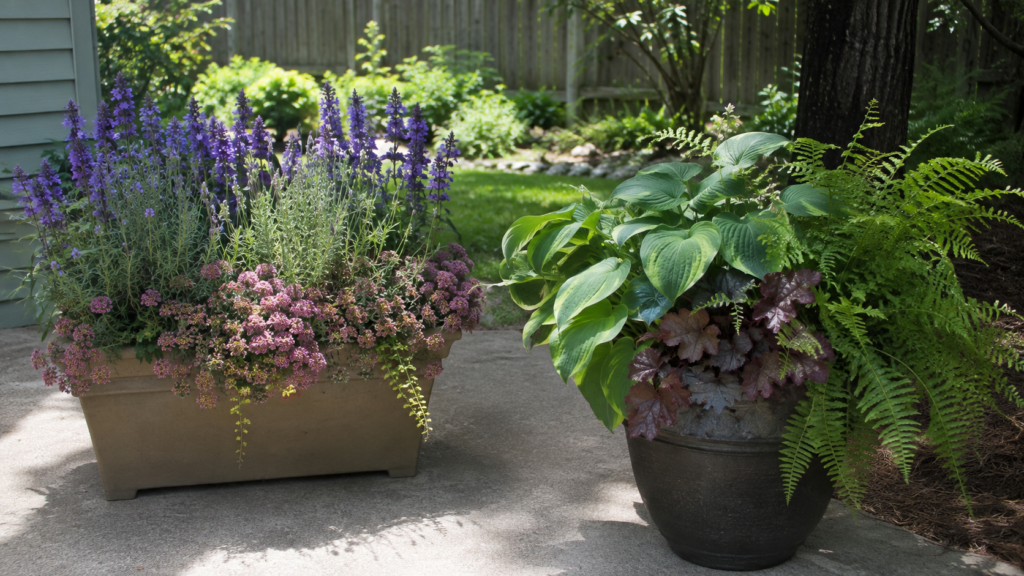
The best perennials for pots remain manageable, tolerate container conditions, and suit the location. Compact cultivars are generally easier to maintain than vigorous plants that quickly fill the root zone.
Useful choices include:
- Lavender
- Salvia
- Sedum
- Hardy geranium
- Heuchera
- Hosta
- Astilbe
- Coneflower
- Coreopsis
- Compact ornamental grasses
- Thyme
- Catmint
Choose according to conditions:
Full sun: lavender, salvia, sedum, coneflower, coreopsis
Part shade: hardy geranium, heuchera
Shade: hosta, fern, heuchera
Moist shade: astilbe, hosta, fern
Dry conditions: lavender, sedum, thyme
Pollinator planting: salvia, agastache, coneflower, suitable regional natives
The exact cultivar matters. One salvia may remain compact while another grows too large for a medium planter.
Are All Perennials Hardy in Containers?
No. “Perennial” means a plant can live for more than two years under suitable conditions. It does not mean the plant is evergreen or frost-proof.
A hardy perennial can tolerate winter within its appropriate climate range. A tender perennial may live for several years in mild conditions but be killed by frost. Many herbaceous perennials die back during winter and return when conditions improve.
Container roots are also more exposed than roots growing in open ground.
Treat these as separate characteristics:
Perennial status ≠ evergreen status ≠ container winter hardiness.
17 Best Perennial Planter Ideas
1. Sunny Lavender, Salvia and Sedum Planter
Best for: Sunny patios | Light: Full sun | Moisture: Low–moderate | Planter: Medium–large
Lavender provides structure and fragrance, salvia adds upright flowers, and sedum supplies low-growing texture and later-season interest.
Use a free-draining growing medium and compact cultivars. This combination works especially well beside patios, gravel paths, warm walls, and seating areas.
2. Coneflower Pollinator Planter
Best for: Wildlife-friendly gardens | Light: Full sun | Moisture: Moderate | Planter: Large
Use one compact coneflower as the main plant with compatible salvia, coreopsis, agastache, or locally suitable native flowers.
Avoid overcrowding vigorous prairie-style perennials. For pollinators, use plants with overlapping bloom periods rather than relying on one short flowering season.
3. Hardy Geranium Planter
Best for: Cottage patios | Light: Sun–part shade | Moisture: Moderate | Planter: Medium–large
Hardy geraniums create relaxed mounding growth and can provide a long flowering period.
Combine one with heuchera or compact salvia for contrast. Hardy perennial geraniums should not be confused with tender pelargoniums commonly sold as seasonal geraniums.
4. Hosta and Fern Shade Planter
Best for: Shaded patios | Light: Part shade–shade | Moisture: Moderate | Planter: Medium–large
Hostas provide broad leaves while ferns add fine texture.
This arrangement works well near shaded entrances and courtyard corners. Remember that shade does not automatically mean wet soil; containers beneath roofs may receive very little rain.
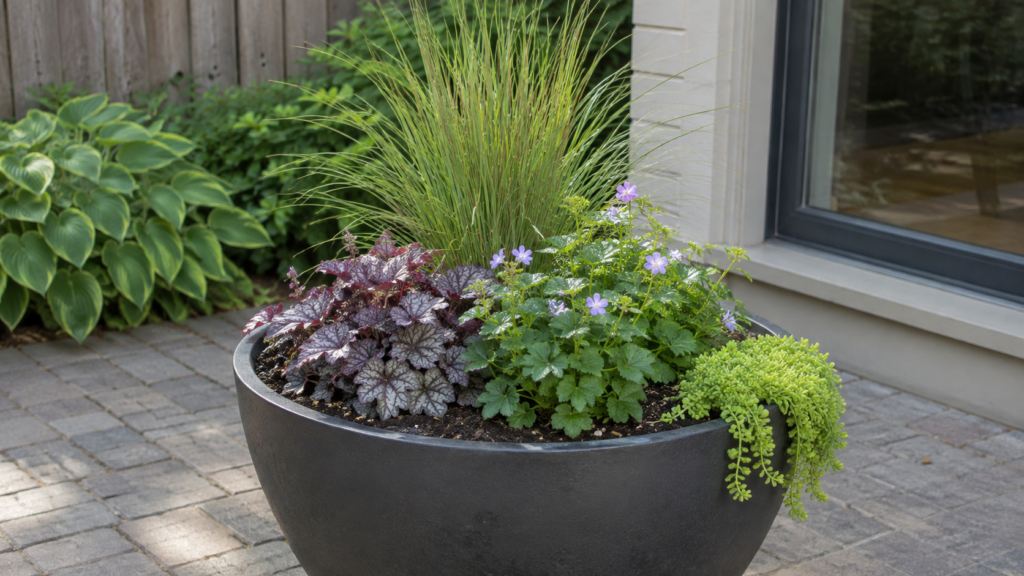
5. Heuchera Foliage Planter
Best for: Long-lasting foliage color | Light: Varies by cultivar | Moisture: Moderate | Planter: Medium
Heuchera can provide lime, bronze, burgundy, caramel, purple, or dark foliage.
A simple combination such as burgundy heuchera + green fern + compact flowering companion provides contrast even when flowers are not at their peak.
6. Astilbe Shade Planter
Best for: Cooler shaded spaces | Light: Part shade–shade | Moisture: Moderate–higher | Planter: Large
Astilbe adds upright flower plumes and pairs naturally with hosta and fern where the soil can remain reasonably moist.
Do not combine it with drought-adapted plants such as lavender simply because the colors work together.
7. Cottage-Style Perennial Planter
Best for: Informal gardens | Light: Sun–part shade | Moisture: Moderate | Planter: Large
Use a restrained combination of hardy geranium, salvia, catmint, heuchera, or compact grasses.
Choose two or three dominant colors and allow natural variation in height. Slightly uneven growth creates a more authentic cottage effect than perfect symmetry.
8. Ornamental Grass and Flower Planter
Best for: Entrances and patio corners | Light: Usually sun | Moisture: Species-dependent | Planter: Large
A compact ornamental grass creates movement and vertical structure.
Combine it with lower plants such as salvia or sedum when their moisture requirements match.
Always check mature grass size because some varieties quickly overwhelm containers.
9. Drought-Tolerant Perennial Planter
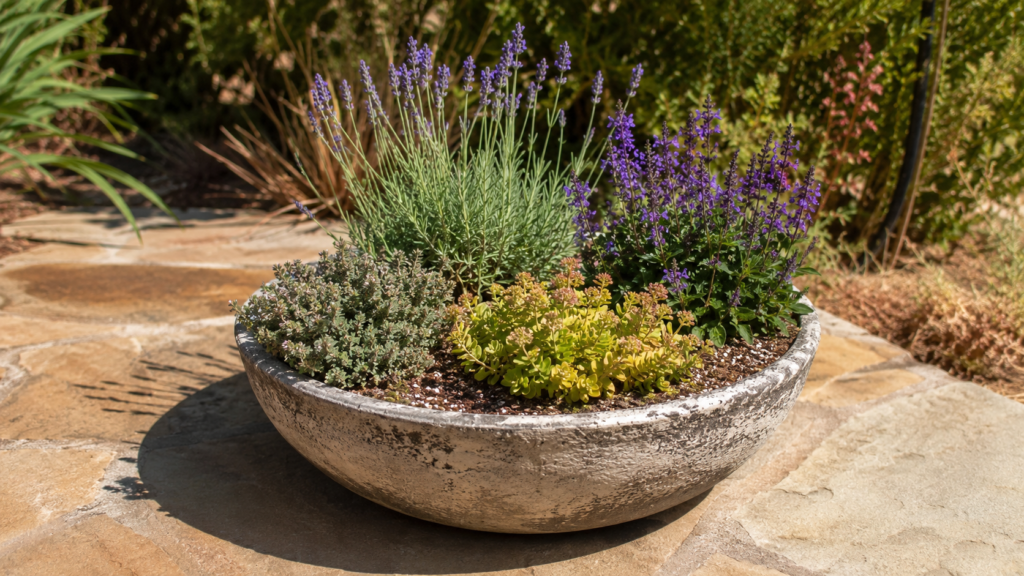
Best for: Hot patios | Light: Full sun | Moisture: Low after establishment | Planter: Medium–large
Useful plants include:
- Lavender
- Sedum
- Thyme
- Salvia
- Compact grasses
Drought-tolerant does not mean no watering. Newly planted perennials still need establishment moisture, and containers dry faster than garden beds.
10. Native Pollinator Planter
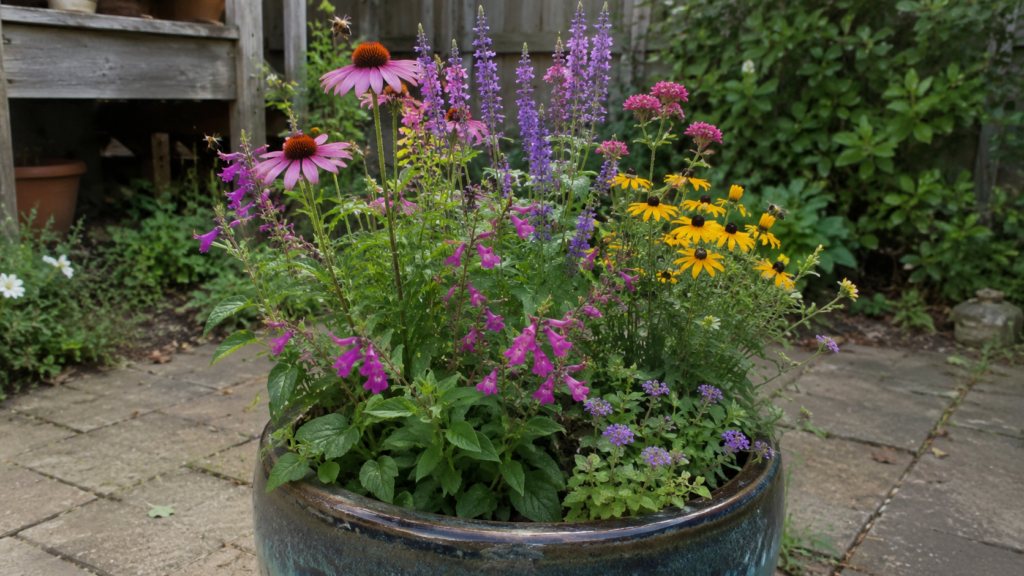
Best for: Wildlife-focused spaces | Light: Species-dependent | Moisture: Species-dependent | Planter: Medium–large
Use regionally appropriate plants that provide nectar, pollen, seedheads, and different flowering periods.
Because this article serves a global audience, native species must be verified locally. A plant native to one region may be introduced elsewhere.
11. Single-Specimen Perennial Pot
Best for: Simple, low-maintenance displays | Planter: Sized for mature roots
One strong perennial can be more effective than several crowded plants.
Possible specimens include:
- Compact hosta
- Lavender
- Large heuchera
- Compact grass
- Salvia
- Suitable dwarf shrub
Single-specimen pots are also easier to water, repot, and troubleshoot.
12. Trailing Perennial Planter
Best for: Steps and raised containers | Planter: Medium–large
Use creeping thyme, suitable sedums, hardy geraniums, or compact perennial groundcovers to soften the planter edge.
Avoid planting a perfect ring. Allow trailing growth to spill naturally from selected areas.
13. Small Balcony Perennial Planter
Best for: Compact spaces | Planter: Small but adequately rooted
A combination such as compact heuchera + hardy geranium + small sedum can work when light and moisture needs match.
Balcony planters require extra attention to:
- Wind
- Reflected heat
- Final weight
- Water runoff
- Safe placement
- Watering frequency
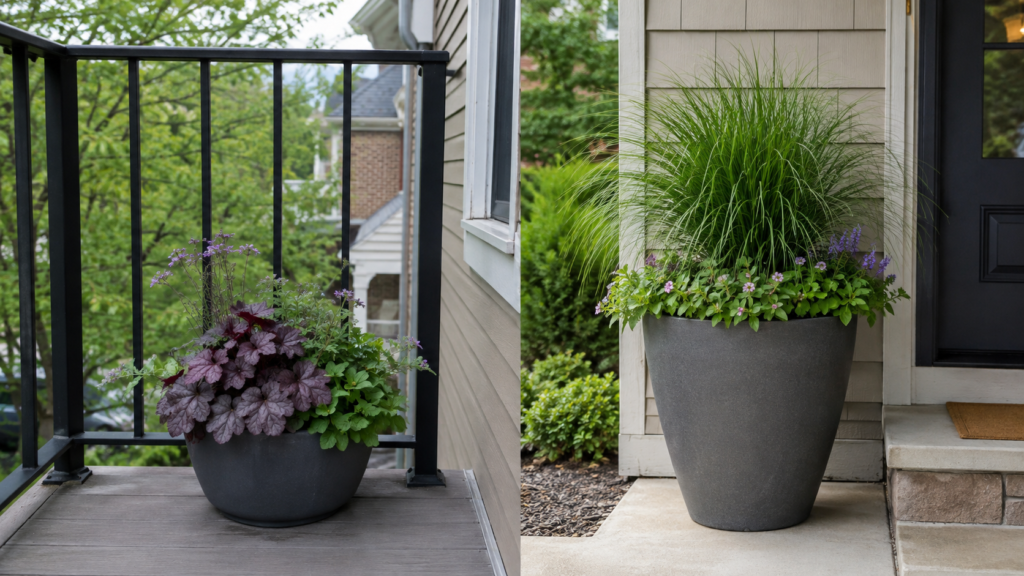
14. Large Porch Perennial Planter
Best for: Entrances | Planter: Large
Start with one architectural focal plant such as a compact grass, large foliage perennial, or suitable shrub.
Add restrained lower companions rather than filling every space.
Place large containers before filling them because moist potting mix makes them extremely heavy.
15. Fragrant Perennial Planter
Best for: Seating areas and paths | Light: Usually sunny | Moisture: Low–moderate
Lavender, thyme, catmint, and other aromatic perennials work best where people can actually experience their fragrance.
Place scented pots beside paths, doors, benches, or dining areas rather than in distant corners.
16. Fall-Interest Perennial Planter
Best for: Late-season color | Planter: Large
Use late-flowering sedum, ornamental grasses, changing foliage, and persistent seedheads.
A strong autumn planter combines:
flowers + foliage + structure
Do not cut every perennial back immediately after flowering if the seedheads remain attractive.
17. Four-Season Perennial Planter
Best for: Prominent year-round locations | Planter: Large
Plan for changing seasonal interest rather than nonstop flowers.
Spring: shoots and early flowers
Summer: peak bloom
Fall: seedheads, foliage, late flowers
Winter: grasses, stems, or evergreen structure where appropriate
A successful perennial planter should change attractively through the year rather than look identical every season.
How Do You Combine Perennials in Planters?
Combine plants in this order:
Light → moisture → soil → mature size → growth habit → bloom season → color
This prevents one of the most common mistakes: selecting plants because their flowers look good together even though they require conflicting care.
Backyard Planter Compatibility Check
| Check | Question |
|---|---|
| Light | Can all plants tolerate the same exposure? |
| Moisture | Can they share the same watering pattern? |
| Root space | Will mature roots fit comfortably? |
| Seasonal interest | Do they contribute at different times? |
| Winter strategy | Can they overwinter together? |
Use different visual roles:
- Upright plant for height
- Mounding plant for body
- Foliage plant for continuity
- Trailing plant for softer edges
If two plants disagree strongly on light or moisture, do not force them into the same permanent container.
What Size Planter Do Perennials Need?
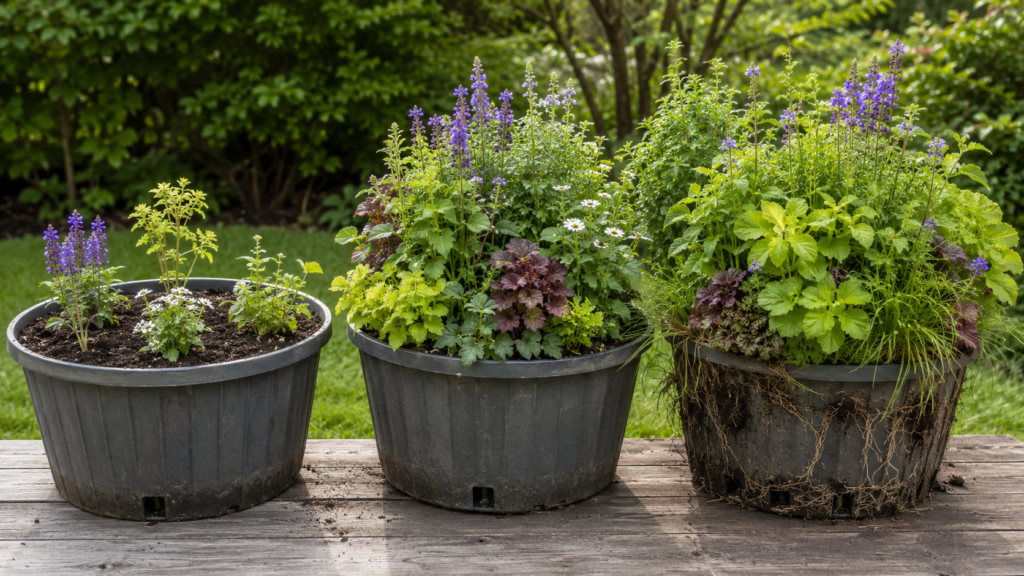
Choose a planter for the mature root system, not the nursery pot.
As a practical starting point:
| Planting Type | Starting Range |
|---|---|
| Small compact perennial | About 3–5+ gallons |
| Medium perennial | About 4–6+ gallons |
| 2–3 compact perennials | About 7–10+ gallons |
| Large grass or specimen | About 10+ gallons |
| Shrub/substantial perennial | Larger container |
These are planning ranges, not universal requirements.
A pot may be too small when:
- Roots circle densely
- It dries extremely quickly
- Water runs straight through
- Flowering declines
- Roots emerge heavily from drainage holes
Choose enough room for long-term growth without creating an unnecessarily large and heavy container.
Which Planter Material Is Best for Perennials?
Planter material affects moisture, temperature, weight, and durability.
| Material | Main Advantage | Main Limitation |
|---|---|---|
| Terracotta | Natural and porous | Dries faster |
| Glazed ceramic | Attractive | Heavy |
| Plastic/composite | Lightweight | Quality varies |
| Wood | Natural appearance | Eventually deteriorates |
| Metal | Durable | Can heat quickly |
| Concrete | Stable | Extremely heavy |
Choose frost-suitable materials in cold climates and consider heat around dark metal pots in intense sun.
Regardless of material, drainage holes remain essential.
What Soil Is Best for Perennial Planters?
Use a quality container-growing medium rather than dense backyard soil alone.
The mix should provide:
- Drainage
- Moisture retention
- Air space
- Root support
- Suitable pH
- Nutrients
Match the medium to the plants.
Lavender and sedum need freer drainage than moisture-loving astilbe. Acid-loving plants require a suitable acidic medium.
Do not rely on a thick gravel layer to improve drainage. Functional drainage holes and appropriate potting mix matter more.
Do Perennial Planters Need Fertilizer?
Many established container perennials eventually benefit from feeding, but fertilizer should not be the first solution for every problem.
Before feeding, check:
- Drainage
- Light
- Soil moisture
- Root congestion
- Age of the potting mix
A mature root-bound planter may benefit more from division and fresh growing medium than repeated fertilizer.
Diagnose first. Feed second.
How Often Should You Water Perennial Planters?
Water according to actual root-zone moisture rather than a fixed calendar.
Watering frequency changes with:
- Temperature
- Wind
- Sun
- Rain
- Pot size
- Planter material
- Root density
- Plant type
Check below the surface before watering.
Water slowly enough to wet the root zone and allow excess moisture to drain.
Avoid two extremes:
Constant saturation, which can reduce oxygen around roots.
Repeated severe drying, which can weaken growth and flowering.
Mature containers often dry faster because roots occupy more of the available potting mix.
Check first, water second.
Can Perennial Planters Survive Winter?
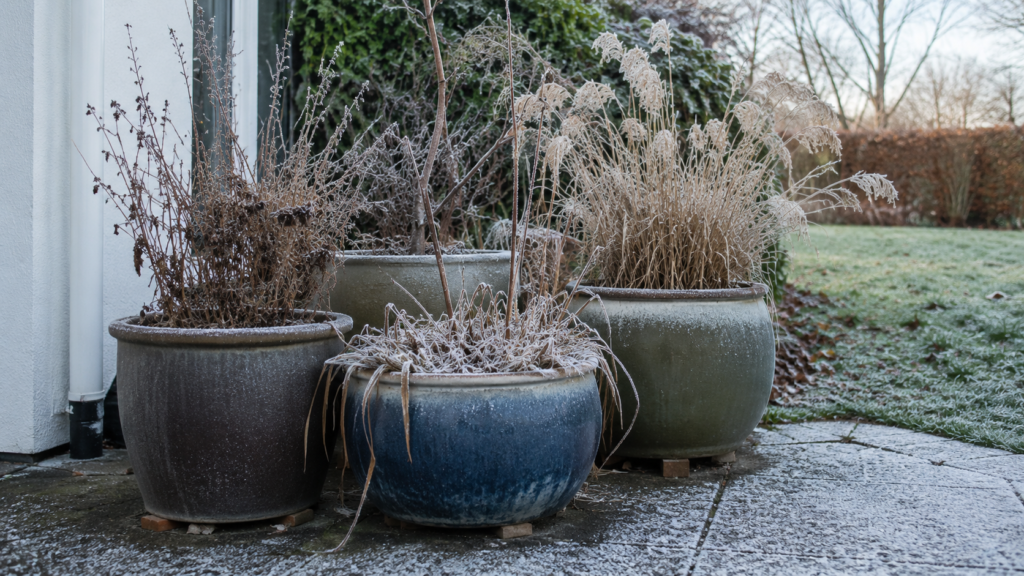
Many can, but container roots are more exposed than roots in garden soil.
Winter survival depends on:
- Plant hardiness
- Climate
- Container size
- Wind
- Drainage
- Winter moisture
- Planter material
In cold regions, useful strategies can include grouping pots, moving them to sheltered locations, using larger frost-resistant containers, and protecting them from severe wind.
Dormant perennials generally need less water, but containers should not remain completely dry for long periods.
In-ground hardiness does not automatically equal container hardiness.
How Do You Maintain Perennial Planters?
Long-term perennial containers need occasional adjustment as plants mature.
Useful maintenance includes:
- Removing damaged growth
- Keeping useful seedheads when attractive
- Dividing overcrowded plants
- Refreshing depleted potting mix
- Checking drainage
- Monitoring changing light conditions
Repot or investigate when:
- Roots circle densely
- The pot dries much faster than before
- Water runs straight through
- Flowering declines
- One perennial dominates the container
Repotting refreshes or increases root space.
Division separates suitable established perennials into smaller sections.
Mixed containers do not have to remain unchanged forever. If one plant outgrows the original design, move or divide it.
What Perennial Planter Mistakes Should You Avoid?
Common mistakes include:
- No drainage
- Using dense garden soil alone
- Overcrowding
- Combining conflicting moisture needs
- Choosing the wrong light exposure
- Using undersized pots
- Ignoring winter conditions
- Designing only for peak summer
- Overfertilizing
- Watering by calendar
When plants struggle, diagnose the real cause before adding more fertilizer or water.
Yellow leaves, for example, may result from excessive moisture, drought, root congestion, nutrient problems, natural aging, or disease.
A single treatment cannot solve every symptom.
Which Perennial Planter Idea Is Best for You?
Use your actual conditions to narrow the choice.
| Situation | Good Starting Direction |
|---|---|
| Hot sunny patio | Lavender + salvia + sedum |
| Shaded patio | Hosta + fern + heuchera |
| Pollinator garden | Regional natives + compatible flowers |
| Dry location | Sedum + thyme + lavender |
| Cottage garden | Hardy geranium + salvia + heuchera |
| Small balcony | Compact heuchera + geranium |
| Large entrance | Grass + compatible companions |
| Fragrant seating area | Lavender + thyme |
| Low-maintenance goal | Single specimen |
| Fall interest | Sedum + ornamental grass |
Ask four questions:
- How much sunlight does the container receive?
- How often can you realistically water?
- How much root space is available?
- Which season matters most visually?
When uncertain, simplify the design.
Two or three highly compatible plants are usually better than six plants competing for space.
What Are the Best Perennial Planter Tips?
Before planting, confirm:
- Drainage works.
- The planter fits mature roots.
- Light is suitable.
- Moisture requirements match.
- The growing medium suits the plants.
- Winter conditions have been considered.
- Plants have enough room to mature.
- Watering is practical.
- Seasonal change is part of the design.
- Future dividing or repotting is realistic.
Every plant should contribute something useful:
- Height
- Texture
- Foliage
- Flowers
- Fragrance
- Pollinator value
- Trailing growth
- Fall interest
- Winter structure
Before filling the container, make sure its final location, walking clearance, drainage, sunlight, and access to water are correct.
Then ask:
Can I realistically maintain this combination in this location for several years?
The objective is not to create the fullest planter immediately.
Create a planter that matures well rather than merely starts well.
Perennial Planter Ideas FAQs
Do Perennials Come Back Every Year in Pots?
Yes. Suitable perennials can return for several years when they have enough root space, drainage, suitable light, water, and winter protection.
What Are the Best Perennials for Pots?
Hardy geraniums, heucheras, hostas, sedums, salvias, lavender, and compact ornamental grasses are useful choices when matched to local conditions.
Can Perennials Survive Winter in Containers?
Yes, many can, but their roots are more exposed than plants growing in the ground. Climate, hardiness, pot size, drainage, and exposure matter.
How Big Should a Planter Be for Perennials?
Choose a planter that accommodates the plant’s mature root system rather than the size of its nursery pot.
How Many Perennials Can You Plant in One Pot?
There is no fixed number. Mature size and root space matter most; one to three compatible perennials are often a practical starting point.
Do Perennial Planters Need Drainage Holes?
Yes. Working drainage holes allow excess water to escape and reduce the risk of saturated roots.
What Soil Is Best for Perennial Planters?
Use a quality container-growing medium suited to the plants rather than dense backyard soil alone.
How Often Should You Water Perennials in Pots?
Check root-zone moisture and water when needed. Heat, wind, pot size, and plant growth can greatly change watering frequency.
When Should You Repot or Divide Perennials?
Repot or divide suitable plants when roots become crowded, the container dries unusually fast, flowering declines, or one plant starts dominating.
Are Perennials Better Than Annuals for Planters?
Neither is always better. Perennials provide multi-year structure, while annuals generally provide stronger seasonal color and easier yearly redesign.
How We Evaluate Perennial Planter Ideas
At backyardplanterideas.online, perennial combinations should be evaluated as growing systems rather than decorative plant lists.
The recommended process is:
- Identify the planter location.
- Observe sunlight.
- Assess heat, wind, and shelter.
- Match moisture requirements.
- Check mature plant size.
- Confirm container and winter suitability.
- Build the design from compatible plants.
Because growing conditions vary internationally, verify local:
- Winter hardiness
- Heat tolerance
- Native status
- Invasive potential
- Water needs
- Planting seasons
The combinations in this guide are therefore design frameworks rather than rigid recipes.
Use the design principle globally, but verify the plant locally.
What Makes Perennial Planters Successful?
Successful perennial planters depend on reliable drainage, suitable growing medium, adequate root space, compatible plants, appropriate moisture, and climate-aware maintenance.
The strongest principles are simple:
Provide drainage. Most perennial roots should not remain permanently saturated.
Use container-growing medium. Dense garden soil can compact inside pots.
Match growing requirements. Sun, moisture, mature size, and climate should determine plant combinations.
Plan for mature growth. Nursery plants become significantly larger.
Treat winter survival locally. Container roots experience different conditions from roots in the ground.
For regional plant decisions, consult trusted horticultural sources such as university extension programs, botanical gardens, the Royal Horticultural Society, regional native-plant organizations, and local horticultural institutions.
The final decision order is:
local climate → planter location → plant compatibility → mature size → soil and drainage → seasonal design
The strongest perennial planter ideas succeed because the container is treated as a living, changing garden rather than a one-season decoration.
Myra is the founder and lead writer of Backyard Planter Ideas, where she shares practical, well-researched guidance on planter design, plant selection, and outdoor styling. Her goal is to help homeowners create attractive, functional garden spaces with clear, reliable, and easy-to-apply advice.