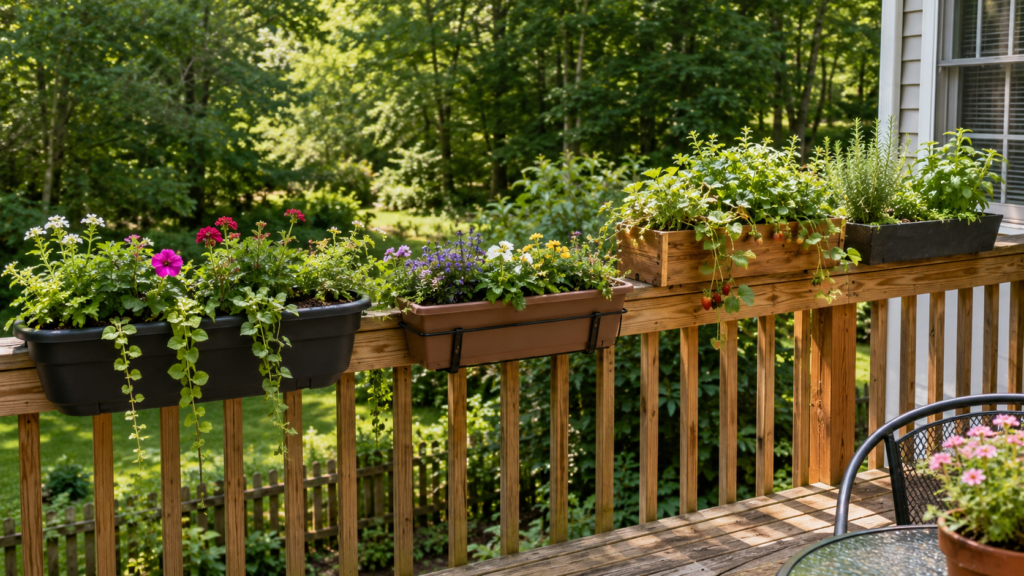
Backyard railing planters turn unused deck, porch, and balcony edges into practical growing space without taking up valuable floor area. They can hold flowers, herbs, strawberries, leafy greens, and trailing plants while adding color and greenery around seating areas.
The best railing planter is not simply the largest box that fits. It needs to match the railing, provide enough root space, drain properly, remain accessible for watering, and stay secure after the soil becomes wet and the plants mature.
Before buying or building one, measure your railing carefully and decide whether the planter will sit over the rail, inside it, or outside it.
Best Backyard Railing Planter Ideas
1. Over-the-Rail Planter Boxes
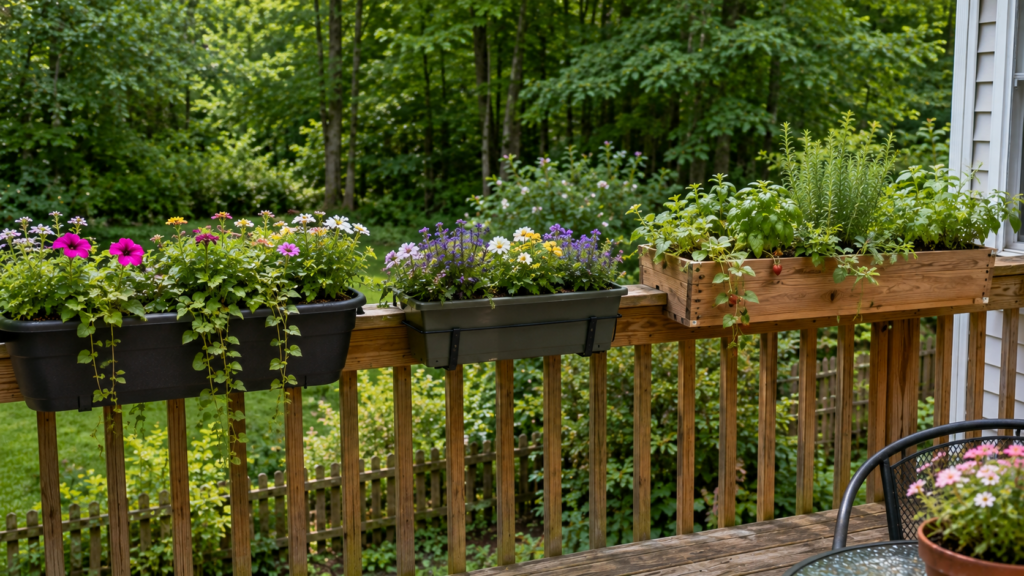
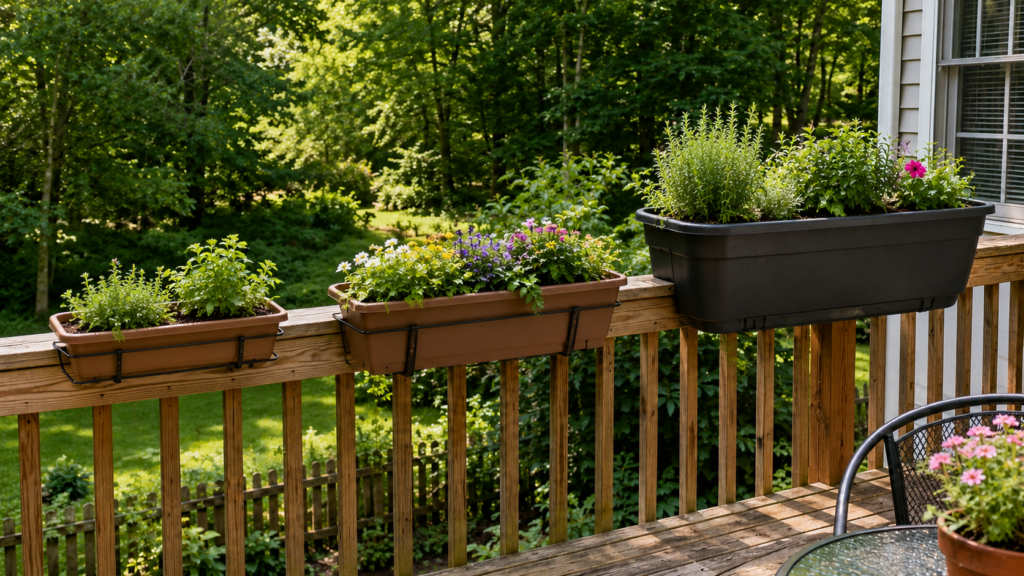
Over-the-rail planters sit directly across the top of a railing and provide planting space on one or both sides.
They work especially well when you want greenery visible from both the deck and the backyard.
Broad over-the-rail boxes are useful for:
- herbs;
- strawberries;
- compact flowers;
- leafy greens;
- trailing plants.
The planter must match the width and shape of the railing closely. A poorly fitted container can shift, lean, or become unstable once filled with wet growing medium.
Choose a planter designed for your railing dimensions rather than assuming a universal model will fit.
2. Inside-Mounted Railing Planters
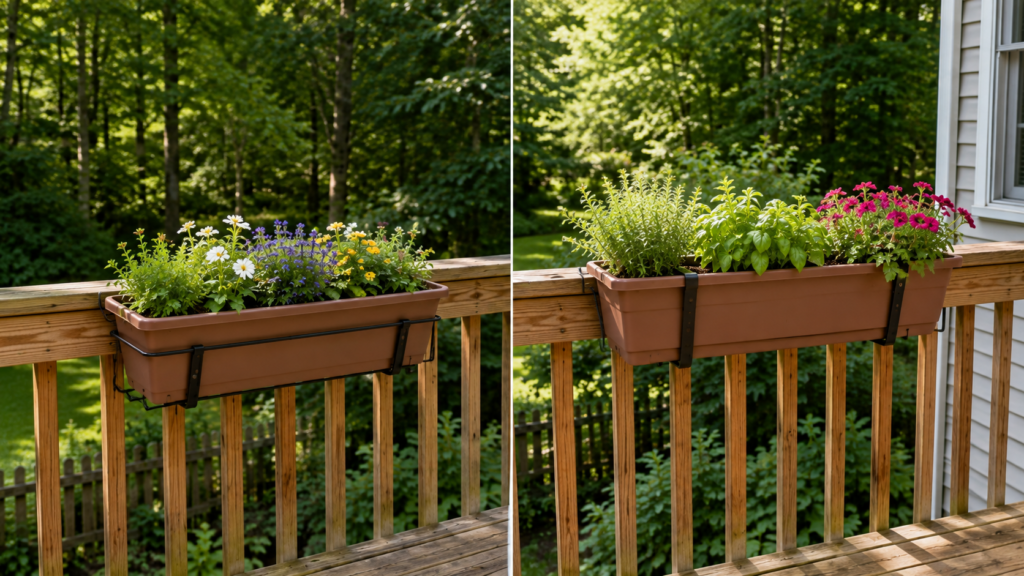
Inside-mounted railing boxes keep plants within easy reach from the deck.
They are one of the most practical options when regular watering, harvesting, pruning, or soil checks are important.
Inside-mounted boxes make watering, pruning, harvesting, and checking soil moisture easier.
They work especially well for herbs, greens, strawberries, and seasonal flowers. On small decks, use slim boxes that do not interfere with walking space.
3. Custom Wooden Railing Boxes
Wooden boxes are useful when standard planters do not fit or when you want them to match a timber deck.
Custom construction gives control over:
- length;
- depth;
- drainage;
- brace position;
- finish.
Avoid unnecessary depth because extra growing medium adds weight without always benefiting the plants.
4. Continuous Flower Boxes
Several boxes along one railing can create a continuous planted border without crowding the deck floor.
Repeat one flower or foliage plant throughout while varying supporting plants. Leave gaps near stairs, gates, grills, and entrances.
A continuous row works particularly well when you want a stronger visual effect without filling the deck with individual containers.
5. Railing Herb Gardens
A railing near the kitchen is ideal for compact herbs such as:
- basil;
- parsley;
- chives;
- thyme;
- oregano;
- cilantro.
Group herbs with similar watering needs instead of mixing every variety in one box.
Frequently used herbs should be positioned where they can be harvested without leaning over the railing or moving furniture.
6. Trailing Railing Planters
Trailing plants soften the railing and create greenery below the planter.
A useful combination is:
- upright plant for height;
- mounding plant for fullness;
- trailing plant for movement.
This combination provides a fuller appearance without requiring an oversized container.
Keep mature stems away from stairs, paths, doors, and other areas where long growth could become inconvenient.
7. Self-Watering Planters
Self-watering railing planters help where sun, heat, or wind dries containers quickly.
They can provide more consistent moisture, but reservoirs still need checking and add to the planter’s total weight.
These planters can be particularly useful when several railing boxes need watering regularly.
8. Compact Vegetable Planters
Railing boxes can grow food when crops suit the available root volume.
Good choices include:
- lettuce;
- radishes;
- green onions;
- leafy greens;
- herbs;
- strawberries.
Large tomatoes and similar crops generally perform better in substantial floor containers.
Use railing planters for crops that remain relatively compact rather than forcing large vegetables into shallow boxes.
9. Mixed Edible and Flower Planters
Flowers and edible plants can share a railing box if their light and moisture needs are compatible.
Parsley, basil, compact flowers, and a trailing plant can provide both color and useful harvests.
The combination works best when every plant has similar sunlight, watering, and soil requirements.
10. Individual Hanging Pots
Individual pots make seasonal changes easy and allow one plant to be replaced without disturbing others.
They are useful when you want flexibility rather than one long permanent planter.
Their main drawback is faster drying because each container holds less growing medium.
11. Railing Planters for Privacy
Railing planters can provide partial screening around seating areas.
Use medium-height foliage rather than oversized plants in shallow boxes.
For stronger privacy, combine railing planters with larger floor pots or a separately supported screen.
Avoid using a lightweight railing box to support plants that become extremely tall or top-heavy.
12. Combine Rail and Floor Planters
Repeat materials or colors between railing boxes and larger containers.
For example:
- black railing boxes with black floor pots;
- cedar boxes with timber planters;
- terracotta accents with warm flowers.
A few repeated elements are enough to make the design feel coordinated.
Use railing boxes for smaller plants and reserve floor containers for crops or ornamentals that need more soil volume.
What to Consider Before Choosing a Railing Planter
Measure the top rail, profile, baluster spacing, available length, and planter clearance before buying.
The container should not interfere with stairs, seating, hand placement, or normal deck movement.
Also consider:
- mounting method;
- root volume;
- sunlight;
- wind;
- drainage;
- watering access;
- mature plant size;
- railing material;
- seasonal removal.
Remember that wet growing medium and mature plants make the finished planter considerably heavier than the empty container.
Choose the planter for its finished use, not appearance alone.
Railing Planter Ideas for Small Backyards
Railing planters work especially well in small backyards because they use perimeter space instead of floor area.
For compact decks:
- keep walkways clear;
- place herbs near the kitchen;
- use trailing plants for visual volume;
- consider exterior mounting where appropriate;
- reserve floor pots for larger plants.
A few well-positioned boxes usually provide more usable space than filling every corner with containers.
The goal should be to create more growing space without making the deck harder to use.
Can You Grow Herbs in Railing Planters?
Yes. Many herbs remain compact and respond well to regular harvesting.
Good choices include basil, parsley, chives, thyme, oregano, cilantro, and compact sage.
Use container potting mix and functioning drainage. Group herbs with similar moisture requirements.
Mint is best kept in its own container because it can grow aggressively.
Place frequently used herbs where they are easy to reach.
Sun or Shade: Which Plants Work Best?
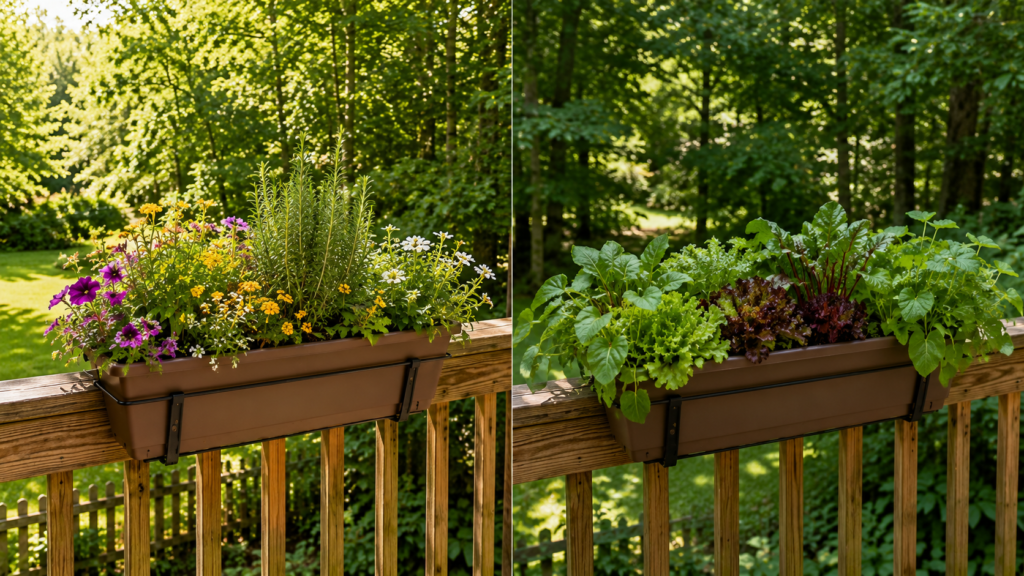
Choose plants according to the actual conditions around the railing.
- Full sun: sun-tolerant flowers, herbs, and compact vegetables.
- Morning sun: many herbs and flowers.
- Hot afternoon sun: heat-tolerant plants with consistent moisture.
- Partial shade: leafy greens and shade-tolerant ornamentals.
- Sun + wind: compact rather than tall plants.
Decking and walls can reflect heat, so observe the area before planting rather than relying only on compass direction.
A railing that appears moderately sunny may become much hotter during the afternoon because of reflected heat.
Can You Grow Vegetables in Railing Planters?
Yes, but container volume determines what will grow successfully.
Typical railing boxes suit:
- lettuce;
- radishes;
- green onions;
- leafy greens;
- strawberries;
- herbs.
Large crops usually need more soil volume, water, and support.
A young tomato may fit physically, but the mature plant is likely to need a substantial floor container.
Use railing boxes for compact crops and reserve larger containers for demanding vegetables.
Are Self-Watering Railing Planters Worth It?
Self-watering planters are useful on exposed railings that dry quickly.
They work best when:
- afternoon sun is intense;
- wind is persistent;
- several boxes need watering;
- plants wilt between normal watering periods.
Check the reservoir, overflow openings, and soil moisture regularly.
They may offer little advantage where shade or rainfall already keeps the growing medium moist.
Remember that reservoir water also increases the total weight of the planter.
Are Wooden Railing Planters a Good Choice?
Wooden boxes are useful when you want custom dimensions or a planter that matches a timber deck.
They can be built around the exact:
- railing width;
- post spacing;
- available length;
- planting depth.
Use exterior-appropriate materials, provide drainage, and avoid trapping moisture against the railing.
A removable insert can simplify seasonal planting and cleaning.
Choose wood for custom fit and appearance. Choose lighter manufactured containers when easy removal matters more.
Which Railings Work With Planters?
Different railing systems require different mounting approaches.
Metal Railings
Adjustable brackets and purpose-built hanging planters often work well.
Protect finished surfaces from rubbing and make sure brackets fit the rail profile securely.
Composite and Vinyl Railings
Do not assume hardware intended for timber is suitable.
Follow manufacturer guidance before drilling or fastening anything to composite or vinyl railing systems.
Cable Railings
Do not use tensioned cables as planter supports.
Attach containers only to appropriate structural parts of the railing system.
Wooden Railings
Wood allows more custom mounting options, but drainage, fasteners, and moisture still need attention.
If mounting compatibility is uncertain, use a floor container beside the railing instead.
Inside vs Outside Railing Planters
| Position | Advantage | Limitation |
|---|---|---|
| Inside | Easy watering and harvesting | Uses some deck space |
| Outside | Preserves floor space | Harder access |
| Over rail | Visible from both sides | Must fit correctly |
| Dual-sided | More planting area | More total weight |
Inside mounting is particularly useful for herbs and edible plants that need frequent attention.
Outside mounting works better where preserving floor area is the priority.
Consider what is underneath outside-mounted boxes because runoff and plant debris may fall below.
Accessibility also matters. A planter that looks attractive outside the railing may become inconvenient if you cannot easily water, prune, or remove it.
How Do Trailing Plants Improve Railing Planters?
Trailing plants make elevated boxes appear fuller and soften the railing line.
Use the simple formula:
upright + mounding + trailing
The upright plant provides height, the mounding plant fills the center, and the trailing plant creates downward movement.
This creates height, body, and movement without overcrowding.
Avoid long trailing stems above stairs, doors, grills, or busy paths.
Can Railing Planters Add Privacy?
Railing planters can soften direct views and provide moderate screening around seating areas.
Use dense medium-height foliage rather than tall plants in small boxes.
For stronger privacy:
- repeat several railing boxes;
- use larger floor planters;
- add a separately supported trellis or screen.
Do not force tall privacy plants into containers too small for their root systems or mature size.
Railing planters work best as partial screening rather than as structural support for a large privacy garden.
What Size Railing Planter Do You Need?
| Planter Type | Best Use | Main Limitation |
|---|---|---|
| Small rail pot | Herbs, flowers | Dries quickly |
| Shallow box | Flowers, greens | Limited depth |
| Broad over-rail | Herbs, strawberries | Exact fit required |
| Medium bracket box | Mixed planting | Increased weight |
| Deep custom box | Larger plants | Heavy when wet |
| Self-watering box | Hot locations | Reservoir adds weight |
Consider planter depth, total volume, mature root size, mounting method, and watering frequency.
Use the smallest container that still provides adequate root room and moisture stability.
Deeper is not automatically better. More soil also means more weight.
Do Railing Planters Need Drainage?
Yes. Conventional railing planters need drainage holes or slots so excess water can escape.
Good drainage requires:
- open drainage holes;
- suitable potting mix;
- unobstructed outlets;
- a safe runoff location.
Check drainage before mounting the planter permanently.
Water should be able to escape without collecting against the railing.
Should You Put Gravel in the Bottom?
Do not rely on gravel to fix poor drainage.
Use functioning holes and an appropriate container mix instead.
Also check where runoff lands so water does not continually drip onto doors, furniture, paths, or neighboring property.
What Soil Is Best for Railing Planters?
Use lightweight container potting mix rather than dense backyard soil.
A suitable mix should provide:
- drainage;
- aeration;
- moisture retention;
- manageable weight.
Garden soil can become heavy and compacted in containers.
If the potting mix is extremely dry, moisten it gradually during planting.
Compost can be included as part of a balanced mix rather than replacing the potting mix entirely.
How Do You Water Railing Planters?
Water according to soil moisture rather than relying only on a fixed schedule.
Small boxes can dry quickly because of:
- sun;
- wind;
- heat;
- limited growing volume.
Check below the soil surface and water thoroughly enough to moisten the root zone while allowing excess water to drain.
Planters exposed to strong wind or afternoon sun may need checking more frequently than nearby floor containers.
What About Fertilizer?
Container plants have access to limited nutrients, so use an appropriate fertilizer according to label directions.
Water and nutrient needs often increase as plants mature.
Avoid assuming that adding more fertilizer will solve poor growth. Light, water, root space, and drainage should also be checked.
How Much Does a Filled Railing Planter Weigh?
Use this practical framework:
Filled planter weight = container + growing medium + retained water + plants + reservoir water
A deep planter can become much heavier than a shallow box of the same length.
Do not treat a generic estimate as a structural rating.
Follow the railing and planter manufacturer’s guidance when determining whether an attachment is appropriate.
When uncertain, use a floor planter instead.
How Do You Secure Railing Planters?
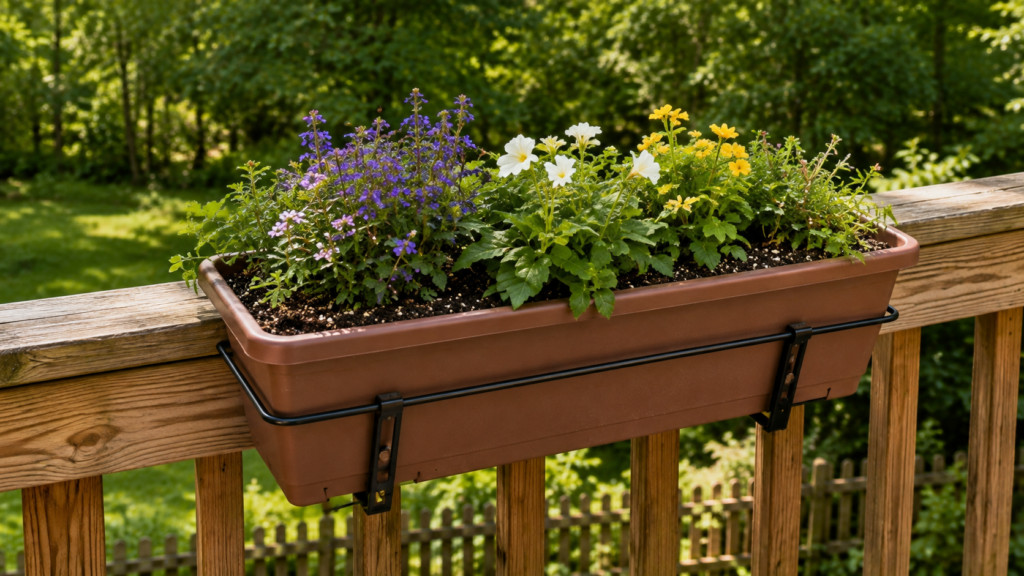
Use brackets, clamps, braces, or over-the-rail systems designed for the specific railing.
Check:
- railing material;
- bracket fit;
- mounting points;
- planter weight;
- wind exposure.
Inspect hardware during the season for:
- movement;
- loose fasteners;
- corrosion;
- rubbing;
- damage.
Be particularly cautious with elevated decks, rentals, cable systems, and manufactured railings.
Avoid improvised mounting systems that were not designed to carry a filled planter.
How Do You Protect Planters From Wind and Heat?
Wind and reflected heat can make railing planters dry faster than ground-level pots.
Reduce problems by:
- choosing compact plants;
- using adequate soil volume;
- monitoring moisture;
- avoiding top-heavy growth;
- selecting plants suited to the exposure.
Dark containers can become especially warm in strong sun.
Observe the location before planting instead of trying to correct an unsuitable planting later.
How Do You Maintain Railing Planters?
A short weekly inspection is usually enough.
Check:
- moisture;
- drainage;
- damaged foliage;
- overcrowding;
- brackets;
- railing surfaces.
Remove dead growth, trim aggressive plants, and check contact points for trapped moisture or rubbing.
Clean reusable containers before replanting or storage.
Also inspect the plants as they mature because a planter that was balanced at planting time may become top-heavy later in the season.
Common Railing Planter Mistakes
Avoid:
- choosing plants before checking container size;
- ignoring mature growth;
- using heavy backyard soil;
- blocking drainage;
- growing large vegetables in shallow boxes;
- using incompatible brackets;
- placing boxes where watering is difficult;
- overcrowding;
- forgetting wet weight;
- failing to inspect hardware.
A good planter should remain practical after months of growth, not just on installation day.
Which Railing Planter Material Is Best?
| Material | Advantages | Considerations |
|---|---|---|
| Plastic/resin | Lightweight, affordable | Quality varies |
| Fabric | Breathable, lightweight | Informal appearance |
| Wood | Customizable, natural | Moisture maintenance |
| Metal | Slim, modern | Can heat quickly |
| Composite | Coordinated appearance | Check compatibility |
| Terracotta | Traditional look | Heavy and breakable |
For elevated installations, lighter materials often make sense because soil, water, and plants already contribute weight.
Choose function first and appearance second.
What to Check Before Buying a Railing Planter
Before purchasing a planter:
- measure the top rail width;
- identify the railing material;
- measure available length;
- check the rail profile;
- choose inside, outside, or over-rail mounting;
- confirm bracket compatibility;
- check whether drilling is appropriate;
- match planter depth to the plants;
- confirm drainage;
- check where runoff will land;
- consider filled weight;
- allow room for mature foliage;
- check wind exposure;
- make watering easy.
Do not choose by planter length alone.
Bracket position, depth, rail shape, and clearance matter too.
How Do You Test Railing Planter Fit?
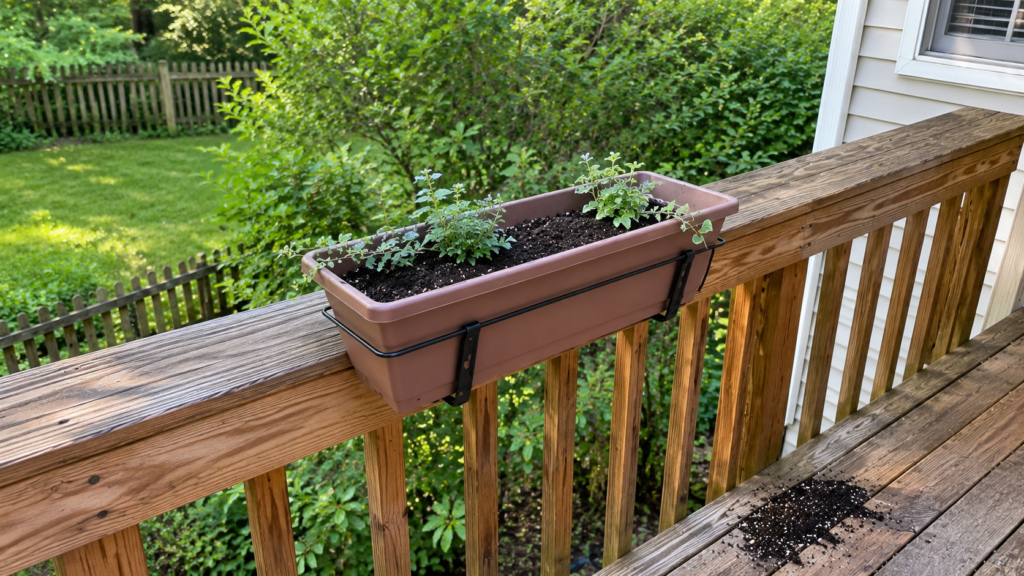
Place the empty planter in position before filling it.
Check the:
- top rail;
- posts;
- balusters;
- seating area;
- walking routes.
Make sure the empty container sits level and does not interfere with normal use of the deck.
Then add growing medium gradually and test drainage.
Check whether:
- the planter sits level;
- brackets remain positioned correctly;
- runoff clears the railing;
- plants will remain accessible;
- walkways stay open.
For stronger E-E-A-T, photograph the real planter when installed and again several weeks later.
Record:
- dimensions;
- plants used;
- sunlight;
- watering;
- drainage performance;
- adjustments made.
Only say “we tested” or “we observed” when you have actually performed the test.
Which Backyard Railing Planter Idea Is Best?
For most backyards, a broad rectangular box mounted securely inside or over the railing provides the best balance of planting space, appearance, and accessibility.
Choose:
- over-the-rail for visibility from both sides;
- inside-mounted for easy maintenance;
- custom wood for unusual dimensions;
- self-watering for fast-drying locations;
- individual pots for flexibility;
- floor containers for large vegetables or tall plants.
Use this order when planning:
- Identify the railing.
- Measure the available space.
- Confirm mounting options.
- Choose planter size.
- Decide what to grow.
- Assess sunlight and wind.
- Select plants.
- Plan maintenance.
- Make the planter fit the railing.
- Make the plants fit the planter.
- Make the finished arrangement fit how you use the backyard.
The railing determines what you can safely mount. The planter determines what root space is available. The plants should be selected only after those two questions are answered.
FAQs About Backyard Railing Planter Ideas
What type of planter is best for a deck railing?
A broad rectangular over-the-rail or bracket-mounted box works well for most decks. Choose according to rail fit, depth, weight, and maintenance access.
Should railing planters hang inside or outside?
Inside-mounted boxes are easier to maintain, while outside-mounted planters preserve deck space. Over-the-rail boxes offer a balanced option when properly fitted.
How do you secure a planter to a railing?
Use purpose-designed brackets, clamps, braces, or a compatible over-the-rail system. Avoid loose improvised hooks or wire.
Can railing planters be installed without drilling?
Yes. Some clamp systems, hooks, and over-the-rail planters require no drilling. Confirm compatibility with the specific railing before installation.
How deep should a railing planter be?
Depth depends on the plants. Herbs, flowers, and leafy greens generally require less root space than tomatoes and other large crops.
Avoid choosing unnecessary depth because additional wet potting mix increases the planter’s weight.
What plants grow best in railing planters?
Compact flowers, herbs, trailing plants, leafy greens, strawberries, and green onions are good choices when matched to the site’s sunlight, moisture, and wind conditions.
Can tomatoes grow in railing planters?
Most standard railing boxes are too small for full-size tomatoes. A larger floor container is usually a better option.
Do railing planters need drainage holes?
Yes. Drainage holes allow excess water to escape and help prevent waterlogging.
What soil should you use?
Use lightweight container potting mix rather than dense garden soil.
How often should railing planters be watered?
Check the growing medium regularly instead of following one fixed schedule. Small boxes may need frequent watering during hot, sunny, or windy weather.
Final Tips for Backyard Railing Planter Ideas
The best railing garden is not the one containing the most plants. It is the one that remains easy to maintain, secure, healthy, and attractive throughout the season.
Remember to:
- measure before buying;
- match hardware to the railing;
- consider wet planter weight;
- use container potting mix;
- maintain drainage;
- allow room for mature plants;
- match plants to sun and wind;
- keep watering easy;
- inspect brackets;
- use floor containers for larger crops;
- keep stairs and paths clear.
Do not try to fit the biggest possible garden onto a railing.
Build the most functional garden that the railing, planter, and plants can comfortably support.
Sources and References
Use authoritative references for technical claims, including:
- University of Maryland Extension for vegetable container size, drainage, growing media, and self-watering containers;
- University of Minnesota Extension for container watering and herb care;
- Penn State Extension for container drainage guidance;
- manufacturer instructions for the specific railing and mounting system;
- relevant local building, tenancy, HOA, strata, or property requirements where railing modifications are involved.
Place important citations inline beside claims about container size, drainage, growing media, watering, and mounting.
Myra is the founder and lead writer of Backyard Planter Ideas, where she shares practical, well-researched guidance on planter design, plant selection, and outdoor styling. Her goal is to help homeowners create attractive, functional garden spaces with clear, reliable, and easy-to-apply advice.