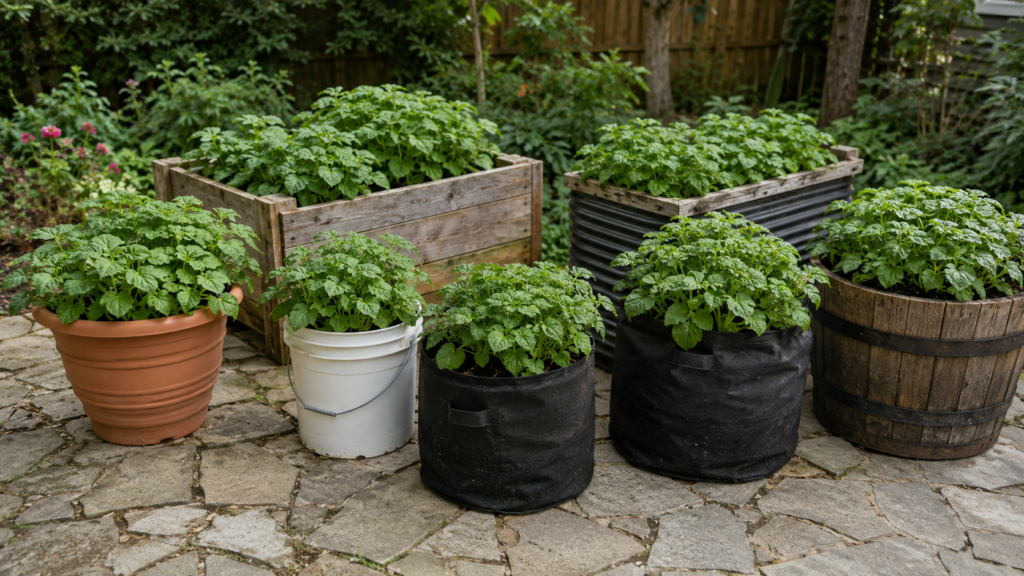
The best potato planter ideas provide enough growing space, reliable drainage, room for hilling, manageable moisture, and easy harvesting. Grow bags, large pots, buckets, wooden boxes, barrels, raised planters, and compact towers can all work when the container supports the needs of the potato plant.
Potatoes (Solanum tuberosum) are well suited to container growing because they do not require a traditional vegetable plot. They can grow on patios, in small backyards, beside raised beds, or anywhere with suitable sunlight and enough room for a productive container.
The key is to think beyond appearance. A successful potato planter connects seed potato count, usable planter volume, drainage, growing medium, sunlight, watering, hilling, and harvesting into one workable system.
Which Potato Planter Ideas Work Best?
The right planter depends on your space, budget, climate, watering habits, and how you want to harvest. A fabric grow bag is simple and easy to empty, while a rigid pot may suit a decorative patio. Wooden boxes provide custom sizing, and potato towers are most useful where floor space is genuinely limited.
Think about the planter for the entire season. Large containers become extremely heavy after filling, fabric bags can dry quickly, and very tall towers may be difficult to water evenly.
| Planter | Best for | Main advantage | Main drawback |
|---|---|---|---|
| Grow bag | Beginners | Easy harvest | Dries faster |
| Large pot | Patios | Attractive and stable | Heavy |
| Bucket | Budget growing | Low cost | Limited volume |
| Wooden box | DIY gardens | Custom sizing | Requires building |
| Potato tower | Small spaces | Small footprint | Moisture management |
| Barrel | Larger crop | High volume | Hard to empty |
| Raised planter | Repeat growing | Easy access | Permanent space |
| Compost sack | Low-cost trial | Very inexpensive | Shorter lifespan |
Before filling a large rigid planter, put it in its final position. Consider its filled weight, access to water, drainage runoff, mature foliage, and how you will remove the crop.
Best rule: choose the planter you can comfortably water, hill, inspect, and harvest.
15 Best Potato Planter Ideas
1. Fabric Grow Bags
Fabric grow bags are one of the easiest options for container potatoes. They drain well, are lightweight when empty, and can usually be tipped onto a tarp at harvest.
Their main disadvantage is faster drying, especially during hot or windy weather.
Choose this when: you want the simplest setup and easiest harvest.
2. Large Patio Pots
Large rigid pots work well where the potato planter remains visible. They can look more finished than bags while providing useful growing volume.
Measure the inside dimensions, because thick walls and tapered sides can reduce usable space.
Choose this when: appearance matters as well as growing performance.
3. Suitable Buckets
A bucket can make an inexpensive potato planter if it is large enough, safe for edible gardening, and has effective drainage.
Avoid containers with an unknown chemical history. Do not assume every reused bucket is suitable for growing food.
Choose this when: you want a low-cost planter for a small planting.
4. Wooden Potato Boxes
A wooden box provides custom dimensions and fits naturally into many backyard designs.
Build it broad enough for useful root space and provide reliable drainage at the base. It does not need to be excessively tall.
Choose this when: you want a permanent DIY planter.
5. Potato Towers
Potato towers reduce the horizontal footprint by growing in a more vertical structure.
However, extra height does not automatically produce more potatoes. Very tall containers can be harder to water evenly.
A potato tower should be treated as a space-saving planter, not a guaranteed yield multiplier.
Choose this when: floor space is genuinely limited.
6. Barrel-Style Planters
Broad barrels provide substantial growing volume and work well in larger vegetable gardens or patios.
Move the barrel before filling it and decide how it will be harvested, because a container full of damp growing medium can be extremely heavy.
Choose this when: you want larger volume and permanent placement.
7. Raised Potato Planters
Raised planters provide more growing area than individual pots and make planting, hilling, and harvesting easier to reach.
They are especially useful if potatoes will be grown regularly.
Choose this when: you want a long-term vegetable-growing setup.
8. Compost or Growing-Medium Bags
Large sturdy sacks can become temporary potato planters when drainage holes are added.
They are inexpensive and require little storage after harvest.
Choose this when: you want to test potato growing before buying permanent planters.
9. Planters With Harvest Doors
Some potato containers have removable panels designed to give access to the growing medium.
These can be convenient, but the door should not weaken the planter or allow soil to spill.
Choose this when: harvest access is a priority.
10. Multiple Matching Grow Bags
Several smaller bags can be easier to manage than one enormous planter.
They let you separate varieties, stagger harvests, and compare different planting methods.
Choose this when: you plan to grow several potato varieties.
11. Low, Broad Containers
A broad planter provides good lateral spacing while avoiding the moisture problems that can occur in excessively tall containers.
It is also more stable when mature foliage becomes large.
Choose this when: you value stability and easier watering.
12. Modular Stackable Planters
A modular planter allows sections to be added gradually as plants develop.
Keep the final structure stable and avoid adding height simply because additional sections are available.
Choose this when: you want adjustable height.
13. Wooden Crate Planters
Strong crates can create attractive rustic potato planters. Open sides may need suitable lining to retain growing medium while still allowing drainage.
Choose this when: you want an informal DIY appearance.
14. Small-Space Vegetable Planter Groups
Potatoes can be grown beside containers of herbs, leafy vegetables, and other edible plants.
Keep potatoes in their own planter because hilling and harvesting disturb the growing medium.
Choose this when: potatoes are part of a larger container garden.
15. A Simple Large Container
A basic broad container with enough volume and good drainage may work better than an elaborate specialty planter.
Prioritize growing conditions over decorative features.
Choose this when: reliability matters more than complexity.
Best Planter by Situation
- Best for beginners: grow bag
- Best for harvesting: grow bag
- Best decorative choice: rigid patio pot
- Best budget choice: suitable bucket or sack
- Best DIY choice: wooden box
- Best permanent choice: raised planter
- Best small-footprint choice: manageable tower
- Best larger-volume choice: barrel
What Size Potato Planter Do You Need?
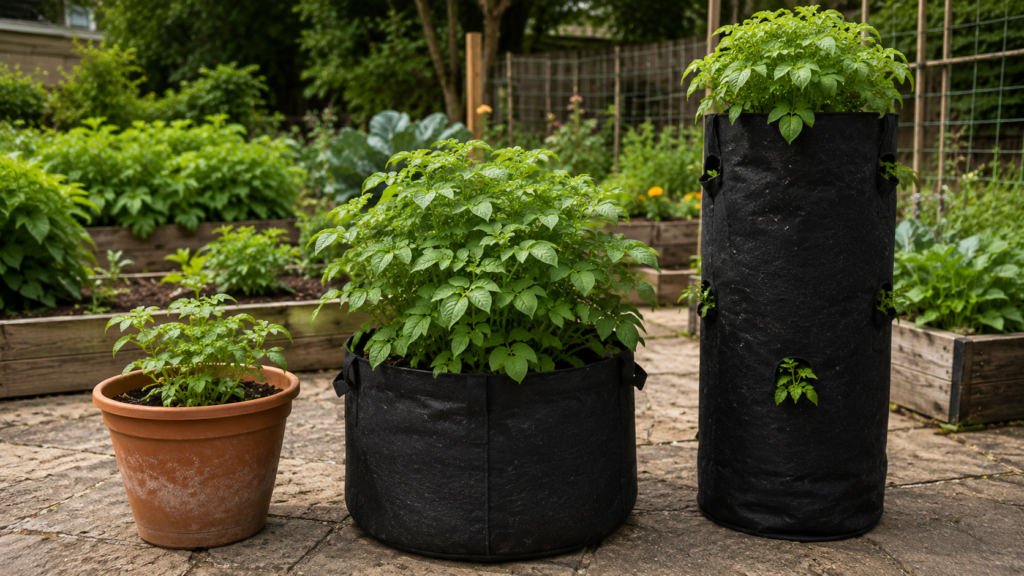
A potato planter needs enough usable volume for the intended number of seed potatoes, enough width to avoid overcrowding, and enough depth for planting and later hilling.
There is no single correct size for every growing method. A planter designed for one seed potato has different requirements from a large grow bag containing several plants.
Check four things:
- Volume: enough growing medium for the plants
- Depth: room for planting and hilling
- Width: adequate spacing between seed potatoes
- Water balance: enough depth without becoming difficult to water evenly
Measure the planter internally rather than relying only on exterior dimensions.
Plant count should also match the actual container. Crowding extra seed potatoes into limited space does not guarantee a larger harvest.
Which Potatoes Grow Best in Planters?
First early, second early, and maincrop potatoes can all grow in containers, but they occupy the planter for different lengths of time.
Earlier-maturing potatoes are convenient for many container gardeners because they can be harvested sooner. Maincrop varieties remain in growth longer and may benefit from larger containers and a longer suitable growing season.
Choose according to your priority:
- Faster crop: first early
- Intermediate crop: second early
- Longer-season crop: maincrop
Start with healthy seed potatoes intended for planting. For international gardeners, choose a variety whose maturity period suits the local climate and growing season.
Which Potato Planter Material Is Best?
Material affects drying speed, weight, durability, and appearance, but it is less important than adequate volume and drainage.
Fabric: excellent drainage and easy harvest, but dries faster.
Plastic or composite: lightweight and retains moisture relatively well, but needs drainage holes.
Wood: attractive for permanent DIY planters, but construction quality affects durability.
Terracotta: traditional appearance but porous walls can increase moisture loss.
Glazed ceramic: attractive and less porous, but very heavy when filled.
Metal: durable but can become hot in intense sunlight.
Use this priority:
drainage → usable volume → stability → moisture management → appearance
Do Potato Planters Need Drainage?
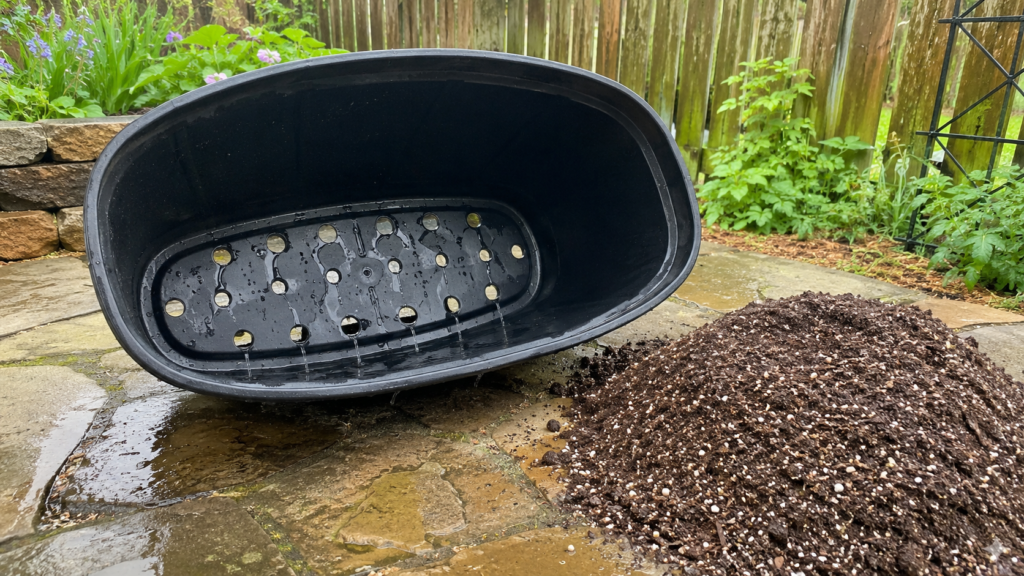
Yes. Excess irrigation and rainwater need a clear route out of the container. Potatoes prefer consistent moisture, but growing medium that remains saturated for long periods can create unhealthy root and tuber conditions.
Before planting, check that:
- drainage holes are open;
- water can leave from the lowest point;
- the planter is not sitting in trapped water;
- an outer decorative pot is not blocking drainage.
Test the planter by pouring water through it before filling completely.
Do not use gravel as a substitute for functioning drainage holes.
How Do You Plant Potatoes in Planters?
Prepare the entire growing system before planting. Position the container, verify drainage, select seed potatoes, and decide how many plants the usable volume can support.
1. Choose Seed Potatoes
Use healthy seed potatoes intended for cultivation rather than relying on potatoes of uncertain planting history.
2. Prepare Large Tubers if Needed
Small seed potatoes can often be planted whole. Larger ones may be divided while retaining viable eyes.
3. Add Growing Medium
Partly fill the planter rather than filling it to the rim. Leave enough space for later hilling.
4. Position the Potatoes
Space seed potatoes rather than clustering them together.
5. Cover and Water
Cover them with growing medium and water evenly.
6. Add More Medium Later
As stems grow, gradually add more growing medium around them while leaving healthy foliage exposed.
When Should You Plant?
Planting time depends on local frost risk, climate, variety maturity, and growing-season length.
Do not follow one universal planting month. Use local potato-growing guidance and plant when enough suitable growing season remains for the chosen variety to mature.
Do You Need to Hill Potatoes?
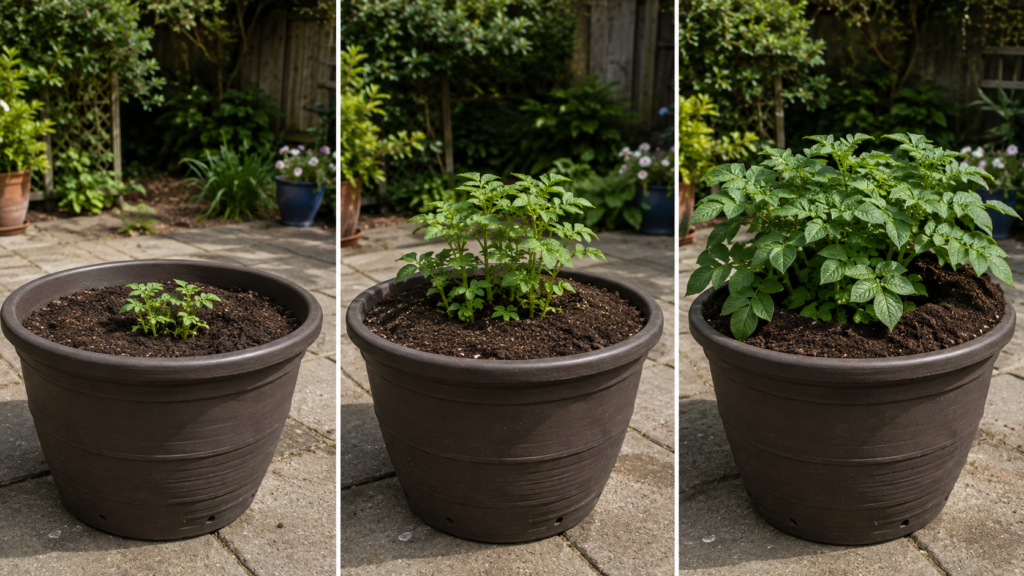
Yes. Hilling means gradually adding growing medium around potato stems as they grow.
One important purpose is to keep developing tubers covered and protected from light, which can cause greening.
To hill container potatoes:
- let shoots become established;
- add growing medium around the stems;
- leave active foliage exposed;
- repeat gradually as needed;
- keep some watering space below the rim.
Do not keep adding height simply to make the container taller.
Hilling supports the crop; it is not an unlimited-yield technique.
How Much Sun Do Potato Planters Need?
Potatoes generally perform best in a sunny outdoor position.
However, sunlight should be considered together with heat and moisture. A dark container on heat-reflective paving may dry much faster than the same planter in a milder location.
Consider:
- useful direct sunlight;
- afternoon heat;
- reflected heat;
- wind exposure;
- watering access.
Choose the planter location before filling it, especially if the container will become too heavy to move.
How Often Should You Water Potato Planters?
Water according to actual moisture in the growing medium rather than following a fixed calendar.
Check more frequently during:
- hot weather;
- strong wind;
- active plant growth;
- dry periods;
- growth in fabric bags.
Water slowly enough to moisten the root zone and allow excess water to drain.
If the surface is dry but deeper growing medium remains wet, wait. If the planter dries rapidly throughout, increase monitoring.
The goal is consistent moisture without prolonged saturation.
What Soil Is Best for Potato Planters?
Use a loose container-growing medium that holds useful moisture while draining freely.
Dense garden soil used alone can compact in containers and restrict drainage.
A suitable mix should:
- drain after watering;
- retain some moisture;
- maintain air spaces;
- resist heavy compaction;
- remain easy to add during hilling.
Container potatoes may also require supplemental nutrients because their root system is limited to the planter.
Use fertilizer suitable for edible vegetable crops and follow label directions. Excess fertilizer, especially excessive nitrogen, can encourage foliage without necessarily improving the potato crop.
Potato Towers vs Grow Bags: Which Is Better?
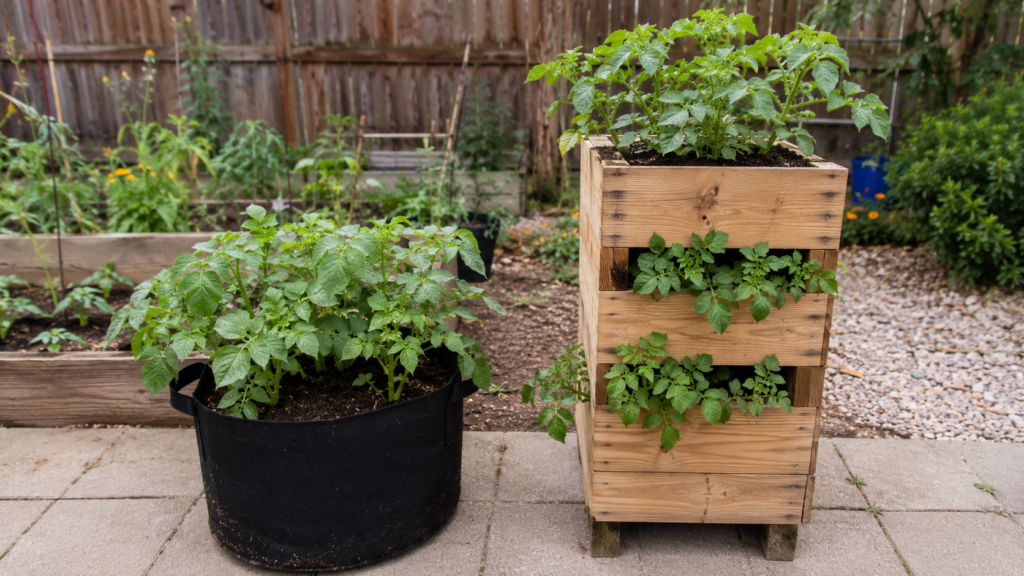
Grow bags are usually the easier choice for beginners, while towers are most useful where horizontal space is limited.
| Feature | Grow bag | Potato tower |
|---|---|---|
| Setup | Easy | More complex |
| Harvest | Very easy | Design dependent |
| Moisture | Easier to monitor | Can vary by depth |
| Footprint | Moderate | Smaller |
| Main risk | Fast drying | Uneven moisture |
Choose a grow bag if you prioritize simplicity and harvesting.
Choose a tower if floor space is limited and you can monitor moisture through the full depth.
How Do You Harvest Planter Potatoes?
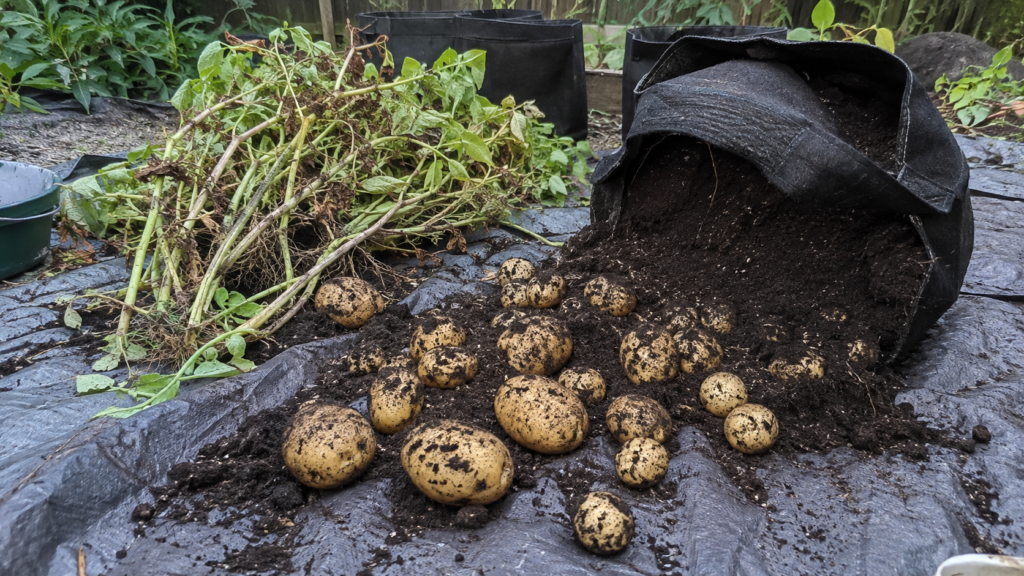
Container harvesting is one of the main advantages of growing potatoes in planters.
For bags and movable containers:
- spread a tarp or sheet;
- tip the planter gently;
- separate the loose growing medium;
- collect potatoes by hand;
- check carefully for smaller tubers.
Do not attempt to tip a very heavy rigid planter. Remove the growing medium gradually instead.
Harvest timing depends on whether you are growing early or mature potatoes. Mature crops are generally left until the plants naturally decline.
Keep developing and harvested potatoes away from light. Tubers that become substantially green should not be treated as normal edible potatoes.
What Problems Affect Planter Potatoes?
Containers make growing conditions easier to control, but they do not eliminate pests, diseases, or environmental stress.
Green Potatoes
Usually caused by tubers being exposed to light.
Action: keep developing potatoes covered.
Rot Problems
Prolonged saturation can damage roots and tubers.
Check: drainage, watering frequency, and growing-medium structure.
Foliar Disease
Rapid browning or unusual foliage decline should be inspected rather than automatically assumed to be normal maturity.
Pests
Check leaves for eggs, larvae, chewing, or unusual defoliation. Important potato pests vary by region.
Small or Poorly Developed Potatoes
Possible causes include:
- overcrowding;
- limited growing volume;
- inconsistent moisture;
- insufficient sunlight;
- heat stress;
- nutrition problems;
- harvesting too early.
Use this diagnostic order:
drainage → moisture → sunlight → plant density → growing medium → pests or disease → maturity
What Potato Planter Mistakes Should You Avoid?
The most common problems come from poor growing conditions rather than the planter’s appearance.
Avoid:
- choosing a container that is too small;
- making a tower unnecessarily tall;
- blocking drainage holes;
- letting the planter dry completely;
- keeping the growing medium permanently soggy;
- filling the planter to the rim before planting;
- overcrowding seed potatoes;
- allowing tubers to become exposed;
- forgetting how the planter will be harvested.
Do not diagnose every weak plant the same way. Wilting does not always mean drought, yellow leaves do not always mean nutrient deficiency, and small potatoes do not have one universal cause.
Check the complete growing system before changing several things at once.
Which Potato Planter Is Best for You?
For most beginners, a broad grow bag or simple large container with reliable drainage is the strongest starting point.
Choose a:
- grow bag for simple harvesting;
- large pot for a polished patio;
- wooden box for custom DIY dimensions;
- raised planter for repeated crops;
- tower when floor space is genuinely limited;
- barrel when you want more volume and permanent placement.
Use this decision sequence:
space → plant count → usable volume → drainage → growing medium → sunlight → watering → hilling → harvest
FAQs About Potato Planter Ideas
What Is the Best Planter for Potatoes?
A broad grow bag or large container with good drainage is easiest for most beginners. It should provide enough usable volume and be easy to water, hill, and harvest.
How Big Should a Potato Planter Be?
Size depends on plant count and growing method. Choose enough internal width, depth, and growing-medium volume without overcrowding the plants.
How Deep Should a Potato Planter Be?
It should accommodate the initial planting plus additional growing medium during hilling. Avoid making the container unnecessarily deep.
Can You Grow Potatoes in a 5-Gallon Bucket?
Yes, but the growing volume is limited. Use it for a small planting and ensure the bucket is suitable for edible gardening and has good drainage.
Do Potato Planters Need Drainage Holes?
Yes. Excess water must be able to leave the growing medium so roots remain moist without sitting in saturated conditions.
Do You Keep Adding Soil as Potatoes Grow?
Yes. Add growing medium gradually around developing stems while keeping healthy foliage exposed and developing tubers covered.
Are Grow Bags Better Than Pots?
Grow bags are easier to empty and usually drain well. Rigid pots may retain moisture longer and provide a more decorative appearance.
Why Are My Container Potatoes Small?
Possible causes include overcrowding, limited planter volume, inconsistent moisture, poor light, heat stress, inadequate nutrition, or harvesting before the crop matures.
How We Researched This Guide
This guide combines potato-planter design with established horticultural principles for container-grown potatoes. The recommendations focus on planter volume, drainage, planting stock, growing medium, sunlight, moisture, hilling, and harvesting.
Because container systems and climates vary, the guide avoids presenting one planter dimension, watering schedule, planting month, or potato variety as universally correct.
For the strongest results in your garden:
- use local guidance for planting dates and regional pests;
- measure the planter internally;
- use healthy seed potatoes;
- match plant count to usable volume;
- monitor actual moisture;
- record what works in your conditions.
What Makes a Potato Planter Successful?
A successful potato planter is not defined by whether it is called a grow bag, bucket, tower, barrel, or wooden box. It works because the complete growing system supports healthy plants and developing tubers.
Use this final checklist:
- Choose healthy seed potatoes.
- Provide enough usable growing volume.
- Match plant count to planter size.
- Confirm effective drainage.
- Position large planters before filling.
- Provide adequate sunlight.
- Use loose container-growing medium.
- Leave room for hilling.
- Keep developing tubers covered.
- Maintain consistent moisture.
- Avoid prolonged saturation.
- Monitor foliage for problems.
- Plan the harvest before planting.
- Clean reusable planters after the crop.
The simplest formula is:
right seed potatoes → right planter volume → drainage → growing medium → sunlight → moisture → hilling → easy harvest
The strongest potato planter ideas begin with the crop’s needs rather than the appearance of the container.
Choose the planter from the potato plant’s needs outward—not from the container’s appearance inward.
Myra is the founder and lead writer of Backyard Planter Ideas, where she shares practical, well-researched guidance on planter design, plant selection, and outdoor styling. Her goal is to help homeowners create attractive, functional garden spaces with clear, reliable, and easy-to-apply advice.