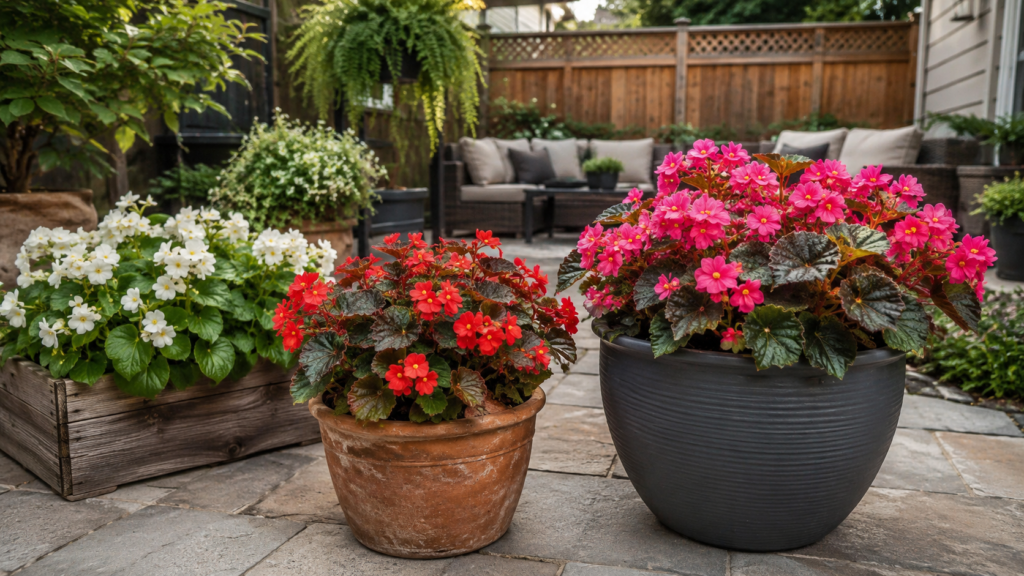
Begonia planter ideas work best when the plant’s growth habit, mature size, planter shape, drainage, and light conditions are considered together. Compact wax begonias suit broad patio pots and window boxes, upright tuberous begonias make attractive focal containers, and trailing varieties work best in hanging baskets or elevated planters.
Begonias are useful container plants because different types can grow compact, mounding, upright, arching, or trailing. That makes them suitable for balconies, patios, porches, window boxes, hanging displays, and larger backyard containers.
The strongest outdoor begonia planter ideas provide enough root space, release excess water, suit the available light, and remain balanced as the plants mature.
The key is simple: choose the begonia first, then match the planter to how it naturally grows.
Quick Guide to Begonia Planter Ideas
Choose a begonia planter according to your space and the plant’s mature habit. Compact begonias fit smaller pots and window boxes, upright varieties create stronger focal displays, and trailing begonias need a raised edge where their stems can cascade.
Maintenance matters too. A beautiful planter is only practical if you can water, inspect, and position it easily.
- Small patio: compact wax begonias in a broad pot.
- Window box: wax or fibrous begonias.
- Large focal container: upright tuberous begonias.
- Hanging display: trailing tuberous begonias.
- Raised planter: Begonia boliviensis or another trailing type.
- Modern patio: pink or white begonias in charcoal planters.
- Rustic backyard: terracotta or wooden planters.
- Easy maintenance: one begonia type rather than a crowded mixture.
For most gardeners, one healthy begonia type in a well-drained planter is the easiest place to start.
What Are the Best Begonia Planter Ideas?
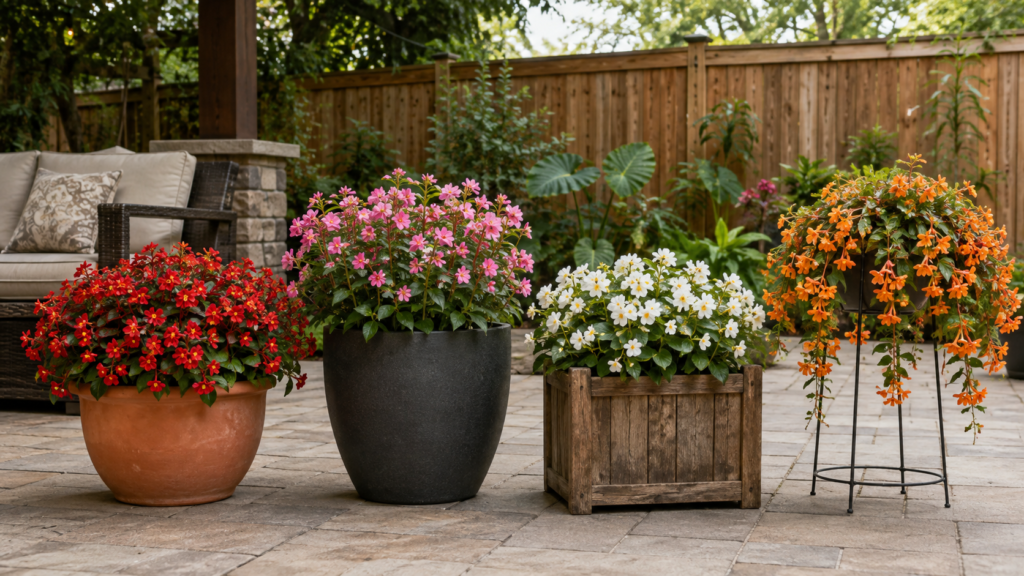
The best begonia planter ideas match the plant’s natural shape to the container. Flower color can guide the appearance, but growth habit should determine whether the plant belongs in a low pot, window box, hanging basket, or elevated planter.
Leave enough space for mature growth rather than trying to make every planter completely full on planting day.
1. Fill a Terracotta Pot With Red Wax Begonias
A broad terracotta pot filled with red wax begonias is an easy way to create dependable patio color.
Wax begonias generally form compact rounded plants, so several can develop into one flowering mound. Warm terracotta also complements red blooms naturally.
This arrangement suits:
- brick and stone patios;
- cottage gardens;
- traditional backyard settings;
- grouped containers beside seating or steps.
Leave enough room for the plants to expand.
2. Grow Pink Begonias in a Charcoal Planter
Pink begonias look particularly strong against charcoal, black, or dark-gray containers.
The combination works well on modern patios with neutral paving or dark outdoor furniture because the planter remains understated while the flowers provide color.
Choose a pot that will balance the begonia at mature size rather than judging proportions from the nursery plant.
3. Use White Begonias in a Wooden Planter
White begonias brighten rustic wooden containers and work well beside fencing, decks, sheds, and pergolas.
Several compact begonias can be planted as a loose mass rather than rigid rows.
Check that the planter has:
- enough internal depth;
- open drainage;
- a draining liner if used;
- sufficient width for mature plants.
4. Let Trailing Begonias Cascade From an Elevated Planter
Trailing begonias look best where their stems can fall naturally below the rim.
Use:
- raised patio edges;
- wall planters;
- railing containers;
- planter stands;
- wide steps.
A simple pot often works better than an ornate one because mature foliage may cover much of the rim.
5. Make Tuberous Begonias a Patio Focal Point
Large-flowered tuberous begonias can provide enough impact to fill a container without several companions.
Use a substantial pot in a sheltered position where the flowers can be appreciated from seating areas, paths, or doorways.
A single vigorous plant often looks more intentional than a complicated mixture.
6. Create a Cascading Begonia Hanging Basket
Trailing begonias are natural choices for hanging baskets.
Allow stems to develop at slightly different lengths rather than creating an artificial perfect sphere.
Place the basket where it is:
- sheltered from strong wind;
- easy to reach;
- able to drain;
- exposed to suitable light.
Check moisture regularly during warm weather because hanging containers can dry quickly.
7. Combine Begonias With Coleus
Coleus adds foliage contrast without introducing another dominant flowering plant.
Dark foliage can strengthen white or pink begonias, while lime foliage contrasts well with red flowers.
Check mature plant size before combining them because vigorous coleus can overwhelm compact begonias.
8. Pair Red Begonias With White Bacopa
Red begonias and white bacopa create a clean two-color combination.
Keep the begonias dominant and use bacopa mainly around selected edges.
Avoid covering the entire rim with trailing growth. The display should still clearly read as a begonia planter.
9. Combine Begonias and Caladiums
Caladiums provide broad tropical foliage behind lower flowering begonias.
Useful combinations include:
- white begonias with green-and-white caladiums;
- pink begonias with rose-patterned foliage;
- red begonias with darker leaves.
Use a container with enough space for both plants to develop.
10. Fill a Window Box With Wax Begonias
Wax begonias suit window boxes because their compact growth creates a consistent band of flowers and foliage.
Repeating one cultivar often looks stronger than mixing several unrelated plants.
Remember that walls and roof overhangs can alter heat, rainfall, and drying around the box.
11. Build a Three-Pot Begonia Display
Three separate containers can create a layered arrangement without forcing different plants into one root zone.
Try:
- a low pot with wax begonias;
- a medium pot with an upright begonia;
- an elevated planter with a trailing variety.
Repeat one flower color or planter material to connect the group visually.
12. Let One Begonia Fill a Statement Pot
One vigorous begonia can be enough for a statement container.
This works particularly well when you want simpler care or when the planter itself is decorative.
Choose a stable pot whose proportions suit the mature plant.
Which Begonias Are Best for Planters?
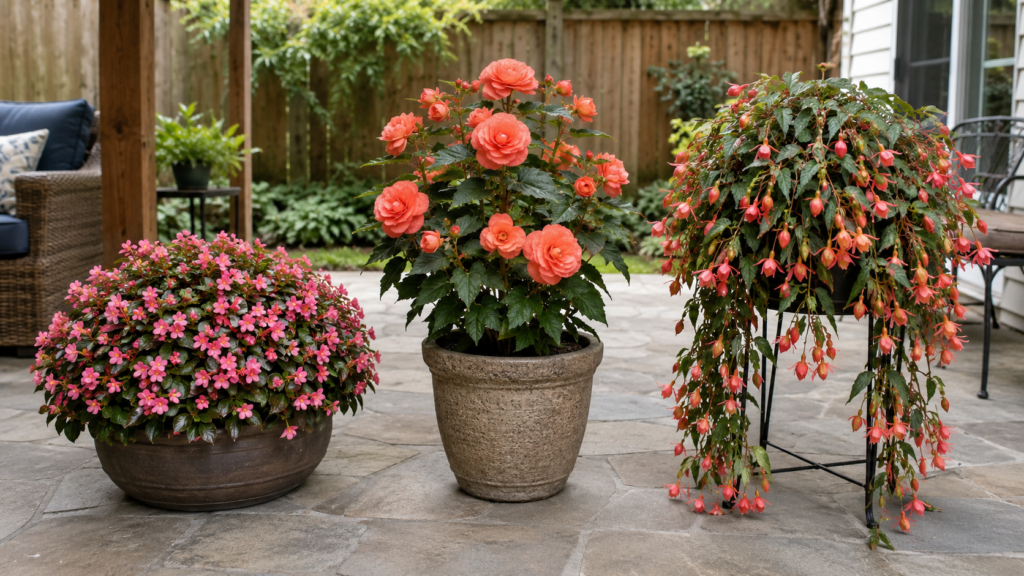
The best begonia depends on the container and the effect you want. Compact wax begonias suit broad pots and window boxes, tuberous begonias provide large flowers, and trailing types are better for hanging or elevated displays.
Common choices include:
- Wax begonias: compact plants for patio pots and boxes.
- Dragon Wing-type begonias: vigorous arching plants for larger containers.
- Upright tuberous begonias: flowering focal plants.
- Trailing tuberous begonias: suitable for hanging baskets.
- Begonia boliviensis hybrids: useful for cascading growth.
- Cane begonias: taller forms for sheltered pots.
- Foliage begonias: selected mainly for decorative leaves.
Wax Begonias
Wax begonias are among the easiest types to use outdoors.
They usually remain compact and work well when repeated across broad pots or window boxes.
Tuberous Begonias
Tuberous begonias are usually selected for their large flowers.
Some grow upright while others trail, so check the cultivar before choosing the planter.
Trailing Begonias
Trailing begonias need a visible edge.
Use them in baskets, wall planters, elevated pots, or along the edge of larger containers.
Cane and Upright Begonias
Larger upright begonias provide height but need greater planter stability and protection from strong wind.
Foliage Begonias
Foliage begonias are useful in protected decorative pots where leaf color and pattern are the main attraction.
Choose by growth habit first and flower color second.
What Size Pot Do Begonias Need?
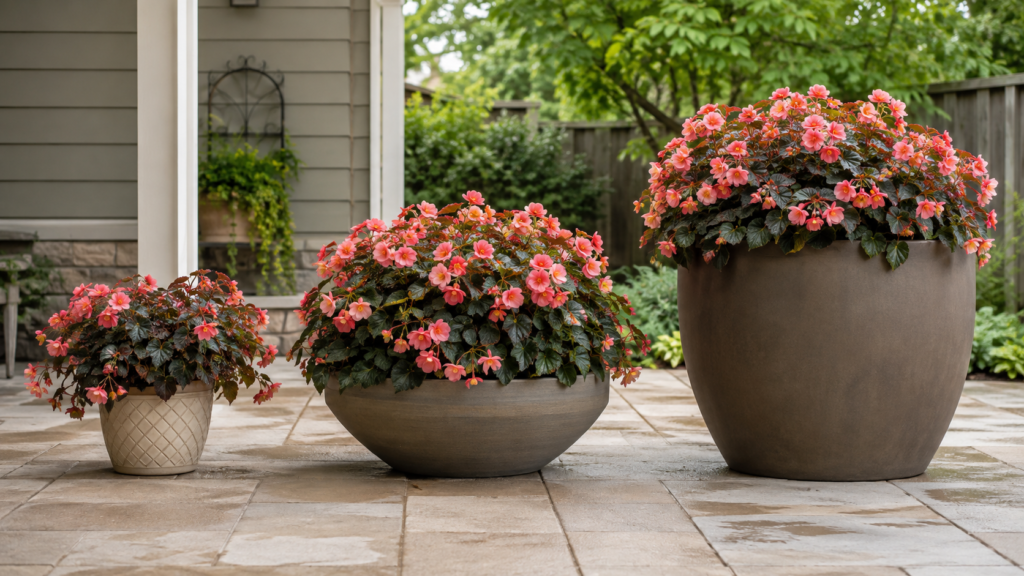
There is no universal pot size for begonias. Choose according to mature spread, number of plants, root volume, and usable internal growing space.
Exterior dimensions can be misleading because thick walls, tapered sides, or inserts reduce actual planting volume.
Check:
- internal width;
- usable depth;
- mature plant spread;
- drainage;
- stability.
Choose for Mature Size
Do not size the planter only for the nursery plant.
Compact begonias need less space than vigorous upright or trailing forms, while several plants require more width than a single specimen.
Consider Moisture and Stability
Small containers can dry faster during warm weather, while very large pots become difficult to move.
Tall begonias also benefit from a broad, stable base.
What Should You Check Before Buying?
Inspect:
- internal dimensions;
- drainage openings;
- removable plugs;
- filled weight;
- base stability;
- watering access.
Prioritize usable root space, drainage, and mature proportions over decorative appearance.
Which Planter Material Is Best?
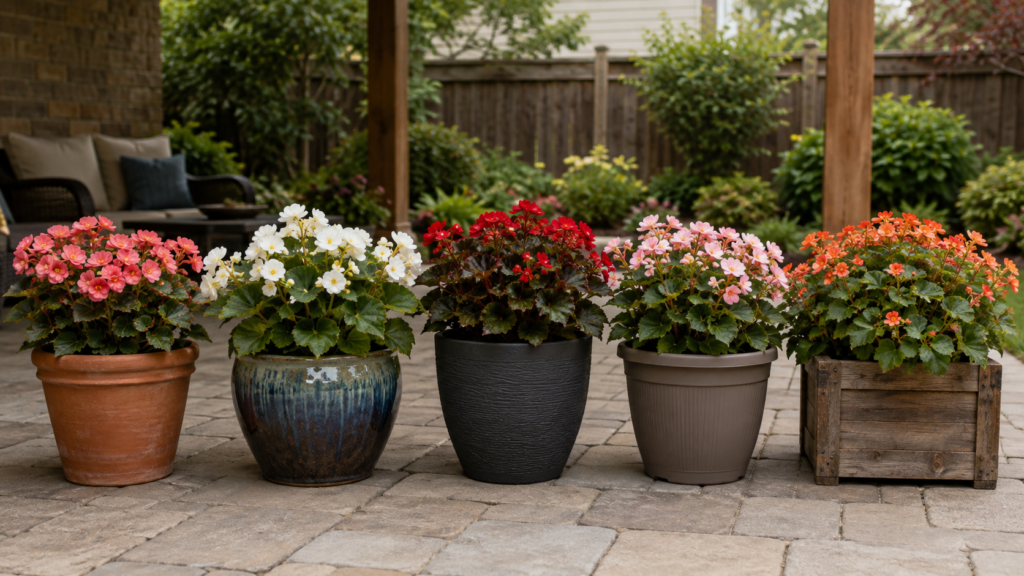
Terracotta, glazed ceramic, resin, plastic, and wood can all work for begonias. Choose according to weight, moisture behavior, appearance, and how the planter will be maintained.
Terracotta
Terracotta creates a traditional garden look and pairs naturally with begonias.
Because it is porous, moisture may disappear faster during warm weather.
Glazed Ceramic
Glazed ceramic works well for decorative focal containers but becomes heavy once filled.
Resin or Composite
Resin and composite planters offer the appearance of large modern pots with less weight.
They are useful where occasional repositioning may be necessary.
Plastic
Plastic is lightweight and practical, particularly for hanging baskets.
It may retain moisture longer than porous terracotta.
Wood
Wood suits rustic backyard settings.
Make sure the container and any liner allow excess water to escape.
For begonias, planter function matters more than planter material.
What Grows Well With Begonias?
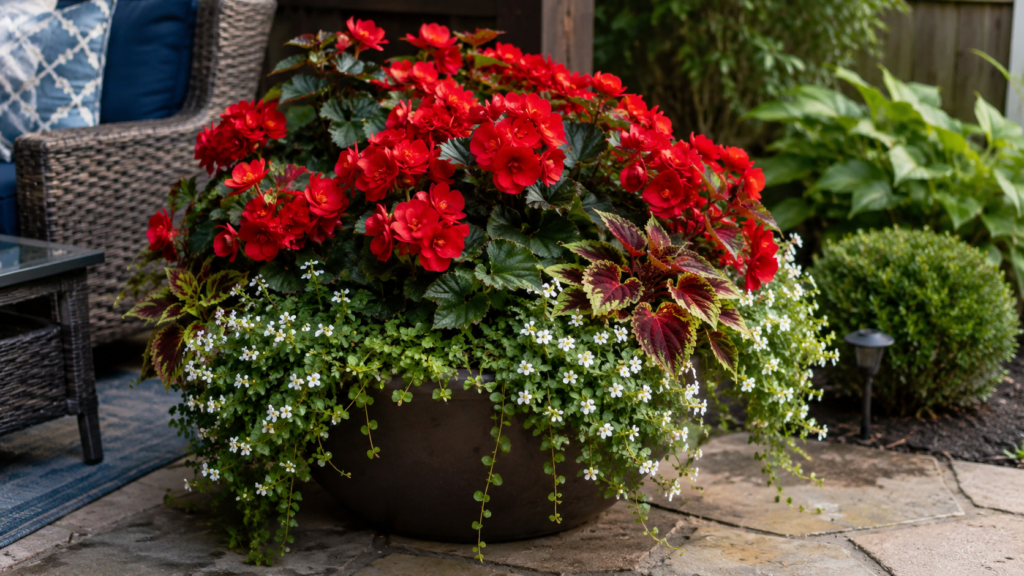
Begonia companions should share similar light, moisture, and drainage requirements.
Choose compatible plants before thinking about color.
Coleus
Coleus provides strong foliage contrast and can add height behind lower begonias.
Avoid vigorous varieties that will dominate the container.
Caladium
Caladium adds broad tropical foliage and works best in larger shade-oriented planters.
Bacopa
Bacopa softens the edge with smaller trailing flowers.
Use it sparingly so the begonia remains visually dominant.
Ferns
Compatible ferns can add fine foliage in shaded containers.
Check the needs of the specific fern before planting.
More Begonias
Repeating one begonia cultivar often creates a stronger display than mixing several unrelated species.
A single-species planter is also easier to maintain.
Where Should You Place Begonia Planters?
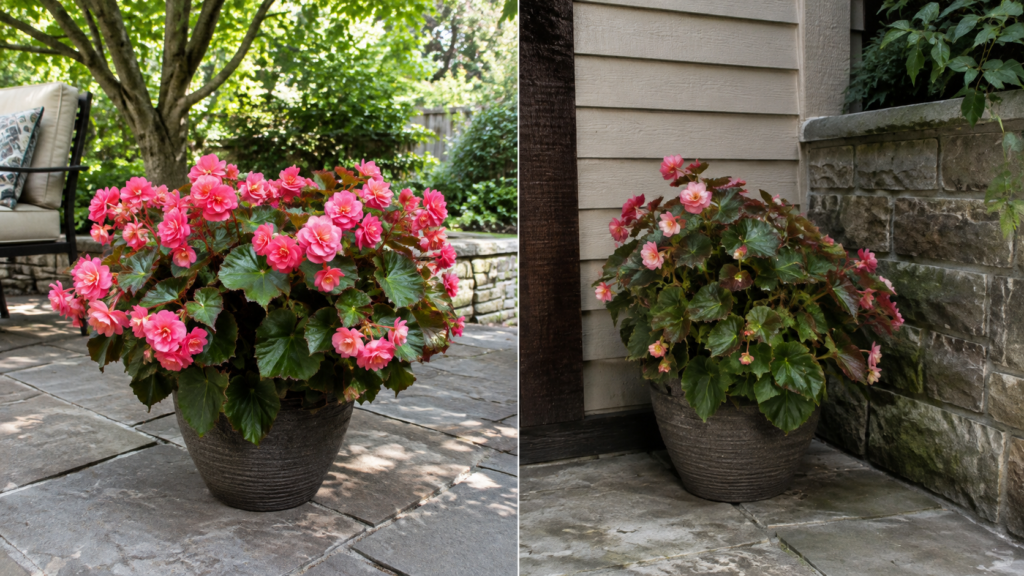
Many begonias perform well in partial shade, bright shade, filtered light, or gentle morning sun. Exact tolerance varies by cultivar.
Backyards also contain microclimates. A planter beside a warm wall may receive more heat than one nearby, while a pot beneath a porch may receive little natural rainfall.
Use Bright or Partial Shade
Morning sun with afternoon protection works well for many begonias.
Open bright shade can also provide useful light without excessive heat.
Avoid Very Dark Corners
Shade does not mean darkness.
Begonias in heavily enclosed positions may survive but flower poorly.
Follow the Cultivar
Some varieties tolerate more sun than others, so use cultivar-specific guidance when possible.
Protect From Wind
Begonia leaves, stems, and flowers can be damaged by repeated strong gusts.
Use fences, walls, or sheltered patio positions where needed.
How Do You Plant Begonias in Pots?
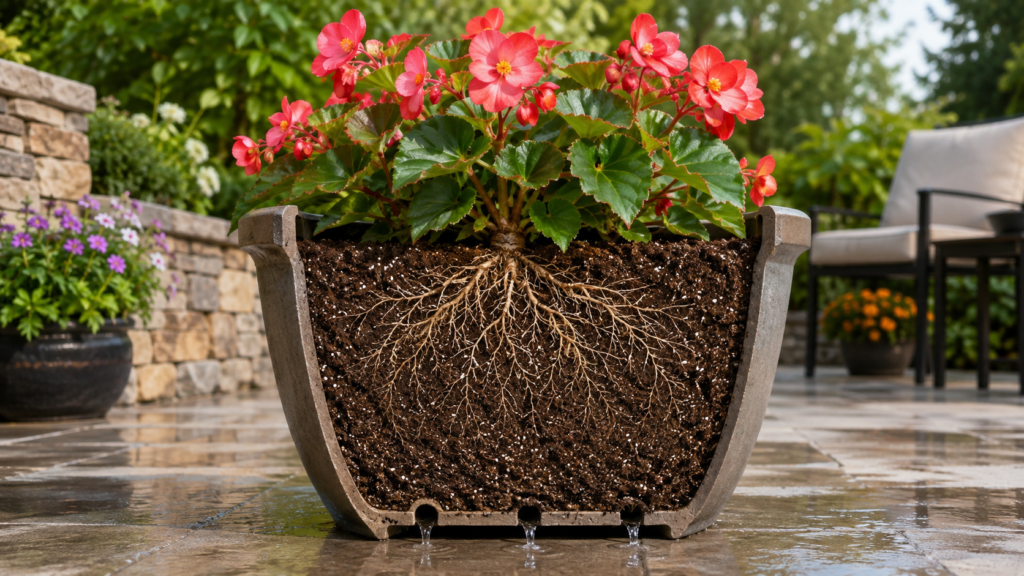
Successful planting starts with functional drainage, suitable potting mix, realistic spacing, and an appropriate final position.
1. Check Drainage
Make sure holes at the bottom of the pot are open before adding potting mix.
2. Use Container Potting Mix
Use a loose growing medium formulated for containers rather than dense garden soil.
3. Skip the Gravel Drainage Layer
Gravel does not replace functioning drainage holes.
What matters is:
well-draining potting mix + open drainage + sensible watering.
4. Arrange Plants Before Planting
Place the nursery pots on the surface first so you can check spacing and balance.
5. Plant at a Sensible Level
Avoid burying stems too deeply and leave some space below the rim for watering.
6. Water Thoroughly
Water after planting and confirm that excess water drains from the base.
7. Move to the Final Position
Place the planter where light and shelter suit the begonia.
How Do You Care for Potted Begonias?
Potted begonias need regular observation rather than a rigid care schedule.
Check Moisture Before Watering
Inspect the potting mix instead of watering automatically.
Water the Root Zone
Direct water toward the growing medium when practical.
Feed Appropriately
Follow fertilizer instructions rather than assuming extra feed will improve flowering.
Maintain Airflow
Thin companion plants if the container becomes crowded.
Remove Damaged Material
Remove badly damaged or dead foliage to keep the planter tidy.
Monitor Pests and Disease
Inspect leaf undersides, stems, new growth, and the soil surface if the plant begins to decline.
What Begonia Planter Mistakes Should You Avoid?
Most problems come from poor drainage, unsuitable exposure, overcrowding, or incorrect watering.
Avoid:
- pots without drainage;
- dense garden soil;
- excessive crowding;
- deep darkness;
- unsuitable intense sun;
- incompatible companions;
- fixed watering schedules;
- unstable containers.
Do Not Treat Every Begonia the Same
Wax, tuberous, trailing, cane, and foliage begonias have different growth habits.
Avoid Overcrowding
Leave enough room for plants to mature naturally.
Do Not Assume More Water Solves Wilting
Wilting can occur in both overly wet and overly dry conditions.
Check the potting mix first.
Keep Mixed Planters Simple
Too many companions increase competition and make maintenance more difficult.
How Do You Choose the Right Begonia Planter?
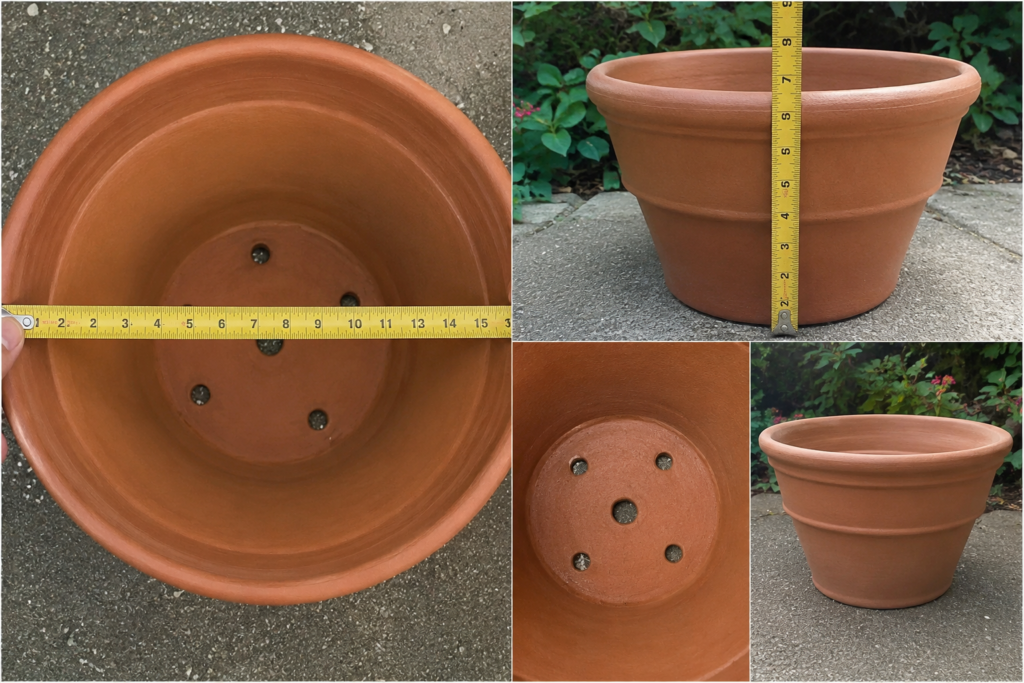
A useful planter provides sufficient root space, reliable drainage, stability, and easy maintenance access.
Check:
- growth habit;
- mature spread;
- internal width;
- usable depth;
- drainage;
- wind exposure;
- watering access.
How Can You Test a Planter?
Measure internal width and usable depth rather than relying only on exterior dimensions.
Inspect the drainage holes from inside and underneath. A basic water-flow check can confirm that water escapes properly.
For a real planter comparison, record:
- dimensions;
- material;
- drainage;
- begonia cultivar;
- planting date;
- exposure;
- growth after several weeks.
Only describe a planter as tested or measured when you genuinely collected those observations.
Which Begonia Planters Are Easiest to Maintain?
The easiest containers usually hold one main begonia type, provide adequate growing volume, drain reliably, and sit somewhere easy to inspect.
For simpler care:
- use one begonia type;
- choose a broad stable pot;
- limit companions;
- keep watering access easy;
- choose a suitable location from the start.
A coordinated three-pot grouping can provide more visual variety without combining several plants in one root zone.
How Do You Avoid an Overplanted Begonia Pot?
A good planter has one clear focal plant or repeated begonia group rather than several plants competing equally for attention.
Use these principles:
- keep the begonia dominant;
- limit major flower colors;
- use foliage for contrast;
- leave growth space;
- place trailing plants near edges;
- match the pot to mature plant size.
A container does not need to look completely full on planting day.
Which Begonia Planter Idea Is Best for You?
Choose according to your space, light, maintenance needs, and design style.
- Simple patio color: wax begonias in a broad pot.
- Large focal flowers: upright tuberous begonias.
- Hanging display: trailing begonias.
- Window box: compact wax begonias.
- Modern patio: pink or white begonias in charcoal pots.
- Rustic backyard: terracotta or wooden planters.
- Tropical shade: begonias with caladiums.
- Foliage contrast: begonias with coleus.
- Low maintenance: one begonia type.
- Flexible arrangement: three coordinated pots.
If you are unsure, start with one begonia type in one well-drained planter positioned in suitable light.
FAQs About Begonia Planter Ideas
Can Begonias Grow Well in Planters?
Yes. Begonias grow well in containers when they have suitable potting mix, drainage, appropriate light, and enough room for mature growth.
What Type of Begonia Is Best for Planters?
Wax begonias suit compact pots and window boxes, tuberous begonias work as focal plants, and trailing varieties suit hanging or elevated containers.
What Size Pot Is Best for Begonias?
Choose according to mature plant size, growth habit, and root volume rather than one universal diameter.
How Many Begonias Can You Plant in One Pot?
It depends on planter width and mature spread. Several compact plants may share a broad pot, while one vigorous begonia may fill a larger container.
Do Begonia Planters Need Drainage Holes?
Yes. Functional drainage allows excess water to escape and reduces prolonged waterlogging.
How Often Should You Water Begonias in Pots?
Water according to potting-mix moisture rather than a fixed schedule. Keep it reasonably moist but not permanently saturated.
Do Begonias Prefer Sun or Shade?
Many begonias prefer partial shade, bright shade, filtered light, or morning sun. Exact tolerance varies by variety.
What Potting Mix Is Best for Begonias?
Use a loose, moisture-retentive but well-draining container potting mix.
What Plants Grow Well With Begonias?
Coleus, caladiums, bacopa, compatible ferns, and other begonias can work when their growing requirements are similar.
Are Begonias Good for Hanging Baskets?
Yes. Trailing and many tuberous begonias work particularly well because their stems can cascade over the edges.
Why Is My Potted Begonia Not Flowering?
Possible causes include unsuitable light, watering problems, poor drainage, overcrowding, or plant stress.
Can Begonias Survive Winter in Pots?
Many outdoor begonias are frost tender. Tuberous forms can often be stored frost-free, while others may need protected conditions.
Final Thoughts on Begonia Planter Ideas
The strongest begonia planter ideas begin with the natural growth habit of the plant.
Compact begonias suit broad pots and window boxes. Trailing types belong in baskets or elevated containers, while larger upright begonias need stable focal pots.
Keep the main rules simple:
- identify the begonia type;
- check mature spread;
- match planter to growth habit;
- confirm drainage;
- use suitable potting mix;
- leave room for growth;
- choose compatible companions;
- provide appropriate light;
- protect plants from strong wind;
- check moisture before watering.
Mixed containers can be attractive, but they are not automatically better. One healthy begonia filling the right planter can look more intentional than a crowded mixture of incompatible plants.
Most importantly, design for the mature begonia rather than the small nursery plant.
Myra is the founder and lead writer of Backyard Planter Ideas, where she shares practical, well-researched guidance on planter design, plant selection, and outdoor styling. Her goal is to help homeowners create attractive, functional garden spaces with clear, reliable, and easy-to-apply advice.