
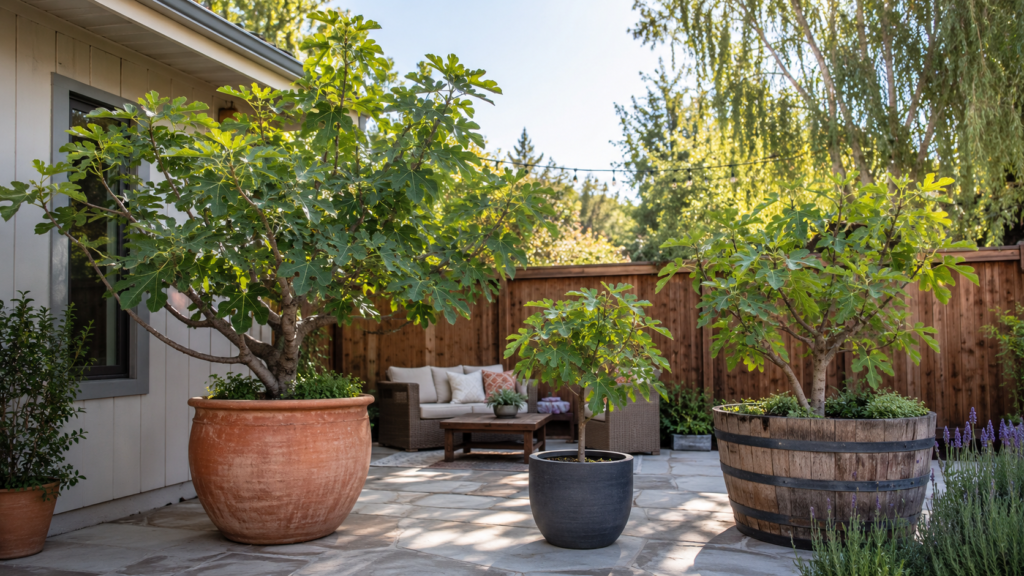
Fig tree planter ideas work best when the container looks good and supports the tree for years. Terracotta pots, charcoal planters, wooden boxes, half barrels, and lightweight composite containers can all work when they provide enough root space, reliable drainage, stability, sunlight, and room for the mature canopy.
The common fig (Ficus carica) is especially useful as a container tree because its broad lobed leaves create a strong patio focal point while many cultivars can also produce fruit. Container growing gives you more control over tree size, root growth, placement, and winter protection, but it also makes watering, feeding, and root management more important.
The best approach is to choose the fig variety, planter size, material, position, and long-term maintenance plan together. A beautiful container that becomes unstable, waterlogged, impossible to move, or severely root-bound is not a successful fig planter.
Quick Fig Tree Planter Guide
A successful setup starts with a fig cultivar suited to your space and climate. Place it in a container moderately larger than its current root system, keep the drainage holes open, and position the tree in strong sunlight with some protection from harsh wind.
Use this simple formula:
- Right fig: match mature size to your available space.
- Right planter: prioritize usable internal dimensions.
- Right drainage: excess water must escape freely.
- Right soil: use quality container potting mix.
- Right position: choose a warm, sunny site.
- Right watering: water according to soil moisture.
- Right maintenance: repot gradually and root-prune when needed.
- Right winter plan: know whether the tree must move.
Choose the decorative style only after these requirements are satisfied.
Best Fig Tree Planter Ideas
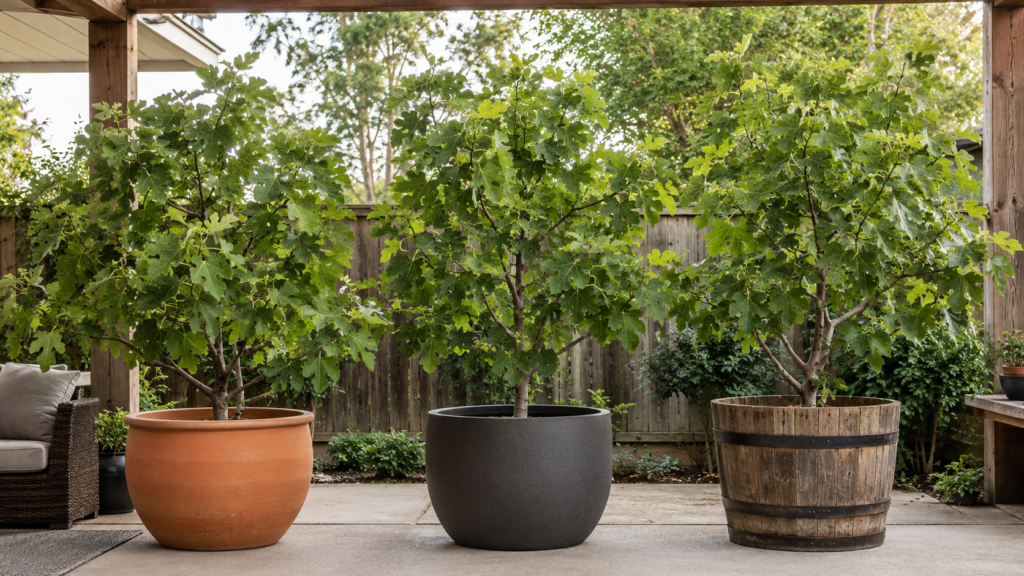
These designs cover the strongest combinations of appearance, space, climate, and practicality.
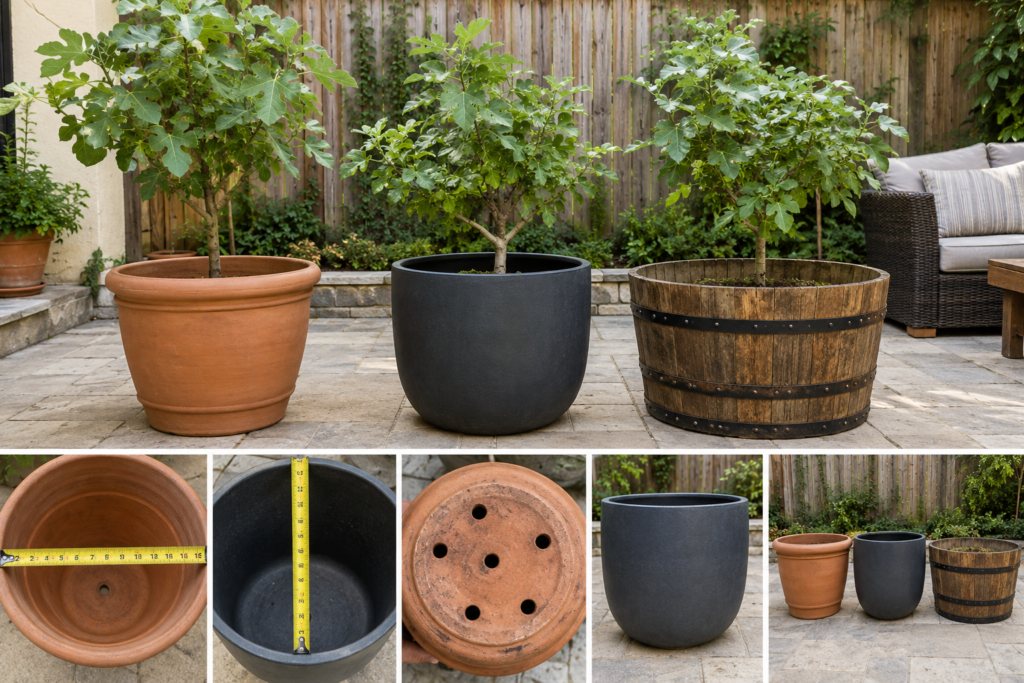
1. Fig Tree in a Terracotta Pot
A broad terracotta planter is one of the most natural choices for a fig tree. Warm clay tones complement green fig leaves and create a Mediterranean or cottage-garden appearance.
Choose a broad pot rather than a tall narrow urn. Unglazed terracotta can dry faster during hot weather, so moisture may need checking more frequently.
Best for: sunny patios where the planter can remain mostly stationary.
2. Fig Tree in a Charcoal Planter
A charcoal or dark-gray planter creates a cleaner contemporary look. The dark container recedes visually, making the fig’s large green leaves the focal point.
This style works well with concrete paving, modern fencing, black-framed doors, and pale walls. Choose a stable planter wide enough to balance the mature canopy.
Best for: modern patios and minimalist backyard designs.
3. Fig Tree in a Half Barrel
A half-barrel planter suits rustic gardens, edible landscapes, cottage patios, and informal backyards.
Its broad shape provides useful root volume and works naturally beneath a spreading canopy. Check converted barrels carefully for drainage and structural condition before planting.
Best for: rustic gardens and productive backyard spaces.
4. Fig Tree in a Wooden Planter
Square wooden planters work especially well beside decking, pergolas, fences, and garden rooms.
Measure the internal dimensions, not only the outer box. Thick timber and liners can reduce usable root volume considerably. Maintain drainage around the base and make sure future root access will be possible.
Best for: decks and natural contemporary gardens.
5. Mediterranean Fig Tree Planter
A single fig in a large terracotta or pale stone-colored planter can anchor a Mediterranean-style courtyard.
Keep the design simple. Pale paving, gravel, weathered timber, and light walls complement the tree without competing with its foliage. Place the planter in a warm, sunny, sheltered position.
Best for: courtyards where one strong focal plant is preferred.
6. Dwarf Fig Tree for a Small Patio
A compact cultivar is usually more practical than repeatedly pruning a vigorous fig into a small space.
‘Little Miss Figgy’ is a useful example of a naturally compact fig suited to containers. A smaller cultivar still needs sunlight, drainage, watering, and occasional pruning, but its proportions are easier to manage.
Best for: small patios, courtyards, and larger balconies.
7. Movable Fig Planter
A movable planter is one of the best choices for colder climates.
Use a sturdy plant caddy, integrated casters, or a lightweight composite container. Always consider the filled weight, since wet potting mix and the tree can make the container much heavier than expected.
Best for: gardeners who may need to move the fig into winter protection.
8. Fig Planter Beside a Sunny Wall
A warm wall-side position can combine good design with favorable growing conditions.
Leave enough space between the planter and wall for watering, airflow, pruning, and maintenance. Observe the actual sun pattern before planting rather than assuming every wall-side position is sunny.
Best for: sheltered patios with strong sunlight.
9. Fan-Trained Fig in a Planter
A fan-trained fig is useful where wall space is available but patio depth is limited.
Branches can be trained across wires or another support instead of spreading freely into the seating area. This also makes canopy management and harvesting easier.
Best for: narrow courtyards and wall-side gardens.
10. Matching Fig Planters
Two matching figs can frame a wide patio entrance or doorway.
Use the same cultivar and similar container volume on both sides. Both positions should receive comparable sunlight; otherwise, one tree may become stronger and break the intended symmetry.
Best for: formal entrances with similar growing conditions on both sides.
11. Fig Tree Planter for a Balcony
A sunny balcony can support a compact fig, but container weight, wind exposure, and drainage runoff become especially important.
Choose a lightweight planter where possible and check total loaded weight against safe structural limits.
Best for: sunny balconies with sufficient load capacity and wind protection.
12. Statement Fig Tree Planter
On a larger patio, one established fig in a broad planter can become the main focal point.
A simple terracotta, charcoal, or stone-effect container usually works better than an overly decorative pot because the tree itself already provides strong visual interest.
Best for: larger patios where a single specimen can anchor the design.
Which Fig Tree Planter Idea Is Best?
Choose the planter according to the site rather than appearance alone.
A Mediterranean patio naturally suits terracotta. A modern backyard may suit charcoal or composite. Rustic gardens work well with barrels or wood. Small spaces benefit from compact cultivars, while cold climates favor movable containers.
Before choosing, ask:
- Will the mature canopy fit?
- Does the planter provide useful root space?
- Can excess water drain freely?
- Can the container be moved if needed?
- Will future root pruning be possible?
- Does the location receive enough sunlight?
If two planters are equally attractive, choose the one with better drainage, stability, access, and long-term practicality.
What Size Fig Tree Planter Do You Need?
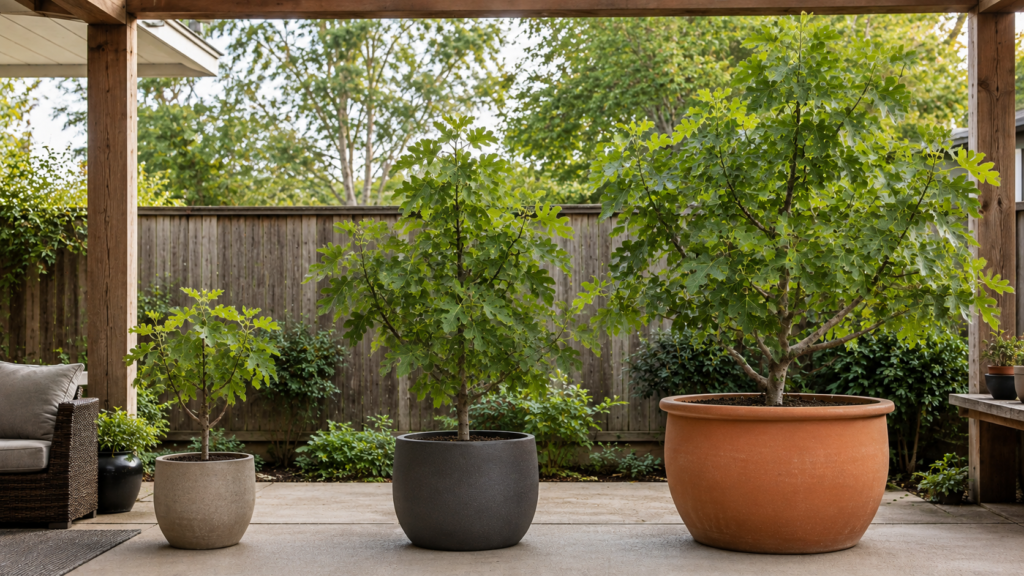
There is no universal mature planter size for every fig tree. The correct size depends on the current root ball, cultivar, age, climate, and how long the tree will remain in the container.
A young fig can start in a container around 30 cm or 12 inches wide and deep, then move gradually into larger pots. Practical guidance also uses sizes such as roughly 7 gallons for earlier stages and around 15 gallons for longer-term growing.
Avoid placing a small fig immediately into an unnecessarily huge pot. A large volume of unused potting mix can remain wet longer than the roots need.
Choose a larger planter when:
- roots densely fill the current container
- the pot dries unusually quickly
- roots emerge strongly from drainage holes
- growth is clearly limited by congestion
A broad, stable container is generally more useful than an extremely tall narrow pot.
Best Materials for Fig Tree Planters
No single material is best for every situation.
Terracotta offers a classic Mediterranean appearance but is heavy and can dry quickly.
Glazed ceramic is attractive and stable but difficult to move once filled.
Wood suits natural gardens and custom dimensions, although the base must be monitored for moisture damage.
Composite or fiberglass-style planters are lighter and useful when mobility matters.
Plastic is lightweight and practical.
Half barrels provide broad growing space and a rustic look.
Stone and concrete offer excellent stability but are best for permanent placement.
Choose heavier materials when stability matters and lighter materials when winter relocation is likely. Whatever material you use, drainage matters more than decorative finish.
How to Choose a Fig Tree Planter
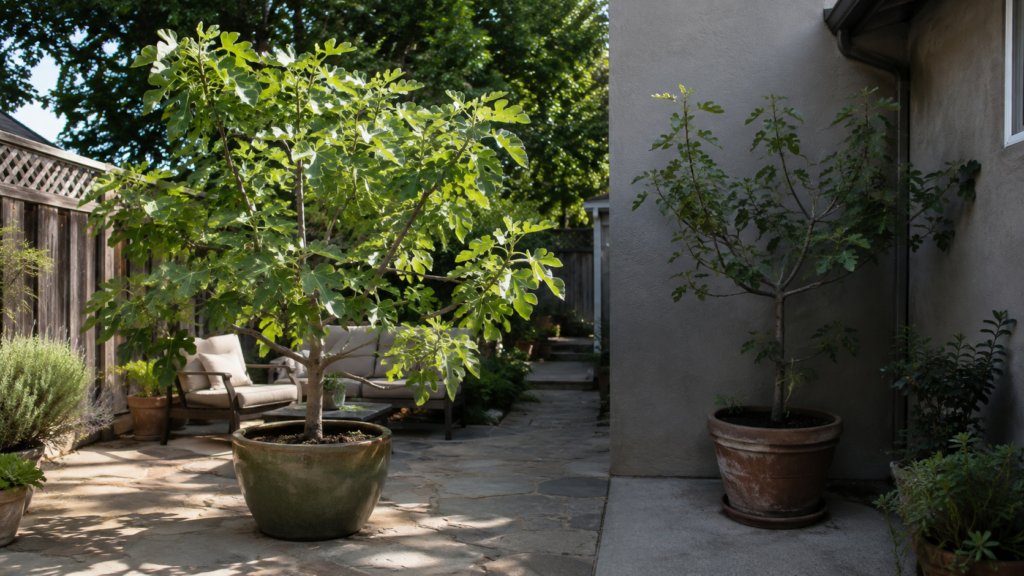
When buying a planter, pay attention to the internal growing space, not just the measurements on the product listing.
A large decorative pot may contain less usable root space than expected because of thick walls, false bases, narrow necks, or tapered sides.
Before buying, check:
- internal diameter or width
- usable depth
- drainage-hole number and position
- top-opening width
- empty and filled weight
- frost resistance where relevant
- stability under a mature canopy
- compatibility with a plant caddy
The top opening is particularly important. A planter that widens below a narrow rim can make a mature root ball difficult to remove.
If you perform a real planter comparison, photograph and record the internal width, usable depth, drainage holes, empty weight, and full planter. Use actual photographs if you describe it as a real measurement test.
Best Fig Trees for Planters
Naturally compact cultivars are usually easiest to manage in containers.
Little Miss Figgy
A compact choice for patios and balconies where mature size matters.
Brown Turkey
A classic fruiting fig suited to container growing and root restriction.
Chicago Hardy
Useful in colder regions because of its greater cold tolerance.
Celeste
A productive cultivar better suited to patios with more room for pruning and canopy development.
Before choosing, consider mature size, local climate, cold tolerance, fruiting performance, pruning requirements, and winter protection.
Will Potted Fig Trees Produce Fruit?
Yes. A container-grown fig can produce fruit when the cultivar, sunlight, warmth, watering, feeding, pruning, and climate are suitable.
Moderate root restriction can help control excessive vegetative growth, but the tree still needs enough sunlight and warmth to ripen fruit.
For better fruiting, provide:
- strong direct sunlight
- a warm sheltered location
- consistent moisture
- balanced feeding
- appropriate pruning
- a suitable cultivar
Most common-type figs grown in home gardens do not require another fig tree for pollination. Smyrna figs require pollination, while San Pedro types have different crop-specific requirements.
If a tree produces many leaves but little ripe fruit, check sunlight, climate, excessive nitrogen, watering, pruning, cultivar suitability, and pollination before assuming it needs a bigger pot.
Where Should You Place a Potted Fig Tree?
Choose a warm, sunny, sheltered location with enough room for the mature canopy.
Around six to eight hours of direct sunlight is a useful target where conditions allow.
Good locations include sunny patios, sheltered courtyards, warm wall-side positions, protected decks, and bright balconies.
Avoid deep shade, wind corridors, permanently wet locations, and positions where future branches will block doors or pathways.
A sunny wall can provide warmth and shelter, but leave enough space for watering, pruning, airflow, and maintenance.
Best Soil and Drainage for Fig Trees
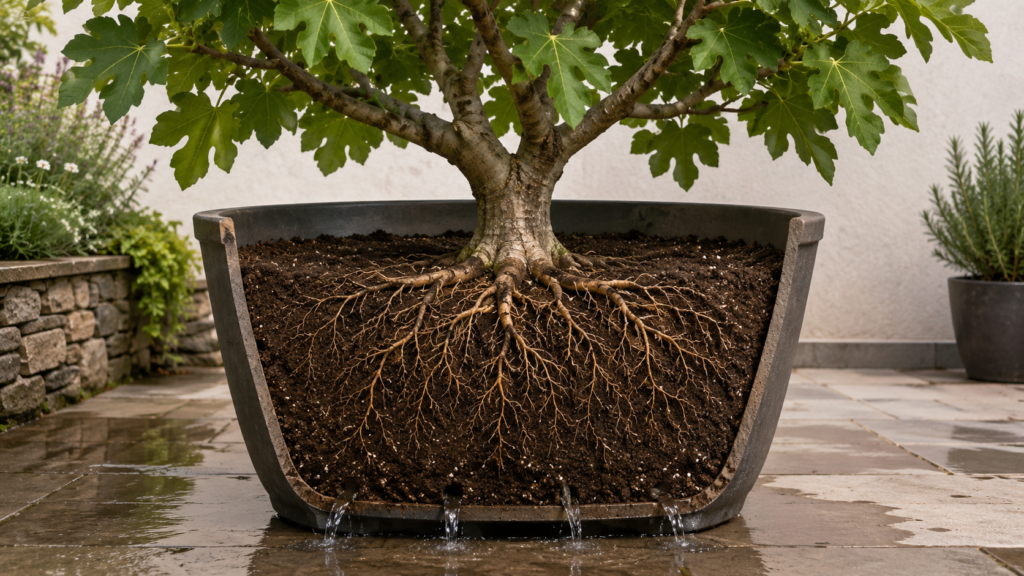
Use a moisture-retentive but free-draining container potting mix rather than dense garden soil.
The planter must have functional drainage holes so excess irrigation and rainfall can leave the root zone.
Check that:
- drainage holes remain open
- the base is not sealed against paving
- the pot is not standing permanently in water
- the growing medium does not remain saturated
Do not rely on a layer of gravel to correct poor drainage. Proper drainage holes and suitable potting mix are more important.
How to Plant a Fig Tree in a Pot
Place the empty planter close to its final position before filling it.
Then:
- Check all drainage holes.
- Add container potting mix.
- Remove the fig from its nursery pot.
- Inspect the root ball.
- Position the tree at approximately its previous growing depth.
- Backfill around the roots.
- Firm gently.
- Leave watering space below the rim.
- Water thoroughly.
- Confirm excess water drains from the base.
Avoid containers with very narrow necks because removing an established root ball later may become difficult.
How Often Should You Water a Potted Fig?
Water according to soil moisture rather than following a fixed schedule.
Water demand increases with heat, direct sun, wind, large canopies, small containers, root congestion, and porous terracotta.
Check the growing medium regularly and water thoroughly when the upper layer begins to dry. Allow excess water to drain after each deep watering.
If the tree wilts while the soil remains wet, investigate drainage, root health, or heat stress rather than automatically adding more water.
How Should You Feed a Potted Fig Tree?
Container-grown figs eventually need nutrient replacement because their roots are confined to a limited volume of growing medium.
Feed during active growth according to the fertilizer instructions and the condition of the tree.
Possible approaches include:
- balanced fertilizer
- controlled-release feed
- suitable organic feeding
- potassium-rich liquid feed where appropriate
Avoid excessive nitrogen. Very lush foliage and long soft shoots do not necessarily mean the tree is healthier or more productive.
If the tree already grows vigorously but fruits poorly, evaluate sunlight, pruning, watering, and nitrogen levels before increasing fertilizer.
How Do You Keep a Potted Fig Small?
Use cultivar selection, moderate root restriction, canopy pruning, and eventual root pruning together.
When roots fill the container:
- move a young tree into a modestly larger planter if useful
- repot gradually
- root-prune once the maximum practical container size is reached
- rebalance the canopy after substantial root pruning
Wear gloves when pruning because fresh fig sap can irritate skin.
A naturally compact fig is easier to maintain than a vigorous cultivar continually forced into a small space.
How Do You Overwinter a Potted Fig Tree?
Winter care depends on the cultivar and local climate.
In mild regions, a suitable fig may remain outside in a sheltered position. In colder climates, a movable container allows the dormant tree to be placed in an unheated garage, shed, greenhouse, or another protected space.
During dormancy:
- reduce watering
- prevent roots from drying completely
- avoid warm indoor conditions intended for active houseplants
- protect vulnerable containers from freeze-thaw damage
If annual movement is likely, consider it before buying a very heavy planter.
Why Is My Potted Fig Tree Struggling?
Start with sunlight, moisture, drainage, roots, and nutrition.
Yellow leaves: check watering, drainage, drought, and nutrient depletion.
Wilting in hot weather: inspect moisture and root congestion.
Lots of leaves but little fruit: check sunlight, nitrogen, pruning, climate, and cultivar.
Dense circling roots: repot or root-prune.
Pot stays wet: inspect drainage holes, potting mix, and the surface beneath the planter.
A tree that performed well for several years and suddenly declines may simply have become root-bound.
Fig Tree Planter Mistakes to Avoid
Avoid:
- choosing only for appearance
- judging size by external measurements
- using a narrow unstable planter
- inadequate or blocked drainage
- dense garden soil
- overpotting a young tree
- placing the fig in deep shade
- ignoring mature canopy width
- choosing an immovable planter in a cold climate
- allowing severe root congestion
- excessive nitrogen feeding
- pruning without considering fruiting growth
Treat the container as a complete growing system rather than a decorative object.
If drainage, root access, watering, or winter management already looks difficult while the planter is empty, choose another container.
Are Fig Trees Good for Planters?
Yes. Fig trees can be excellent container plants when sunlight, drainage, watering, feeding, and root management are handled correctly.
They provide architectural foliage, edible fruit, controlled size, portability, and strong focal-point value.
The trade-off is greater maintenance. A container fig depends more heavily on the gardener for water, nutrients, repotting, root pruning, and winter protection than a tree growing freely in suitable ground.
When cultivar, planter, climate, and location match, a fig can remain attractive and productive for many years.
Fig Tree Planter FAQs
What size planter is best for a fig tree?
Start with a container moderately larger than the current root ball. Young figs can begin around 30 cm (12 in) wide and deep, then move gradually into larger planters.
Do fig trees grow well in planters?
Yes. Figs can grow and fruit successfully in containers with enough sunlight, drainage, water, nutrients, and root management.
How much sun does a potted fig tree need?
Aim for around 6–8 hours of direct sunlight where possible. A warm, sheltered position generally supports stronger growth and fruiting.
Do fig trees like being root-bound?
They tolerate moderate root restriction, but severe congestion eventually requires repotting or root pruning.
Should a fig tree planter be wide or deep?
Choose useful width and depth rather than a tall narrow shape. A broad planter also improves stability.
Can a fig tree stay in a planter permanently?
Yes, with long-term maintenance. Once the tree reaches its largest practical planter, root pruning can help keep it manageable.
What is the best soil for a fig tree in a planter?
Use a moisture-retentive but free-draining container potting mix rather than dense garden soil.
Does a fig tree planter need drainage holes?
Yes. Functional drainage holes are essential so excess water can leave the root zone.
How often should you water a potted fig tree?
Check soil moisture rather than following a fixed schedule. Water thoroughly when the upper layer begins to dry.
Do potted fig trees need fertilizer?
Usually, yes. Feed during active growth, but avoid excessive nitrogen.
Will a fig tree produce fruit in a planter?
Yes. Container figs can fruit with adequate sunlight, warmth, water, feeding, and appropriate pruning.
Does a potted fig need another fig tree for pollination?
Most common-type figs do not. Smyrna and some San Pedro figs have different pollination requirements.
What is the best fig tree for a planter?
Compact cultivars are usually easiest for small patios. Choose according to climate, mature size, and winter conditions.
How do you overwinter a fig tree in a planter?
In cold climates, move the dormant tree into a suitable protected location when necessary.
Are fig trees better in pots or in the ground?
Pots provide size control and portability. In-ground figs have more root space and generally require less intensive maintenance.
Sources and Horticultural References
Key horticultural references for this guide include:
- Royal Horticultural Society — How to Grow Figs
- Royal Horticultural Society — Figs: Pruning and Training
- Royal Horticultural Society — Fruit in Containers
- Oregon State University Extension — Grow Great Figs
- UC Master Gardeners — Figs
Climate, cultivar, container size, growing medium, and winter conditions can change the exact care required, so local horticultural guidance should also be considered.

Myra is the founder and lead writer of Backyard Planter Ideas, where she shares practical, well-researched guidance on planter design, plant selection, and outdoor styling. Her goal is to help homeowners create attractive, functional garden spaces with clear, reliable, and easy-to-apply advice.