Japanese maple planter ideas work best when the container supports both the tree and the garden design. The right planter should provide enough root space, reliable drainage, a stable base, and a location protected from excessive heat and drying wind.
Compact Japanese maples are especially useful in containers because they offer attractive branching, changing foliage color, and strong structure without immediately overwhelming a patio. Burgundy leaves pair beautifully with charcoal pots, lime and gold foliage stands out against pale stone, and cascading laceleaf maples suit broad, low containers.
The simplest rule is to choose the tree first and the planter second. A beautiful pot cannot compensate for restricted roots, blocked drainage, or an unsuitable location.
Which Japanese Maple Planter Ideas Should You Choose?
Choose your planter according to space, tree form, exposure, and purpose. A dwarf maple on a small patio needs a different setup from a cascading maple in a large courtyard.
| Situation | Best approach | Why it works |
|---|---|---|
| Small patio | Dwarf maple in broad pot | Adds structure without crowding |
| Large patio | Mature specimen planter | Creates a focal point |
| Woodland garden | Maple with separate fern pots | Adds layers without root competition |
| Modern garden | Burgundy maple in charcoal pot | Strong foliage contrast |
| Japanese-inspired space | Neutral stone planter | Creates a restrained look |
| Cascading maple | Broad, low planter | Suits spreading branches |
| Timber deck | Square wooden planter | Connects with surrounding materials |
| Hot courtyard | Sheltered placement | Reduces heat stress |
| Windy site | Broad, heavy planter | Improves stability |
For upright maples, choose a substantial container that visually anchors the canopy. Cascading forms usually look better in lower, wider planters.
When two pots look equally attractive, choose the one with better root space, drainage, stability, and exposure.
Best Japanese Maple Planter Ideas
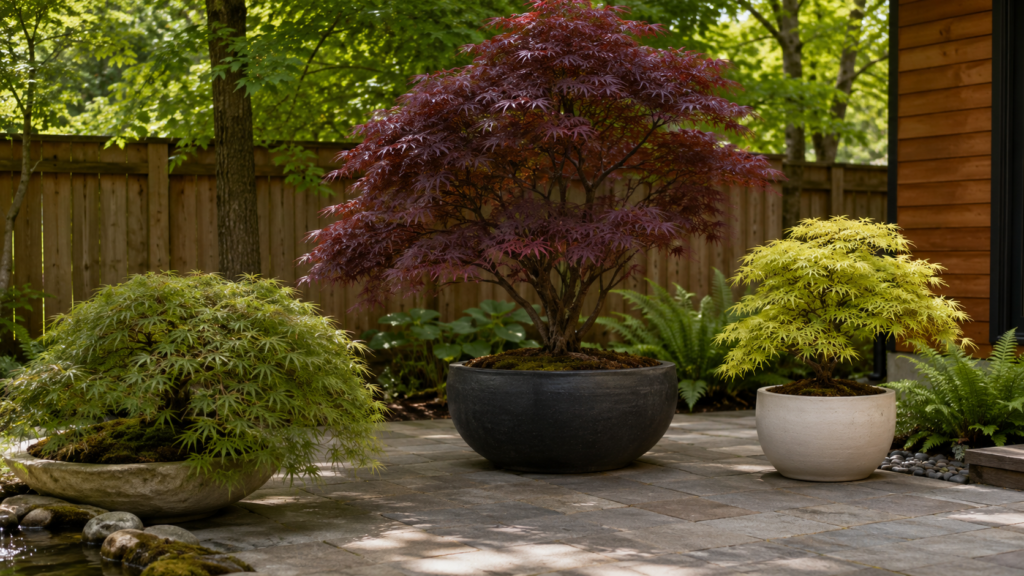
The strongest Japanese maple planter ideas give the tree a clear role rather than surrounding it with too many competing pots.
1. Make One Japanese Maple the Specimen
Place one Japanese maple in a broad ceramic, stone, or composite planter and let it become the main feature.
This works well beside patio seating, at the end of a path, or where paving meets planting. Leave enough open space around the canopy for the branching structure to remain visible.
2. Use a Low Wide Planter for a Cascading Maple
Cascading and laceleaf maples naturally spread outward and downward.
A broad, low stone or ceramic planter supports that shape better than a tall narrow urn. Give branches enough room to extend beyond the rim without hitting furniture or walls.
3. Pair Burgundy Foliage With Charcoal
Dark red Japanese maple foliage looks especially strong against charcoal, graphite, and dark gray planters.
Use this combination against pale paving, cream walls, gravel, or timber. Keep nearby containers neutral so the maple remains the strongest color.
4. Pair Gold or Lime Foliage With Pale Stone
Gold and lime foliage can brighten a shaded patio.
Choose cream, pale gray, taupe, or weathered stone containers. Avoid repeating too much yellow nearby; the foliage should remain the brightest element.
5. Use a Glazed Pot as a Focal Point
Muted glazed ceramic works especially well near seating areas.
Smoky gray, blue-green, dark green, cream, and earthy glazes suit changing foliage better than highly saturated colors. Use one statement pot rather than several competing glazed containers.
6. Create a Japanese-Inspired Stone Display
Keep a Japanese-inspired container arrangement simple.
Use one maple in a neutral stone planter with gravel, understated paving, a few rocks, or restrained foliage. Negative space makes the tree feel more important than adding multiple themed ornaments.
7. Use a Square Wooden Planter
Wooden planters work naturally on decks or beside fences and pergolas.
Make sure the planter is suitable for outdoor use and that any liner allows water to escape. Measure the internal dimensions because thick wooden walls can reduce usable root space.
8. Build a Woodland Container Group
Use the Japanese maple as the tallest plant and surround it with separate pots of ferns, heucheras, or low shade foliage.
Separate containers create a layered woodland look while reducing competition for water and root space.
9. Create a Three-Pot Patio Composition
Combine three containers at different heights.
Use the maple as the tallest element, add a medium foliage pot, and finish with a lower planter in front. The containers can differ in shape as long as their color or material feels coordinated.
10. Use a Dwarf Japanese Maple on a Small Patio
A dwarf Japanese maple can provide tree structure without overwhelming a compact space.
Use one stable, broad planter rather than several tiny decorative pots. Dwarf growth does not mean the tree can remain permanently in an undersized container.
11. Center a Maple in a Gravel Courtyard
A Japanese maple can soften hard surfaces such as gravel, concrete, masonry, and paving.
Use a neutral planter that relates to the hardscape, but check for reflected afternoon heat before choosing the final position.
12. Frame an Entrance With One Maple
One maple placed slightly to one side of an entrance often looks more natural than a matching pair.
Leave enough room for the mature canopy so branches do not obstruct the doorway or path.
13. Combine a Red Maple With Neutral Pots
If your patio already contains several containers, let the Japanese maple provide the strongest color.
Gray, cream, brown, charcoal, and muted green pots make good supporting containers around burgundy foliage.
14. Use a Coral-Bark Maple for Winter Interest
Acer palmatum ‘Sango-kaku’ provides colorful young stems after its leaves fall.
It can make an attractive winter specimen, but it is not permanently compact. Use it only where there is enough long-term canopy space and you are prepared to manage its roots and container size.
15. Create a Moveable Seasonal Focal Point
Containers provide some flexibility to reposition a Japanese maple for seasonal display or protection.
If movement matters, use a durable lightweight planter or a properly rated wheeled base before filling it. Large stone and ceramic pots quickly become difficult to move.
Best Japanese Maples for Planters
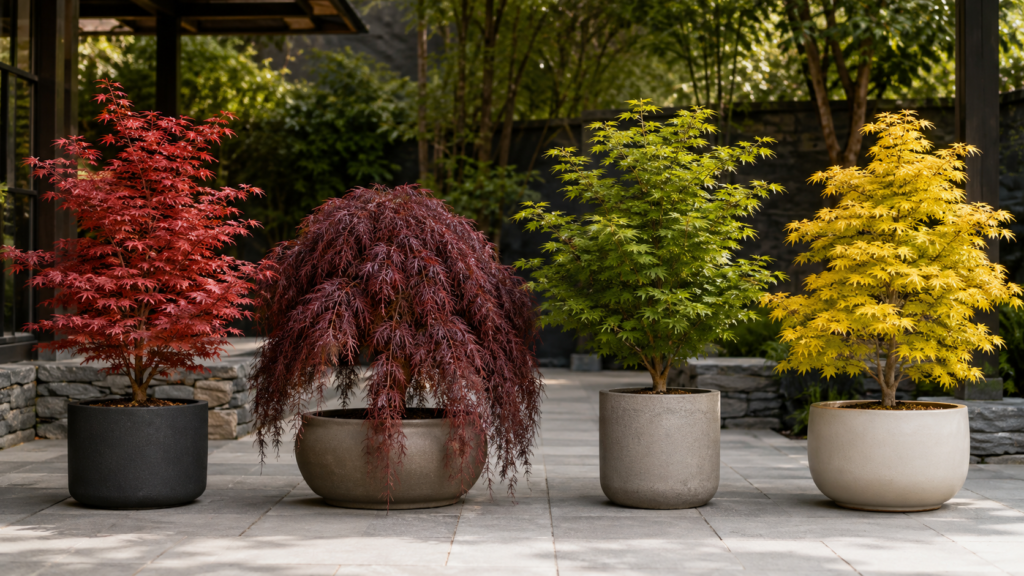
Compact, relatively slow-growing maples are usually easiest to maintain in containers. Mature spread matters just as much as height because some cultivars stay fairly low while becoming broad.
Most Japanese maples used in containers belong to Acer palmatum, although related species such as Acer shirasawanum are also grown for similar ornamental effects.
| Maple | Habit | Best planter use |
|---|---|---|
| ‘Jerre Schwartz’ | Compact upright | Small patios |
| ‘Crimson Queen’ | Cascading laceleaf | Broad low planters |
| ‘Shaina’ | Dense upright | Specimen pots |
| ‘Jordan’ | Slow-growing upright | Gold foliage focal point |
| ‘Sango-kaku’ | Upright, larger | Managed large container |
‘Shaina’
‘Shaina’ suits patios where an upright form is more useful than a spreading canopy. A broad ceramic or stone planter works well.
‘Crimson Queen’
‘Crimson Queen’ develops finely divided foliage and a cascading habit. Use a broad, low planter that allows branches to spread beyond the rim.
‘Jerre Schwartz’
‘Jerre Schwartz’ is a useful compact choice for small patios and courtyard gardens where long-term scale matters.
‘Jordan’
Acer shirasawanum ‘Jordan’ provides bright lime-to-gold foliage. Pale stone, cream, gray, and muted blue-green containers complement its color.
What Size Planter Does a Japanese Maple Need?
Choose a planter moderately larger than the current rootball instead of moving a young maple directly into an enormous pot.
An established tree may eventually need a container around 18 inches wide or larger, but this is only a general reference, not a universal finished size.
Check:
- current rootball size;
- usable internal width;
- usable depth;
- planter taper;
- drainage openings;
- mature canopy size;
- expected planted weight.
Move up in container size gradually as the tree develops. Internal measurements matter more than the advertised external diameter.
Should Japanese Maple Planters Be Wide or Deep?
Choose a planter with good width, adequate depth, and a stable base.
Broad containers usually look better beneath spreading canopies and provide useful lateral root space. Cascading forms especially benefit from lower, wider pots.
Depth still matters because the existing rootball must fit without being compressed or planted too high.
Avoid very tall, narrow planters that appear large but provide limited usable width or poor stability.
How Much Root Space Does a Japanese Maple Need?
External planter dimensions can be misleading. Thick rims, tapered walls, and false bottoms can significantly reduce the space available to roots.
Real Planter Measurement Test
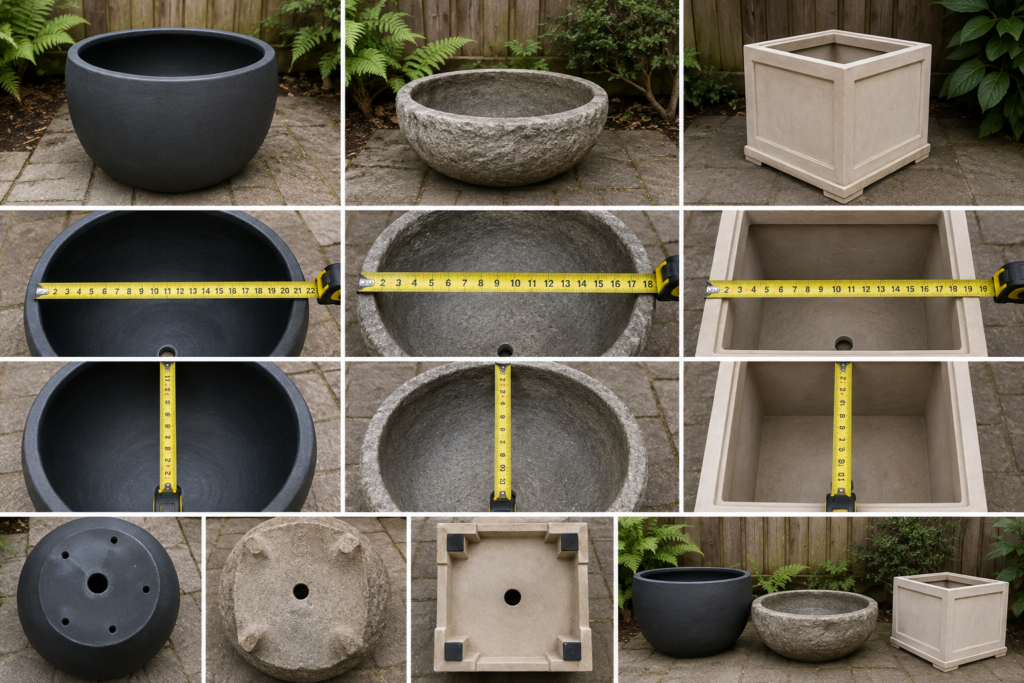
Compare three empty planters before choosing one.
| Measurement | Planter A | Planter B | Planter C |
|---|---|---|---|
| External width | Measure | Measure | Measure |
| Internal width | Measure | Measure | Measure |
| Usable depth | Measure | Measure | Measure |
| Drainage holes | Count | Count | Count |
Use real photographs showing:
- tape across internal width;
- usable depth;
- visible drainage holes;
- the complete planter.
Then calculate:
External width − internal width = width lost to the rim and walls
Only publish measurements you actually record. This gives the article a genuine E-E-A-T asset rather than another generic planter recommendation.
Best Planter Materials for Japanese Maples
There is no single best material. Choose according to climate, weight, durability, mobility, and style.
Ceramic: decorative and substantial but heavy once filled.
Terracotta: natural and stable, although its porous walls can dry more quickly.
Stone: highly stable and visually suited to Japanese maples but difficult to move.
Wood: works well on decks and in natural gardens; check that liners and bases still drain.
Composite: lighter and easier to reposition, but broad proportions are important for stability.
Material is secondary to root space, drainage, and stability.
Where Should You Place a Potted Japanese Maple?
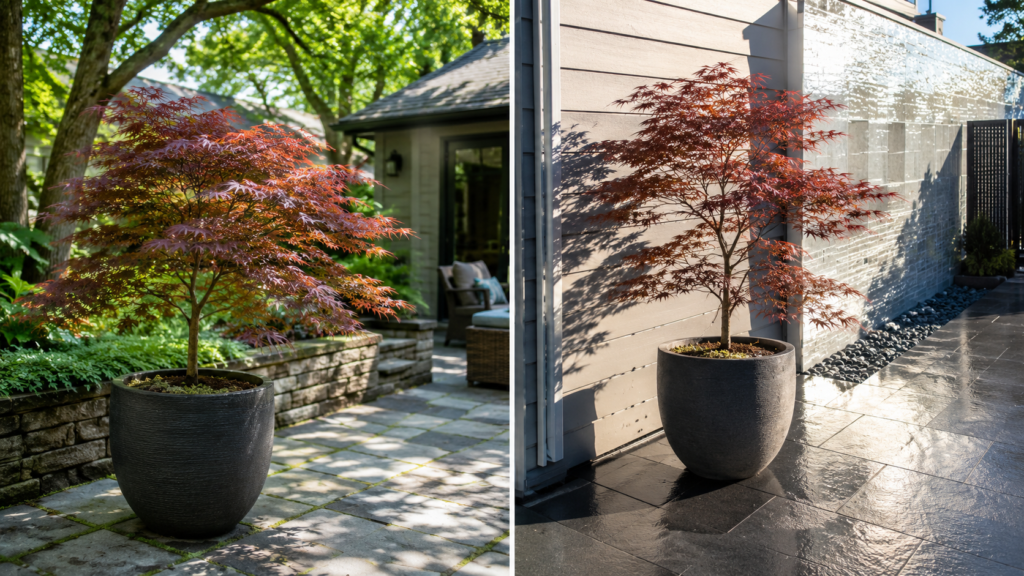
A sheltered location with suitable light is generally safest.
Many Japanese maples perform well with morning sun and protection from intense afternoon conditions. Some red and purple forms benefit from more light for strong color, while delicate green, gold, or variegated foliage may need greater protection in hot climates.
Good locations include:
- morning sun with afternoon shade;
- beneath an open tree canopy;
- sheltered patios;
- lightly shaded courtyards;
- woodland edges.
Use more caution near west-facing walls, dark paving, reflective glass, exposed terraces, and windy corners.
Choose the best microclimate before the best viewing angle.
Japanese Maple Planter Ideas for Different Climates
Container roots heat, cool, dry, and freeze faster than roots growing in open ground.
| Climate | Main concern | Adjustment |
|---|---|---|
| Hot and dry | Rapid drying | Afternoon protection |
| Hot courtyard | Reflected heat | Move away from hot surfaces |
| Windy | Drying and instability | Shelter and heavier pot |
| Cold winter | Root freezing | Protect the container |
| Wet winter | Waterlogging | Keep drainage clear |
In cold regions, the tree can often stay outside, but the rootball may need extra protection. Shelter or insulate the container and keep drainage open.
Do not automatically bring a dormant Japanese maple into a heated room; it is an outdoor deciduous tree.
Best Soil for Japanese Maples in Pots
Use a high-quality container growing medium that retains moisture but still drains freely.
Avoid dense garden soil used alone because it can compact and reduce oxygen around the roots.
A suitable mix should:
- stay evenly moist;
- drain excess water;
- remain aerated;
- resist rapid collapse;
- support a woody plant over several seasons.
A slightly acidic mix is generally suitable, but drainage and structure matter more than chasing an exact pH.
How Much Drainage Does a Japanese Maple Need?
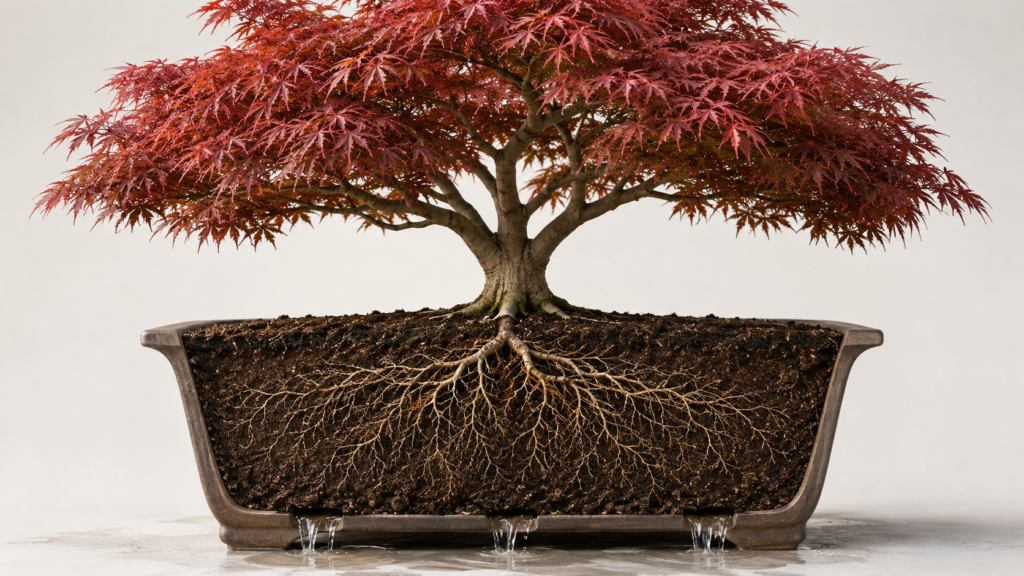
A Japanese maple planter needs open drainage holes so excess water can escape freely.
Check the bottom before planting, especially with decorative pots that may have plugs or sealed bases.
Do not rely on gravel to replace drainage holes.
The important pathway is:
growing medium → roots → open drainage holes
Pot feet can help keep outlets clear on flat paving. After planting, water thoroughly and confirm that water leaves the base.
How Do You Plant a Japanese Maple in a Pot?
Plant the maple at approximately the same depth it was growing in its nursery container.
- Confirm that drainage holes are open.
- Position heavy planters before filling.
- Add enough mix to establish the correct rootball height.
- Remove the tree carefully.
- Inspect obvious circling roots.
- Set the tree at its previous soil level.
- Backfill with container mix.
- Firm gently.
- Water thoroughly.
- Recheck drainage and planting depth.
Avoid burying the trunk, severely disturbing healthy roots, or immediately placing a newly potted maple in harsh exposure.
Best Companion Plants for Japanese Maples
Ferns, heucheras, and other low shade-tolerant foliage plants combine naturally with Japanese maples.
For long-term growing, separate pots are usually better than filling the maple’s root zone with vigorous companions.
Separate containers:
- reduce root competition;
- allow different watering;
- simplify replacement;
- give more design flexibility.
A simple woodland layout is a maple at the back, a fern to one side, and a lower foliage pot toward the front.
Common Japanese Maple Planter Mistakes
Avoid these common problems:
- buying by external planter size only;
- putting a small tree into an enormous pot;
- using a container without drainage;
- choosing a tall, narrow unstable planter;
- planting the trunk too deeply;
- overcrowding the root zone;
- watering strictly by calendar;
- placing the tree beside a hot reflective wall;
- ignoring drying wind;
- fertilizing brown leaves before diagnosing the cause.
Before planting, ask:
- Does the rootball fit?
- Can excess water escape?
- Is the planter stable?
- Is the location suitable?
- Can I reach it easily for maintenance?
How Do You Care for a Potted Japanese Maple?
Container-grown Japanese maples mainly need consistent moisture, moderate feeding, and periodic root management.
Watering
Check the growing medium rather than following a rigid schedule.
Keep it moist but not waterlogged. Hot or windy weather may require more frequent checking.
Feeding
Feed moderately. Japanese maples are valued for controlled growth and fine branching, not excessive soft shoots.
Repotting
Inspect the root system periodically.
Repot when:
- roots become heavily congested;
- roots appear through drainage holes;
- the pot dries unusually quickly;
- growth declines.
Increase planter size gradually. Mature specimens already in a practical final container may eventually need root management and fresh growing medium instead of a continually larger pot.
Why Are Japanese Maple Leaves Turning Brown?
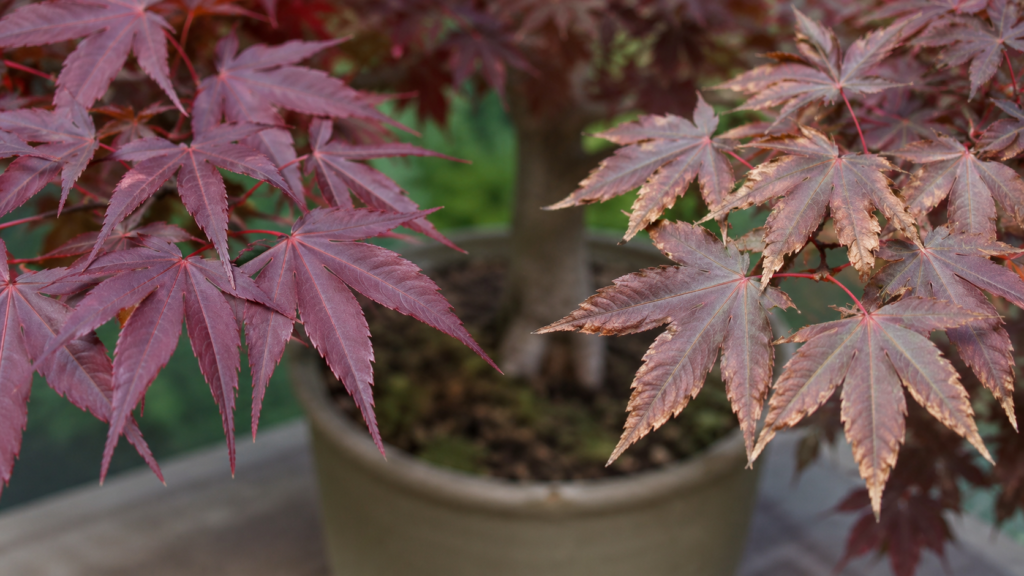
Brown or crispy leaf edges often indicate environmental leaf scorch rather than disease.
Common causes include:
- dry roots;
- strong afternoon sun;
- reflected heat;
- drying wind;
- recent frost;
- waterlogged roots;
- severe root congestion.
Check in this order:
moisture → drainage → heat → wind → frost → roots
Do not automatically add fertilizer. Correct the environmental cause first.
What Makes Japanese Maple Planter Ideas Work?
Use the Backyard Planter Ideas R.D.S.E. Test.
| Factor | What to check |
|---|---|
| R — Root Space | Rootball fits with room to develop |
| D — Drainage | Excess water can leave freely |
| S — Stability | Pot supports the developing canopy |
| E — Exposure | Site provides suitable light and shelter |
Backyard Planter Ideas rule: If a planter fails one R.D.S.E. requirement, solve that problem before choosing it for appearance.
This four-part test is more useful than selecting a pot by color or external dimensions alone.
What Should You Check Before Buying a Planter?
Use this order when comparing planters:
- Root fit
- Drainage
- Stability
- Climate suitability
- Mobility
- Appearance
Also check internal width, usable depth, base width, empty weight, expected planted weight, frost resistance where relevant, and whether a liner or false bottom reduces usable space.
Once two planters meet the functional requirements, choose between them according to color, material, and garden style.
Japanese Maple Planter Ideas FAQs
Do Japanese Maples Grow Well in Pots?
Yes. Compact and slow-growing Japanese maples grow well in containers when they have adequate root space, drainage, and suitable exposure.
How Long Can a Japanese Maple Stay in a Pot?
A Japanese maple can remain container-grown for many years with proper watering and root management. Repot or manage the roots as space becomes limited.
What Size Planter Is Best for a Japanese Maple?
Choose a planter moderately larger than the current rootball. Increase container size gradually as the tree develops.
Do Japanese Maples Prefer Wide or Deep Pots?
Broad, stable pots with enough depth for the existing rootball generally work best.
What Type of Planter Is Best?
Ceramic, terracotta, stone, wood, and composite can all work. Drainage, root space, and stability matter more than material alone.
Do Potted Japanese Maples Need Full Sun?
Not always. Many perform best with sheltered light, morning sun, or partial shade, especially in hot climates.
How Often Should You Water a Japanese Maple in a Pot?
Water according to the moisture in the growing medium rather than a fixed schedule. Keep the root zone moist but not saturated.
Does a Japanese Maple Planter Need Drainage Holes?
Yes. Open drainage holes are essential so excess rain and irrigation can leave the root zone.
Can a Japanese Maple Stay Outside in Winter?
Yes in many climates, although container roots may need extra protection where winters are severe.
Why Is My Japanese Maple Crispy in a Pot?
Crispy leaves often result from drought, heat, wind, frost, poor drainage, or root congestion. Check moisture and exposure before fertilizing.
Final Thoughts
The best Japanese Maple Planter Ideas start with the tree rather than the decorative container.
Choose a maple whose mature shape fits the available space, then give it enough root room, open drainage, stable proportions, and a suitable microclimate.
Broad low planters work especially well with cascading maples, charcoal and stone containers complement strong foliage colors, and separate companion pots make woodland-style arrangements easier to manage.
Before making the final choice, use the R.D.S.E. Test: Root Space, Drainage, Stability, and Exposure. When those four factors are right, a Japanese maple planter can provide structure, foliage texture, and seasonal color for years.
Sources and Horticultural References
Key horticultural references for this guide include:
- RHS Japanese Maples Growing Guide
- RHS Trees in Containers
- RHS Acer Leaf Scorch guidance
- RHS cultivar information for ‘Shaina’
- RHS cultivar information for ‘Crimson Queen’
- RHS cultivar information for ‘Jerre Schwartz’
- RHS cultivar information for ‘Jordan’
- RHS cultivar information for ‘Sango-kaku’
Myra is the founder and lead writer of Backyard Planter Ideas, where she shares practical, well-researched guidance on planter design, plant selection, and outdoor styling. Her goal is to help homeowners create attractive, functional garden spaces with clear, reliable, and easy-to-apply advice.