
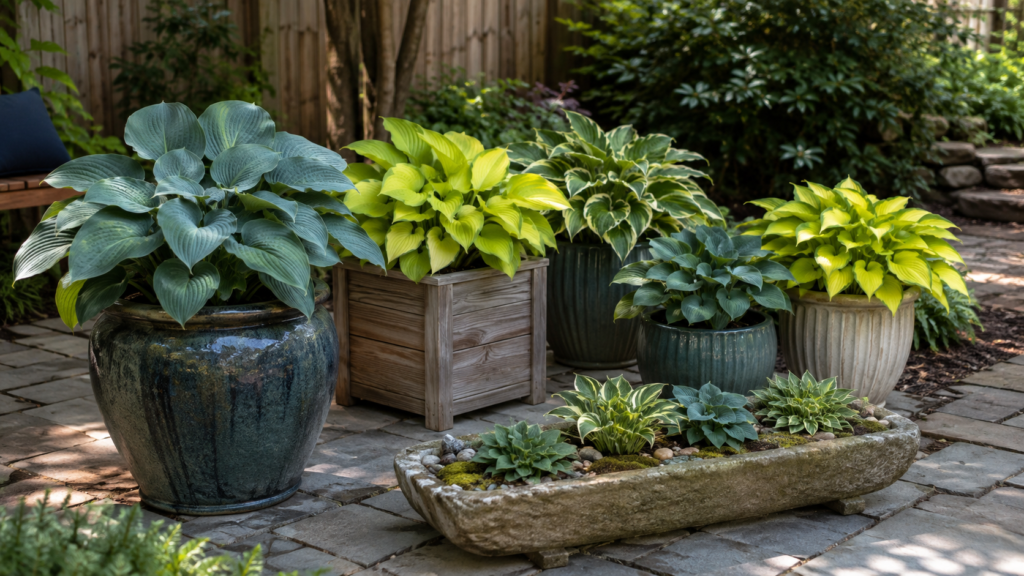
The best hosta planter ideas combine attractive foliage with a container that gives the plant enough room, dependable drainage, consistent moisture, and suitable shade. Large specimen pots, miniature hosta troughs, coordinated patio containers, raised planters, and woodland-style combinations can all work when the planter matches the hosta’s mature size.
Hostas are especially valuable in shaded backyards because their leaves provide color and structure where many flowering container plants struggle. Blue-gray, lime, gold, deep green, and variegated foliage can brighten patios, fence lines, entrances, garden paths, and woodland corners.
The most important rule is simple:
Choose the hosta first, understand its mature size and light needs, then choose the planter.
A beautiful pot cannot compensate for poor drainage, inadequate root space, or the wrong location.
Hosta Planter Design Formula
A successful hosta planter combines five elements:
hosta size + foliage color + planter scale + light + surrounding materials
The planter should complement the foliage rather than compete with it.
Useful combinations include:
- Blue hosta + pale stone planter + light shade
- Gold hosta + charcoal planter + morning light
- Variegated hosta + neutral pot + simple background
- Large hosta + broad container + open space
- Miniature hosta + low trough + close viewing position
- Several hostas + matching pots + consistent spacing
Large foliage generally needs a visually substantial container, while miniature hostas look better in smaller pots or troughs where their leaves can be viewed closely.Avoid combining a highly patterned planter, strongly variegated hosta, and busy background. Allow either the plant or the container to make the stronger visual statement.
12 Best Hosta Planter Ideas
1. Large Single Hosta Specimen Planter
One mature hosta in a substantial container is one of the strongest hosta planter ideas.
A single plant receives the entire root zone and becomes the focal point without competition from permanent companion plants.
This works particularly well with hostas featuring:
- large blue-green leaves
- strong puckering or corrugation
- cream or white margins
- bright lime foliage
- upright growth
Choose a broad planter that visually balances the mature foliage. Avoid very narrow containers beneath large spreading plants.
Good locations include shaded entrances, patios, garden steps, benches, and path endings.
Best for: creating one strong foliage focal point.
2. Three Hosta Pots at Different Heights
Three coordinated planters create more depth than three identical pots placed in a straight line.
Arrange them:
tall → medium → low
Then vary foliage color rather than changing every container style.
For example:
- blue hosta at the back
- variegated hosta in the middle
- compact gold hosta in front
Repeat one planter material or color to create visual consistency.
Position the empty pots before filling them because large containers become difficult to move once filled with moist potting mix.
Best for: shaded patio corners and wider entrances.
3. Miniature Hosta Trough
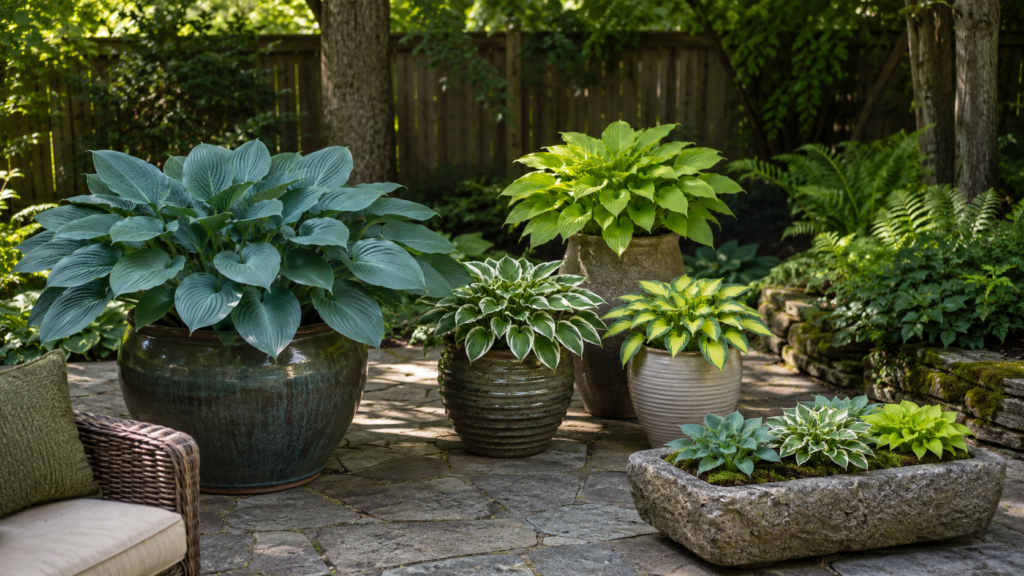
Miniature hostas are ideal for bowls, troughs, and low containers.
Their small leaves are easier to appreciate when planted near paths, seating areas, or other close-viewing locations.
Use genuinely miniature cultivars and leave visible space between crowns.
A miniature planter still needs:
- useful soil depth
- good drainage
- moisture-retentive potting mix
- protection from harsh sun
Do not overcrowd the trough with aggressive companion plants.
Best for: small yards, patios, and hosta collections.
4. Shaded Patio Hosta Planter
A large hosta container can soften the transition between paving and the garden.
Match the planter to the patio material:
- cedar with decking
- charcoal resin with concrete
- pale ceramic with stone
- terracotta with brick
Leave enough room for mature leaves to expand without blocking walking areas or furniture.
Also consider reflected heat. A shaded patio can still become hot when walls or paving absorb sunlight.
Best for: shaded seating areas and patio edges.
5. Matching Hosta Planters Along a Fence
Repeated containers can turn a plain shaded fence into a structured foliage display.
Keep the planter material consistent and alternate leaf colors.
For example:
blue → variegated → gold → variegated → blue
Before positioning the pots permanently, observe the fence throughout the day. Some sections may receive much more afternoon sun than others.
Leave enough space behind the containers for watering, airflow, and fence maintenance.
Best for: long shaded boundaries.
6. Woodland Hosta Container Group
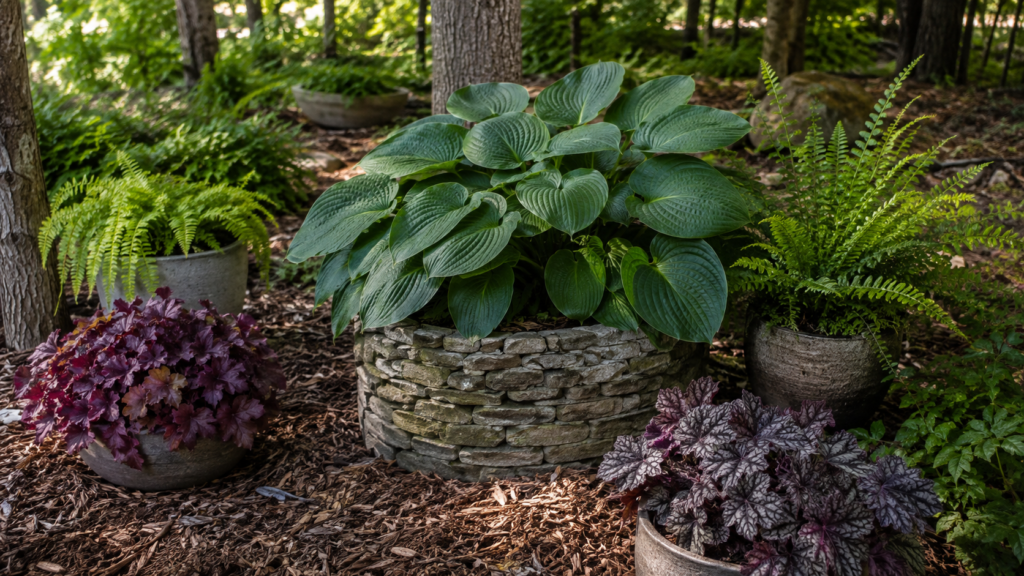
Hostas combine naturally with ferns and other shade foliage.
Instead of filling one container with many plants, consider grouping separate pots to create a layered woodland effect.
Strong combinations include:
- broad hosta leaves + fine fern fronds
- blue hosta + burgundy heuchera
- lime hosta + deep-green foliage
Remember that shade beneath trees can be dry because the canopy intercepts rainfall.
Best for: woodland gardens and mature landscapes.
7. Blue Hosta in a Pale Planter
Blue-gray foliage looks especially effective against:
- cream
- beige
- pale gray
- weathered stone
- light concrete
containers.
Keep the background simple so the foliage remains the focal point.
Blue hostas generally look strongest in protected shade where their cool-toned foliage remains visually distinctive.
Best for: calm, elegant container displays.
Gold Hosta in a Dark Planter
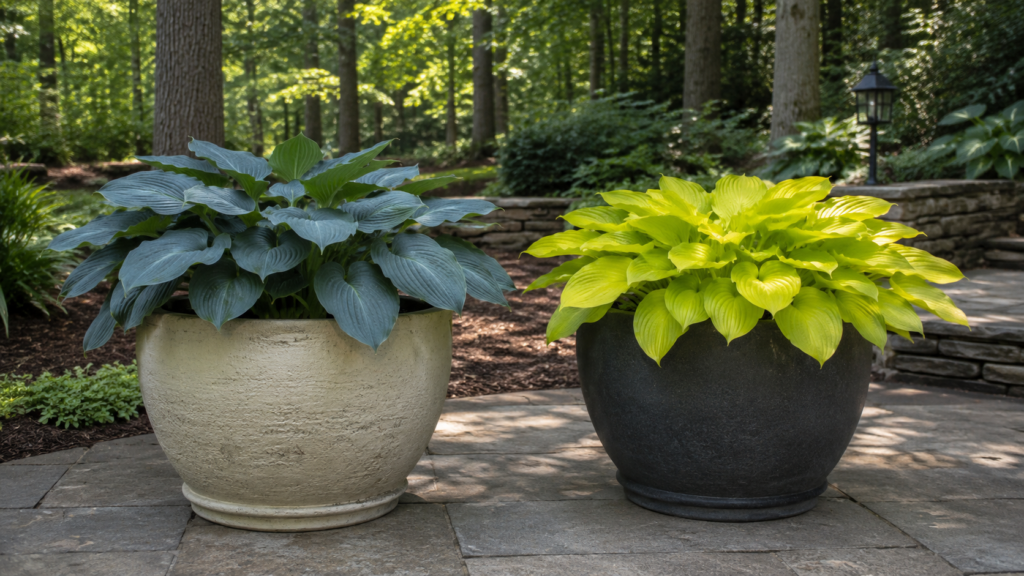
Gold or chartreuse foliage can brighten shaded corners.
Pair it with:
- charcoal
- black
- dark brown
- deep gray
containers.
The contrast is particularly useful in modern gardens.
Watch dark containers in sunny locations because they can absorb heat even when the hosta itself receives partial shade.
Best for: contemporary patios and darker garden corners.
9. Hosta and Heuchera Planter
Hostas and heucheras create strong foliage contrast.
Useful combinations include:
- blue + burgundy
- chartreuse + dark purple
- variegated + caramel
- green + silver
Use the hosta as the main structural plant and heuchera as a supporting element.
Check mature dimensions before planting them together. Large hostas are often better in their own pots.
Best for: mixed foliage containers.
10. Raised Hosta Planter
A wide raised planter can hold several hostas while keeping soil, moisture, and spacing easier to manage.
Arrange larger cultivars toward the back or center and smaller plants near accessible edges.
Do not overcrowd young plants just to create instant fullness.
A raised planter also makes slug inspection, watering, and maintenance easier.
Best for: several hostas intended to grow together long term.
11. Hostas Beneath a Tree Canopy
Containers allow hostas to grow beneath mature trees without directly competing with established tree roots.
They also avoid the need to disturb existing root systems.
However, tree canopies often intercept rainfall, so containers may require regular watering even when the surrounding area looks shaded and cool.
Do not pile additional soil around tree trunks.
Best for: established landscapes with heavy root competition.
12. Hosta Planters Along a Garden Path
A pathside collection allows foliage differences to be appreciated closely.
Hostas vary in:
- leaf size
- waviness
- puckering
- corrugation
- margin color
- variegation
- overall mound shape
Place smaller plants near the path and larger hostas farther back.
Keep enough walking clearance for mature foliage.
Best for: collectors and foliage-focused shade gardens.
Which Hosta Planter Idea Should You Choose?
Match the design to your space rather than choosing only by appearance.
- One standout hosta: specimen planter
- Large patio: three coordinated pots
- Miniature cultivars: trough or bowl
- Fence line: matching repeated containers
- Several hostas: raised planter
- Woodland area: grouped natural-toned pots
- Under trees: individual containers
- Modern garden: geometric resin or composite pot
- Garden path: cultivar collection
Ask three questions before deciding:
- How large will the hosta become?
- How much usable root space does the planter provide?
- Will the location still work when the foliage reaches mature width?
Choose the design that remains practical several years after planting.
Which Hostas Are Best for Planters?
Almost any appropriately sized hosta can grow in a container, but smaller cultivars are generally easier to manage.
Miniature hostas such as Blue Mouse Ears work well in bowls and troughs. Medium cultivars such as June and Halcyon can become attractive individual specimens. Larger hostas require substantially more soil volume and open space.
Choose according to:
- mature height
- mature spread
- foliage color
- light requirements
- growth rate
- available planter size
Blue hostas pair naturally with pale planters, while gold and chartreuse foliage stands out against darker containers.
Do not try to permanently restrict a naturally giant hosta by keeping it in a small pot.
What Size Planter Is Best for Hostas?
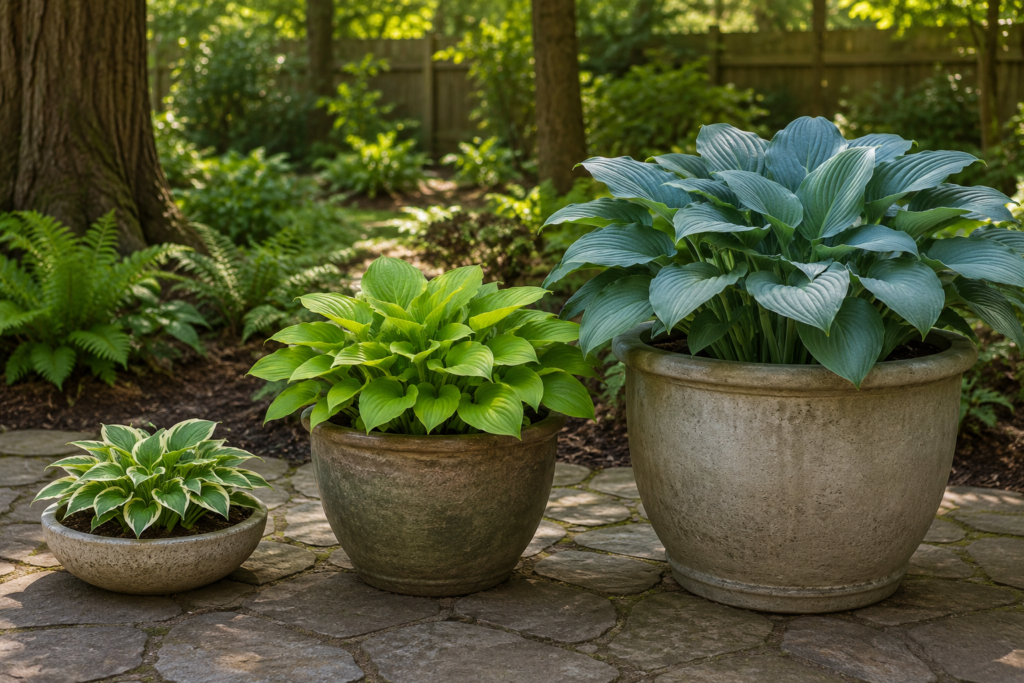
There is no universal hosta planter size.
The correct container depends on the cultivar and current root system.
Check:
- internal width
- usable depth
- base width
- drainage openings
- taper
- current root-ball size
Young hostas can be moved progressively into larger pots as they develop.
A hosta may need more space when:
- the pot dries unusually quickly
- roots are tightly packed
- the crown fills most of the surface
- growth declines
- little potting mix remains around the roots
Judge the inside of the planter rather than relying only on exterior measurements.
Wide or Deep?
Hostas need both width and depth, but broad stable containers usually suit their spreading foliage better than extremely tall narrow pots.
Avoid containers with excessive taper, very narrow bases, or large false bottoms that reduce usable root volume.
Useful internal volume matters more than decorative height.
Which Hosta Planter Materials Are Best?
Several materials work well.
Ceramic
Good for specimen plants and patios. It offers attractive finishes but can become very heavy.
Resin or Plastic
Lighter when empty and useful for larger planters. Check that drainage holes are open.
Composite
Durable and suitable for modern gardens. Verify actual internal dimensions before buying.
Wood
Works naturally beside fences, decks, and woodland gardens. Choose exterior-grade material suitable for repeated moisture exposure.
Terracotta
Traditional and attractive but porous, so it may dry faster during warm weather.
Concrete or Stone-Look
Stable and excellent for permanent displays, but difficult to move once filled.
Self-Watering Planters
Self-watering containers can help reduce moisture fluctuations, especially beneath roof overhangs or tree canopies.
They still require suitable growing media, proper reservoir design, and adequate aeration.
Self-watering does not mean permanently waterlogged.
Where Should You Place Hosta Planters?
Most hostas perform well in partial, light, or dappled shade.
Before filling a large planter, observe the location throughout the day.
Check:
- morning sun
- afternoon sun
- reflected heat
- fence shadows
- tree canopy
- wind
- rainfall
- watering access
Morning sunlight is often easier for hostas to tolerate than intense afternoon exposure.
Some gold or yellow cultivars benefit from extra light, while blue foliage generally looks strongest in more protected conditions.
Deep shade can work, but extremely dark locations may reduce vigor.
What Soil Is Best for Hosta Planters?
Use a quality container potting mix that remains moist while allowing excess water to drain.
The root environment should provide:
- moisture
- air
- drainage
- stable structure
Avoid filling the container mainly with ordinary backyard soil because it can compact inside pots.
The goal is:
moist + aerated + well drained
Do not waste useful root space on unnecessary decorative internal layers.
How Do You Plant a Hosta in a Planter?
- Check that drainage holes are open.
- Add enough potting mix to establish the correct planting height.
- Remove the hosta from its nursery pot.
- Inspect the roots.
- Gently loosen severely circling roots if necessary.
- Position the hosta near its previous growing depth.
- Fill around the root ball.
- Firm the mix lightly.
- Leave watering space beneath the rim.
- Water thoroughly.
Do not deeply bury the crown.
After planting, place the hosta in suitable shade and monitor moisture while it becomes established.
If water does not exit after thorough watering, inspect the drainage immediately.
How Much Drainage Do Hosta Planters Need?
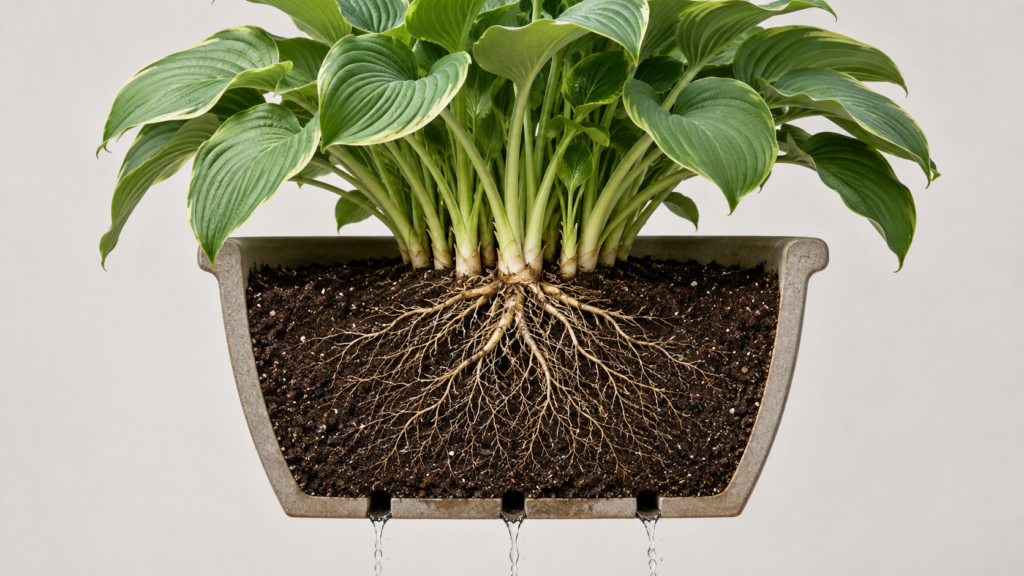
Hosta containers need unobstructed drainage.
The correct cycle is:
water → evenly moist soil → excess water exits
Several drainage openings are generally safer than one easily blocked hole.
Check that:
- drainage holes remain open
- the planter does not seal flat against paving
- water has somewhere to exit
- saucers do not hold standing water continuously
Hostas prefer moisture, but their roots should not remain permanently saturated.
How Should You Water Hostas in Planters?
There is no universal watering schedule.
Frequency depends on:
- temperature
- wind
- pot size
- planter material
- hosta size
- rainfall
- root density
Check moisture below the surface rather than watering automatically.
Water deeply enough to moisten the root zone and allow excess water to drain.
If a hosta suddenly needs much more frequent watering, check whether its roots have filled the planter.
What Plants Can You Combine With Hostas?
Good companions include:
- ferns
- heucheras
- brunnera
- compact shade perennials
- shade-tolerant annuals
Use foliage contrast:
broad + fine
blue + burgundy
gold + dark green
variegated + solid
Check mature plant sizes before combining several permanent plants in one container.
For large hostas, separate coordinated pots usually provide more reliable long-term space.
How Can You Stop Slugs Damaging Hostas?
Inspect:
- beneath foliage
- under planter rims
- behind pots
- damp debris
- boards and stones
- dense mulch
Look for irregular holes and slime trails.
Reduce unnecessary hiding places and inspect plants after wet weather.
Thicker-leaved cultivars may experience less damage than thin-leaved varieties.
What About Vine Weevil?
Container hostas can also be affected by vine weevil.
Adults may notch leaf edges, while larvae can damage roots.
If a properly watered hosta suddenly wilts or declines, inspect the root zone instead of assuming drought or nutrient deficiency.
Can Hosta Planters Stay Outside During Winter?
Many hostas can remain outside, but container roots are more exposed than in-ground roots.
Winter risks include:
- freeze-thaw cycles
- saturated soil
- drying wind
- cracked containers
- blocked drainage
In colder regions, consider:
- sheltered locations
- grouping pots
- insulating containers
- protecting them from excessive winter rain
- using frost-resistant planters
Smaller exposed pots generally need more protection.
Are Hostas Safe for Pets?
Hostas are considered toxic to dogs and cats if eaten.
If your pet regularly chews plants, position hosta containers where access can be controlled or consider an alternative plant.
Pet safety should be considered before filling a large permanent container.
What Maintenance Do Hosta Planters Need?
Regularly check:
- moisture
- drainage
- damaged foliage
- slug activity
- root crowding
- planter stability
Repotting
Repot when roots become crowded, the container dries excessively quickly, or the plant clearly needs more growing space.
Division
Divide hostas when you need to reduce an oversized clump or create additional plants. Healthy hostas do not require division simply because a certain number of years has passed.
Fertilizer
Container hostas may benefit from feeding during active growth, but fertilizer should not be the first response to every problem.
Use this diagnostic order:
light → moisture → drainage → roots → pests → nutrition
Correct the growing environment before increasing fertilizer.
What Hosta Planter Mistakes Should You Avoid?
Avoid:
- choosing the pot before the cultivar
- using an undersized planter
- overcrowding plants
- ignoring mature foliage spread
- giving every cultivar identical light
- allowing repeated drought
- blocking drainage
- ignoring winter exposure
- creating damp slug habitat
- assuming fertilizer fixes every problem
The strongest rule is:
Plan for the mature hosta, not the small nursery plant.
What Should You Check Before Buying?
Before buying a hosta planter, check:
- internal width
- usable depth
- internal base width
- drainage holes
- taper
- false bottoms
- filled weight
- outdoor durability
- frost resistance
A shorter straight-sided planter may provide more usable root space than a taller decorative container with a narrow base.
Real Planter Measurement Test
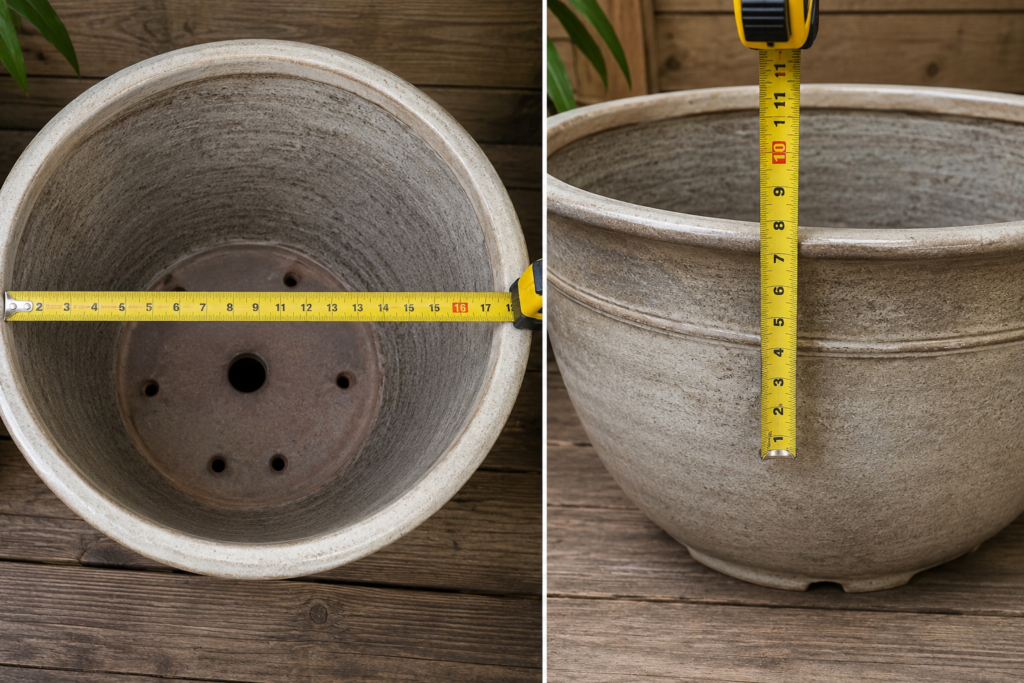
For stronger first-hand evidence, measure real planters before planting.
Record:
- exterior width
- internal width
- internal base width
- usable depth
- drainage-hole count
- approximate capacity
- planter material
Photograph the planter with a tape measure showing the internal dimensions.
After planting, record watering frequency, drainage performance, root crowding, and whether the planter remains appropriately sized.
Only publish measurements as personal experience when they were actually taken.
What Is the Best Hosta Planter Idea?
For most gardens, the strongest option is one appropriately sized hosta in one substantial planter.
It provides:
- a separate root zone
- easier watering
- simple drainage management
- easy repotting
- clear visual impact
For larger displays:
- Two hostas: two coordinated pots
- Three hostas: staggered grouping
- Miniature hostas: trough
- Several hostas: raised planter
- Modern garden: geometric composite or resin pot
- Woodland garden: natural-toned containers
- Cold climate: durable planter with winter protection
Use this order:
light → cultivar → mature size → planter volume → drainage → soil → water → winter → appearance
The simplest rule is:
Choose the planter from the hosta’s long-term needs outward, not from the decoration inward.
Hosta Planter FAQs
Can hostas grow well in planters?
Yes. Hostas grow well in containers with suitable shade, consistent moisture, drainage, and enough root space.
What size planter is best for hostas?
It depends on the cultivar. Miniature hostas need smaller pots, while medium and large hostas require more space as they mature.
Do hostas prefer deep or wide pots?
Both matter, but broad containers generally suit their spreading growth better than very tall narrow pots.
How many hostas can you put in one planter?
One medium or large hosta per ordinary container is usually easiest. Several can share a genuinely large trough or raised planter.
Can hostas grow in full shade?
Many tolerate substantial shade, but partial or dappled shade is usually a stronger growing environment.
How often should you water hostas in pots?
Water according to soil moisture rather than a fixed schedule. Check more frequently during hot, dry, or windy weather.
What soil is best for hostas in containers?
Use a moisture-retentive but well-draining container potting mix rather than dense backyard soil.
Do hosta pots need drainage holes?
Yes. Open drainage holes allow excess water to escape while keeping the root zone moist.
Can hostas stay in pots for several years?
Yes. They can remain container-grown for years when they have enough root space and are repotted or divided when necessary.
Can hostas stay outside in winter?
Often yes, but containers may need extra protection in very cold climates because the roots are more exposed.
How do you stop slugs eating hostas in pots?
Inspect beneath leaves, rims, pots, and damp debris. Reduce hiding places and use appropriate controls when needed.
Are hostas toxic to dogs and cats?
Yes. Hostas can be toxic if eaten, so keep them away from pets that regularly chew garden plants.

Myra is the founder and lead writer of Backyard Planter Ideas, where she shares practical, well-researched guidance on planter design, plant selection, and outdoor styling. Her goal is to help homeowners create attractive, functional garden spaces with clear, reliable, and easy-to-apply advice.