
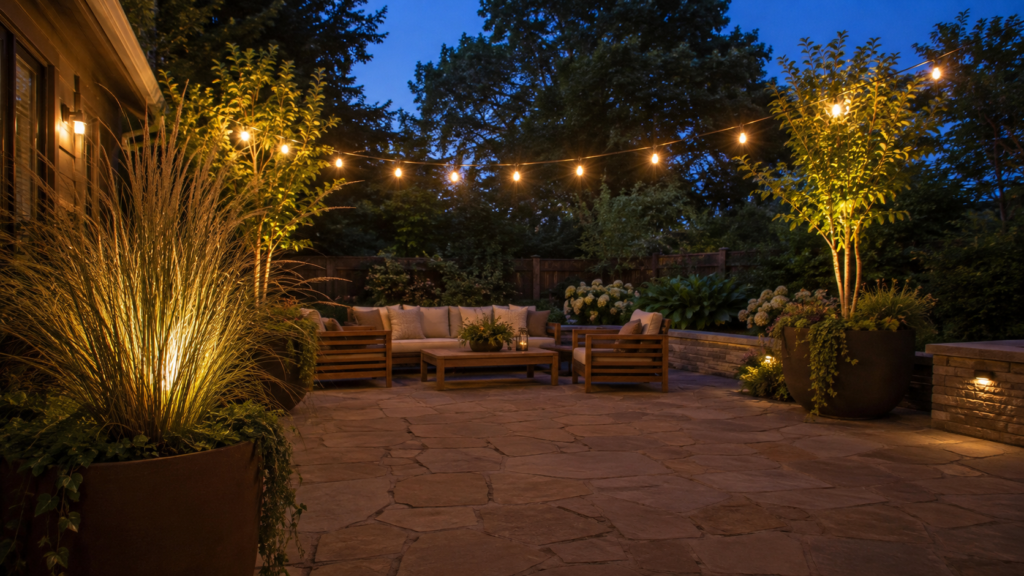
Backyard planter ideas with lights combine containers, plants, and outdoor lighting to make patios, pathways, entrances, fences, and seating areas more inviting after sunset. Solar stake lights are the easiest option for existing planters, uplights work well for dramatic foliage, planter poles can support string lights around entertaining areas, and low-voltage lighting suits more permanent landscapes.
The best setup starts with one decision: are you lighting the container, the plant, or the surrounding space? Then check practical conditions such as sunlight, drainage, plant growth, glare, and outdoor electrical suitability. Good planter lighting should enhance the backyard without making every container equally bright.
Quick Choice: Backyard Planter Ideas With Lights
Choose lighting according to the problem you want to solve rather than the fixture that looks most impressive. A solar stake may be all an existing patio planter needs, while a string-light pole planter is more useful when the real goal is to create overhead ambience.
| Your goal | Best starting option |
|---|---|
| Easiest setup | Solar stake planter |
| Cozy patio | String-light pole planter |
| Dramatic foliage | Low uplight |
| Modern design | Concealed planter lighting |
| Rental-friendly | Solar lantern + planter |
| Deep shade | Remote-panel or wired light |
| Walkway | Low marker light |
| Focal point | Spotlighted planter |
| Small backyard | Perimeter lighting |
| Vertical interest | Trellis + micro lights |
Use solar or rechargeable fixtures when flexibility matters. Choose low-voltage or wired lighting for permanent landscapes or heavily shaded areas. If two options seem equally suitable, test the simpler movable option first.
Which Backyard Planter Lights Work Best?
The best planter light depends on the planter’s location, plant type, intended lighting effect, and whether the installation is temporary or permanent. A sunny freestanding container works well with solar lighting, while a permanent raised planter may justify concealed low-voltage fixtures.
Think about what needs attention:
- Solar stake: easy decorative glow
- Uplight: foliage and plant form
- String lights: patio or seating atmosphere
- Concealed light: modern raised planters
- Marker light: walkways and transitions
- Spotlight: specimen plants
- Remote-panel solar: shaded containers
- Integrated LED planter: container as focal point
The fixture’s position matters as much as its type. A powerful light aimed badly can cause glare, while a smaller light positioned behind foliage may create a better result.
17 Backyard Planter Ideas With Lights
1. Add a Solar Light to a Tall Planter
Place a solar stake near the outer area of a large planter so it does not interfere with the main root crown, watering, or drainage. Tall grasses, compact shrubs, and upright foliage work especially well because the light can pass through the plant and create texture.
Keep the solar panel exposed to useful daylight rather than burying it under leaves. This is one of the easiest choices for patios, gates, entrances, and rental-friendly gardens.
2. Create a Three-Planter Solar Light Cluster
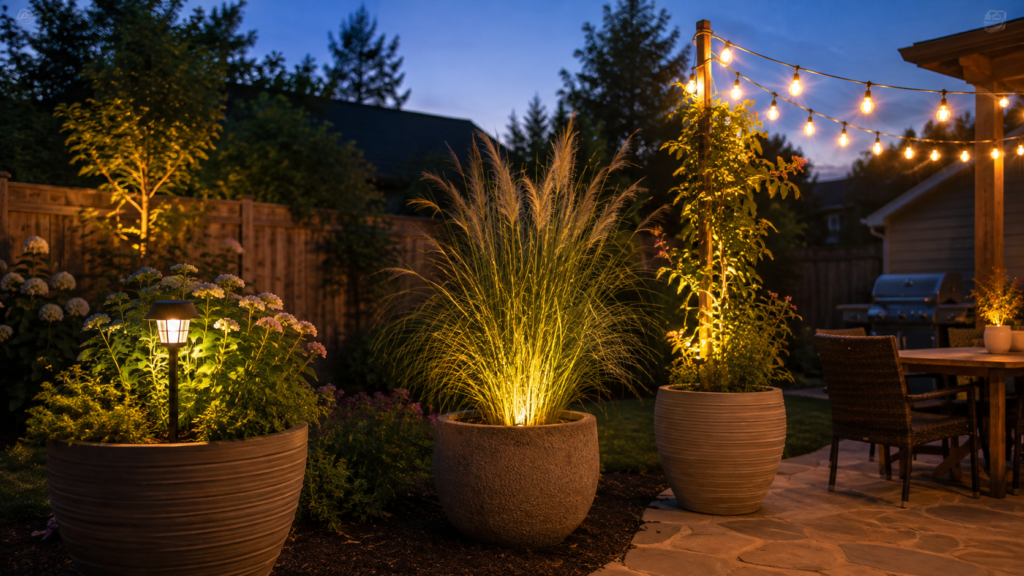
Group one tall, one medium, and one low planter instead of lighting several isolated pots.
A simple arrangement could be:
- tall ornamental grass
- medium foliage planter
- low trailing plant
- one uplight
- one subtle marker light
Do not illuminate all three equally. Let one planter act as the focal point and allow the others to catch reflected light.
3. Build a String-Light Pole Planter
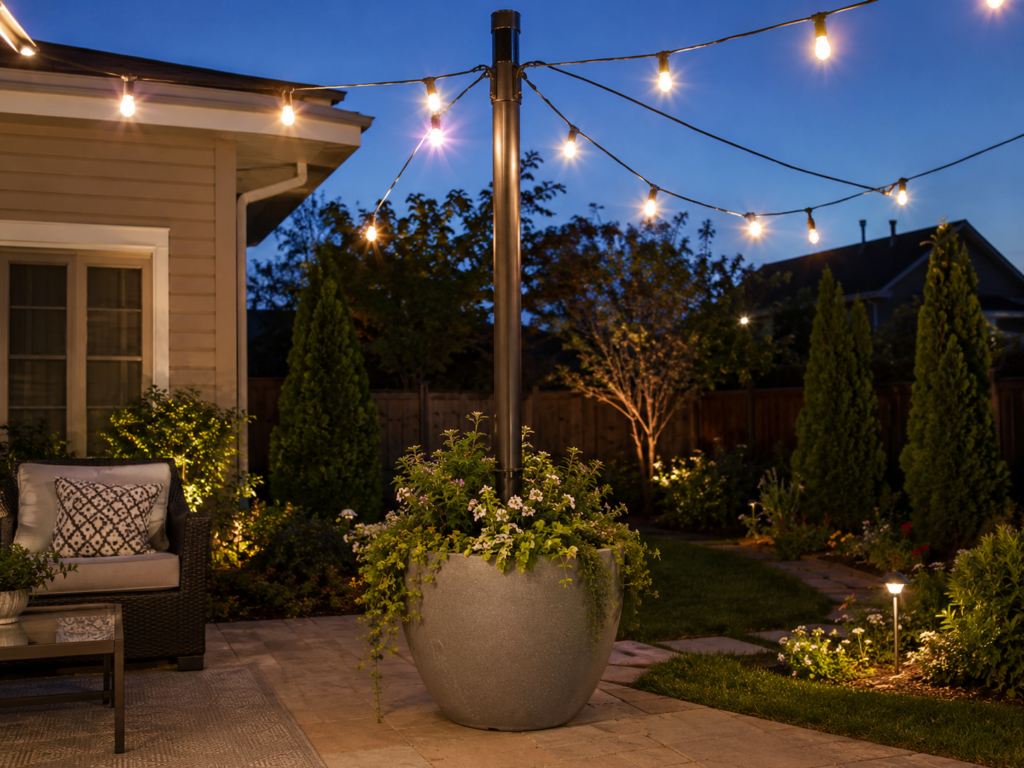
A large planter can visually conceal the base of a support pole for outdoor string lights. This works well when a patio has no pergola, wall, or tree suitable for overhead lighting.
Plan the structure before planting:
- determine where the string lights need support
- choose a substantial planter
- install a stable pole-support system
- preserve drainage
- add potting medium and plants
- install outdoor-rated string lights
Do not rely on loose soil or roots to hold a tall pole upright.
4. Frame a Patio With Two Light-Pole Planters
Place two structurally suitable planter poles at important patio corners and connect the lighting overhead. The planters create a visual frame during the day, while the string lights define the entertaining space after sunset.
Use related container finishes and similar plant heights without making both arrangements identical. This gives the patio structure without making it feel rigid.
5. Uplight Ornamental Grasses
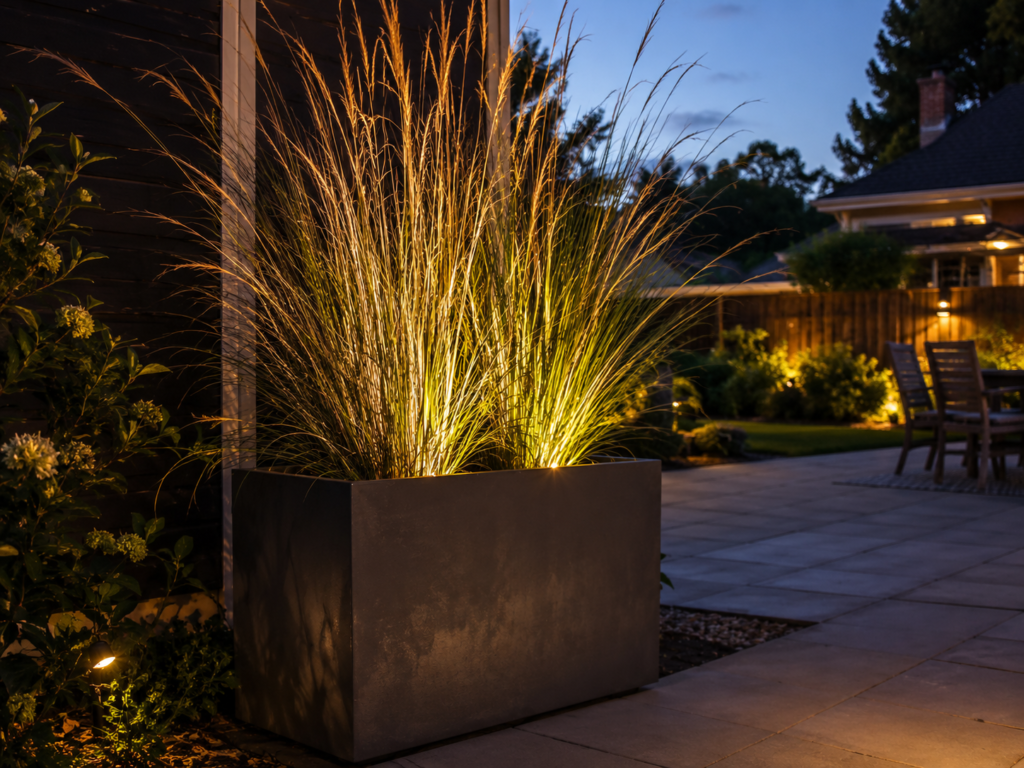
Ornamental grasses are excellent for uplighting because narrow leaves catch light at different angles and move naturally in the wind.
Place a controlled light near the base and aim it through the foliage. Test the result from the house, seating area, and walkway so the fixture remains hidden and does not produce glare.
This approach also works with small container trees, architectural succulents, and large textured foliage.
6. Hide Lighting Beneath a Raised Planter
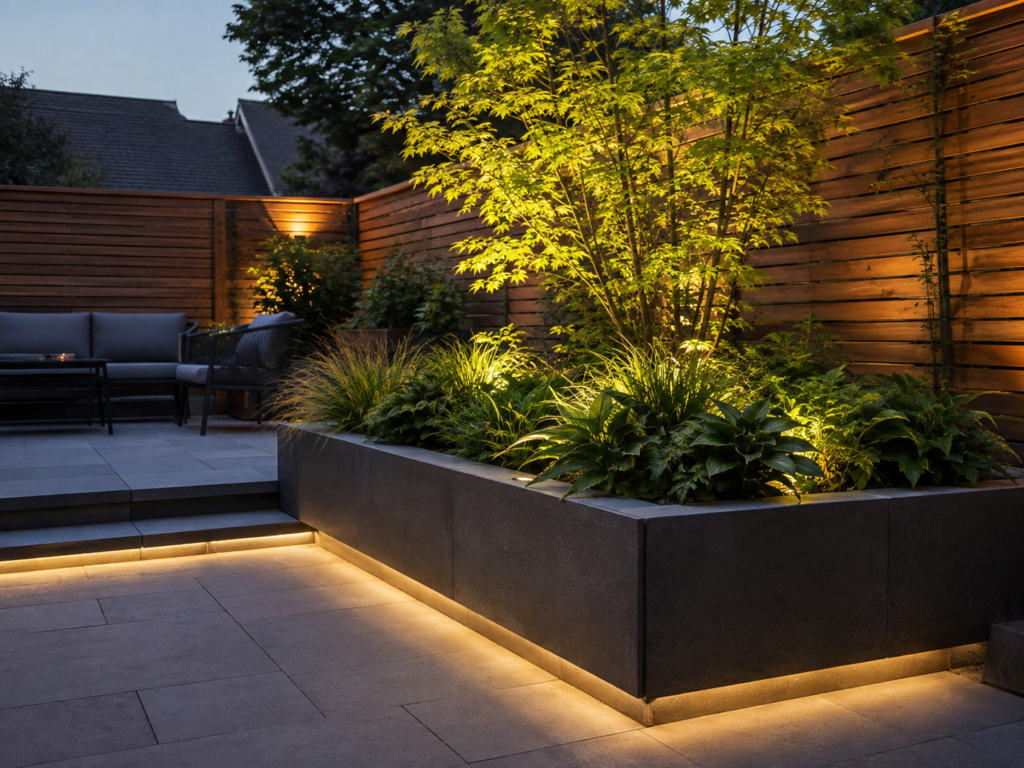
A raised planter can conceal suitable outdoor lighting beneath an edge or overhang, creating a clean modern glow across paving, decking, or gravel.
Keep the functions separate:
plants → soil/drainage → structure → lighting
Do not block drainage just to hide a fixture. Use enough light to reveal the planter’s shape rather than making the ground beneath it excessively bright.
7. Use an Illuminated Planter
An illuminated planter makes the container itself part of the nighttime design.
This works best with simple planting such as:
- ornamental grass
- one architectural plant
- compact shrub
- restrained trailing foliage
Use illuminated containers as focal points rather than lighting every pot. One or two strong examples usually look more intentional than a whole row of glowing planters.
8. Combine Fence Planters With Downlighting
Place planters beneath controlled fence or wall lights so the beam passes through foliage and creates shadows on the boundary behind them.
The visual sequence becomes:
fence → light → plant → planter → ground
This works especially well in narrow backyards where lighting can soften a tall boundary. Keep some areas dark to create depth instead of lighting the entire fence equally.
9. Line a Walkway With Lighted Planters
Use planters as visual markers at useful points rather than placing identical lights every few feet.
Good positions include:
- path entrance
- bend
- gate
- step
- change in paving
- patio transition
A few strategically placed planters can help people understand the route while adding greenery. Decorative planter lighting should complement dependable lighting where genuine hazards require reliable visibility.
10. Add Micro Lights to a Hanging Planter
Outdoor-rated micro lights can add a soft glow to hanging baskets beneath pergolas or covered patios.
Use them sparingly. Hanging planters already contain several visual elements, including foliage, flowers, chains, and trailing stems. Too many lights can make the arrangement look cluttered.
Keep the lights removable and allow room for plant growth and watering.
11. Light a Trellis Planter Vertically
A planter with a trellis can provide vertical greenery, privacy, and subtle lighting in one footprint.
Guide a small outdoor-rated light strand loosely through the trellis rather than outlining every section. Let portions of the light disappear behind foliage and reappear between leaves.
This works well beside patios, blank walls, pergolas, and narrow side yards.
12. Light a Kitchen Herb Planter
A herb planter near an outdoor kitchen or dining area can use a small focused light for practical visibility.
The light can help you see herbs such as rosemary, thyme, parsley, mint, or basil while cooking outdoors. Turn it off when the area is no longer in use rather than treating decorative lighting as an all-night grow light.
13. Pair a Planter With a Solar Lantern
A solar lantern beside a planter creates a lighted composition without placing electrical or lighting components in the soil.
This works well for:
- renters
- movable patios
- decks
- seasonal arrangements
Place the lantern slightly to one side so some light reaches the foliage. Keep its solar collector in a location with useful daylight exposure.
14. Spotlight One Statement Planter
A specimen plant can become the backyard’s main nighttime focal point with one carefully positioned spotlight.
Good candidates include:
- small container trees
- sculptural shrubs
- ornamental grasses
- architectural foliage
- succulents
Before fixing the light permanently, test it from the house, the main seating area, and the nearest walkway. The goal is visual separation, not maximum brightness.
15. Light the Boundary of a Small Backyard
Small yards benefit from keeping planters and lighting near the perimeter so the center remains open.
Place selected lighted planters near:
- fences
- walls
- corners
- patio edges
Avoid lighting the entire boundary equally. A few brighter points separated by darker areas can make a compact backyard feel deeper.
16. Light Shaded Planters Differently
A shade-loving plant may sit in a poor location for an integrated solar panel.
Instead of moving the plant into unsuitable sun, consider:
- remote-panel solar lighting
- rechargeable fixtures
- nearby wall lighting
- low-voltage landscape lights
- suitable wired fixtures
Choose the correct location for the plant first, then solve the lighting problem separately.
17. Combine Planters and Lights Around Seating
Use planters and lighting together to define an outdoor room.
A simple layout is:
tall rear planters → seating → side foliage → low accent lights → overhead string lights
During the day, the planters create enclosure. At night, the lighting reinforces it.
Sit in every main chair before finalizing fixture positions. Lighting that looks hidden while standing can create uncomfortable glare at seated eye level.
Common Backyard Planter Lighting Mistakes
Many planter-lighting problems come from placement rather than the fixture itself. A solar light may fade because its collector is shaded, a plant may look flat because the beam angle is wrong, or a patio may feel harsh because visible bulbs create glare.
| Problem | Likely cause | Better solution |
|---|---|---|
| Solar light fades early | Poor panel exposure | Reposition panel |
| Plant looks flat | Wrong beam angle | Move light off-center |
| Patio feels harsh | Too bright/exposed | Reduce or shield |
| Pole moves | Weak support | Improve structure |
| Light disappears | Plant growth | Reposition seasonally |
| Drainage suffers | Blocked outlet | Restore drainage |
| Colors conflict | Mixed light temperatures | Standardize |
| Guests see glare | Poor sight line | Re-aim fixture |
Avoid buying lights before deciding their purpose. Do not block drainage, hide solar collectors beneath foliage, or light every planter at equal brightness.
3-Layer Rule for Backyard Planter Lights
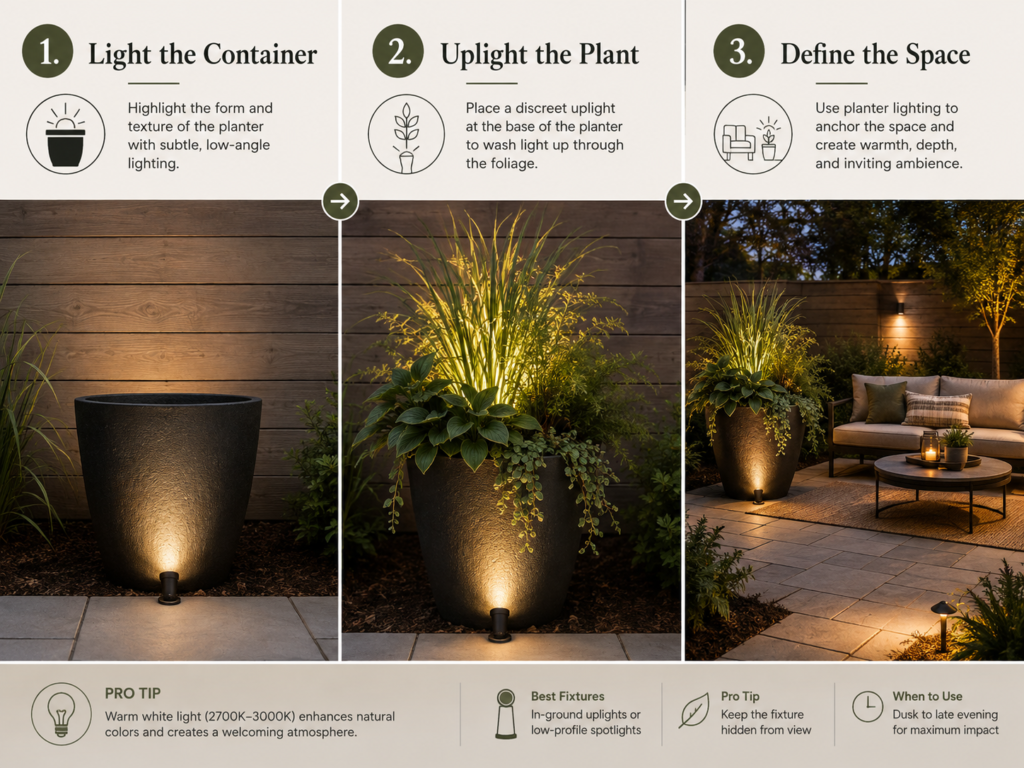
The 3-Layer Planter Lighting Rule helps decide what each fixture should illuminate.
Container
Light the container when its material, shape, or structure deserves attention.
Examples include:
- illuminated pots
- raised-planter edge lighting
- architectural containers
Plant
Light the plant when foliage, movement, texture, or branching is the main attraction.
Examples include:
- grass uplighting
- specimen-tree spotlights
- backlit leaves
Space
Light the surrounding space when the planter helps define a patio, path, or seating area.
Examples include:
- planter-supported string lights
- pathway containers
- trellis lighting
Most planters do not need all three layers.
A stronger design usually uses one dominant layer and one supporting layer.
Solar vs Wired Planter Lights
Solar lighting is best when you want easy installation, portability, and seasonal flexibility. Wired or low-voltage lighting is generally better for permanent landscapes, heavily shaded locations, and coordinated lighting systems.
| Factor | Solar | Wired/Low Voltage |
|---|---|---|
| Installation | Easy | More involved |
| Mobility | High | Limited |
| Shade tolerance | Lower | Better |
| Rental-friendly | Excellent | Less suitable |
| Permanent design | Good | Excellent |
| Coordinated controls | Limited/product dependent | Strong |
Choose solar when the planter receives useful daylight and may move.
Choose low voltage when the landscaping is permanent, shade is substantial, or several fixtures need to work together.
Neither option is universally better. Match the system to the location and intended function.
Best Light Color for Backyard Planters
Warm lighting is usually the safest choice around backyard planters because it works naturally with foliage, timber, terracotta, brick, and stone.
A simple guide:
- 1800–2200K: amber
- around 2700K: warm residential light
- 2700–3000K: warm white
- 4000K+: noticeably cooler
Consistency matters more than chasing an exact number. Mixing warm string lights, blue-white solar stakes, and neutral wall lights can make a small patio feel visually confused.
For most backyard seating and planter areas, keep the lighting warm and consistent.
Sun-Water-Wire Check for Planter Lights
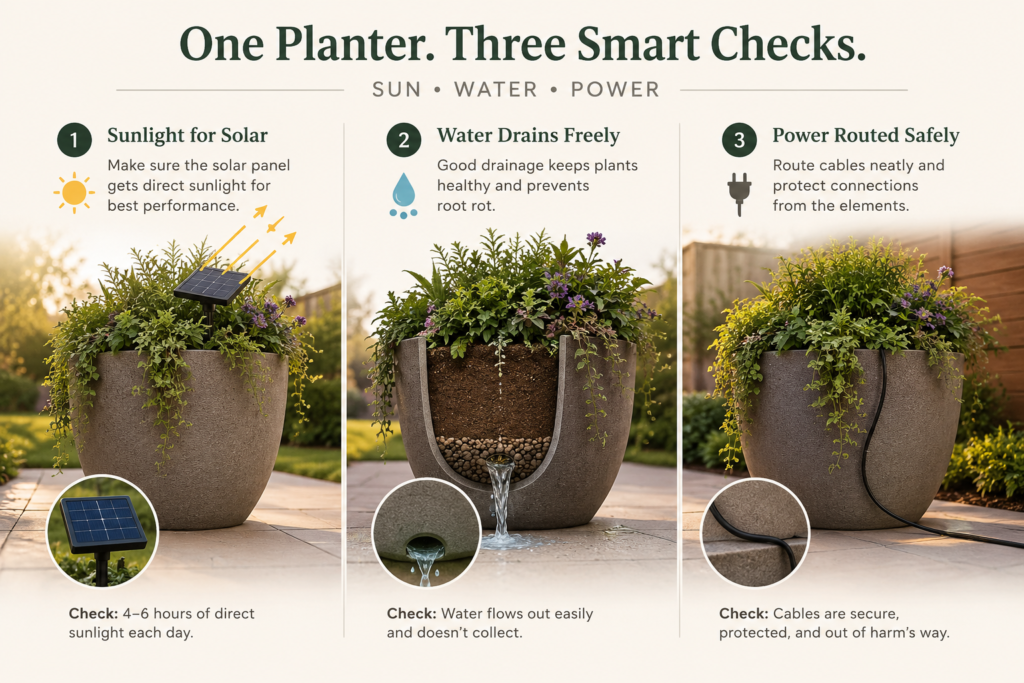
Use the Sun-Water-Wire Check before making any planter-lighting setup permanent.
Sun
For solar fixtures, check:
- whether foliage shades the panel
- whether buildings block useful light
- whether seasonal growth will cover it
- whether a remote panel would work better
Water
The planter must still function normally.
Check:
- drainage remains open
- watering is easy
- fixtures remain accessible
- water does not collect around unsuitable components
Wire
For electrical installations, check:
- outdoor-use suitability
- cable routing
- trip hazards
- exposure to irrigation
- applicable local electrical requirements
A setup that fails one of these checks is not ready just because it looks good at night.
How to Test Backyard Planter Lights
Test the lighting for several evenings before fixing anything permanently.
Use the 3-Night Planter Lighting Test.
Night 1: Appearance
Check:
- focal point
- fixture visibility
- shadows
- brightness
- view from the house
Night 2: Real Use
Walk through the backyard and sit in the main chairs.
Check for:
- glare
- exposed bulbs
- reflections
- poor cable placement
- weak route visibility
Night 3: Final Decision
Ask:
- Does this planter need this much light?
- Could one fixture be removed?
- Would another position work better?
- Is it lighting the Container, Plant, or Space?
If you document the setup, take photographs in daylight, at dusk, and after dark. Only publish measured runtime, lux, battery, or durability claims if they were genuinely tested.
How to Arrange Planter Lights on a Patio
Plan planter lighting around activity zones rather than equal spacing.
A useful arrangement is:
Entrance → low planter light
Dining zone → overhead string lights
Feature corner → uplight
Background → soft downlight
Unused edge → darker
Always test from seated eye level. A fixture hidden from someone standing can be directly visible from a chair.
Darkness should remain part of the design. If every boundary, container, and surface receives equal illumination, the patio can feel flatter and smaller.
Best Plants for Backyard Planter Lighting
Plants with strong silhouettes, texture, or movement generally create the best nighttime effects.
Good options include:
- ornamental grasses
- architectural foliage
- small container trees
- trailing plants
- flowering plants with strong structure
Choose plants first according to climate, sun or shade, container volume, watering, and maintenance needs.
Then use lighting to highlight the plant’s strongest feature.
Artificial light at night can affect some plant responses, particularly when exposure is intense or prolonged. Decorative planter lights therefore do not need to remain on throughout the night. Use timers or controls when practical.
How to Avoid Overlighting Planters
A strong lighting plan uses hierarchy.
Think:
Focal planter → strongest accent
Supporting planter → softer light
Background planter → reflected light or darkness
Before adding another fixture:
- reduce glare
- change beam angle
- hide visible bulbs
- lower brightness
- standardize color temperature
Try a simple test: turn every outdoor light on, then switch several off. If the backyard looks better, there were probably too many competing sources.
Best Planter Lights for Small Backyards
Small backyards benefit from lighting that performs more than one function.
Useful combinations include:
- solar stake inside an existing planter
- wall light above a container
- string-light pole planter
- illuminated planter
- trellis planter with micro lights
Keep larger features near fences, walls, and corners so the center remains available for seating and circulation.
In a small yard, multi-function lighting is usually more valuable than adding more fixtures.
Seasonal Care for Backyard Planter Lights
Planter lighting needs occasional adjustment because plants, sunlight, and weather change.
Spring: clean solar panels, inspect drainage and cables.
Summer: watch for foliage covering panels or fixtures.
Autumn: remove leaves and debris around lights and drainage.
Winter: follow product weather ratings and expect solar performance to change with shorter days and different sun angles.
A solar light may perform differently from one season to another even when the fixture itself has not changed.
Which Backyard Planter Lighting Idea Is Best?
Choose the simplest option that solves your main problem.
| Goal | Best choice |
|---|---|
| Fast upgrade | Solar stake |
| Cozy patio | String-light pole |
| Dramatic plant | Uplight |
| Modern design | Concealed lighting |
| Rental | Solar lantern |
| Small yard | Perimeter lighting |
| Shade | Remote-panel/wired |
| Walkway | Marker light |
| Vertical interest | Trellis lighting |
| Focal planter | Spotlight |
If starting from scratch:
- choose the planter location
- select the right plant
- decide whether you are lighting Container, Plant, or Space
- run the Sun-Water-Wire Check
- install one primary light
- test it after dark
- add another only if a clear need remains
Backyard Planter Ideas With Lights FAQs
Can You Put Solar Lights in Flower Pots?
Yes. Place the light near the outer area of a large planter so it does not interfere with roots, drainage, or watering. Keep the solar panel exposed to useful daylight.
Do Solar Planter Lights Need Direct Sun?
They need sufficient useful light to recharge effectively, although exact requirements vary. Dense foliage, roofs, walls, and tree shade can reduce performance.
Can Solar Lights Work in Shade?
Partial shade may work, but deep shade can reduce charging. A remote solar panel, rechargeable light, or wired system may be more reliable.
Can You Put String-Light Poles in Planters?
Yes, but the pole needs appropriate structural support. Do not rely only on potting soil or plant roots to hold it upright.
Can You Put LED Lights Around Planters?
Yes, when the lights and related components are suitable for outdoor conditions. Follow manufacturer instructions and applicable electrical requirements.
How Do You Hide Lights in a Planter?
Place the fixture behind foliage, near the planter edge, beneath a suitable lip, or behind the container itself. The lighting effect should be more visible than the fixture.
How Bright Should Planter Lights Be?
Use only enough light to reveal the plant, planter, path, or seating zone. Placement and beam control usually matter more than maximum brightness.
What Color Light Is Best?
Warm light around the warm residential range is a good starting point and works well with most foliage and natural outdoor materials.
Should Planter Lights Stay On All Night?
Usually not. Run decorative lighting while the backyard is in use, then switch it off later with a timer or other control.
Can Outdoor Lights Affect Plants?
Artificial nighttime light can influence some plants when exposure is strong or prolonged. Decorative lights should not be treated as all-night grow lights.
Can Planter Lights Mark a Walkway?
Yes. Use lighted planters at entrances, turns, gates, and patio transitions rather than spacing them mechanically at equal intervals.
How Do You Reduce Glare?
Lower the fixture, change the angle, hide it behind foliage, or add suitable shielding. Always test from seated eye level.
Is Solar or Low-Voltage Lighting Better?
Solar is better for portability and easy installation. Low voltage is generally better for permanent landscapes, shade, and coordinated systems.
How Many Planters Should You Light?
Usually only a few. Highlight one or two focal containers, use softer supporting light, and leave some background planters dark.
Final Tips for Backyard Planter Ideas With Lights
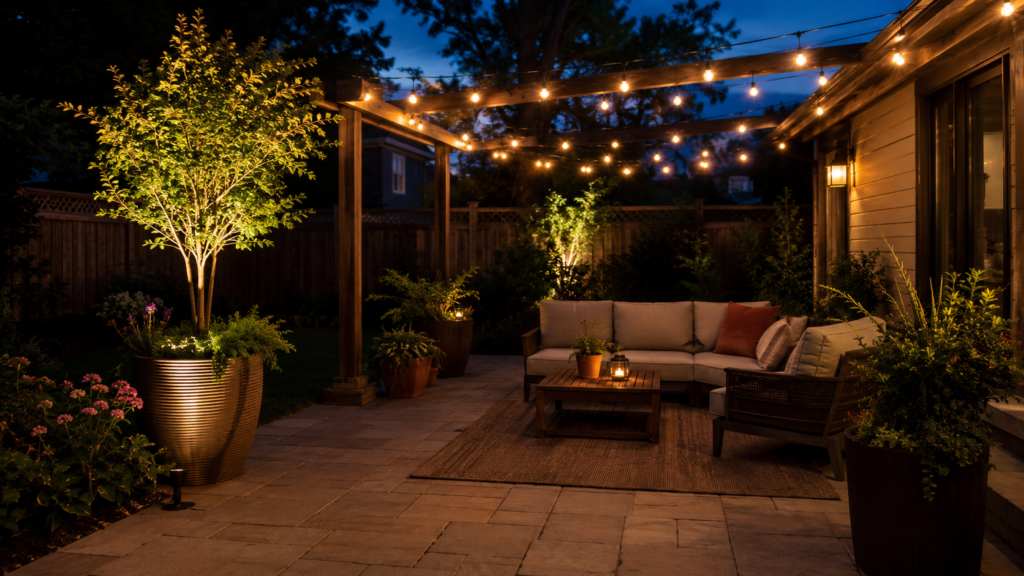
The best backyard planter ideas with lights start with a healthy, functional planter and a clear purpose for the lighting.
Use the 3-Layer Rule:
Container → Plant → Space
Then run the Sun-Water-Wire Check:
Sun → Can the solar panel charge?
Water → Can the planter drain normally?
Wire → Is the installation appropriate for outdoors?
Start with one fixture, test it for several evenings, and add another only if a clear problem remains.
For an easy upgrade, use a solar stake. For entertaining, use planter-supported string lights. For dramatic foliage, choose uplighting. For modern spaces, use concealed lighting. For shade, consider remote-panel solar or low-voltage options.
Most importantly, leave some areas dark.
The goal is not to make every container glow. The goal is to use a few carefully chosen backyard planter ideas with lights so plants, patios, paths, and seating areas remain visually connected after sunset.

Myra is the founder and lead writer of Backyard Planter Ideas, where she shares practical, well-researched guidance on planter design, plant selection, and outdoor styling. Her goal is to help homeowners create attractive, functional garden spaces with clear, reliable, and easy-to-apply advice.