
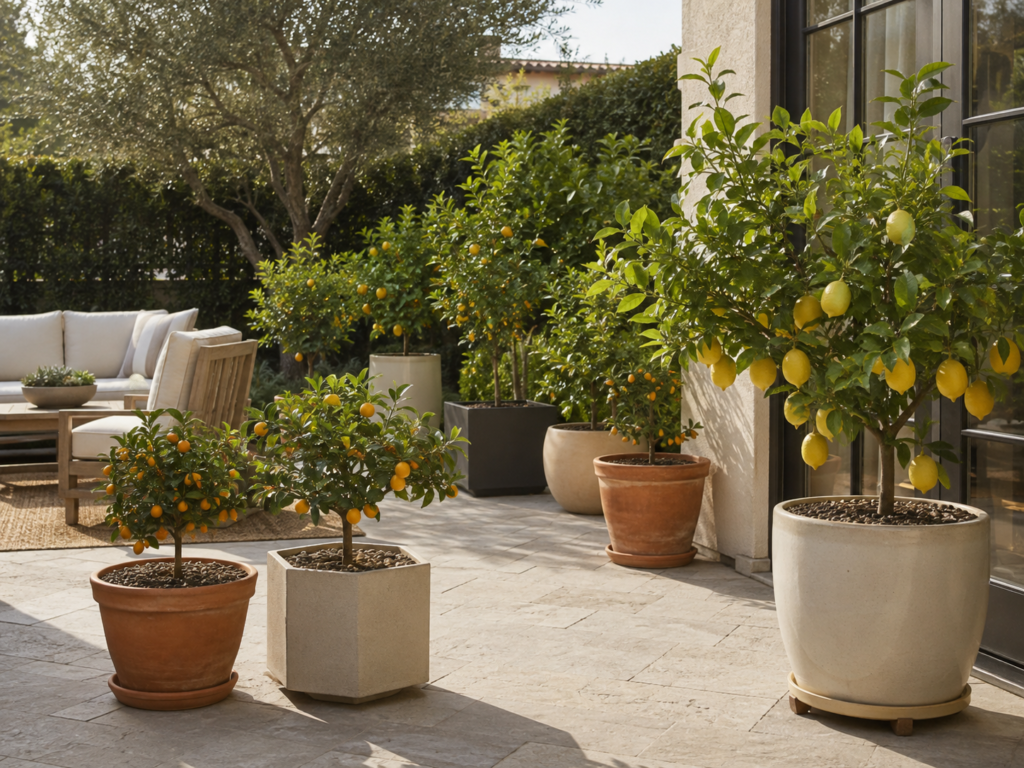
Backyard citrus planter ideas work best when the tree, container, and location are planned together. Choose a compact citrus tree, use a stable planter with open drainage holes, and place it where the canopy receives strong direct sunlight. Movable planters are best in frost-prone climates, while large permanent containers suit warm, sheltered backyards.
A potted citrus tree can add evergreen foliage, fragrant flowers, colorful fruit, and useful height to a patio or courtyard. The design must also leave enough room for the roots, future canopy growth, watering, drainage, and winter protection.
Explore Backyard Citrus Planter Ideas
Choose a design based on what the citrus tree needs to do in your backyard.
- Statement displays: Best for entrances, open patios, and courtyards.
- Small-space ideas: Best for compact patios, narrow areas, and movable setups.
- Privacy ideas: Best for softening fences and blocking unwanted views.
- Decorative styles: Best for Mediterranean, modern, and outdoor-kitchen spaces.
Before choosing an idea, check that the location receives enough sunlight, the canopy will not block movement, and the planter can drain safely.
Choose a Citrus Planter Fast
Use your hardest limitation to guide the first decision.
| Your situation | Best starting choice |
| Small patio | One dwarf citrus tree on wheels |
| Narrow wall space | Wall-trained citrus |
| Warm, large backyard | Heavy permanent planter |
| Frost-prone climate | Lightweight movable pot |
| Modern patio | Geometric resin or fibreglass planter |
| Mediterranean garden | Terracotta citrus grouping |
| Privacy needed | Staggered citrus containers |
| Outdoor kitchen | Lemon or lime with separate herb pots |
Citrus generally needs at least six hours of direct sunlight, while longer exposure is often better when extreme heat is not a problem.
How We Chose These Ideas
Each idea was assessed for root space, drainage, stability, sunlight, mature canopy size, watering access, finished planter weight, and climate flexibility.
The layouts are planning guides rather than fixed rules. Results depend on the citrus variety, rootstock, local weather, planter material, and maintenance. Rootstock matters because it can affect tree size and cold tolerance.
Statement Citrus Planter Ideas
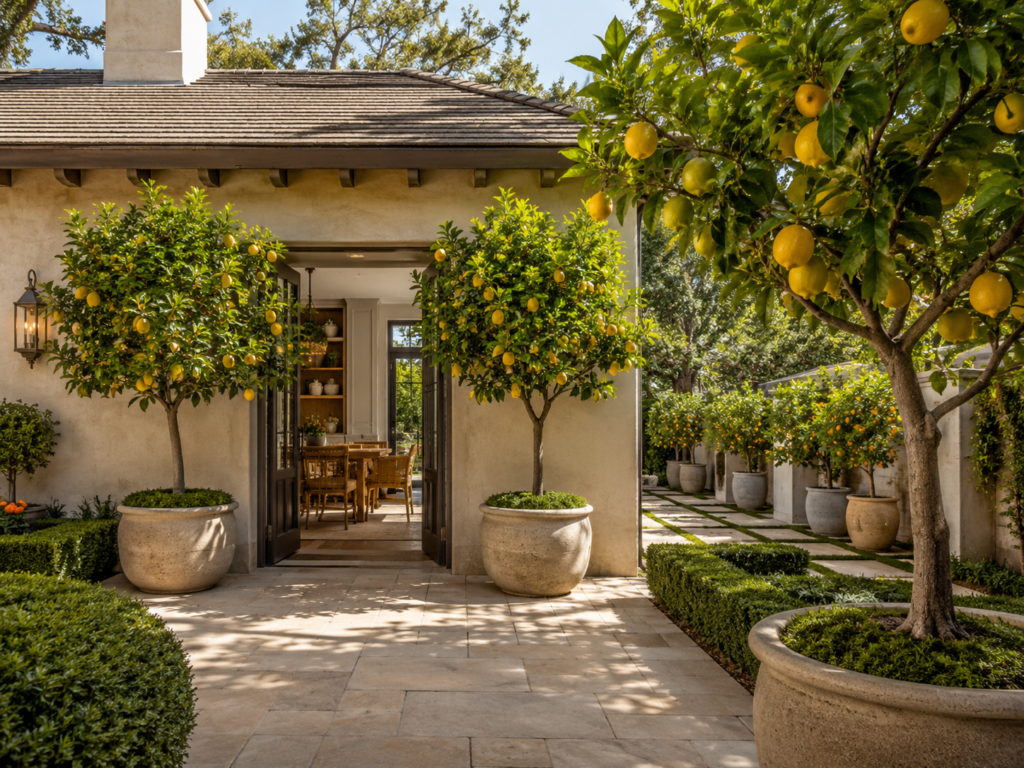
1. Frame an Entrance with Paired Lemon Trees
Place two similar lemon trees in matching pots on either side of a doorway, pergola, or patio entrance. The repeated shape creates a formal and welcoming look.
Use broad-based planters that will remain stable as the trees grow. Both sides should receive similar light so the pair develops evenly.
2. Add One Citrus Focal Point
A single citrus tree can become the main feature beside an outdoor lounge. Position it slightly outside the furniture area so branches do not touch people or block chairs.
A Meyer lemon, calamondin, or kumquat can provide attractive leaves, flowers, and fruit without needing a full orchard display.
3. Create a Formal Citrus Row
Place matching citrus standards in repeated planters along a wide path, wall, or pool edge. Consistent spacing and matching materials create a clean rhythm.
Measure the expected mature canopy before planting. Trees that look far apart at the nursery stage may become crowded later.
4. Raise a Citrus Centrepiece
A citrus planter on a low reinforced platform can anchor a courtyard or circular seating area. Slight elevation makes the tree easier to see without creating an unsafe pedestal.
The support must carry the full wet weight of the planter, and drainage should not run across a walkway.
5. Arrange a Citrus Trio
Use three separate citrus planters to create a small orchard effect. Place the tallest tree at the back and the smallest at the front.
Repeat one feature, such as the planter material or color, but leave enough space to water, prune, and inspect each tree.
Small Backyard Citrus Planter Ideas
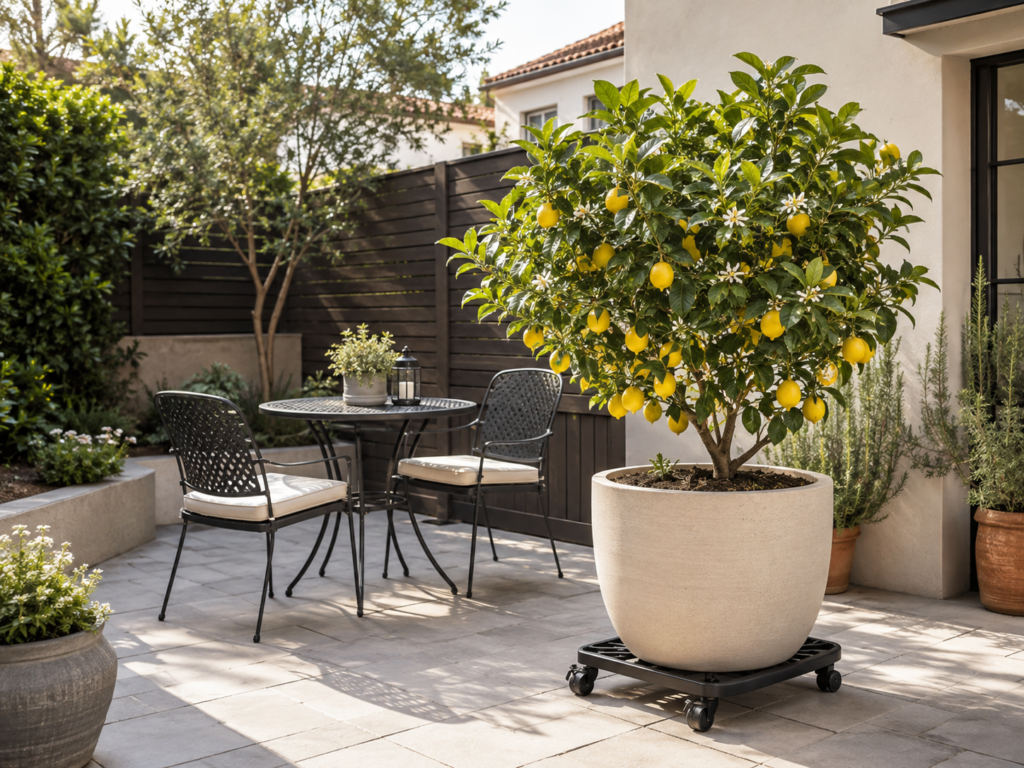
6. Grow a Meyer Lemon on Wheels
A dwarf Meyer lemon on a heavy-duty plant caddy works well on a small patio. It can move toward better light, clear space for visitors, or enter winter protection.
The caddy must support the filled planter, not only the empty pot. Use locking wheels and test the full movement route before planting.
7. Train Citrus Against a Wall
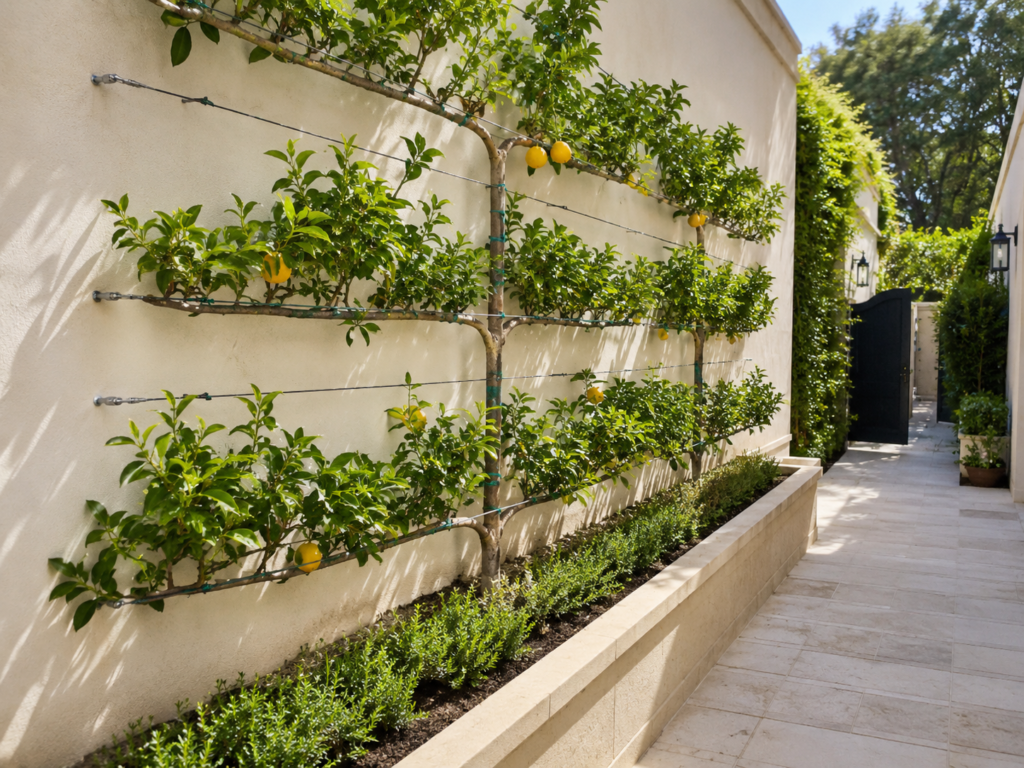
Wall-trained or espalier citrus uses vertical space instead of spreading across the patio. It can work beside a fence, courtyard wall, or narrow side passage.
Install strong wires or a trellis before the tree grows large. Leave space between the foliage and wall for airflow and maintenance.
8. Use Calamondin in a Sunny Corner
Calamondin is compact and decorative, with dark leaves, white flowers, and small orange fruit. It can turn an unused sunny corner into an edible focal point.
Do not push the planter tightly against both walls. The rear leaves still need light, air, and inspection access.
9. Surround Citrus with Herb Pots
Place the citrus tree in the main planter and arrange separate pots of rosemary, thyme, or oregano around it.
Separate pots prevent root competition and allow each plant to receive the right amount of water. They are also easier to move or replace.
10. Create a Mobile Dining Nook
Use one or two movable citrus trees to frame a small outdoor dining area. Keep them outside the space needed for chairs and normal movement.
Check the tree for thorns and make sure falling fruit will not create a trip hazard.
Citrus Planters for Privacy
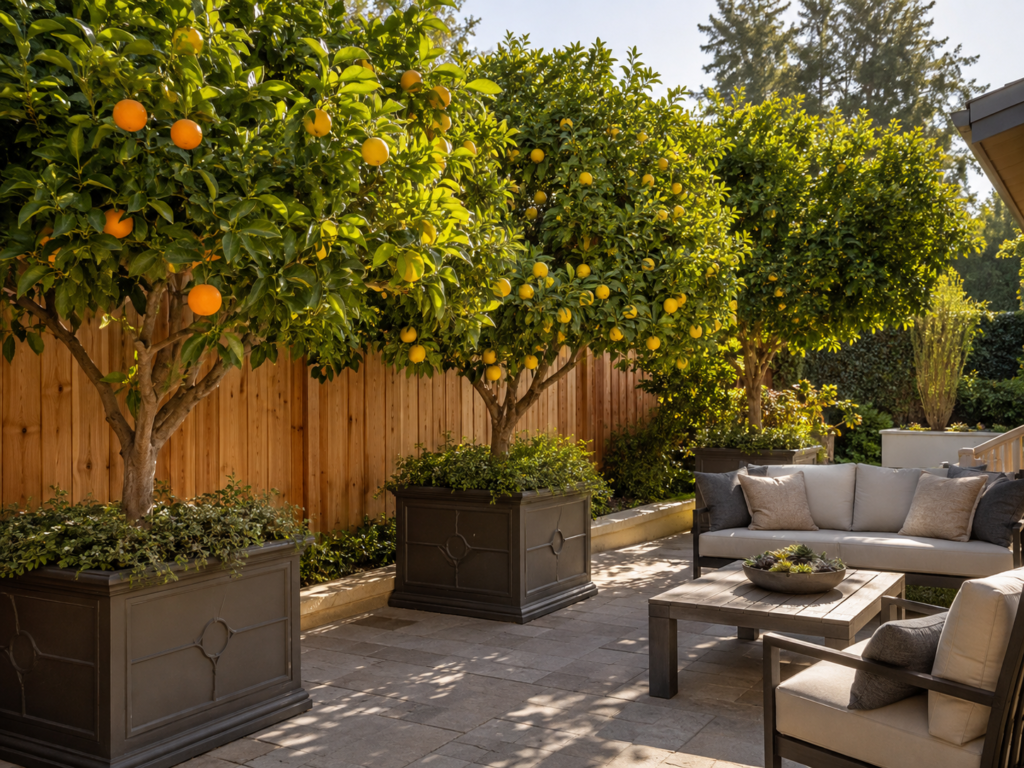
11. Build a Staggered Citrus Screen
Place three or more planters in an offset line. The canopies can overlap visually while the containers remain separate and accessible.
This layout creates softer privacy than a straight row and works well beside seating areas.
12. Line a Sunny Fence
Repeated citrus planters can soften a long fence or wall. Use matching containers for a formal look or two coordinated sizes for a more relaxed design.
Leave room behind each pot for pruning, cleaning, and pest inspection.
13. Create a Two-Level Screen
Use citrus trees for upper foliage and smaller separate pots to fill gaps near the ground.
This design can hide bins, storage areas, or neighboring windows without forcing several plants into one root zone.
14. Use Espalier Citrus as a Divider
A trained citrus tree in a rectangular planter can divide a dining area from a lounge or outdoor kitchen.
This option saves floor space but requires regular tying and pruning to maintain its narrow shape.
Decorative Citrus Planter Ideas
15. Create a Mediterranean Grouping
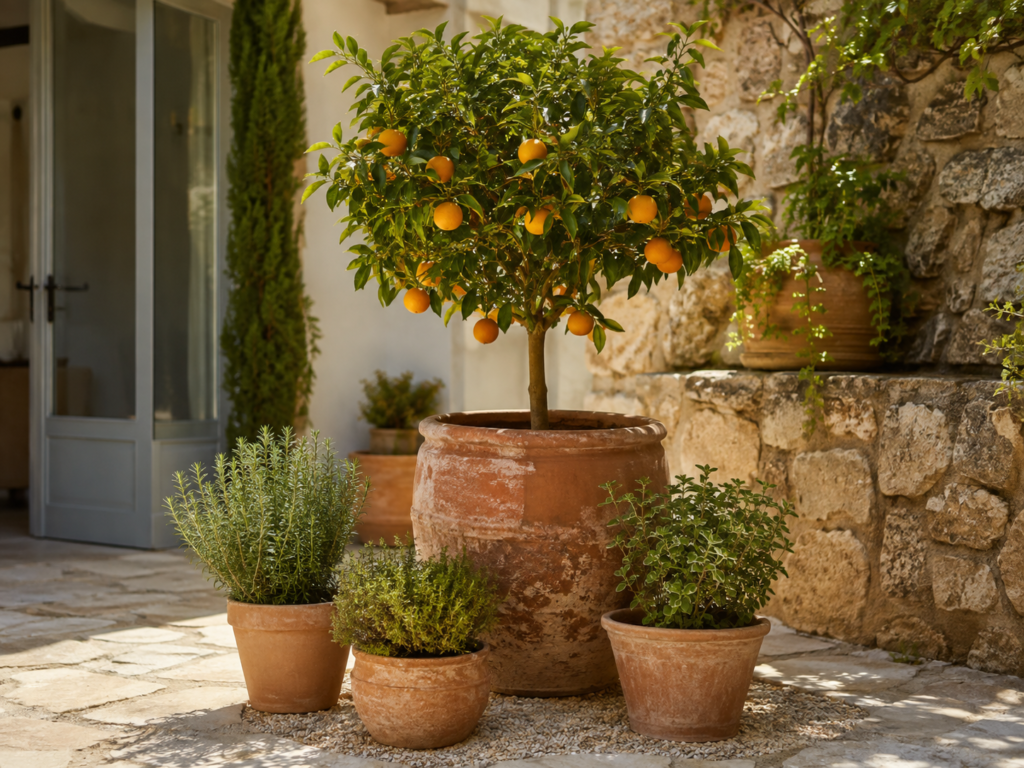
Combine one citrus tree in a large terracotta pot with two or three smaller herb containers. Pale paving, gravel, and warm clay tones create a Mediterranean feel.
Terracotta dries faster than glazed or plastic pots, so check moisture more often during hot weather.
16. Use a Modern Geometric Planter
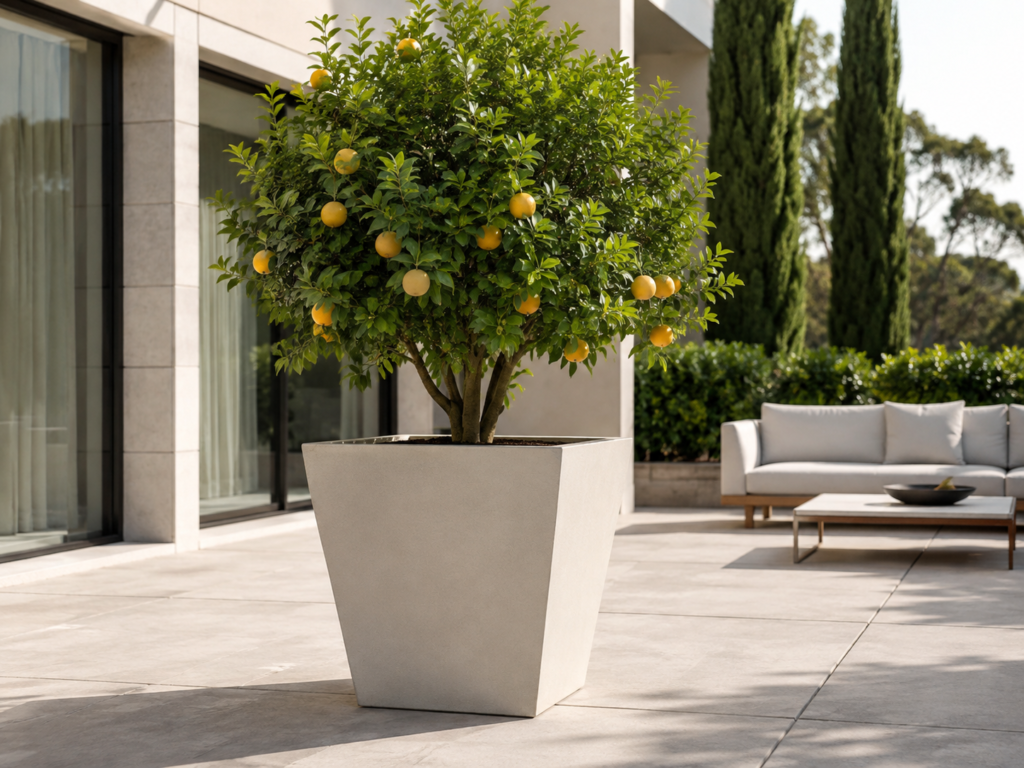
A square or tapered planter creates a strong contrast with the rounded citrus canopy. Charcoal, cream, stone, and muted sand suit modern patios.
Fibreglass and resin are easier to move than concrete, but lightweight pots still need a stable base.
17. Add Ceramic Accent Pots
Keep the citrus tree in a practical main planter and use blue-and-white or patterned pots for herbs and seasonal flowers.
This gives the display color without placing a mature tree inside a delicate or extremely heavy decorative pot.
18. Build an Outdoor Kitchen Station
Place a potted lemon, lime, or kumquat near an outdoor kitchen for fragrance, color, and convenient fruit.
Keep the tree away from barbecues, ovens, hot exhaust, cabinet doors, and busy preparation areas.
Compare the 18 Ideas
| Idea type | Best for | Main thing to check |
| Paired trees | Entrances | Equal light |
| Single focal tree | Lounge area | Furniture clearance |
| Formal row | Long walls | Consistent watering |
| Raised centrepiece | Courtyard | Structural load |
| Citrus trio | Medium patio | Access between pots |
| Mobile lemon | Small patio | Caddy rating |
| Wall-trained tree | Narrow area | Support and heat |
| Corner calamondin | Small corner | Rear light |
| Citrus with herbs | Edible patio | Separate watering |
| Dining nook | Flexible patio | Thorns and chairs |
| Staggered screen | Privacy | Airflow |
| Fence row | Boundary | Sun variation |
| Two-level screen | Utility area | Maintenance path |
| Espalier divider | Garden zoning | Regular pruning |
| Terracotta group | Mediterranean style | Faster drying |
| Geometric planter | Modern style | Wind stability |
| Ceramic accents | Decorative patio | Excess weight |
| Kitchen station | Cooking area | Heat clearance |
Three Practical Citrus Layouts
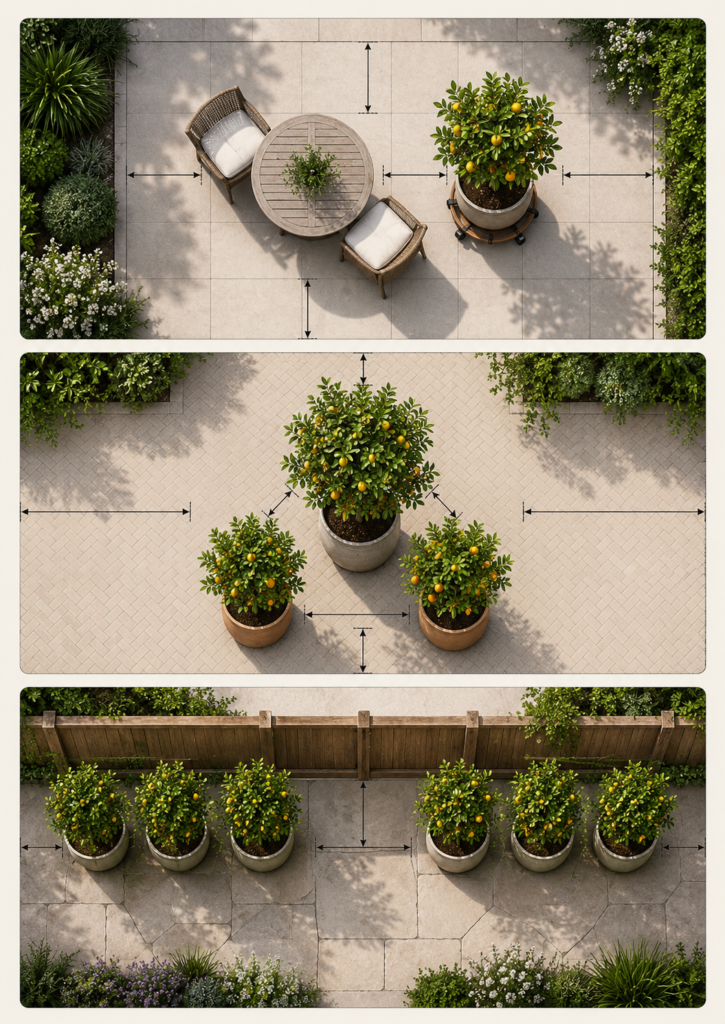
Compact Patio
Use one mobile dwarf citrus tree, one small table, and two chairs in a space around 2.5 by 3 metres. Keep at least 75 centimetres of clear movement space.
Medium Citrus Trio
Place the tallest tree at the rear and two shorter trees in front. Leave around 60 to 100 centimetres between planter rims.
Long Boundary
Repeat citrus containers along a sunny fence. Leave rear access and create a maintenance opening after every two or three trees.
Best Citrus Trees for Planters
Good container choices include:
- Meyer lemon: Compact, productive, and popular for patios.
- Bearss lime: Useful near kitchens but sensitive to cold.
- Kumquat: Naturally small with decorative fruit.
- Calamondin: Compact and ornamental.
- Satsuma: More cold-tolerant than many citrus types.
- Finger lime: Unusual fruit but may be thorny.
- Yuzu: Aromatic and relatively cold-tolerant.
- Compact mandarin or orange: Suitable when grown on manageable rootstock.
| Citrus | Container suitability | Best use |
| Meyer lemon | High | Patio focal point |
| Bearss lime | High in warm climates | Outdoor kitchen |
| Kumquat | High | Doorway display |
| Calamondin | High | Small courtyard |
| Satsuma | Medium to high | Productive display |
| Finger lime | Medium | Specialist edible garden |
| Yuzu | Medium | Culinary garden |
| Compact orange | Medium | Statement planter |
Container-grown citrus is more exposed to freezing than mature trees growing in the ground.
Best Citrus Planter Materials
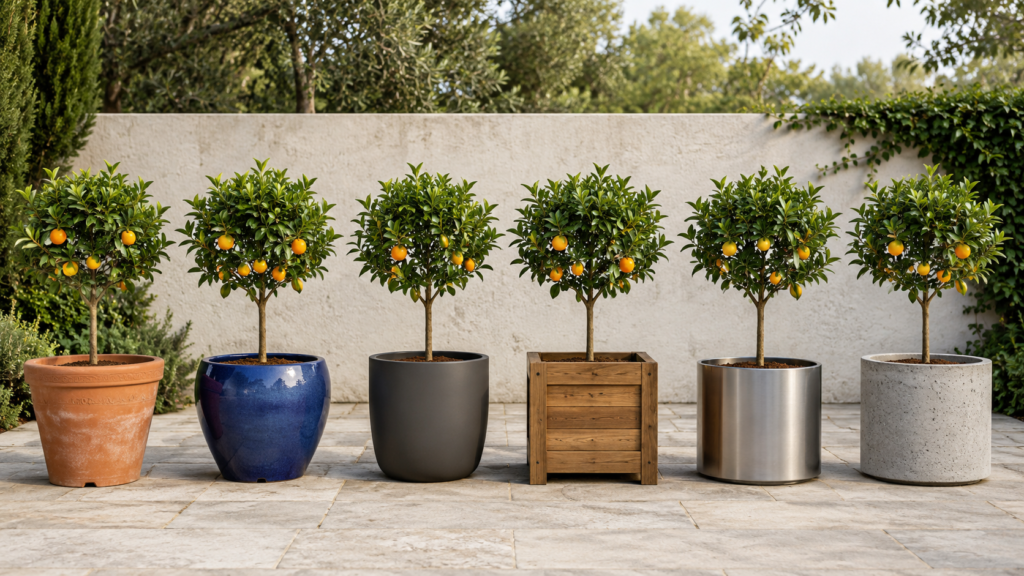
Terracotta looks natural and suits Mediterranean designs, but it dries quickly. Glazed ceramic holds moisture longer but can become very heavy.
Fibreglass and resin work well for movable trees. Wood offers a warm appearance but must not remain constantly wet. Metal can become hot in direct sun. Concrete and stone provide strong wind stability but are difficult to move.
Choose the material according to:
- Climate
- Finished weight
- Drainage
- Heat exposure
- Winter movement
- Surface strength
Choosing the Right Planter Size
Move a young citrus tree into a container only slightly larger than its current root ball. An oversized pot may hold wet growing medium beyond the reach of the active roots.
Increase the pot size gradually as the root system develops. The final container should provide enough root space without making winter movement impossible.
Do not judge size from the exterior alone. Some decorative planters have thick walls or narrow bases that reduce usable root volume.
Calculate the Filled Weight
Use this formula:
Planter + damp potting mix + tree + retained water + top-dressing = finished weight
Example:
| Component | Weight |
| Empty planter | 10 kg |
| Damp potting mix | 38 kg |
| Tree and root ball | 7 kg |
| Top-dressing | 4 kg |
| Retained water | 3 kg |
| Total | 62 kg |
Choose a caddy with a load rating well above the estimated total. Also check wheels, thresholds, slopes, path width, and turning space.
Essential Planter Features
A citrus planter should have:
- Open drainage holes
- A stable base
- Enough width for roots and balance
- Space below the rim for watering
- Accessible soil surface
- Suitable outdoor material
- Pot feet or a correctly rated caddy
Do not add gravel or broken pot pieces beneath the growing medium. They reduce root space and do not improve drainage.
On paving, raise the planter slightly and direct water away from paths. On timber decking, prevent constant trapped moisture. On soil or gravel, create a firm level base. On balconies, confirm load limits before installation.
Best Citrus Planter Placement
Measure sunlight at canopy height rather than judging the area by brightness alone.
Check:
- Direct sun
- Reflected heat
- Wind
- Water access
- Drainage direction
- Door clearance
- Furniture movement
- Winter route
- Mature canopy width
Avoid deep roof shade, barbecue heat, heater exhaust, and narrow pathways.
Use the Three-Day Position Test
Day one: Record direct sun from morning to late afternoon.
Day two: Open doors, move chairs, and walk through the area as you normally would.
Day three: Pour water where the pot will drain and observe wind, puddling, staining, and reflected heat.
Approve the position only when:
- The tree receives enough light.
- People can move safely.
- Water drains without damage.
- The planter can reach winter protection.
How to Plant Citrus in a Pot
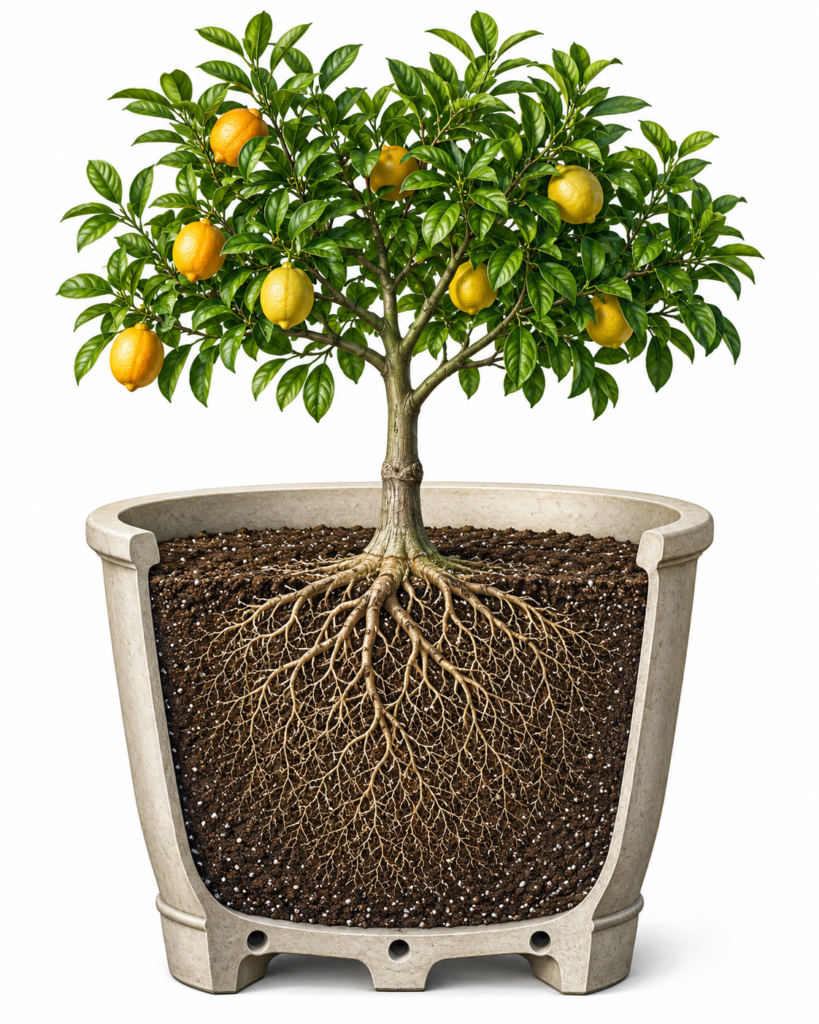
- Choose a healthy grafted tree.
- Test every drainage hole.
- Position the empty planter and base.
- Add free-draining container mix.
- Remove the nursery pot and inspect the roots.
- Keep the top of the root ball level with the surrounding mix.
- Fill gently without heavy compaction.
- Leave space below the rim for watering.
- Water until moisture drains from the base.
- Monitor the tree closely during establishment.
Keep the trunk flare and graft union above the growing medium.
Citrus Planters by Climate
In tropical and subtropical areas, focus on drainage, heat, and wind stability. In warm-temperate climates, many citrus trees can stay outside but may need temporary frost protection.
In mild-winter climates, tender citrus should remain movable. In cold-winter regions, move the tree into a bright protected area before frost and adjust it gradually to lower indoor light.
Buy citrus from a reputable nursery that can identify the cultivar and rootstock. Citrus plant material may be subject to regional movement or quarantine controls, so check local rules before ordering trees or cuttings online.
Permanent vs Movable Planters
Choose a permanent planter when the tree can stay outside year-round, the surface supports the weight, and the location has been fully tested.
Choose a movable planter when frost protection, seasonal sunlight, rental restrictions, or changing patio use require flexibility.
A planter is not truly movable just because it can be lifted when empty. Plan for its future wet weight.
Watering and Feeding Potted Citrus
Check the growing medium rather than watering on a fixed schedule. Water when the upper section begins to dry, then continue until excess water leaves the drainage holes.
Outdoor citrus may need frequent summer checks, while indoor winter trees use less water. Never leave the container standing in retained water.
Use a fertilizer labeled for citrus or container fruit. Follow the product instructions and do not assume every yellow leaf means the tree needs more feed. Check drainage, light, pests, moisture, and temperature first.
Citrus Companion Plants
Separate companion pots are usually better than planting herbs and flowers inside the citrus planter.
They protect root space, simplify watering, and make plants easier to replace. Rosemary, thyme, oregano, and seasonal flowers can sit around the citrus pot without competing directly with the tree.
Avoid vigorous mint, ivy, dense groundcovers, and large shrubs in the citrus root zone.
Check Citrus Before Moving Indoors
Inspect the tree before winter relocation. Scale, whiteflies, and spider mites can become more difficult to control indoors.
Check leaf undersides, branch joints, new growth, stems, planter rims, drainage holes, and the soil surface. Clean the container, remove fallen leaves, and keep the tree separate from other houseplants during the first few weeks indoors.
Common Citrus Planter Mistakes
Common problems include:
- Choosing the pot before the tree
- Ignoring the rootstock
- Blocking drainage holes
- Adding gravel beneath the soil
- Moving a small tree into an oversized pot
- Blocking the winter route
- Planting the trunk too deeply
- Crowding the canopy
- Watering by calendar
- Treating every yellow leaf with fertilizer
Most of these mistakes are easier to prevent than correct later.
Citrus Planter Troubleshooting
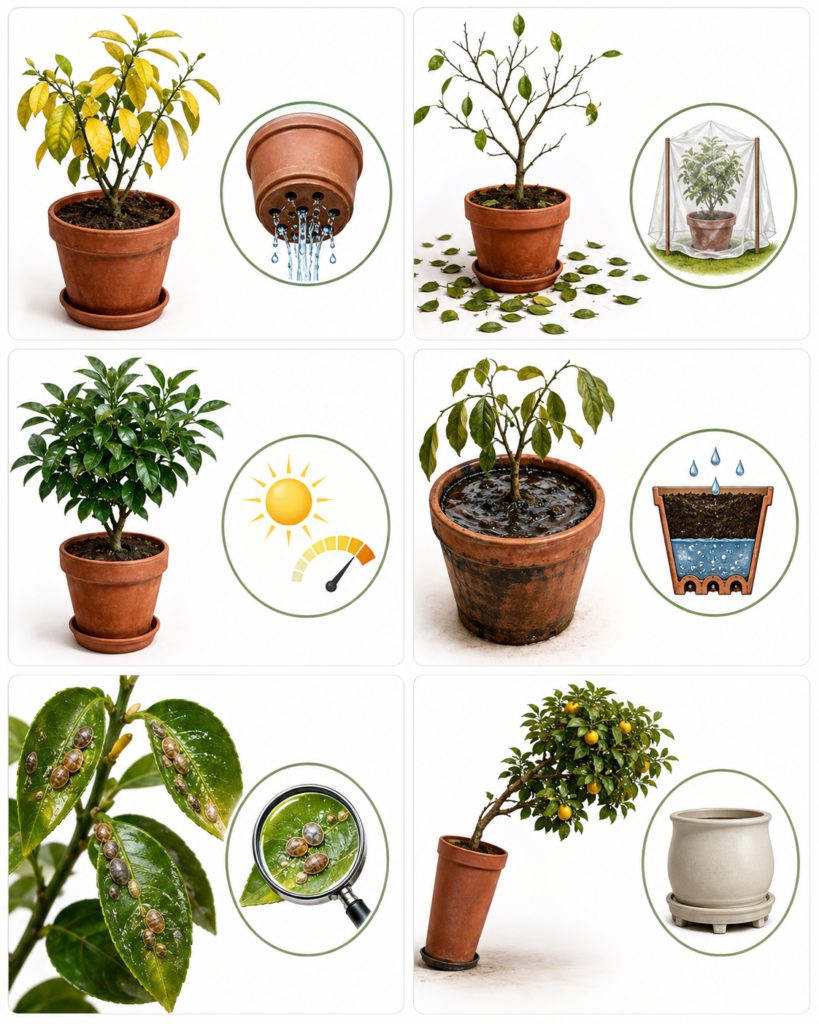
| Symptom | Possible cause | First action |
| Yellow leaves | Wet roots, nutrients, cold, or low light | Check moisture and conditions |
| Leaf drop | Sudden change or watering stress | Review recent movement |
| No flowers | Low light or immature tree | Measure direct sun |
| Wet soil | Blocked drainage or oversized pot | Inspect drainage |
| Rapid drying | Small pot, heat, or crowded roots | Check root condition |
| Sticky leaves | Scale, aphids, or whitefly | Inspect leaf undersides |
| Fine webbing | Spider mites | Isolate and inspect |
| Leaning tree | Wind or unstable base | Improve support |
Change one clear cause at a time and monitor the result.
Seasonal Citrus Planter Care
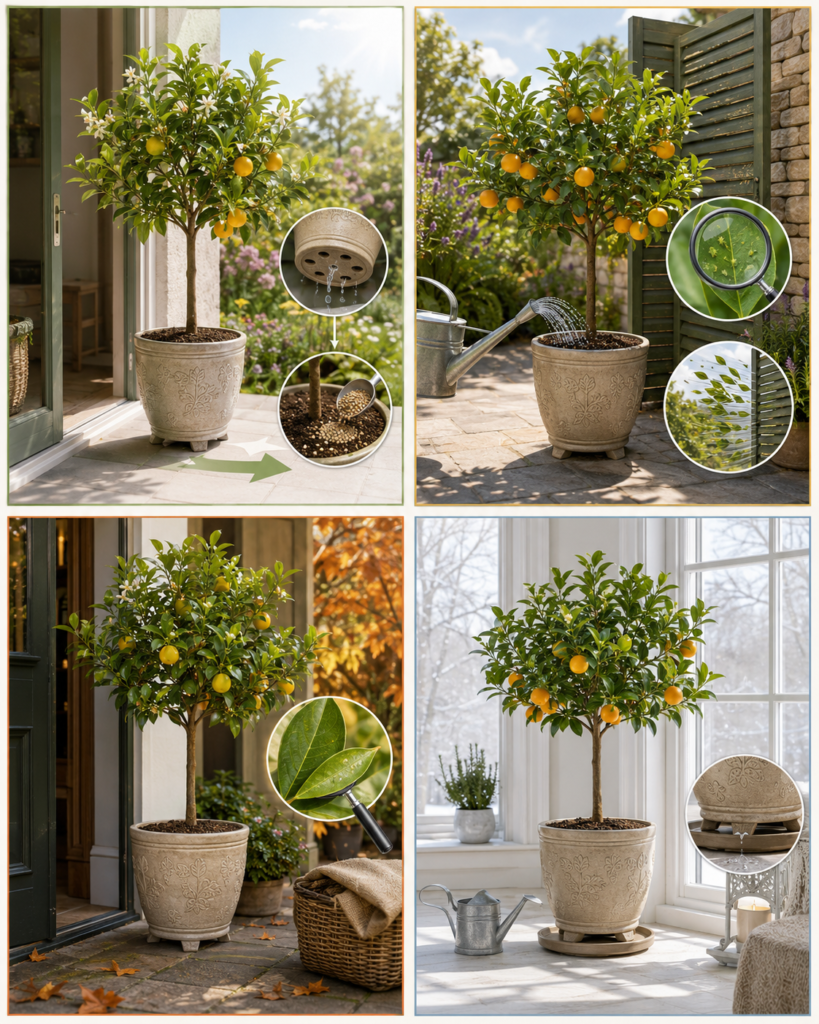
Spring: Move overwintered trees outside gradually, inspect drainage, and resume feeding when growth begins.
Summer: Check moisture often, monitor pests, and protect lightweight pots during storms.
Autumn: Prepare the winter location and inspect the tree before moving it.
Winter: Reduce watering, provide strong light, and keep the roots out of standing water.
Are Citrus Planters Worth It?
Citrus planters are worthwhile for gardeners who want evergreen structure, fragrant flowers, fresh fruit, and flexible placement.
The main benefits are controlled size, patio suitability, seasonal movement, and decorative value. The main limits are regular watering, feeding, root-space management, winter protection, and eventual repotting.
A citrus planter is a good choice when the backyard receives strong light and the gardener can provide consistent care.
Final Citrus Planter Checklist
Before buying, confirm:
- The cultivar suits the climate.
- The rootstock is known.
- The site receives enough sun.
- The planter is only moderately larger than the root ball.
- Drainage holes are open.
- The filled weight is manageable.
- The surface supports the load.
- The winter route is clear.
- The canopy has room to grow.
- Water and maintenance access are available.
The correct order is:
Climate → cultivar → rootstock → location → planter → drainage → mobility → potting mix → planting → styling
Backyard Citrus Planter Ideas FAQs
What citrus tree grows best in a planter?
Meyer lemon, calamondin, and kumquat are practical container choices. Confirm the rootstock, expected mature size, and local climate suitability before buying.
Can a lemon tree grow in a planter?
Yes. Lemon trees grow well in containers with strong sunlight, open drainage, suitable potting mix, and regular feeding.
How large should a citrus planter be?
Choose a pot slightly larger than the current root ball and increase its size gradually. An oversized pot may remain wet for too long.
How much sun does potted citrus need?
Most potted citrus needs at least six hours of direct sunlight each day. Longer exposure can support better growth when heat is not excessive.
Do citrus planters need drainage holes?
Yes. Citrus roots need moisture and air, so extra water must be able to leave the container freely.
Should rocks go in the bottom?
No. Rocks and gravel reduce root space and do not improve container drainage.
Can citrus stay outside in winter?
Citrus can remain outside where the variety suits local winter temperatures. In colder climates, container trees usually need protection.
Why are my citrus leaves turning yellow?
Possible causes include wet roots, poor drainage, low light, cold stress, pests, or nutrient imbalance. Check the growing conditions before feeding.
How often should potted citrus be watered?
Water when the upper growing medium begins to dry, then continue until water drains from the bottom.
Can companion plants share the pot?
Separate pots are usually better because they protect citrus root space and allow different watering routines.
Final Citrus Planter Tips
The best backyard citrus planter ideas combine design with realistic growing needs. A paired entrance display, mobile Meyer lemon, citrus privacy screen, or outdoor-kitchen planter can work well when the tree receives enough light and the roots remain healthy.
Choose the citrus tree before the decorative pot. Confirm the cultivar and rootstock, test the location, estimate the filled weight, and solve drainage first. Add colors, companion pots, and decorative materials only after the growing system is complete.

Myra is the founder and lead writer of Backyard Planter Ideas, where she shares practical, well-researched guidance on planter design, plant selection, and outdoor styling. Her goal is to help homeowners create attractive, functional garden spaces with clear, reliable, and easy-to-apply advice.