
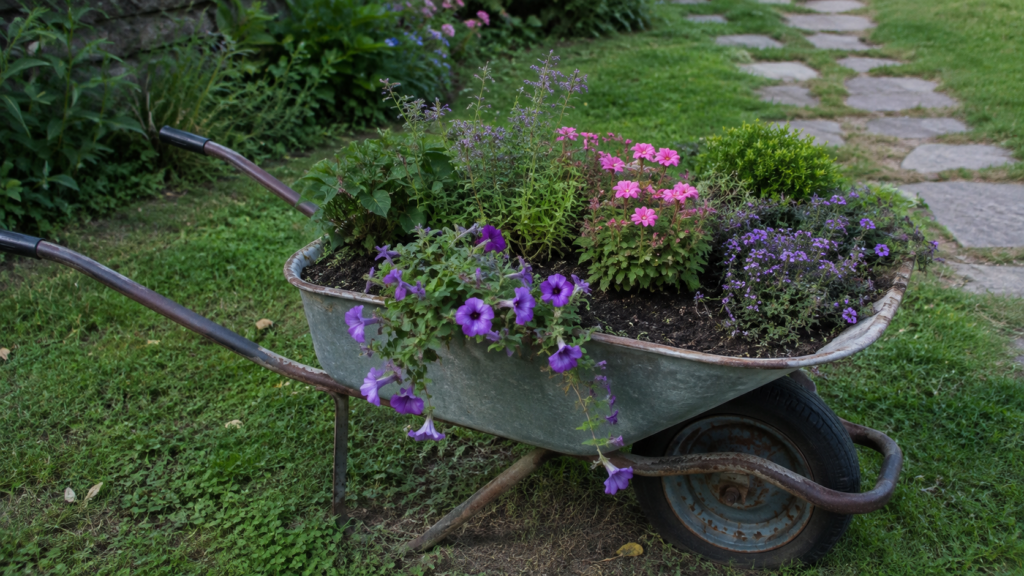
A wheelbarrow can become a practical garden planter when it is structurally sound, drains freely, and is filled with suitable container potting mix. Depending on the location, it can hold annual flowers, trailing plants, foliage, succulents, herbs, strawberries, bulbs, ornamental grasses, or pollinator-friendly plants.
Its long tray provides room for different plant heights: one upright plant for structure, mounding plants through the middle, and trailing growth near the rim. Old metal or wooden wheelbarrows also suit rustic, cottage, farmhouse, and informal gardens.
Treat the wheelbarrow as a real container garden. Drainage, sunlight, root space, growing medium, mature plant size, and compatible water requirements matter more than instant fullness.
Best Wheelbarrow Planter Ideas
The best design depends on sunlight, moisture, tray depth, climate, and maintenance. A full-sun wheelbarrow on warm paving needs a different planting approach from one beside a shaded porch.
| Garden condition | Best starting idea |
| Full sun | Flowering annuals |
| Hot and dry | Succulents |
| Partial shade | Begonia and foliage mix |
| Mostly shade | Foliage planter |
| Cottage garden | Loose mixed flowers |
| Pollinator garden | Regionally suitable flowers |
| Edible garden | Herbs or strawberries |
| Antique wheelbarrow | Removable pots |
| Shallow tray | Compact plants |
| Low maintenance | 2–3 compatible plants |
| Maximum visual impact | Thriller, filler, spiller |
| Seasonal display | Bulbs or autumn plants |
| Choose according to light first, moisture second, root space third, and appearance fourth. |
Why Use a Wheelbarrow Planter?
A wheelbarrow’s broad tray creates more horizontal planting space than many traditional containers. That makes it easy to combine upright, mounding, and trailing plants without crowding everything around one central point.
Weathered paint, timber handles, light rust, and small dents can add character. A wheelbarrow that is no longer reliable for carrying soil may still work as a stationary planter.
Main advantages include:
- broad planting space;
- raised display height;
- good visibility for trailing plants;
- reuse of an old garden object;
- compatibility with rustic and cottage gardens.
The main limitation is root space. Plants depend entirely on the soil, moisture, nutrients, and drainage inside the tray. Position the wheelbarrow before filling because wet potting mix makes it much heavier.
Is Your Wheelbarrow Suitable for Planting?
Inspect the tray, frame, handles, legs, wheel, axle, and attachment points. Cosmetic wear is less important than structural weakness. Light rust may be harmless, while severe corrosion around support points can make a filled planter unsafe.
| Condition | Best approach |
| Solid tray and stable frame | Direct planting |
| Minor surface rust | Plant after inspection |
| Small existing holes | Use if drainage is adequate |
| Severe corrosion | Use separate pots |
| Unstable legs | Repair first |
| Valuable antique | Place pots inside |
| Unknown previous use | Avoid direct edible planting |
| Shallow tray | Choose shallow-rooted plants |
| If preservation, structural condition, or food safety is uncertain, individual drained pots inside the wheelbarrow are the safer option. |
17 Best Wheelbarrow Planter Ideas
1. Cottage Flower Wheelbarrow
Best for: informal sunny or partly sunny gardens.
Use loose groups of flowers rather than perfect symmetry. Combine one or two main flowering plants with lower companions and a restrained trailing plant.
Pink, purple, blue, white, and muted red work particularly well with weathered metal or timber. Leave some soil visible so plants have room to mature.
2. Thriller, Filler, and Spiller Wheelbarrow
Best for: beginners and balanced mixed planting.
Use one compact thriller for height, several fillers through the middle, and one or two spillers around visible edges.
Keep the structural plant proportionate to the tray. This is one of the easiest designs to manage because every plant has a clear role.
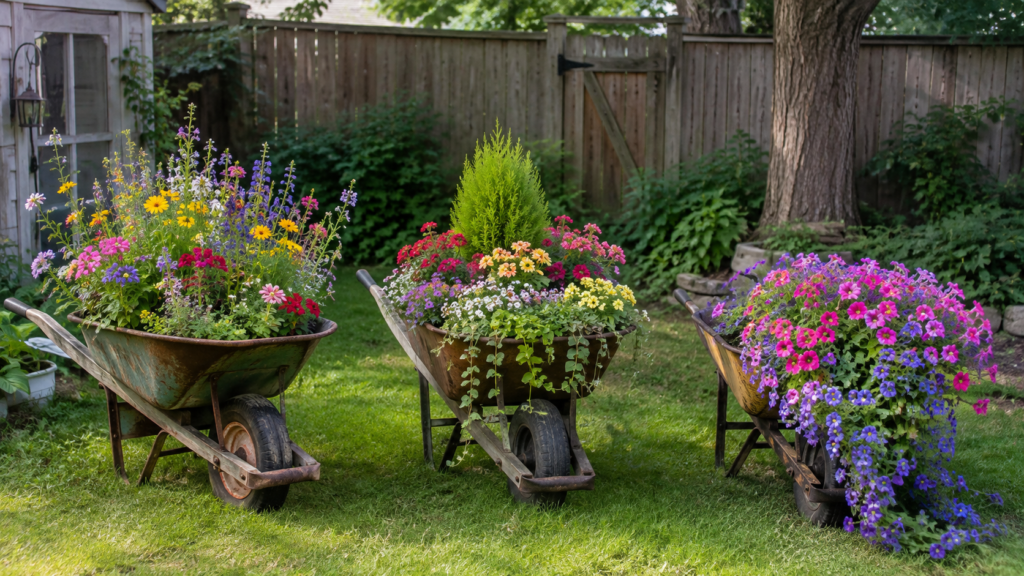
3. Trailing Flower Waterfall
Best for: patio edges and raised positions.
Trailing petunias, verbena, or other locally suitable cascading plants can soften the rim. Concentrate them where they are visible instead of covering every edge.
Keep upright or mounding growth in the middle so the planter retains structure.
4. One-Color Wheelbarrow
Best for: strongly colored or weathered wheelbarrows.
Choose one dominant flower color and create variety through height, form, and foliage. A purple planting might combine upright blooms, lower flowers, and green or silver foliage.
This creates visual cohesion without requiring many species.
5. Pollinator Wheelbarrow
Best for: wildlife-friendly gardens.
Use locally appropriate flowers with different shapes and flowering periods. Combine open flowers, clusters, upright spikes, and lower nectar-rich plants.
Avoid generic plant lists; choose species suited to your climate and local invasive-plant guidance.
6. Succulent Wheelbarrow
Best for: sunny, relatively dry conditions.
Combine rosette, upright, spreading, and trailing succulents while leaving visible growing space.
Use excellent drainage and avoid mixing succulents with plants that require consistently moist soil.
7. Herb Wheelbarrow
Best for: patios and kitchen gardens.
Group herbs with similar light and moisture requirements and position taller plants where they will not shade smaller ones.
For old wheelbarrows with an unknown history, grow edible plants in a known-safe inner container.
8. Strawberry Wheelbarrow
Best for: sunny edible gardens.
Strawberries suit the long tray because leaves and fruit can extend toward the edges. Give plants enough room rather than filling every gap.
Keep crowns at the correct depth and monitor moisture during flowering and fruiting.
9. Shade Foliage Wheelbarrow
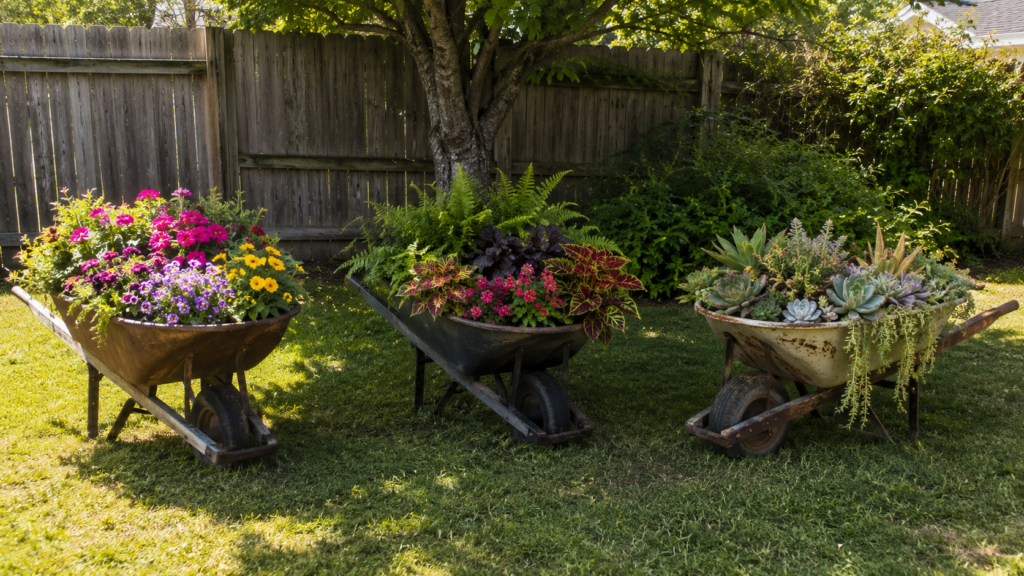
Best for: shaded patios and garden corners.
Use differences in leaf size, texture, shape, and color instead of relying on flowers.
Ferns, suitable coleus varieties, begonias, and other shade-tolerant plants can work well, but match them to the actual light level.
10. Begonia and Foliage Wheelbarrow
Best for: partial shade.
Begonias provide flower color where many full-sun annuals may struggle. Pair them with one or two foliage plants rather than an overly complex mixture.
A sheltered shaded planter may still need regular watering if it receives little rainfall.
11. Rustic Wildflower-Style Wheelbarrow
Best for: cottage and naturalistic gardens.
Choose a small group of compatible flowering plants rather than a random seed mix with conflicting needs.
Use staggered heights and slightly uneven spacing to create a relaxed meadow-like effect.
12. Ornamental Grass and Flower Wheelbarrow
Best for: texture and vertical structure.
Use one genuinely compact ornamental grass for height and lower flowers around it.
Avoid large grasses that will quickly outgrow the tray and available root volume.
13. Fairy Garden Wheelbarrow
Best for: miniature decorative gardens.
Start with living plants, then add small pathways or accessories without covering most of the soil.
The planter still needs drainage, watering access, and adequate root space.
14. Spring Bulb Wheelbarrow
Best for: seasonal spring color.
Use repeated groups of one or two bulb varieties with compact companions.
Planting depth, timing, and winter requirements vary by species and climate, so follow regional guidance.
15. Autumn Wheelbarrow Display
Best for: extending seasonal interest.
Replace tired summer plants with locally suitable cool-season flowers and foliage.
Use decorative pumpkins or similar accents sparingly so living plants retain enough root space.
16. Tipped Wheelbarrow Flower Spill
Best for: large flower borders.
Continue similar flowers from the wheelbarrow into the surrounding soil to create a spill effect.
Avoid balancing a heavily soil-filled wheelbarrow at an unsafe angle; use limited soil or separate pots where necessary.
17. Nursery-Pot Wheelbarrow
Best for: antiques and seasonal changes.
Place individual drained pots inside the tray instead of filling the wheelbarrow directly.
This preserves the original container and makes plant replacement, seasonal changes, and different growing media easier.
Best Plants for Wheelbarrow Planters
Choose plants according to sunlight, moisture, mature size, and root requirements. Everything growing directly in the tray shares the same basic watering environment.
For full sun, consider compact annuals, herbs, strawberries, succulents, and trailing plants. For partial shade, begonias, suitable coleus varieties, ferns, and foliage plants may be more appropriate.
Avoid:
- large woody plants;
- oversized grasses;
- aggressive spreaders;
- plants with conflicting water needs;
- sun-loving and deep-shade plants together;
- plants requiring very different soil mixes;
- invasive species;
- deep-rooted crops in shallow trays.
Judge the mature plant, not the nursery pot.
Direct Planting vs Pots Inside
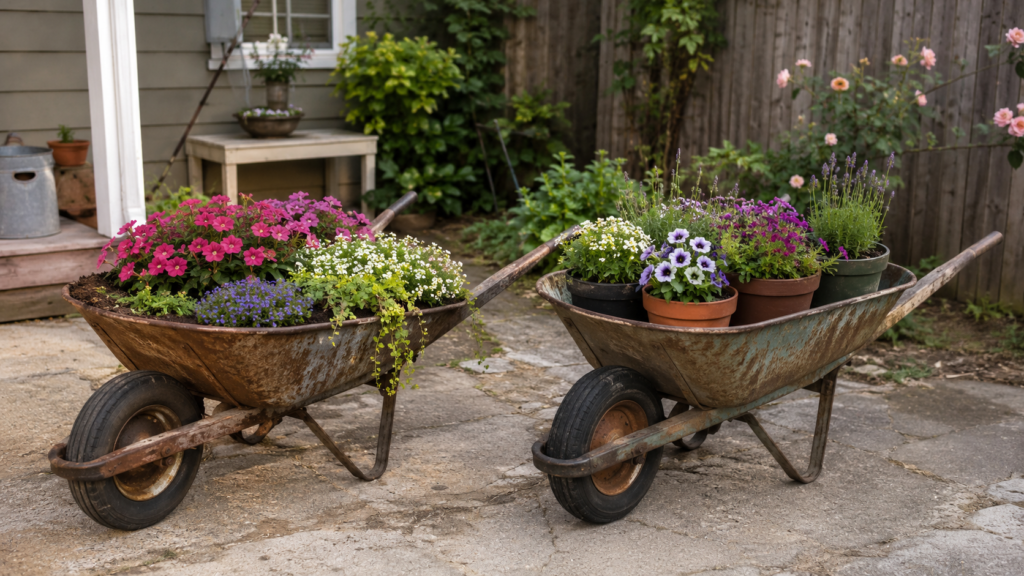
Direct planting uses the entire wheelbarrow as one container, giving plants more shared root volume and a natural appearance. Individual pots provide greater flexibility and are better for antiques, difficult-to-drill trays, or plants needing different growing media.
| Factor | Direct planting | Pots inside |
| Root volume | Maximum | Limited per pot |
| Natural appearance | Excellent | Good |
| Seasonal changes | Harder | Easy |
| Different soil mixes | Difficult | Easy |
| Antique preservation | Lower | Higher |
| Plant replacement | More disruptive | Simple |
| Choose direct planting for one compatible long-term arrangement. Choose inner pots when flexibility, preservation, or material safety matters more. |
How to Make a Wheelbarrow Planter
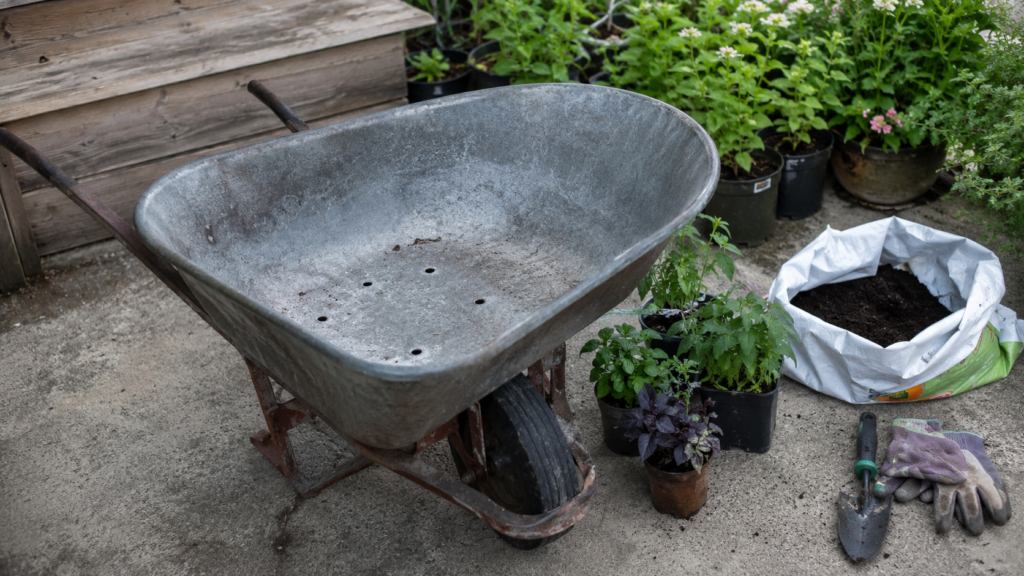
Use this sequence: inspect, clean, position, drain, fill, arrange, plant, water, observe.
Step 1: Inspect
Check the tray, legs, handles, wheel, axle, and structural connections. Repair instability first.
Step 2: Clean
Remove debris, old soil, loose rust, and unknown residues. Avoid direct edible planting if previous use is uncertain.
Step 3: Position
Move the empty wheelbarrow into its final location. Consider sunlight, wind, drainage runoff, and access to water.
Step 4: Add Drainage
Create drainage openings where water naturally collects. The objective is to prevent standing water, not reach an arbitrary hole count.
Step 5: Add Potting Mix
Use container growing medium rather than dense garden soil and leave some space below the rim.
Step 6: Arrange Plants
Place nursery pots on the surface first. Check mature height, spread, trailing direction, and compatibility.
Step 7: Plant
Set plants at the appropriate depth and gently fill around the roots.
Step 8: Water
Water thoroughly and confirm that excess water leaves through the drainage openings.
Step 9: Observe
During the first weeks, watch for wilting, persistent wetness, excessive drying, leaf scorch, aggressive growth, or blocked drainage.
Our Wheelbarrow Planter Test
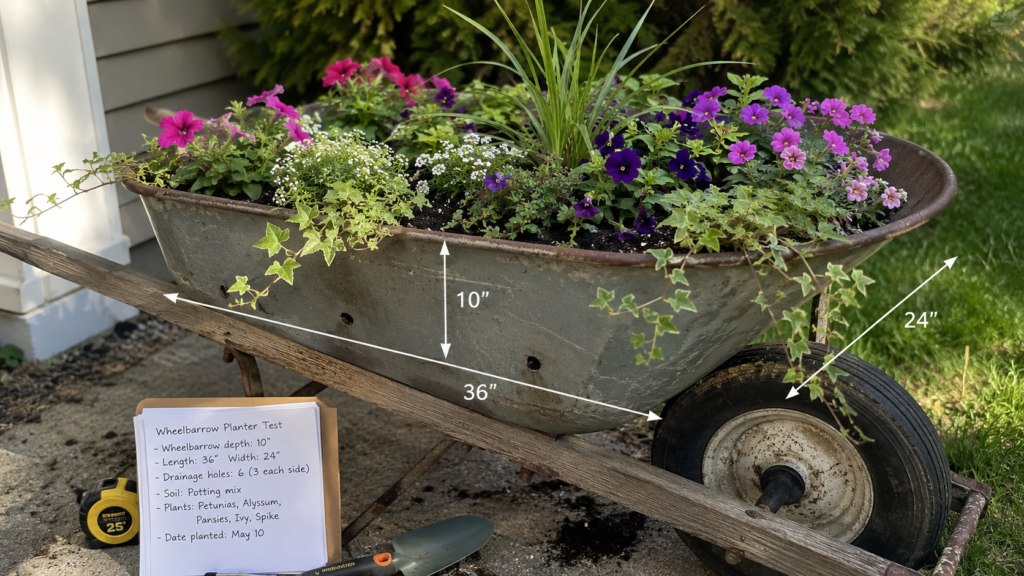
A genuine backyard test can make this guide more useful by showing how the planter performs after planting day. Record real measurements and observations rather than estimates.
| Test detail | Actual result |
| Wheelbarrow material | [Add actual result] |
| Tray length | [Add measurement] |
| Tray width | [Add measurement] |
| Usable depth | [Add measurement] |
| Drainage openings | [Add details] |
| Potting mix | [Add type] |
| Plants used | [Add varieties] |
| Sun exposure | [Add conditions] |
| Planting date | [Add date] |
| Initial drainage | [Add observation] |
| 7-day result | [Add observation] |
| 30-day result | [Add observation] |
| Also record what worked, what failed, and what you would change next time. A genuine problem—such as one side drying faster or one plant becoming too aggressive—is useful information. |
Wheelbarrow Planter Drainage
A directly planted wheelbarrow needs drainage because roots require both moisture and oxygen.
There is no universal number of holes. Tray shape, slope, and existing openings determine where water collects.
Test drainage by adding water to the empty wheelbarrow and observing the low points. Add openings where needed, then test again.
Do not rely on a gravel layer to correct poor drainage. Use effective drainage openings + suitable potting mix + appropriate watering.
If soil escapes through a large opening, use a small permeable screen without blocking water flow.
Best Soil for Wheelbarrow Planters
Use quality potting mix designed for outdoor containers. It provides a better balance of moisture retention, drainage, aeration, and root support than ordinary garden soil.
Garden soil can become heavy and compact inside a wheelbarrow, particularly after watering.
Keep the final soil level below the rim. If different plants require fundamentally different growing media, use separate pots rather than forcing them to share the same root zone.
Rusty and Vintage Wheelbarrow Planters
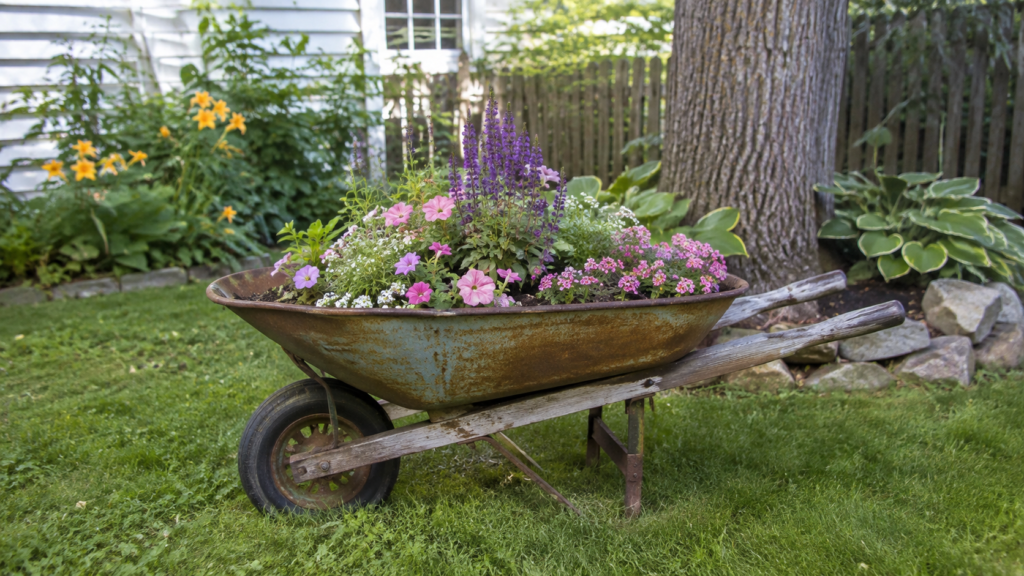
Surface rust does not automatically make a wheelbarrow unsuitable. What matters is whether corrosion has weakened the tray, legs, frame, or support points.
Check for:
- deep rust;
- sharp edges;
- loose hardware;
- cracked timber;
- unstable supports;
- unknown peeling coatings.
For ornamentals, a structurally sound weathered wheelbarrow may be usable. For herbs, strawberries, and vegetables, use an inner container if previous use or coatings are uncertain.
Valuable antiques are also better suited to removable pots because drilling and constant moisture can damage the original material.
Where to Place a Wheelbarrow Planter
Choose the location according to plant needs first.
Observe:
- morning and afternoon sun;
- shade;
- reflected heat;
- wind;
- natural rainfall.
Good positions include beside a path, near a patio, beside a shed, at the end of a flower border, or near a vegetable garden entrance.
Avoid narrow walkways where handles or wheels become trip hazards. On soil, check that the legs are not sinking; on paving, consider drainage runoff.
Wheelbarrow Planter Care
Check soil moisture before watering rather than following a fixed schedule. Hot, windy weather can increase water use, while cool or wet conditions may reduce it.
Apply fertilizer according to plant and product requirements. Remove spent flowers where useful, trim aggressive growth, and remove diseased foliage.
At the end of the season, remove finished annuals. Evaluate perennials, bulbs, grasses, and succulents according to local winter conditions because container roots can experience greater temperature extremes than plants in the ground.
Wheelbarrow Planter Cost
Costs depend on what you already own. Main expenses may include:
- wheelbarrow;
- potting mix;
- plants;
- drainage supplies;
- tools;
- optional paint or accessories.
The lowest-cost version usually reuses an existing wheelbarrow, tools already available, and a small number of compatible plants.
Prioritize healthy plants, sufficient growing medium, and drainage before decorative extras.
How Long Do Wheelbarrow Planters Last?
Lifespan depends on material, existing condition, drainage, climate, and maintenance.
Metal can corrode, while wood can deteriorate through repeated moisture exposure. Standing water and freeze-thaw cycles can shorten the useful life of both.
Extend longevity by:
- keeping drainage clear;
- checking support points;
- repairing deterioration early;
- avoiding standing water;
- using removable pots when preservation matters.
Plant lifespan varies separately according to whether you use annuals, herbs, bulbs, succulents, grasses, or perennials.
Which Wheelbarrow Planter Idea Is Best?
Choose the option that requires the fewest compromises.
For beginners, a thriller-filler-spiller design with two or three compatible plants is a strong choice. For lower maintenance, use fewer species with similar needs.
For visual impact, use:
- one structural plant;
- one middle layer;
- one trailing accent.
For antiques or frequent seasonal changes, use separate pots.
The best design is the one that suits your site’s sunlight, root space, drainage, and realistic maintenance level.
Wheelbarrow Planter FAQs
Can You Use an Old Wheelbarrow as a Planter?
Yes. Use it if the tray and frame are strong and excess water can drain freely. Use removable pots for valuable or badly damaged wheelbarrows.
Do Wheelbarrow Planters Need Drainage Holes?
Yes. Directly planted wheelbarrows need drainage so excess rain and irrigation do not remain around the roots.
Should You Put Gravel in the Bottom?
No. Proper drainage openings and suitable container potting mix are more important than a gravel layer.
What Soil Is Best?
Use quality outdoor container potting mix. Garden soil is heavier and may compact inside the tray.
What Plants Work Best?
Compact flowers, foliage, trailing plants, herbs, strawberries, succulents, and small grasses can work when their requirements are compatible.
Can You Grow Herbs or Strawberries?
Yes, with suitable drainage, root depth, sunlight, and safe materials for edible growing.
Can Succulents Grow in a Wheelbarrow?
Yes. They work well in sunny conditions with excellent drainage and an appropriate growing medium.
Can You Plant Into a Rusty Wheelbarrow?
Yes for ornamentals if the rust is cosmetic and the structure remains strong. Use more caution with edible plants when the wheelbarrow’s history is unknown.
How Often Should You Water?
Check the growing medium rather than following a fixed schedule. Heat, wind, sun, and plant size all affect watering needs.
Why Are My Plants Dying?
Common causes include poor drainage, incorrect watering, unsuitable light, overcrowding, and incompatible plants.
Can a Wheelbarrow Planter Stay Outside in Winter?
Sometimes. Plant hardiness, drainage, local climate, and container exposure determine whether it can remain outdoors.
Is a Wheelbarrow Planter Worth Making?
Yes, especially when reusing an unwanted wheelbarrow. It works best when drainage, root space, and plant compatibility are planned properly.
Wheelbarrow Planter Checklist
Before planting:
- Tray and frame are structurally sound.
- Final location is stable.
- Sunlight conditions are known.
- Drainage has been tested.
- Container potting mix is ready.
- Plants share compatible light and water needs.
- Mature plant size fits the tray.
- Edible plants are separated from questionable materials.
- The planting is not overcrowded.
After planting: - Water drains freely.
- The wheelbarrow remains stable.
- Moisture is checked before watering.
- Aggressive growth is controlled.
- Dead or diseased growth is removed.
- Seasonal or winter care is planned.
A successful wheelbarrow planter follows a simple formula:
sound wheelbarrow + drainage + suitable growing medium + correct light + compatible plants + realistic maintenance
Conclusion
Wheelbarrow planter ideas work best when growing conditions guide the design. Check the wheelbarrow’s condition, choose an appropriate location, provide effective drainage, and use container potting mix before adding plants.
A sunny wheelbarrow can support annuals, herbs, strawberries, or succulents, while a shaded one may perform better with begonias and foliage. Antique wheelbarrows can hold removable pots instead of being permanently altered.
Give plants enough space to mature and monitor the planter during the first weeks. The strongest wheelbarrow planter is not the one with the most plants, but the one that remains healthy, stable, attractive, and manageable throughout the season.

Myra is the founder and lead writer of Backyard Planter Ideas, where she shares practical, well-researched guidance on planter design, plant selection, and outdoor styling. Her goal is to help homeowners create attractive, functional garden spaces with clear, reliable, and easy-to-apply advice.