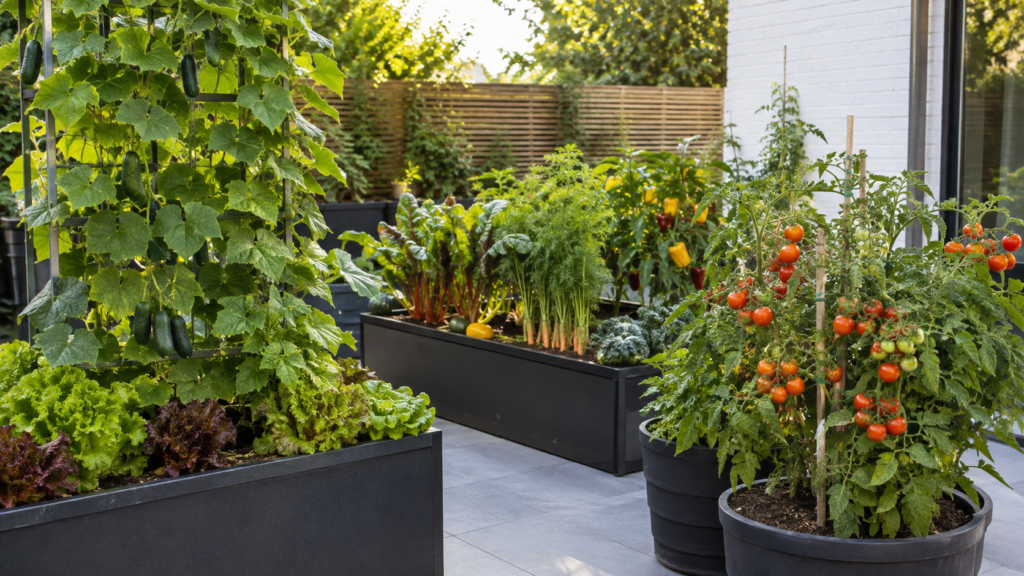
The best vegetables for deep planters include tomatoes, carrots, potatoes, peppers, eggplants, cucumbers, beans, beets, Swiss chard, compact squash, and broccoli or cabbage. Most medium-rooted vegetables can grow in about 8–12 inches (20–30 cm) of usable soil, while larger fruiting crops generally benefit from 12–18 inches (30–45 cm) or more.
Depth is only one part of the decision. A tall, narrow planter can hold less usable soil than a shorter, wider one, so planter width, total soil volume, drainage, sunlight, watering needs, and mature plant size matter just as much.
Use this simple order:
vegetable → mature size → root requirement → planter depth → width → soil volume → drainage → support
What Is a Deep Vegetable Planter?
For practical backyard gardening, a planter with about 12 inches or more of usable growing medium can be considered deep. Usable depth means the soil actually available to roots, not the outside height of the planter.
False bottoms, self-watering reservoirs, thick bases, and internal platforms can reduce the real root zone. Measure the inside depth before planting.
A useful guide is:
| Usable soil depth | Best suited to |
|---|---|
| 4–9 in / 10–23 cm | Lettuce, spinach, radishes, scallions, small herbs |
| 8–12 in / 20–30 cm | Carrots, beets, beans, chard, compact vegetables |
| 12–18+ in / 30–45+ cm | Tomatoes, peppers, eggplants, cucumbers, squash |
| 18–24 in / 45–60 cm | Generous space for vigorous crops and large root zones |
These are practical ranges, not strict biological limits; cultivar size, planter width, climate, and care can change what works best.
Why Do Vegetables Benefit From Deep Planters?
Deep planters give vegetables a larger controlled root zone. More growing medium usually means more room for roots, a larger reserve of moisture and nutrients, and better stability for tall or heavily fruited plants.
Different crops use that space differently. Carrots need unobstructed soil for their edible roots. Tomatoes and peppers benefit from a larger moisture and nutrient reserve. Cucumbers and pole beans combine root space below the soil with vertical growth above it. Potatoes need enough soil volume for underground tubers.
A deeper or larger planter can provide:
- More usable root space.
- Better moisture and nutrient buffering.
- Better anchorage for cages and trellises.
- Room for storage roots and tubers.
Extra depth only helps when the crop can use it.
How Deep Should Vegetable Planters Be?
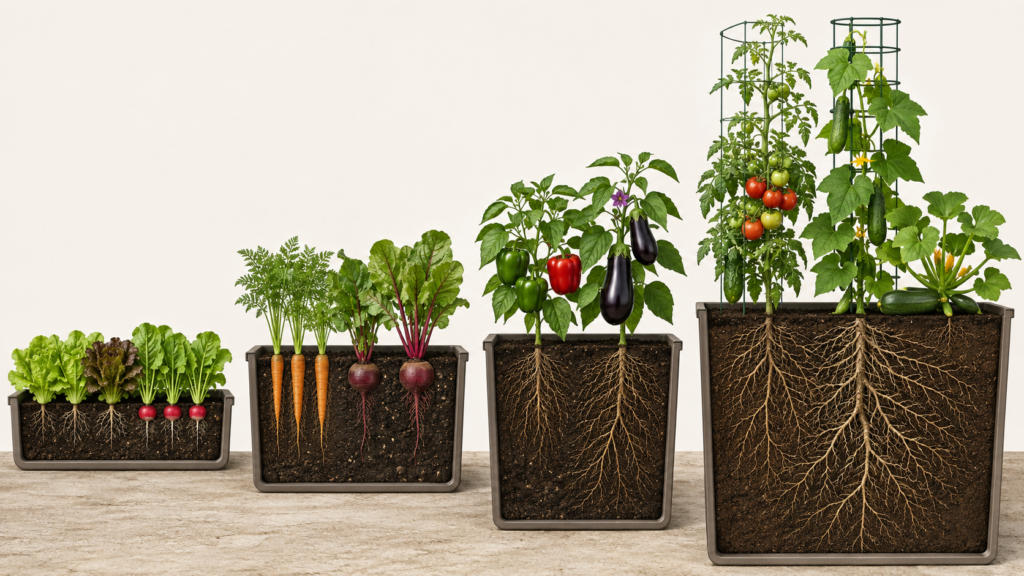
There is no single ideal depth for every vegetable. Match the planter to the crop, then confirm that the container is wide enough and holds enough growing medium.
Vegetable Planter Depth Chart
| Vegetable | Practical depth | Main requirement |
| Tomato | 12–18+ in | High soil volume and support |
| Potato | 12–18+ in | High soil volume |
| Carrot | 8–12+ in | Depth matched to root length |
| Pepper | 12–16+ in | Moisture reserve |
| Eggplant | 12–16+ in | Volume and stability |
| Cucumber | 12–18+ in | Volume and trellis |
| Beans | 8–12+ in | Root room; support for pole types |
| Beets | 8–12 in | Width and spacing |
| Swiss chard | 8–12 in | Long-term moisture reserve |
| Compact squash | 12–18+ in | High volume and space |
| Broccoli/cabbage | 8–12+ in | Width and spacing |
| Lettuce | 4–9 in | Shallow root zone |
Some charts describe a minimum workable size while others recommend a more comfortable container. If two planters provide adequate depth, the wider container with greater total volume is usually the more forgiving choice.
For long-season crops, choose the larger end of the range when the planter sits in full sun, catches regular wind, or cannot be watered frequently. More growing medium gives roots a larger moisture reserve and usually makes day-to-day container care more forgiving. This is especially useful for tomatoes, cucumbers, peppers, and squash.
Is Planter Depth the Same as Natural Root Depth?
No. A vegetable’s natural root depth in open ground is not the same as the planter depth required in container culture.
In garden soil, roots can spread through a much larger vertical and horizontal area. In a planter, water and nutrients are concentrated inside a limited root zone. That is why a tomato can grow productively in a container much shallower than the maximum depth its roots might explore in open soil.
For containers, evaluate usable depth, horizontal root room, total soil volume, water and nutrient availability, and mature plant size. Container depth is a management guideline, not a claim about maximum biological root depth.
What Are the Best Vegetables for Deep Planters?
The strongest choices are vegetables that make real use of additional depth, volume, or planter stability.
1. Tomatoes
Tomatoes are one of the best crops for deep planters because mature plants support a large root system, foliage, fruit, and usually a cage or stake.
Aim for roughly 12–18 inches or more of usable depth with generous width. Compact, patio, dwarf, and determinate tomatoes are easier in smaller spaces, while vigorous indeterminate varieties benefit from larger containers.
Install support at planting time instead of pushing a stake through an established root system later.
2. Carrots
Carrots directly benefit from usable soil depth because the edible storage root grows downward.
For many varieties, 8–12 inches is enough, but long carrots need deeper, unobstructed soil. Short, round, and half-long carrots are particularly convenient for containers.
Use loose growing medium without stones or compacted clumps, and thin seedlings properly.
3. Potatoes
Potatoes grow well in large containers, but overall volume is more useful than extreme height.
A broad planter, tub, or grow bag with around 12–18 inches or more of usable depth gives the crop room without relying on a narrow “potato tower.” Maintain consistent moisture and good drainage.
4. Peppers
Peppers perform well in medium-to-deep planters because extra growing medium supports the roots and creates a larger moisture reserve.
Use roughly 12–16 inches or more for full-size plants. Compact varieties can use smaller pots. Heavily fruited plants may need support, especially in windy areas.
5. Eggplants
Eggplants are strong deep-planter vegetables because mature plants can become wide and carry several heavy fruits.
A container around 12–16 inches or deeper with good width works well for many full-size plants. Avoid crowding several large eggplants into one planter. Compact varieties are better for patios and small spaces.
6. Cucumbers
Cucumbers combine especially well with deep containers because their roots occupy the planter while vines use vertical space above it.
Use around 12–18 inches of usable depth for full-size varieties. Vining cucumbers need a strong trellis; bush varieties work where vertical support is unavailable.
Because mature foliage can use water quickly, a larger soil volume makes irrigation easier to manage.
7. Beans
Beans usually need less depth than tomatoes but still grow comfortably in medium or deep planters.
Around 8–12 inches or more works for many bush beans. Pole beans need a sturdy support and are particularly efficient where patio floor space is limited because they grow upward.
8. Beets
Beets grow well in about 8–12 inches of soil.
Width and spacing are often more important than extra depth because the roots enlarge near the surface. A broad 10–12-inch planter may produce more useful planting space than a narrow 18-inch pot.
Thin seedlings properly and use loose, well-drained growing medium.
9. Swiss Chard
Swiss chard is productive in approximately 8–12 inches of soil and can also make good use of deeper containers.
Because chard can be harvested repeatedly, a larger soil volume helps provide moisture and nutrients over a longer period. Harvest the outer leaves while allowing the center to continue growing.
10. Compact Squash
Compact summer squash can grow successfully in deep containers, but overall volume and above-ground space are critical.
Aim for around 12–18 inches or more and choose bush, patio, or compact cultivars where possible. Remember that the leaves may spread much wider than the planter.
11. Broccoli and Cabbage
Broccoli and cabbage can grow in substantial containers, but planter width is especially important.
Around 8–12 inches or more can work when the container has sufficient volume and surface area. Large leaves make overcrowding a bigger problem than insufficient vertical depth.
Which Vegetables Don’t Need Deep Planters?
Lettuce, spinach, radishes, scallions, many Asian greens, mustard greens, and small herbs generally do not need deep containers.
They can grow in an 18-inch planter, but much of that extra growing medium is unnecessary for their root systems. A deeper pot may still be useful for increased working height, moisture reserve, or patio design.
If you have several container sizes, reserve the deepest planters for tomatoes, potatoes, cucumbers, peppers, eggplants, carrots, squash, and other crops that can make greater use of the soil volume.
What Grows in 12-, 16-, 18-, and 24-Inch Planters?
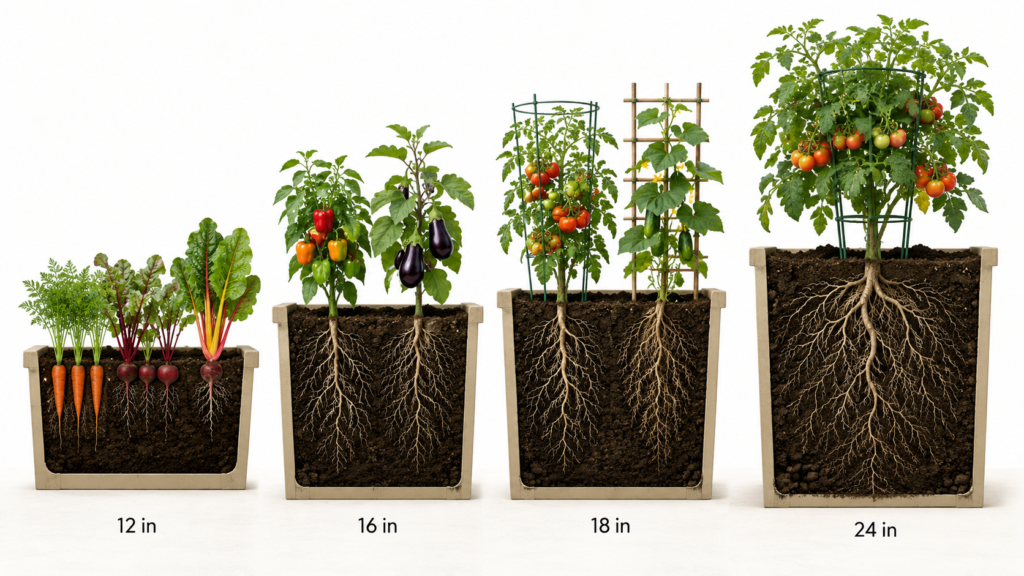
12 Inches
Good choices include carrots, beets, beans, Swiss chard, many brassicas, compact peppers, and leafy vegetables.
16 Inches
A 16-inch planter can support tomatoes, peppers, eggplants, cucumbers, carrots, beans, chard, and compact squash when it also provides enough width.
18 Inches
Eighteen inches is a generous multipurpose depth for tomatoes, cucumbers, potatoes, peppers, eggplants, zucchini, beans, and many other container crops.
24 Inches
A 24-inch planter can accommodate most common container vegetables, but many crops do not need the full depth.
Once adequate depth is available, width, total volume, drainage, and planting density often matter more than extra height.
Is a Deeper Planter Always Better?
No. A deeper planter can increase root space and moisture storage, but unnecessary depth also adds potting-mix cost, weight, and water-holding capacity.
A 16-inch-deep container that is 24 inches wide can provide more useful growing space than a 24-inch-deep planter only 10 inches across.
The goal is adequate depth plus adequate volume, not maximum height—especially for large fruiting, root, tuber, and long-season crops.
How Much Soil Does a Deep Planter Hold?
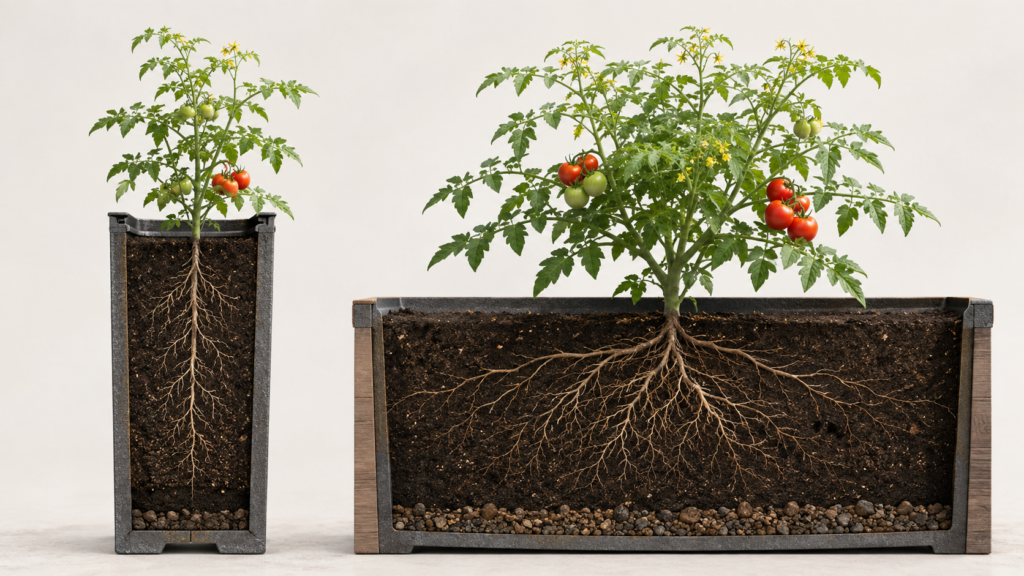
Volume helps compare planters more accurately than height alone.
For rectangular planters:
Gallons = length × width × usable depth in inches ÷ 231
Example:
24 × 12 × 12 inches ≈ 15 US gallons
For metric measurements:
Liters = length × width × usable depth in centimeters ÷ 1,000
Example:
60 × 30 × 30 cm = 54 liters
Use internal measurements rather than exterior dimensions.
As a practical guide:
- Around 2 gallons / 7.6 L: compact crops.
- Around 5 gallons / 19 L: common minimum territory for many individual fruiting vegetables.
- 8–10+ gallons / 30–38+ L: more comfortable for substantial vegetables.
- 10+ gallons / 38+ L: useful for squash and vigorous long-season crops.
What Soil Is Best for Deep Vegetable Planters?
Use a quality potting or container mix in freestanding deep planters rather than filling them mainly with dense garden soil.
Good container media should hold useful moisture, drain excess water, maintain air around roots, retain nutrients, and remain reasonably lightweight.
Do not waste productive root volume by filling the bottom with random bulky materials if the crop actually needs that space.
Is a Raised Bed the Same as a Planter?
No. A freestanding patio planter behaves like a large container, while an open-bottom raised bed can interact with the native soil below.
Use container mix for freestanding planters and a suitable raised-bed soil system for open-bottom beds.
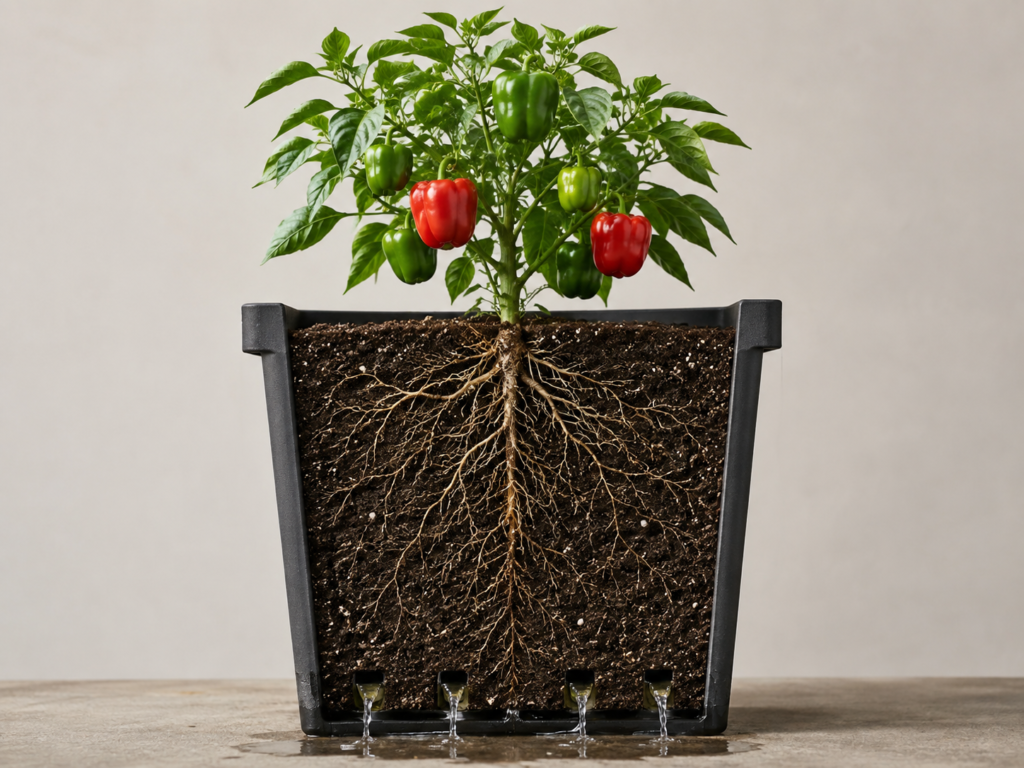
Do Deep Vegetable Planters Need Drainage?
Yes. Conventional vegetable planters need functioning drainage holes or a properly designed reservoir and overflow system.
Do not add a thick gravel or stone layer simply to improve drainage. Instead, use appropriate growing medium and keep the drainage openings clear.
If a planter sits directly on paving, make sure water can escape freely. The goal is to hold useful moisture while allowing excess water to leave the root zone.
How Do You Water and Fertilize Deep Planters?
Water according to actual root-zone moisture rather than a fixed schedule. Deep planters hold more water than small pots, but mature tomatoes, cucumbers, peppers, and squash can still dry quickly in hot, sunny, or windy weather.
Water thoroughly enough to moisten the active root zone, then allow excess water to drain. Avoid repeatedly wetting only the top inch.
For fertilizer:
- Check whether the potting mix already contains nutrients.
- Follow the fertilizer label.
- Feed long-season fruiting vegetables as needed.
- Avoid excessive fertilizer.
- Remember that repeated watering can leach nutrients.
Aim for consistent moisture and moderate nutrition.
How Much Sun Do Planter Vegetables Need?
Most fruiting vegetables need strong light. Tomatoes, peppers, eggplants, cucumbers, and squash generally perform best with around 6–8 hours of direct sun.
Leafy greens such as lettuce and spinach can tolerate less.
Observe the location before filling a large planter. Walls, trees, fences, and nearby buildings may create shade at different times of day, and hard surfaces can increase heat around containers.
Climate also affects planter management:
- Hot or windy locations benefit from more soil volume.
- Wet climates require especially reliable drainage.
- Dry climates may benefit from self-watering systems.
- Cool climates require locally appropriate planting dates.
Use local frost dates and regional sowing calendars rather than one universal planting month.
Which Vegetable Varieties Work Best in Planters?
Compact cultivars are often the easiest choice.
Look for descriptions such as bush, dwarf, compact, patio, container, or determinate.
Compact plants still benefit from good root volume, but their top growth is easier to manage. This is especially useful for tomatoes, cucumbers, peppers, and squash.
Choose by mature size, not by the size of the transplant at planting time.
Do Deep Planters Need Stakes or Trellises?
Many large container vegetables benefit from support.
- Tomatoes: cages, stakes, or trellises.
- Cucumbers: trellises for vining cultivars.
- Pole beans: poles or vertical mesh.
- Peppers: stakes when heavily fruited.
- Eggplants: support for heavy branches.
Install supports early so you do not damage established roots later.
A broad planter also provides a more stable base than a tall, narrow container, particularly in windy areas.
What Mistakes Should You Avoid With Deep Planters?
Avoid:
- Choosing a tall but very narrow planter.
- Overcrowding large vegetables.
- Using dense garden soil.
- Blocking drainage holes.
- Adding gravel as a drainage fix.
- Watering only the surface.
- Ignoring mature plant width.
- Installing supports too late.
- Overfertilizing.
- Putting sun-loving vegetables in shade.
When a container vegetable struggles, troubleshoot in this order:
water → drainage → sunlight → soil volume → nutrients → spacing → support
How Do You Choose a Deep Vegetable Planter?
Before buying, check:
- Usable internal depth and width.
- Total soil capacity.
- Drainage.
- Filled weight and stability.
- Planter material.
- Trellis or stake compatibility.
- Water access and mature plant size.
For beginners, a broad planter around 12–18 inches deep with reliable drainage is a versatile choice.
Start with one manageable crop such as a compact tomato, pepper, bush cucumber, eggplant, chard, carrots, or beets. One properly spaced vegetable is easier to learn from than several large plants competing in the same container.
What Is the Simplest Planter-Depth Rule?
Use this framework:
Leafy crop → shallow or medium planter.
Root crop → depth matched to mature root length.
Large fruiting crop → deep, wide, high-volume planter.
Climbing crop → enough root volume plus support.
Sprawling crop → enough root volume plus surrounding space.
For Backyard Planter Ideas, the main rule is:
Choose the vegetable first, then match the planter depth, width, soil volume, drainage, and support to the mature crop.
FAQs About Vegetables for Deep Planters
Is 12 inches deep enough for vegetables?
Yes. Twelve inches works for carrots, beets, beans, chard, many brassicas, and compact crops. Larger fruiting vegetables usually benefit from more soil volume.
Is 18 inches deep enough for tomatoes?
Yes. Eighteen inches provides generous vertical depth for many tomatoes when the planter is also wide, stable, and high-volume.
How deep should a planter be for carrots?
Many carrots grow well in 8–12 inches of loose soil. Choose a deeper planter for long-rooted varieties.
How deep should a planter be for potatoes?
Use a substantial medium-to-deep container and prioritize generous width and total soil volume rather than extreme planter height.
Is a 24-inch planter too deep?
No. Most vegetables can grow in a 24-inch planter, but many will not use the full depth.
Do deep planters need drainage holes?
Yes. Conventional vegetable planters need functional drainage holes or a properly engineered reservoir and overflow system.
Should you put gravel in the bottom?
No. Use suitable container mix and keep the drainage openings clear instead.
Which vegetables don’t need deep planters?
Lettuce, spinach, radishes, scallions, many Asian greens, and small herbs generally grow successfully in shallower containers.
Are deeper planters always better?
No. A moderately deep, wide planter can provide more useful root space than a very tall, narrow one.
What is the best all-purpose vegetable planter depth?
A broad planter around 16–18 inches deep is a practical multipurpose choice for many container vegetables.
Final Deep Planter Checklist
Before planting, confirm:
- Enough usable soil depth.
- Adequate width.
- Sufficient soil volume.
- Working drainage.
- Quality container growing mix.
- Appropriate sunlight.
- Stable planter position.
- Stakes or trellises where needed.
- Easy access to water.
- Correct spacing for mature plants.
- A suitable compact variety where space is limited.
The best vegetables for deep planters are not simply the crops with the deepest natural roots. They are vegetables whose mature size, root system, moisture needs, and growth habit make productive use of the planter’s combined depth, width, and soil volume.
Myra is the founder and lead writer of Backyard Planter Ideas, where she shares practical, well-researched guidance on planter design, plant selection, and outdoor styling. Her goal is to help homeowners create attractive, functional garden spaces with clear, reliable, and easy-to-apply advice.