
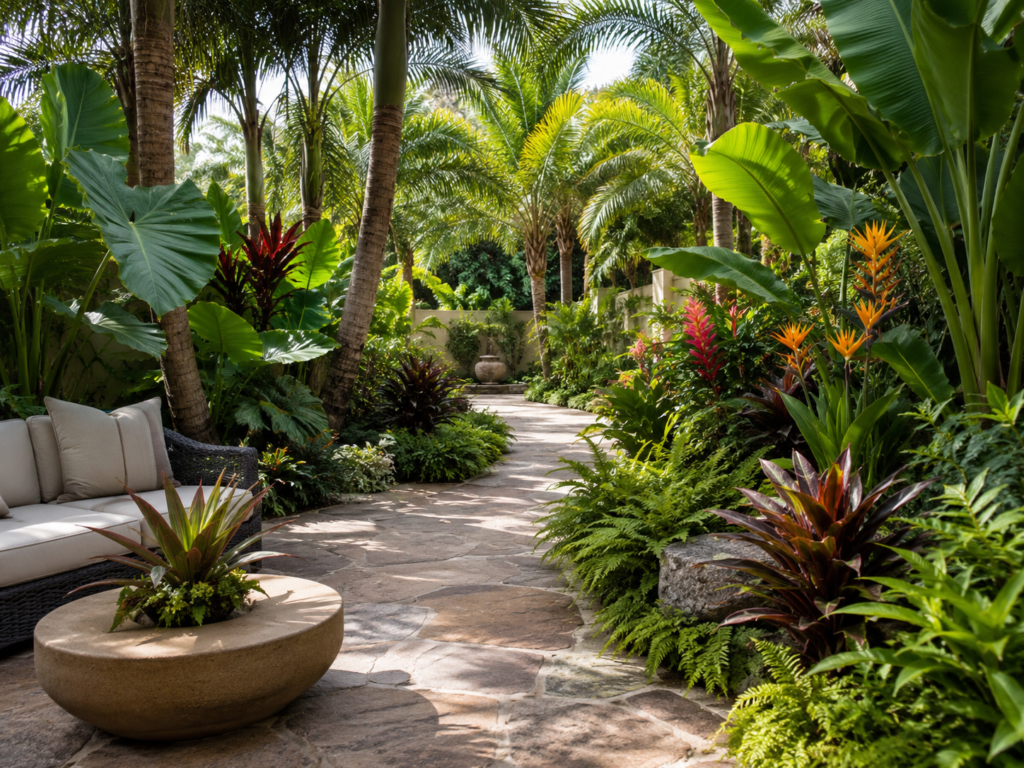
Tropical backyard plant ideas work best when bold foliage, layered heights, repeated plant groups, and usable outdoor space are planned together. Start with one architectural plant, repeat two dependable plants through the middle layer, and finish with lower foliage around paths, patios, containers, and seating areas.
A successful tropical backyard should feel lush without becoming crowded. Match every plant to the site’s winter temperature, sunlight, drainage, wind, mature size, and maintenance level. Cooler regions can achieve the same effect with hardy tropical-looking plants and seasonal containers.
These tropical backyard plant ideas can be adapted for sunny gardens, shaded yards, compact patios, pool areas, cold climates, and water-wise landscapes.
Which Tropical Backyard Style Fits?
Choose the design according to the main problem you want to solve. Containers suit patios and cold climates; layered borders add privacy; upright palms save width; and bananas, gingers, and elephant ears create faster volume.
| Backyard condition | Best approach | Plant direction | Main concern |
|---|---|---|---|
| Small yard | Container jungle | Compact palms, cordyline, canna | Keep paths open |
| Sunny, humid yard | Layered border | Banana, ginger, canna | Water and feeding |
| Shaded yard | Foliage retreat | Fatsia, ferns, caladium | Match shade depth |
| Cold climate | Hardy tropical garden | Hardy palms, fatsia, ferns | Winter protection |
| Dry climate | Water-wise tropical look | Palms, phormium, red yucca | Separate irrigation |
| Privacy-focused yard | Layered screen | Narrow palms, bamboo, ginger | Mature width |
| Pool area | Clean structural planting | Palms, bird of paradise | Roots and leaf drop |
Choose the design first and the plants second so your tropical backyard plant ideas remain compatible with the available sunlight, space, irrigation, and winter conditions.
What Makes a Backyard Look Tropical?
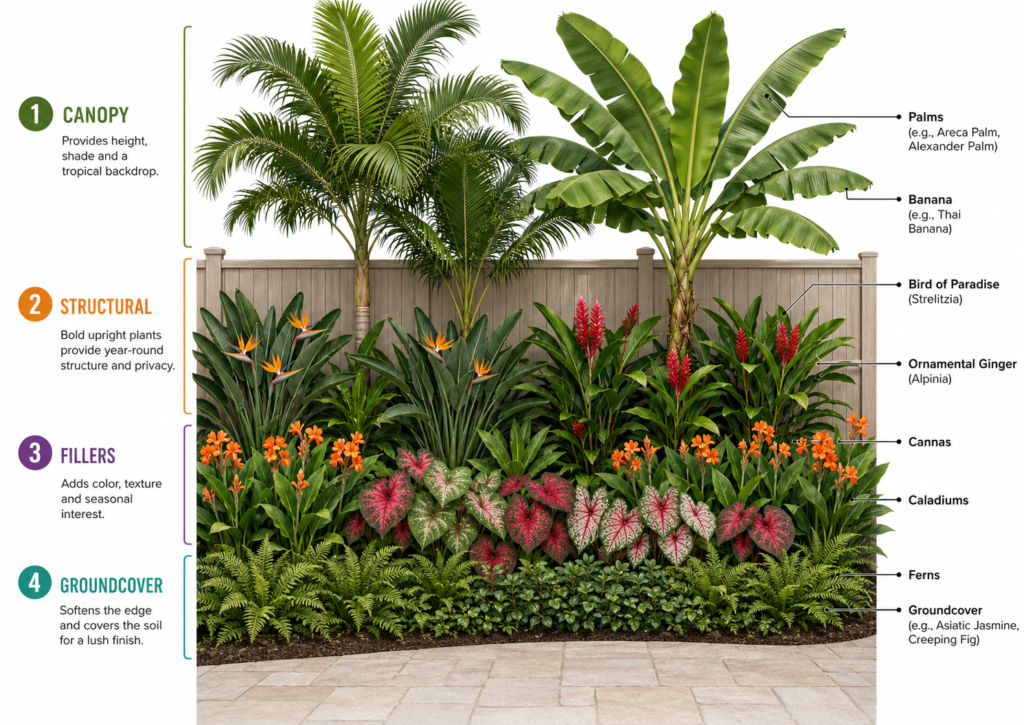
A backyard looks tropical when it combines height, oversized foliage, contrasting leaf shapes, repeated groups, and partial enclosure. Flowers add color, but foliage creates the lasting structure.
Use four planting layers:
- Canopy: palms, bananas, tree ferns, or small trees
- Structure: bird of paradise, gingers, cordylines, and broad shrubs
- Filler: cannas, bromeliads, caladiums, coleus, and begonias
- Ground layer: ferns, trailing foliage, groundcovers, and mulch
A simple 3-2-1 framework keeps the design balanced: use three low foliage groups, repeat two medium-height plants, and add one dominant architectural plant.
Tropical vs Tropical-Looking Plants
True tropical plants usually need warm, frost-free conditions or seasonal protection. In cooler climates, use hardy palms, fatsia, large ferns, phormiums, and glossy shrubs as permanent structure, then add cannas, bananas, elephant ears, caladiums, and coleus for summer impact.
Check Your Backyard First
Observe the backyard morning, midday, and afternoon. Treat full sun, reflected heat, filtered shade, wet soil, and windy corners as separate planting zones.
Before buying plants, check:
- Hours of direct sunlight
- Winter minimum temperatures
- Frost and wind exposure
- Soil texture and drainage
- Existing irrigation
- Mature plant width
- Fence, path, and utility access
- Container movement and winter storage
Measure mature size, not nursery size, and preserve pruning, fence, and furniture access.
Best Tropical Backyard Plant Ideas by Climate
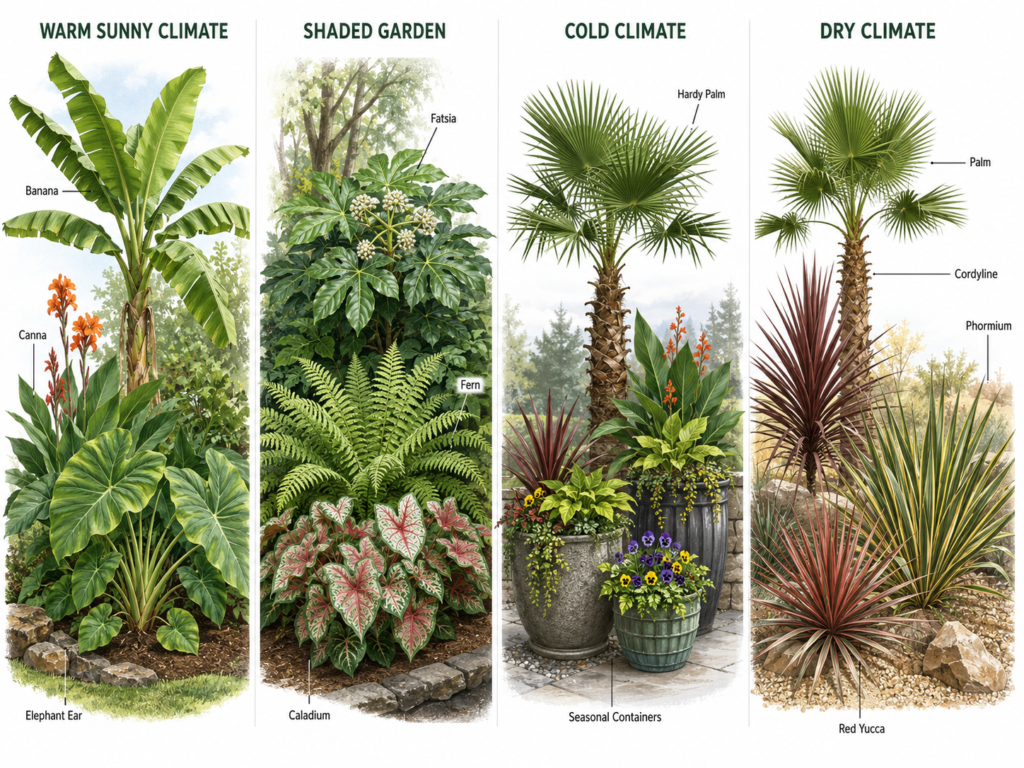
The best tropical backyard plant ideas begin with plants that match the site’s climate, sunlight, soil moisture, and available width.
| Plant | Best use | Light | Moisture | Main caution |
|---|---|---|---|---|
| Hardy banana | Fast canopy | Sun/part shade | Consistent | Wind damage |
| Elephant ear | Focal foliage | Sun/part shade | Moist | Spreading leaves |
| Bird of paradise | Patio structure | Bright light | Moderate | Mature width |
| Canna | Flowers and height | Sun | Consistent | Winter storage |
| Fatsia | Cool-climate structure | Part shade | Moderate | Exposed wind |
| Windmill palm | Hardy focal point | Sun/part shade | Drained | Final size |
| Cordyline | Upright color | Bright light | Moderate | Hardiness varies |
| Caladium | Shade color | Filtered light | Consistent | Tender |
| Coleus | Seasonal foliage | Varies | Consistent | Cold sensitive |
| Ginger | Middle layer | Varies | Usually moist | Spread varies |
| Bromeliad | Rosette color | Varies | Type dependent | Exact care varies |
| Tree fern | Shaded canopy | Filtered light | Consistent | Wind and cold |
Always verify the exact species or cultivar. Plants in the same group may differ in size, hardiness, and moisture requirements.
Plants to Use Carefully
Use extra caution with running bamboo, large clumping bamboo, aggressive gingers, elephant ears in narrow beds, fruiting plants beside pools, sharp foliage near paths, and high-water plants in dry climates.
Verify pet safety by botanical name, and choose an easier substitute when a plant requires constant containment or pruning.
1. Layer a Jungle Border
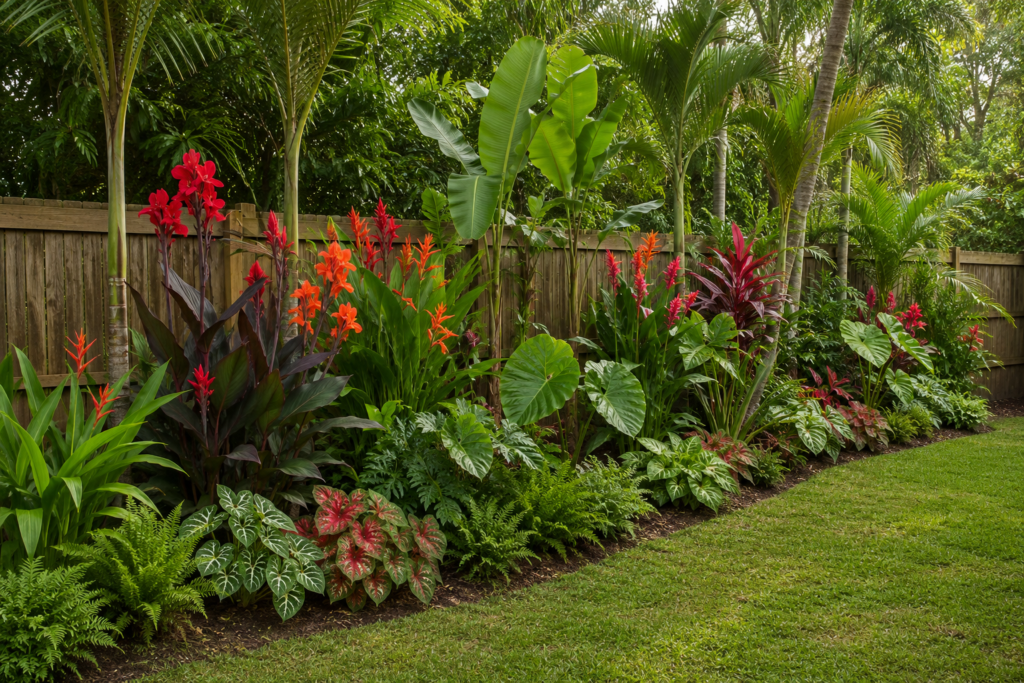
A layered jungle border can soften a fence, frame a lawn, and create privacy. Place palms or bananas at the rear, repeat gingers or cannas through the middle, and use ferns or caladiums at the front.
Among the most versatile tropical backyard plant ideas, a layered jungle border can soften a fence, frame a lawn, and improve privacy.
For a border around 2.5 to 3 metres deep:
- Use the rear third for canopy
- Use the middle third for structural groups
- Keep the front third lower
- Repeat three to six species
- Leave hidden stepping spaces
- Keep broad leaves away from paths
A limited palette usually looks more convincing than a collection of unrelated plants.
2. Add a Palm Focal Point
One palm can establish a tropical identity without redesigning the whole yard. Position it where the trunk and canopy are visible, then underplant with elephant ears, gingers, bird of paradise, or ferns.
Keep the trunk visible and choose a palm that matches the local climate, available root space, and final height.
3. Use Bananas for Canopy
Bananas create rapid height and oversized foliage at the back of borders, beside sheltered fences, or in large containers.
Protect them from wind and keep them away from paths, roofs, and windows. In cold climates, decide on wrapping, storage, or seasonal use before purchase.
4. Feature Elephant Ears
Elephant ears work best as focal plants. Use one in a large container or a group near water, a path turn, or beneath a palm.
Some prefer wet soil while others need drainage, so verify the exact type and allow room for arching leaves.
5. Add Canna for Color
Cannas combine upright foliage with bright flowers. Plant them in groups of three to seven for seasonal screening, border height, containers, or poolside color.
They prefer strong light and regular moisture, and their rhizomes may need winter storage.
6. Plant a Ginger Border
Ornamental gingers soften fences and connect tall plants with lower foliage. Repeat one main variety, leave room for division, and check its spreading habit before using it in a narrow border.
7. Frame Patios With Bird of Paradise
Bird of paradise suits patios, modern walls, and dining areas. Use one as a corner anchor or two at a wide entrance, leaving enough room for mature leaves.
In cold climates, grow it in a stable movable container. Check household and pet suitability before deciding its position.
8. Create a Tropical Shade Garden
A tropical shade garden should rely on texture and leaf color. Use fatsia or a tree fern for height, ferns and gingers through the middle, and begonias or caladiums at the front.
Pale leaves brighten darker areas, while tree-root competition may make shaded soil surprisingly dry.
9. Display Bromeliads Under Trees
Bromeliads add rosette shapes and concentrated color in sheltered shade. Use one large plant as the anchor, repeat smaller plants around it, and soften the edge with ferns.
In cold climates, keep them in removable pots placed inside decorative containers or planting pockets.
10. Layer Caladium and Coleus
Caladium and coleus create a colorful lower layer beneath taller plants. Limit the palette to two or three colors, repeat them, and separate patterned foliage with plain green leaves.
Both work well as seasonal edging and container fillers.
11. Grow a Tropical Privacy Screen
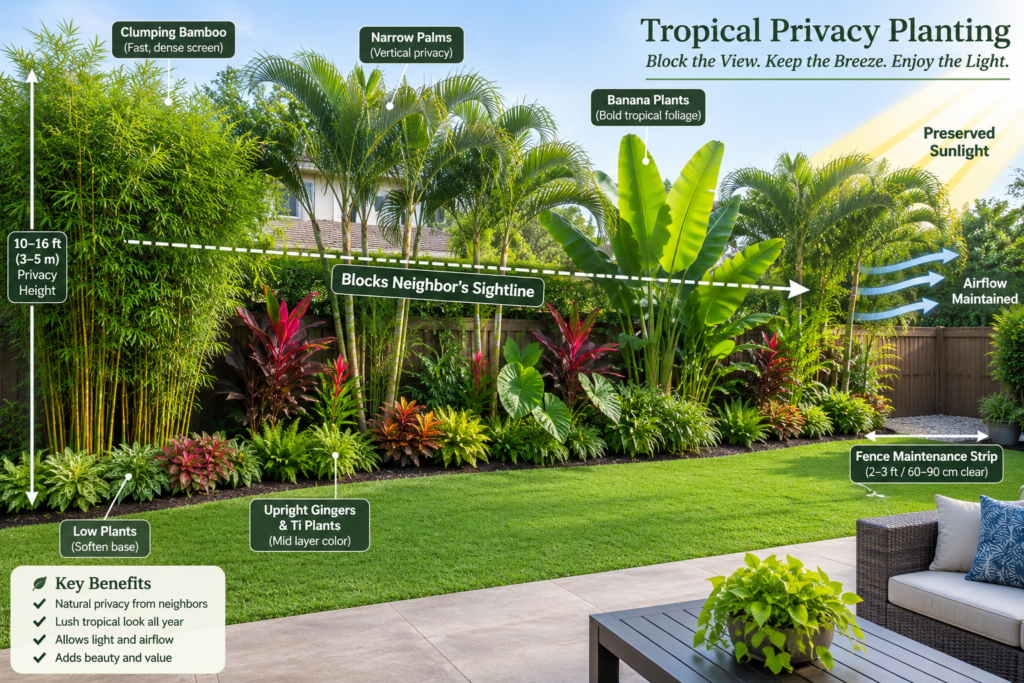
A tropical privacy screen should block the exact unwanted sightline. Use narrow evergreen structure near the boundary and broad seasonal foliage in front.
Suitable options may include:
- Narrow palms
- Podocarpus
- Verified clumping bamboo
- Upright gingers
- Bananas
- Dense evergreen shrubs
Check mature spread and leave enough room to repair the fence.
For detailed boundary planning, connect this section to your guide on best plants along a backyard fence for privacy.
12. Build a Container Jungle
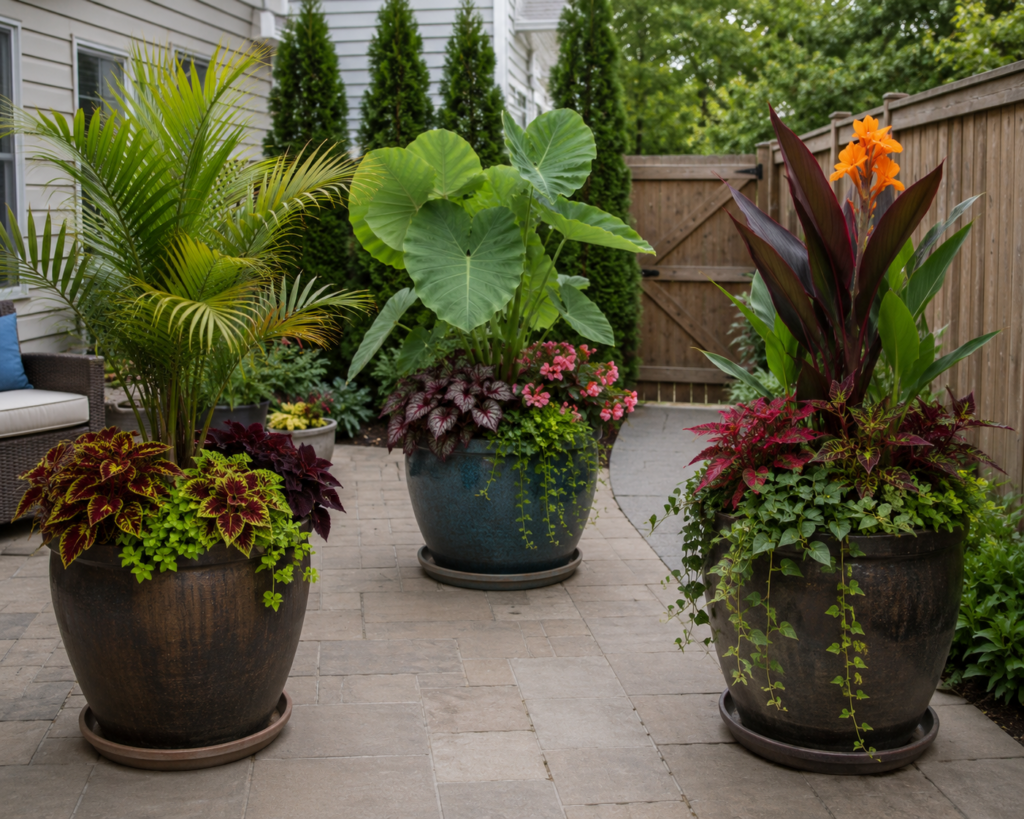
Containers suit patios, rentals, small yards, and cold climates. Use fewer large pots rather than many small ones.
Cold-climate tropical backyard plant ideas should combine hardy permanent plants with tender seasonal foliage.
Build each container around three roles:
- Anchor: palm, canna, cordyline, or elephant ear
- Filler: coleus, begonia, or caladium
- Edge: trailing or low foliage
Keep the tallest pot near the back, preserve the central walkway, and make sure every container has drainage.
Connect this section to your guide on backyard ideas with potted plants.
13. Tropical Plants for Dining Areas
Frame a dining area with a palm or bird of paradise behind the seating, compact gingers or cannas near the corners, and low ferns beside paths.
Keep irrigation, thorns, strong fragrance, and falling fruit away from the table. Leave enough space behind chairs so guests do not brush against wet foliage.
14. Best Tropical Poolside Plants
Poolside plants should have controlled roots, limited litter, and no sharp foliage. Palms, bird of paradise, cordylines, bromeliads, compact grasses, and low evergreen foliage are practical choices.
Keep bananas, heavy-fruiting trees, and aggressively spreading plants farther from the water. Preserve access to pumps, filters, drains, and pipes.
15. Tropical Plants for Water Features
Use elephant ears near suitable moist edges, ferns in shade, cannas or gingers behind the water, and bromeliads in raised rock pockets.
Confirm whether each planting area is permanently wet, periodically moist, or normally drained. Keep pumps and cleaning points accessible and prevent loose mulch from washing into the water.
16. Tropical Plants for Rain Gardens
A tropical-looking rain garden must manage stormwater first. Check runoff entry, standing-water duration, and overflow direction.
Use moisture-tolerant broad foliage in the lower zone, cannas or upright grasses through the middle, and adaptable ferns around the upper edge. Choose plants that tolerate temporary saturation and drier periods.
17. Create a Hardy Tropical Garden
Cold-climate tropical backyard plant ideas should combine hardy permanent plants with tender seasonal foliage.
Add cannas, elephant ears, coleus, caladiums, and ornamental bananas seasonally. Keep tender plants near paths so they can be removed without damaging established beds.
Cold-Climate Plant Substitutes
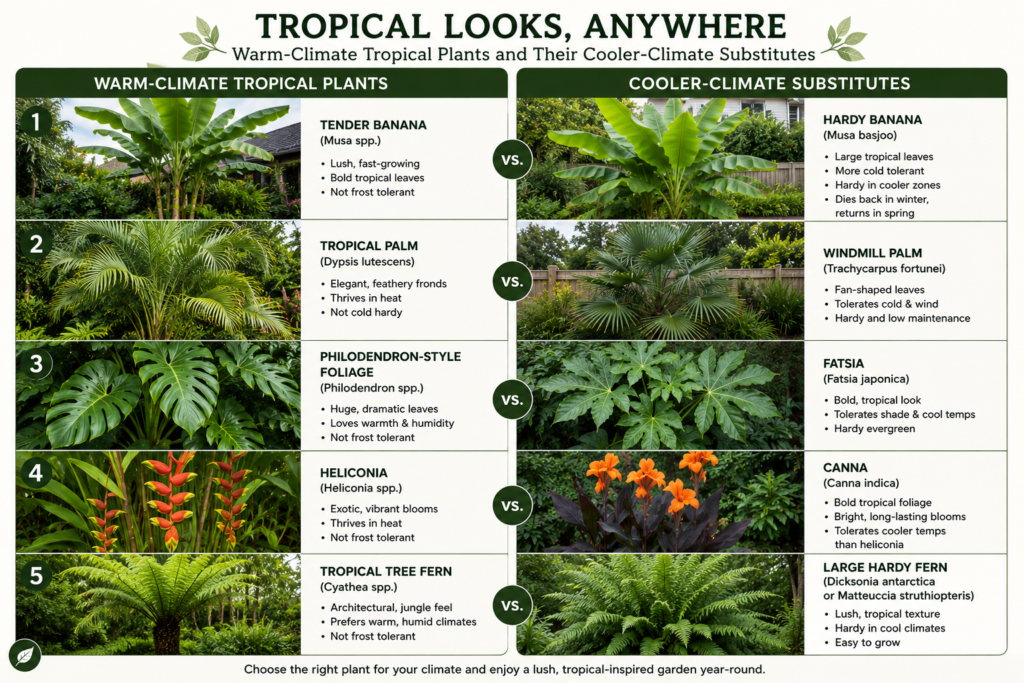
| Tropical effect | Warm-climate plant | Cooler-climate alternative |
|---|---|---|
| Large canopy leaves | Tender banana | Hardy banana or bold perennial |
| Palm silhouette | Tender palm | Locally suitable hardy palm |
| Broad evergreen foliage | Tropical philodendron | Fatsia |
| Upright flowers | Heliconia | Canna |
| Colored ground layer | Tropical caladium | Seasonal caladium or hardy shade plant |
| Fern canopy | Tropical tree fern | Large hardy fern |
| Vertical spikes | Tender cordyline | Phormium or hardy equivalent |
Choose substitutes according to the visual role they perform, not botanical similarity.
18. Create a Water-Wise Tropical Garden
Dry-climate gardens should imitate tropical form rather than rainforest water needs. Use palms, cordylines, phormiums, red yucca, grasses, succulents, and durable shrubs.
Separate irrigation zones and concentrate higher-water plants in one smaller oasis near the patio. Use gravel or climate-appropriate mulch to unify the design.
19. Tropical Plants for Side Yards
A narrow side yard needs upright plants and a clear path. Place one slim palm, cordyline, or vertical container at the far end and repeat narrow foliage along one side.
Keep meters, drains, gates, and exterior walls accessible. Place the largest leaves only where the side yard widens.
20. Add an Edible Tropical Corner
An edible tropical corner may include banana, papaya, pineapple, citrus, guava, passionfruit, or tropical herbs where climate permits.
Use one productive plant as the upper layer, add compact edibles below, and keep a clear harvesting route. Avoid heavy-fruiting plants beside pools, dining areas, and slippery paving.
21. Create a Low-Maintenance Tropical Yard
A low-maintenance tropical garden uses fewer species, more repetition, and locally adapted plants.
Begin with:
- One dependable focal plant
- Two repeated structural plants
- One seasonal color group
- One durable lower layer
- Consistent mulch
- Permanent irrigation access
Avoid plants that naturally exceed the available space or require repeated lifting, dividing, and replacement.
Tropical Plant Fit Score
Score each plant from zero to two in six categories.
| Factor | 0 points | 1 point | 2 points |
|---|---|---|---|
| Climate | Unsuitable | Needs protection | Reliably suited |
| Light | Wrong exposure | Tolerates site | Prefers site |
| Water | Conflicts | Manageable | Matches zone |
| Mature size | Obstructs space | Needs control | Fits naturally |
| Tropical impact | Weak | Supporting | Strong |
| Maintenance | Unrealistic | Moderate | Easy |
Score 10–12 as excellent, 9 as suitable, 7–8 as a compromise, and below 7 as unsuitable. Reject any zero in climate, light, or water unless the plant is seasonal.
4 × 5 Metre Tropical Layout
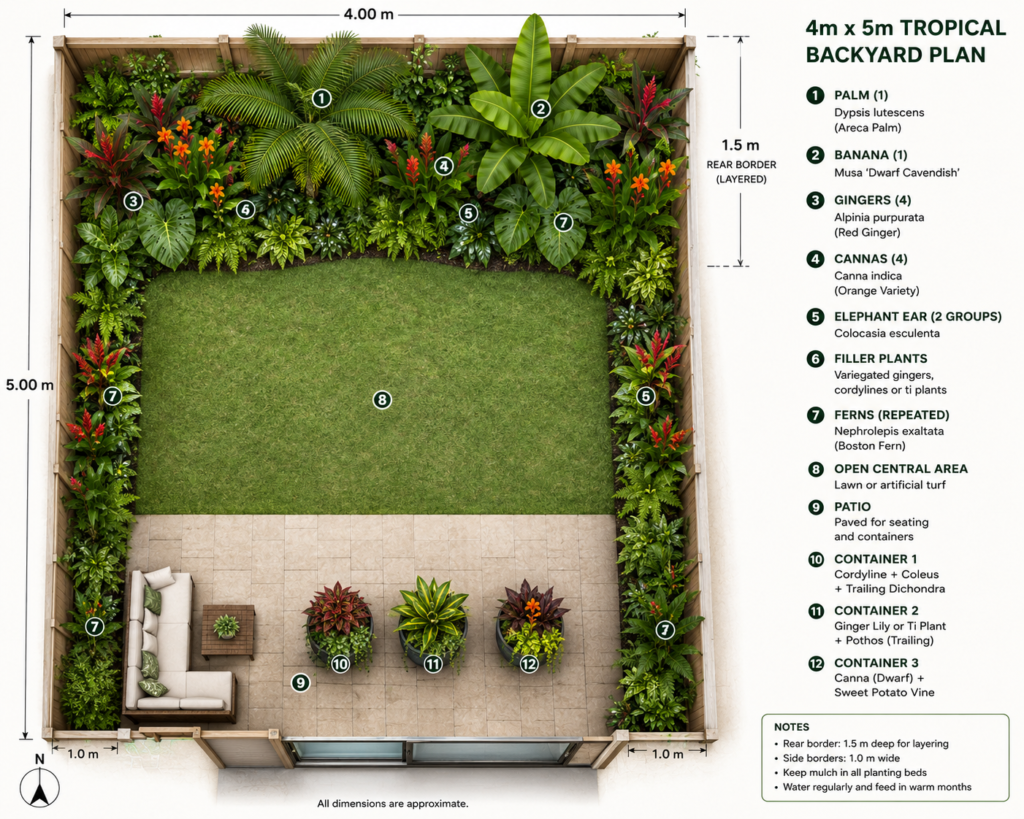
For a compact backyard, use a 1.5-metre rear border, a narrow side border, and an open central patio, lawn, or gravel area.
A practical starting ratio is:
- 1 canopy plant
- 2 architectural plants
- 5–7 middle-layer plants
- 9–15 lower plants
- 3 coordinated containers
- 1 open central area
Use the rear border for canopy and broad foliage, the side border for upright plants, and the patio edge for containers.
Connect this section to your guide on backyard plant layout ideas.
What to Buy First
Purchase plants in this order:
- One canopy or focal plant
- Two repeated structural plants
- Five to seven middle-layer plants
- One lower foliage group
- Irrigation materials
- Mulch and edging
- Containers
- Seasonal color
With a limited budget, complete one high-visibility area properly instead of scattering small plants across the yard.
Tropical Plant Checklist
Before purchasing plants for any tropical backyard plant ideas, confirm their mature dimensions, light requirements, winter survival, and watering needs.
Before buying, confirm:
- Botanical name
- Mature height and width
- Light and moisture needs
- Winter plan
- Spreading behavior
- Root space
- Pet safety
- Wind tolerance
- Leaf and fruit drop
- Maintenance access
- Tropical Fit Score
The most important question is: What exact role will this plant perform after reaching mature size?
How to Plant a Tropical Backyard
- Mark patios, paths, gates, drains, and utilities.
- Map sun, shade, wind, and wet areas.
- Mark mature plant widths.
- Install canopy and structural plants first.
- Add repeated middle-layer groups.
- Install separate irrigation zones.
- Add lower foliage selectively.
- Apply mulch without burying trunks or crowns.
- Preserve maintenance access.
- Review the garden after one growing season.
Do not fill every gap immediately; allow plants to mature and mulch temporary open soil.
Common Tropical Garden Mistakes
Avoid:
- Buying before measuring
- Ignoring mature width
- Using too many focal plants
- Blocking paths with large leaves
- Planting directly against fences
- Mixing conflicting water needs
- Choosing tender plants without a winter plan
- Filling every open area
- Treating fast-growing plants as low maintenance
Correct placement prevents more problems than repeated pruning.
Tropical Garden Care Calendar
Spring
- Repair irrigation
- Remove damaged growth
- Divide crowded clumps
- Refresh containers
- Apply suitable fertilizer
- Reintroduce stored plants gradually
Summer
- Check root-zone moisture
- Feed vigorous plants
- Remove damaged leaves
- Inspect for pests
- Keep paths and drains clear
- Secure plants before storms
Late Season
- Reduce feeding
- Select plants for storage
- Inspect containers
- Label rhizomes
- Remove diseased foliage
Winter
- Protect vulnerable crowns
- Reduce watering for dormant plants
- Monitor stored specimens
- Review permanent structure
- Plan replacements
Tropical Backyard FAQs
What plants make a backyard look tropical?
Palms, bananas, elephant ears, bird of paradise, cannas, gingers, bromeliads, caladiums, coleus, and ferns create the strongest effect.
What are the best tropical plants for a small backyard?
Compact palms, cordylines, cannas, bird of paradise, coleus, caladiums, and container-grown elephant ears work well.
What are the best tropical plants for privacy?
Narrow palms, podocarpus, clumping bamboo, upright gingers, bananas, and evergreen shrubs can provide tropical screening.
Which tropical plants grow in shade?
Fatsia, ferns, caladiums, begonias, bromeliads, and shade-tolerant gingers suit filtered or partial shade.
Can I create a tropical backyard in a cold climate?
Yes. Use hardy palms, fatsia, ferns, and bold-leaved perennials as permanent structure and add tender plants seasonally.
Do tropical plants need full sun?
No. Cannas and many bananas prefer brighter light, while ferns, caladiums, begonias, and fatsia prefer partial shade.
Can tropical plants grow in containers?
Yes. Palms, cannas, cordylines, elephant ears, coleus, bromeliads, and bird of paradise can grow in large containers with drainage.
How far apart should tropical plants be spaced?
Space plants according to mature width and leave extra room for broad leaves that arch beyond the root center.
How can I create a tropical backyard on a budget?
Complete one visible area first, buy one focal plant, repeat affordable foliage, and add seasonal color after the main structure is established.
What are the most common tropical garden mistakes?
Overcrowding, ignoring mature size, mixing incompatible water needs, blocking paths, and buying tender plants without a winter plan are the most common problems.
Your Final Tropical Backyard Plan
The best tropical backyard plant ideas begin with an assessment of the site rather than an unplanned nursery shopping trip.
Build in layers, repeat dependable foliage, and preserve open space for movement and maintenance. A tropical backyard succeeds when it remains attractive and manageable after the plants mature.

Myra is the founder and lead writer of Backyard Planter Ideas, where she shares practical, well-researched guidance on planter design, plant selection, and outdoor styling. Her goal is to help homeowners create attractive, functional garden spaces with clear, reliable, and easy-to-apply advice.