
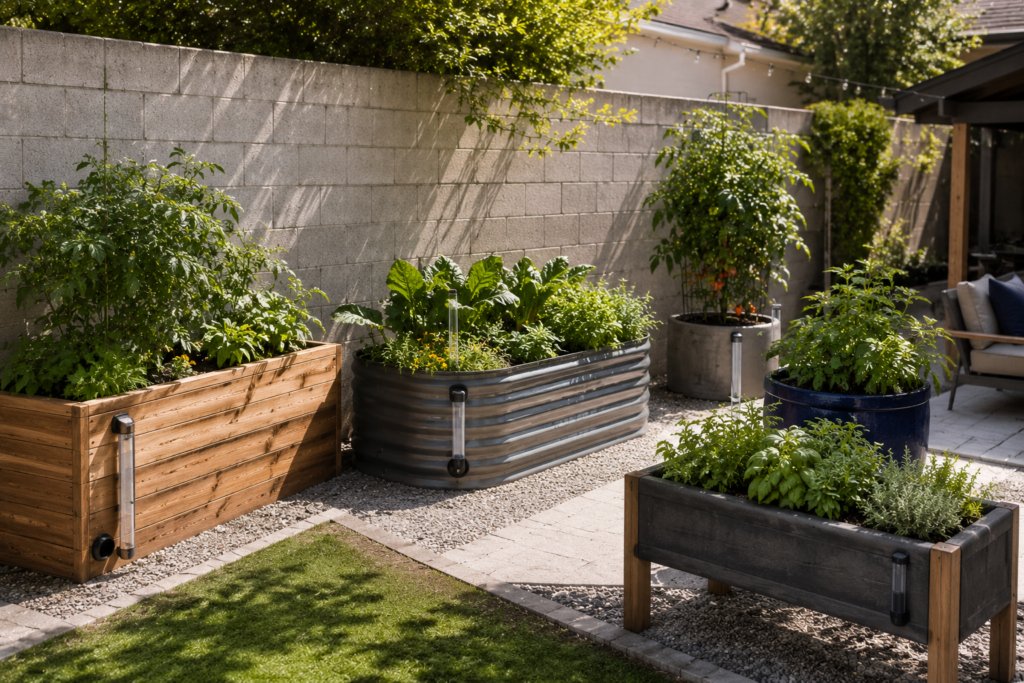
Self-watering backyard planter ideas include bucket planters, raised wicking beds, tomato boxes, herb planters, olla-fed pots, and rain-barrel systems that keep moisture available around plant roots for longer. These planters use a built-in reservoir, wick, soil column, porous clay vessel, or controlled water line. The best option depends on your plants, available space, climate, budget, and preferred level of maintenance.
A self-watering planter reduces routine watering but still needs aerated potting mix, a clear overflow, occasional cleaning, and regular checks during heat, wind, heavy rain, or freezing weather. Test one planter before repeating the system across your backyard.
Which Self-Watering Backyard Planter Is Best?
Choose the planter according to the problem you need to solve rather than reservoir size alone.
| Your main need | Best option | Why it fits |
|---|---|---|
| Lowest-cost DIY project | Five-gallon bucket planter | Simple parts and easy repairs |
| Several herbs or greens | Storage-tote planter | Wider shared growing area |
| Tomatoes or peppers | Deep reservoir planter | More root space and steady moisture |
| Easier access | Waist-height planter | Reduces bending |
| Decorative patio use | Cedar box or planter insert | Hides the functional reservoir |
| Larger vegetable garden | Raised wicking bed | Supports several crops |
| Hot, dry climate | Olla or covered reservoir | Limits surface evaporation |
| Several connected pots | Rain-barrel or gravity-fed system | Centralizes watering |
| Roof-runoff control | Downspout planter | Captures and redirects rain |
Choose the simplest system that meets your needs. One pepper plant may only need a bucket, while a row of ten containers may justify a connected watering line.
How this guide was developed: The ideas below were compared by plant compatibility, root volume, water-storage method, climate suitability, overflow safety, maintenance, cost, and DIY difficulty. Passive reservoir planters are separated from connected systems because they deliver water differently.
How Self-Watering Backyard Planters Work
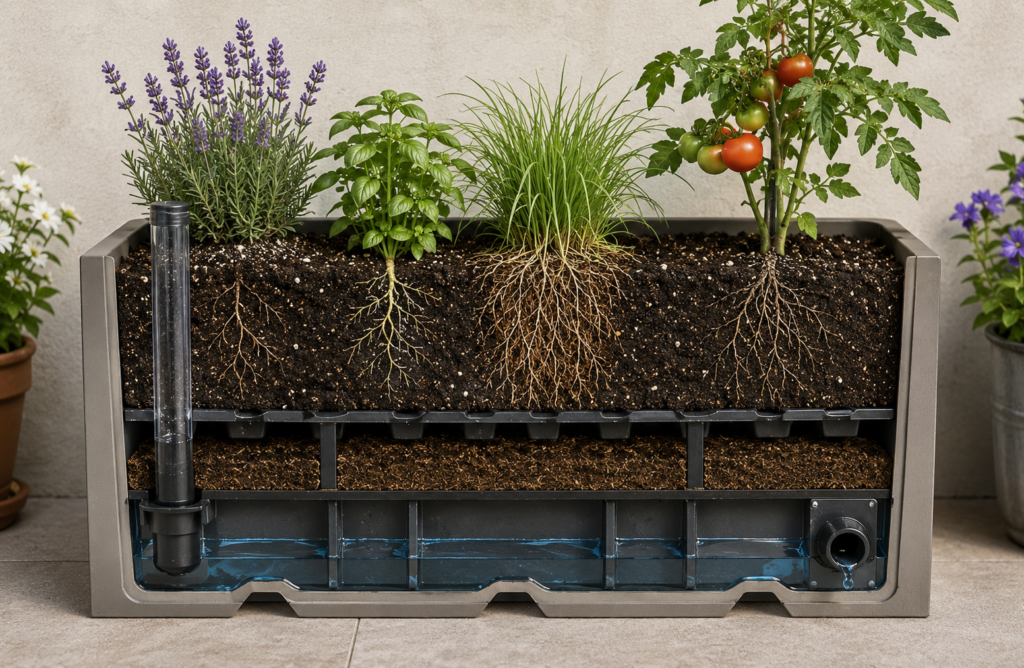
Most self-watering planters store water below the main growing area. A perforated platform supports the potting mix above the reservoir, while a wick or soil-filled chamber connects stored water to the root zone. As the upper mix dries, moisture rises through capillary action.
A fill tube provides direct reservoir access. An overflow opening controls the maximum water level and releases excess water during overfilling or rain. Without a clear overflow, the growing medium may remain saturated and lose the air spaces roots need.
A reliable planter includes:
- A stable reservoir
- A strong support platform
- Continuous wick-to-water contact
- An accessible fill tube
- A clear overflow
- Lightweight potting mix
- A way to drain or clean the system
New plants should be watered from the top until their roots establish and the wicking system works consistently. Reservoir demand then changes with heat, wind, plant size, fruit production, and container exposure.
Passive vs Connected Watering Systems
Passive systems store water inside the planter and move it toward the roots through a wick, soil column, capillary mat, or porous clay vessel. Buckets, totes, raised wicking beds, tomato boxes, ollas, and decorative reservoir inserts belong in this group.
Connected systems receive water from an external source such as a header tank, rain barrel, drip line, or downspout. They suit multiple containers but require tubing, filters, valves, or runoff management.
Choose a passive system for independent containers with few moving parts. Choose a connected system when several planters need centralized watering or rainwater capture is part of the project.
Choose the Right Self-Watering Planter
Plan for the mature plant, not the seedling. Tomatoes and peppers need more root volume and stronger support than lettuce or herbs. Also check the filled weight, overflow direction, and whether the fill tube will remain accessible once plants mature.
Use the SPACE method:
- Space: Measure the floor, wall, or raised-bed area.
- Plants: Match depth and moisture to the crop.
- Absence: Consider how long the planter may be unattended.
- Climate: Account for heat, wind, rainfall, humidity, and frost.
- Effort: Decide between DIY flexibility and ready-made convenience.
Before buying or building, confirm the planter can be cleaned, drained, supported, and safely overflowed. A larger reservoir is not always better if it reduces root space or makes the planter impractical to move.
Best Self-Watering Planters by Climate
| Climate or exposure | Best direction | Main risk |
|---|---|---|
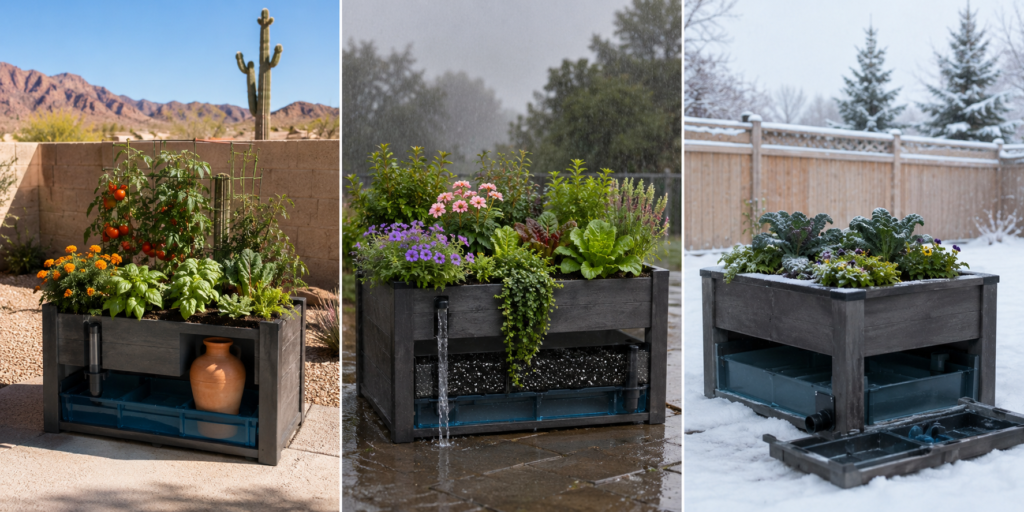
| Hot and dry | Covered reservoir, olla, or deep wicking bed | Rapid depletion |
| Hot and humid | Aerated mix and reliable overflow | Saturated roots |
| Frequent rain | Drainable or flow-through system | Constantly wet medium |
| Cold winters | Removable or fully drainable parts | Freeze damage |
| Windy backyard | Heavy, low-profile planter | Drying and instability |
| Tropical rainfall | Large overflow and erosion control | Flooding |
In dry climates, reduce evaporation with covered reservoirs, mulch, and below-surface watering. In rainy climates, prioritize aeration and overflow rather than maximum storage. In cold areas, choose systems that can be emptied before water freezes inside tubes, fittings, reservoirs, or clay vessels.
15 Self-Watering Backyard Planter Ideas
These self-watering backyard planter ideas cover vegetable gardens, patios, fence lines, outdoor kitchens, and decorative seating areas. The first 12 use internal reservoirs or passive watering, while the final three receive water from an external tank or rain source.
1. Five-Gallon Bucket Vegetable Planter
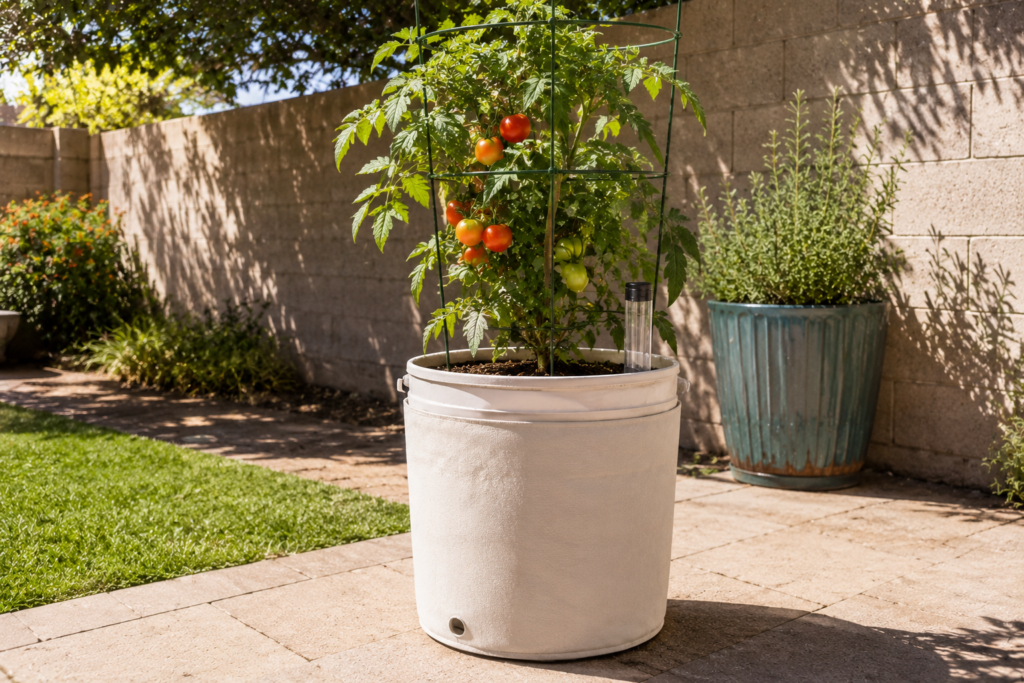
A five-gallon bucket is the easiest low-cost option for one pepper, compact tomato, eggplant, or group of herbs. The lower section stores water, while a platform and soil-filled wick connect the reservoir to the roots.
Use a plant-safe bucket, add support before planting, and keep the overflow visible. Dark buckets may overheat in strong sun, so use a lighter outer sleeve in hot climates.
Best for: Beginners and single vegetables
Main limitation: Limited root and reservoir capacity
2. Storage-Tote Planter
A heavy-duty tote offers more growing area than a bucket and suits lettuce, spinach, radishes, bush beans, or mixed herbs. Use several wicking points so moisture reaches the full width.
Set the tote on a level permanent base before filling it. Reinforce thin walls if they bow under wet growing medium.
Best for: Greens and herbs
Main limitation: Uneven wicking and weak plastic
3. Cedar Box With a Hidden Reservoir
A cedar planter can conceal a removable liner or reservoir insert, making it suitable for patios and outdoor dining areas. Keep the decorative wood separate from standing water and leave the fill tube and overflow accessible.
A removable inner system is easier to clean and repair than a permanently sealed wooden reservoir.
Best for: Visible backyard spaces
Main limitation: Higher cost and build complexity
4. Self-Watering Raised Garden Bed
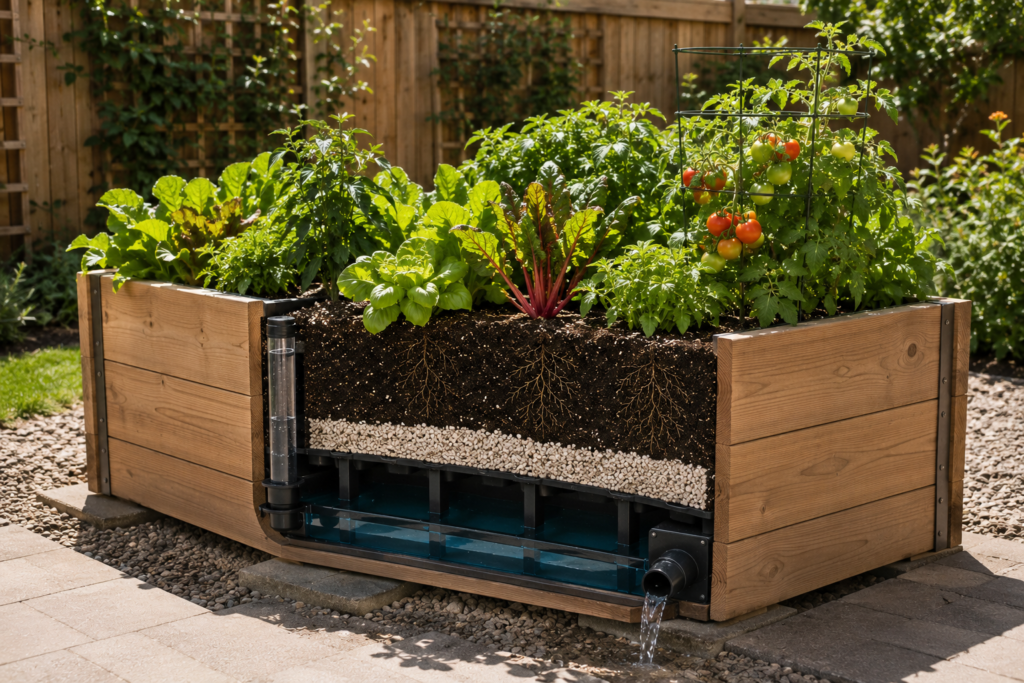
A raised wicking bed stores water beneath a larger growing zone and supports several vegetables. It is useful where ordinary raised beds dry quickly.
The bed needs strong walls, a waterproof reservoir, a stable base, a defined wicking layer, a clear overflow, and a drain. Do not simply seal a standard raised bed and fill it with soil.
Best for: Mixed vegetables
Main limitation: Heavy, permanent construction
5. Waist-Height Herb Planter
An elevated herb planter reduces bending and keeps herbs near an outdoor kitchen or patio door. Basil, parsley, cilantro, and chives can share a consistently moist section, while rosemary, thyme, sage, and lavender need a drier zone.
Keep frequently harvested herbs near the front and isolate mint to prevent spreading.
Best for: Accessible herb gardening
Main limitation: Mixed herbs may need different moisture levels
6. Tomato Reservoir Planter
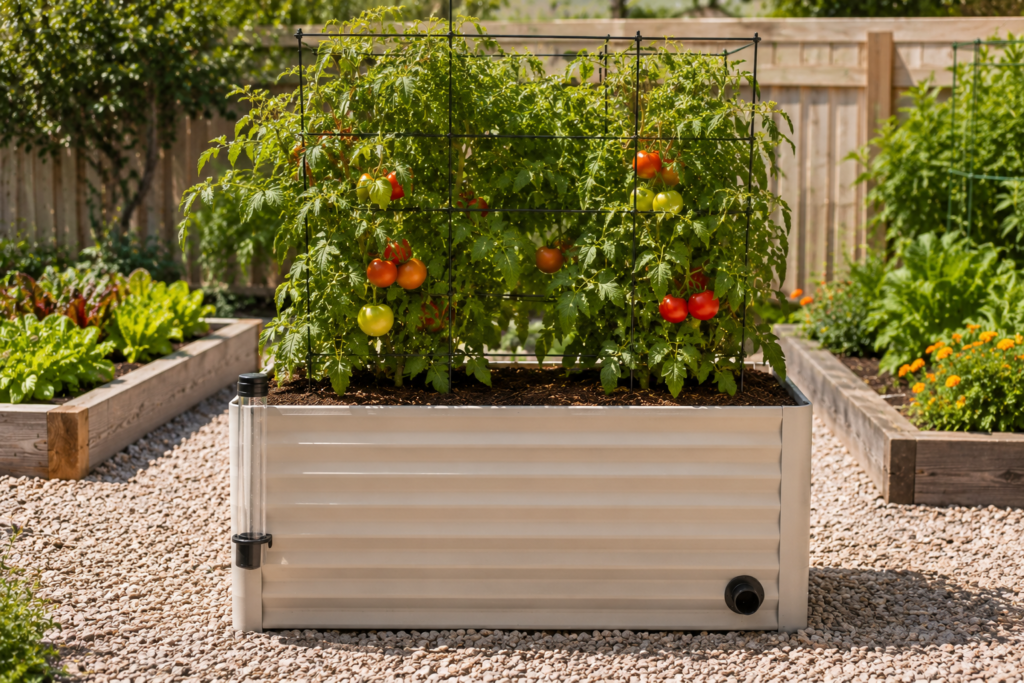
Tomatoes need steady moisture, deep growing space, full sun, and strong support. Use a planter with a clear overflow and install the cage or trellis before roots expand.
Compact, dwarf, patio, or determinate varieties are easier to manage than vigorous indeterminate tomatoes. Check the reservoir frequently during flowering and fruiting.
Best for: Tomatoes and peppers
Main limitation: High summer water demand
7. Strawberry Trough
A long reservoir trough keeps strawberries clean and easy to harvest. Use multiple wicking points so the ends do not dry while the center remains overly wet.
Keep crowns above the potting-mix surface, place the trough on a level base, and use clean mulch around developing fruit.
Best for: Compact or day-neutral strawberries
Main limitation: Uneven moisture in long containers
8. Backyard Salad Table
A shallow, elevated salad table suits lettuce, spinach, arugula, baby greens, and small herbs. Its reservoir slows drying, while the raised height simplifies sowing and harvesting.
Plant small sections every few weeks for continuous production. In warm climates, morning sun and afternoon shade reduce heat stress.
Best for: Leafy greens
Main limitation: Shallow root zones heat quickly
9. Reservoir Window Box
A reservoir window box adds herbs, flowers, or compact greens to a fence, shed, or sturdy railing. Use corrosion-resistant brackets rated for the full saturated weight.
Direct overflow away from siding and keep both the fill opening and outlet visible after plants grow.
Best for: Small spaces
Main limitation: Mounting strength and runoff control
10. Self-Watering Hanging Basket
A lower reservoir helps hanging baskets resist rapid drying. It works for trailing annuals, strawberries, and selected herbs.
Use a load-rated hook, inspect chains and brackets, and avoid positioning a heavy basket over seating. The reservoir reduces watering frequency but does not eliminate summer checks.
Best for: Trailing plants
Main limitation: Weight, wind, and heat exposure
11. Olla-Fed Decorative Planter
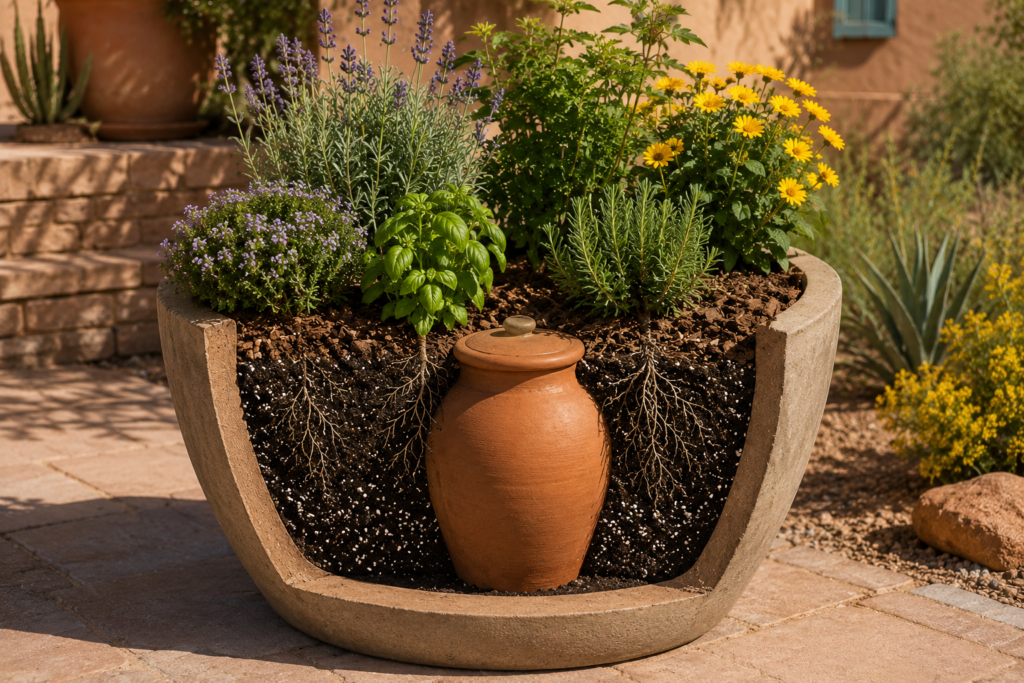
An olla is an unglazed clay vessel buried in the growing medium. Water moves through its porous wall toward nearby roots, making it useful in warm, dry climates.
Place plants within the vessel’s watering radius, cover the refill opening, and use more than one olla in a very wide container. Drain or remove it before hard freezes.
Best for: Large pots in dry climates
Main limitation: Limited watering radius
12. Decorative Pot With an Insert
A removable insert converts an ornamental pot into a reservoir planter without changing its exterior appearance. It suits patios, pool areas, and entrances.
Measure the actual growing space after the insert is installed. Confirm that the outer pot can release rainwater and that the insert can be removed for cleaning.
Best for: Polished outdoor spaces
Main limitation: Reduced root volume
13. Vertical Garden With a Header Tank
A vertical system uses an upper tank and gravity-fed tubing to supply several planting pockets. Add a filter and individual flow controls because lower planters may receive more water than upper ones.
Grow plants with similar moisture needs on the same line. Lettuce and rosemary, for example, are difficult to manage together.
Best for: Narrow patios and fences
Main limitation: Uneven flow and tubing maintenance
14. Rain-Barrel-Fed Planter Row
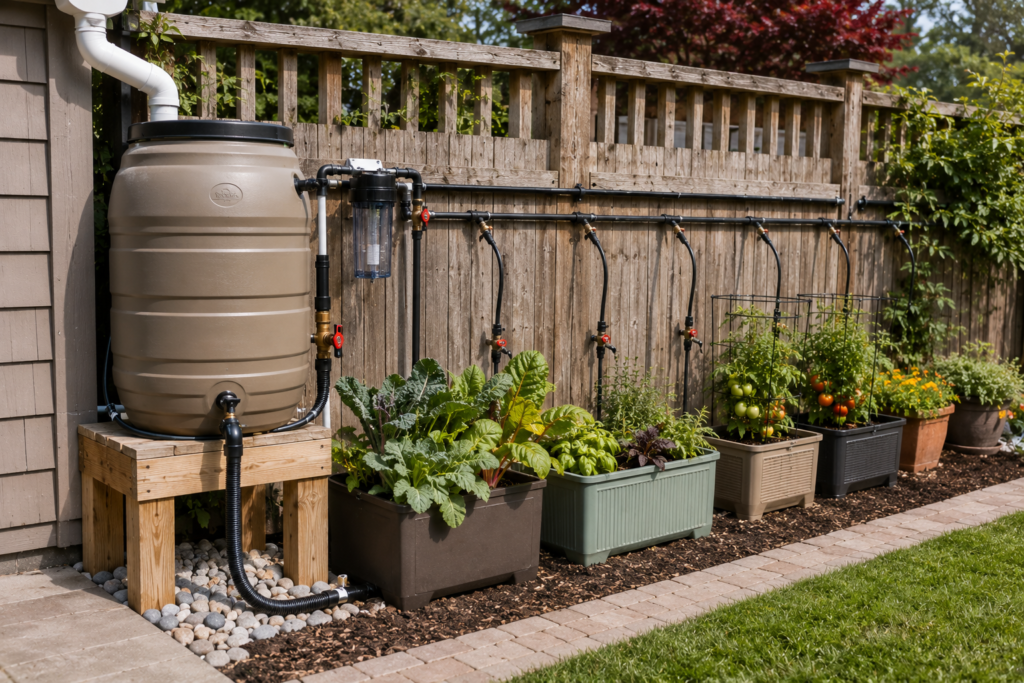
A rain barrel can supply several planters through gravity-fed tubing. Include a screened inlet, sediment filter, shutoff valve, individual controls, and safe overflow.
Raise the barrel enough to create usable pressure and provide backup watering during dry periods. Check whether roof materials and local conditions make captured water suitable for edible crops.
Best for: Planter rows and rainwater reuse
Main limitation: Low pressure and sediment
15. Downspout Rain Garden Planter
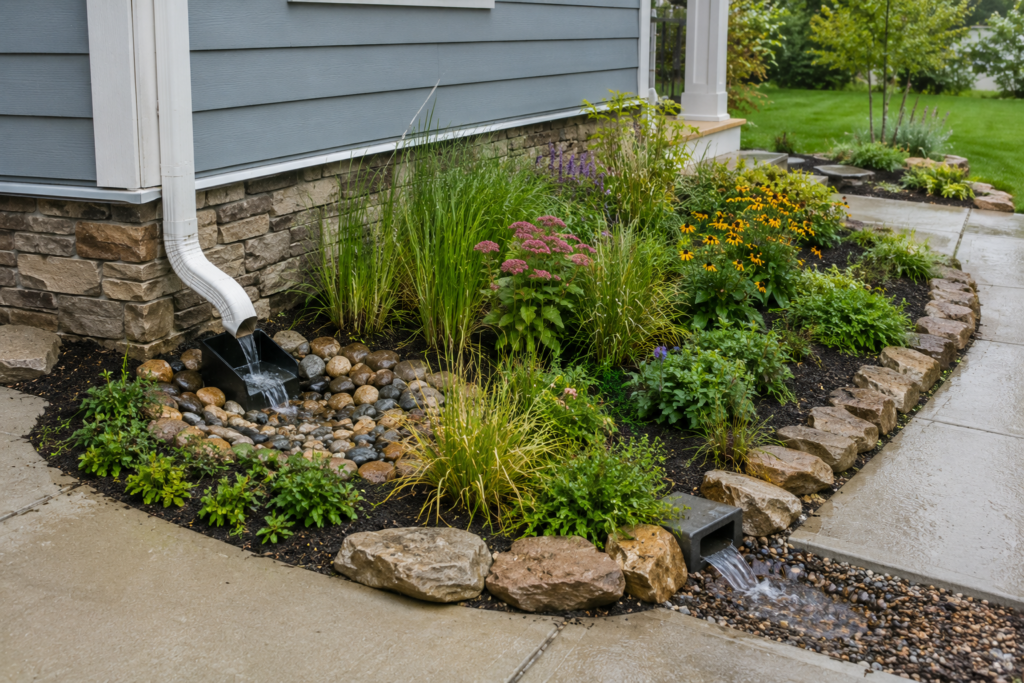
A downspout planter intercepts roof runoff and directs it through a planted box. Use moisture-tolerant plants, erosion-resistant stone, and a dependable emergency overflow.
Direct surplus water away from foundations, paths, and neighboring property. This system may still need supplemental irrigation during dry weather.
Best for: Runoff management
Main limitation: Irregular water supply
Best Plants for Self-Watering Planters
These self-watering backyard planter ideas perform best with plants that benefit from steady moisture, including tomatoes, peppers, leafy greens, basil, parsley, strawberries, and annual flowers. Plants that prefer steady moisture are the strongest candidates.
| Plant group | Suitability | Main requirement |
|---|---|---|
| Tomatoes | Excellent | Deep container and support |
| Peppers | Excellent | Warm site and steady moisture |
| Lettuce and greens | Excellent | Even moisture and heat protection |
| Basil and parsley | Very good | Regular harvesting |
| Strawberries | Very good | Aerated mix and even wicking |
| Bush beans | Very good | Adequate depth and sunlight |
| Rosemary and thyme | Conditional | Strong aeration and limited wicking |
| Succulents | Usually unsuitable | Distinct drying periods |
Group plants by moisture needs rather than appearance. Basil and rosemary may look attractive together but usually perform better in separate zones.
When to Avoid Self-Watering Planters
Avoid reservoir planters for cacti, most succulents, and plants that need the root zone to dry substantially between waterings. Rosemary, lavender, thyme, and sage may also struggle in cool or rainy conditions.
A self-watering planter is a poor choice when:
- The overflow cannot drain safely
- The surface cannot support the filled weight
- The reservoir cannot be inspected or cleaned
- The system cannot be emptied before winter
- The container is too shallow for the plant
- The planter has not been tested before a trip
Choose a conventional fast-draining pot when drying cycles matter more than moisture consistency. Choose drip irrigation when many containers need separate flow control.
DIY Self-Watering Planter Steps
Among the most affordable self-watering backyard planter ideas, bucket and storage-tote systems are the easiest for beginners to build, test, and repair.
A basic DIY planter needs a plant-safe container, reservoir, platform, wick, fill tube, overflow, and lightweight potting mix.
- Plan the reservoir. Balance water storage with root space and filled weight.
- Install the platform. It must support saturated mix without collapsing.
- Create the wick. Pack a basket or soil column with pre-moistened mix so it contacts both the reservoir and upper growing area.
- Fit the fill tube. Keep it accessible after plants mature.
- Add the overflow. Position it at the maximum water level and test it before filling.
- Fill and plant. Use pre-moistened mix and top-water new plants.
- Test the system. Check for leaks, stable structure, even moisture, and predictable reservoir use.
Do not rely on a new planter during a vacation until it has worked reliably for at least one week in similar weather.
Potting Mix, Reservoir Size, and Refills
Use a lightweight container mix that wicks moisture while preserving air around roots. Coir or peat, bark, perlite, and vermiculite are common components. Avoid unmodified backyard soil because it can compact and distribute water unevenly.
Reservoir size depends on the mature plant, container dimensions, sun, wind, temperature, rainfall, weight limits, and time between inspections.
| Condition | Effect on water use |
|---|---|
| Young plants | Lower |
| Fruiting vegetables | Higher |
| Full sun | Faster depletion |
| Strong wind | Faster depletion |
| Cool, cloudy weather | Slower depletion |
| Heavy rain | Reservoir may remain full |
Check a new planter every day or two until its pattern becomes clear. Avoid fixed claims about how many days a reservoir will last.
Follow fertilizer labels carefully. Excess fertilizer may accumulate as salts, particularly in systems with limited top-to-bottom drainage. Flush the mix only when the planter can release excess water safely.
7-Day Self-Watering Planter Test
Test the planter before using it during a trip or repeating the design.
| Day | Weather | Water added | Root-zone condition | Plant response | Action |
|---|---|---|---|---|---|
| 1 | |||||
| 2 | |||||
| 3 | |||||
| 4 | |||||
| 5 | |||||
| 6 | |||||
| 7 |
A successful planter should show predictable reservoir depletion, moist but aerated roots, no leaks or odors, and a working overflow. Test during representative weather rather than only on cool, cloudy days.
Common Problems and Fixes
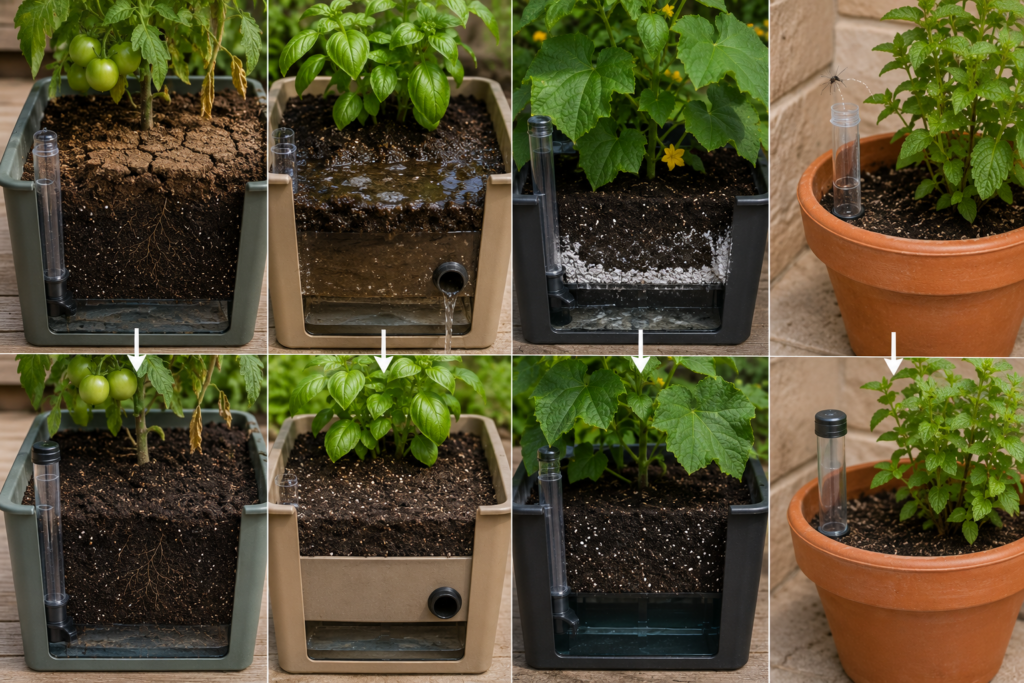
| Symptom | Likely cause | Fix |
|---|---|---|
| Upper mix stays dry | Weak wick contact | Repack the wick and top-water |
| Plant wilts with a full reservoir | Heat stress or waterlogging | Check root-zone moisture |
| Mix remains saturated | Blocked or high overflow | Clear or reposition the outlet |
| Reservoir empties quickly | Leak or high demand | Inspect and monitor |
| One side stays dry | Too few wicks | Add more wicking points |
| White crust forms | Fertilizer salts | Reduce feeding and flush |
| Reservoir smells | Organic debris | Drain and clean |
| Mosquitoes appear | Open water access | Add a cap or screen |
| Rain floods the planter | Small or blocked overflow | Increase safe discharge |
| Planter cracks in winter | Trapped water | Drain before freezing |
Wilting does not always mean the plant needs more water. Dry roots, saturated roots, and heat stress can produce similar symptoms, so check the growing medium before refilling.
Reservoir vs Drip vs Olla
| Method | Best use | Main limitation |
|---|---|---|
| Reservoir planter | Individual containers | Depends on wick and mix |
| Raised wicking bed | Several vegetables | Heavy and complex |
| Drip irrigation | Multiple planters | Emitters need maintenance |
| Olla | Large pots in dry climates | Limited radius |
| Rain-barrel system | Connected planter rows | Low pressure |
| Downspout planter | Stormwater management | Irregular supply |
| Ordinary pot | Drying-cycle plants | Frequent manual watering |
Choose a reservoir planter for self-contained containers, drip irrigation for several controlled pots, an olla for simple underground watering, and a downspout planter when runoff management is also a goal.
Build or Buy?
When comparing self-watering backyard planter ideas, choose DIY for custom dimensions and lower costs, or select a ready-made planter when appearance, fast installation, and a warranty matter more.
| Choose DIY when | Choose ready-made when |
|---|---|
| Custom dimensions matter | Appearance matters |
| Budget is limited | Fast installation matters |
| You can test and repair it | A warranty is useful |
| The planter is functional | The planter is highly visible |
Before buying, compare growing volume, reservoir size, filled weight, overflow position, UV resistance, cleaning access, winter drainage, and replacement parts. Do not choose a planter only because its reservoir is large; confirm that enough root space remains for the mature plant.
Final Planning Checklist
- Measure the site and check the filled-weight limit.
- Match growing depth to the mature plant.
- Keep the fill tube and overflow accessible.
- Use lightweight, pre-moistened potting mix.
- Group plants with similar moisture needs.
- Install cages and trellises before roots expand.
- Check the reservoir frequently during the first weeks.
- Test the planter before leaving it unattended.
- Inspect for leaks, debris, salt buildup, and freeze risk.
Self-Watering Planter FAQs
How does a self-watering planter work?
A reservoir stores water below the growing medium. A wick or soil column carries moisture upward, while an overflow prevents flooding.
Are self-watering planters good for vegetables?
Yes. Tomatoes, peppers, lettuce, herbs, and strawberries can grow well when they have enough root space, light, and aerated potting mix.
How often should the reservoir be refilled?
Refill frequency depends on plant size, heat, wind, and reservoir capacity. Check a new planter every one or two days until its pattern becomes clear.
Can self-watering planters cause root rot?
Yes, when the overflow is blocked, the mix is too dense, or the plant prefers drier conditions.
What potting mix should be used?
Use a lightweight, porous container mix. Avoid dense garden soil because it can compact and restrict oxygen.
Do self-watering planters work in heavy rain?
They work when the overflow is clear and positioned so excess water leaves before reaching the main root zone.
Can a planter be left while you are on vacation?
A tested planter may support plants during a short absence. Complete a seven-day test and arrange backup watering during extreme heat.
Can mosquitoes breed in the reservoir?
Mosquitoes may enter through open fill tubes or gaps. Use a fitted cap or fine screen.
Do self-watering planters save water?
They can reduce runoff and repeated surface watering by storing moisture near the roots. Actual savings vary by design, climate, and plant demand.
What is the easiest DIY design?
A five-gallon bucket planter is usually the easiest option. It needs a reservoir, platform, wick, fill tube, and overflow.
Create a Lower-Maintenance Backyard Garden
The best self-watering backyard planter ideas combine water storage with suitable plants, enough root space, aerated potting mix, and reliable overflow.
Start with a bucket for a low-cost project, an elevated herb box for accessibility, a deep reservoir planter for tomatoes, or a raised wicking bed for several vegetables. Use an olla in a dry climate or a connected system when several planters need one water source.
Test one planter through changing weather before expanding. Record refill frequency, root-zone moisture, and plant response, then adjust the wick, mix, or reservoir. This creates a practical lower-maintenance backyard rather than a system that only appears automatic.

Myra is the founder and lead writer of Backyard Planter Ideas, where she shares practical, well-researched guidance on planter design, plant selection, and outdoor styling. Her goal is to help homeowners create attractive, functional garden spaces with clear, reliable, and easy-to-apply advice.