
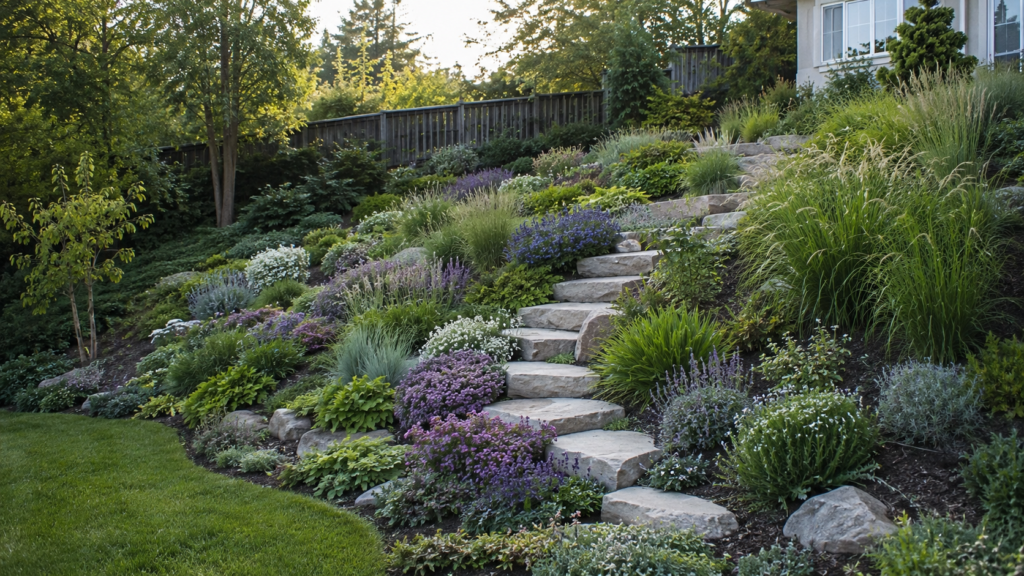
The best plant ideas for sloped backyards combine low groundcovers, fibrous-rooted grasses or sedges, and structural shrubs. These layers cover exposed soil, create root density, add privacy, and keep the slope attractive through several seasons.
Before planting, check steepness, sunlight, soil depth, drainage, and safe access. Stable gentle slopes may need only permanent planting and controlled watering. Steeper or visibly eroding banks may also require contour planting, erosion-control materials, terraces, drainage work, or professional assessment.
Treat the upper, middle, and lower slope as separate zones. The top is often drier, the middle is more exposed, and the bottom may collect moisture. Adapt every recommendation to local climate, soil, invasive-species rules, and plant availability.
Which Slope Planting Idea Fits Best?
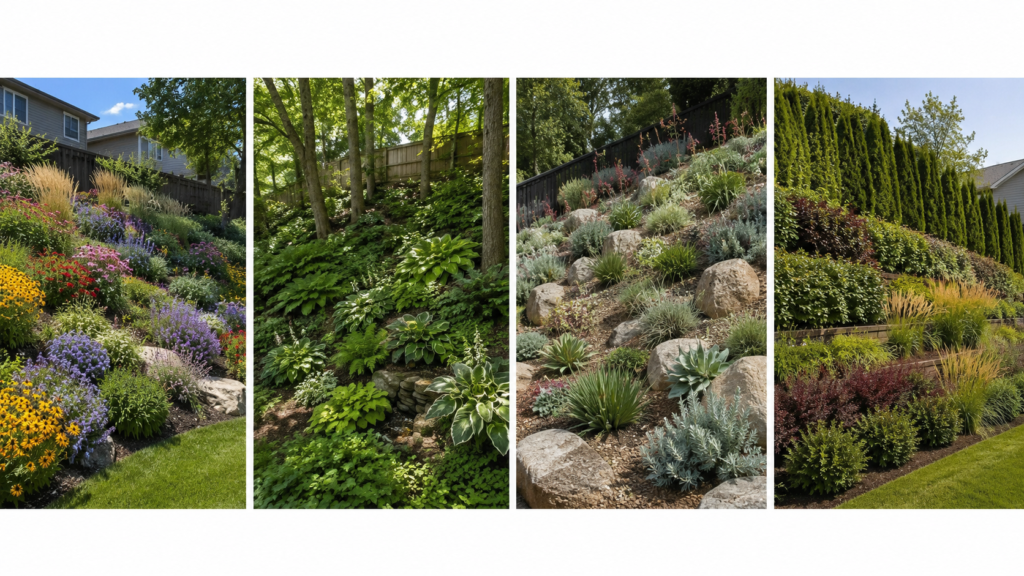
Choose a planting system according to the slope’s hardest condition. A sunny upper bank may need drought-tolerant grasses and compact shrubs, while shade beneath trees may suit sedges, ferns, and woodland plants. Steep areas should use long-lived plants requiring little routine access.
Decide whether the slope must replace lawn, cover bare soil, provide privacy, support pollinators, or soften a retaining feature.
| Slope condition | Best planting direction | Main benefit |
|---|---|---|
| Gentle sunny slope | Flowers with ornamental grasses | Color and reduced mowing |
| Steep exposed slope | Shrubs, grasses, and low plants | Permanent coverage |
| Dry upper slope | Drought-tolerant shrubs and grasses | Lower water demand |
| Shaded slope | Sedges, ferns, and woodland shrubs | Shade coverage |
| Rocky slope | Stonecrops and compact shrubs | Uses dry pockets |
| Moist lower slope | Moisture-tolerant sedges and shrubs | Matches wetter soil |
| Privacy slope | Staggered shrubs with underplanting | Screening |
| Terraced slope | Herbs and compact plants | Safer access |
Before buying plants:
- Map sun, moisture, and access.
- Check mature size.
- Keep demanding plants near paths.
- Exclude invasive species.
- Leave drains and utilities accessible.
Best Plants for Backyard Slopes
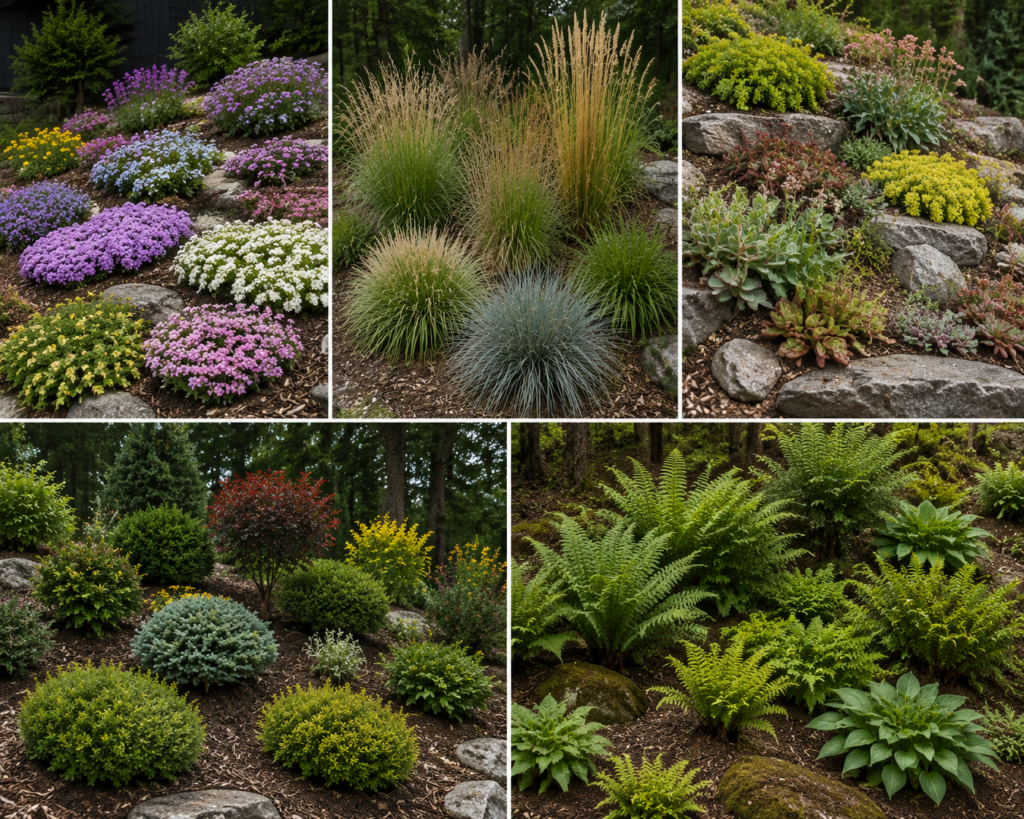
The best slope plants match existing conditions. Groundcovers replace impractical turf, grasses and sedges provide fibrous roots, and shrubs create permanent structure. Use these examples as starting points and substitute locally suitable plants with similar needs.
| Plant or group | Best condition | Main role | Caution |
|---|---|---|---|
| Creeping phlox | Sunny, drained slope | Flowering cover | Temperate climates |
| Stonecrop | Rocky, dry upper slope | Succulent cover | Avoid wet soil |
| Creeping juniper | Sunny, dry slope | Evergreen cover | Allow mature spread |
| Hardy geraniums | Sun or partial shade | Flowering layer | Choose restrained types |
| Regional sedges | Shade or moist areas | Fibrous coverage | Match moisture needs |
| Bunchgrasses | Sunny upper and middle zones | Roots and texture | Check local behavior |
| Regional ferns | Shaded pockets | Woodland foliage | Moisture needs vary |
| Compact shrubs | Mixed conditions | Structural layer | Check mature width |
| Native flowers | Sun or open shade | Pollinator value | Match local ecology |
| Moisture-tolerant shrubs | Verified wet lower zone | Lower structure | Keep drains open |
Build a shortlist of shrubs, grasses or sedges, low plants, and one seasonal accent. Record mature size, zone, light, moisture, and maintenance.
How Steep Is Your Slope?
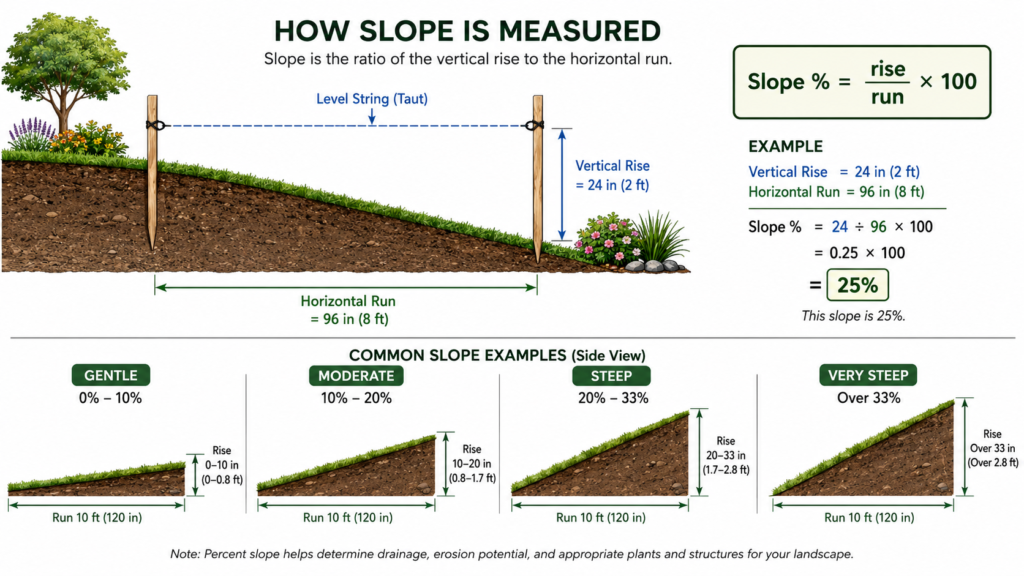
Measure the gradient before treating the area like an ordinary bed.
Slope percentage = vertical rise ÷ horizontal run × 100
A slope rising 1 metre over a 5-metre horizontal run has a 20% gradient.
| Approximate slope | Interpretation | General decision |
|---|---|---|
| Under 10% | Gentle | Most permanent planting styles may work |
| 10–25% | Moderate | Use contour planting and continuous coverage |
| 25–50% | Steep | Avoid routine mowing and demanding plants |
| Over 50% | Very steep | Consider professional assessment |
These are garden-planning bands, not engineering standards. Stability also depends on slope length, soil, water, vegetation, and nearby structures.
To measure the slope, place stakes at the top and bottom, stretch a level string from the upper stake, measure the horizontal run and vertical rise, then apply the formula. A long moderate slope receiving roof runoff may be harder to manage than a short steeper bank.
Assess Your Backyard Slope
Check whether every area can be watered, weeded, and pruned safely. Place frequently maintained plants on accessible terraces and durable plants in remote areas.
Measure sunlight at the top, middle, bottom, beside structures, and beneath trees. Reflected heat from paving or walls can make a small area much hotter than the rest of the garden.
Dig several test holes and inspect soil depth, compaction, rock, roots, drainage speed, sediment, and persistent saturation.
Observe the slope during steady rain. Look for downspout discharge, channels, moving mulch, water emerging from the bank, sediment on patios, puddles behind retaining edges, and runoff approaching foundations.
Plants can protect ordinary exposed soil, but they cannot permanently repair concentrated drainage, a failing wall, or structural soil movement.
Use the Slope Plant Fit Score
Score each plant from zero to two for root contribution, site compatibility, maintenance, climate reliability, and design value.
| Factor | 0 points | 1 point | 2 points |
|---|---|---|---|
| Roots | Unsuitable | Moderate | Dense, fibrous, or woody |
| Site fit | Poor | Acceptable | Strong match |
| Maintenance | Frequent | Seasonal | Minimal |
| Climate | Marginal | Protected-site option | Reliable |
| Design value | Limited | One useful feature | Multi-season |
- 8–10: Strong core plant
- 5–7: Accent or terrace plant
- 0–4: Replace or relocate
Score plants for their exact zone. A sedge may fit the moist bottom but fail at the dry crest. Also check invasive spread, thorns, mature width, disease risk, and water demand.
The Slope Plant Fit Score and Three-Layer Planting Strategy are original editorial planning tools, not engineering assessments or guarantees of stability.
How Many Plants Do You Need?
Plant quantity affects cost, coverage, irrigation, and maintenance. Measure only the plantable area, excluding paths, drains, walls, and existing vegetation.
Estimated plant quantity = plantable area ÷ space allocated per plant
| Spacing | Plants per 100 sq ft | Plants per 10 m² |
|---|---|---|
| 12 in / 30 cm | 100 | 111 |
| 18 in / 45 cm | 44 | 49 |
| 24 in / 60 cm | 25 | 28 |
| 30 in / 75 cm | 16 | 18 |
| 36 in / 90 cm | 11 | 12 |
A mixed 100-square-foot planting may use 3–5 shrubs, 10–15 grasses or sedges, and 25–40 low plants. Space shrubs for maturity.
Use Three Planting Layers
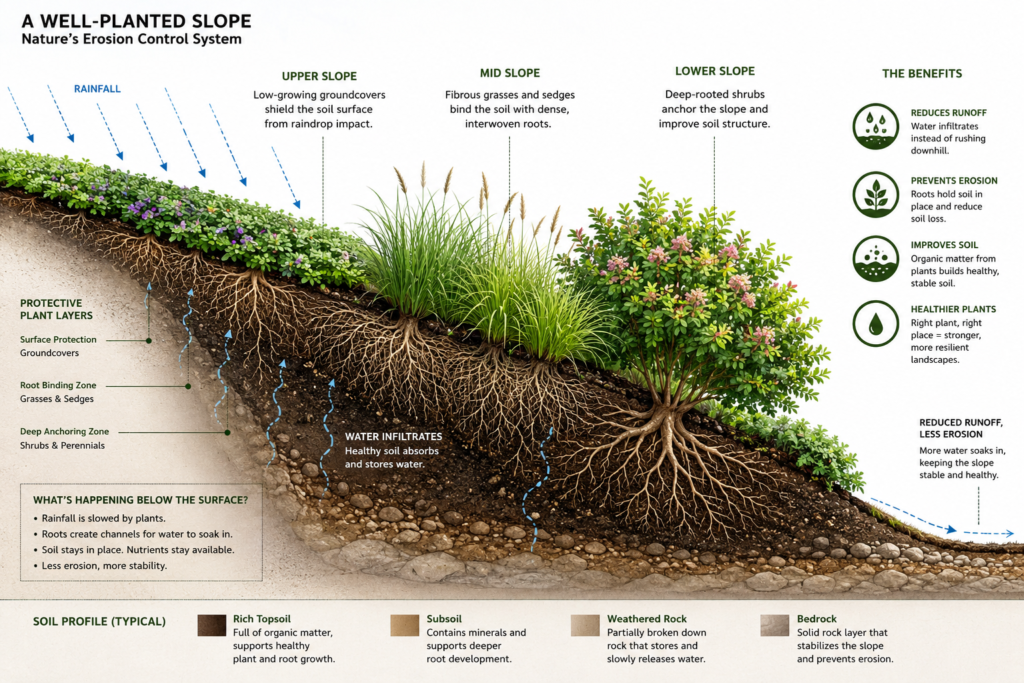
A dependable slope design contains three complementary layers.
Surface Layer
Low plants cover soil between larger specimens, shade the surface, and reduce open spaces where weeds establish. Useful forms include mat-forming flowers, low perennials, small sedges, short grasses, and low evergreens.
Fibrous Layer
Grasses and sedges provide fine roots near the soil surface, upright texture, and winter seed heads. Use sunny grasses on exposed banks, woodland sedges in shade, moisture-tolerant sedges at the bottom, and drought-tolerant bunchgrasses near the crest.
Structural Layer
Shrubs and occasional small trees create the permanent framework. Use them to frame the crest, interrupt a long bank, screen a boundary, or anchor terrace corners. Leave drains, walls, foundations, fences, and utilities accessible.
21 Plant Ideas for Sloped Backyards
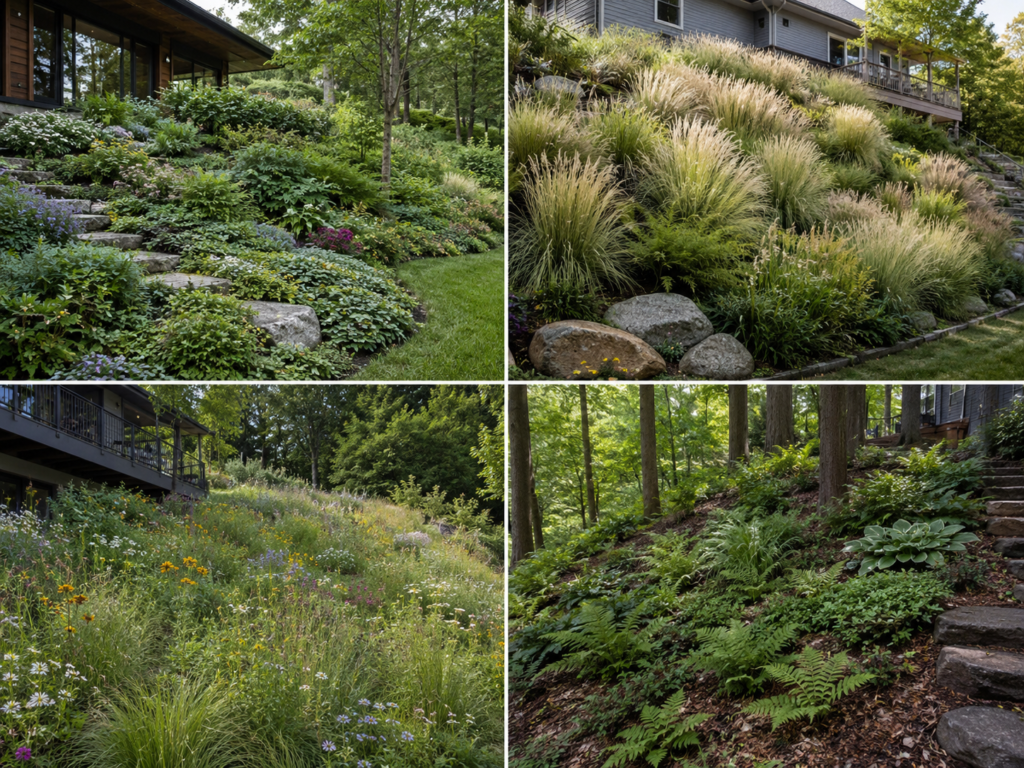
Adapt these planting systems to local climate and repeat a limited palette instead of using many unrelated plants.
1. Regional Native Carpet
Combine local flowers, low plants, grasses, and compact shrubs with different bloom periods.
2. Ornamental Grass Drifts
Plant clumping grasses across a sunny slope and fill gaps with low perennials.
3. Shaded Sedge Bank
Use regional sedges beneath trees or structures, supported by ferns and woodland flowers.
4. Flowering Groundcover Ribbons
Create broad horizontal bands with two or three compatible low-flowering plants.
5. Stonecrop Mosaic
Use stonecrops and suitable succulents in dry, rocky pockets with compact grasses.
6. Prostrate Evergreens
Add low evergreens for winter form, spacing them for mature spread.
7. Compact Flowering Shrubs
Repeat natural-form shrubs that need little clipping and fit the available width.
8. Mixed Three-Layer Slope
Combine shrubs, grasses or sedges, and low perennials around a permanent contour path.
9. Pollinator Bands
Use regional flowers with overlapping bloom periods plus grasses for structure.
10. Low-Mow Meadow
Replace unsafe turf with short grasses, flowers, sedges, and bulbs.
11. Woodland Bank
Use sedges, ferns, shade flowers, understory shrubs, and retained leaf litter.
12. Fern Pockets
Group ferns in cool sheltered areas and match each type to actual moisture.
13. Drought-Tolerant Rock Garden
Retain stable rocks and fill planting pockets with compact drought-tolerant plants.
14. Mediterranean Herb Bank
In warm dry climates, use lavender-type plants, rosemary, sage, thyme, and oregano near safe access.
15. Cascading Terrace Plants
Use restrained trailing plants on sound terrace edges without covering drains or cracks.
16. Accessible Herb Terraces
Grow herbs and strawberries on level terraces where watering and harvesting are safe.
17. Fruiting Shrub Slope
Use suitable berries on a gentle bank after checking pH, climate, and thorniness.
18. Staggered Privacy Planting
Arrange upright shrubs and small trees in staggered groups with low underplanting.
19. Moist Lower-Zone Garden
Use moisture-tolerant sedges, shrubs, and perennials only where wetter soil is verified.
20. Planted Dry Creek
Frame an existing runoff route while keeping the channel open for water and debris.
21. Four-Season Slope
Combine evergreen shrubs, bulbs, summer flowers, seed heads, and persistent grasses.
Match Plants to Slope Zones
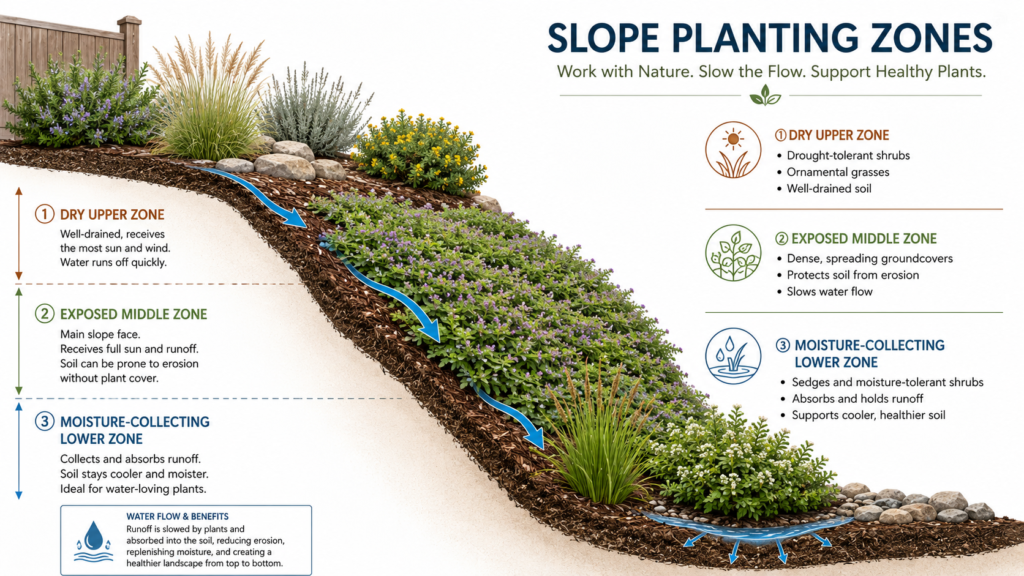
Treat the upper, middle, and lower areas as separate planting zones.
| Zone | Common conditions | Useful plant forms |
|---|---|---|
| Upper slope | Dry, windy, shallow, exposed | Drought-tolerant shrubs and grasses |
| Middle slope | Runoff, exposure, difficult access | Dense grasses, sedges, and low plants |
| Lower slope | Moisture and deposited sediment | Moisture-tolerant sedges and shrubs |
| Terrace edge | Heat and limited root space | Compact and trailing plants |
| Beside steps | Visibility and access | Non-thorny upright plants |
| Beneath trees | Shade and root competition | Sedges, ferns, and woodland flowers |
Use drought-tolerant plants at the crest, dense low-maintenance coverage through the middle, and moisture-tolerant plants only where the lower soil is genuinely wetter. Replace unavailable plants by function rather than appearance.
Choose Plants by Climate
Slope planting must account for rainfall, humidity, winter wetness, summer drought, salt, and fire risk. In the Northern Hemisphere, south- and west-facing slopes are often warmer and drier; in the Southern Hemisphere, north- and west-facing slopes often receive stronger solar heating. Actual shade and wind may change this pattern.
| Climate | Useful plant forms | Main concern |
|---|---|---|
| Cool temperate | Hardy grasses, sedges, and shrubs | Winter wetness |
| Continental cold | Hardy shrubs and dormant perennials | Short season |
| Mediterranean | Aromatic shrubs and bunchgrasses | Drought and fire |
| Hot arid | Desert grasses and succulents | Overwatering |
| Humid subtropical | Heat-tolerant grasses and evergreens | Aggressive growth |
| Tropical | Dense grasses and broadleaf plants | Heavy rainfall |
| Coastal | Salt-tolerant grasses and shrubs | Salt and wind |
Substitute plants by function, not appearance. Replace unsuitable named plants with regional groundcovers, sedges, grasses, shrubs, and native flowers that perform the same role.
How to Plant a Slope
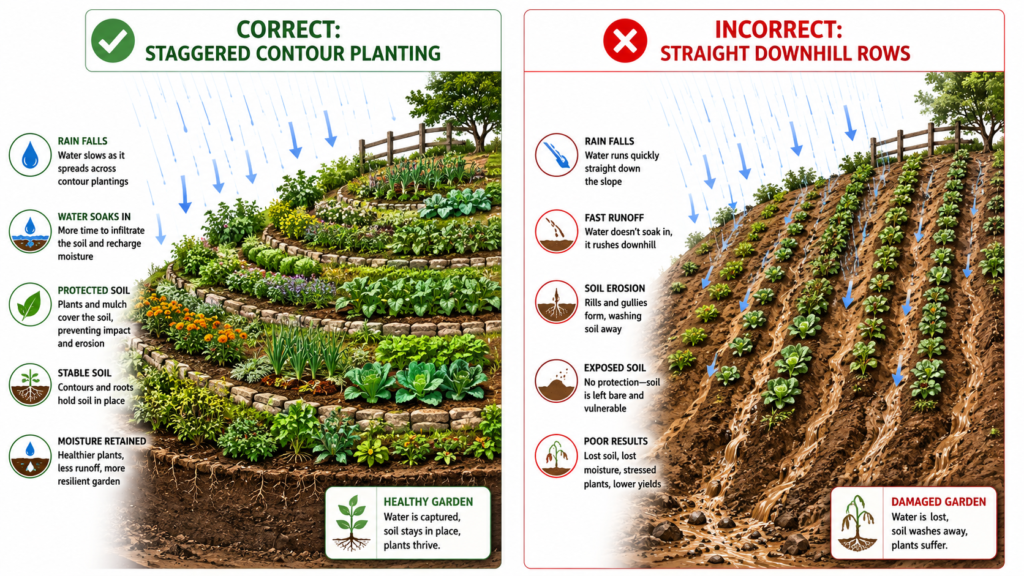
Plant one manageable section at a time. Clearing the entire bank before plants are ready leaves soil exposed to storms and foot traffic.
- Control weeds. Remove invasive weeds but preserve useful vegetation.
- Mark contour bands. Run planting lines across, not down, the slope.
- Install shrubs first. Check mature spacing and access.
- Add grasses and sedges. Repeat them in irregular drifts.
- Add ground-layer plants. Fill open soil between larger plants.
- Support root balls. Use stable supports where loose soil moves downhill.
- Protect open soil. Apply coarse mulch, leaf litter, or biodegradable material.
- Water slowly. Stop when runoff begins.
- Inspect after rain. Check for exposed roots, channels, and blocked drains.
Avoid straight downhill rows because disturbed lines can encourage water to channel through the soil.
Seeds, Plugs, or Potted Plants?
Seeds cost less but can wash away or germinate unevenly. Plugs establish more predictably and disturb less soil. Larger containers create immediate structure but are heavier and more expensive.
| Method | Cost | Coverage | Best use | Limitation |
|---|---|---|---|---|
| Seed | Low | Slow | Meadow areas | Can wash downhill |
| Small plugs | Moderate | Moderate | Sedges and groundcovers | More holes |
| Small pots | Moderate-high | Faster | Residential slopes | Higher cost |
| One-gallon plants | High | Immediate | Shrubs and anchors | Heavy to install |
| Temporary cover | Low | Fast | Short-term protection | May compete |
Choose seed where runoff is controlled, plugs on steep or root-filled areas, and potted plants selectively for structural anchors.
How to Water a Slope
Water slowly enough for moisture to enter the root zone instead of flowing downhill. Install dripline across the contour and separate upper and lower zones when their moisture needs differ.
- Use short cycles on slow-absorbing soil.
- Place emitters near new root balls.
- Move emitters outward as shrubs grow.
- Check for leaks and blockages.
- Inspect the lower slope for runoff.
- Group plants with similar water needs.
- Reduce watering gradually after establishment.
Check moisture around the root ball, not only at the soil surface. A slope can look damp while new roots remain dry.
First-Year Planting Timeline
The first year should focus on moisture, weeds, surface protection, and storm inspection.
First 30 Days
Check root-ball moisture, test irrigation, repair washed-out pockets, reposition mulch, remove small weeds, and inspect after rain.
Months 2–3
Replace failed plugs, adjust watering, protect bare gaps, correct leaning plants, and watch for new channels.
Months 4–6
Water more deeply where appropriate, reduce unnecessary frequency, move shrub emitters outward, avoid hard pruning, and keep drains visible.
Months 7–12
Review seasonal survival, replace plants that failed through poor site fit, and record which plants needed the least care.
Repeated failure signals a mismatch in light, moisture, drainage, soil depth, or root competition.
Create a Low-Maintenance Slope
Low maintenance depends on suitable plants, mature spacing, and safe access.
- Use long-lived plants and a limited palette.
- Choose natural-form shrubs instead of formal hedges.
- Replace difficult lawn.
- Keep thorny plants away from steps.
- Group plants by water needs.
- Leave walls and drains accessible.
- Install permanent paths.
- Include evergreen or winter structure.
Place herbs, vegetables, annuals, and plants needing frequent division on accessible terraces. A plant is not low maintenance when it survives only through constant watering, clipping, staking, containment, or replacement.
Slope Planting Mistakes
Avoid:
- Planting one species across the entire slope
- Choosing plants only because they spread fast
- Planting straight downhill
- Leaving bare soil between young shrubs
- Using loose lightweight mulch
- Hiding retaining-wall damage
- Putting demanding plants at the top
- Ignoring mature plant size
- Treating every wet area as a rain garden
- Expecting plants to repair instability
Keep drainage and structural warning signs visible.
When Plants Are Not Enough
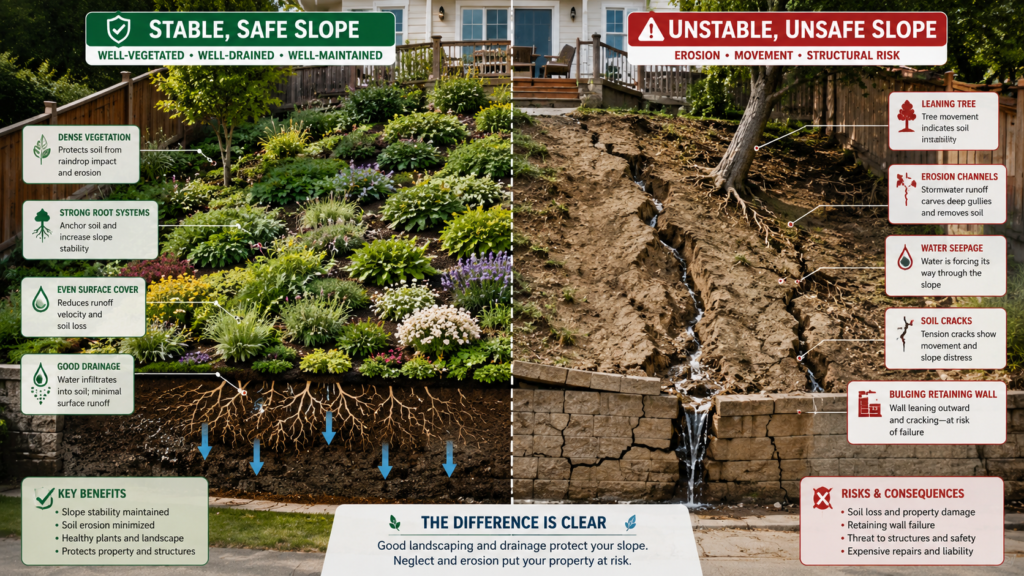
Seek qualified local advice when the slope shows:
- Deep gullies
- Widening cracks
- Water emerging from the bank
- Bulging or leaning retaining walls
- Exposed foundations
- Recently leaning trees
- Repeated sediment movement
- Water reaching buildings
- Unsafe access
- Major excavation plans
Ordinary planting suits stable slopes with dispersed runoff, safe access, and only surface erosion.
The decision rule is simple: when the primary concern is appearance or mowing, horticultural planning may be enough. When the concern is movement, cracking, seepage, or safety, diagnose that issue first.
A Practical Slope Planting Plan
Use this formula for a stable residential slope:
One structural layer + one fibrous layer + one surface layer + managed runoff + safe access
A sample 20-by-30-foot slope might contain five structural shrubs, fifteen grasses or sedges, thirty ground-layer plants, one contour access path, separate upper and lower irrigation zones, and an inspection strip beside structures.
Use the Plant Fit Score to reject plants that do not suit the zone, climate, mature space, or maintenance level.
FAQs About Plant Ideas for Sloped Backyards
What are the best plants for a sloped backyard?
Use groundcovers, grasses or sedges, and shrubs matched to sunlight, soil, moisture, climate, and access.
What should I plant on a steep slope?
Choose long-lived, low-maintenance plants and arrange them in staggered groups across the slope.
Can groundcovers stop erosion?
They can reduce ordinary surface erosion but cannot repair seepage, deep movement, or structural failure.
What grows on a sunny, dry slope?
Use drought-tolerant grasses, compact shrubs, stonecrops, low flowers, and suitable aromatic plants.
What grows on a shaded slope?
Use sedges, ferns, shade-tolerant flowers, and understory shrubs suited to the actual moisture.
Are plugs better than seeds?
Plugs establish more predictably; seed costs less but needs careful watering and surface protection.
How should I water a slope?
Apply water slowly across the contour and separate dry upper zones from wetter lower areas.
Does every slope need a retaining wall?
No. Stable gentle slopes may only need planting, runoff control, and safe access.
When are plants not enough?
Seek assessment when the slope shows cracks, seepage, deep channels, wall movement, exposed footings, or leaning trees.
Final Slope Planting Checklist
The strongest plant ideas for sloped backyards begin with function. Decide whether the slope needs coverage, reduced mowing, privacy, wildlife value, seasonal interest, or safer access, then select plants for the upper, middle, and lower zones.
Before planting, confirm:
- The slope is stable and runoff has been observed.
- The gradient, sunlight, and soil depth are known.
- Safe access is available.
- Plants fit the climate and mature space.
- Invasive species are excluded.
- Bare soil will be protected.
- Drains and walls remain visible.
- Irrigation matches plant needs.
- The design contains surface, fibrous, and structural layers.
Where the slope shows deep erosion, widening cracks, seepage, wall movement, or unsafe access, solve the drainage or structural issue before relying on decorative plants.

Myra is the founder and lead writer of Backyard Planter Ideas, where she shares practical, well-researched guidance on planter design, plant selection, and outdoor styling. Her goal is to help homeowners create attractive, functional garden spaces with clear, reliable, and easy-to-apply advice.