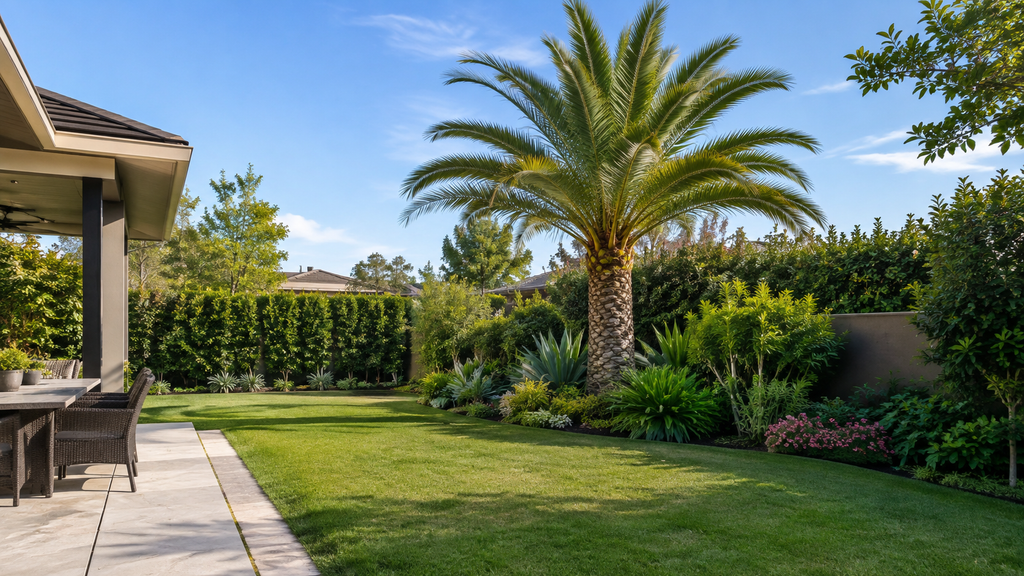
Palm plant ideas for backyards work best when the palm matches the climate, mature space, sunlight, drainage, and purpose of the planting. A backyard may need one architectural palm, a compact palm for a small garden, a container palm for flexibility, or a moisture-tolerant palm for a wetter area. The best choice should look attractive now and still fit, remain manageable, and perform its intended function when mature.
Palm Plant Ideas for Backyards: Choose the Right Palm
The best backyard palm landscape starts with plant suitability rather than appearance. Two young palms may look similar at a nursery but develop very different mature heights, crown widths, growth habits, moisture requirements, cold tolerance, and maintenance needs.
Use the 4S Palm Selection Framework: Survival, Size, Site, and Service.
Survival
Choose a palm that can tolerate your climate. Consider winter minimum temperatures, frost duration, summer heat, humidity, rainfall, wind, and coastal exposure.
Windmill palm (Trachycarpus fortunei) is one of the more cold-tolerant true palms commonly used in temperate landscapes, while dwarf palmetto (Sabal minor) is another option worth researching for comparatively cool conditions.
Size
Check mature height and width before planting.
Consider:
- crown spread;
- roof and gutter clearance;
- overhead utilities;
- nearby trees;
- neighboring boundaries;
- maintenance access.
A young palm that fits comfortably today may not fit once its mature crown develops.
Site
Evaluate the exact planting position rather than assuming every part of the backyard has the same conditions.
Check:
- sunlight;
- soil drainage;
- reflected heat;
- standing water;
- wind exposure;
- irrigation access.
Lady palm (Rhapis excelsa) is useful in sheltered shade, while Mediterranean fan palm (Chamaerops humilis) prefers bright, well-drained conditions and becomes drought tolerant after establishment.
Service
Consider whether you can realistically manage:
- irrigation;
- dead fronds;
- fruit or flower debris;
- sharp foliage;
- winter protection;
- future crown access;
- container repotting.
A palm should pass all four tests before becoming a permanent part of the backyard.
Map Your Backyard Microclimate
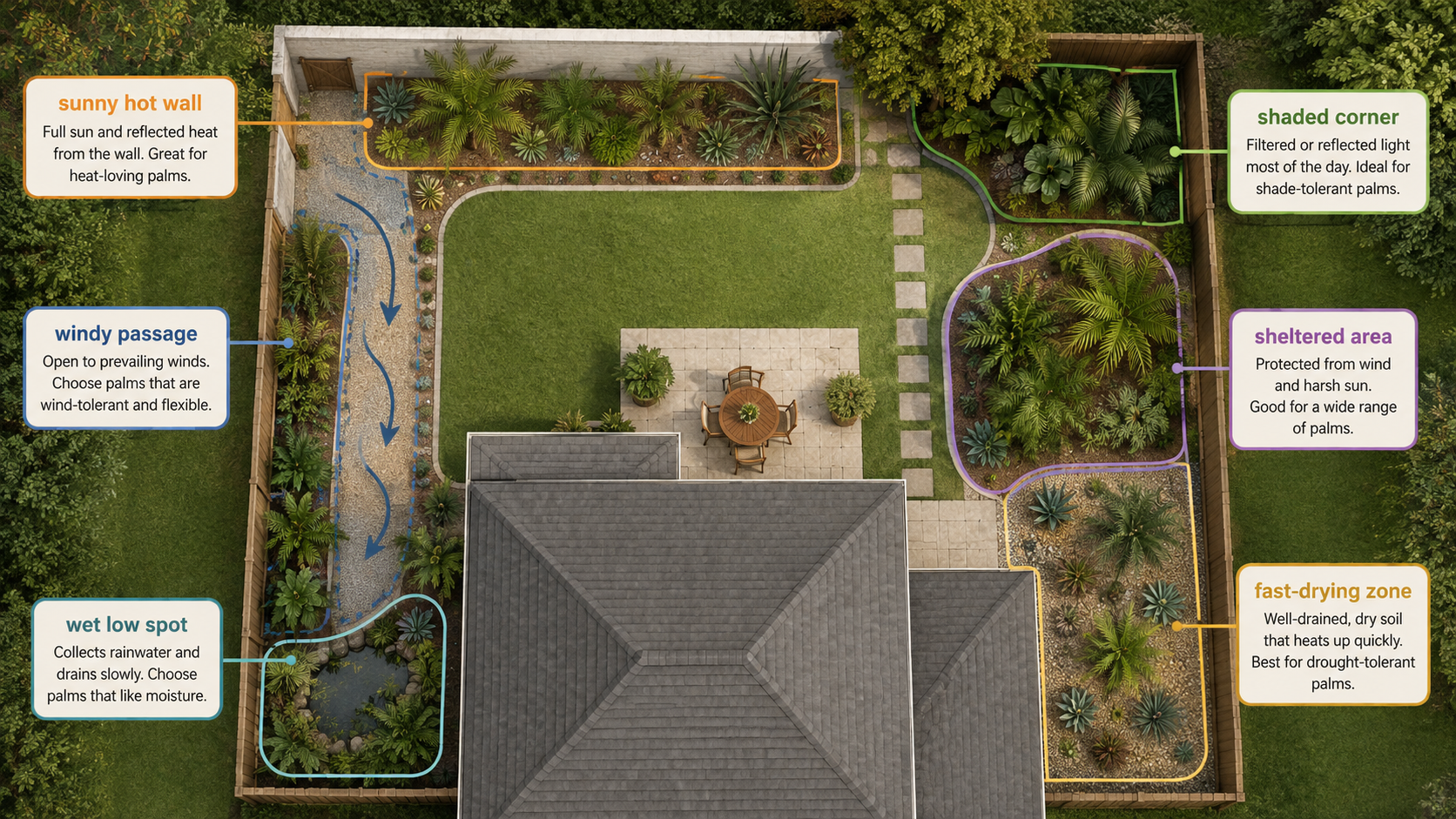
A backyard rarely has one uniform climate. A west-facing wall may create intense afternoon heat, while a shaded corner remains cooler and wetter. Low areas may collect water, narrow passages can funnel wind, and enclosed courtyards may stay more sheltered.
Before choosing a planting position, mark:
- morning sun;
- strong afternoon sun;
- seasonal shade;
- reflected heat;
- wind corridors;
- sheltered corners;
- wet areas;
- fast-drying areas;
- possible frost pockets.
This matters because a palm can be suitable for your general region but poorly suited to one particular location within the property.
Use this order:
Regional climate → backyard microclimate → palm selection → exact placement
A sheltered site may improve the appearance of a relatively cold-tolerant palm, while a moisture-compatible palm may perform better in a lower area than on a raised, fast-drying bed.
Best Palms for Backyard Conditions
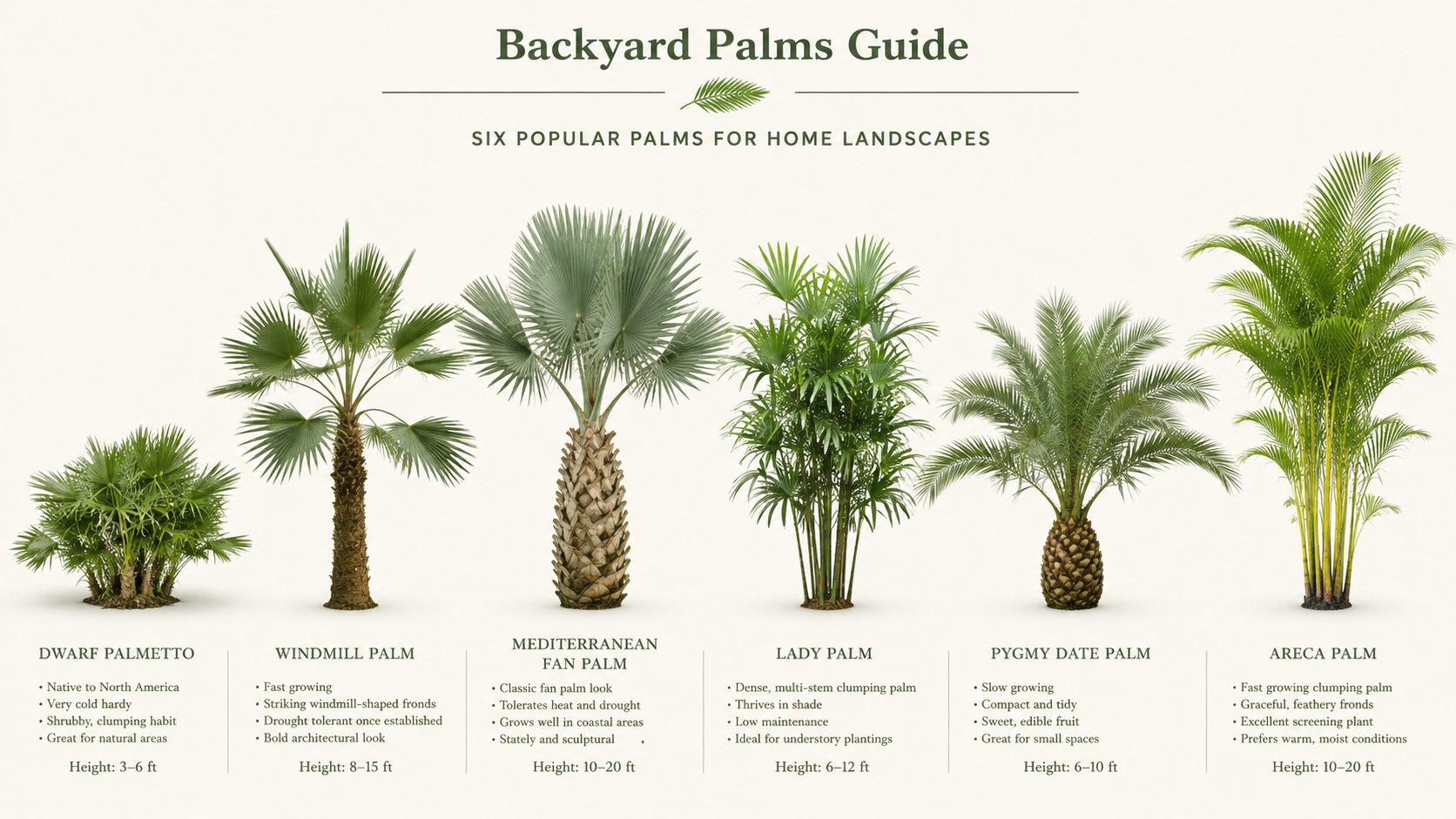
Different palms solve different backyard problems. Use climate, mature dimensions, growth habit, and site requirements to narrow the choice.
| Palm | Useful Role | Approximate Mature Scale | Key Consideration |
| Dwarf palmetto (Sabal minor) | Small yards, moist areas | 2–10 ft high, 4–6 ft wide | Compact and moisture tolerant |
| Windmill palm (Trachycarpus fortunei) | Cooler-climate specimen | Moderate landscape size | Protect from damaging wind |
| Mediterranean fan palm (Chamaerops humilis) | Hot, dry sites | 6–15 ft high, broad clump | Sharp petiole spines |
| Lady palm (Rhapis excelsa) | Shade, sheltered areas | 4–12 ft high, 6–15 ft wide | Tender tropical palm |
| Pygmy date palm (Phoenix roebelenii) | Compact warm-climate planting | About 12 ft high, 6–8 ft wide | Sharp basal spines |
| Areca palm (Chrysalidocarpus lutescens) | Broad warm-climate planting | Can become large outdoors | Needs substantial width |
Use the selector in this order:
- Remove palms unsuitable for your climate.
- Remove palms that exceed the mature space available.
- Match remaining species to sunlight and drainage.
- Choose the growth habit that performs the required function.
- Check safety and maintenance.
- Verify the final choice using regional horticultural guidance.
The best palm is not the most impressive plant in the nursery. It is the species whose mature form suits the backyard.
Palm Climate Guide for Global Gardens
International gardeners should not depend only on USDA hardiness zones. Actual winter lows, frost duration, rainfall, heat, humidity, and local growing conditions are more transferable.
Tropical and Humid
Prioritize palms suited to heat and humidity while ensuring the root zone drains adequately during heavy rainfall.
Important factors include:
- mature size;
- rainfall;
- humidity;
- wind exposure;
- drainage.
Warm Subtropical
Warm subtropical gardens may experience occasional cold events despite long hot summers.
Check:
- winter minimum temperature;
- frost frequency;
- duration of cold;
- wind exposure;
- recovery after unusual freezes.
Mediterranean or Hot-Dry
Prioritize:
- heat tolerance;
- good drainage;
- establishment watering;
- drought tolerance;
- strong-sun exposure.
Mediterranean fan palm is particularly relevant to warm, dry, well-drained conditions.
Mild Temperate
Choose palms with credible cold tolerance and use sheltered microclimates where possible. Protection from damaging wind can sometimes be almost as important as minimum temperature.
Colder Temperate
Where permanent outdoor palms are unreliable, consider:
- container palms;
- seasonal outdoor placement;
- protected overwintering;
- climate-appropriate plants with similarly bold foliage.
For international planning, actual local temperature and weather patterns should guide the decision more than a single zone label.
Choose the Right Palm Growth Habit
Growth habit determines what a palm can realistically do in a backyard.
Solitary Palms
Solitary palms develop one main trunk and are useful for:
- vertical structure;
- specimen planting;
- focal positions;
- architectural height.
Clustering Palms
Clustering palms develop multiple stems, creating greater horizontal mass and more foliage at lower levels.
They can work well where broader visual coverage is needed but often require more mature width than expected.
Areca palm is one example of a naturally clustering palm.
Short or Subterranean-Trunk Palms
These produce palm foliage without becoming conventional tall trees.
Dwarf palmetto is useful where vertical space is limited because much of its trunk remains below ground.
Container-Managed Palms
Containers provide mobility but require attention to:
- drainage;
- watering;
- root space;
- stability;
- repotting;
- seasonal protection.
Use this decision order:
Function → growth habit → species
Define what the palm needs to do before choosing the plant.
Use the 4S and 3F Palm Framework
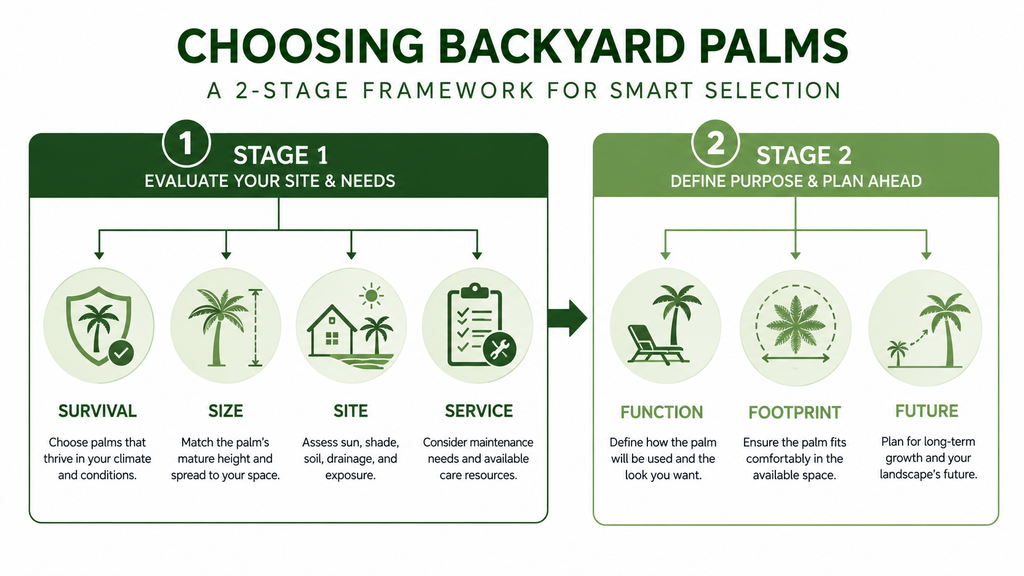
The 4S Framework determines whether a palm is suitable:
- Survival: Can it handle the climate?
- Size: Will it fit when mature?
- Site: Does the exact location suit it?
- Service: Can you maintain it?
The 3F Design Filter determines how the palm should be used:
- Function: What job does it perform?
- Footprint: How much space does it require?
- Future: Will the decision still work as the palm matures?
4S determines whether the palm belongs in the backyard.
3F determines how the palm belongs there.
This simple sequence helps prevent unsuitable palms from being planted in otherwise attractive locations.
Backyard Palm Ideas for a Focal Point
One well-positioned palm can create more impact than several unrelated palms scattered around the backyard.
Place a focal palm where the eye naturally travels, such as:
- beyond a patio;
- outside an important window;
- near the end of an open view;
- beside a transition between garden areas.
Use the View Corridor Test.
Stand at:
- the kitchen window;
- back door;
- patio;
- main seating area;
- garden entrance.
Ask whether the mature palm strengthens the view, blocks something important, or competes with another major tree.
Keep surrounding planting lower enough for the palm to remain visually dominant.
A focal palm works best when the backyard needs one clear structural anchor rather than maximum plant density.
Create a Three-Palm Grove
Three palms can create depth without crowding the backyard. A triangular arrangement often feels more natural than a straight row, although mature crown dimensions should determine actual spacing.
Keep the grove coherent with:
- one species where possible;
- enough crown space;
- repeated lower planting;
- intentional open areas.
Avoid planting palms too closely just to create immediate fullness.
Properly spaced palms may look slightly open when young but usually become better balanced as their crowns develop.
A three-palm grove works best where the goal is rhythm, depth, and stronger palm presence rather than dense screening.
Small Palm Ideas for Backyards
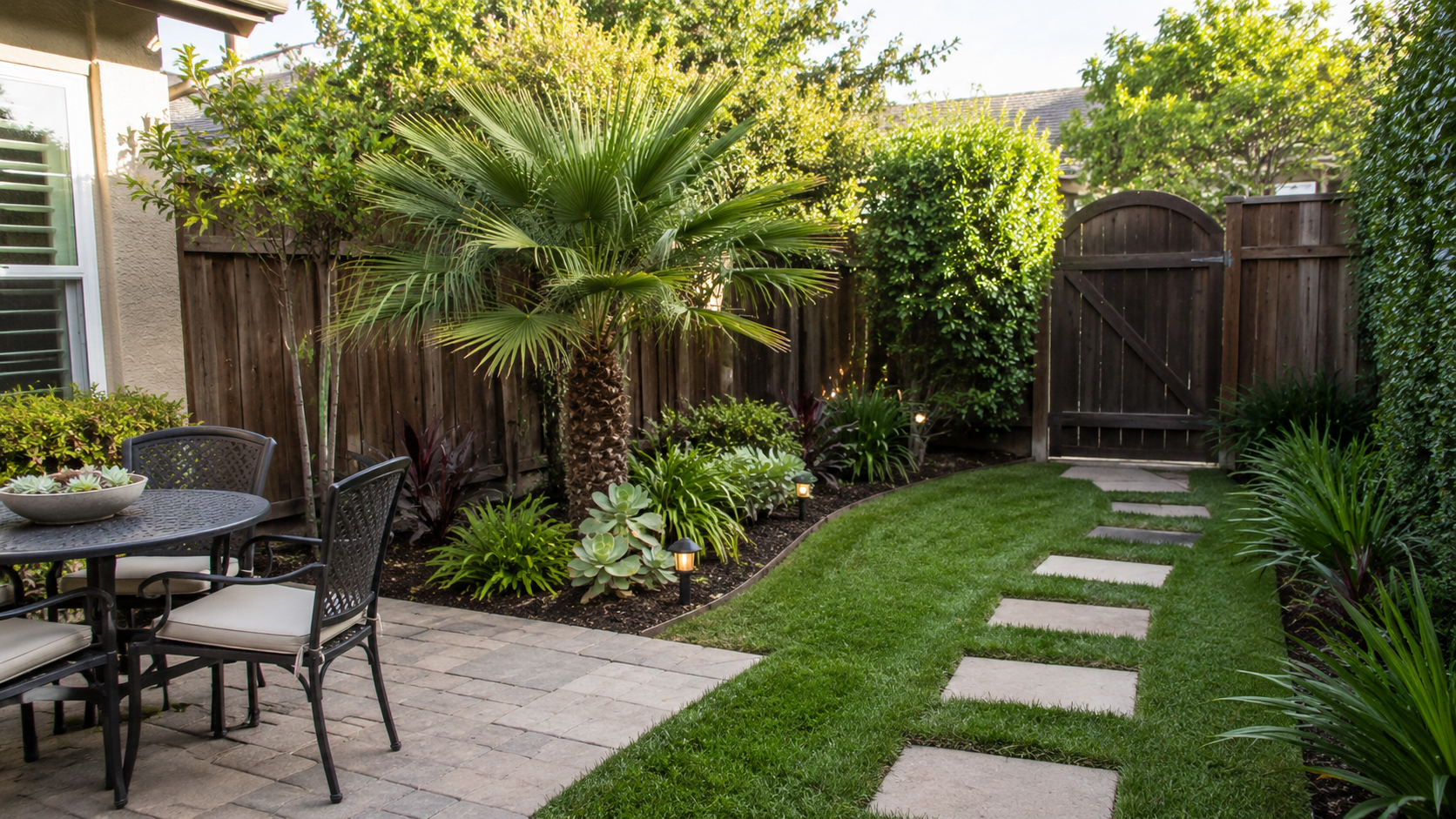
Small backyards usually benefit from one carefully selected compact palm rather than several palms forced into limited space.
Dwarf palmetto is worth considering where climate and moisture conditions fit. Pygmy date palm is another relatively compact option for warm climates, although its sharp basal foliage means it needs additional clearance from people.
Use a simple small-yard composition:
- one compact palm;
- one repeated mid-height companion;
- one low groundcover;
- open circulation.
In confined yards, mature width can matter more than height.
A broad palm crown may dominate a small courtyard even when the trunk remains relatively short.
The objective is to create palm character without sacrificing usable outdoor space.
Grow Palms in Outdoor Planters
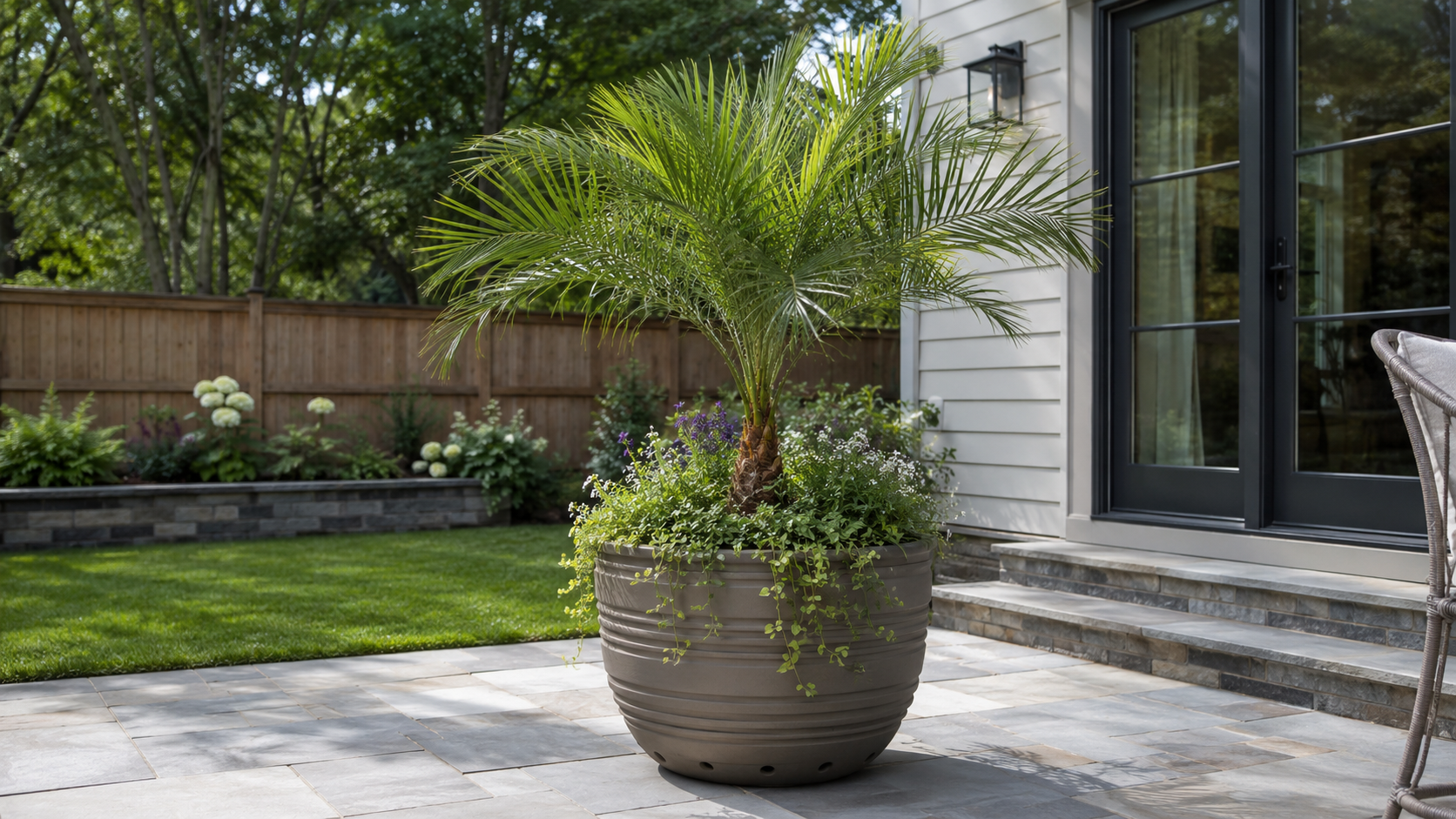
Container palms work well on patios, paved yards, rental properties, and in climates where seasonal protection is needed.
Before choosing a planter, consider:
- drainage;
- root volume;
- stability;
- watering;
- repotting;
- winter movement;
- eventual mature size.
Lady palm and windmill palm can both be grown in containers under appropriate conditions.
Remember that a planter does not permanently make a naturally large palm small. The palm may eventually need more root space, a larger container, or another growing position.
Choose the container according to long-term plant needs rather than appearance alone.
Palms for Wet Backyard Areas
Wet areas can support palms when the species matches the actual moisture pattern.
Dwarf palmetto is particularly useful to research because it tolerates moist to wet conditions.
Before planting, determine:
- how long water remains after rain;
- whether the soil dries between storms;
- whether moisture is seasonal;
- how much sunlight reaches the area;
- whether poor drainage is the underlying problem.
A rain garden normally experiences alternating wet and dry conditions rather than permanent flooding.
Choose both the palm and surrounding plants according to the real wet-dry cycle.
Palms for Cooler Backyards
A tropical-looking backyard can be created in cooler climates with relatively hardy palms and climate-appropriate companion foliage.
Windmill palm is one of the main palms to research for comparatively cool conditions. Dwarf palmetto is another option for some cooler regions.
Improve the chances of success with:
- sheltered planting;
- wind protection;
- hardy broadleaf companions;
- seasonal tender plants;
- containers where winter protection is necessary.
Avoid relying on one hardiness number alone.
Actual winter minimums, freeze duration, moisture, wind, and microclimate all influence survival.
Where permanent palms are marginal, container growing can be more practical than repeatedly replacing cold-damaged plants.
Palms for Shaded Backyards
Some palms tolerate shade and can make lower-light areas more useful.
Lady palm is a strong example because it naturally grows as an understory palm and tolerates partial to deep shade.
Determine whether the site receives:
- bright indirect light;
- morning sun;
- tree-canopy shade;
- building shade;
- seasonal shade.
Shade tolerant does not mean no light.
Choose companion plants that share similar moisture, light, and climate requirements.
A limited planting palette usually performs better than filling a shaded area with unrelated tropical-looking plants.
Calculate Your Palm’s Safe Space
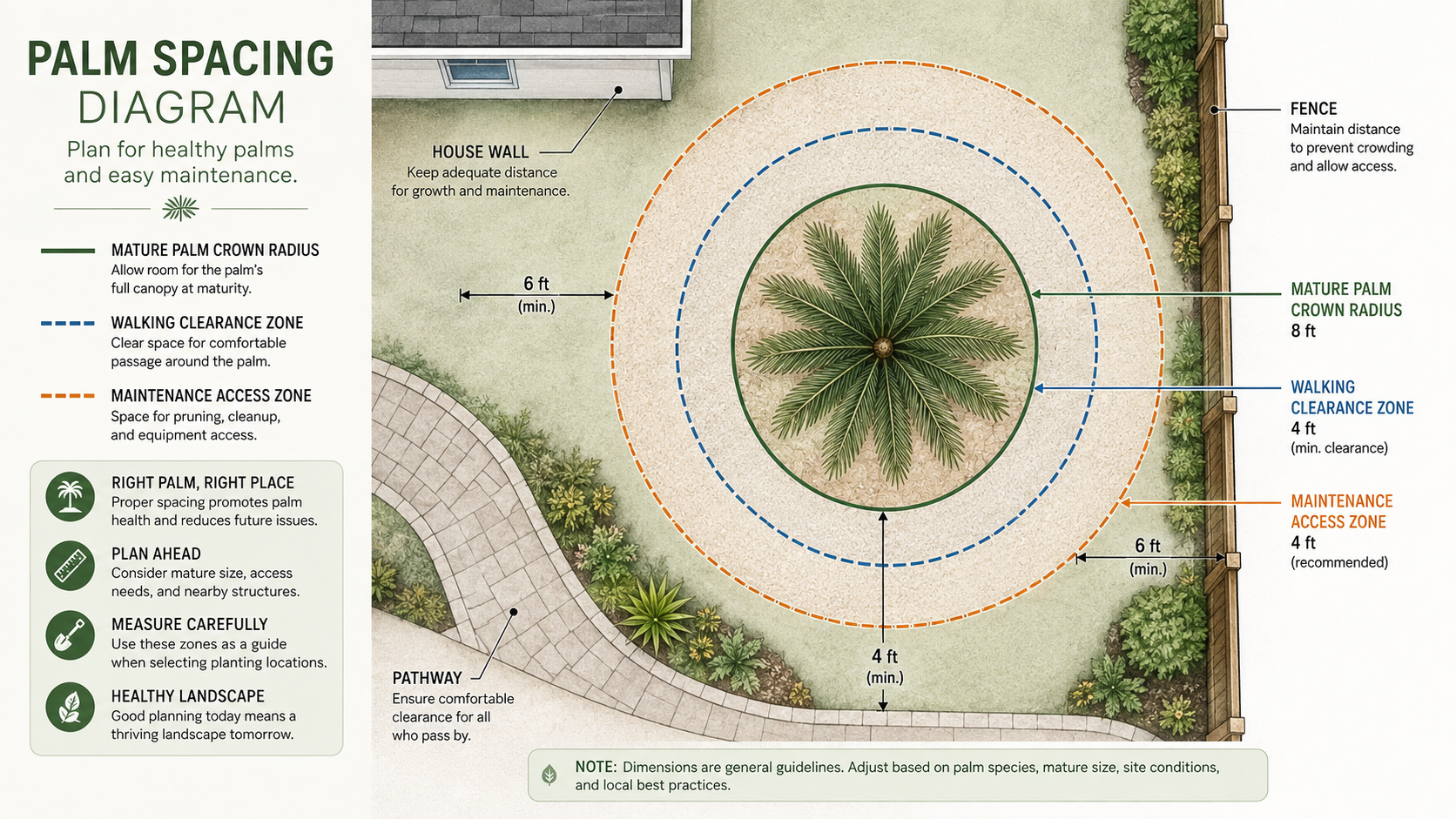
Palm spacing should include the mature crown and the space people need around it.
Use:
Mature Crown Radius + Functional Clearance + Maintenance Access = Safe Space Envelope
If a palm develops an eight-foot-wide crown, begin by visualizing approximately four feet of foliage extending outward from the center before adding practical clearance.
Check for conflicts with:
- patios;
- paths;
- gates;
- fences;
- roofs;
- gutters;
- utilities;
- neighboring property.
Sharp palms need greater human clearance.
Mediterranean fan palm has sharp petiole spines, while pygmy date palm has sharp basal foliage.
If the Safe Space Envelope overlaps a permanent structure or essential route, choose another position or a smaller palm.
Use the Mature Palm Footprint Test
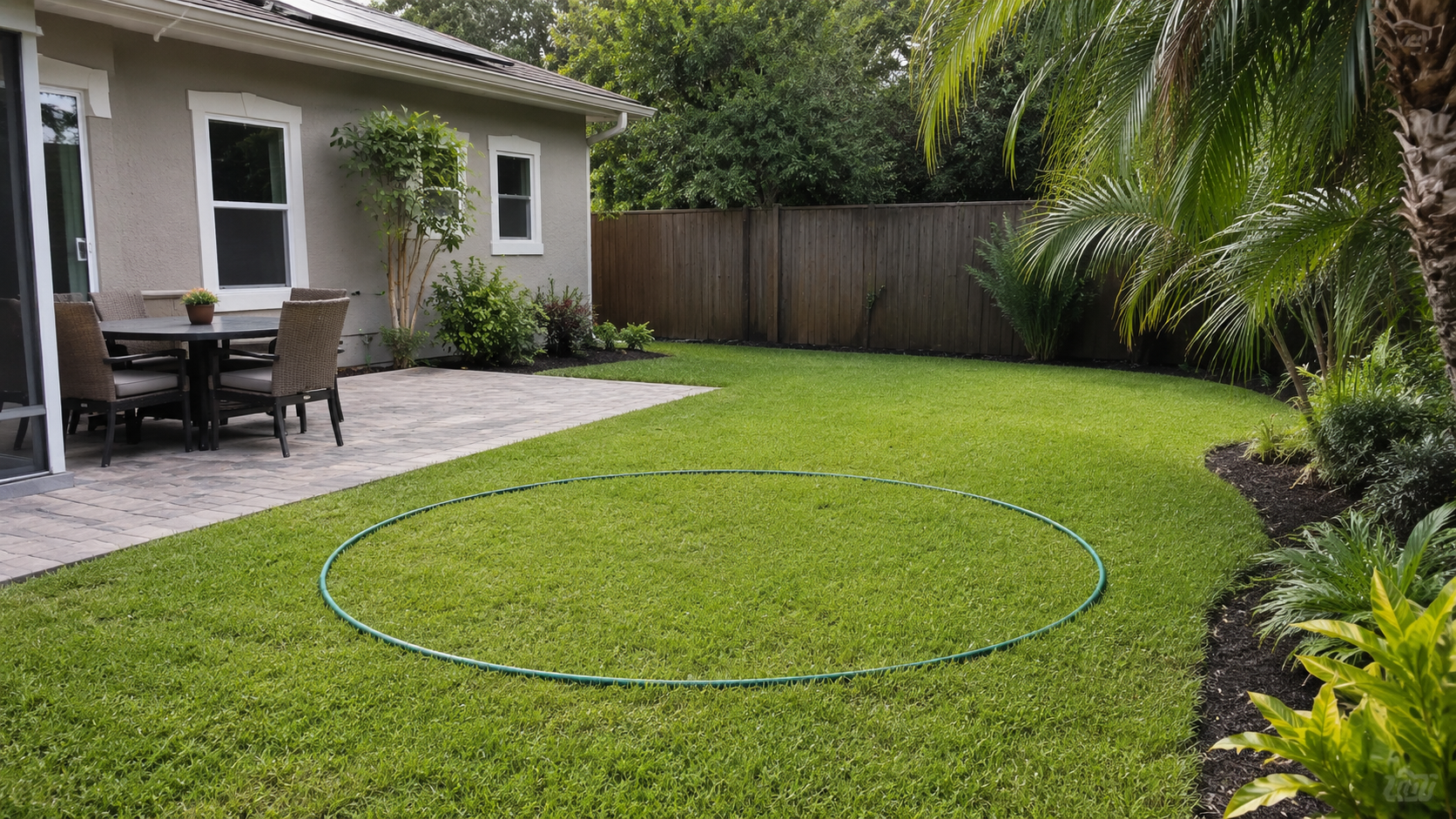
Before planting, mark the expected mature width using:
- rope;
- chalk;
- temporary stakes;
- a garden hose.
View the marked space from the patio, back door, major windows, lawn, and garden entrance.
Then look upward for:
- roofs;
- balconies;
- utility lines;
- existing trees;
- important views.
Finally, walk around the footprint.
If circulation already feels awkward before the palm is planted, the mature palm is too large for that position.
This simple test prevents planning for nursery size instead of mature size.
Plan Palm Growth: Year 1 to Maturity
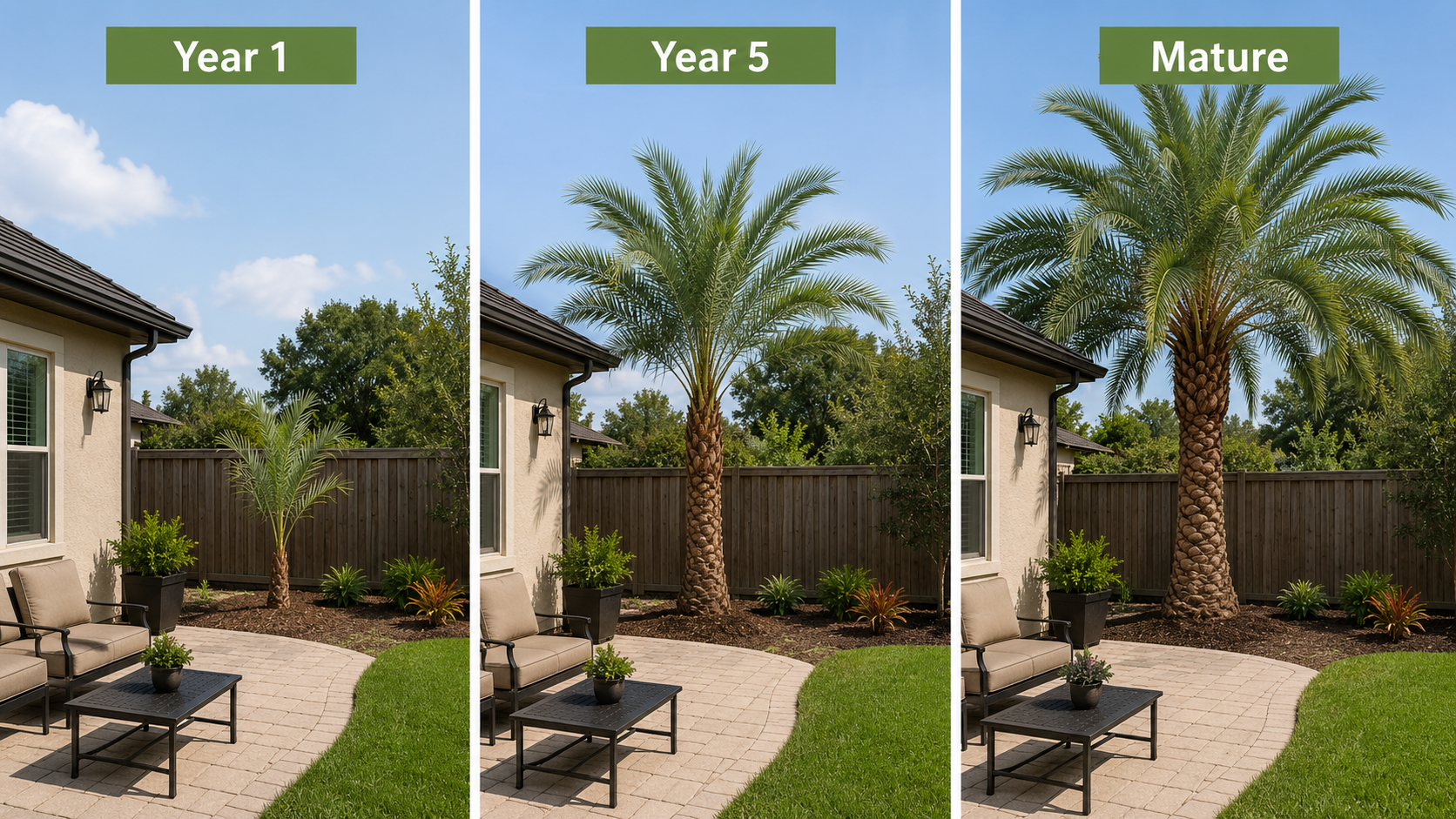
Palm landscaping should be planned as a timeline.
Year 1
Allow open space while the palm establishes.
Use low-growing companions or movable containers rather than adding more permanent palms just to fill temporary gaps.
Year 5
Check:
- crown expansion;
- changing shade;
- plant competition;
- path clearance.
Mature Stage
The backyard should still provide:
- usable outdoor space;
- structural clearance;
- maintenance access;
- comfortable circulation.
Do not solve a temporary empty-space problem with another permanent tree.
Design permanent spacing for the mature landscape.
Choose Palms for Backyard Screening
Start with the sightline that needs to be blocked.
Identify whether it is:
- a neighboring patio;
- ground-floor window;
- upper-story window;
- street view;
- service area.
A tall solitary palm may eventually raise its crown above the required sightline, while clustering palms can provide more foliage at lower levels.
Use lower companion planting where necessary.
The best screen interrupts the required view without creating unnecessary crowding, darkness, or maintenance problems.
Create a Safe Palm Circulation Zone
Palms near paths, doors, gates, seating, play areas, or pet routes need enough clearance for normal movement.
Before planting:
- Mark the mature footprint.
- Walk the normal route.
- Carry something bulky.
- Imagine wet or wind-blown foliage.
- Check future maintenance access.
If mature foliage would force people to duck, turn sideways, or brush against sharp leaves, increase the clearance.
This is particularly important around narrow passages and frequently used backyard routes.
What to Plant Around Palm Trees
Companion plants should be selected by growing conditions first.
Match:
- sunlight;
- moisture;
- drainage;
- climate;
- mature scale.
Then create visual contrast with:
Palm canopy → medium foliage → low ground layer → open foreground
For shaded palms, use shade-compatible companions.
For moisture-tolerant palms, choose plants that accept the same wet-dry pattern.
For hot, well-drained sites, select companions adapted to those conditions.
The central rule is:
Ecological compatibility first; visual compatibility second.
Compare Palm Maintenance Needs
Before buying, assess:
- watering needs;
- drainage sensitivity;
- dead-frond management;
- fruit or flower debris;
- sharp foliage;
- cold protection;
- mature crown access;
- container care;
- wind exposure.
Maintenance depends on location as much as species.
A palm that is easy to manage at the back of a large garden may become inconvenient beside a doorway or narrow path.
Ask:
Is this palm easy to maintain in this exact position?
That question is more useful than asking whether the species is generally considered low maintenance.
Common Backyard Palm Mistakes
Avoid:
- choosing by nursery size;
- ignoring mature width;
- planting too close to structures;
- ignoring microclimates;
- adding palms without a clear function;
- using tall palms for lower screening;
- ignoring sharp foliage;
- designing only for Year 1;
- assuming every palm-like plant is a true palm.
The biggest mistake is choosing a palm that cannot coexist comfortably with the backyard once mature.
Is Sago Palm Safe for Backyards?
Sago palm (Cycas revoluta) is not a true palm. It is a cycad and is highly toxic when ingested.
Before buying any palm-like plant, confirm:
- botanical name;
- plant family;
- toxicity;
- sharp foliage;
- fruit or seed hazards;
- suitability around children and pets.
Physical safety and toxicity are different issues.
A true palm may not present the same ingestion hazard but can still have sharp petioles, spines, or rigid foliage.
Backyard Palm Decision Matrix
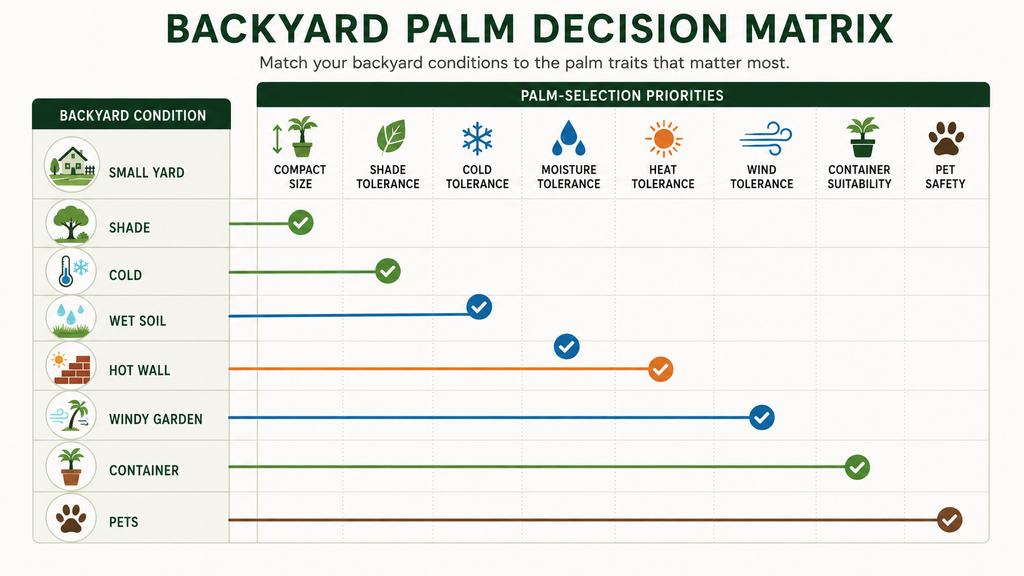
| Backyard Condition | Prioritize | Main Risk |
| Very small yard | Compact mature crown | Excess width |
| Narrow passage | Safe clearance | Physical contact |
| Windy garden | Suitable palm + shelter | Frond damage |
| Cold winter | Verified tolerance | Freeze injury |
| Wet soil | Moisture compatibility | Root-zone mismatch |
| Hot wall | Heat tolerance | Reflected heat |
| Shaded corner | Shade tolerance | Insufficient light |
| Difficult access | Manageable mature form | Maintenance problems |
| Pets or children | Safe, identified species | Toxicity or spines |
| Container | Manageable growth | Root restriction |
Identify the biggest site limitation first.
Then apply:
4S → 3F → Safe Space Envelope → local verification
The best palm solves the largest backyard constraint while creating the fewest new problems.
When Not to Plant a Palm
Delay planting if:
- the species is unknown;
- mature width is unknown;
- climate compatibility is uncertain;
- drainage has not been checked;
- utility clearance is uncertain;
- sharp foliage blocks a mandatory route;
- pet or child safety has not been checked;
- the mature crown conflicts with a structure;
- the palm has no clear function.
Ask:
What happens if this palm becomes exactly as large and vigorous as it is capable of becoming?
If the answer creates a serious problem, choose another palm or another location.
FAQs About Palm Plant Ideas for Backyards
What is the best palm for a small backyard?
Compact palms such as dwarf palmetto can work well in limited spaces. Always check mature width as carefully as mature height.
Which palm is good for cold backyards?
Windmill palm is one of the more cold-tolerant true palms commonly used in temperate landscapes. Dwarf palmetto is another option worth researching.
Can palm trees grow in shade?
Yes. Lady palm tolerates partial to deep shade, although adequate natural light is still necessary.
Can palms grow in outdoor pots?
Yes. Containers work when drainage, root volume, watering, stability, and seasonal protection are properly managed.
Which palm is good for wet soil?
Dwarf palmetto is worth considering for moist or periodically wet conditions when the rest of the site requirements also fit.
Which palm is good for hot, dry backyards?
Mediterranean fan palm can tolerate hot, well-drained conditions and drought after establishment, but its sharp foliage should influence placement.
How much space does a palm need?
Allow enough room for the mature crown plus walking and maintenance clearance rather than measuring the trunk alone.
How many palms should I plant?
Use the smallest number needed to achieve the landscape goal. One correctly positioned palm can be more effective than several crowded palms.
Are palms low maintenance?
Maintenance varies by species and position. Consider watering, debris, mature height, sharp foliage, cold protection, and accessibility.
Are sago palms true palms?
No. Sago palm is a cycad rather than a true palm and is highly toxic when ingested.
Backyard Palm Planning Checklist
- I know the botanical species.
- The palm suits my regional climate.
- I mapped the backyard microclimate.
- I know the mature height and width.
- I identified the growth habit.
- Light and drainage are suitable.
- The palm passes 4S.
- The design passes 3F.
- The Safe Space Envelope fits.
- I tested the mature footprint.
- I considered Year 1, Year 5, and maturity.
- Circulation remains comfortable.
- Physical hazards have been checked.
- Structure and utility conflicts are resolved.
- Maintenance remains practical.
- Companion plants need compatible conditions.
- Pet and child safety has been checked where relevant.
- The palm performs a clear landscape function.
Which Backyard Palm Idea Is Best?
Choose a solitary palm when the backyard needs a clear focal point, a compact palm when mature space is limited, and the appropriate clustering or solitary growth habit when screening is required.
Use a container palm where mobility or winter protection matters. Research windmill palm or dwarf palmetto for comparatively cool conditions, lady palm for suitable shaded areas, and dwarf palmetto for compatible moist locations.
Avoid palms whose mature crown conflicts with paths, buildings, utilities, boundaries, or essential outdoor space.
Use the final decision system:
4S: Survival → Size → Site → Service
3F: Function → Footprint → Future
A successful backyard palm fits the climate, fits the available space, performs a clear function, remains practical to maintain, and still makes sense when the landscape reaches maturity.
Myra is the founder and lead writer of Backyard Planter Ideas, where she shares practical, well-researched guidance on planter design, plant selection, and outdoor styling. Her goal is to help homeowners create attractive, functional garden spaces with clear, reliable, and easy-to-apply advice.