
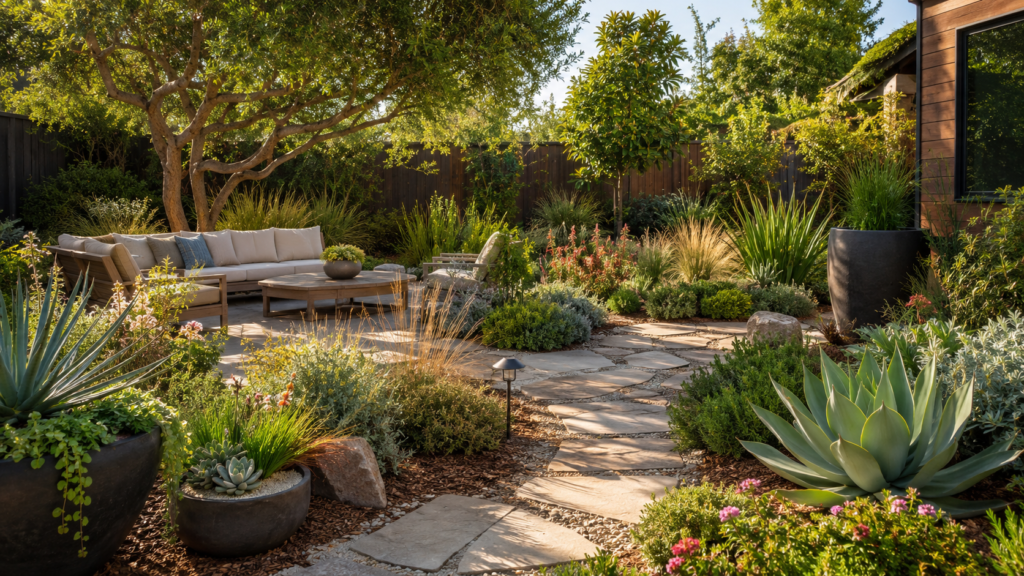
These backyard xeriscape ideas combine climate-suitable plants, efficient irrigation, practical hardscape, and comfortable outdoor-living spaces.
A successful backyard xeriscape combines climate-suitable plants, efficient irrigation, healthy soil, practical hardscape, and comfortable outdoor-living areas. It does not need to resemble a bare desert or an all-gravel yard. Assess sunlight, soil, drainage, wind, and how the backyard will be used. Then group plants by water needs and choose ideas that fit your climate, budget, space, and maintenance capacity.
Backyard Xeriscape Ideas at a Glance
The best backyard xeriscape ideas solve specific problems such as limited space, excessive heat, unused lawn, poor drainage, or difficult slopes.
| Idea | Best for | Cost | Main benefit |
|---|---|---|---|
| Curving path | Narrow yards | Low–medium | Organizes movement |
| Perimeter beds | Small yards | Medium | Preserves central space |
| Vertical planters | Paved or rental yards | Low–medium | Uses wall space |
| Repeated plant palette | Low-maintenance yards | Low | Creates visual unity |
| Focal planter | Patios | Medium | Adds visual impact |
| Pavers with planted joints | Modern yards | Medium–high | Softens hardscape |
| Geometric grass beds | Contemporary homes | Medium | Adds structure |
| Gravel accents | Paths and drainage | Low–medium | Defines zones |
| Fire-pit courtyard | Entertaining | Medium–high | Creates a gathering area |
| Raised patio planters | Privacy | Medium–high | Divides outdoor rooms |
| Phased lawn conversion | Limited budgets | Low initially | Spreads costs |
| Local stone and mulch | Budget projects | Low–medium | Reduces material costs |
| Divided perennials | Existing gardens | Low | Fills beds cheaply |
| Small plants at mature spacing | Long-term plans | Low–medium | Prevents crowding |
| Paths before features | New projects | Medium | Improves usability |
| Staggered flowers | Seasonal colour | Medium | Extends bloom time |
| Mixed foliage | Year-round interest | Medium | Adds texture |
| Wildlife water source | Wildlife gardens | Low–medium | Supports birds and insects |
| Habitat spaces | Naturalistic yards | Low | Supports biodiversity |
| Dry creek bed | Runoff areas | Medium–high | Directs water |
| Planted terraces | Slopes | High | Reduces erosion |
Choose two or three compatible ideas. A compact yard might combine perimeter beds, a curving path, and one statement planter. A sloped yard may need terraces, contour planting, and a dry creek.
How We Evaluated These Backyard Xeriscape Ideas
These ideas were evaluated for water efficiency, climate adaptability, drainage, usability, mature plant size, maintenance, accessibility, wildlife value, and budget flexibility.
A design should solve a practical problem rather than provide visual appeal alone. Gravel may create a durable path but can increase heat. Vertical planters save space but may dry quickly. Large plants offer immediate impact but cost more and can be harder to establish.
The strongest ideas provide several benefits at once. A raised trough can create privacy, define a patio, and support plants that need specialized soil. A dry creek can manage runoff and become a focal feature.
Choose the option whose limitations are easiest to manage in your yard.
What Makes a Backyard Xeriscape Successful?
A successful backyard xeriscape matches the landscape to local conditions rather than following a fixed desert style. Xeriscaping can work in arid, temperate, Mediterranean, coastal, cold, and seasonally wet climates.
The essential principles are:
- Plan around household needs.
- Understand soil and drainage.
- Select climate-suitable plants.
- Group plants by water requirements.
- Irrigate efficiently.
- Keep turf only where useful.
- Protect soil with suitable mulch.
- Maintain the yard as plants mature.
Before designing, determine where water enters, collects, and leaves. Record full-sun, partial-shade, and deep-shade zones. A hot wall, shaded corner, and low wet area should not receive the same plants or irrigation schedule.
The goal is not to remove the most grass. It is to use each part of the backyard intentionally.
Choose the Right Xeriscape Style for Your Backyard
Choose a style according to the backyard’s size, architecture, climate, and use.
Compare these backyard xeriscape ideas according to your yard’s size, climate, architecture, and daily use rather than choosing a style by appearance alone.
| Backyard condition | Suitable style | Main approach |
|---|---|---|
| Small and sunny | Modern courtyard | Compact repeated plants |
| Family yard | Zoned outdoor space | Limited turf and protected beds |
| Pet-friendly yard | Open activity zone | Durable, non-toxic plants |
| Sloped yard | Terraced xeriscape | Deep-rooted planting |
| Shaded yard | Woodland-inspired garden | Organic mulch and dry-shade plants |
| Hot exposed yard | Layered shade design | Trees, pergolas, and pale paving |
| Rental | Container xeriscape | Movable planters |
| Entertaining yard | Patio-centred design | Seating, planters, and lighting |
| Wildlife garden | Naturalistic xeriscape | Long-blooming regional plants |
| Low-budget yard | Phased DIY design | Small plants and local materials |
A modern yard benefits from simple forms and a limited material palette. A wildlife garden can use softer paths, layered planting, and longer seasonal interest.
Keep a small grass area when it supports children, pets, or exercise. Remove only lawn that has no clear purpose.
Use the Backyard Xeriscape Fit Score
Score a proposed design from 0 to 2 for each factor.
| Factor | 0 | 1 | 2 |
|---|---|---|---|
| Sun | Unsuitable | Adjustable | Suitable |
| Drainage | Major issue | Minor correction | Safe |
| Function | Removes needed use | Compromise | Supports use |
| Irrigation | No clear plan | Manual or mixed | Zoned |
| Soil | Severe limitation | Improvable | Suitable |
| Heat | Excessive exposure | Partial shade | Controlled |
| Maintenance | Too demanding | Manageable | Fits routine |
| Mature spacing | Crowded | Adjustable | Adequate |
- 13–16: Strong fit
- 9–12: Correct weak factors first
- 5–8: Redesign the idea
- 0–4: Choose another option
One serious weakness can outweigh a high total. A patio may look attractive but still fail if it directs water toward the house.
Small Backyard Xeriscape Ideas
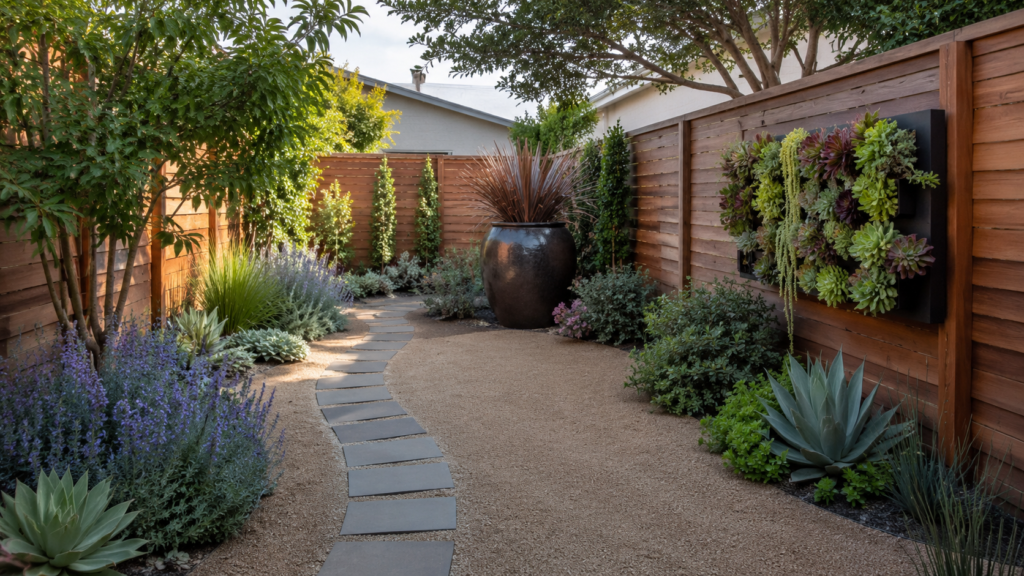
Small backyard xeriscape ideas should preserve open space, simplify circulation, and use fences, boundaries, and vertical surfaces efficiently.
1. Use a Curving Path as the Design Spine
A single path can organize the yard and make a narrow space feel deeper. Lead it from the house toward a bench, gate, shed, or focal planter.
Use stable pavers, compacted gravel, decomposed granite, or stepping stones. Keep the route wide enough for comfortable access and garden maintenance.
2. Build Planting Beds Around the Perimeter
Perimeter beds preserve the centre for seating, play, or movement. Vary their depth so wider sections can hold a shrub or small tree.
Repeat plant groups and check mature width so foliage does not block paths or press against walls.
3. Add Vertical Planters Along a Fence
Vertical planters add greenery without taking up floor space. Use wall pots, planting pockets, shelves, troughs, or trellises.
Select plants for the wall’s actual light and heat. Use secure supports, open drainage, and plants with similar water needs.
4. Repeat Three to Five Plant Types
A limited palette creates unity and simplifies care. Use one shrub, one grass, one flowering perennial, one groundcover, and one seasonal accent.
Repeat these plants rather than adding a different species to every gap.
5. Use One Bold Focal Plant or Planter
Choose one dominant tree, shrub, planter, sculpture, or water bowl. Position it where it can be seen from the house or patio.
Keep surrounding planting simple so the focal feature remains visually important.
Modern Backyard Xeriscape Ideas Without Grass
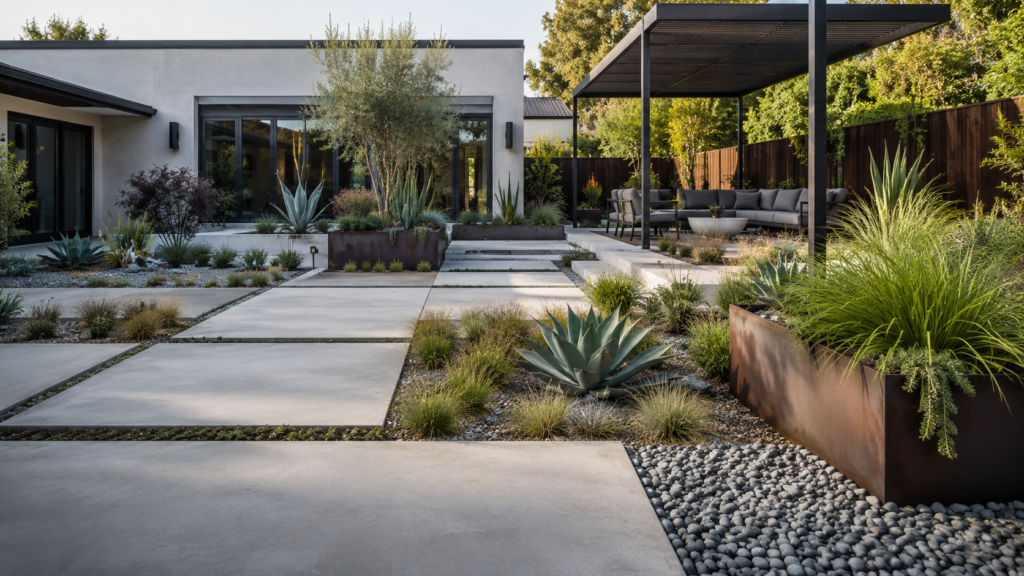
A grass-free yard should balance clean hardscape with generous planting and shade.
6. Combine Large Pavers with Planted Joints
Large pavers create a modern surface without one continuous slab. Fill controlled gaps with gravel or a low groundcover suited to the traffic level.
Frame the paving with planted beds to reduce heat and soften the hard edges.
7. Create Geometric Beds with Repeated Grasses
Rectangular or angled beds echo modern architecture. Repeated grasses add movement and contrast with horizontal paving.
Choose non-invasive varieties and provide enough room for mature growth.
8. Use Gravel as an Accent, Not the Entire Landscape
Use gravel for paths, drainage strips, dry creek beds, or transitions. Avoid covering the complete yard because exposed stone can increase heat and collect debris.
Balance gravel with plants, shade, mulch, and permeable soil.
9. Install a Minimal Fire-Pit Courtyard
Place a fire feature on a stable, non-combustible surface and follow local rules. Use simple seating and maintain safe clearance from plants and structures.
Where open flames are restricted, use a sculptural bowl, low table, or circular planter instead.
10. Frame a Patio with Raised Xeriscape Planters
Long troughs can create privacy and define dining or lounge zones. Select materials that suit local heat, frost, and wind.
Provide sufficient soil volume, drainage, stability, and access for maintenance.
Budget-Friendly Xeriscape Ideas
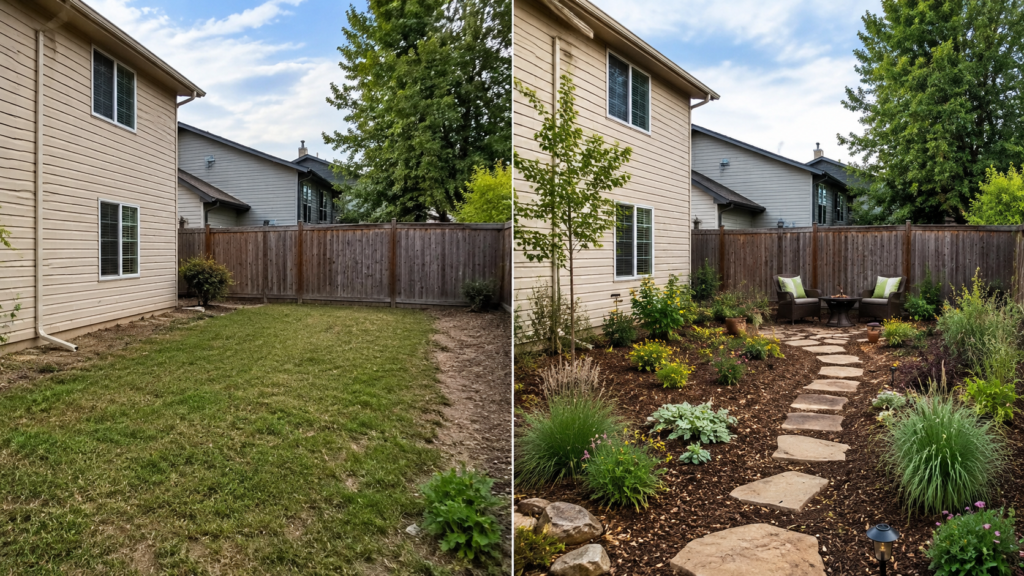
Budget-friendly backyard xeriscape ideas reduce initial costs by phasing lawn conversion, reusing suitable materials, and prioritizing essential infrastructure.
11. Convert the Lawn in Manageable Phases
Begin with the least useful lawn section. Convert it into a bed, path, seating area, or planter zone and observe how it performs.
Follow one master plan so every phase uses compatible materials and plants.
12. Use Locally Available Stone and Mulch
Compare regional stone, recycled aggregate, municipal mulch, and arborist wood chips before buying imported materials.
Use organic mulch in beds, stable material on paths, and larger stone in drainage routes.
13. Divide Existing Drought-Tolerant Perennials
Divide healthy clumping plants that already perform well in the yard. Reuse them to repeat colour and texture.
Move divisions only to locations with similar light, soil, and moisture.
14. Start with Small Plants at Mature Spacing
Small plants cost less and often establish well. Space them for their mature width instead of crowding them for instant impact.
Cover temporary gaps with mulch or seasonal plants.
15. Build Paths Before Premium Features
Complete the main route before buying decorative pots, furniture, or artwork. Use the path for several weeks and adjust awkward corners or access points.
Prioritize work that is expensive to correct later.
Colorful Xeriscape Ideas That Support Wildlife
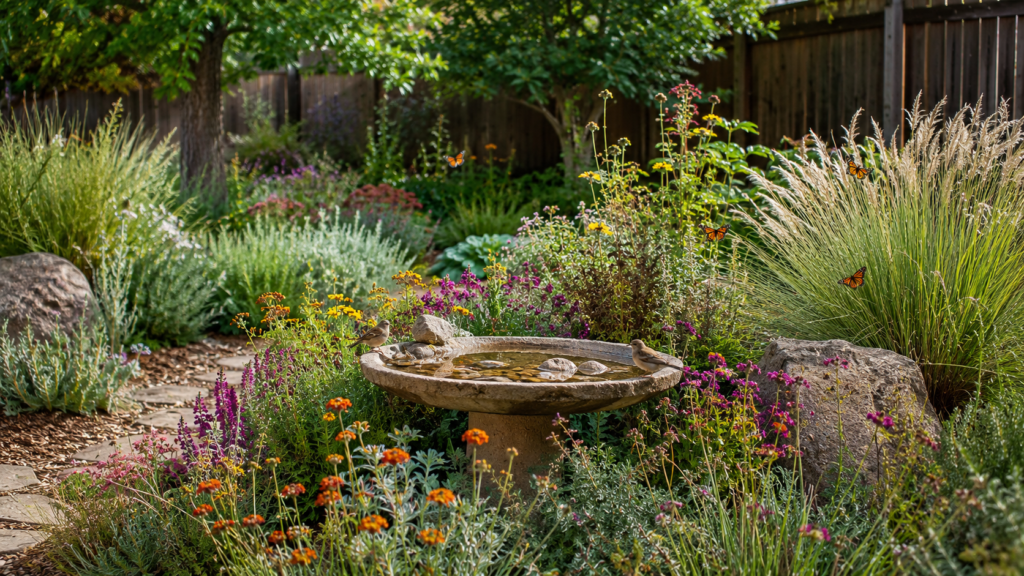
A water-wise yard can provide colour through flowers, foliage, bark, berries, grasses, and seed heads.
16. Plant Flowers with Staggered Bloom Times
Choose plants that flower in early, middle, and late seasons. Repeat flowering groups so pollinators can locate them easily.
Add foliage plants between bloom periods to maintain structure.
17. Combine Fine, Rounded and Architectural Foliage
Mix fine grasses, rounded shrubs, and strong architectural plants. Use groundcovers to connect these forms.
Repeat important textures so the design looks intentional rather than random.
18. Add a Shallow Wildlife Water Source
A birdbath, shallow basin, or recirculating bowl can support wildlife. Include safe landing points and clean the feature regularly.
Prevent stagnant water and place it where evaporation can be controlled.
19. Leave Selected Habitat Spaces
Retain some seed heads, hollow stems, leaf litter, and small areas of exposed soil within designated planting zones.
Keep paths and patios clear, and remove invasive plants before they spread.
Xeriscape Ideas for Slopes and Drainage Problems
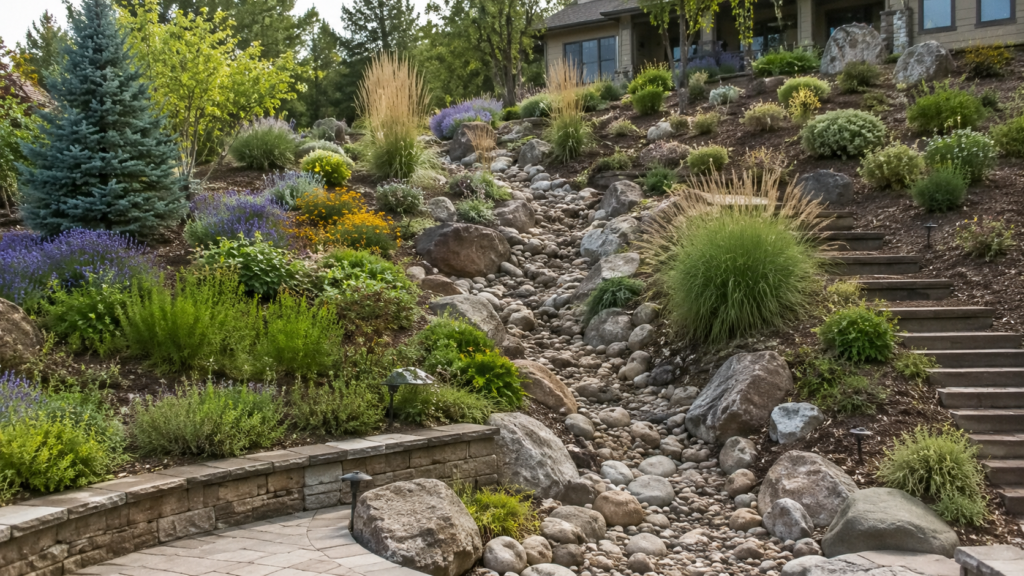
Slopes must be planned around water movement before decorative planting.
20. Turn a Runoff Route into a Functional Dry Creek Bed
Observe the yard during rain and identify the inlet, route, and safe outlet. Use mixed stone sizes and larger rocks where water moves forcefully.
Plant the edges with species suited to alternating wet and dry conditions.
21. Terrace the Slope with Planted Contours
Terraces reduce the distance water travels and create stable planting areas. Low terraces may use stone, timber, masonry, or planted berms.
Arrange plants along the contour. Significant retaining work should be professionally designed.
Three Backyard Xeriscape Layouts You Can Adapt
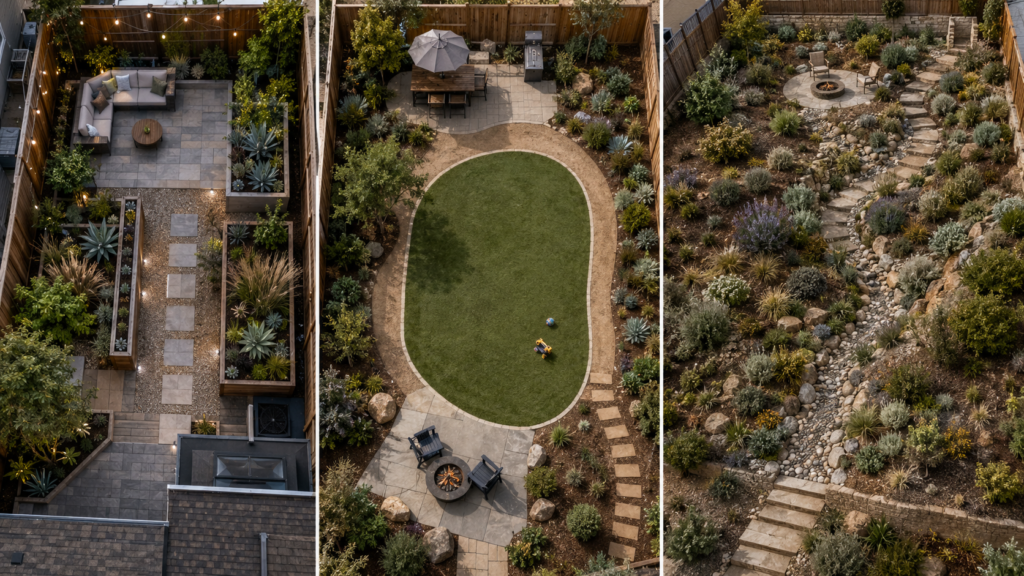
These adaptable layouts show how individual backyard xeriscape ideas can be combined into complete, functional designs.
Layout A: Compact Urban Backyard
Suggested allocation:
- 35% seating
- 25% perimeter beds
- 15% path
- 15% raised or vertical planters
- 10% storage or focal feature
Use one main route and keep the central area open.
Layout B: Family and Pet-Friendly Backyard
Suggested allocation:
- 30% activity surface
- 25% patio
- 25% planting
- 10% paths
- 10% shade
Retain a safe play surface and keep thorny or toxic plants away from movement areas.
Layout C: Sloped Backyard with Runoff
Use an upper infiltration bed, contoured planting bands, stable steps, a drainage route, and a lower outlet area.
Create separate irrigation zones for the dry upper slope and wetter lower sections.
Choose Xeriscape Plants by Climate, Not by Trend
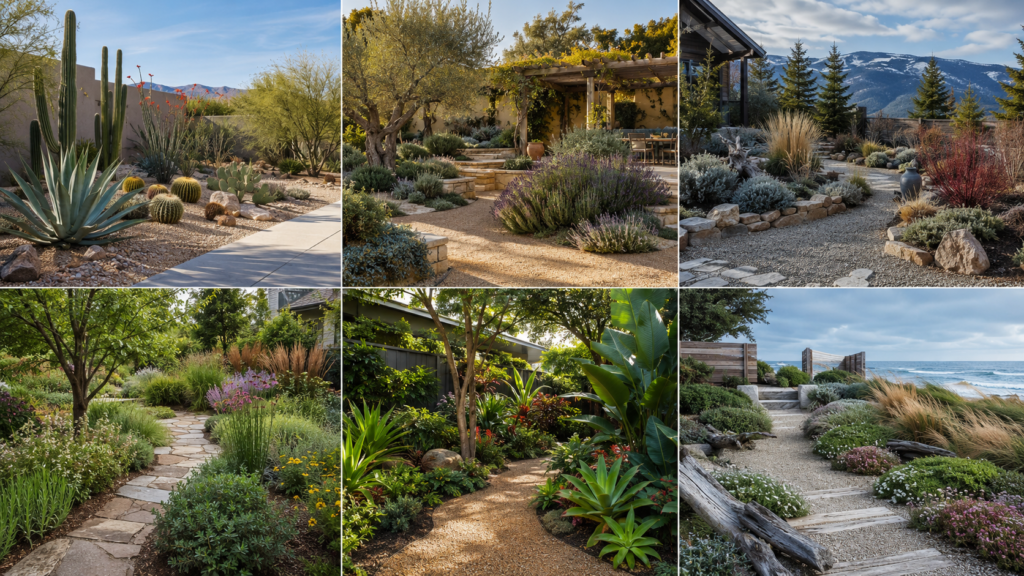
Select plants according to local temperature, rainfall, soil, drainage, wind, and winter conditions.
| Climate | Useful traits | Priority |
|---|---|---|
| Hot and arid | Heat tolerance and deep roots | Shade |
| Mediterranean | Dry-summer tolerance | Winter drainage |
| Cold and dry | Cold and drought tolerance | Winter structure |
| Temperate | Flexible moisture tolerance | Wet-season drainage |
| Seasonally dry tropical | Wet-dry adaptability | Storm drainage |
| Coastal | Wind and salt tolerance | Shelter |
Hot climates need shade and limited exposed stone. Mediterranean climates need plants that tolerate dry summers and wet winters. Cold climates require both drought tolerance and winter hardiness.
Temperate regions should prioritize drainage during wet periods. Tropical regions need plants that tolerate seasonal contrasts. Coastal yards require stable planting and wind protection.
Verify Every Xeriscape Plan Against Local Conditions
Before buying plants or materials, confirm:
- Local climate suitability
- Mature plant size
- Invasive status
- Pet and child safety
- Soil and drainage needs
- Wind and salt tolerance
- Firewise guidance
- Irrigation restrictions
- Drainage regulations
- Permit requirements
Use regional botanical gardens, government agencies, water authorities, and qualified professionals.
A choice should pass three tests:
- Can it survive the regional climate?
- Can it grow in this exact site?
- Can the household maintain it?
Use Outdoor Planters in a Xeriscape Backyard
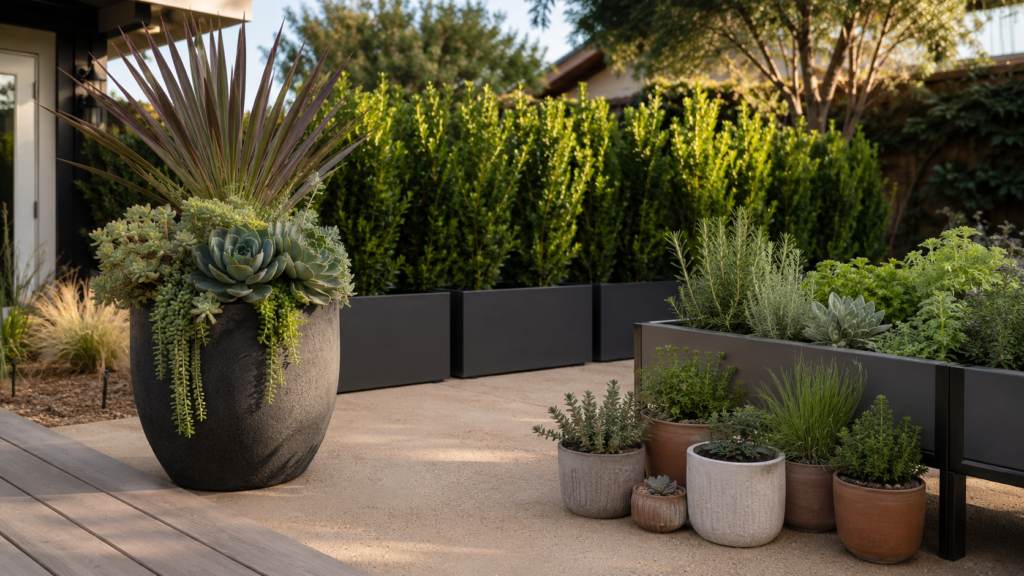
Planters can add privacy, edible plants, height, and specialized soil. They also dry faster than many in-ground beds.
Use large statement containers near patios, trough planters for privacy, raised planters for herbs, and deep containers where the existing soil is unsuitable.
Group pots by water needs. Do not place moisture-loving annuals and drought-adapted shrubs on one irrigation schedule.
Plan Hydrozones and Irrigation Before Planting
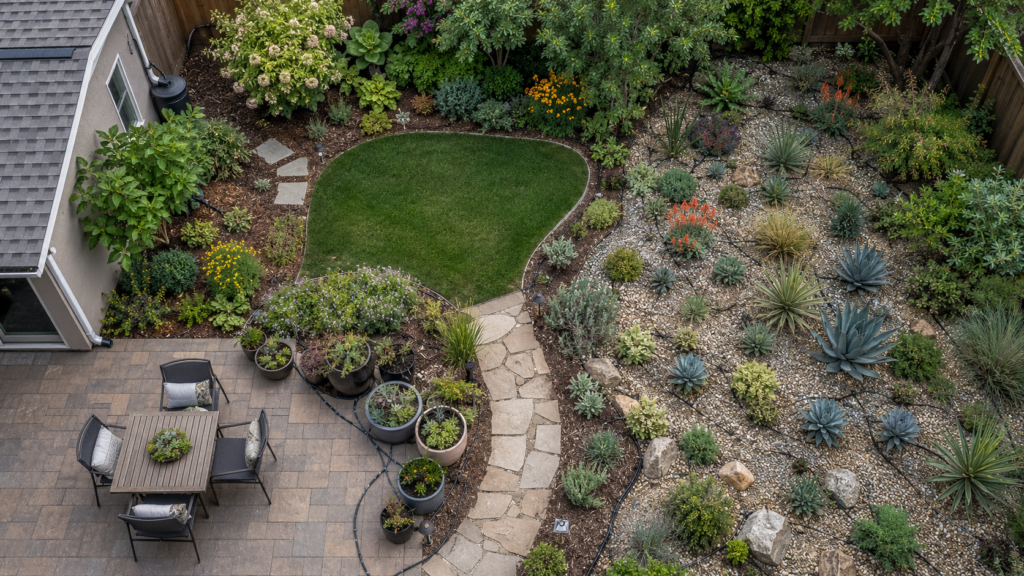
Hydrozoning groups plants by water requirements and site conditions.
- Map downspouts, drains, taps, and wet areas.
- Identify naturally dry and moist zones.
- Create high-, moderate-, and low-water groups.
- Select drip, microirrigation, or another suitable method.
- Water new plants during establishment.
- Reduce and adjust irrigation as plants mature.
Keep lawn, containers, and shrub beds on separate schedules where their needs differ.
Select Mulch and Hardscape Without Creating a Heat Trap
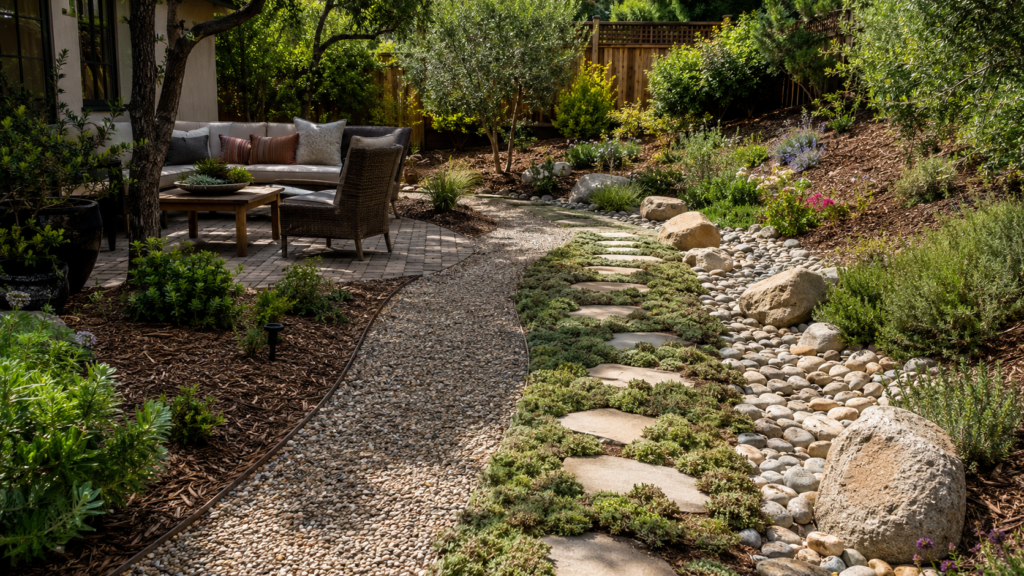
| Material | Best use | Main caution |
|---|---|---|
| Wood chips | Planted beds | Needs replenishment |
| Bark | Slopes | Quality varies |
| Gravel | Paths | Can radiate heat |
| Decomposed granite | Informal routes | Can erode |
| Pavers | Seating | Higher cost |
| Groundcover | Low-traffic areas | Must suit climate |
| Boulders | Structure | Difficult to move |
Use organic mulch where soil protection is important. Keep mulch away from trunks and plant crowns.
Use stone only where it supports access, drainage, seating, or design. Add shade and plants around hard surfaces.
How to Xeriscape a Backyard Step by Step
- Define how the yard will be used.
- Measure boundaries, structures, utilities, and slopes.
- Record sun, wind, soil, and drainage.
- Map water movement.
- Position paths, patios, and activity zones.
- Create hydrozones.
- Select suitable surfaces.
- Prepare soil where necessary.
- Install drainage, hardscape, and irrigation.
- Position trees and large shrubs.
- Add smaller plant layers.
- Apply suitable mulch.
- Water during establishment.
- Evaluate the first year before expanding.
Complete structural and underground work before planting.
When Should You Hire a Professional?
Professional help is advisable when the project involves:
- Water entering a foundation
- Significant grading
- Unstable slopes
- Retaining walls
- Buried utilities
- Gas or electrical work
- Major irrigation systems
- Stormwater changes
- Accessible route construction
- Permit requirements
A hybrid approach works well: hire professionals for drainage, structural work, or irrigation design and complete planting independently.
Common Xeriscaping Mistakes
Avoid these frequent errors:
- Covering the entire yard with gravel
- Choosing plants only by appearance
- Treating drought-tolerant plants as water-free
- Ignoring mature size
- Mixing incompatible water needs
- Removing useful lawn without a replacement
- Installing irrigation after planting
- Directing runoff toward structures
- Using one mulch type everywhere
- Forgetting shade and comfortable access
The correction is usually better planning, not more materials.
How Much Maintenance Does a Xeriscape Backyard Need?
A xeriscape can reduce mowing and unnecessary irrigation, but it is not maintenance-free.
During the first season, monitor:
- Soil moisture
- Plant stress
- Weeds
- Irrigation blockages
- Erosion
- Settled paving
- Mulch movement
- Unexpected runoff
Established yards need seasonal irrigation adjustments, pruning, weed control, mulch replenishment, drainage cleaning, and planter checks.
Use a First-Year Xeriscape Performance Log
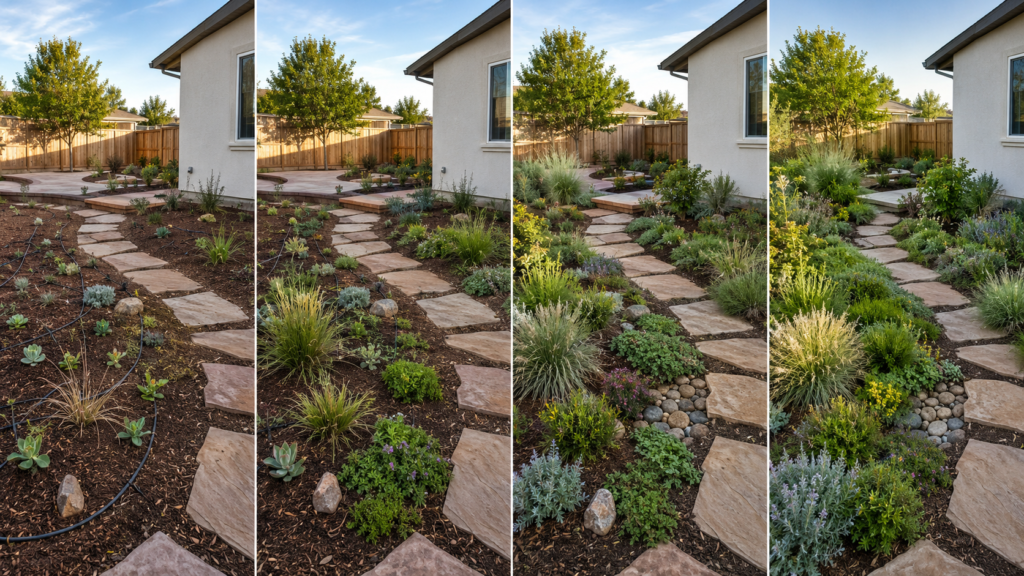
Track these factors monthly:
| Factor | What to record |
|---|---|
| Plants | Healthy, stressed, or failed |
| Soil | Dry, suitable, or saturated |
| Runoff | Puddles, channels, or sediment |
| Heat | Uncomfortable surfaces |
| Irrigation | Leaks or blocked emitters |
| Paths | Shortcuts or avoided areas |
| Spacing | Crowding or large gaps |
| Planters | Drying or instability |
| Maintenance | Actual time required |
Repeat successful plants and materials. Diagnose failure before replacing anything.
Frequently Asked Questions
What is xeriscaping?
Xeriscaping is a landscaping approach that reduces unnecessary irrigation through suitable plants, efficient watering, mulch, healthy soil, and practical hardscape.
Can xeriscaping work in wet climates?
Yes. The design must use plants, drainage, and materials suited to local rainfall and soil conditions.
Can a xeriscape include grass?
Yes. Keep a small climate-suitable lawn when it serves play, pets, exercise, or another useful purpose.
Does xeriscaping require gravel?
No. Xeriscapes can include mulch, flowers, trees, groundcovers, planters, pavers, and limited turf.
Do xeriscape plants need water?
New plants need establishment watering. Suitable mature plants generally require less supplemental irrigation.
Is xeriscaping expensive?
Costs depend on drainage, hardscape, labour, and plant size. Phasing the project and using smaller plants can reduce the initial cost.
Is xeriscaping maintenance-free?
No. It still requires weed control, irrigation checks, pruning, mulch care, and drainage maintenance.
Can xeriscaping make a backyard hotter?
Yes, when excessive unshaded gravel or paving absorbs heat. Use trees, pergolas, planted beds, and limited hardscape.
Choose Your Next Backyard Xeriscape Step
Start with the yard’s biggest limitation:
- Small yard: Add perimeter beds and one main path.
- Paved yard: Add planters and shade.
- Unused lawn: Convert one section first.
- Family yard: Preserve a safe activity surface.
- Hot yard: Create shade before adding stone.
- Slope: Manage water before planting.
- Rental: Use movable planters.
- Low budget: Complete one planned zone at a time.
Define the backyard’s purpose, correct drainage, establish circulation, create hydrozones, and select locally suitable plants. Add planters only where they solve a clear problem.
A successful backyard xeriscape uses water responsibly, supports everyday life, and becomes easier to manage as the landscape matures.

Myra is the founder and lead writer of Backyard Planter Ideas, where she shares practical, well-researched guidance on planter design, plant selection, and outdoor styling. Her goal is to help homeowners create attractive, functional garden spaces with clear, reliable, and easy-to-apply advice.