
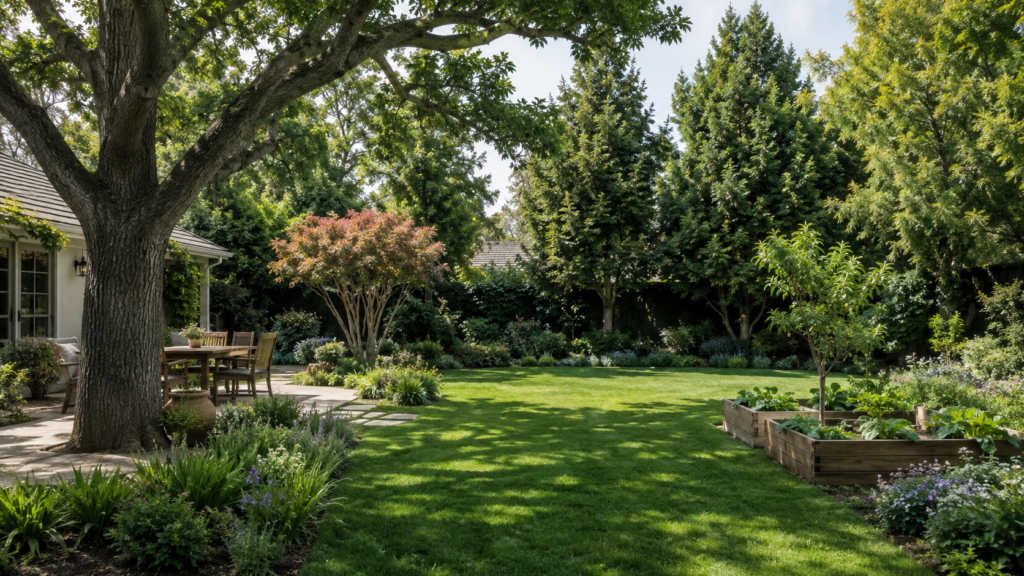
Backyard tree planting ideas work best when every tree has a clear purpose, enough room to mature and growing conditions that match its needs. A well-positioned tree can shade a patio, block an upper-story view, produce fruit, support wildlife or become the main focal point in a compact yard.
Start with function, not appearance. Decide what the tree must do, measure the available space and check mature canopy width, root space, drainage, utilities and maintenance. A young nursery tree may fit almost anywhere, but its mature branches and roots can eventually affect paving, fences, buildings and neighboring plants.
Quick answer: Use a broad deciduous canopy for seasonal patio shade, a raised canopy for upper-window privacy, a compact multi-stem tree for a small yard or dwarf fruit trees for food production. Choose the final location by mature size and local suitability, not nursery size.
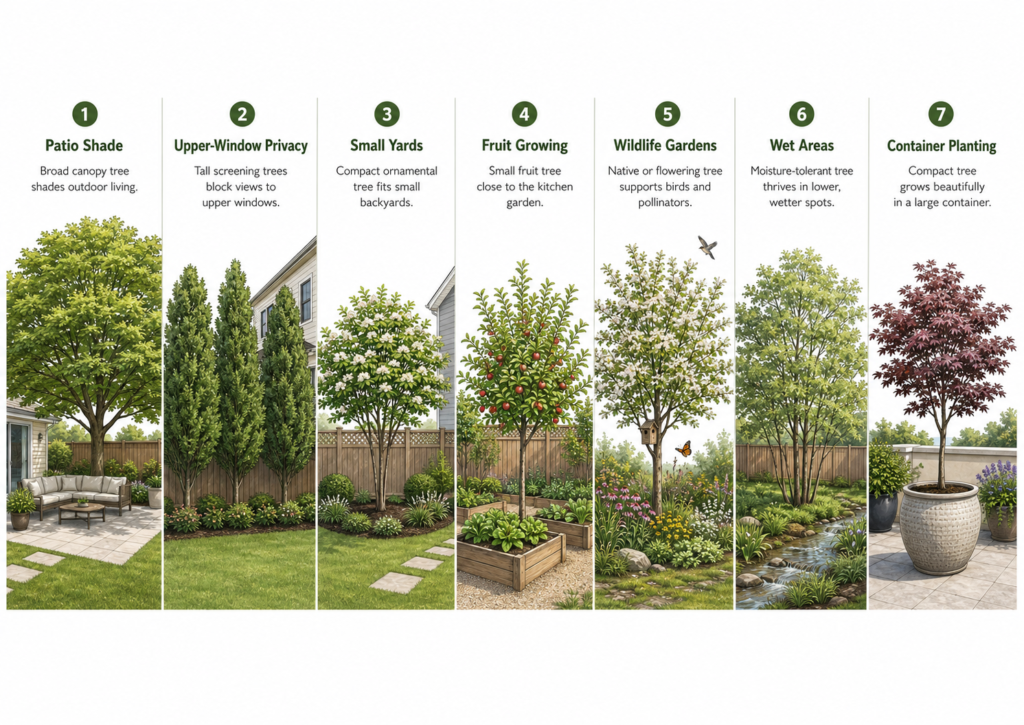
| Main need | Best starting idea |
|---|---|
| Patio shade | Offset canopy tree |
| Upper-window privacy | Targeted viewline tree |
| Narrow space | Columnar tree |
| Small-yard focal point | Multi-stem ornamental tree |
| Fruit | Dwarf orchard or espalier |
| Wildlife | Locally suitable mixed tree cluster |
| Wet area | Rain-garden tree |
| Patio container | Compact container tree |
Which Backyard Tree Planting Ideas Fit Your Yard?
Choose a backyard tree according to the problem you need to solve. A broad canopy may suit a sunny patio, while a narrow upright form can add height beside a path without consuming much width. A compact fruit tree can make a small yard productive, whereas one correctly placed canopy may block an elevated view more efficiently than a full boundary screen.
The location should come before the species. Measure the planting zone, observe sunlight and drainage, and identify nearby structures, utilities and access routes. Once the site is understood, choose a locally suitable tree with the correct mature form.
| Goal | Best arrangement | Tree form | Main risk |
|---|---|---|---|
| Patio shade | One offset tree | Broad canopy | Paving and litter |
| Upper-window privacy | Targeted tree | Raised canopy | Wrong foliage height |
| Boundary screening | Staggered mix | Upright trees and shrubs | Overcrowding |
| Small-yard impact | One focal tree | Compact or multi-stem | Excessive spread |
| Fruit production | Mini orchard or espalier | Dwarf or semi-dwarf | Pollination and pruning |
| Wildlife | Mixed cluster | Native or compatible trees | Local suitability |
Before buying, rank the tree’s primary function, maximum width, canopy height, seasonal behavior, maintenance and conflict risk.
Choose the tree that fits at maturity and solves the main problem with the fewest compromises.
How We Evaluated the Ideas
Each layout was judged by purpose, mature footprint, rooting space, access, climate adaptability, maintenance, seasonal value and safety. Stronger ideas solve the main problem while adding a secondary benefit, such as privacy plus summer shade, without requiring repeated corrective pruning.
Use the same test before planting:
- Does the tree solve the intended problem?
- Can its canopy and roots mature without conflict?
- Can you maintain it realistically?
- Will the layout still work in ten years?
Decision rule: Prefer ideas that fit at maturity, suit local conditions and deliver more than one useful benefit.
Plan Your Tree Layout
Draw a simple overhead plan showing the house, patio, fences, gates, paths, drains, utilities, existing trees and areas that must remain open. Represent each proposed tree by its mature canopy, not by a small trunk symbol.
Include walking routes, views from the home and possible future changes such as a shed, pool or larger patio. Mark areas that must remain sunny, privacy targets, utilities, water collection and maintenance routes.
Use the 10-Year Footprint Test
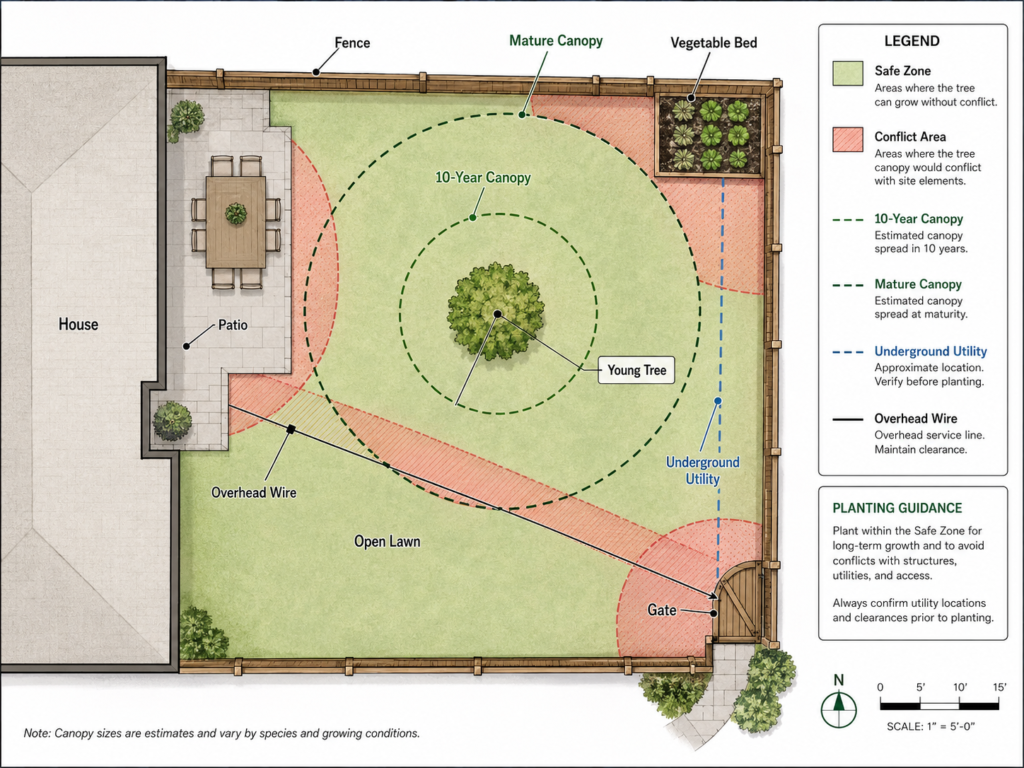
Mark the tree’s expected canopy width on the ground with rope, flags or a garden hose. Stand inside and outside the circle and check whether it overlaps:
- Roofs, walls or gutters
- Paths, patios or pools
- Overhead wires
- Underground services
- Vegetable beds needing sun
- Gates and maintenance routes
- Neighboring trees or property
- Play or lawn areas
Roots may extend beyond the canopy, but the circle still exposes obvious conflicts.
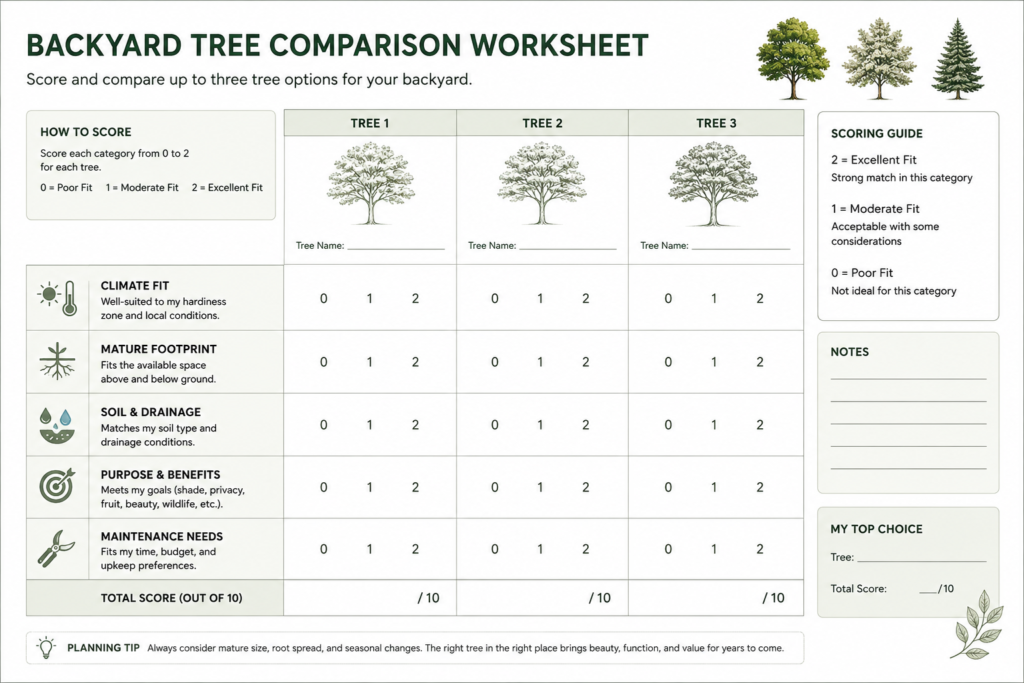
Calculate a Tree Fit Score
Score each candidate from zero to two.
| Factor | 0 | 1 | 2 |
|---|---|---|---|
| Climate fit | Poor | Tolerable | Naturally suitable |
| Mature footprint | Major conflict | Tight | Comfortable fit |
| Soil and drainage | Unsuitable | Improvement needed | Compatible |
| Purpose | Weak | Partial | Direct solution |
| Maintenance | Excessive | Manageable | Good match |
8–10: Strong candidate
5–7: Reconsider the cultivar or location
0–4: Choose another tree
A compact deciduous tree may outperform a broad evergreen when it screens summer views without creating permanent winter shade.
Map Sun, Wind and Water
Observe morning, midday and afternoon sun, wind and drainage. Avoid universal compass rules because site orientation and hemisphere change the ideal position.
Decision rule: Approve a location only when the mature canopy, root space, access and intended function all work together.
Tree Layouts by Yard Size
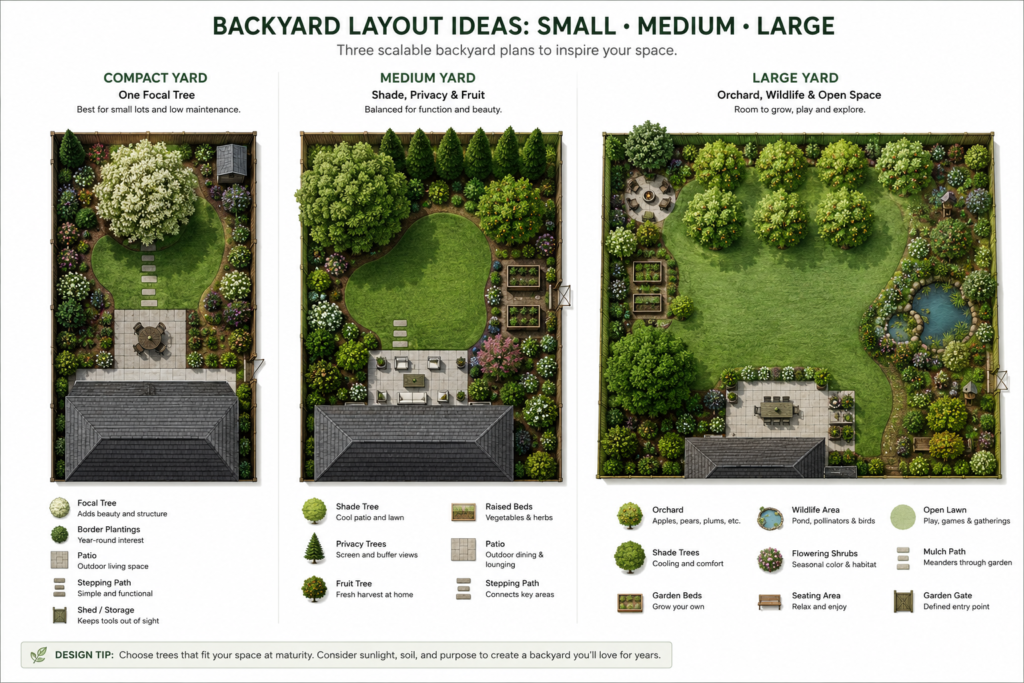
Backyard size determines how many trees can mature without crowding. Exact spacing must follow the chosen cultivars’ mature widths.
Compact Yard
Use one main tree as the visual anchor.
- One compact multi-stem or vase-shaped tree
- Low planting around the base
- Open central circulation
- Narrow boundary shrubs
- One container tree only when extra height is needed
Medium Yard
Separate tree functions.
- One patio shade tree
- One targeted privacy tree
- One compact fruit or ornamental tree
- Open lawn, seating or play space
- Clear access beside fences
Large Yard
Create connected zones.
- A canopy tree near the main activity area
- A mixed privacy grove
- A mini orchard
- A wildlife cluster
- Open lawn or meadow between groups
Backyard Tree Planting Ideas for Shade
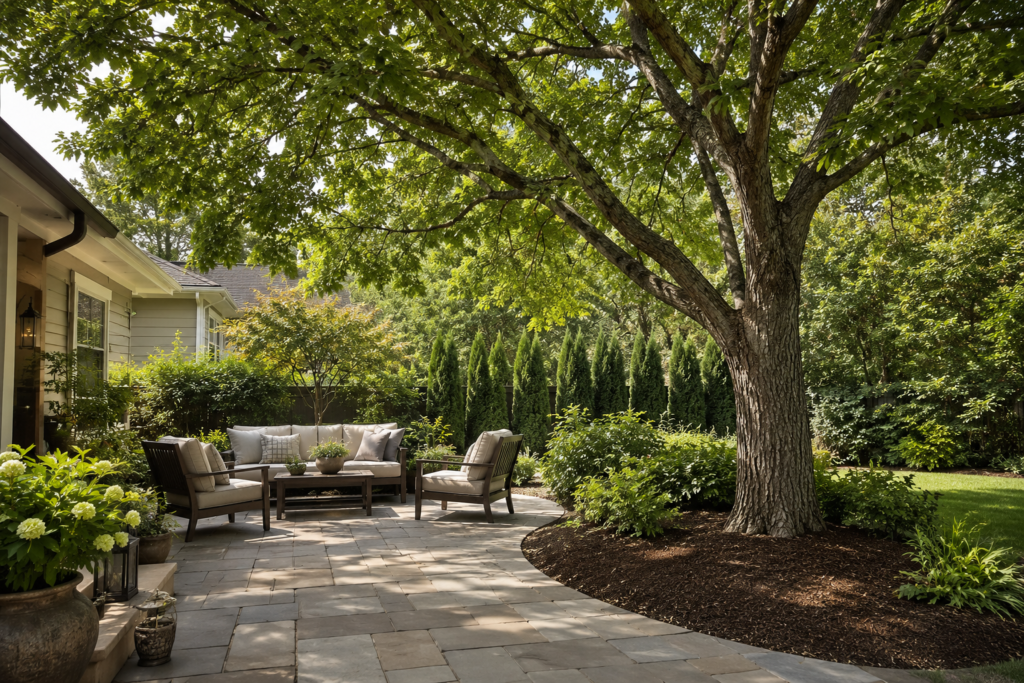
Shade trees improve comfort when their trunks, roots and litter do not interfere with the space below.
1. Shade a Patio With an Offset Tree
Plant the tree beside the patio rather than inside it. The canopy can extend over seating while the trunk and root flare remain in open soil.
A deciduous tree can provide summer shade and winter light. Avoid brittle branches, surface-root conflicts and heavy fruit drop near paving.
2. Create a Tree-Covered Dining Area
Use one broad tree or two smaller trees to define an outdoor dining room. Keep trunks outside the furniture footprint and leave room for chairs, umbrellas and lighting.
3. Build a Bench Retreat
Place a bench beneath or just beyond a flowering or multi-stem tree. This works well at the end of a path, beside a pond or in an unused corner.
Use permeable gravel, stepping stones or mulch rather than tight paving around the trunk.
4. Frame a Conversation Area
Plant two compact trees on opposite sides of a seating circle. Their trunks create vertical boundaries while the canopies provide filtered enclosure.
Keep trees away from grills, fire pits and heat sources, and use low plants underneath to preserve openness.
Backyard Tree Planting Ideas for Privacy
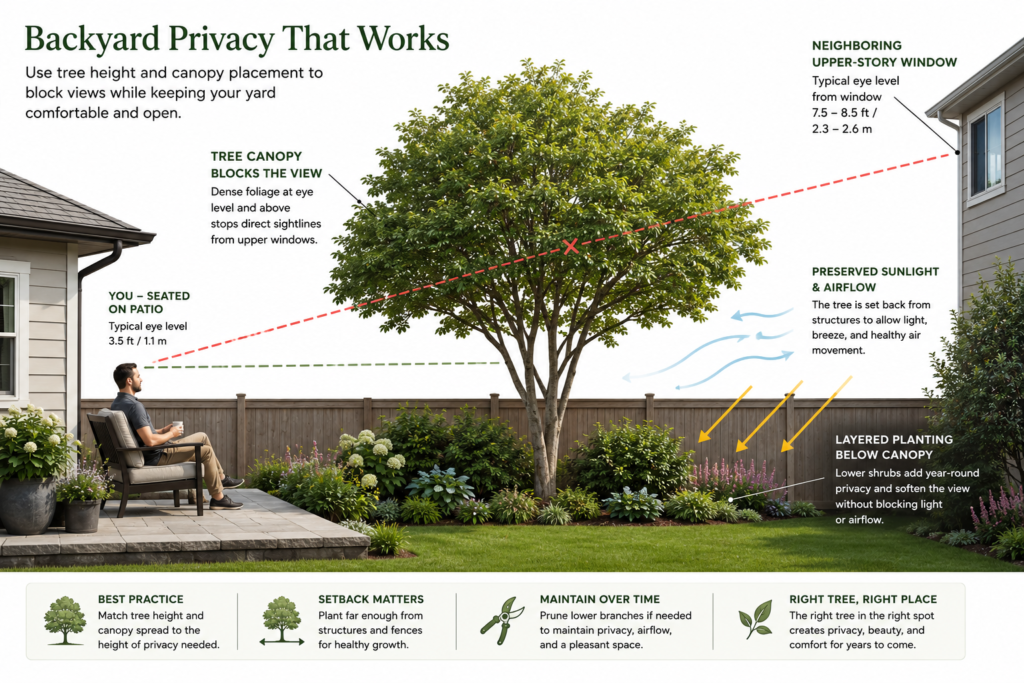
Privacy planting should block the actual viewline rather than cover every boundary automatically.
5. Use the Targeted Viewline Method
Sit where privacy matters and look toward the unwanted window. Use a pole or marker to identify the location and height where foliage must interrupt the sightline.
A raised canopy may block the window while preserving light and airflow below.
6. Plant a Mixed Privacy Screen
Combine trees and shrubs in staggered rows.
- Upright trees for height
- Evergreen shrubs for year-round mass
- Flowering shrubs for seasonal interest
- Perennials or grasses at the front
Space plants by mature width and use temporary fillers instead of crowding permanent plants.
7. Block an Upper Window
Choose a tree whose mature canopy crosses the elevated viewline. A full hedge may create unnecessary shade from the ground upward.
Use a temporary trellis, pergola panel or container planting while the tree develops.
8. Create a Woodland Boundary
In a deep rear border, combine taller trees, smaller understory trees, shrubs and groundcovers. This provides privacy, habitat and seasonal variation.
Do not force a layered woodland design into a narrow strip. Keep access to the fence and use locally appropriate plants.
Small Backyard Tree Planting Ideas
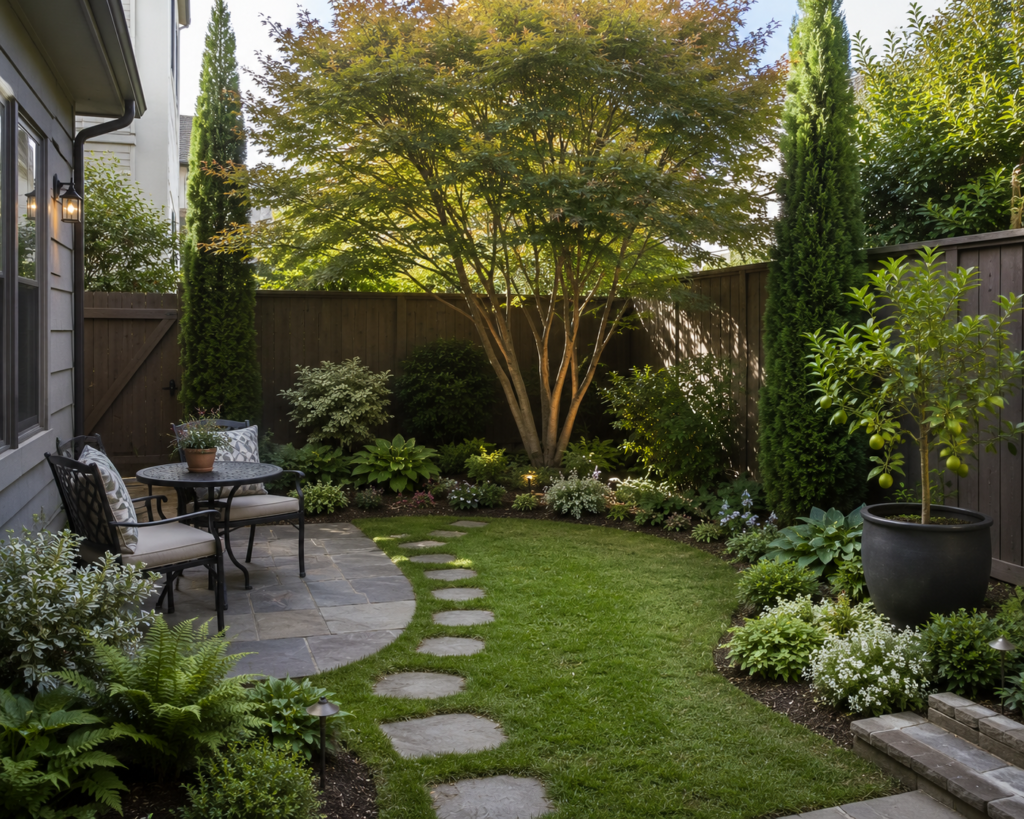
Small yards need controlled forms, predictable mature size and careful placement.
9. Use One Multi-Stem Tree
A multi-stem tree provides sculptural trunks, filtered shade and a broad visual presence without always reaching the height of a large shade tree.
Keep nearby planting low so the stems remain visible.
10. Add a Columnar Tree
Columnar trees add height with a relatively narrow canopy. Use them beside gates, paths or tall walls.
Confirm the exact cultivar’s mature width because “columnar” does not mean permanently pencil-thin.
11. Soften a Rear Corner
Plant a compact tree slightly inward from where two fences meet. This softens hard boundaries and can make the yard feel deeper.
Leave room for the trunk flare, branches and fence maintenance.
12. Create a Central Tree Island
Use one tree to organize the yard. Surround it with a curved or geometric bed that is easy to walk or mow around.
Keep companion planting low during establishment and expand the bed as the canopy grows.
13. Grow a Container Tree
Container trees add height, foliage or fruit where in-ground planting is impossible.
Use a stable, well-drained container with adequate root volume and plan for watering and repotting.
Trees for Food and Wildlife
Food and wildlife trees add value, but their placement must allow harvesting, pruning and cleanup.
14. Build a Mini Orchard
Plant two to four compact fruit trees near a vegetable garden, along a boundary or around a narrow path.
Check:
- Rootstock and mature size
- Pollination compatibility
- Chill or heat requirements
- Disease resistance
- Harvest season
- Support and pruning needs
Dwarf fruit trees still require care and may need permanent support.
15. Train an Espalier
Espalier trees grow in a controlled two-dimensional form along wires or a frame. They are useful where a full canopy would occupy too much width.
Install the support before planting and expect regular tying and pruning.
16. Mix Fruit and Ornamental Trees
Place a productive tree near the kitchen and an ornamental tree where it creates the best view or shade.
This keeps fallen fruit and harvesting activity away from the main entertaining area.
17. Create a Wildlife Cluster
Use regionally native or ecologically compatible trees that flower, fruit or provide shelter at different times.
Check local invasive status before creating habitat for pollinators, birds and other wildlife.
Trees for Difficult Areas
Select trees for the site’s moisture, heat and wind conditions before considering appearance.
18. Plant Beside a Rain Garden
Choose a tree that tolerates alternating wet and dry periods. Place it near the edge or upper part of the rain garden unless it can handle prolonged saturation.
Do not use a tree to hide a drainage problem near a building.
19. Build a Drought-Responsive Guild
Combine one climate-adapted tree with shrubs, perennials and groundcovers that have similar water needs.
Use a broad mulch zone and expandable drip irrigation. Keep thirsty turf away from the trunk.
20. Frame a Path
Use two coordinated trees to mark an entrance, rear gate or transition between garden areas.
Allow enough branch and trunk clearance for people, wheelbarrows and equipment.
21. Choose a Four-Season Tree
Select a specimen with at least two or three lasting features:
- Spring flowers
- Summer shade
- Fruit or wildlife value
- Autumn color
- Attractive bark
- Evergreen foliage
- Winter structure
Check thorns, brittle branches, staining fruit and large seed pods before planting near paths or play areas.
Choose Trees for Climate and Soil
Climate, soil, pests and invasive-species rules vary widely, so choose by function and local suitability rather than universal species lists.
| Condition | Prioritize | Avoid |
|---|---|---|
| Cold winters | Proven hardiness | Tender trees |
| Hot, dry summers | Heat and drought tolerance | Moisture-demanding trees |
| Humid climate | Disease resistance | Dense disease-prone forms |
| Coastal exposure | Wind and salt tolerance | Brittle, salt-sensitive trees |
| Heavy clay | Slower-drainage tolerance | Trees needing sharp drainage |
| Sandy soil | Drought tolerance | Constant-moisture species |
| Small urban yard | Compact mature form | Large forest trees |
| Wildlife garden | Local ecological value | Invasive species |
Confirm the full botanical name and cultivar. For grafted fruit trees, identify the rootstock because it affects mature size and support needs.
Before buying, verify:
- Local climate suitability
- Mature regional size
- Soil and drainage compatibility
- Invasive status
- Common pests and diseases
- Boundary or tree-protection rules
- Utility clearance
- Water restrictions
Use function-based substitution. Ask a local nursery for “a non-invasive deciduous privacy tree under four metres wide” rather than relying only on a species suggested for another country.
Where to Plant a Backyard Tree
A strong location provides enough soil, suitable light, drainage, canopy space and access. Review it from windows, doors, patios and paths before planting.
Check permanent features:
- House walls and foundations
- Patios and pools
- Fences and retaining walls
- Gates and paths
- Drains and utilities
- Existing trees
Contact the local utility-marking service before digging. House clearance depends on mature size, soil, foundations and local conditions; no universal distance fits every tree.
Inspect a Tree Before Buying
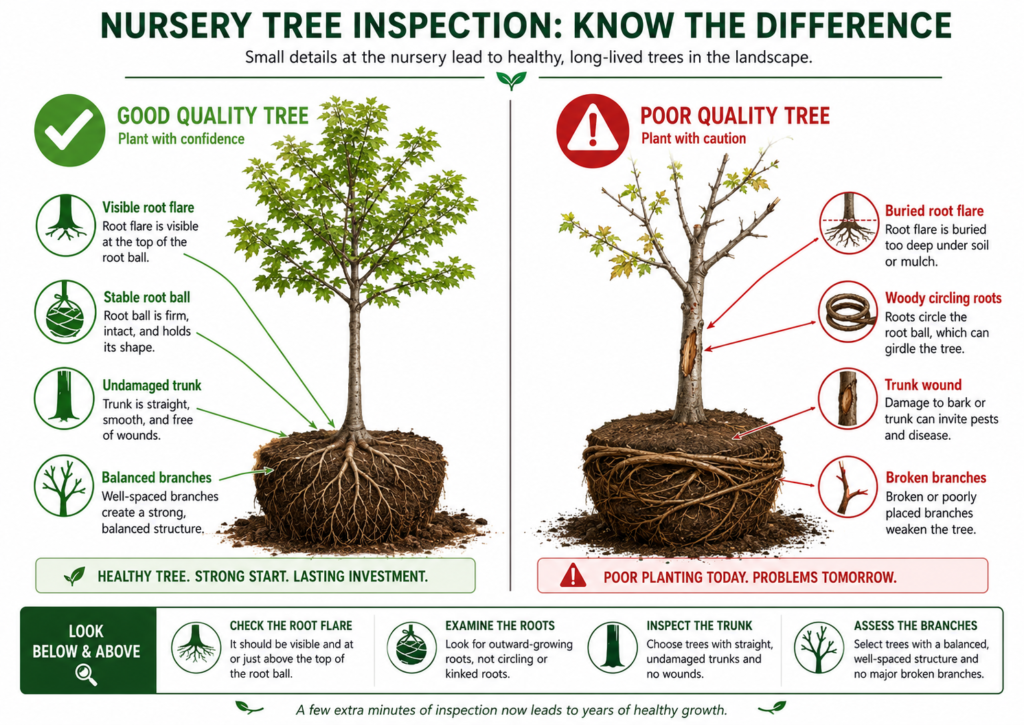
Trees with the same label may differ in root and structural quality, so inspect the actual specimen.
Inspect:
- Root flare visibility
- Major circling roots
- Root-ball stability
- Trunk cracks or wounds
- Broken or tightly crossing branches
- Widespread pest or disease symptoms
- Moist but not waterlogged roots
| Observation | Decision |
|---|---|
| Minor flexible surface roots | Usually manageable |
| Major woody circling roots | Reject or seek advice |
| Severe trunk wound | Reject |
| Missing cultivar label | Avoid for restricted sites |
| Loose root ball | Reject |
| Healthy form and visible flare | Strong candidate |
How to Plant a Backyard Tree
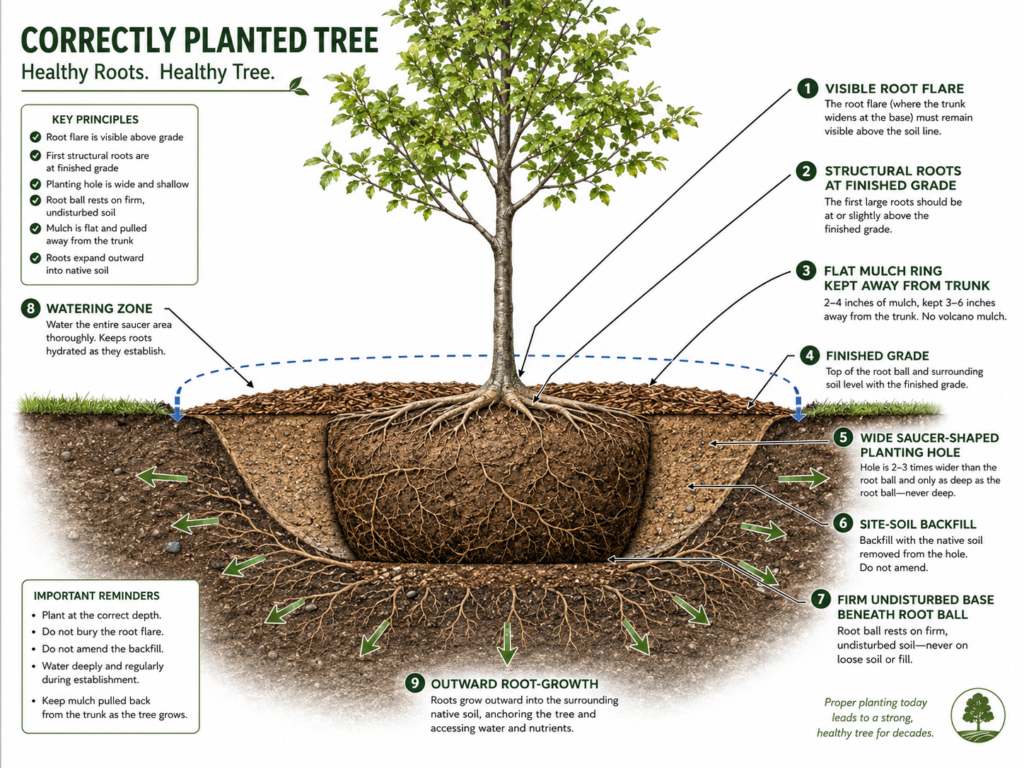
Correct planting keeps the root flare visible and encourages outward root growth.
- Find the root flare. Remove excess soil until the first structural roots are visible.
- Measure the root ball. Use the distance from its base to the flare as the hole depth.
- Dig wide, not deep. Make a broad, saucer-shaped hole, commonly two to three times wider than the root ball where practical.
- Inspect the roots. Correct manageable circling or matted roots before planting.
- Set the tree correctly. Place the root ball on firm soil with the flare visible at finished grade.
- Backfill with site soil. Avoid filling the hole with rich potting mix.
- Water thoroughly. Moisten the root ball and surrounding soil slowly.
- Apply flat mulch. Use roughly 2–3 inches, keeping it away from the trunk.
- Stake only if needed. Support an unstable tree with flexible ties and remove them after establishment.
- Delay heavy pruning. Remove only dead, broken or unsafe branches initially.
Correct buried flares, instability or severe circling roots before backfilling.
Watering and First-Year Care
Newly planted trees need consistent moisture, but watering frequency depends on rainfall, heat, wind, soil and drainage. Check both the root ball and surrounding soil because they may dry at different rates.
| Period | Main task |
|---|---|
| Planting day | Water slowly and check drainage |
| Days 2–14 | Check root-ball moisture frequently |
| Weeks 3–8 | Adjust watering to weather |
| Months 2–4 | Maintain mulch and remove weeds |
| Months 4–6 | Expand the watering area |
| End of season | Review staking and trunk condition |
| Start of year two | Reassess stability and growth |
Watch for:
- Buried root flare
- Mulch against bark
- Rocking root ball
- Standing water
- Dry root ball
- Leaf scorch
- Yellowing in wet soil
- Tight staking ties
- Trunk damage
Water according to observed moisture, not a rigid calendar.
Tree Planting Mistakes
Avoid these common selection, placement and planting errors:
- Choosing by nursery size instead of mature size
- Planting too deeply
- Creating a mulch volcano
- Digging a deep, narrow hole
- Filling the hole with potting mix
- Planting one species everywhere
- Ignoring utilities
- Leaving turf against the trunk
- Choosing speed over structural quality
- Blocking fence or drain access
- Using species advice without local verification
- Planting messy fruit trees over paving
Relocate or replace trees that will always require severe pruning or restricted roots.
Final Tree Planting Checklist
Before planting, confirm:
- The tree solves one clear landscape need.
- Mature height and width fit the site.
- Soil and drainage are compatible.
- Important light and views remain protected.
- Utilities and access routes are clear.
- Local climate and invasive status are verified.
- Watering and maintenance are realistic.
- The nursery tree has a healthy root system and trunk.
- The root flare can remain visible.
- Mulch will stay away from the bark.
Do not plant until the tree, location and maintenance plan all receive a clear approval.
Backyard Tree FAQs
What is the best tree for a backyard?
The best tree suits your local climate, soil, space and main goal. Compare mature height, width and maintenance before buying.
How many trees should I plant?
Plant only as many as the yard can support at mature size. One well-positioned tree is often better than several crowded trees.
How far should a tree be from a house?
There is no universal distance. Consider mature size, soil, root space and foundation conditions, and seek local advice for large trees.
Which trees suit small yards?
Compact cultivars, multi-stem trees, dwarf fruit trees and columnar forms are usually practical. Verify the exact cultivar’s mature dimensions.
What tree arrangement gives the best privacy?
Use one targeted canopy for an upper-window view or a staggered mixture of trees and shrubs for broader screening.
How deep should a tree be planted?
Plant it so the root flare remains visible at finished grade. Do not rely automatically on the container soil line.
How often should a new tree be watered?
Check the root ball and surrounding soil, then water when they begin to dry. Adjust for rainfall, heat, wind and drainage.
Can fruit trees grow in containers?
Yes, compact fruit trees can grow in large, well-drained containers with reliable watering, feeding and root management.

Myra is the founder and lead writer of Backyard Planter Ideas, where she shares practical, well-researched guidance on planter design, plant selection, and outdoor styling. Her goal is to help homeowners create attractive, functional garden spaces with clear, reliable, and easy-to-apply advice.