Backyard planter ideas with rocks combine raised beds or outdoor containers with gravel, river rock, crushed stone, natural stone, flagstone, or boulders. The best designs use rock for paths, edging, structure, visual contrast, or selective surface mulch while keeping enough quality soil inside the planter for healthy roots.
A successful design should look attractive and remain practical once plants mature. Planters need adequate soil volume, drainage must stay unobstructed, paths should be comfortable to use, and rock coverage should suit the climate. Rocks should support the growing system rather than compete with it.
Which Backyard Planter Ideas With Rocks Work Best?
The strongest designs give rock a clear purpose instead of covering every empty area with stone. One consistent material usually looks better than several unrelated rock types.
1. Raised Vegetable Beds With Gravel Paths
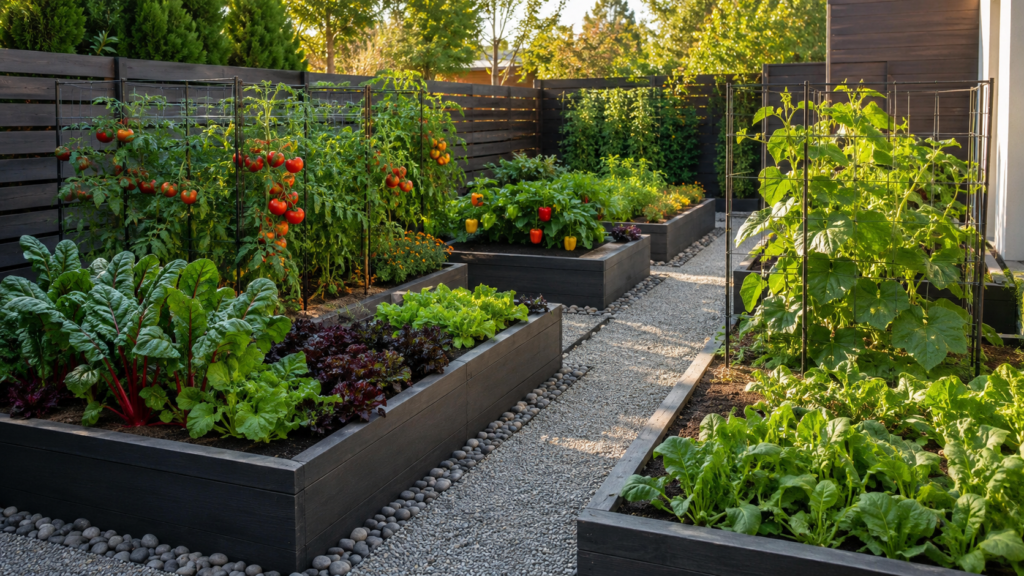
Gravel between wood, metal, or stone raised beds creates defined walking space while keeping foot traffic away from productive soil.
This works especially well in vegetable gardens because watering, harvesting, pruning, and carrying tools become easier when paths stay clean and accessible.
2. Wooden Planters With River-Rock Borders
Rounded river rock softens the straight edges of cedar or timber beds.
Use a narrow border so the plants remain the main feature.
3. Dark Planters With Light Gravel
Black or charcoal planters paired with pale gray or beige gravel create a clean contemporary look.
Tomatoes, peppers, Swiss chard, herbs, and trellised cucumbers provide enough foliage to soften the hardscape.
4. Galvanized Beds With Crushed Stone
Angular crushed stone works naturally with metal beds.
Timber trellises or edging can prevent the layout from feeling overly industrial.
5. Natural-Stone Raised Planters
Stone can form the actual planter walls.
These permanent beds work well for:
- herbs
- strawberries
- leafy vegetables
- peppers
- compact tomatoes
- ornamental edibles
6. Gravel Courtyards With Grouped Planters
One gravel surface can visually connect several containers in a small backyard.
Place taller tomato or cucumber planters toward the back and lower herb or lettuce containers toward the front.
7. Stepping Stones Through Gravel
Flagstone or pavers can provide stable walking points through a loose gravel surface.
8. Large Planters With Boulder Accents
One substantial boulder often creates more impact than several small decorative stones.
9. Rock Top-Dressing for Herbs
A light gravel surface can suit rosemary, thyme, sage, and similar herbs where climate and moisture conditions are appropriate.
10. Mixed Edible and Ornamental Rock Gardens
Peppers, Swiss chard, herbs, lettuce, and compact tomatoes can be combined with ornamental plants for an attractive edible landscape.
Best rule: choose plants first, planter dimensions second, layout third, and decorative rock last.
What Is the 5-Factor Rock + Planter Test?
Before repeating a design throughout the backyard, evaluate it using five factors.
1. Roots
Does the planter provide enough:
- depth
- width
- length
- total soil volume?
2. Drainage
Can excess water leave freely through drainage holes or the underlying soil?
3. Heat
Will dark rock, dark planter walls, paving, and strong afternoon sun create excessive heat?
4. Access
Can you comfortably:
- water
- prune
- harvest
- weed
- inspect irrigation?
5. Maintenance
Can you realistically manage:
- weeds
- leaves
- moving gravel
- edging
- irrigation repairs?
A good combination should perform well in at least four of these five areas before it is repeated across the garden.
What Is the Best Planter and Rock Layout?
Start with function.
Divide the backyard into four zones:
- Growing zone: planters and raised beds
- Access zone: paths
- Transition zone: edging and rock borders
- Focal zone: feature containers, boulders, or seating
Place crops according to sunlight and mature size. Tall tomatoes and cucumber trellises can shade shorter vegetables, while squash leaves and tomato branches may extend into paths.
Do not judge walking space when plants are young.
Before installing rock, stand where each planter will go and imagine yourself:
- watering it
- pruning it
- harvesting it
- carrying compost to it
If a wall, fence, boulder, or neighboring planter makes those tasks awkward, adjust the layout before installation.
Decision: growing conditions first, access second, decorative stone third.
Which Rocks Are Best Around Planters?
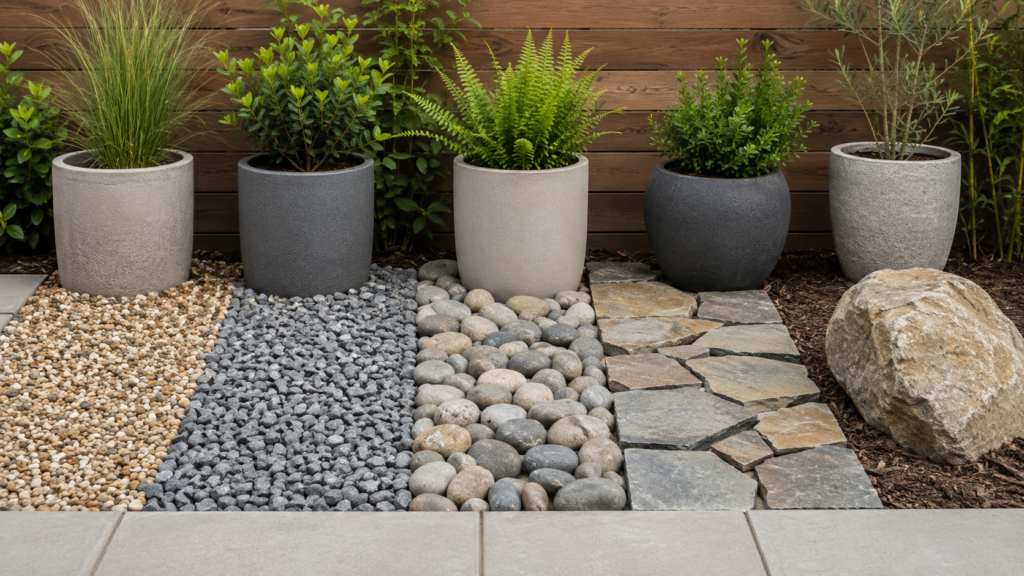
Different rock types perform different jobs.
Pea Gravel
Useful for informal paths and small backyard gardens. Its rounded particles look soft but can shift underfoot.
Crushed Stone
Better for structured paths where a firmer surface is preferred.
River Rock
Best for decorative borders and patio transitions rather than heavily used walkways.
Decomposed Granite
Creates a finer surface that suits modern gardens.
Fieldstone
Ideal for rustic edging and natural-stone planter construction.
Flagstone
Useful for stepping routes and stable walking points through gravel.
Boulders
Best used as occasional focal elements.
A simple selection guide:
- paths: compactable gravel or crushed stone
- borders: river rock
- rustic walls: fieldstone
- stepping routes: flagstone
- focal areas: boulders
What Rock Size Works Best?
Use smaller stone for repeated surfaces such as paths, medium stone for edging, flat stone for stepping routes, and boulders only where they have a clear visual or structural purpose.
Choose rock by function first and appearance second.
How Do You Choose the Right Rock Color?
Match rock color to permanent backyard materials such as paving, fencing, the house exterior, deck, and planter walls.
Reliable combinations include:
- dark planter + light gravel
- cedar planter + gray river rock
- galvanized planter + warm beige stone
- light concrete planter + charcoal accents
Avoid mixing too many stone colors in a small garden.
Climate also matters. Large areas of dark rock exposed to strong sun can create hotter conditions around planters.
Before ordering, place a sample beside the planter and view it in morning and afternoon light.
One dominant rock color plus one limited accent is usually enough.
How Do You Use Gravel Around Raised Beds?
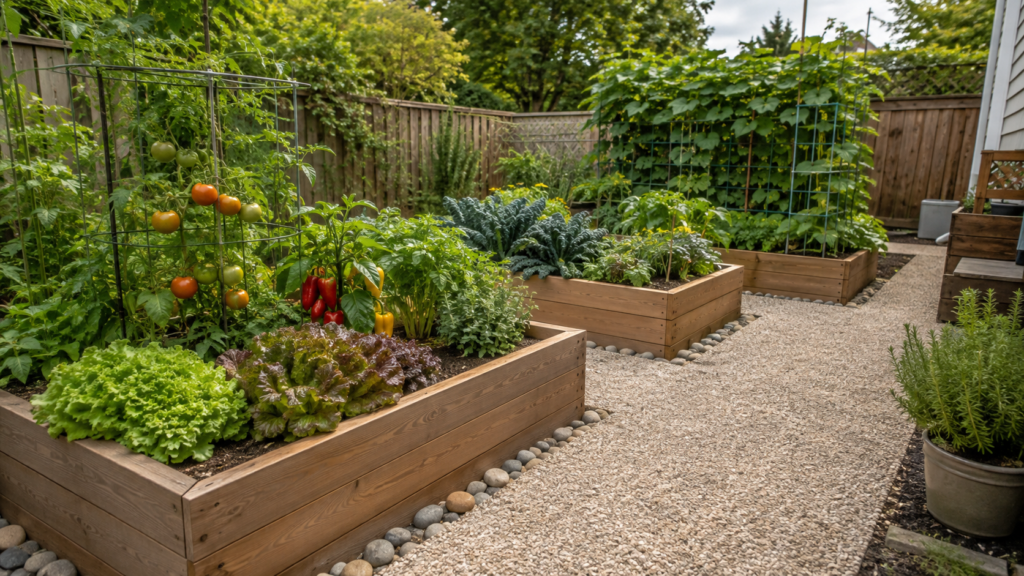
Gravel works best outside the growing area as a circulation surface.
Before installation:
- remove established weeds
- level obvious low areas
- identify standing-water problems
- mark planter locations
- plan irrigation
- install edging where needed
Keep the roles separate:
Gravel = walking area
Growing mix = root zone
Edging helps prevent gravel from spreading into lawns, patios, and productive soil.
Even well-installed gravel requires occasional:
- weed removal
- leaf cleanup
- raking
- edging repair
- small top-ups
Rock landscaping is lower-maintenance than some alternatives, but it is not maintenance-free.
How Much Rock Do You Need Around Planters?
Calculate rock quantity from the area being covered and the intended depth.
Rock volume = surface area × installed depth
For a rectangular path:
length × width × depth = volume
Measure each area separately:
- central path
- side paths
- planter borders
- patio transitions
Then combine the totals.
Because density and compaction vary, convert the calculated volume using the units provided by your supplier.
Before ordering, confirm:
- rock type
- particle size
- intended depth
- total area
- delivery access
Calculate volume before comparing prices.
Is Gravel, Mulch, or Paving Better?
The best surface depends on how the space will be used.
Gravel is useful for defined walking routes and reducing mud.
Organic mulch works well where a softer appearance, moisture conservation, and cooler surface conditions are priorities.
Pavers provide the most stable route where access and frequent use matter.
A practical garden can combine materials:
- gravel between beds
- organic mulch inside suitable growing areas
- stepping stones or pavers at high-traffic points
River rock is usually better as decorative edging than as the main walking surface.
Decision: use each material where it performs best.
Do Rocks Make Vegetable Planters Too Hot?
They can.
Heat becomes more important when several conditions occur together:
- dark gravel
- black planters
- concrete paving
- reflective walls
- full afternoon sun
- small soil volume
Reduce the risk by:
- using lighter stone
- limiting total rock coverage
- choosing larger planters
- monitoring soil moisture
- using organic mulch where appropriate
- providing afternoon protection for sensitive crops
A large wooden planter beside pale gravel behaves very differently from a small black pot surrounded by dark rock against a west-facing wall.
Judge the entire microclimate, not the rock alone.
Should You Put Rocks in the Bottom of Planters?
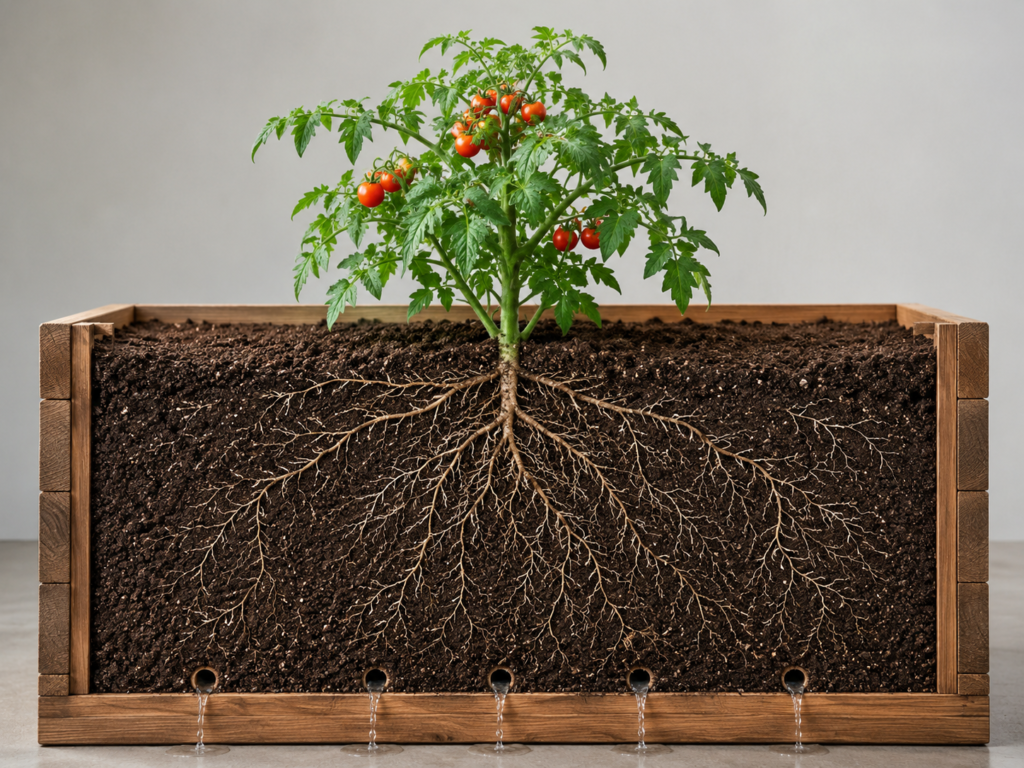
No. Do not place a thick gravel layer beneath potting mix simply to improve drainage.
Although the idea sounds logical, water does not automatically move from fine-textured growing media into a coarse rock layer as gardeners often expect. A saturated zone can remain above the gravel.
The rock also reduces usable root space.
For most vegetable planters, prioritize:
- unobstructed drainage holes
- suitable growing medium
- sufficient root volume
- appropriate watering
If soil falls through a large drainage opening, use a permeable screen instead.
Use rocks around the planter for landscaping. Use the inside primarily for roots and growing medium.
Can Raised Beds Sit Directly on Gravel?
Yes, in many situations.
An existing gravel surface beneath a raised bed is different from deliberately adding gravel inside the bed as a drainage layer.
Before installing the bed, check:
- what lies beneath the gravel
- whether water collects after rain
- whether the bed is open-bottom or closed-bottom
- whether enough productive soil depth remains
- whether the structure sits level
Existing gravel does not count as growing depth.
A raised bed in a gravel courtyard may perform well when enough soil is added and runoff has somewhere to go.
Existing gravel beneath a bed ≠ gravel added inside the bed for drainage.
What Soil Is Best for Outdoor Planters?
The surrounding rock does not change what roots need.
A useful growing medium should balance:
- aeration
- drainage
- moisture retention
- nutrients
- root support
Small containers generally perform better with a mix intended for container growing than with dense garden soil alone.
Larger raised beds may use suitable combinations of topsoil, compost, and other amendments according to local conditions.
Do not reduce productive soil volume by filling the lower part of a normal vegetable planter with decorative stone.
Choose soil according to the crop and planter, not the surrounding hardscape.
Can You Put Rocks on Top of Planter Soil?
Yes, but rock mulch is not ideal for every plant.
It works particularly well with:
- rosemary
- thyme
- sage
- oregano
- succulents
- drought-tolerant ornamentals
Organic mulch may be more suitable around vegetables that benefit from cooler soil and stronger moisture conservation.
Do not pile stones tightly against plant stems or crowns. Leave enough space to inspect the plant base, check moisture, and service irrigation.
Use rock top-dressing because it suits the plant, not simply because the pathway contains gravel.
What Vegetables Grow Best in Rock Planter Gardens?
The surrounding rock does not determine crop suitability. Planter size, soil, sunlight, water, and nutrients matter more.
Tomatoes
Use substantial soil volume and strong support.
Peppers
Their compact form works well in structured gardens.
Cucumbers
Grow vertically to keep vines out of paths.
Carrots and Beets
Provide loose soil with adequate depth.
Swiss Chard
Colorful stems make it useful for edible landscaping.
Lettuce
Works well in shallower beds and around taller crops where light remains suitable.
Compact Squash
Choose bush varieties where paths are close.
For larger fruiting crops, think about both depth and horizontal root space.
Which Herbs Work Best With Rock Planters?
Herbs pair naturally with stone because their foliage softens the hard landscape.
Good choices include:
- rosemary
- thyme
- sage
- oregano
- parsley
- basil
Rosemary, thyme, sage, and oregano work especially well in Mediterranean-style designs.
Basil usually prefers more consistent moisture, so group herbs by watering needs as well as appearance.
A practical combination is:
rosemary + sage + thyme
with basil grown separately when irrigation requirements differ.
How Do You Use Rocks in a Small Backyard?
Small gardens benefit from fewer materials and stronger repetition.
Use:
- matching planters
- one main gravel type
- vertical crops
- clear paths
- intentional open space
A simple layout might include:
- tomato planter against a fence
- cucumber trellis beside it
- pepper planter next
- herb container toward the front
Connect the area with one gravel strip rather than several unrelated patches.
Vertical growing is particularly useful for cucumbers, pole beans, and supported tomatoes.
Small-space success comes from useful root volume and vertical growth, not from maximizing container count.
How Do You Create a Modern or Rustic Rock Planter Garden?
For a modern garden, use:
- simple rectangular planters
- neutral gravel
- limited colors
- clean edging
- repeated materials
- simple trellises
A strong modern palette might combine charcoal planters, pale gray gravel, warm timber fencing, and green foliage.
For a rustic garden, use:
- cedar
- weathered timber
- fieldstone
- river rock
- irregular flagstone
Allow herbs and leafy vegetables to soften edges.
The style can be informal, but paths, bed stability, and irrigation should remain functional.
How Do You Irrigate Planters Surrounded by Gravel?
Plan irrigation before installing the final rock layer.
Locate:
- taps
- timers
- valves
- main lines
Keep fittings accessible so repairs do not require removing large quantities of gravel.
Drip irrigation works well because water is directed into the planter rather than across the pathway.
Different beds may need different schedules. Cucumbers often need more consistent moisture than Mediterranean herbs, while small containers dry faster than larger beds.
Install the water system before finishing the decorative rock.
How Do You Prevent Weeds in Gravel?
Gravel reduces exposed soil but does not eliminate weeds.
Seeds can germinate in:
- dust
- spilled potting mix
- decomposing leaves
- organic debris
Reduce problems by:
- removing weeds before installation
- keeping soil inside planters
- cleaning fallen leaves
- maintaining edging
- pulling seedlings early
Landscape fabric may help separate gravel from native soil in dedicated paths, but weeds can still develop above it.
Regular light maintenance is usually easier than removing established weeds later.
What Rock Planter Mistakes Should You Avoid?
Avoid these common mistakes:
- Adding gravel beneath soil for drainage
- Using excessive dark stone in strong sun
- Making paths too narrow
- Choosing rock before selecting crops
- Mixing too many rock colors
- Blocking drainage outlets
- Assuming gravel eliminates weeds
- Using planters with too little root volume
- Blocking harvesting or irrigation access
- Ignoring local climate
Before installing rock, ask:
- Is there enough soil?
- Can water leave?
- Will heat become a problem?
- Can I reach every planter?
- Can I maintain the paths?
Does Planter Width Matter More Than Depth?
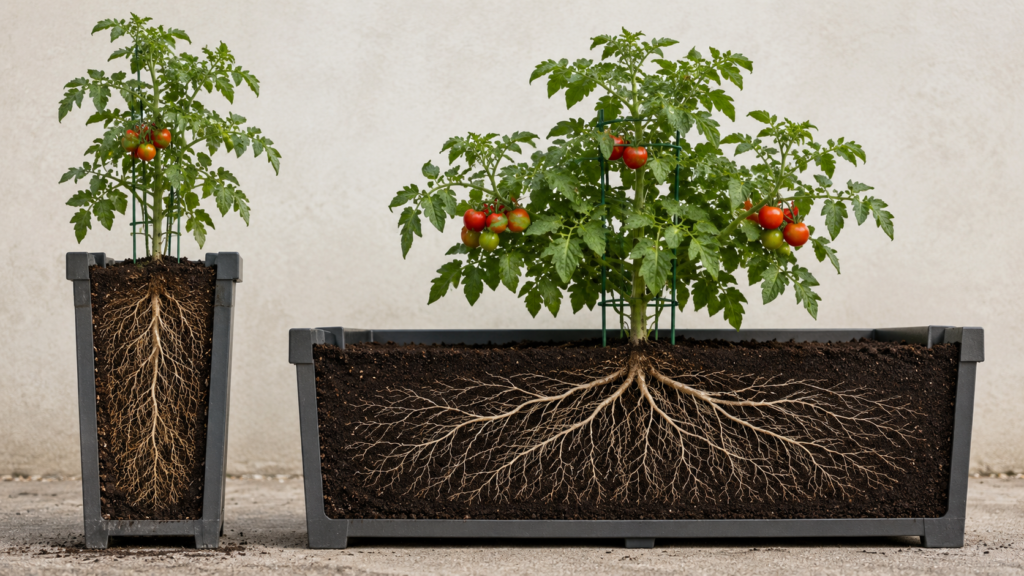
Depth matters, but it should not be considered alone.
Roots occupy three-dimensional space:
depth × width × length = usable soil volume
A very tall but narrow planter may provide less useful soil than a moderately deep planter that is substantially wider.
Greater width can provide:
- broader root spread
- more moisture reserve
- greater temperature stability
- room for multiple plants
Large crops such as tomatoes, cucumbers, peppers, eggplants, and squash generally benefit from generous overall soil volume.
Provide sufficient depth, then maximize practical horizontal root space.
What Is the Easiest Rock Planter Layout to Copy?
For most backyards, start with three productive beds.
Planter 1: Tomatoes
Use a substantial planter with sturdy support.
Planter 2: Peppers and Herbs
Combine compact crops with compatible watering needs.
Planter 3: Cucumbers and Greens
Train cucumbers vertically and use lower areas for suitable leafy vegetables.
Create one consistent gravel route around the beds.
Add only limited decorative elements such as:
- a narrow river-rock border
- stepping stones
- one focal boulder
This layout works because:
plants use soil
people use paths
rocks define the paths
repeated materials unify the garden
For a smaller backyard, use two beds. For a larger garden, repeat the same module.
How Do You Build a Rock Planter Garden?
Follow this order:
- Measure the backyard.
- Observe sunlight.
- Choose crops.
- Select planter dimensions.
- Position tall plants and trellises.
- Plan comfortable paths.
- Choose one primary rock material.
- Correct drainage problems.
- Prepare edging and path surfaces.
- Install planters and irrigation.
- Add decorative rock.
- Plant and monitor the garden.
Do not buy large quantities of stone before confirming planter dimensions and circulation space.
Heavy rock is much easier to install correctly the first time than to move later.
How Do You Choose the Best Backyard Planter Ideas With Rocks?
Review the backyard as one system.
Ask:
What will you grow?
Identify mature plant size, support needs, and sunlight requirements.
Is there enough root space?
Check depth, width, and total soil volume.
Can excess water leave?
Keep drainage openings clear and observe runoff.
What job will the rock perform?
Is it a:
- path
- border
- mulch
- planter wall
- focal point?
Will heat become a problem?
Consider rock color, container color, sunlight, and paving together.
Can the garden be maintained?
You should be able to water, harvest, weed, and repair irrigation without moving large stones.
Will it still work when plants mature?
Imagine tomato branches, cucumber vines, squash leaves, hoses, tools, and harvest baskets in the space.
Choose the design that balances healthy roots, drainage, manageable heat, comfortable access, and realistic maintenance.
Frequently Asked Questions
Are rocks good around raised garden beds?
Yes. Rocks work well for pathways, borders, and decorative areas around raised beds. Keep them outside the main growing soil unless intentionally used as suitable surface mulch.
What kind of rock is best around raised beds?
Small gravel or crushed stone is useful for paths, while river rock is better for decorative borders. Select material according to function and stability.
Is pea gravel good around raised beds?
Yes. Pea gravel creates attractive paths and reduces mud, although edging helps keep the rounded stones contained.
Should you put rocks in the bottom of a planter?
No. A gravel layer does not improve drainage as commonly assumed and reduces usable root space. Use suitable growing mix and unobstructed drainage holes.
Can raised beds sit directly on gravel?
Yes, in many situations, provided the site drains adequately and enough productive soil is added.
Do rocks make vegetable planters hotter?
They can. Stone absorbs heat, so lighter rock, adequate soil volume, and careful irrigation are helpful in hot sunny locations.
Do rocks stop weeds?
No. Gravel reduces exposed soil, but weeds can still germinate in debris that accumulates between stones.
Can vegetables grow in planters surrounded by rocks?
Yes. Success depends mainly on planter size, soil, sunlight, water, nutrients, and drainage.
How much gravel do you need around planters?
Calculate surface area × installed depth to estimate rock volume, then convert it to the units used by your supplier.
What is the lowest-maintenance rock planter design?
Use a few substantial planters, one consistent gravel material, clear edging, and easy irrigation access.
What Are the Most Important Final Tips?
The best backyard planter ideas with rocks make the landscape and growing system support one another.
Use rock primarily for:
- paths
- edging
- structural walls
- focal accents
- suitable surface mulch
Preserve planter volume for roots, design paths for mature plants, and use one dominant rock type instead of several unrelated materials.
Watch heat where dark stone, dark containers, paving, and strong afternoon sun occur together.
Keep drainage outlets open and plan irrigation before finishing the rock surface.
When uncertain, install the garden in this order:
- planters
- irrigation
- paths
- edging
- decorative stone
The most useful relationship to remember is:
Plants occupy productive soil → planters organize roots → paths organize people → rocks define and connect the spaces.
When those elements work together, backyard planters with rocks become attractive, practical, and productive rather than simply decorative.
Myra is the founder and lead writer of Backyard Planter Ideas, where she shares practical, well-researched guidance on planter design, plant selection, and outdoor styling. Her goal is to help homeowners create attractive, functional garden spaces with clear, reliable, and easy-to-apply advice.