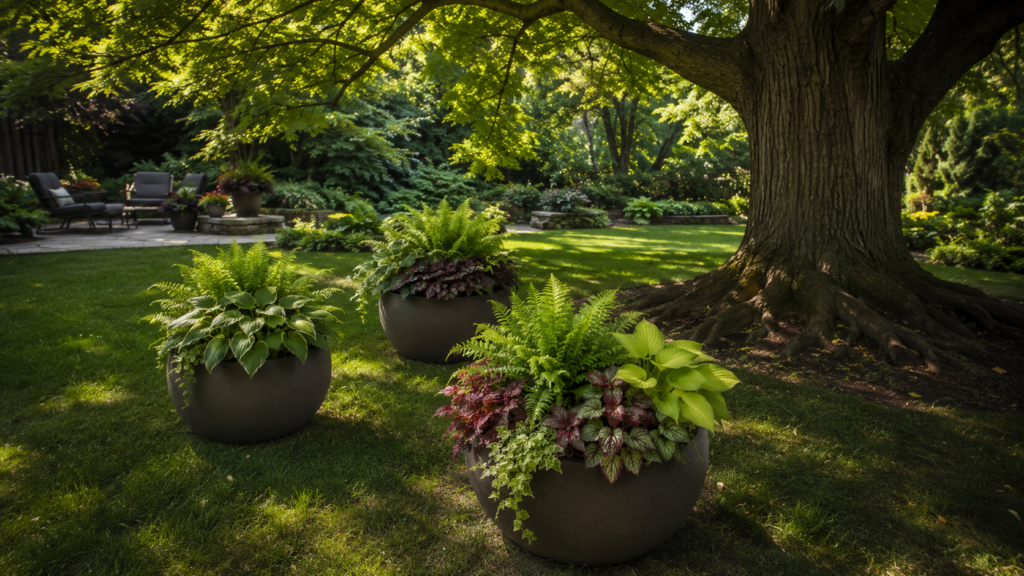
Backyard planter ideas under trees work best when containers solve the problems created by shade, surface roots, limited rainfall, and difficult soil. Freestanding pots give plants their own growing space without extensive digging around an established tree, while also giving you better control over drainage, watering, soil, and seasonal placement.
For most backyards, one to three well-sized containers are enough to create a strong design. Keep the trunk and root flare visible, choose plants for the actual summer shade level, and use foliage as the main feature where flowering is limited. The goal is not to fill every inch beneath the canopy. It is to create an attractive container garden that works with the tree.
Planters Under Trees: Quick Guide
Conditions can change quickly beneath one mature tree. The area near the trunk may be dark and dry, while the canopy edge receives brighter filtered light and more rainfall. Tree roots can also make direct planting difficult, which is why containers are often such a useful solution.
| Condition | Best Approach | Main Priority |
|---|---|---|
| Dappled shade | Grouped pots | Flowers + foliage |
| Moderate shade | Medium or large pots | Consistent moisture |
| Deep shade | Fewer large pots | Foliage plants |
| Dry shade | Larger containers | Moisture monitoring |
| Exposed roots | Freestanding pots | Protect roots |
| Bright canopy edge | Troughs or flower pots | Watch heat |
| Small backyard | Statement pot or trio | Preserve space |
| Large tree | Separated groups | Keep trunk visible |
Before choosing a design, check four things:
- Light: How much summer light reaches the area?
- Roots: Can the pot sit without damaging or covering roots?
- Moisture: Is the location dry, average, or damp?
- Access: Can you easily water and maintain the planter?
These four factors should guide every later decision.
Check the Space First
Study the area before buying plants. Look at it during the morning, midday, and afternoon, preferably after the tree has developed its full canopy. Early spring conditions beneath deciduous trees can be much brighter than summer conditions.
Think of shade in simple levels:
- Dappled shade: Moving patches of sunlight
- Partial shade: Several hours of usable light
- Moderate shade: Mostly indirect light
- Deep shade: Very little direct sunlight
Dappled and partial shade support the widest range of plants. Deep shade is usually better for foliage than flower-heavy designs.
Moisture also matters. Tree canopies can intercept rainfall while established roots use moisture from the surrounding soil. The result may be dry shade, even when the area feels cool.
Canopy type changes the conditions too. Dense evergreen foliage can create strong year-round shade, while deciduous trees may be bright in spring and much darker in summer. High, open canopies generally offer better opportunities for flowering planters than low, dense canopies.
Finally, inspect the tree itself. Avoid designs that require cutting major roots, burying exposed roots, raising the soil level, or covering the root flare.
4-Factor Planter Test
Use the Backyard Planter Ideas 4-Factor Test before placing a large pot beneath a tree.
1. Light
Choose plants for the amount of usable summer light.
If flowering plants repeatedly stretch, weaken, or produce few blooms, the location may be too dark. Move the container toward the canopy edge rather than forcing the plant to struggle.
2. Roots
A suitable location should not require:
- Major root cutting
- Deep excavation
- Soil piled around the trunk
- Root flare burial
Move the planter instead of altering the tree.
3. Moisture
Decide whether the location is dry, average, or damp.
Larger pots generally provide more stable moisture conditions than many tiny decorative containers.
4. Access
You should be able to water, inspect, prune, clean, and repot the container without difficulty.
Excellent Fit: All four factors work naturally.
Good Fit: One minor limitation is manageable.
Conditional: Extra maintenance is needed.
Skip: The setup risks damaging the tree or gives plants unsuitable conditions.
15 Backyard Planter Ideas Under Trees
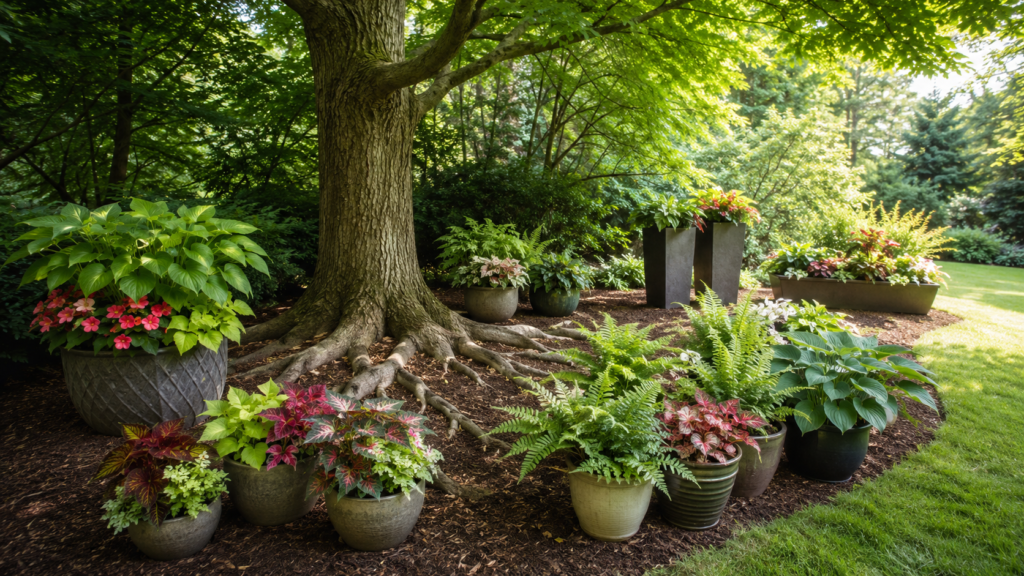
1. Large Statement Pot
One generous container can make a stronger impact than several small pots. Position it slightly away from the trunk and use bold foliage in deeper shade or flowers and foliage where filtered light is available.
Best for: Small gardens and simple layouts.
2. Three-Pot Cluster
Use one large anchor pot, one medium supporting planter, and one smaller accent container.
Vary the heights and repeat one material, color, or plant type. This is one of the easiest designs to adjust if light conditions change.
Best for: Most backyards.
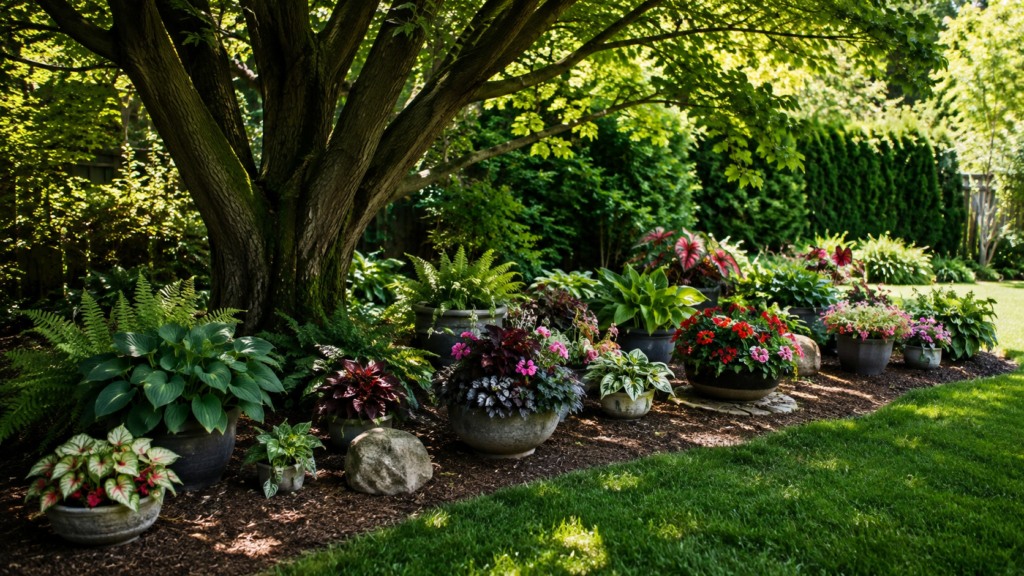
3. Crescent Planter Group
Arrange three to five containers along one side of the tree instead of making a complete ring.
A crescent keeps the trunk visible and works particularly well when the tree is mainly viewed from a patio, window, or garden path.
4. Fern Woodland Pots
Ferns create a natural woodland look without extensive planting among tree roots.
Mix upright and arching forms in terracotta, stone-effect, dark ceramic, or other muted containers.
Best for: Moderate to deep shade.
5. Hosta Container Group
Hostas provide strong leaf shape and color in suitable climates.
Instead of using identical plants, combine different leaf sizes or tones. A broad blue-green hosta can look especially attractive beside lighter foliage.
6. Heuchera Color Pots
Heuchera can provide green, lime, bronze, burgundy, purple, or silver foliage.
Use lighter leaves to brighten dark corners and deeper tones for contrast with pale containers.
7. Seasonal Flower Pots
Use seasonal flowers where enough filtered light reaches the area.
Begonias and other locally suitable shade or part-shade plants can add temporary color without requiring you to disturb the ground.
8. Tall-and-Trailing Planter
Create several visual layers in one pot:
- Upright plant
- Mounding foliage
- Trailing edge plant
Choose plants with compatible light and moisture requirements.
9. Matching Path Planters
Place two coordinated containers beside a nearby path or entrance into the shaded area.
Matching pots create order while keeping the space around the trunk open.
10. Canopy-Edge Trough
A rectangular trough near the outer canopy often receives more light and rainfall than a container near the trunk.
Position it beside a patio, fence, path, or low wall. Check whether strong afternoon sun reaches the site before choosing plants.
11. Pots on Stands
Stable outdoor stands can add height without changing the soil level around the tree.
Use them for smaller containers that would otherwise disappear beneath larger foliage.
12. Woodland Container Collection
Group ferns, hostas, heuchera, and other compatible shade plants in coordinated containers.
Limit the number of pot finishes so the foliage remains the main feature.
13. Modern Minimalist Planters
Use two or three large cylinders, cubes, or tapered containers.
Repeat one plant or foliage style for a clean architectural effect.
14. Moveable Seasonal Pots
Light beneath deciduous trees changes throughout the year.
Lightweight planters or wheeled caddies allow you to move plants toward brighter conditions or protect tender plants when necessary.
15. Bench-and-Planter Corner
Turn the natural shade into a useful destination.
Place a bench or outdoor chair outside the main root flare area, then add two or three planters nearby.
Best for: Backyards where the tree can become a relaxing seating area.
Best Choices by Situation
- Small space: Large statement pot
- Most flexible: Three-pot cluster
- Large mature tree: Crescent grouping
- Deep shade: Fern or foliage display
- Changing light: Moveable containers
- Brighter canopy edge: Long trough
Best Planters for Under Trees
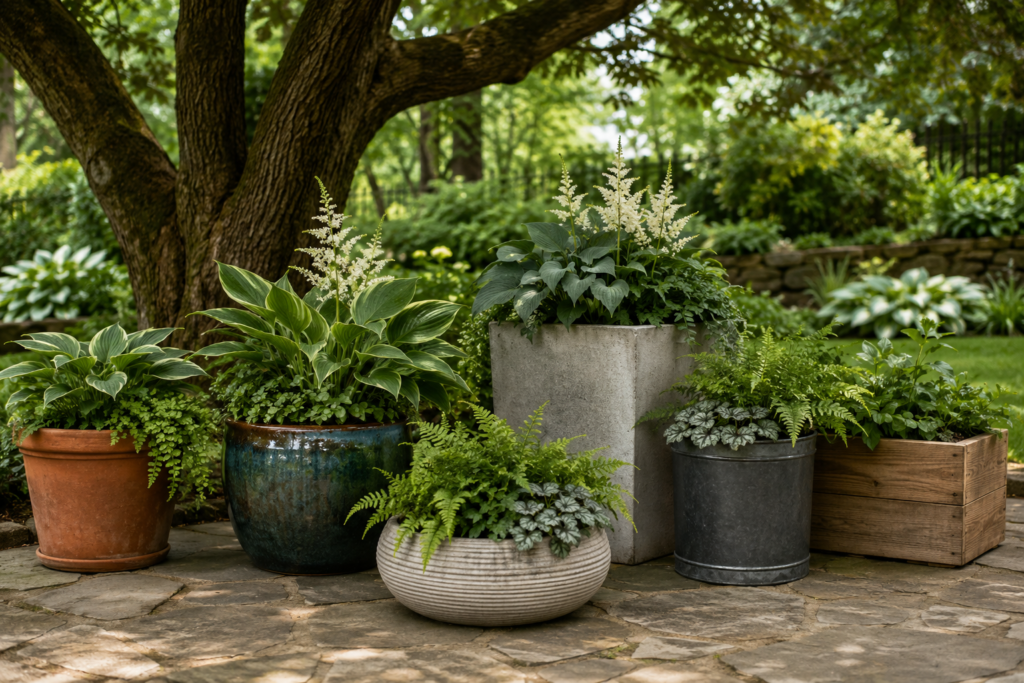
Choose a planter for the mature plant, site conditions, climate, and long-term maintenance—not simply because it looks attractive at the nursery.
| Material | Best Use | Main Benefit | Watch For |
|---|---|---|---|
| Terracotta | Cottage/woodland | Natural appearance | Dries faster |
| Glazed ceramic | Statement pots | Decorative | Heavy |
| Resin | Large displays | Lightweight | Quality varies |
| Concrete | Permanent designs | Stable | Very heavy |
| Metal | Modern gardens | Clean profile | Temperature changes |
| Wood | Natural settings | Warm appearance | Rot/durability |
Think of container sizes by role:
- Accent planter: Small finishing element
- Supporting planter: Medium container in a group
- Anchor planter: Largest visual container
Before buying, check drainage holes, mature plant size, filled weight, stability, winter durability, root clearance, watering access, and whether the pot may need to be moved later.
Functional drainage is essential. A decorative outer pot without drainage is better used with a draining inner nursery pot than as a permanently waterlogged container.
Best Plants for Under-Tree Pots
The best plant is one that matches the light, moisture, climate, mature size, and container conditions.
“Shade tolerant” alone is not enough.
Foliage Plants
Useful options include:
- Hostas
- Suitable ferns
- Heuchera
- Brunnera
- Shade-tolerant sedges
Foliage is especially valuable in deeper shade because it provides interest without relying on flowers.
For stronger combinations, mix:
- Broad and fine leaves
- Dark and light foliage
- Upright and mounding forms
Flowering Plants
Begonias and other locally appropriate shade or part-shade plants can add seasonal color.
Use more flowers in brighter dappled shade and rely increasingly on foliage as the shade becomes deeper.
Trailing Plants
Trailing foliage softens the edge of a planter. Choose varieties with similar light and moisture requirements to the plants sharing the pot.
Small Shrubs
Compact shrubs can work in large containers when their mature size, winter hardiness, shade tolerance, and root requirements are suitable.
Choose the plant for the site first, then choose its container.
Easy Under-Tree Plant Combos
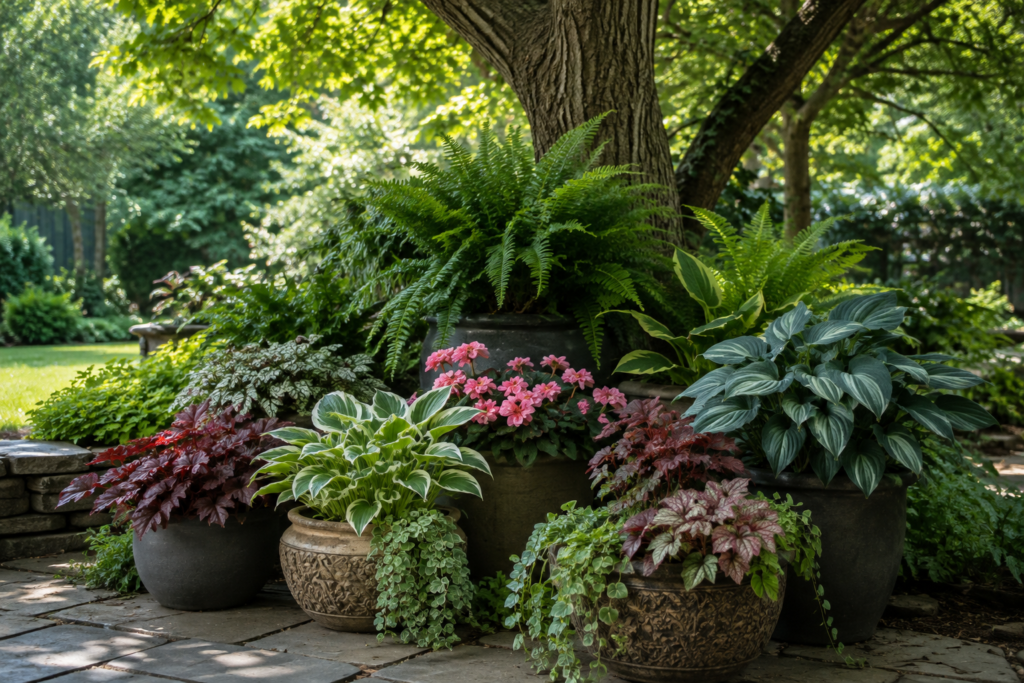
Keep combinations simple and make sure the plants need similar conditions.
Deep-Shade Foliage Pot
Combine:
- Upright fern
- Broad-leaved hosta
- Compatible low foliage plant
This design depends on leaf shape and texture rather than blooms.
Dappled-Shade Color Pot
Try:
- Compact foliage plant
- Shade-tolerant flowering plant
- Compatible trailing foliage
Use this where the canopy provides enough filtered light.
Dry-Shade Pot
Use fewer, tougher plants in a generous container. Suitable dry-shade ferns and locally adapted foliage plants are usually more practical than moisture-demanding flowers.
Minimalist Pot
One healthy fern, hosta, heuchera, or other suitable foliage plant in a strong container can look better than an overcrowded mixture.
If two plants need very different amounts of light or water, grow them in separate coordinated pots.
Dry Shade vs. Dappled Shade
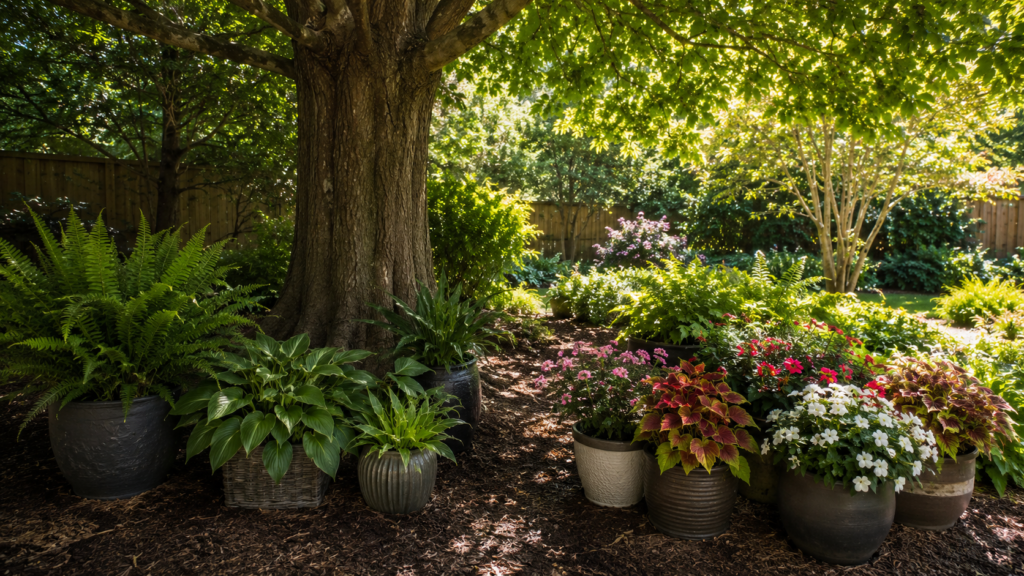
Shade is only half the decision. Moisture also determines which plants and planters will work.
| Condition | Best Strategy | Priority |
|---|---|---|
| Dappled + moderate moisture | Mixed flowers and foliage | Balanced watering |
| Dappled + dry | Larger pots | Moisture checks |
| Deep + moderate moisture | Foliage pots | Avoid overwatering |
| Deep + dry | Simple tough foliage | Consistency |
| Bright edge | Flowering containers | Watch heat |
| Damp shade | Freely draining pots | Drainage |
Dappled shade usually provides the widest selection.
Dry shade favors larger pots and tougher plants.
Deep shade benefits from foliage color, texture, and form.
Damp shade still requires good drainage.
The simplest rule is: more usable light allows more flowers; deeper shade calls for stronger foliage.
How to Arrange and Style Planters
Start with the main viewing direction from the patio, house, path, or seating area.
One reliable formula is:
Large anchor + medium support + small accent + open space.
Vary the pot heights rather than lining up identical containers.
Repeat at least one visual element:
- Container material
- Pot color
- Plant type
- Foliage color
- Flower color
Leave enough empty space for the trunk and roots to remain visible. The tree should always be the largest visual element.
A few larger containers usually look more polished than many unrelated small pots. Limit the palette to two or three related finishes such as terracotta and warm stone, charcoal and concrete, or cream ceramic and natural clay.
Keep paths clear and allow enough room for the plants at mature size.
Protect Tree Roots and Trunks
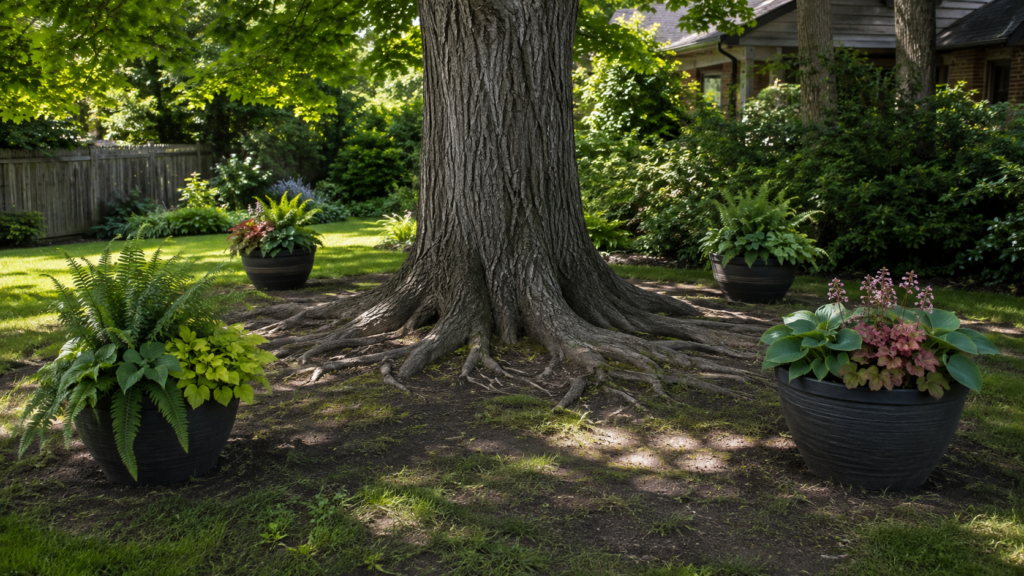
The established tree should take priority over the container display.
Keep the root flare—the point where the trunk broadens toward the main roots—visible. Do not bury it beneath added soil, compost, deep mulch, or raised-bed fill.
Avoid cutting major roots simply to create a symmetrical planter arrangement. If a container does not fit naturally, move it.
Freestanding pots are very different from building a deep soil-filled raised bed around a mature tree. Containers create their own growing environment without substantially changing the existing soil level.
Also avoid repeatedly placing very heavy objects or creating unnecessary disturbance directly over major roots.
Use one rule:
If the planter layout requires altering the tree, alter the planter layout instead.
Watering and Drainage
Shade does not guarantee moist containers.
Tree branches and foliage may intercept rainfall, while a container plant can only use the moisture stored inside its pot. A shaded planter may therefore dry faster than expected.
Check the growing mix rather than watering on a rigid schedule.
Watering needs change with:
- Temperature
- Wind
- Container size
- Plant size
- Rainfall
- Season
Drainage is equally important. Standard outdoor pots should allow excess water to escape freely.
Use an appropriate container-growing mix rather than dense soil dug from around the tree.
As roots fill the container, watering may become more frequent and repotting may eventually be needed.
Aim for consistent moisture with free drainage, not permanently wet soil.
Common Under-Tree Planter Mistakes
| Mistake | Better Approach |
|---|---|
| Burying the root flare | Keep the tree base visible |
| Adding deep soil over roots | Use freestanding pots |
| Cutting major roots | Move the container |
| Sun plants in deep shade | Match plants to light |
| Too many tiny pots | Use fewer larger pots |
| No drainage | Keep holes functional |
| Assuming shade stays wet | Check moisture |
| Relying only on flowers | Use foliage |
| Blocking paths | Leave mature clearance |
| Ringing the entire trunk | Use partial groups |
| Random pot styles | Repeat finishes |
| Ignoring seasonal shade | Reassess in summer |
Most failures can be avoided by studying the site before buying the plants.
Planters vs. In-Ground Planting
Containers are often the better choice where exposed roots make digging difficult, soil is unsuitable, or the design needs to remain flexible.
In-ground planting may still work where natural gaps exist between roots and suitable shade plants match the existing soil and moisture conditions.
| Situation | Containers | In-Ground | Non-Plant |
|---|---|---|---|
| Heavy exposed roots | ★★★ | ★ | ★★★ |
| Seasonal color | ★★★ | ★★ | ★ |
| Deep dry shade | ★★ | ★ | ★★★ |
| Need flexibility | ★★★ | ★ | ★ |
| Woodland effect | ★★ | ★★★ | ★ |
| Almost no usable light | ★ | ★ | ★★★ |
| Difficult soil | ★★★ | ★ | ★★ |
A non-plant solution such as seating, a path, or another low-disturbance feature may be better where the area is extremely dark, dry, or difficult to maintain.
Use containers when they simplify the space, not when they create another maintenance problem.
Seasonal Planter Care
Spring
Check drainage, remove damaged growth, refresh growing mix where necessary, and review planter placement before the canopy fully develops.
Summer
Monitor moisture, heat near canopy edges, pests, overcrowding, and poor flowering. Move containers if summer shade becomes too deep.
Autumn
Remove declining seasonal plants and excess fallen leaves. Note which positions and plant combinations performed best.
Winter
Consider plant hardiness, drainage, freeze damage, container durability, and whether tender plants need protection.
Plan for winter when purchasing the container rather than after cold weather arrives.
Backyard Planter Ideas Under Trees FAQs
Can You Put Planters Under Trees?
Yes. Freestanding planters are a practical way to garden beneath mature trees without extensive digging. Keep the tree base open and choose plants suited to the available shade.
What Are the Best Planters Under Trees?
Large containers with good drainage usually work best. Choose a size suited to the mature plant and a material appropriate for your climate and maintenance needs.
What Plants Grow Best in Pots Under Trees?
Hostas, suitable ferns, heuchera, shade-tolerant sedges, and some begonias can work well. Match each plant to the actual light and moisture conditions.
What Grows Well in Dry Shade?
Dry-shade-tolerant foliage plants are usually the safest choice. Suitable ferns and locally adapted plants often perform better than moisture-demanding flowers.
Can I Put a Raised Bed Around a Tree?
Avoid building a deep, soil-filled raised bed around an established tree trunk. Freestanding containers are a lower-disturbance alternative.
Can Pots Sit on Exposed Roots?
Avoid placing heavy pots directly on prominent roots when possible. Use stable gaps or move the planter toward the canopy edge.
Do Planters Under Trees Need Much Water?
They can. Tree canopies may reduce rainfall reaching the pots, so check the growing mix instead of assuming shade keeps them moist.
Is Dappled Shade Better Than Deep Shade?
Dappled shade usually provides more plant choices and stronger flowering. Deep shade is better suited to foliage-led displays.
Can Hydrangeas Grow in Pots Under Trees?
Some hydrangeas can grow in large containers where light, moisture, climate, and root space are suitable. Deep shade may reduce flowering.
What Is the Easiest Planter Layout?
A three-pot cluster is one of the easiest: one large anchor pot, one medium supporting container, and one smaller accent planter.
How Do You Make Planters Look Good Around Trees?
Use fewer, larger pots, repeat one color or material, vary the heights, and leave open space around the trunk.
What Is the Best Overall Planter Idea Under Trees?
For most backyards, two or three freestanding containers give the best balance of flexibility, tree protection, attractive planting, and easy maintenance.
Final Tips for Planters Under Trees
The best backyard planter ideas under trees respond to the conditions already present.
Start with:
- Light
- Roots
- Moisture
- Access
Then choose containers that provide drainage, suit the mature plants, and remain easy to maintain.
For most backyards, a statement pot, three-pot cluster, crescent arrangement, woodland foliage group, or canopy-edge trough is enough. Avoid overcrowding the trunk with containers.
Protect the tree first, use foliage where shade is deepest, introduce flowers where filtered light permits, and move containers when seasonal conditions change.
The mature tree is already the main feature. Planters should enhance it rather than hide it.
Sources & References
Horticultural guidance in this article is based on established recommendations from:
- Royal Horticultural Society (RHS) — shade gardening, dry shade, and planting beneath trees
- University of Minnesota Extension — shade gardening and containers beneath trees
- Penn State Extension — underplanting established trees and protecting roots
- Illinois Extension — container drainage and container-growing guidance
The 4-Factor Under-Tree Planter Test, layout formulas, comparison framework, and design recommendations are editorial frameworks developed by Backyard Planter Ideas to help readers apply established horticultural principles to practical backyard design.
Myra is the founder and lead writer of Backyard Planter Ideas, where she shares practical, well-researched guidance on planter design, plant selection, and outdoor styling. Her goal is to help homeowners create attractive, functional garden spaces with clear, reliable, and easy-to-apply advice.