
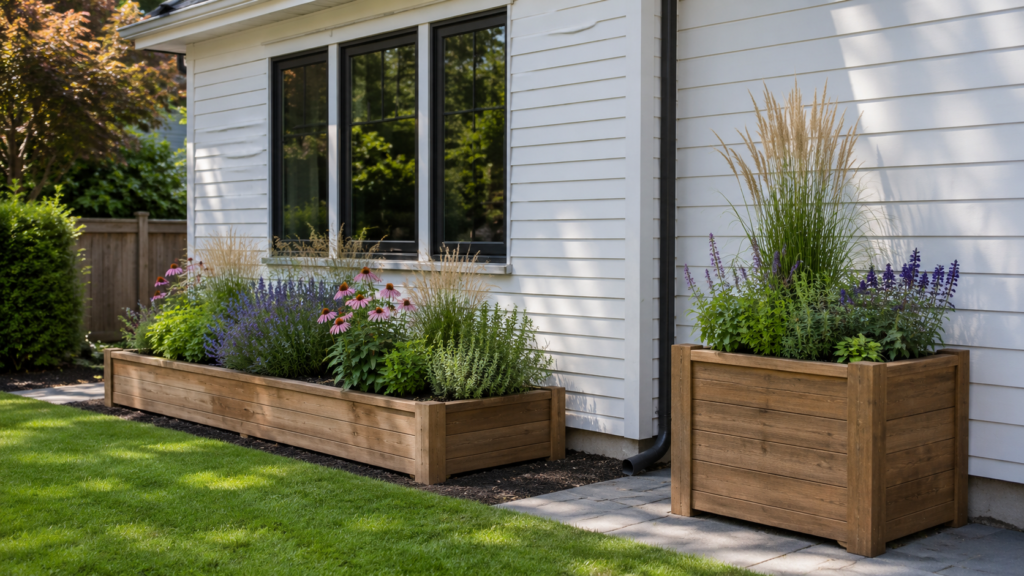
The best backyard planter box along house ideas use freestanding containers that add greenery without blocking windows, trapping water, hiding downspouts, or making the house difficult to maintain. Long troughs, low window planters, trellis boxes, herb planters, elevated containers, and mixed-height arrangements can all work when they match the wall, available space, drainage, and mature plant size.
Planter boxes give you more control than permanent foundation beds. You choose the growing medium, height, plant combination, drainage, and exact placement, and you can move or replace individual boxes later. The key is to plan around the house first. Windows, doors, vents, downspouts, taps, utilities, pathways, and wall maintenance should all remain accessible after the plants mature.
Which Planter Box Design Fits Your House?
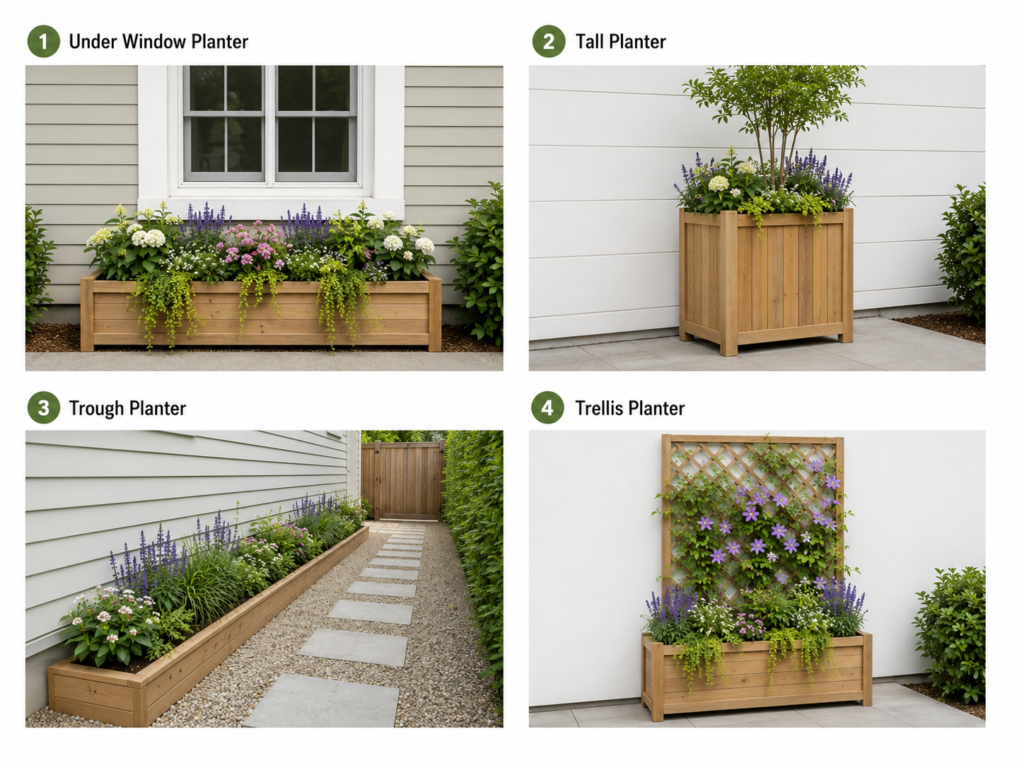
Choose the planter according to the main constraint created by the house. Low boxes work under windows, tall planters suit blank walls, narrow troughs preserve walking space, and movable containers work best near utilities or areas that need occasional access.
Before buying, identify the main issue you need the planter to solve:
- Window above the planter: keep the finished planting low.
- Narrow side yard: prioritize a slim footprint.
- Blank wall: use more vertical structure.
- Hot exposed wall: choose adequate soil volume and moisture control.
- Utility access: use modular or movable boxes.
- Sloping ground: use separate stepped planters.
- Downspout nearby: leave a clear service gap.
A reliable planning order is:
house condition → planter size → drainage → material → plants
What Are the Best Backyard Planter Box Along House Ideas?
1. Use a Long Narrow Planter in a Tight Side Yard
A long rectangular planter creates a strong planted border without taking too much space from a narrow path or small lawn. It works well beside garages, side yards, patios, and secondary entrances.
Instead of one oversized box, use two or three matching modules if the wall is long. Separate boxes are easier to move, repair, drain, and replant.
Best for: herbs, grasses, compact perennials, and seasonal flowers.
2. Place a Low Planter Beneath a Window
A low planter can turn the space beneath a window into an attractive feature without blocking light or access. Always consider the final height:
planter height + mature plant height
Keep enough room to open and clean the window and maintain the sill or trim.
Best for: low grasses, compact flowers, herbs, and foliage plants.
3. Use a Tall Planter Beside a Blank Wall
A tall planter adds structure where the wall has no windows or architectural detail. The container itself provides height, so the plants do not need to become large.
Use upright grasses, compact shrubs, or architectural foliage. Make sure the box has enough base width and weight to remain stable.
Best for: garage walls, corners, and blank sections between openings.
4. Create a Row of Cedar Planter Boxes
Timber boxes soften brick, stone, siding, and modern walls. A repeated sequence often looks better than one continuous wall-length planter.
For example:
long box → gap → long box → accent planter
The gaps improve drainage access and make individual containers easier to repair or move.
Best for: cottage, farmhouse, natural, and modern-rustic yards.
5. Use Slim Metal Planters for a Modern Look
Metal planters suit modern architecture, black window frames, concrete, and clean paving. Their crisp shape works especially well with softer plants such as grasses and flowering perennials.
On hot walls, monitor moisture carefully because containers can dry quickly.
Best for: contemporary homes and narrow patios.
6. Add a Trellis Planter Beside a Blank Wall
A trellis planter creates vertical greenery without requiring climbing plants to attach directly to the house.
Use it for flowering vines, edible climbers, screening, or privacy. The support must be strong enough for mature growth and wind exposure.
Keep trellis planters clear of windows, vents, and downspouts.
7. Build an Herb Planter Near the Back Door
Herbs are most practical when placed close to the kitchen or back entrance.
Possible combinations include parsley and chives, thyme and oregano, or basil and parsley. Group herbs with similar light and watering needs.
Best for: small backyards and frequently harvested plants.
8. Choose an Elevated Planter
Elevated planters make watering, harvesting, deadheading, and replanting easier because the soil is closer to working height.
They also leave open space beneath the planter, which can make a narrow patio feel less crowded.
Check stability once wet growing medium and mature plants are added.
9. Use a Self-Watering Planter on a Hot Wall
Self-watering planters can help maintain more consistent moisture in hot or rain-sheltered areas.
They still need monitoring for reservoir level, overflow, drainage, and plant health. Make sure excess water does not discharge toward the house.
10. Put Planter Boxes on Locking Casters
Rolling planters are useful where you may need to clean the wall, repaint siding, inspect utilities, or rearrange the patio.
Use outdoor-rated casters designed for the loaded planter weight. Large containers become much heavier after soil and water are added.
11. Arrange Two Boxes Around an Exterior Corner
Two rectangular planters positioned at right angles can create an L-shaped effect while remaining separate.
Use a taller plant near the corner and lower plants extending along the wall. If a downspout occupies the corner, leave it completely accessible.
12. Use Stepped Boxes on Sloping Ground
Separate planters can follow a slope while each box remains level.
Repeat the same material, color, or plant palette so the arrangement still feels connected. Give each container its own drainage route instead of allowing uncontrolled overflow into the planter below.
13. Create a Pollinator Planter Strip
A row of flowering containers can support pollinators without creating a permanent in-ground bed.
Choose locally appropriate plants with overlapping bloom periods and container-friendly mature sizes.
14. Fill Long Planters With Ornamental Grasses
Grasses add movement and soften hard architectural lines. Compact varieties work near windows, while taller types suit blank walls.
Check mature size carefully because some grasses outgrow narrow boxes quickly.
15. Combine One Tall Planter With Two Lower Boxes
Different heights can create a stronger composition than identical containers.
Place the tallest box beside a blank wall and lower the planting as it approaches windows or paths. Repeat one material, color, or plant to keep the group visually connected.
16. Choose Lightweight Planters for Flexibility
Resin, composite, and fiberglass-style containers are easier to move than stone or concrete.
They are useful if you expect to repaint the wall, redesign the patio, move plants seasonally, or inspect the house later.
17. Create a Mixed-Height Container Border
A group of coordinated containers can imitate a foundation garden without becoming permanent.
For example:
tall grass planter → flowering trough → herb box → flowering trough → tall planter
This gives you a landscaped look while keeping each box independent for drainage, watering, soil, and maintenance.
What Should You Check Before Adding Planters?
Check the wall, openings, utilities, sunlight, drainage, and walking space before installing anything.
A planter that fits when empty may become inconvenient after wet soil and mature plants are added.
Check:
- exterior wall material
- windows and doors
- vents
- downspouts
- utility meters
- taps and outlets
- remaining walking width
- actual sunlight
- drainage direction
The most important question is not simply whether the planter fits. Ask:
Will the mature planting still fit while the house remains easy to use and maintain?
Keep soil contained inside the planter rather than using the house wall as part of the planting structure.
How Far Should Planters Be From the House?
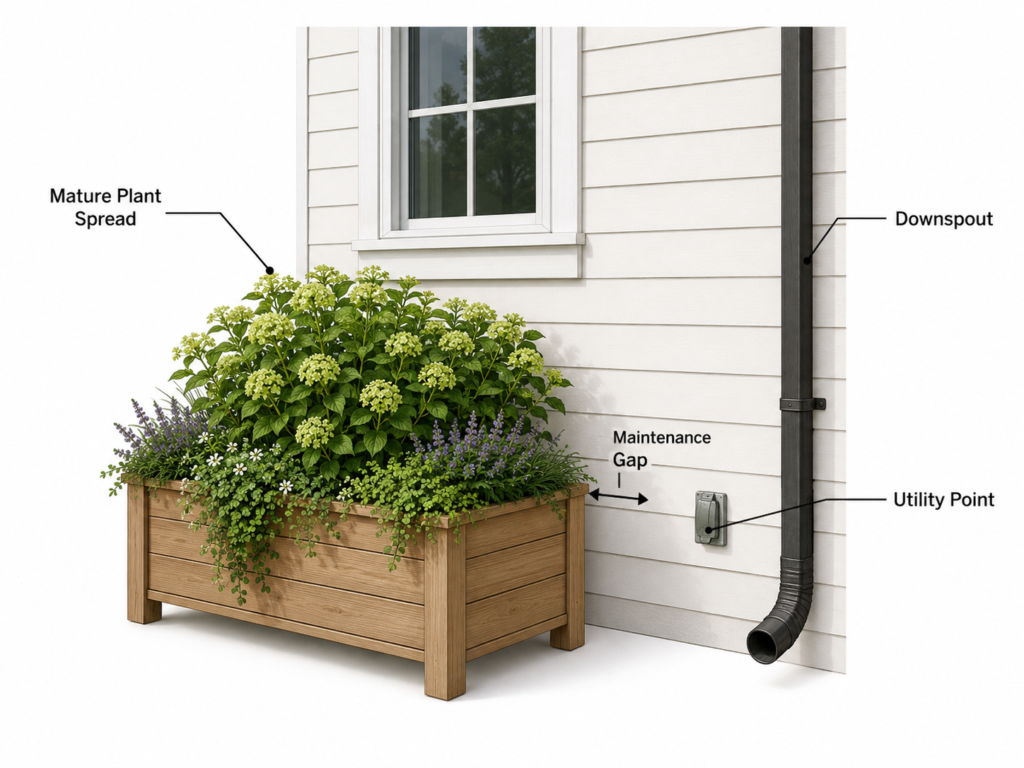
There is no universal planter-to-house clearance. Leave enough space to inspect the wall, remove debris, monitor drainage, and reach nearby utilities or downspouts.
As a practical layout test, some freestanding installations may begin by trying roughly 15–30 cm (6–12 inches) of separation, but this is not a universal building requirement.
Increase clearance where needed for:
- vents
- utility meters
- downspouts
- moisture-sensitive siding
- termite inspection
- mature plant spread
The useful gap is the one that still works after the plants grow.
What Should Planter Boxes Sit On?
Planters can sit on paving, gravel, prepared soil, lawn, or a suitable deck as long as the base is stable and water can move away from the house.
Paving provides a firm surface but may direct runoff toward the wall if it slopes incorrectly. Gravel can reduce mud but does not automatically solve drainage. Soil can settle, lawn can make mowing difficult, and decking requires extra attention to loaded weight.
Whatever the surface, confirm that:
- the planter stays level;
- drainage holes remain open;
- water does not collect behind the box;
- the surface can tolerate repeated moisture.
How Should Planter Boxes Drain?
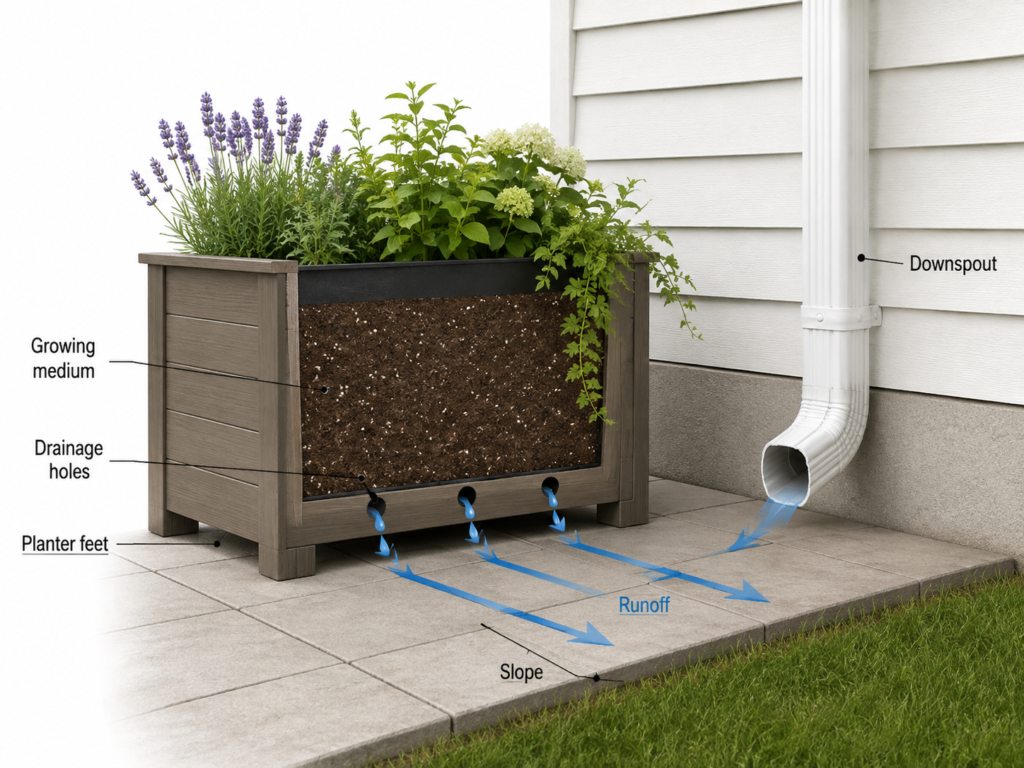
Good drainage means excess water can leave the container and continue away from the house.
Think of the complete path:
water → growing medium → drainage holes → ground surface → runoff away from house
Make sure:
- drainage holes are open;
- bottom outlets are not sealed against paving;
- feet or spacers are used when needed;
- debris cannot easily block drainage;
- the surrounding surface does not send water back toward the building.
Do not rely on a thick gravel layer inside the planter to compensate for poor drainage openings.
Before planting, perform a simple test: place the empty box in position, pour water through it, and watch where the water exits and travels. If it pools behind the planter or moves toward the wall, correct the layout first.
What Size Planter Box Should You Choose?
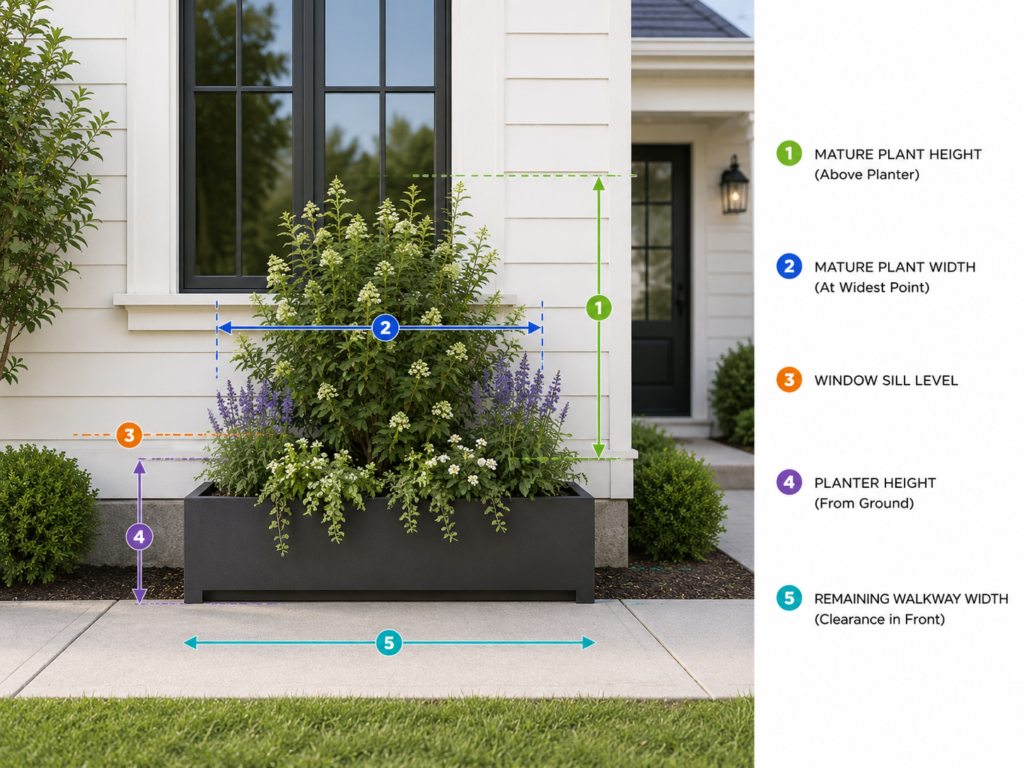
Choose the size according to plant roots, wall length, available pathway width, finished plant height, and future maintenance.
Use architectural features as natural boundaries. Windows, doors, downspouts, corners, and utility zones can help determine where a planter should begin and end.
For height, calculate:
planter height + mature plant height = finished height
Under windows, keep the total height lower. Beside blank walls, taller planters can provide more structure.
Several medium boxes are often easier to manage than one extremely long container.
Which Planter Box Material Is Best?
The best material depends on climate, appearance, weight, heat exposure, maintenance, and mobility.
Wood: warm, customizable, and suitable for many styles, but it weathers and may need repair.
Metal: clean and modern with thin walls, but it can become hot in strong sun.
Resin: lightweight and easy to move, but quality and UV resistance vary.
Fiberglass/composite: useful for large architectural planters without the weight of masonry.
Concrete or stone: visually permanent but heavy and difficult to move.
For wall-side installations, consider whether the planter may need to move for future house maintenance.
What Soil Should You Use in Planter Boxes?
Use a growing medium intended for containers rather than dense garden soil.
Container mixes are designed to balance moisture retention, drainage, and root aeration inside a restricted space.
Choose the growing medium according to:
- plant type
- container size
- climate
- irrigation
- whether the planting is seasonal or long-term
Leave some space below the planter rim so water can soak in without washing soil over the edge.
Long-term shrubs and perennials may eventually need fresh growing medium, root management, or repotting.
What Plants Work Best Beside a House?
Choose plants according to sunlight, mature size, climate, root volume, and watering needs.
For a box viewed mainly from the yard, use a simple layered arrangement:
- Back: taller structural plants
- Middle: flowers or medium foliage
- Front: low or trailing plants
Good plant categories include:
- compact shrubs
- ornamental grasses
- perennial flowers
- annuals
- herbs
- climbers with independent support
- trailing plants
Choose the site first and the plant second.
How Does Wall Direction Affect Planters?
The wall can change sunlight, heat, wind, and drying rate.
Sunny and west-facing walls can become hot and may require larger soil volume or closer moisture monitoring. Shaded walls usually dry more slowly. Roof overhangs can keep a planter dry even when the surrounding yard receives rain.
Building corners may also channel wind, making tall planters or trellises less stable.
Observe the actual location in the morning, midday, and afternoon before selecting plants.
How Should Planters Handle Seasonal Weather?
Container plants experience seasonal temperature and moisture changes more quickly than plants growing in open ground.
In cold climates, check planter frost resistance and make sure drainage remains open before freezing weather.
In wet climates, remove fallen leaves and debris that can trap moisture or block drainage.
In hot climates, choose adequate soil volume and monitor moisture closely.
Lightweight or rolling containers can be useful if plants need temporary seasonal protection.
How Should You Arrange Planter Box Plants?
Repeat a small number of elements so separate containers look like one design.
You can repeat:
- planter shape
- planter color
- one plant species
- flower color
- foliage texture
Use a simple height hierarchy:
tall → medium → low
Place taller elements beside blank walls and lower planting near windows or walkways.
Leave some negative space. Gaps around downspouts, windows, and between modules often improve both appearance and maintenance.
What Does a Good Planter Layout Look Like?
A good layout changes planter height according to the architecture and keeps building features accessible.
For a wall with a blank section, window, and downspout, a practical sequence might be:
blank wall → tall planter → low window planter → maintenance gap → downspout → optional planter
This works because:
- taller planting sits where height is useful;
- low plants stay below the window;
- the downspout remains accessible;
- each planter can drain independently;
- repeated materials keep the arrangement visually connected.
You do not need one continuous planter to create a continuous visual effect.
How Do You Maintain Planter Boxes?
Check moisture, drainage, plant growth, and the area behind the container regularly.
Different planters may dry at different rates depending on size, material, sunlight, wind, and plant density.
Water the growing medium rather than spraying the wall. Keep drainage outlets free of roots and debris.
Prune foliage before it presses against the house, and periodically check the planter for loose boards, corrosion, cracks, or failing feet.
Where possible, inspect behind movable planters for trapped leaves, staining, standing water, or wall damage.
What Planter Box Mistakes Should You Avoid?
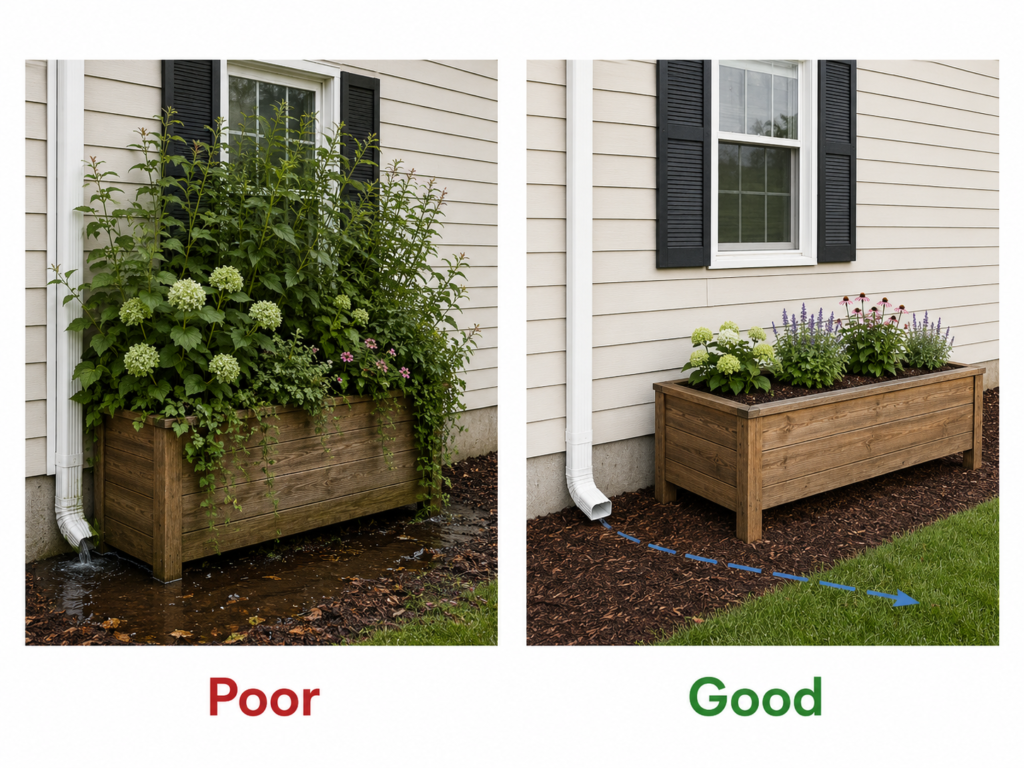
The most common problems are practical rather than decorative.
Avoid:
- pressing wet soil against siding;
- allowing drainage to run toward the house;
- blocking downspouts;
- hiding utilities;
- choosing plants by nursery size instead of mature size;
- using containers too small for the plant;
- building one box too large to move;
- ignoring loaded weight;
- combining plants with very different moisture needs;
- blocking windows with mature growth;
- placing planters where rainfall never reaches them;
- choosing appearance over drainage.
The final test is simple:
Can you still inspect, clean, drain, and maintain this area after the planting matures?
How Do You Test a Planter Box Layout?
Mock up the layout before buying or filling the planter.
Use the Backyard Planter Ideas Wall-Safe Planter Test:
- Mark the planter footprint with tape, rope, or cardboard.
- Walk through the remaining space.
- Simulate planter height.
- Add the expected mature plant height.
- Mark mature plant width.
- Check access to windows, taps, outlets, and downspouts.
- Test whether a mower, bin, or wheelbarrow can still pass.
- Pour water where the planter will drain.
- Observe sunlight at different times of day.
- Adjust the design before installation.
This simple test prevents many expensive placement mistakes.
Planter Boxes vs. Foundation Beds: Which Is Better?
Planter boxes are better when you want controlled soil, flexibility, modularity, or a reversible design. Foundation beds are better when the site supports permanent in-ground landscaping and larger root systems.
Planter boxes provide:
- controlled growing medium
- individual drainage
- root containment
- mobility
- easier redesign
Foundation beds provide:
- more root volume
- more stable soil conditions
- room for larger shrubs
- permanent landscape integration
The key distinction is that a planter box remains an independent container. Do not automatically fill the space between the planter and house with soil.
What Are the Best Budget Planter Box Ideas?
Use fewer containers, repeat simple materials, and spend first on structure, drainage, and growing medium.
Budget-friendly strategies include:
- using two or three matching boxes;
- building simple timber troughs;
- reusing suitable containers with drainage;
- buying smaller plants and allowing them to grow;
- growing annuals or herbs from seed;
- repeating inexpensive plants for visual consistency.
Prioritize spending in this order:
- planter structure
- drainage
- root volume
- growing medium
- plants
- decorative extras
FAQs About Planter Boxes Along a House
Can you put a planter box directly against a house?
A freestanding planter can sit beside a house, but avoid pressing wet soil tightly against the wall. Leave practical room for drainage, cleaning, and inspection.
How much space should be between a planter and the house?
There is no universal distance. Leave enough clearance for the wall, drainage, utilities, and mature plant growth to remain accessible.
Can planter boxes cause moisture problems?
Yes, if water or wet debris remains against the wall. Keep soil inside the planter and direct overflow away from the building.
Do planter boxes need drainage holes?
Most outdoor planters need functional drainage openings so excess water can escape the root zone.
What should planter boxes sit on?
Paving, gravel, prepared soil, lawn, or suitable decking can work if the surface remains stable and allows water to move away from the house.
Can you put a planter under a window?
Yes. Keep the planter and mature plants low enough that the window can still open, be cleaned, and remain accessible.
How deep should a planter box be?
Depth depends on the root needs of the plants. Herbs and annuals generally require less growing volume than shrubs and larger perennials.
What plants work well beside a house?
Compact shrubs, grasses, flowers, herbs, trailing plants, and supported climbers can all work when matched to the site’s sunlight, climate, and container size.
Is wood or metal better?
Wood offers a natural appearance, while metal provides a cleaner modern look. Climate, weight, maintenance, and heat exposure should guide the choice.
Can planter boxes damage siding?
They can if wet soil, water, debris, or foliage stays against the wall. Proper separation and drainage reduce the risk.
Can you put a raised bed against a house?
Avoid banking raised-bed soil directly against the wall. A freestanding planter with contained soil and controlled drainage is easier to manage.
What is the easiest planter layout to maintain?
Two or three separate rectangular boxes are usually easier to move, repair, drain, and replant than one oversized wall-length planter.
Which Planter Box Idea Is Best Overall?
For most homes, two or three freestanding rectangular planter boxes with good drainage, practical wall clearance, and realistic mature plant sizing provide the best balance of appearance and maintenance.
Use low boxes under windows, taller planters beside blank wall sections, and deliberate gaps around downspouts or utilities. Repeat one material, color, or plant across the arrangement so separate boxes feel like one landscape.
Before installation, confirm:
- wall access
- drainage direction
- window clearance
- downspout access
- walking width
- mature plant size
- loaded weight
- future maintenance
The strongest backyard planter box along house ideas are not simply attractive on installation day. They continue to work after the soil is wet, the plants are mature, and the house eventually needs cleaning, inspection, or repair.

Myra is the founder and lead writer of Backyard Planter Ideas, where she shares practical, well-researched guidance on planter design, plant selection, and outdoor styling. Her goal is to help homeowners create attractive, functional garden spaces with clear, reliable, and easy-to-apply advice.