
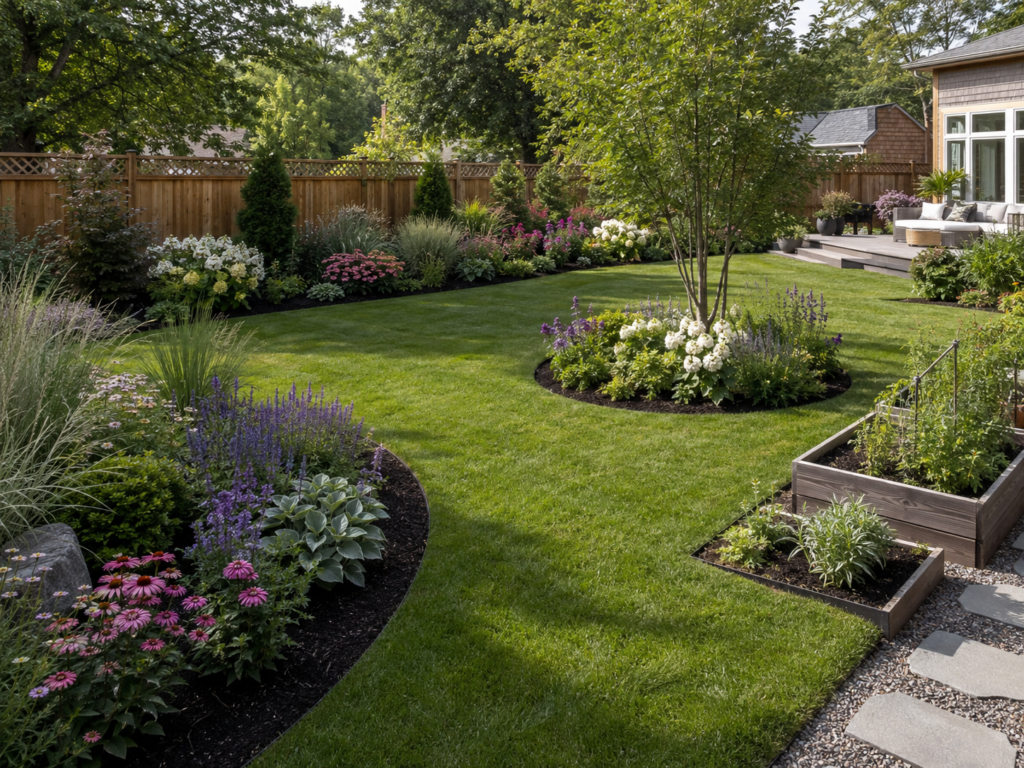
The best backyard plant bed ideas make a yard more attractive without making it harder to use or maintain. Borders frame lawns and patios, island beds create focal points, fence-line beds add privacy, curved beds soften rigid spaces, raised beds improve access and soil control, and narrow beds make small areas useful.
The right layout depends on your available space, viewing direction, mature plant size, sunlight, drainage, access, and maintenance needs. Choose the bed shape first, then decide how individual plants should be arranged inside it.
This guide covers 21 practical backyard plant bed layouts for small, narrow, medium, and large yards, along with spacing, drainage, costs, maintenance, and plant-placement guidance.
21 Backyard Plant Bed Ideas at a Glance
The best layout is the one that solves a specific problem in your yard.
- Border beds: Best for framing lawns, walls, patios, and paths.
- Island beds: Best for adding a focal point to open lawn.
- Fence-line beds: Best for privacy, screening, and softening boundaries.
- Curved beds: Best for breaking up rectangular lawns and straight lines.
- Raised beds: Best for improved access, organized planting, and greater control over the growing area.
- Narrow beds: Best for side yards, paths, walls, and restricted spaces.
Before choosing a design, ask whether the bed will be viewed from one side or several, whether every plant can be reached after it matures, and whether the remaining lawn and paths will still be practical.
How to Choose a Backyard Plant Bed
Choose the simplest layout that fits your yard and solves the main problem. A border works naturally along an existing edge. An island works when the center of a lawn feels empty. Fence-line beds help with privacy and visual screening. Raised beds are useful where access or growing-medium control matters. Narrow beds preserve circulation in restricted spaces.
Before digging, check:
- mature plant width and height;
- access from one or both sides;
- sunlight throughout the day;
- drainage after rainfall;
- gates, taps, drains, and utilities;
- mowing and pathway access;
- fence maintenance.
A bed that looks attractive on paper can become difficult if it is too deep to reach or if mature shrubs block a walkway. Design for how the space will work several years from now, not only how it looks when newly planted.
Best Border Plant Bed Ideas
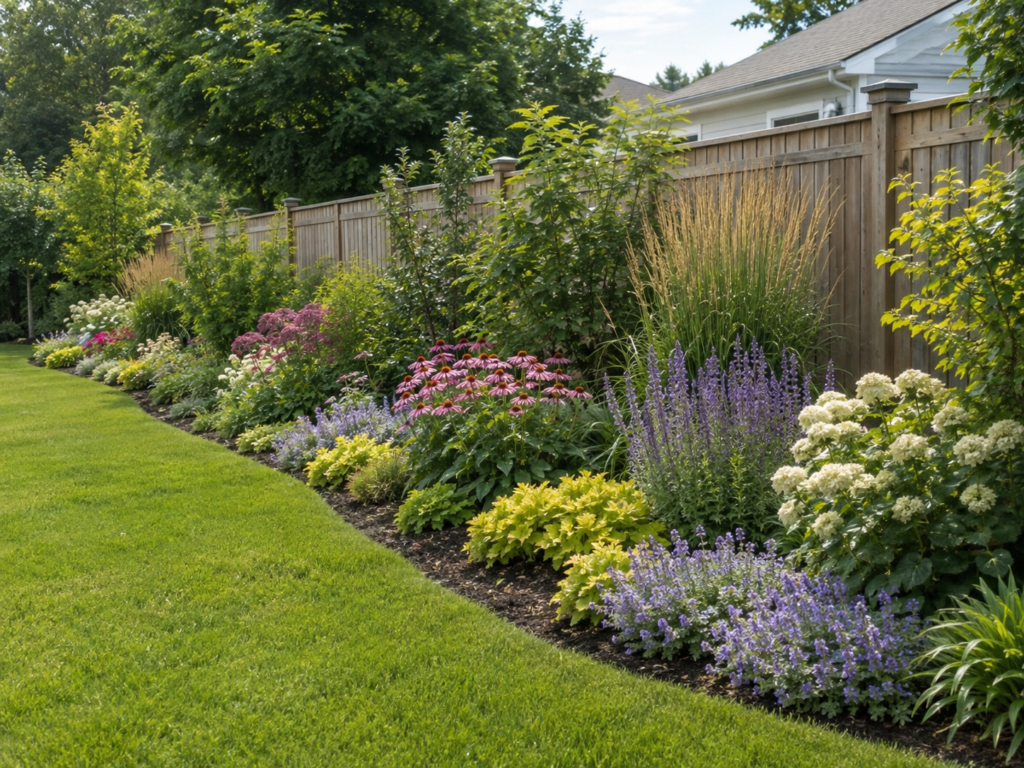
Border beds work well beside fences, walls, patios, lawns, and paths. They usually have one primary viewing direction, making it easy to arrange plants from lower to taller.
1. Layered Three-Depth Border
Divide the bed into front, middle, and back zones.
Use lower plants along the front edge, medium-height plants through the center, and taller structural plants toward the back. Let the groups overlap slightly rather than creating three rigid rows.
Best for: fences, walls, and long lawn edges.
2. Patio-Framing Border
Plant one or two sides of a patio to soften paving and connect the seating area to the garden.
Keep compact plants near chairs and paths. Place larger plants farther from active areas so stems and foliage do not interfere with movement.
Leave access to doors, taps, grills, storage, and electrical outlets.
Best for: decks, patios, and entertaining areas.
3. Deep Mixed Border
A deeper bed allows shrubs, perennials, grasses, bulbs, and groundcovers to overlap naturally.
Use larger groups rather than placing one different plant in every gap. Repeat several important plants along the border to create rhythm.
Deep borders need maintenance access, so add stepping points if the center cannot be reached comfortably.
Best for: medium and large yards.
4. Evergreen-and-Perennial Border
Combine long-lasting structural plants with seasonal flowering plants.
Place shrubs, grasses, or other structural plants first. Then fill the spaces between them with repeated perennial groups.
This prevents the bed from looking empty when fewer flowers are in bloom.
Best for: year-round structure.
Best Island Plant Bed Ideas
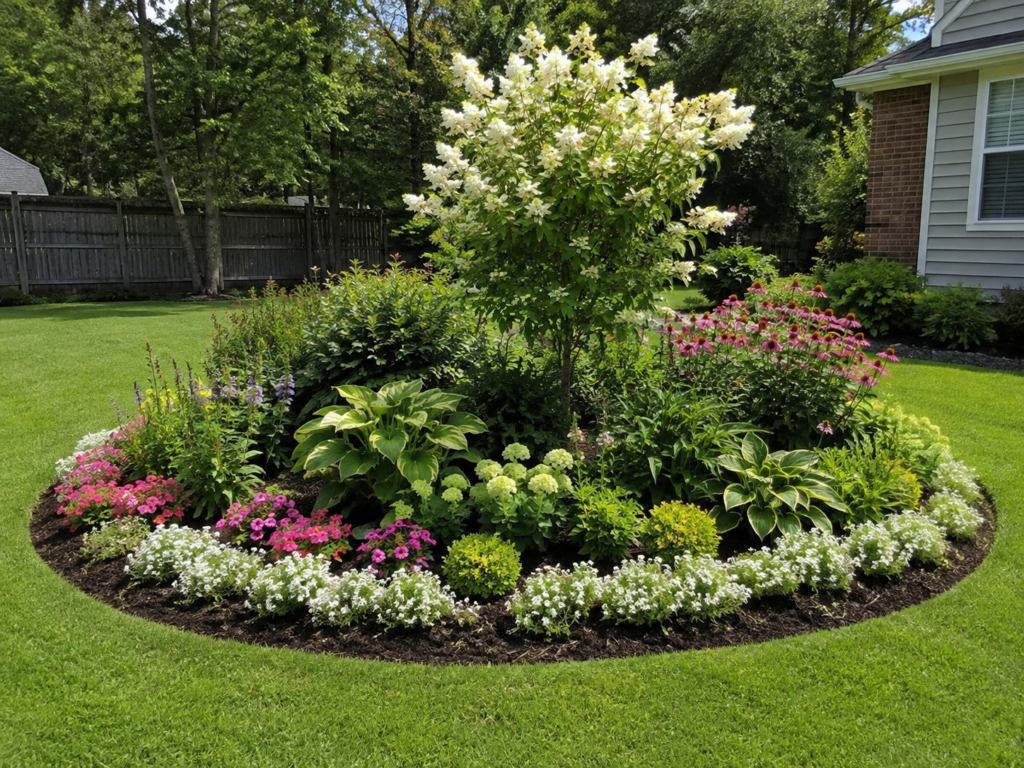
Island beds sit away from fences and walls and are usually viewed from several directions. The tallest plants should normally sit nearer the interior, with lower planting around the outer edge.
5. Oval Island Bed
An oval provides a simple shape that works well in open lawn.
Place the strongest plant slightly off-center, then surround it with medium and lower groups. Avoid creating a perfect ring around one central specimen.
Keep the edge smooth so mowing remains easy.
Best for: medium and large lawns.
6. Kidney-Shaped Island Bed
A kidney shape has one inward curve and one broader outer curve.
The inward section can face a bench, path, lawn seating area, or small garden feature. Use the wider part of the bed for larger plants.
Broad curves usually look more intentional than many small bends.
Best for: informal backyard designs.
7. Off-Center Specimen Island
Build the bed around one dominant shrub, ornamental grass, compact tree where suitable, sculpture, or architectural plant.
Position the feature slightly off-center and balance it with repeated supporting groups.
Check mature size carefully so the focal plant does not eventually dominate the whole bed.
Best for: creating a strong focal point.
Best Fence-Line Plant Bed Ideas
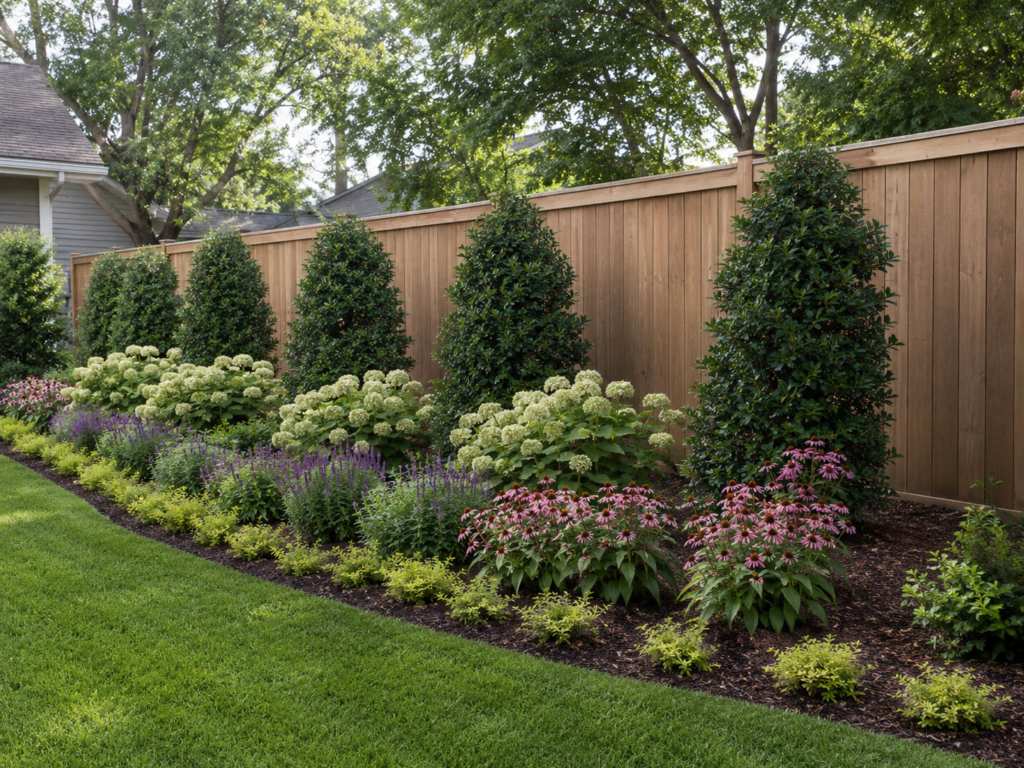
Fence-line beds soften boundaries and can add privacy, flowers, or vertical structure. Always leave enough space for plants to mature and for the fence to be maintained.
8. Layered Privacy Fence Bed
Place taller plants near the rear, medium plants through the middle, and lower plants toward the lawn.
You do not need a solid wall of shrubs. Several structural groups can provide screening while keeping the bed visually lighter.
Leave clearance for pruning and fence repair.
Best for: privacy and screening.
9. Repeating Pollinator Strip
Choose a smaller number of compatible flowering plants and repeat them along the fence.
Choose species suitable for your local climate and pollinators rather than copying a universal plant list.
Best for: sunny boundaries and wildlife-friendly gardens.
10. Trellis-and-Low-Border Layout
Use vertical space where ground width is limited.
A trellis or support provides height, while compact plants fill the lower bed.
Keep climbing plants accessible for watering, pruning, and tying.
Best for: narrow fence lines and side yards.
Best Curved Plant Bed Ideas
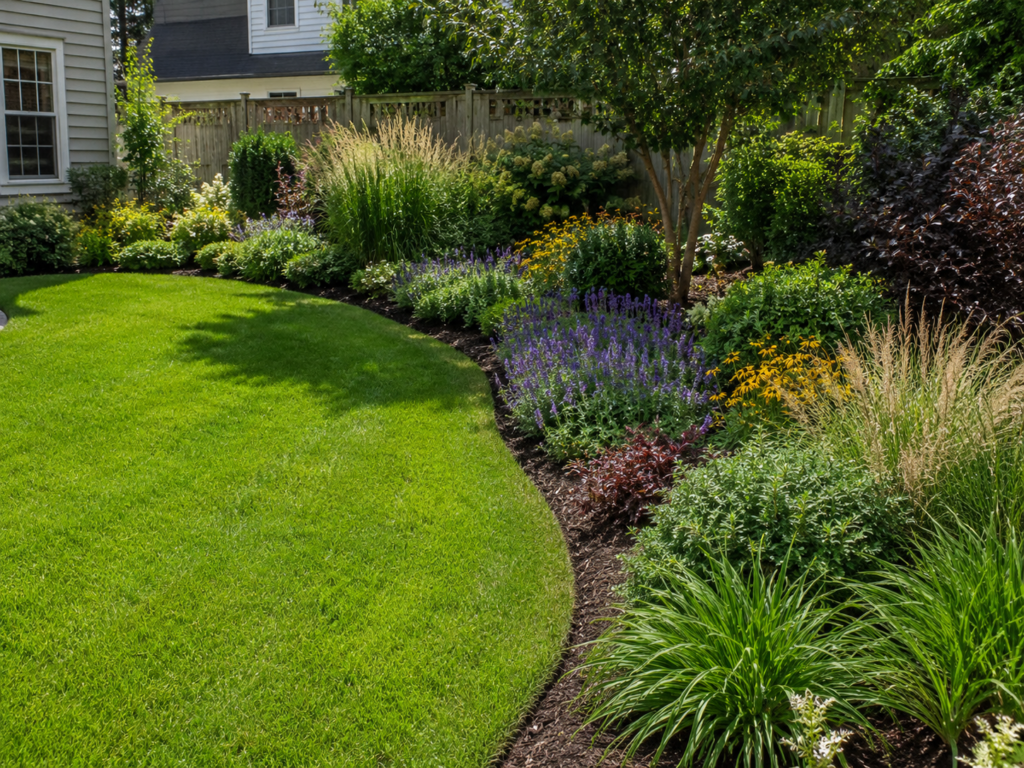
Curved beds are useful when straight property lines make a yard feel rigid. Use broad, deliberate curves instead of many small waves.
11. Single Sweeping Curve
Bring one section of the bed farther into the lawn to create a deeper planting pocket, then gradually return the edge toward the boundary.
Use the deeper area for larger shrubs, grasses, or stronger planting groups.
Best for: long rectangular lawns.
12. Curved Corner Bed
Turn a sharp lawn corner into a rounded planting area.
Place taller plants deeper in the corner and reduce height toward the lawn.
This keeps the center of the yard open while making better use of an otherwise empty corner.
Best for: small and medium yards.
13. Lawn-Reduction Curve
Expand one or two planting areas farther into underused lawn.
The added depth allows better layering and can remove awkward mowing corners.
Do not reduce the lawn if the remaining grass becomes too narrow or difficult to use.
Best for: yards with more lawn than needed.
Best Raised Plant Bed Ideas
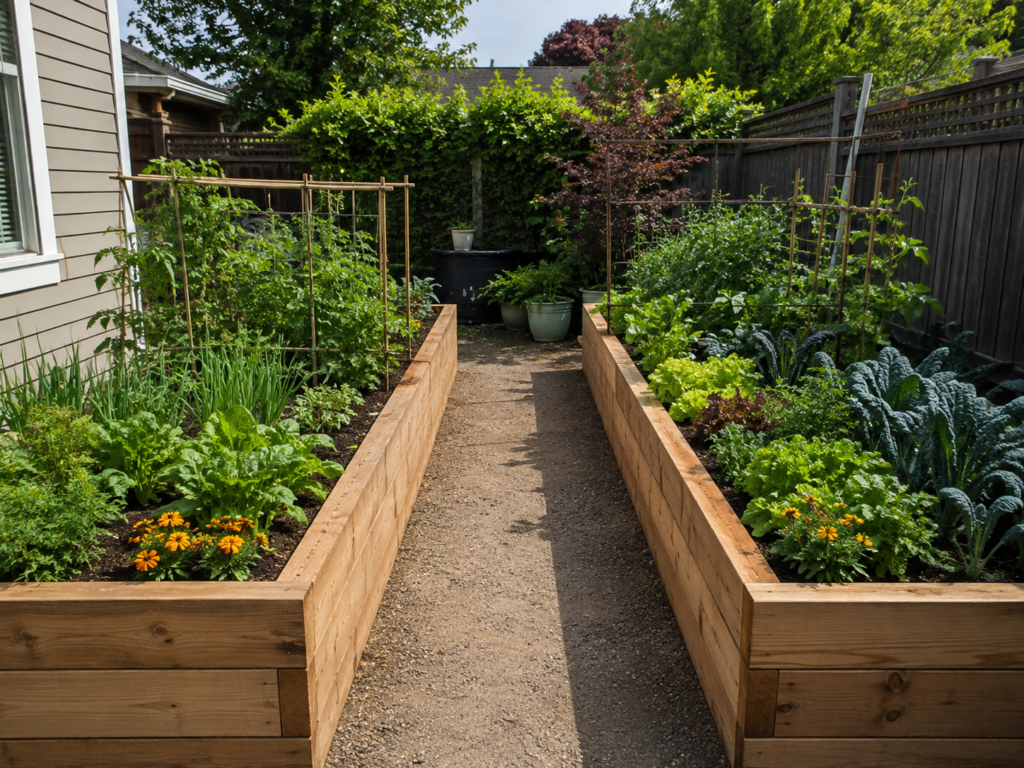
14. Twin Parallel Raised Beds
Place two rectangular beds with a clear path between them.
This makes watering, harvesting, and maintenance straightforward.
Keep the path wide enough for normal gardening equipment and movement.
Best for: organized growing areas.
15. U-Shaped Raised Bed
A U-shaped bed surrounds a central working area on three sides.
It creates a large amount of reachable planting edge within a compact footprint.
Keep the opening wide enough for comfortable movement and avoid making the arms too deep.
Best for: intensive gardening.
16. L-Shaped Raised Bed
Use an L-shaped bed in a corner beside a patio, shed, or fence.
It preserves central space while creating two usable planting sections.
Make sure the inside corner remains reachable.
Best for: compact yards.
17. Mixed-Height Raised Beds
Combine two or three raised beds at different heights.
Higher beds can reduce bending for frequently tended plants, while lower beds suit larger plants that do not need extra elevation.
Use coordinated materials so the beds feel connected.
Best for: accessibility-focused gardens.
Narrow Backyard Plant Bed Ideas
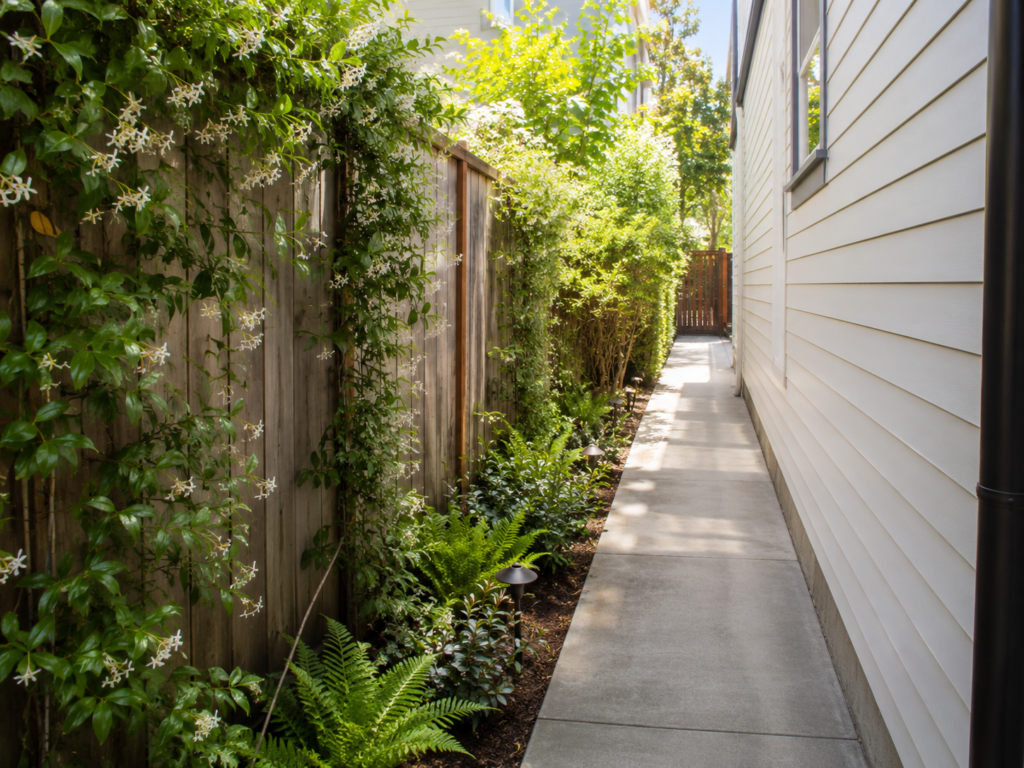
Narrow yards require careful mature-size planning. Protect walking space first, then fit the planting around it.
18. One-Sided Narrow Raised Bed
Place a shallow raised bed against a wall or fence.
Because it can only be reached from the front, keep it narrower than a freestanding bed.
Use taller plants toward the back and compact plants near the edge.
Best for: side yards and walls.
19. Side-Yard Ribbon Bed
Run a narrow planting strip beside a path.
Repeat a limited plant palette instead of using many unrelated species.
Choose plants whose mature width will not block the walkway.
Best for: passages between a house and fence.
20. Vertical Fence-Pocket Bed
Combine a shallow ground bed with climbing or vertically trained plants.
This adds height without requiring broad shrubs.
Monitor moisture carefully because beds beside walls and fences can dry quickly.
Best for: very narrow spaces.
21. Stepping-Stone Access Bed
A deeper bed can remain practical if stepping points are intentionally placed through it.
Use stable stones as maintenance access points rather than random decoration.
Install them before plants mature.
Best for: deeper borders with limited outer access.
Cheapest Backyard Plant Bed Ideas
Simple in-ground borders are usually among the lowest-cost choices because they need few structural materials.
Curved beds and islands can also remain economical when existing soil is suitable. Raised beds generally cost more because they require framing, extra growing medium, fasteners, and sometimes constructed paths.
To keep costs down:
- simplify the bed shape;
- use existing soil when suitable;
- avoid buying too many plants initially;
- use correct mature spacing;
- mulch temporary gaps;
- avoid complex structures without a practical reason.
Consider ongoing maintenance as well as installation cost. A cheap bed with difficult mowing edges or poor access can create more work over time.
How to Arrange Plants in a Backyard Bed
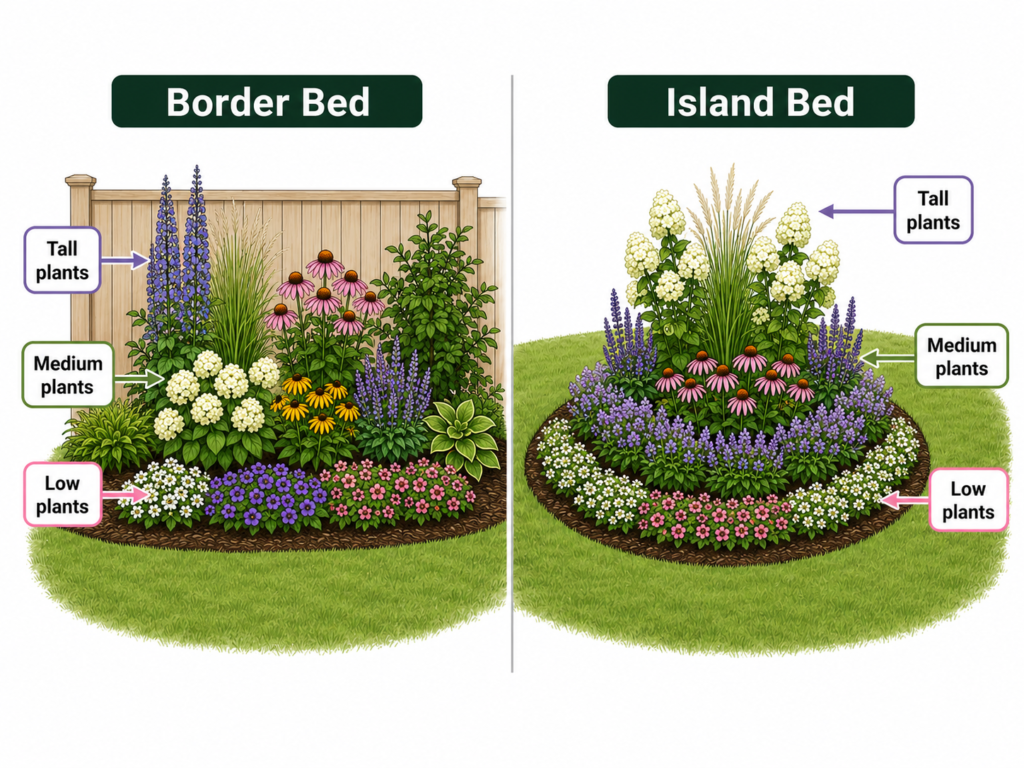
Start with the plants that will provide long-term structure, then add repeated medium-height groups and lower plants.
For one-sided borders, taller plants usually belong toward the back. In island beds, taller plants generally move closer to the center.
Useful principles include:
- arrange plants by mature size;
- repeat key plants;
- use groups and drifts instead of random singles;
- keep low plants near paths;
- limit the number of focal points;
- leave room for plants to mature.
A new bed often looks sparse. That is better than overcrowding permanent plants simply to create immediate fullness.
How Wide Should a Backyard Plant Bed Be?
The bed should be wide enough for the mature plants while remaining easy to reach. Beds accessible from both sides can usually be wider than beds against a fence or wall.
Consider plant spread before drawing the edge. A shrub expected to reach four feet wide does not belong in a very narrow strip simply because it fits when young.
Deep ornamental beds may require stepping access.
Raised beds accessible from both sides are commonly kept around four feet wide so the center remains reachable. One-sided beds should generally be narrower.
Simple rule: plant size determines the required depth, while human reach determines the practical width.
Paths and Edging for Backyard Plant Beds
Edging gives a bed a clean boundary, while paths provide maintenance access.
Possible edging options include cut lawn edges, timber, brick, stone, metal, gravel, and paving. Choose according to garden style, climate, maintenance needs, and budget.
Paths should reflect real use. Consider:
- wheelbarrows;
- carts;
- watering cans;
- kneeling space;
- wheelchair access;
- frequent harvesting.
Deep ornamental beds may only need discreet stepping stones. Raised-bed areas usually benefit from more permanent paths.
Any part of the bed that cannot be comfortably reached from the outside should have an intentional access point.
Sun, Soil and Drainage for Plant Beds
The site determines whether plants succeed.
Observe sunlight throughout the day because one long bed can contain both sunny and shaded areas.
After rainfall, check for:
- standing water;
- fast-drying areas;
- compacted soil;
- runoff;
- dry zones beside walls;
- tree-root competition.
Raised beds can improve control over the growing medium, but they should not be used to hide a major drainage problem.
Also take care around established trees. The ground beneath them may appear empty while containing a large root system.
Choose plants for the actual conditions instead of copying a plant list from a photograph.
Backyard Plant Beds on Slopes
Plant beds can work on slopes, but water movement and safe access should be considered before the final shape.
On gentle slopes, following the natural contour may work better than cutting directly across it.
Check:
- runoff direction;
- erosion;
- mulch movement;
- irrigation behavior;
- safe working access;
- whether a structure will retain significant soil.
Raised or terraced beds can create flatter planting areas, but major retaining work or drainage changes may require appropriate local professional advice.
Plan sloped beds in this order: water movement, maintenance access, then bed shape.
How to Make Plant Beds Look Professional
A professional-looking bed usually relies on repetition, structure, proportion, and clear edges rather than a large number of plant varieties.
Use a few strong plants as anchors, then repeat supporting plants through the bed.
Combine different heights and textures, but avoid making every plant a focal point.
A strong bed may include:
- structural shrubs or grasses;
- repeated flowering groups;
- compact edge planting;
- foliage contrast;
- clear negative space.
Think beyond flowers. Leaves, stems, grasses, bark, and seed heads can keep the bed interesting when fewer plants are blooming.
Backyard Plant Bed Mistakes to Avoid
Avoid:
- making beds too deep to reach;
- ignoring mature plant size;
- placing shrubs too close to fences;
- overcrowding new planting;
- blocking paths or gates;
- creating too many small curves;
- hiding irrigation or drains;
- forgetting maintenance access;
- choosing plants before checking sunlight and soil;
- using too many unrelated species.
Good design reduces future correction.
What to Check After 30 Days
The first month is mainly about establishment and function, not the finished appearance.
Check:
- whether every plant receives water;
- whether water pools anywhere;
- whether soil has settled;
- whether mulch has moved;
- whether plants are leaning;
- whether paths remain clear;
- whether irrigation is accessible;
- whether any plant is obviously misplaced.
Take a photograph from one fixed position on Day 1 and another from the same angle around Day 30.
30-Day Plant Bed Test Checklist
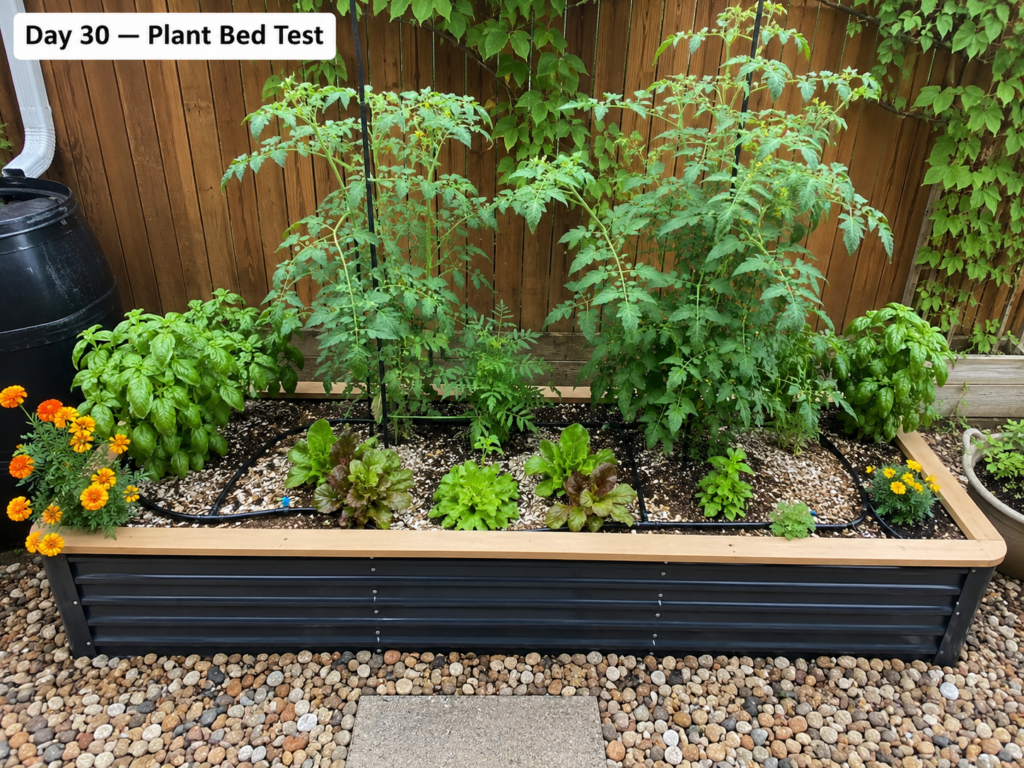
A genuine 30-day test should document the layout, growing conditions, and any problems rather than simply showing a nicer photograph.
Record on Day 1:
- bed dimensions;
- sunlight;
- plant positions;
- watering method;
- drainage setup;
- maintenance access;
- one fixed photo location.
Check again around Day 30 for:
- establishment;
- moisture differences;
- drainage problems;
- soil settlement;
- mulch movement;
- leaning plants;
- blocked paths;
- access issues.
The purpose is not to prove long-term garden success. It is to determine whether the physical bed layout works during establishment.
Best Plant Bed Ideas for Small Yards
Small yards usually benefit from using their boundaries before occupying the center.
Good options include fence-line beds, curved corners, patio borders, narrow raised beds, L-shaped beds, and vertical planting.
Avoid splitting a small lawn into many disconnected beds. One continuous border often creates more useful planting space and fewer awkward mowing edges.
A few correctly scaled structural plants can also create more depth than many tiny plants.
Use corners for deeper planting and vertical space where ground width is limited.
If a bed makes the remaining yard harder to use, simplify it or move more planting toward the perimeter.
How to Plan a Backyard Plant Bed
Use this order before planting:
- Measure the space and mark fixed features.
- Identify important views from windows, patios, and paths.
- Observe sunlight throughout the day.
- Choose the bed category.
- Mark the footprint with rope or a hose.
- Test whether every part can be reached.
- Position the largest structural plants first.
- Add the internal plant layout.
- Walk around the marked design.
- Check future maintenance access.
Use pots, stakes, or temporary markers to represent major plants before digging. This makes it easier to spot overcrowding, awkward proportions, and blocked paths.
How We Evaluate Backyard Plant Bed Ideas
At backyardplanterideas.online, a useful layout should work practically as well as visually.
The main factors are:
- purpose;
- placement;
- viewing direction;
- mature plant dimensions;
- maintenance access;
- sunlight;
- soil;
- drainage;
- circulation;
- long-term structure.
Research-based recommendations should be presented as guidance. Original diagrams should be identified as planning tools. Genuine measurements, photographs, and tests should show the actual conditions and methods used.
The goal is to help readers understand not only what a backyard plant bed looks like, but whether that layout is suitable for their own yard.
Backyard Plant Bed Ideas FAQs
What is the best layout for a backyard plant bed?
Choose the simplest layout that solves the main problem. Borders frame edges, islands create focal points, fence-line beds add screening, curves soften lawns, and raised or narrow beds solve access and space problems.
How wide should a backyard flower bed be?
Make it wide enough for mature plants but narrow enough to reach comfortably. Beds accessible from both sides can be wider than beds reached from only one side.
Should a flower bed be straight or curved?
Straight beds create a cleaner, more formal look. Broad curves create a softer appearance and can break up rectangular lawns.
What should go at the back of a flower bed?
For one-sided beds, taller structural plants usually belong toward the back, medium plants in the middle, and lower plants near the front. Islands need taller plants closer to the center.
What is the best plant bed for a small backyard?
Fence-line beds, corner beds, patio borders, narrow raised beds, and vertical planting usually work well because they preserve central space.
Are raised beds better than in-ground beds?
Neither is always better. Raised beds improve access and growing-medium control, while in-ground beds require fewer construction materials.
Which plant bed layout is cheapest?
Simple in-ground borders are usually among the lowest-cost options when existing soil is suitable.
Can you build a plant bed on a slope?
Yes, but runoff, erosion, drainage, and maintenance access need extra planning.
How do you keep weeds down in a backyard bed?
Remove weeds before planting, use appropriate mulch, and avoid leaving excessive bare soil between permanent plants.
How do you make a flower bed look professionally designed?
Use a limited plant palette, repeated groups, clear height relationships, mature spacing, and a defined edge.
How many plants should go in a backyard bed?
Base plant numbers on mature spacing rather than how empty the bed looks immediately after planting.
What should you check after planting?
Check watering, drainage, soil settlement, plant stability, access, and obvious spacing problems during the first month.
Which Backyard Plant Bed Idea Should You Choose?
Choose the layout that solves the biggest problem in your yard while remaining practical after the plants mature.
- Large empty lawn: oval, kidney-shaped, or specimen island.
- Bare fence: privacy border, pollinator strip, or trellis bed.
- Rigid rectangular lawn: sweeping curved border.
- Excess grass: lawn-reduction curve.
- Accessibility or soil concerns: raised bed.
- Narrow yard: ribbon, shallow raised, or vertical bed.
- Small backyard: use borders and corners before taking over the center.

Myra is the founder and lead writer of Backyard Planter Ideas, where she shares practical, well-researched guidance on planter design, plant selection, and outdoor styling. Her goal is to help homeowners create attractive, functional garden spaces with clear, reliable, and easy-to-apply advice.