
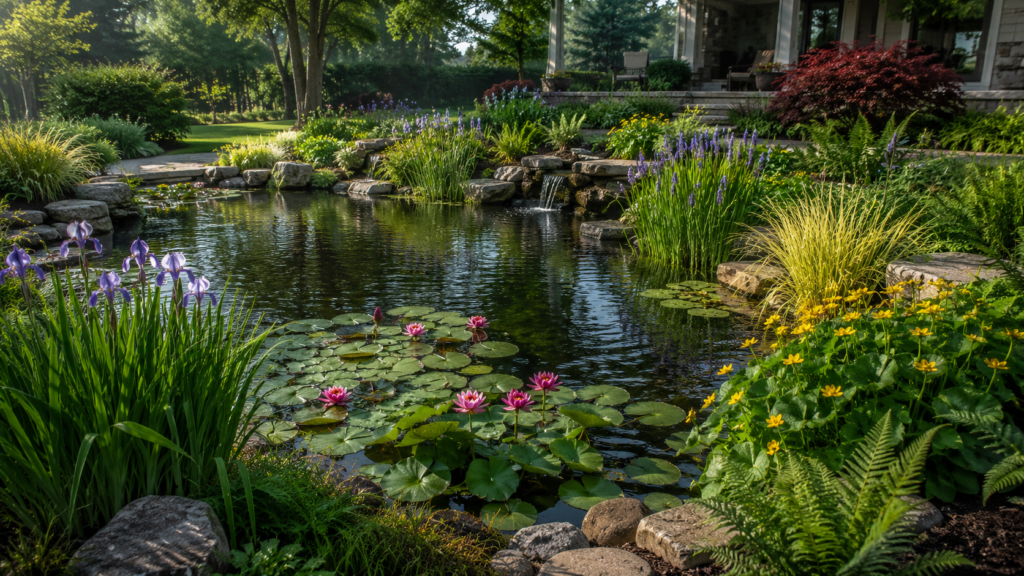
Backyard pond plant ideas work best when each plant is chosen for a specific water depth, mature size, sunlight level, and design role. A balanced pond normally combines floating-leaved plants for shade, marginal plants for flowers and height, submerged plants for underwater cover, and moisture-loving plants around the outer edge.
The goal is not to fill every part of the pond. Leave visible open water, keep filters and baskets accessible, and choose plants that remain proportional after reaching maturity. Aquatic plant legality and invasive status vary internationally, so always confirm the botanical name and local suitability before purchasing.
Choose Your Pond Planting Style
The best planting arrangement depends on the pond’s purpose. Wildlife ponds need varied habitat and shallow access, formal ponds benefit from controlled repetition, and koi ponds require protected baskets and open swimming space. Container ponds need compact plants that will not dominate a small volume of water.
| Pond type | Best starting combination | Main concern |
|---|---|---|
| Small wildlife pond | One dwarf lily, low marginals, submerged cover and shoreline plants | Overcrowding |
| Formal pond | One focal lily and two repeated marginal species | Too many colors |
| Koi pond | Protected lilies, tough marginals and open water | Fish uprooting plants |
| Container pond | One miniature focal plant and one small marginal | Full-size varieties |
| Shaded pond | Sedges, rushes, ferns and foliage plants | Limited flowering |
| Large natural pond | Repeated plant groups across several zones | Uncontrolled spread |
Choose plants in this order:
- Identify the pond’s main purpose.
- Measure every shelf from the finished water level.
- Select one main floating-leaved plant.
- Add low, medium and tall marginal layers.
- Add a restrained amount of submerged planting.
- Finish selected shoreline sections.
- Confirm mature spread and local legal status.
Quick Plant Selector
| Plant | Zone | Light | Best use |
|---|---|---|---|
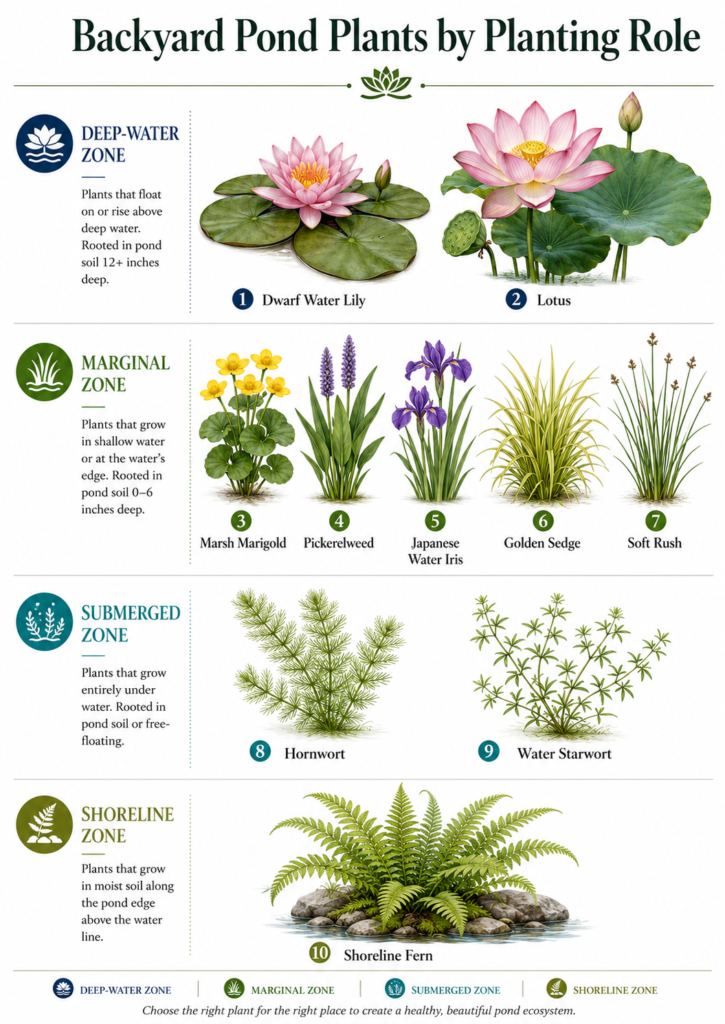
| Dwarf water lily | Deep water | Sun | Small ponds |
| Medium water lily | Deep water | Sun | Main surface feature |
| Lotus | Deep water | Sun | Large statement pond |
| Marsh marigold | Very shallow | Sun–part shade | Spring flowers |
| Pickerelweed | Marginal | Sun | Upright summer color |
| Japanese water iris | Marginal | Sun–part shade | Flowering height |
| Golden sedge | Shallow edge | Part shade | Bright foliage |
| Soft rush | Marginal | Sun–part shade | Vertical structure |
| Hornwort | Submerged | Variable | Underwater shelter |
| Ferns and sedges | Shoreline | Variable | Edge softening |
21 Backyard Pond Plant Ideas
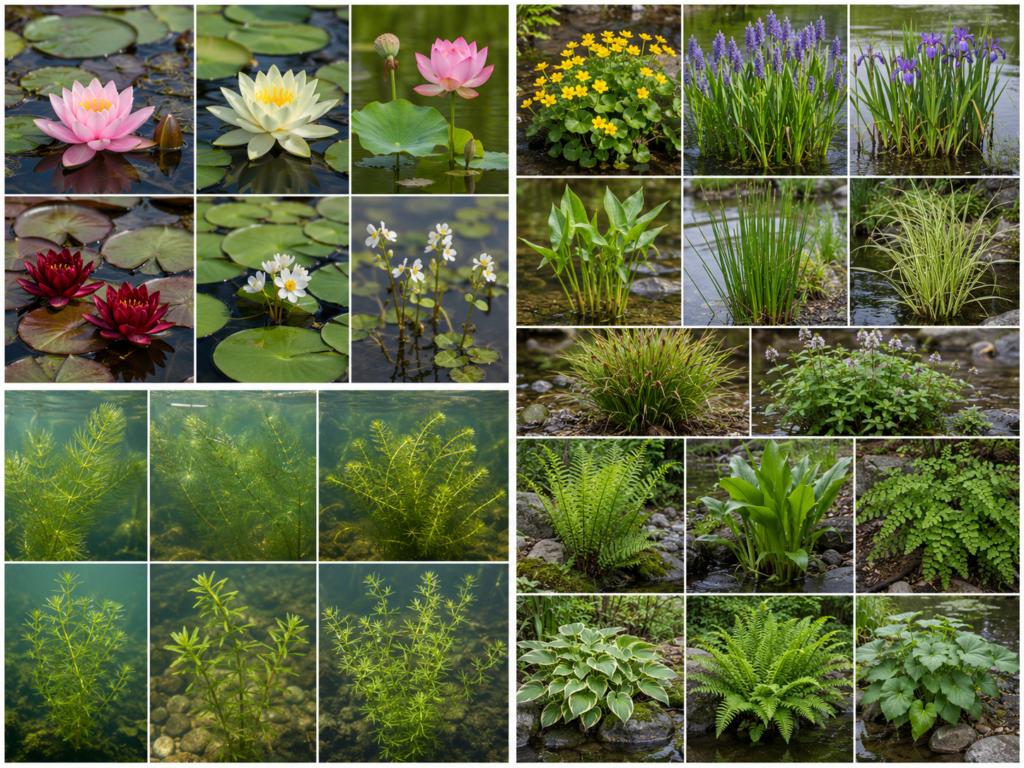
Deep-Water Plants
1. Dwarf Hardy Water Lily
A dwarf hardy water lily gives a small pond the classic lily-pad appearance without the spread of a full-size cultivar. It works well in compact wildlife ponds, raised ponds, half barrels, and large containers.
Choose a named dwarf cultivar and follow its recommended planting depth. Raise the basket temporarily if young leaves cannot reach the surface.
- Best for: Small ponds
- Main role: Flowers and surface shade
- Avoid: Strong fountain spray
2. Medium Hardy Water Lily
A medium hardy water lily can become the main focal plant in an average backyard pond. Its broad leaves create shade while its flowers draw attention toward the water.
Use one dominant flower color rather than several competing varieties. Leave open water between the lily and the primary viewing edge.
- Best for: Medium ornamental ponds
- Main role: Surface focal point
- Needs: Good sunlight and calm water
3. Tropical Water Lily
Tropical water lilies offer intense summer color and dramatic flowers, but they need warm conditions and may require winter storage in cold climates.
Choose one when seasonal impact matters more than low maintenance. A hardy lily is usually the simpler choice for gardeners who want year-round outdoor survival.
- Best for: Warm climates
- Main trade-off: Extra winter care
4. Water Hawthorn
Water hawthorn produces narrower floating leaves and delicate flower spikes that contrast with rounded water-lily pads. It works well in naturalistic and cottage-style ponds.
Use it as a secondary surface plant rather than allowing it to compete with the main lily.
- Best for: Medium natural ponds
- Main role: Fine surface texture
5. Lotus
Lotus creates a bold architectural feature because many leaves rise above the water. It needs more space than a typical small wildlife pond and should usually be treated as the dominant specimen.
Give lotus a wide container and position it where its mature foliage will not block the main view.
- Best for: Large sunny ponds
- Main risk: Overwhelming small spaces
Marginal Plants
6. Marsh Marigold
Marsh marigold adds bright yellow spring flowers to shallow water or saturated soil. Its low height makes it suitable near the front of the pond.
Combine it with later-performing foliage plants so the shelf remains attractive after flowering.
- Best for: Spring interest
- Placement: Very shallow shelf
7. Pickerelweed
Pickerelweed creates upright leaves and blue-purple flower spikes. It provides height, pollinator interest, and a useful background behind lower marginal plants.
Grow it in a separate basket so its spread can be controlled.
- Best for: Medium wildlife ponds
- Main role: Upright flowers
- Main risk: Vigorous growth
8. Japanese Water Iris
Japanese water iris provides sword-shaped foliage and large summer flowers. It suits formal and Japanese-inspired ponds where strong seasonal color is desired.
Place it behind lower marginals and confirm that the selected plant tolerates the available water depth.
- Best for: Ornamental ponds
- Main role: Summer height and color
9. Locally Native Iris
A locally native iris can add flowers, upright foliage, and emergent stems that aquatic insects use when leaving the water.
The correct species depends on location. Avoid purchasing an unidentified “pond iris,” because some iris species are invasive outside their natural range.
- Best for: Wildlife ponds
- Buying rule: Verify the botanical name
10. Arrowhead
Arrowhead produces distinctive pointed leaves that contrast with circular lily pads and narrow rushes. It creates a useful middle layer between low flowers and tall marginal plants.
Use a basket to control runners and choose a locally suitable species.
- Best for: Naturalistic ponds
- Main role: Bold foliage
11. Lizard’s Tail
Lizard’s tail has curved white flower spikes and relaxed foliage that soften hard stone, concrete, or brick pond edges.
Pair it with upright rushes or irises so the different shapes remain visually clear.
- Best for: Cottage ponds
- Main role: Soft flowering transition
12. Golden Sedge
Golden sedge provides yellow-green foliage and brightens partially shaded pond edges. It remains useful even when few plants are flowering.
Repeat it in two or three groups instead of using one isolated plant.
- Best for: Partial shade
- Main role: Foliage color
13. Corkscrew Rush
Corkscrew rush produces twisted stems that add movement and sculptural interest. It is particularly effective in container ponds and modern water features.
Use it as one accent rather than repeating it around the complete pond.
- Best for: Modern ponds
- Main role: Sculptural form
14. Soft Rush
Soft rush creates simple upright stems that frame the water and screen selected equipment. It suits contemporary, naturalistic, and wildlife designs.
Place it at the rear or side so it does not block the main viewing edge.
- Best for: Medium and large ponds
- Main role: Vertical structure
15. Water Forget-Me-Not
Water forget-me-not creates a low edge with small blue flowers. It is useful near seating areas where tall plants would hide the water.
Allow it to form broken groups rather than a continuous ring.
- Best for: Small wildlife ponds
- Main role: Low flowering edge
16. Bog Bean
Bog bean provides low spreading foliage that connects upright marginals with surface plants. It can also help hide exposed basket rims.
Control stems that move into neighboring containers or maintenance areas.
- Best for: Naturalistic ponds
- Main role: Horizontal shelf cover
17. Water Mint
Water mint offers aromatic foliage and small pollinator-friendly flowers. Position it close enough to a path or seating area for its scent to be noticed.
Keep it in a separate basket because it can spread vigorously.
- Best for: Sensory and wildlife gardens
- Main risk: Root spread
Submerged Plants
18. Hornwort
Hornwort creates underwater shelter for aquatic insects, tadpoles, and small fish. Begin with a small amount and thin it before it forms a dense mass.
Inspect removed stems for wildlife and never release plant fragments into natural waterways.
- Best for: Wildlife ponds
- Main role: Underwater structure
19. Water Starwort
Water starwort can grow below the surface and form small floating rosettes. It provides a natural transition between submerged and surface habitat.
Purchase it from a reliable specialist because aquatic plants with similar common names can be difficult to identify.
- Best for: Wildlife ponds
- Buying rule: Require botanical identification
20. Locally Native Pondweed
A locally native pondweed can provide underwater structure with less environmental risk than an imported waterweed.
Ask a regional aquatic specialist for a species suited to a contained garden pond. Native to the same country does not always mean native to the same ecological region.
- Best for: Responsible regional planting
- Main role: Submerged habitat
Shoreline Plants
21. Ferns and Native Sedges
Moisture-loving ferns and locally suitable sedges connect the pond to surrounding planting. They hide exposed liner, soften stones, and add texture without occupying more water.
Use ferns in shade and sedges where upright structure is needed. Leave access points around pumps, paths, and shallow wildlife edges.
- Best for: Every naturalistic pond
- Main role: Pond-to-garden transition
Pond Planting Zones
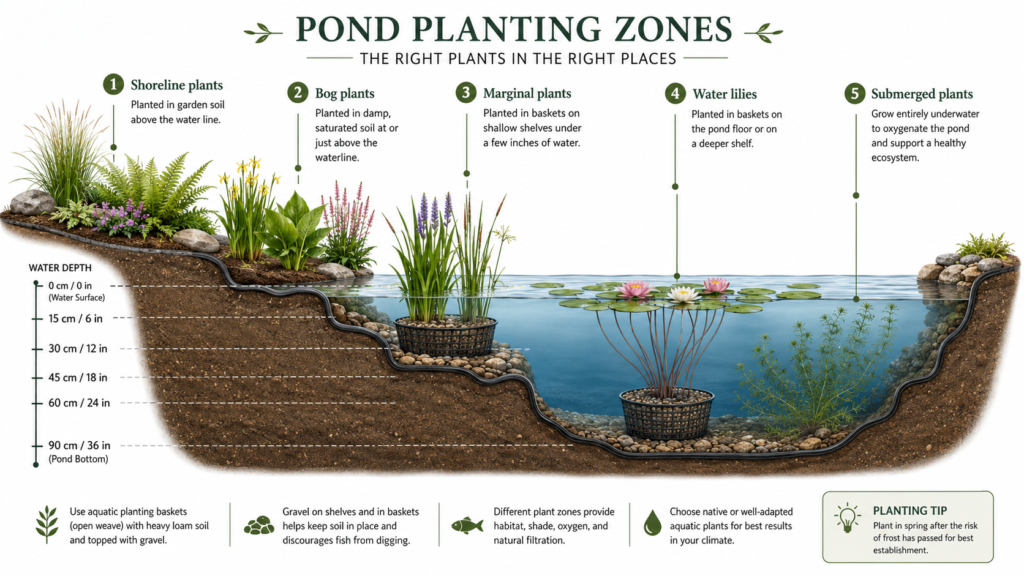
A pond should be planted from deep water outward. Plants placed at the wrong depth may produce weak growth, fail to flower, or rot at the crown.
Deep Water
Deep-water plants root in submerged baskets and send leaves to the surface. Water lilies, lotus, and water hawthorn belong here. Their exact depth depends on the named species or cultivar.
Keep them away from strong waterfalls and fountains, and leave enough space for mature surface spread.
Floating Surface
Free-floating plants provide adjustable shade but may reproduce rapidly and collect around filters. Their invasive and legal status varies greatly by region.
Use only locally approved plants, begin with a small amount, and never allow a complete surface mat.
Submerged Water
Submerged plants create underwater structure and may absorb nutrients during active growth. However, they do not replace filtration or aeration in a stocked fish pond.
Keep underwater growth loose and clear of pump inlets.
Marginal Shelves
Marginal plants grow in shallow water while their stems and leaves rise above the surface. They provide the greatest range of flowers, foliage forms, and heights.
Useful shelf depths include:
- Saturated mud to 5 centimetres
- Approximately 5–15 centimetres
- Approximately 15–30 centimetres for suitable species
Shoreline and Bog Edge
Shoreline plants grow outside permanent standing water. They hide the pond edge and connect the water to nearby beds.
Bog plants need damp soil but may not tolerate permanent submersion. Leave selected areas open for wildlife access and maintenance.
Pond Plans by Size
Container Pond
Use:
- One miniature water lily
- One compact marginal plant
- One small submerged plant group
- One branch, stone, or ramp for wildlife
- A visible area of open water
Place the container on a surface strong enough to support its full weight. Avoid koi and large goldfish because small water volumes heat and change quickly.
Small Wildlife Pond
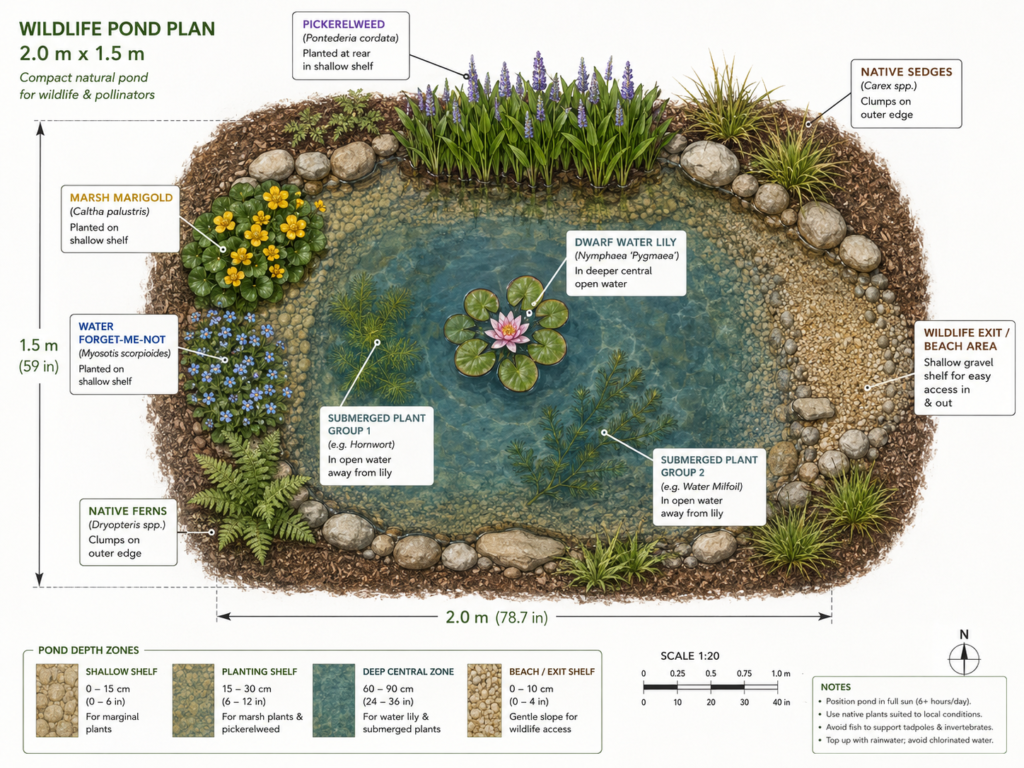
For a pond around 2 × 1.5 metres, use:
- One dwarf lily
- Two submerged plant groups
- Two low marginal groups
- One upright marginal group
- Two shoreline groups
- One shallow gravel exit
Keep tall plants on one side and preserve an open sunny edge.
Medium Ornamental Pond
For a pond around 4 × 3 metres, use:
- One or two compatible water lilies
- Three repeated low marginal groups
- Two medium flowering groups
- Two structural groups
- Two submerged areas
- One open reflection zone
Limit the visible palette to five or six main species.
Koi Pond
Use heavy baskets, smooth gravel, protected planting shelves, and separate bog or filter zones. Preserve open swimming space and do not rely on plants as the only filtration or aeration system.
Shaded Pond
Use golden sedge, rushes, water forget-me-not, ferns, and locally suitable submerged plants. Design around foliage and reflection rather than expecting heavy water-lily flowering.
Pond Plant Depth and Coverage
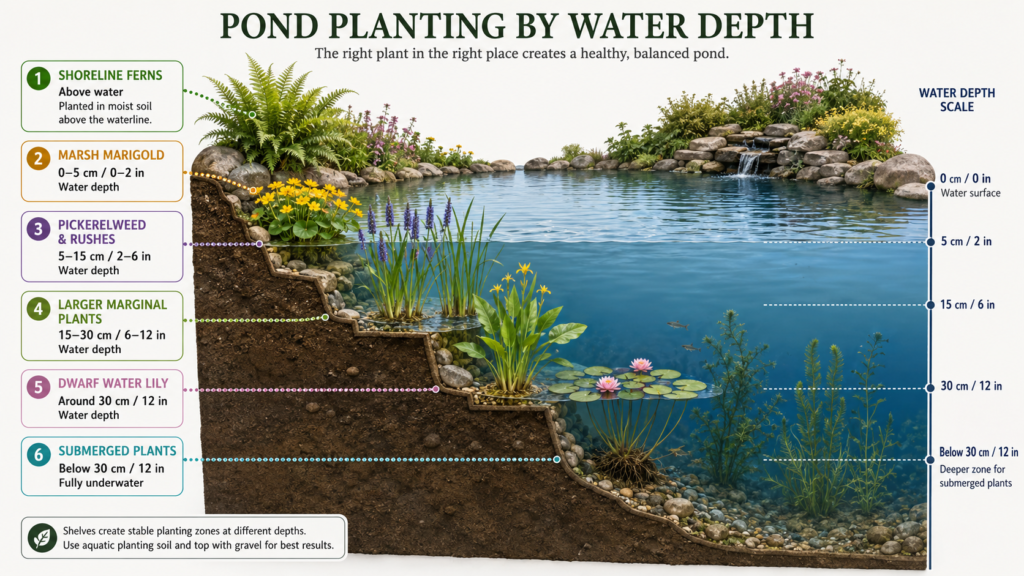
Aim to keep roughly half of the pond surface visibly open as a practical starting point. Surface leaves can provide shade, but complete coverage hides reflections, blocks access, and may reduce light below the water.
| Pond position | Approximate depth | Plant role |
|---|---|---|
| Shoreline | Above water | Ferns and sedges |
| Bog edge | Damp soil | Moisture-loving plants |
| Very shallow shelf | 0–5 cm | Marsh marigold and low sedges |
| Shallow shelf | 5–15 cm | Rushes, iris and pickerelweed |
| Medium shelf | 15–30 cm | Larger marginals |
| Dwarf-lily area | Around 30 cm or cultivar-specific | Small water lilies |
| Deeper area | Cultivar-specific | Medium or large lilies |
| Submerged zone | Below the surface | Underwater plants |
Signs of excessive coverage include overlapping lily pads, blocked filters, hidden fish, and no visible open-water area. Thin plants gradually rather than removing a large amount at once.
Plants Near Fountains and Waterfalls
Water movement creates different planting conditions inside the same pond. Water lilies and delicate floating leaves perform best in calm water, while rushes and robust marginals can tolerate areas near waterfall outlets.
| Area | Suitable plants |
|---|---|
| Calm corner | Water lilies and water hawthorn |
| Waterfall edge | Rushes, sedges and tough marginals |
| Splash zone | Moisture-loving shoreline plants |
| Pump inlet | Low, controlled planting |
| Viewing edge | Low flowers and sedges |
Keep loose submerged plants away from pump inlets and leave pipe connections accessible. Check whether fountain spray reaches paths and creates slippery surfaces.
How to Plant Pond Plants
1. Measure the Water Level
Measure each shelf vertically from the finished water surface. Record shelf width, sunlight, water movement, and maintenance access.
2. Choose Aquatic Baskets
Use baskets that provide room for root growth but remain manageable when lifted. Keep vigorous plants in separate containers.
3. Use Aquatic Planting Media
Use heavy aquatic soil or loam-based media. Avoid lightweight general potting compost, fresh manure, and loose bark-based mixtures.
4. Position the Crown
Spread roots into the soil while keeping the crown or growing point at the correct level. Do not bury new shoots.
5. Add Washed Gravel
Cover the soil with washed gravel to keep it inside the basket. Leave the crown uncovered and use smooth material in fish ponds.
6. Lower Plants Gradually
Raise young water lilies temporarily on bricks or stable supports. Lower them toward their final position as the leaves extend.
7. Inspect New Plants
Check botanical labels, remove unidentified fragments, inspect roots and leaves, and verify local legal status.
8. Label Every Basket
Record the plant name, cultivar, planting date, depth, and expected spread.
Control Pond Plant Spread
Contain vigorous plants before they become a problem. Water mint, pickerelweed, arrowhead, rushes, lotus, and some water lilies may require regular division.
Use these controls:
- Keep vigorous species in separate baskets.
- Leave gaps between containers.
- Remove escaping runners.
- Thin floating plants before they form a mat.
- Divide crowded crowns.
- Keep plant fragments away from drains.
- Dispose of surplus growth responsibly.
Inspect spreading plants in late spring and midsummer. Reduced flowering, unstable baskets, and roots escaping through containers are signs that division may be needed.
Pond Plants by Sunlight and Climate
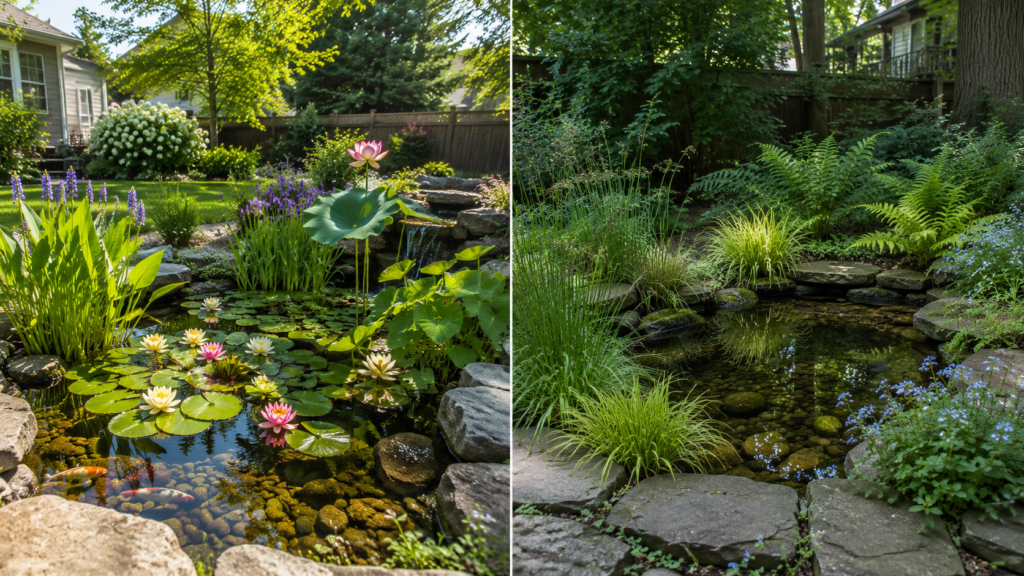
Full Sun
Sunny ponds suit:
- Hardy and tropical water lilies
- Lotus
- Pickerelweed
- Arrowhead
- Japanese water iris
- Many flowering marginals
In hot climates, partial afternoon shade can prevent a small pond from overheating.
Partial Shade
Choose:
- Golden sedge
- Soft rush
- Water forget-me-not
- Water mint
- Native sedges
- Moisture-loving ferns
Deep Shade
Focus on foliage, stones, reflections, ferns, and structural rushes. Deep shade is less suitable for flower-heavy water-lily displays.
Climate Decisions
In cold climates, choose hardy lilies and plants that can remain below freezing water. Store tropical plants indoors when necessary.
In warm climates, prioritize heat tolerance, water-level monitoring, and invasive-species control. Plants that die in winter elsewhere may spread continuously in tropical regions.
Wildlife and Fish Pond Plants
Wildlife Ponds
A wildlife pond needs submerged cover, floating leaves, emergent stems, low marginal growth, and a shallow exit.
Include:
- One shallow slope
- Open sunny water
- Underwater shelter
- Upright rush or iris stems
- Low flowering edges
- Nearby stones, grass, or shrubs
Avoid adding fish automatically because they may eat amphibian eggs, larvae, and aquatic insects.
Koi and Goldfish Ponds
Use heavy baskets, smooth gravel, protected shelves, and tough marginal plants. A separate planted filter or bog zone can protect roots while preserving swimming space.
Plants do not replace:
- Mechanical filtration
- Biological filtration
- Aeration
- Water testing
- Correct fish stocking
- Debris removal
Invasive Plants and Pond Safety
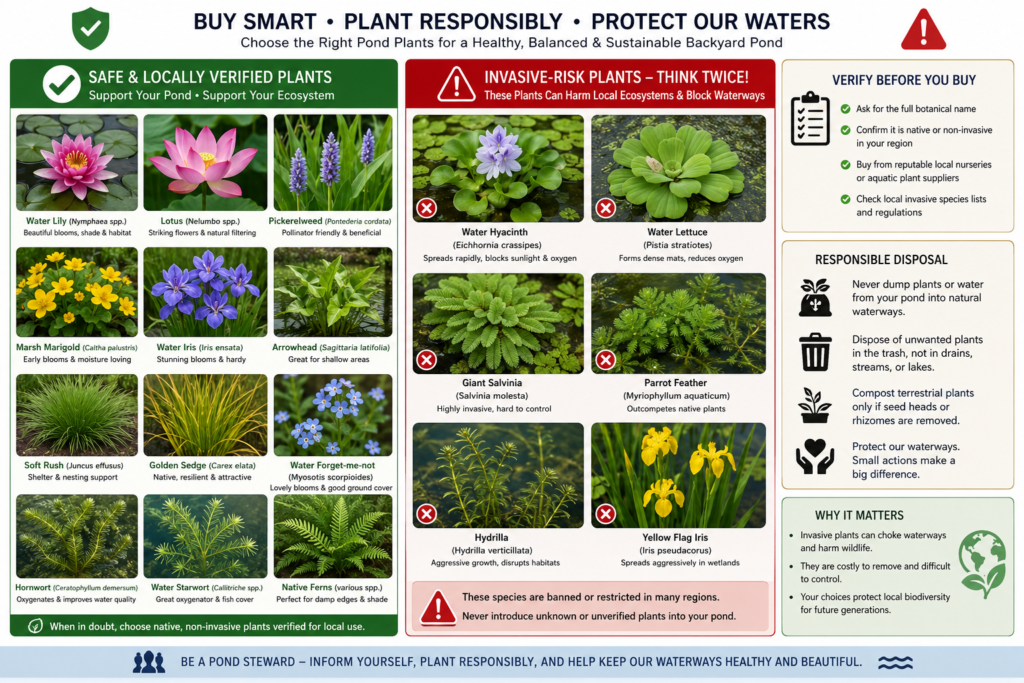
Never purchase an aquatic plant without confirming its botanical name and local status. High-risk plants in some regions include:
- Water hyacinth
- Water lettuce
- Giant salvinia
- Parrot’s feather
- Hydrilla
- Eurasian watermilfoil
- Yellow flag iris
- Purple loosestrife
Never place unwanted aquatic plants in lakes, rivers, drains, wetlands, or public ponds.
For household and wildlife safety:
- Keep pond edges stable.
- Avoid hidden deep drops beside paths.
- Keep electrical equipment accessible.
- Prevent fountain spray from making paving slippery.
- Provide a ramp or shallow edge for wildlife.
- Use smooth fish barriers.
- Keep one edge open for visibility and maintenance.
- Follow local child-safety requirements.
Seasonal Pond Plant Care
Spring
Remove collapsed foliage, inspect baskets, divide crowded plants, repot water lilies, and add new plants after the water begins warming.
Summer
Thin excessive surface leaves, remove fading flowers, control spreading marginals, clear pump inlets, and monitor fish during hot weather.
Autumn
Remove collapsing foliage before it sinks, reduce heavy leaf accumulation, and prepare tender plants for winter storage.
Winter
Keep hardy crowns at a safe depth, protect containers from freezing damage, and avoid unnecessary disturbance of dormant wildlife.
Common Pond Planting Mistakes
Buying Before Measuring
Measure pond depth, shelf width, sunlight, and access before visiting a nursery.
Choosing Unnamed Plants
Require a botanical name. Common names may refer to native, non-native, or invasive species.
Covering the Whole Surface
Preserve open water for reflection, maintenance, fish movement, and light penetration.
Planting Every Shelf at One Height
Use low, medium, and tall groups to create depth and keep the viewing edge open.
Using Too Many Species
Repeat a limited palette instead of planting one specimen of every available plant.
Ignoring Mature Spread
Plan for the plant’s final size, not its nursery-pot width.
Expecting Plants to Fix Water Quality
Plants cannot compensate for excessive fish, poor filtration, nutrient runoff, or decomposing debris.
Blocking Maintenance Access
Leave clear routes to pumps, filters, baskets, and electrical equipment.
What to Buy for a Planted Pond
Start with:
- Aquatic planting baskets
- Heavy aquatic planting media
- Washed gravel
- Stable underwater risers
- Durable plant labels
- One named surface focal plant
- Two or three marginal groups
- One verified submerged plant
- Shoreline plants
- Basic pruning tools
Ask the nursery:
- What is the botanical name?
- What is the mature spread?
- What depth does it need?
- Is the depth measured to the basket or crown?
- Is it hardy locally?
- How quickly does it spread?
- Is it safe and legal locally?
- Does it need protection from fish?
Final Pond Plant Checklist
Confirm that:
- Every shelf has been measured.
- Each plant has a known botanical name.
- Mature spread fits the pond.
- The sunlight matches the plant.
- The main viewing edge remains open.
- Vigorous plants are contained.
- Approximately half the surface remains visible.
- Wildlife has an exit.
- Fish cannot overturn baskets.
- Pumps and filters remain accessible.
- Invasive-species rules have been checked.
- A disposal method is available.
Backyard Pond Plant FAQs
What are the best plants for a small backyard pond?
Choose a dwarf water lily, one compact marginal plant, a restrained submerged plant, and low shoreline foliage. Avoid lotus, full-size cattails, and vigorous floating plants.
How many plants should I put in a pond?
Start with one surface focal plant, several marginal groups, limited submerged growth, and selected shoreline planting. Leave space for mature growth.
How much of the pond surface should plants cover?
Keep approximately half the surface open as a practical starting point. Thin floating leaves when they block filters, reflections, fish movement, or access.
Which pond plants grow in shade?
Golden sedge, soft rush, water forget-me-not, native sedges, and moisture-loving ferns suit partial shade. Deep shade should emphasize foliage and reflection.
Can pond plants replace a filter?
Pond plants cannot reliably replace filtration in koi or heavily stocked goldfish ponds. Fish ponds normally need mechanical and biological filtration.
How deep should pond plants be placed?
Very shallow marginals may need less than 5 centimetres of water, while others suit shelves 5–30 centimetres deep. Water-lily depth depends on the cultivar.
How do I stop pond plants from spreading?
Use separate baskets, remove escaping runners, thin foliage, and divide crowded plants before they reach neighboring containers.
What are the best pond plants for wildlife?
Use submerged plants, floating leaves, rushes or irises, low marginal flowers, and shoreline vegetation. Add a shallow slope or gravel exit.
Which pond plants work with koi?
Protected water lilies, tough marginals, and plants in separate bog-filter zones are practical options. Use heavy baskets and smooth gravel.
Are water hyacinth and water lettuce safe?
Their status varies by region, and both are invasive or regulated in some climates. Verify local rules before purchasing and never release them outdoors.
When is the best time to plant a pond?
Mid-spring to early summer is generally suitable because warming water supports active growth. Adjust for local frost and extreme heat.
Editorial Method
The plant ideas in this guide were evaluated by pond zone, mature spread, visual role, sunlight, wildlife value, fish compatibility, maintenance demand, and invasive-species risk.
The plant selector and planning recommendations are editorial decision tools rather than scientific ratings. Readers should confirm botanical identity, local hardiness, legal status, and disposal requirements through relevant regional authorities or aquatic-plant specialists.

Myra is the founder and lead writer of Backyard Planter Ideas, where she shares practical, well-researched guidance on planter design, plant selection, and outdoor styling. Her goal is to help homeowners create attractive, functional garden spaces with clear, reliable, and easy-to-apply advice.