
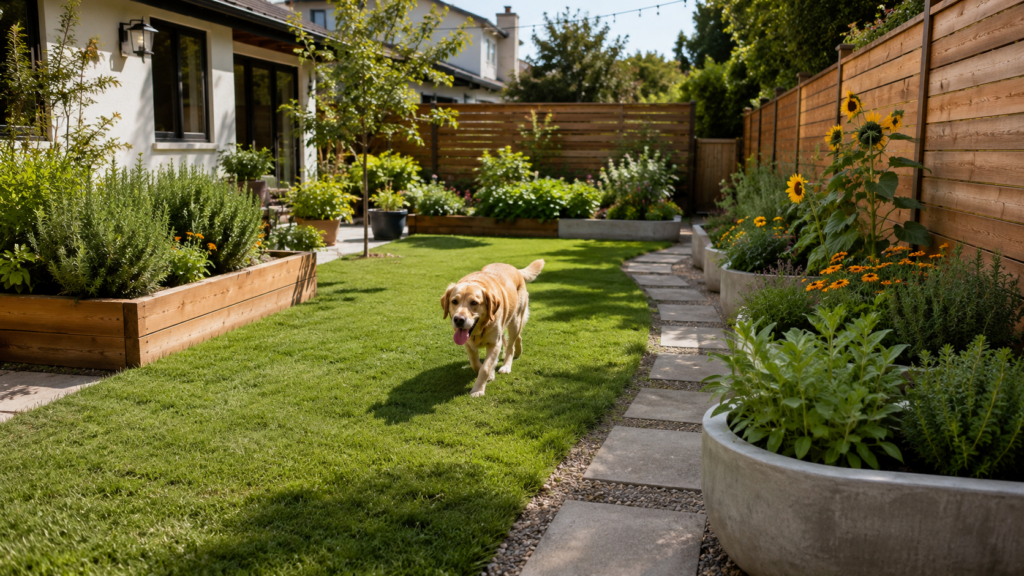
Dog-friendly backyard planter ideas combine verified plant choices, stable containers, protected soil and clear routes for walking, running and play. Raised beds, heavy pots, tall troughs and vertical planters can protect plants from digging and trampling without making the yard feel restricted.
Start with your dog’s behaviour. Watch where your dog runs, rests, digs, sniffs or marks. A planter placed across an established route is likely to be jumped over, squeezed behind or damaged. Safety also extends beyond toxicity: a suitable plant can still sit in an unstable pot with sharp hardware or poor drainage.
This guide helps you choose planter types, materials, plants and layouts while avoiding common hazards and maintenance problems.
Which Dog-Friendly Backyard Planter Is Best?
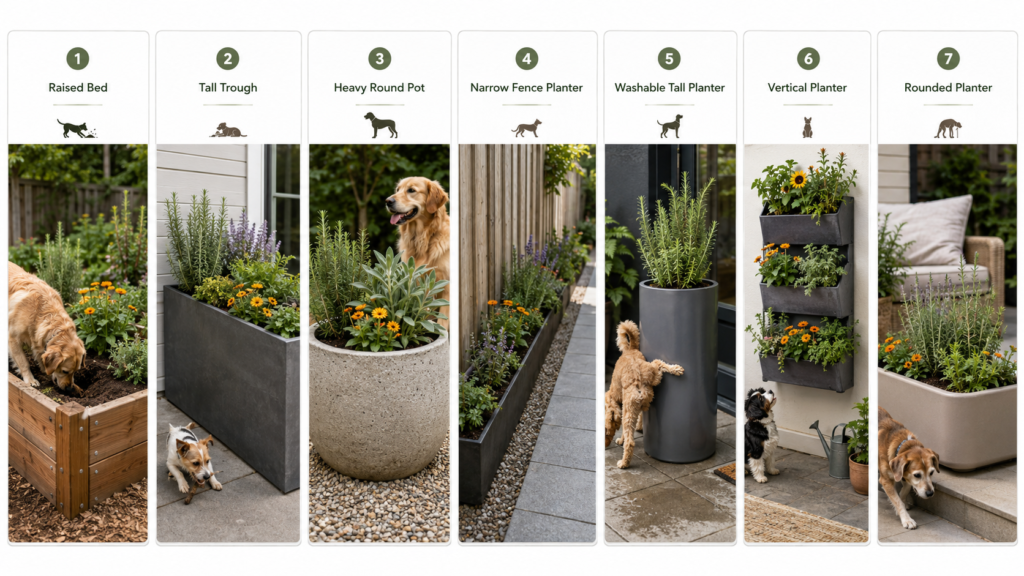
The best dog-friendly planter solves the main problem without creating a new one. A digging dog needs protected soil, a chewer needs foliage above mouth level, and a large active dog needs a broad container that will not tip when bumped.
| Main problem | Best starting option | Main caution |
|---|---|---|
| Digging | Raised or protected bed | Determined dogs may jump inside |
| Chewing | Tall trough or wall planter | Trailing stems may remain reachable |
| Knocking over pots | Broad, heavy container | Difficult to move when filled |
| Fence running | Narrow planter inside the route | Preserve the patrol lane |
| Marking | Tall, washable planter | Porous materials retain odour |
| Small patio | Vertical or tiered planter | Requires secure support |
| Senior dog | Rounded planters and wide paths | Avoid slippery runoff |
Use height for chewing, width and weight for impact, soil covers for digging and vertical growing for limited space. Keep containers outside fast routes and never place one where it becomes a step toward a fence.
4 Essential Dog-Planter Rules
Four rules should guide every planter decision. Identify each plant by its botanical name, never use elevation to justify a toxic plant, preserve the dog’s established routes and prioritize stability over decorative height. UF/IFAS notes that paths can help guide pets toward suitable areas, although they do not force behaviour.
- Verify every plant by scientific name.
- Keep toxic species out of accessible areas.
- Preserve fence lanes, gates and door-to-lawn routes.
- Choose a broad base and secure fixings.
- Protect loose soil where digging is likely.
- Store fertilizer, pesticides and compost securely.
- Remove fallen flowers, berries and seeds.
- Prevent planters from becoming climbing aids.
These rules apply to the whole growing system. A suitable flower in an unstable pot beside a running route is not a dog-friendly setup.
What Makes a Planter Dog-Friendly?
A dog-friendly planter passes five tests: plant safety, stability, soil protection, route compatibility and maintenance safety. The ASPCA maintains a searchable list of toxic and non-toxic plants for dogs, but the exact species still needs verification.
- Plant safety: Confirm the botanical name.
- Stability: Test the filled planter for rocking or tipping.
- Soil protection: Raise, cover or densely plant exposed soil.
- Route compatibility: Keep doors, gates, shade and water accessible.
- Maintenance safety: Secure drainage, fixings, tubing and products.
Dog-Planter Fit Score
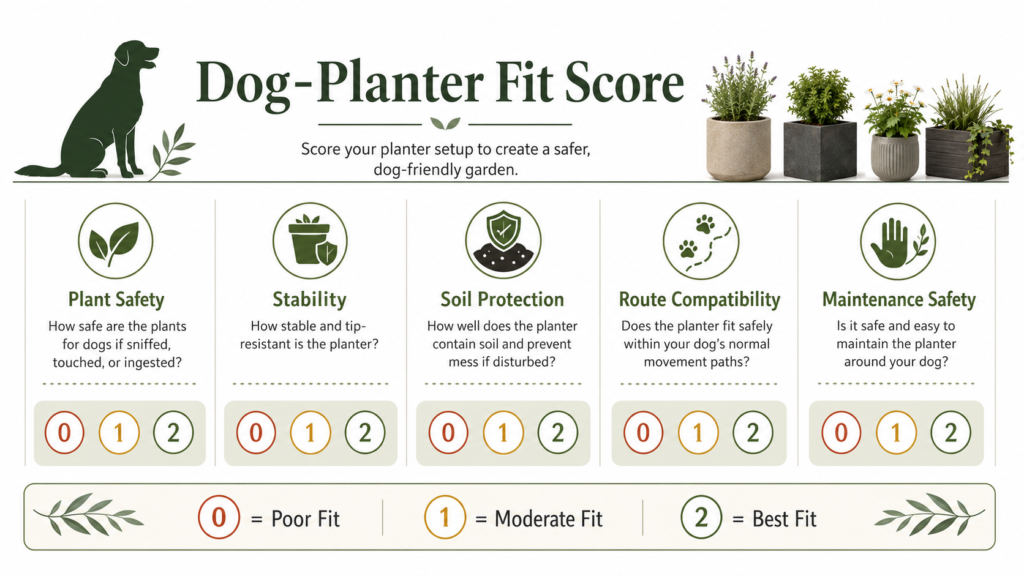
| Factor | 0 points | 1 point | 2 points |
|---|---|---|---|
| Plant safety | Unknown | Mostly checked | Fully verified |
| Stability | Easily tipped | Normally stable | Broad or anchored |
| Soil protection | Accessible | Partly protected | Raised or fenced |
| Route compatibility | Blocks route | Narrows route | Preserves movement |
| Maintenance safety | Hazards exposed | Controlled | Permanently secured |
A score of 8–10 indicates a strong fit, 5–7 needs modification, and 0–4 suggests another design. This is a planning tool, not a veterinary or engineering standard.
Match Planters to Dog Behaviour
Observe the dog before changing the garden. A dog may dig because the soil is cool, run along a fence because activity is visible outside or chew foliage because stems move in the wind. The right planter removes the reward or redirects access rather than merely making the behaviour inconvenient.
For diggers, use raised beds, protected soil and dense edge planting. Penn State Extension recommends providing a dedicated dig pit where suitable because it gives dogs an acceptable outlet for natural digging behaviour. Chewers benefit from tall troughs and upright plants. Fence runners need their patrol strip preserved, with planters placed along its inner edge rather than across it.
Large dogs need fewer, heavier containers and wider turning space. Dogs that mark should have washable planters positioned away from gates, corners and edible crops. Senior dogs benefit from rounded containers, visible routes and surfaces that remain non-slip after watering.
Best Planter Materials for Dogs
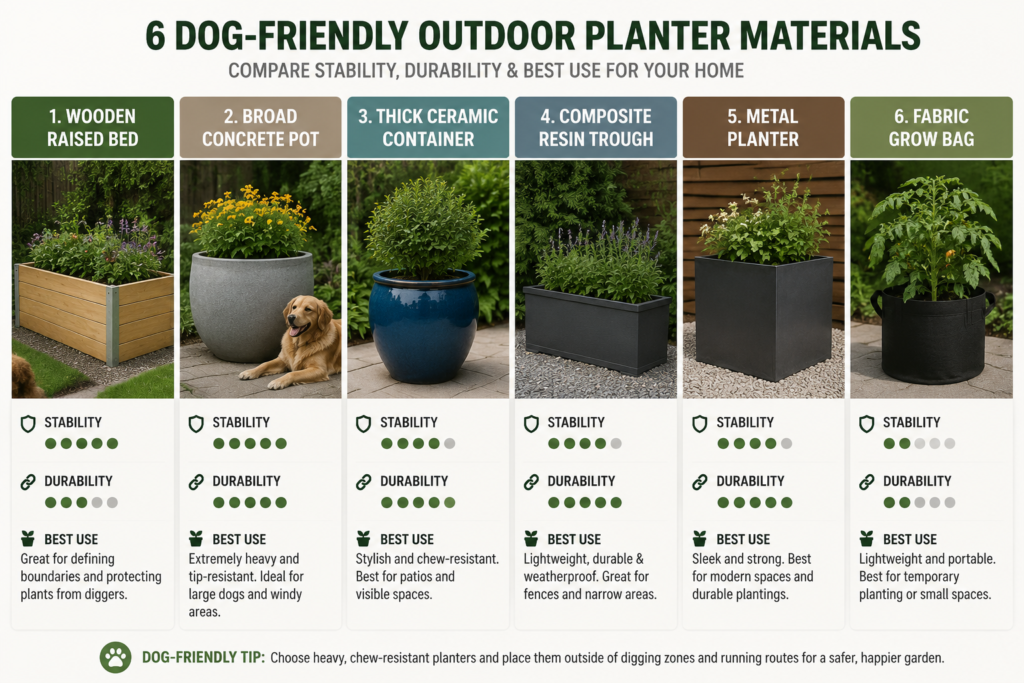
Material matters, but shape and placement matter more. A broad resin trough may be safer than a narrow ceramic column, while a concrete pot can still be hazardous inside a running line.
| Material | Main strength | Main limitation | Best use |
|---|---|---|---|
| Wood | Customizable and repairable | Can splinter or rot | Raised beds |
| Concrete | Very stable | Heavy to move | Large dogs |
| Ceramic | Washable and attractive | May crack sharply | Quiet patios |
| Composite | Light and weather-resistant | Quality varies | Mobile layouts |
| Metal | Durable | Can become hot | Shaded areas |
| Fabric | Good drainage | Easy to scratch | Protected zones |
Choose concrete for permanent high-impact areas, wood for custom beds and composite when mobility matters. Keep ceramic outside play routes, control heat around metal and place fabric bags behind a barrier.
17 Dog-Friendly Backyard Planter Ideas
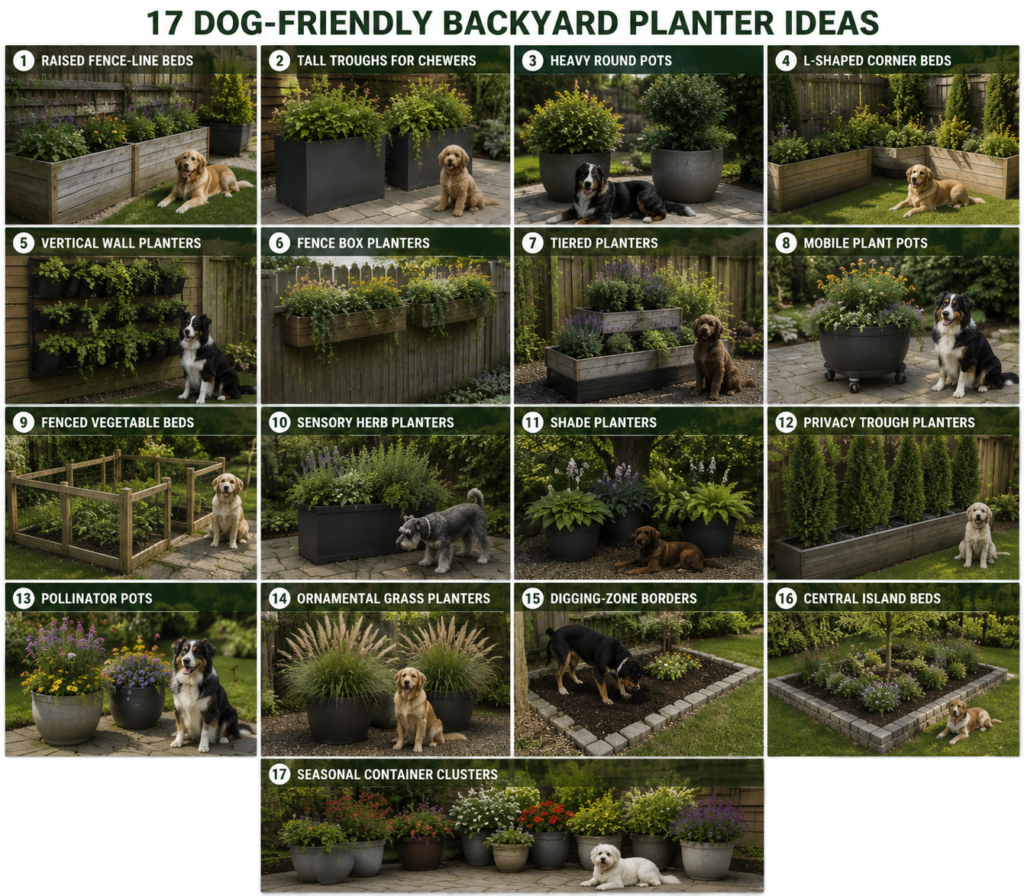
Choose one design that solves the main problem, test it, then repeat it only if the dog responds well.
1. Raised Fence-Line Bed
A raised wooden or masonry bed protects loose soil. Place it inside, not across, the patrol route and use smooth boards with recessed fixings.
Best for: Diggers and fence lines.
2. Tall Trough
A tall trough raises upright plants above mouth level. Use a broad base and trim trailing stems.
Best for: Chewers and narrow patios.
3. Heavy Round Planter
Concrete, stone or reinforced composite resists impact, while rounded sides reduce sharp corners. Direct drainage away from paths.
Best for: Large dogs and busy patios.
4. L-Shaped Corner Bed
An L-shaped planter uses an awkward corner without filling the centre. Keep the inside corner visible and easy to clean.
Best for: Small yards.
5. Vertical Wall Planter
A vertical system preserves floor space. Fix it to a suitable support and account for the weight of wet soil.
Best for: Courtyards and herb displays.
6. Fence-Mounted Boxes
Mounted boxes add colour without narrowing the patrol lane. Use only on a sound fence and trim hanging growth.
Best for: Narrow side yards.
7. Tiered Planter
Tiered planters create several growing levels. Keep delicate plants above and avoid staircase shapes beside fences.
Best for: Small patios.
8. Mobile Planter
Load-rated locking casters allow seasonal movement. Test the planter at full weight and lock every wheel.
Best for: Rentals and flexible layouts.
9. Fenced Kitchen Planter
A raised edible bed inside a secondary fence protects seedlings, soil and garden products. Include a secure gate.
Best for: Vegetables and persistent diggers.
10. Sensory Herb Planter
A planter beside a slow sniffing route can hold rosemary or sage. Dogs Trust lists both as dog-friendly choices but notes that eating a lot may upset the stomach.
Best for: Enrichment areas.
11. Resting-Area Planter
A stable planter can frame shade without blocking airflow, water or an exit route. Choose soft foliage and control runoff.
Best for: Senior dogs.
12. Privacy Trough
Staggered tall troughs provide screening with better airflow than one solid wall. Keep them away from the boundary fence.
Best for: Urban patios.
13. Pollinator Planter
Use a broad pot with two or three identified flowers rather than an unknown seed mix. Place it away from fast play.
Best for: Sunny gardens.
14. Grass Route Markers
Soft ornamental grasses can define a path. Verify the species and avoid sharp blades or awns.
Best for: Modern layouts.
15. Digging-Zone Border
Stable planters can outline a designated dig pit. Avoid cocoa mulch, compost, toxic bulbs and swallowable stones.
Best for: Habitual diggers.
16. Central Island
A round or oval island creates a running loop. Keep outer plants low and provide generous clearance on every side.
Best for: Larger yards.
17. Seasonal Cluster
Group one large, one medium and one low pot instead of scattering small containers. Verify every seasonal replacement.
Best for: Flexible patios.
Dog-Safe Plants for Planters
Plant selection should combine toxicity verification, climate fit, mature size and physical form. Dogs Trust lists rosemary, sage, calendula, cornflower and sunflower among dog-friendly garden options, while noting that eating a large amount may still upset the stomach.
| Planter use | Starting options | Main caution |
|---|---|---|
| Sunny herb trough | Rosemary, sage | Keep woody stems out of paths |
| Flower pot | Calendula, cornflower | Clear fallen stems |
| Deep structural pot | Identified sunflower | Tall types need support |
| Sensory planter | Rosemary and sage | Do not encourage chewing |
| Flowering focal pot | True rose | Thorns remain hazardous |
The ASPCA lists true roses in the genus Rosa as non-toxic to dogs, but thorns can still injure eyes or paws.
Before buying, confirm the botanical name, toxicity classification, mature size, light needs, climate suitability and physical hazards. A limited palette of three compatible plants is easier to verify and maintain than an overcrowded mixture.
Toxic Plants and Safer Alternatives
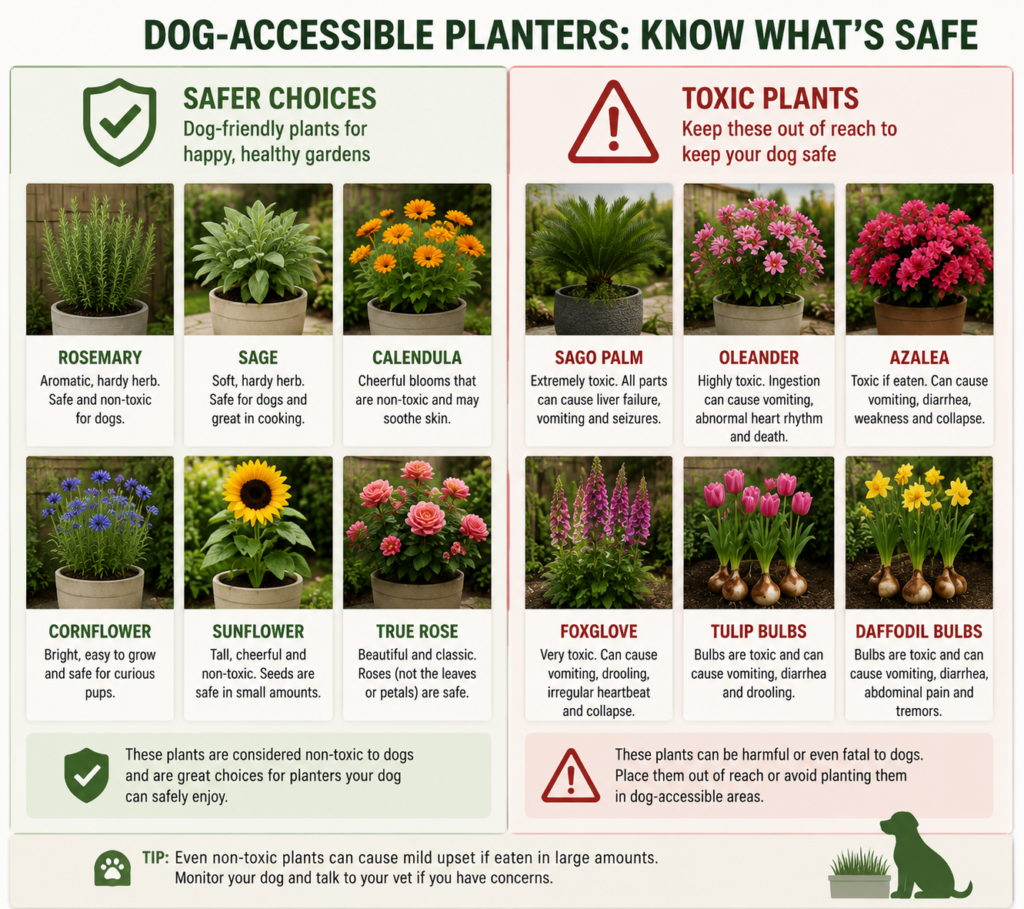
Do not use a toxic plant simply because its container is high. Leaves, seeds, berries and bulbs can fall, and the ASPCA dog plant database should be checked for every exact species.
Common concerns include sago palm, oleander, azalea, rhododendron, foxglove, yew, tulip bulbs, daffodil bulbs and autumn crocus. Replace the plant’s function rather than choosing a visually similar unknown species.
| Unsafe function | Safer direction |
|---|---|
| Tropical focal point | Verified non-toxic architectural plant |
| Toxic privacy shrub | Staggered troughs with verified screen plants |
| Toxic flowering spike | Verified upright annuals |
| Toxic bulbs | Verified seasonal annuals |
| Thorny path plant | Soft foliage away from the route |
Every substitute still needs botanical verification and must fit the climate, planter and available space.
Dog-Safe Soil, Mulch and Hardware
A suitable plant can still sit inside an unsafe system. Review potting mix, mulch, fertilizer, compost, supports, drainage and nearby storage.
Avoid cocoa mulch. The ASPCA warns that its chocolate-like smell can attract dogs and that ingestion may cause gastrointestinal, cardiac or neurological signs. Store fertilizers, pesticides and tools in a locked area, follow label directions and keep dogs away during any stated re-entry period.
Use a closed compost system because mouldy food and ingredients such as onion, garlic or grapes may create additional hazards.
Inspect for:
- Exposed screws, wire and staples
- Broken ceramic or splintered boards
- Loose trellises
- Pullable irrigation tubing
- Standing water on paths
- Thorny stems projecting into routes
- Small stones that may be swallowed
“Natural” does not automatically mean safe. Judge every material by the individual dog’s tendency to chew, swallow or dig.
How Tall Should Planters Be?
No planter height is universally dog-proof. A 45–60-centimetre, or 18–24-inch, raised edge may discourage many calm or smaller dogs, but it will not stop every jumper or persistent digger. Treat height as one layer of protection rather than the complete solution.
| Behaviour | Better response |
|---|---|
| Casual stepping | Raised edge with dense planting |
| Persistent digging | Raised bed plus soil grille or barrier |
| Plant chewing | Tall trough with upright plants |
| Jumping into beds | Fenced growing zone |
| Large-body impact | Broad, heavy base rather than extra height |
| Climbing near a fence | Move the planter away from the boundary |
Select height according to shoulder height, jumping ability and previous response to boundaries. Test an empty planter or temporary barrier first. A wider container that is difficult to enter may work better than a taller, narrow pot that can tip.
Plan a Dog-Friendly Layout
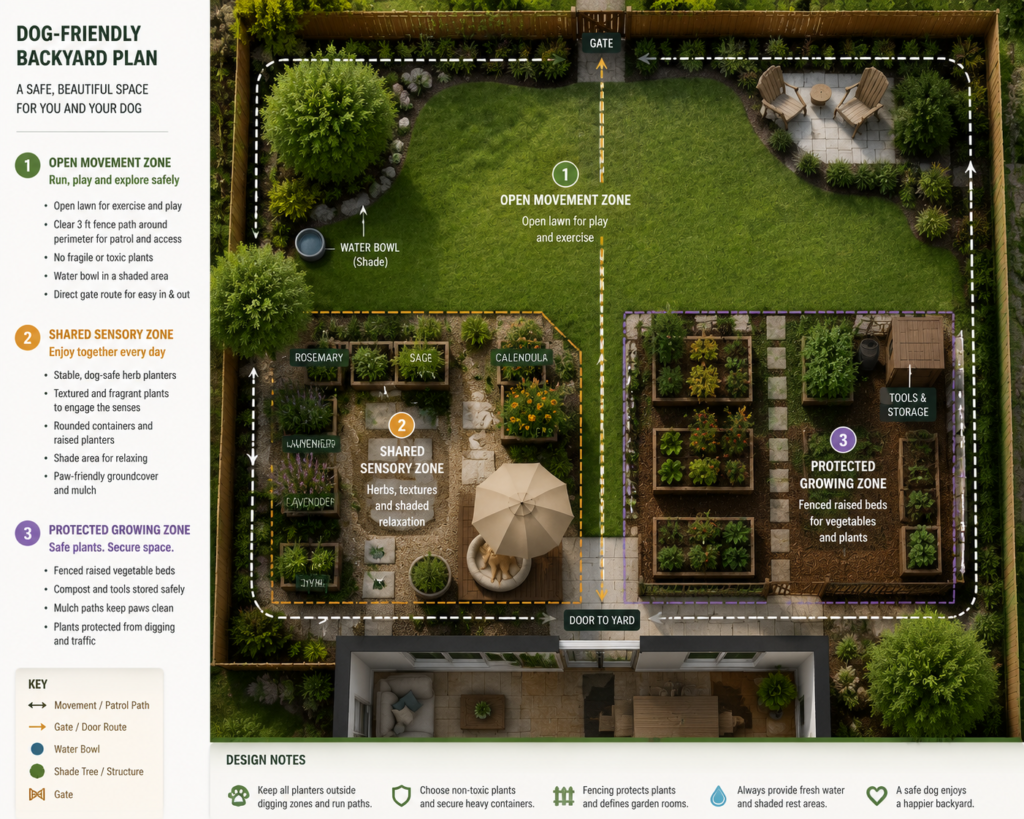
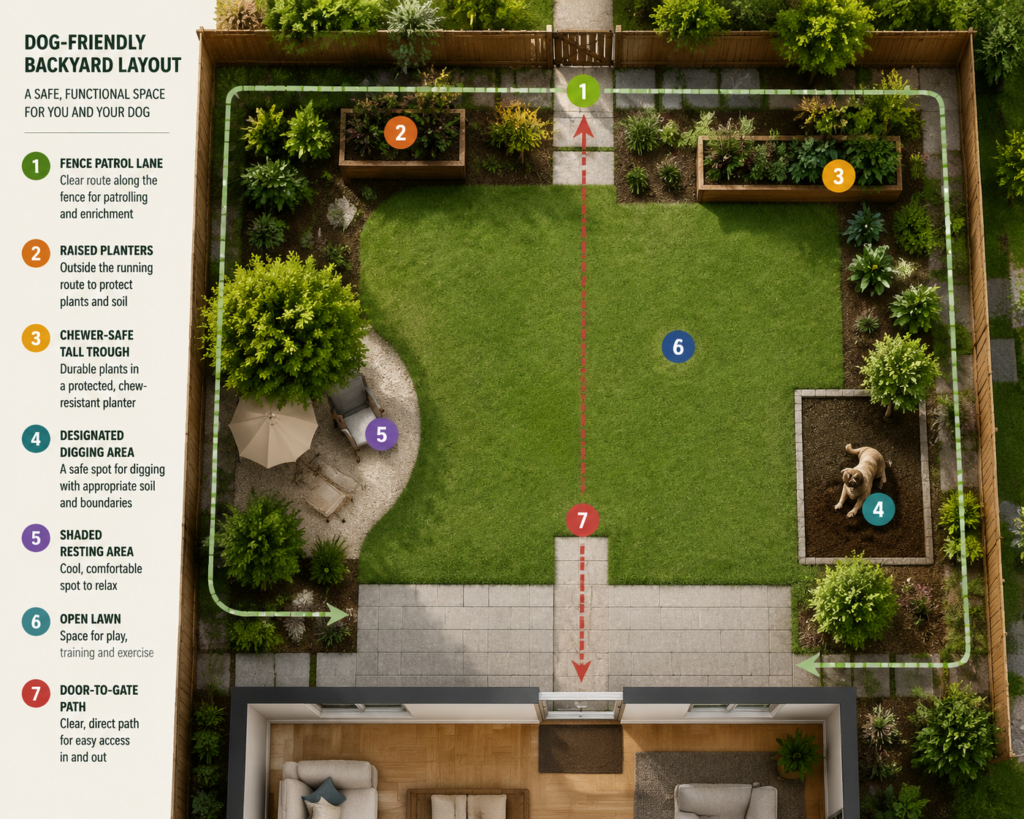
Begin with movement, not planting. Mark the door-to-lawn route, fence lane, gate approach, shade, water, toileting areas and digging spots. Then use three zones:
- Movement zone: Open lawn, patrol lane and direct routes.
- Shared sensory zone: Stable planters beside slower sniffing areas.
- Protected growing zone: Raised or fenced beds for vegetables and seedlings.
For a 3 × 4 metre patio, use one vertical planter, one corner trough and an open central route. In a 1.5 × 6 metre side yard, preserve the fence lane and use mounted boxes. In a 6 × 8 metre family yard, keep the centre open and place beds around the perimeter.
Test footprints with empty pots or cardboard. Open gates, move furniture and play with the dog before filling anything. This reveals pinch points and drainage problems while changes are still easy.
Build or Buy a Planter?
Build when the site needs custom dimensions, an L shape or a permanent bed designed around a specific route. Buy when speed, predictable finishing or mobility matters more.
| Factor | Build | Buy |
|---|---|---|
| Custom sizing | Excellent | Limited |
| Speed | Slower | Faster |
| Tools | Required | Minimal |
| Repairability | Often good | Varies |
| Portability | Must be designed | Often available |
Before deciding, check:
- Base width and filled stability
- Drainage direction
- Rounded or protected corners
- Covered hardware
- Weather resistance
- Mature plant size
- Fence clearance
- Caster ratings where relevant
- Suitability for edible growing
For a DIY bed, reinforce corners, recess screws and finish materials appropriately for outdoor use. For a purchased planter, look beyond colour and empty weight; product dimensions, drainage and filled stability matter more.
A well-made purchased planter is safer than a weak DIY box, while a reinforced custom bed may fit an awkward location better than a standard product.
Climate and Maintenance
Climate affects both material and plant choice. Dark metal can become hot in strong sun, porous ceramic may crack during freeze-thaw cycles, and tall plants can destabilize undersized pots in wind.
In wet climates, prioritize drainage and airflow. In dry climates, group plants with similar water needs and protect irrigation tubing. Check local plant suitability and invasive-species guidance.
Inspect new planters weekly for the first month and monthly afterward. Recheck after storms, repotting or pruning. Look for rocking, chewed wood, cracks, blocked drainage, exposed tubing, fallen seeds, overgrown routes and accessible products.
Reassess the layout as the dog ages. Senior dogs may need wider paths, fewer obstacles and better traction.
Why Is Your Planter Failing?
Most failures come from a mismatch between placement and behaviour.
| Symptom | Likely cause | Correction |
|---|---|---|
| Dog still digs | Exposed soil | Add planting, grille or barrier |
| Planter tips | Base too narrow | Weight, anchor or replace |
| Dog squeezes behind | Shortcut remains | Close or formalize the path |
| Stems are chewed | Foliage is reachable | Prune or use upright plants |
| Pot is marked | Poor location | Move away from gates and corners |
| Water crosses path | Drainage is wrong | Redirect or level the base |
| Dog jumps toward fence | Planter is a step | Move it inward |
| Senior dog avoids route | Narrow or slippery passage | Widen and improve traction |
Change one factor at a time. Adding height without identifying the cause may create a larger obstacle while leaving the original reward unchanged.
Final Dog-Planter Checklist
Before filling the planter, confirm that:
- Every plant has been identified botanically.
- Toxicity has been checked specifically for dogs.
- The planter does not rock or roll.
- Fixings and edges are smooth.
- The location does not block a route.
- Soil is protected from persistent digging.
- Drainage stays away from paths.
- Fertilizers, pesticides and compost are secure.
- The planter does not become a climbing aid.
- Mature plant width has been considered.
- Shade and water remain accessible.
- The layout has been tested while empty.
- The design can adapt as the dog ages.
A planter that fails several checks should be modified before plants and wet soil make it difficult to move.
Dog-Friendly Planter FAQs
What is the best planter for a dog that digs?
A raised bed with protected soil is the best starting point. Persistent diggers may also need a grille, barrier or designated dig area.
How tall should a dog-resistant planter be?
A height of 45–60 centimetres may discourage many calm or smaller dogs, but jumpers may need a fenced growing zone.
Which material is best for a large dog?
Broad concrete, masonry or reinforced composite planters usually provide the best stability outside fast running routes.
Are wooden planters safe?
Yes, when stable, smooth and free from exposed screws or splinters. Replace chewed or rotting boards promptly.
Can toxic plants be kept in tall pots?
No. Plant material can fall and pots can tip. Use verified non-toxic alternatives.
Which plants can I use?
Dogs Trust lists rosemary, sage, calendula, cornflower and sunflower as starting options. Verify every exact species.
Can a non-toxic plant still cause illness?
Yes. Eating a large amount of a dog-friendly plant may still upset the stomach.
Are roses safe for dogs?
True Rosa roses are listed as non-toxic, but thorns remain hazardous.
Can planters stop fence running?
They can define the route but should not block it abruptly. Preserve a clear strip beside the fence.
What is the safest small-yard layout?
Keep the centre open and use perimeter planters, one corner trough and vertical growing.
How often should planters be checked?
Inspect weekly during the first month, monthly afterward and after storms or major pruning.
What if my dog eats an unknown plant?
Remove access, retain a label or sample and contact a veterinarian or animal poison-control service promptly.
Final Thoughts
The best dog-friendly backyard planter ideas combine verified plants, stable construction, protected soil and a layout based on real behaviour. Start with one problem area, test the planter while empty and observe the dog before repeating the design.
A successful yard gives each activity the right place: open routes for movement, shared planters for controlled sniffing and protected zones for delicate plants and crops.
Editorial note: This guide provides general garden-planning information and does not replace veterinary advice. Verify every plant by botanical name and contact a veterinarian after suspected toxic exposure.

Myra is the founder and lead writer of Backyard Planter Ideas, where she shares practical, well-researched guidance on planter design, plant selection, and outdoor styling. Her goal is to help homeowners create attractive, functional garden spaces with clear, reliable, and easy-to-apply advice.