
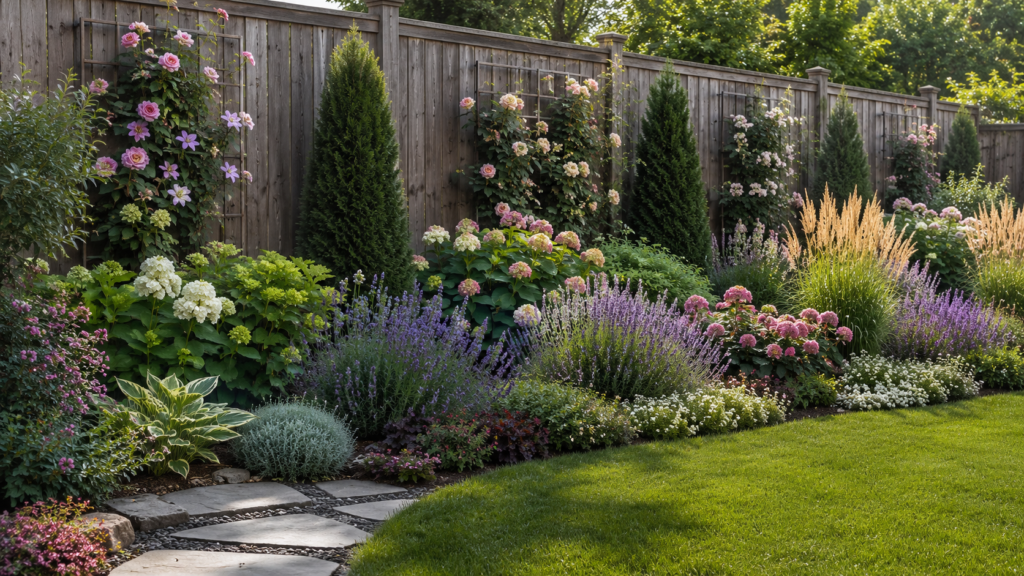
The best plants along a backyard fence are those that fit the site at maturity. Narrow evergreens provide year-round privacy, climbers use vertical space, flowering perennials add color, edible plants make the boundary productive, and groundcovers finish the border. The right choice depends on sunlight, climate, soil, fence strength, bed depth, and maintenance access.
Planting softens a bare fence, adds depth, filters views, supports wildlife, and connects the boundary with lawns, patios, and paths. The strongest design uses a limited number of plants, each with a clear structural or decorative role.
Five Rules for Choosing Best Plants Along a Backyard Fence
Use these rules before buying plants:
- Match the plant to the light. Note full sun, partial shade, deep shade, dry shade, and reflected afternoon heat.
- Check mature size. Nursery size is temporary; mature height and width determine long-term fit.
- Match plant weight to fence strength. Heavy climbers need strong wires, trellises, posts, or masonry.
- Check safety and invasive status. Confirm the botanical name, spreading habit, thorns, toxicity, and regional restrictions.
- Preserve access. Leave room to prune, paint, inspect posts, repair panels, and clear drains.
These rules prevent overcrowded shrubs, dry roots, damaged panels, boundary spread, and constant corrective pruning.
Quick Comparison of Popular Fence Plants
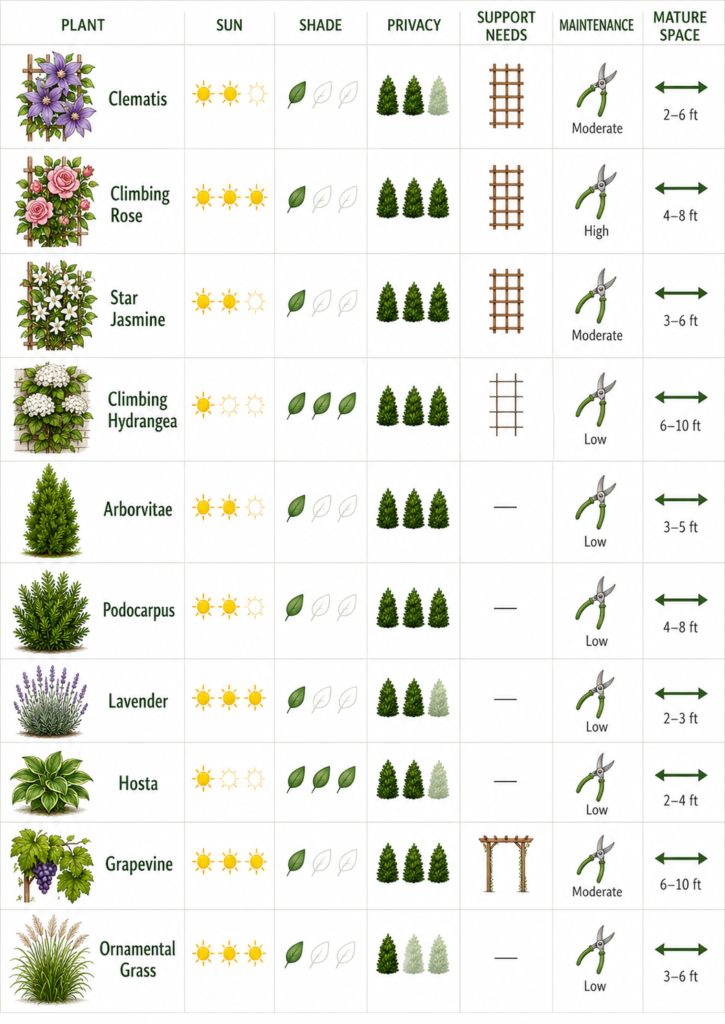
| Plant | Best use | Light | Evergreen? | Space | Support | Maintenance | Main caution |
|---|---|---|---|---|---|---|---|
| Clematis | Vertical flowers | Sun to part shade | Usually no | Narrow | Yes | Medium | Pruning varies |
| Climbing rose | Flowers and height | Full sun | Usually no | Narrow to medium | Yes | Medium to high | Thorns |
| Star jasmine | Fragrance and cover | Sun to part shade | Often | Narrow | Yes | Medium | Cold sensitivity |
| Climbing hydrangea | Shaded coverage | Part to full shade | Usually no | Narrow to medium | Strong support | Low to medium | Heavy at maturity |
| Arborvitae | Privacy | Sun to part shade | Yes | Medium | No | Low to medium | Cultivar width |
| Podocarpus | Narrow screening | Sun to part shade | Yes | Medium | No | Medium | Climate suitability |
| Lavender | Sunny edging | Full sun | Often | Narrow | No | Low | Dislikes wet soil |
| Hosta | Shaded foliage | Part to full shade | No | Narrow to medium | No | Low | Dry-shade stress |
| Grapevine | Fruit and cover | Full sun | No | Medium | Strong support | High | Annual pruning |
| Ornamental grass | Seasonal screening | Mostly sun | Varies | Medium | No | Low | Seasonal cutback |
Table of Contents
- Best overall fence plants
- Site checks
- Climate suitability
- Fence-Line Plant Fit Score
- Sunny and shady fence plants
- Privacy and above-fence screening
- Fence-material compatibility
- Spacing, narrow borders, and containers
- Layered layouts
- Edible plants and plants to avoid
- Safety, installation, and maintenance
- Plant combinations and planning
- FAQs
What Are the Best Plants to Grow Along a Backyard Fence?
The best fence border combines plants with different jobs. Use one structural layer for height, a middle layer for flowers or foliage, and a low front layer to cover soil.
Useful plant groups include:
- Evergreen structure: arborvitae, podocarpus, pittosporum, compact conifers, and viburnum
- Vertical climbers: clematis, climbing rose, star jasmine, and climbing hydrangea
- Flowering shrubs: hydrangea, weigela, choisya, and compact native shrubs
- Sunny perennials: lavender, salvia, nepeta, coneflower, and ornamental onion
- Shade plants: hosta, fern, heuchera, hellebore, and epimedium
- Seasonal screening: switchgrass, feather reed grass, and selected fountain grasses
- Edible plants: grapes, espalier fruit, cane berries, beans, cucumbers, and herbs
- Groundcovers: thyme, hardy geranium, strawberries, and controlled native spreaders
Choose fewer species and repeat them. Several groups of the same salvia or fern usually look more intentional than single examples of many unrelated plants.
Native plants can be excellent, but native status alone does not guarantee a good fit. Mature size, moisture needs, and spreading behavior remain important.
What Should You Check Before Selecting Fence-Line Plants?
Start with the site, not the plant label. Light, bed depth, drainage, fence condition, and nearby property determine what will succeed.
Sunlight and Heat
Observe the fence throughout the day. Full sun usually means six or more hours of direct light, while partial sun or shade receives roughly three to six hours.
West-facing fences may create severe afternoon heat, especially when masonry or pale vinyl reflects warmth onto nearby plants.
Bed Width
Measure from the fence to the lawn, path, or patio. A 60-centimetre strip suits climbers and compact perennials, not a shrub that matures two metres wide.
A naturally narrow cultivar is better than a broad plant that needs severe annual pruning.
Fence Condition
Check:
- Posts and panels
- Timber rot
- Masonry cracks
- Vinyl joints
- Metal fixings
- Gates, utilities, and drains
Repair weak sections before planting because mature growth may block access.
Soil and Moisture
Fence lines often contain rubble, compacted soil, shallow footings, or dry rain-shadow areas. Observe drainage after rain and note competition from nearby trees.
Neighboring Property
Choose plants that can be maintained from your side. Avoid uncontrolled runners, suckering shrubs, and large woody plants where growth may cross the boundary.
Which Fence Plants Suit Your Climate?
Climate narrows the plant list, but the fence creates its own microclimate.
| Climate | Strong starting options | Main limitation |
|---|---|---|
| Cold temperate | Clematis, climbing rose, arborvitae, hydrangea, hosta, hardy fern | Winter damage to tender climbers |
| Mild temperate | Star jasmine, pittosporum, viburnum, rosemary, climbing rose | Waterlogging and frost |
| Mediterranean | Lavender, rosemary, grapevine, star jasmine, bougainvillea | Drought and reflected heat |
| Humid subtropical | Podocarpus, star jasmine, passionfruit, selected bamboo | Fast growth and fungal pressure |
| Tropical | Bougainvillea, passionfruit, tropical shrubs, selected bamboo | Vigorous growth and invasive risk |
| Hot arid | Bougainvillea, rosemary, salvia, thyme, drought-adapted grasses | Establishment irrigation |
| Cool coastal | Hydrangea, fern, hardy climbers, wind-tolerant grasses | Salt, wind, and wet soil |
Use climate as a first filter, then check cultivar hardiness, heat tolerance, disease resistance, and mature size.
Microclimate should overrule general labels. Lavender may suit the region but fail in damp shade, while hydrangea may scorch beside a heat-reflecting fence.
How Do You Compare Fence Plants Before Buying?
Compare privacy, narrow-bed suitability, year-round interest, maintenance, fence safety, and spread control.
The scores below are planning aids rather than scientific ratings.
| Plant | Privacy | Narrow-bed fit | Year-round interest | Ease | Fence safety | Spread control |
|---|---|---|---|---|---|---|
| Clematis | 2 | 5 | 2 | 3 | 4 | 4 |
| Climbing rose | 3 | 4 | 2 | 2 | 3 | 4 |
| Star jasmine | 4 | 5 | 5 | 3 | 3 | 4 |
| Climbing hydrangea | 4 | 4 | 3 | 4 | 2 | 4 |
| Arborvitae | 5 | 3 | 5 | 4 | 5 | 5 |
| Podocarpus | 5 | 4 | 5 | 3 | 5 | 4 |
| Ornamental grass | 3 | 3 | 3 | 4 | 5 | 4 |
| Clumping bamboo | 5 | 2 | 5 | 2 | 5 | 3 |
| Lavender | 1 | 5 | 4 | 4 | 5 | 5 |
| Grapevine | 4 | 3 | 2 | 2 | 2 | 4 |
For privacy, focus on foliage density and year-round interest. For narrow spaces, prioritize compact width and spread control. For weak fences, fence safety matters more than flower production.
Which Plants Are Best Along a Sunny Backyard Fence?
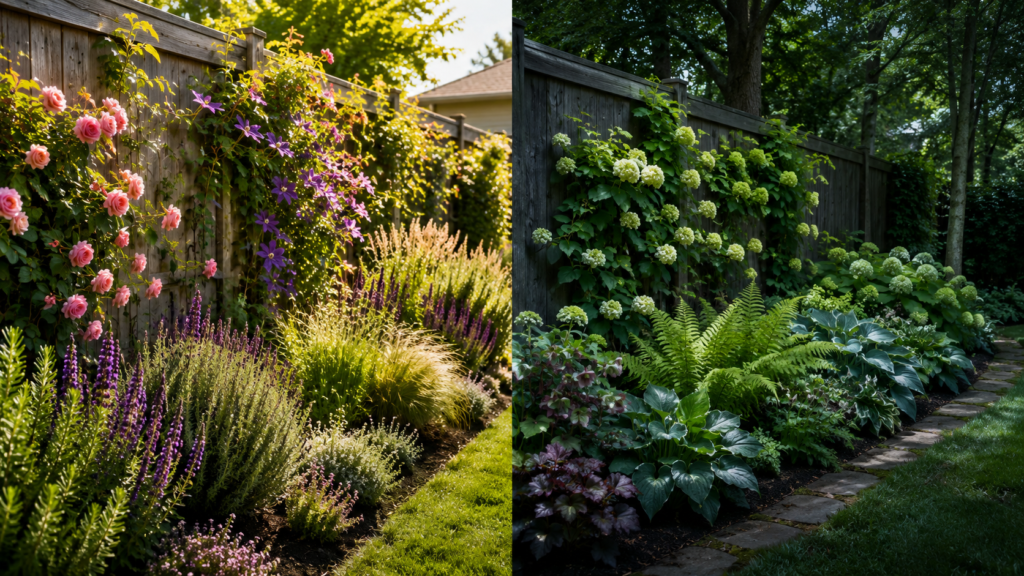
Sunny fences suit flowering climbers, Mediterranean herbs, grasses, and trained fruit. West-facing sites need plants that tolerate reflected heat and dry soil.
Climbing Roses
Climbing roses add fragrance, height, and long-season flowers. They need wires or trellis because they do not cling on their own.
Train canes horizontally or diagonally to encourage more flowering shoots. Keep thorny growth away from gates, paths, seating, and play areas.
Clematis
Clematis adds vertical color without using much bed width. Its leaf stalks need narrow wires or mesh.
Check flowering season, mature height, light needs, and pruning group before purchase. Position the roots away from the driest point at the fence base.
Star Jasmine and Bougainvillea
Star jasmine provides fragrance and often evergreen foliage in mild climates. It needs support and shelter from severe cold.
Bougainvillea suits hot, dry sites but has thorny woody growth and needs a strong support away from paths.
Lavender, Rosemary, Salvia, and Grasses
These plants create an effective lower layer where drainage is sharp.
Lavender and thyme form low mounds, rosemary adds edible evergreen structure, salvia extends flowering, and upright grasses add movement.
Grapes and Espalier Fruit
Grapes and trained fruit trees make sunny fences productive. They need structured training, regular pruning, and strong support.
Useful combination: clematis or climbing rose at the back, repeated salvia and lavender in the middle, and thyme along the front.
Which Plants Grow Best Along a Shady Fence?
Shade planting works best when foliage texture replaces constant flowers.
Climbing Hydrangea and Honeysuckle
Climbing hydrangea suits a strong shaded surface but becomes heavy with age.
Selected honeysuckles add flowers and wildlife value, but some species are invasive, so verify the botanical name.
Shrub Hydrangeas
Compact hydrangeas provide middle-layer foliage and seasonal flowers. Choose varieties suited to the available width and light.
Hostas, Ferns, Heucheras, and Hellebores
Hostas create broad mounds, ferns add fine texture, heucheras brighten the front, and hellebores flower in late winter or early spring.
Match ferns to the actual moisture level rather than assuming all require wet soil.
Evergreen Structure
Fatsia suits mild shaded gardens, while colder regions may require another hardy evergreen shrub.
Useful combination: climbing hydrangea, compact hydrangeas, repeated ferns and hostas, heucheras at the front, and spring bulbs in gaps.
Which Plants Provide the Best Privacy Along a Fence?
The best privacy plants combine height, density, manageable width, and climate reliability.
Strong options include:
- Arborvitae
- Columnar conifers
- Podocarpus
- Pittosporum
- Viburnum
- Selected clumping bamboo
- Upright ornamental grasses
- Evergreen climbers
Choose named cultivars with documented dimensions. A fast-growing plant that becomes too wide may create more work than a slower, naturally narrow variety.
A mixed screen with two or three compatible species can look softer and be more resilient than one continuous row.
Which Plants Can Grow Above a Six-Foot Fence?
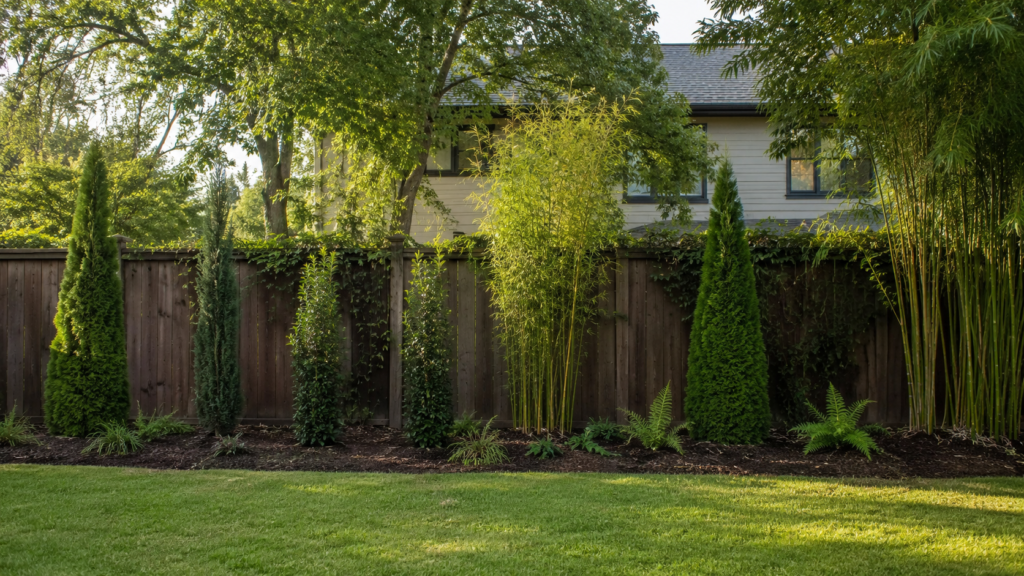
Columnar evergreens, narrow conifers, upright trees, selected bamboo, and climbers on raised trellises can extend screening.
Check:
- Wind exposure
- Width at the required height
- Neighboring light
- Upper pruning access
- Support strength
- Local height rules
A raised independent trellis often provides extra privacy without filling the bed with a broad hedge.
Which Climbers Are Safest for Different Fence Materials?
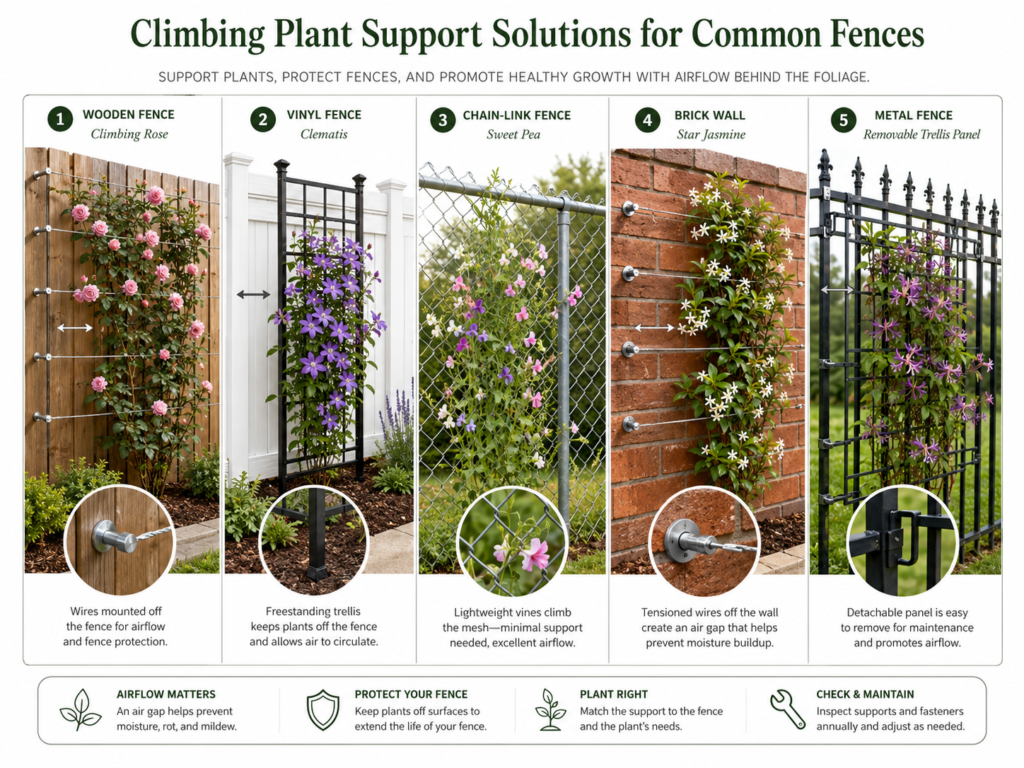
Match the climber’s weight and attachment method to the fence.
| Fence material | Best method | Suitable plants | Main risk |
|---|---|---|---|
| Wood | Raised wires or trellis | Clematis, roses, annual vines | Moisture and stems in gaps |
| Vinyl | Freestanding support | Lightweight climbers | Panel distortion |
| Chain-link | Direct training with pruning | Beans, clematis, selected honeysuckle | Wind load |
| Brick or masonry | Wires on sound surface | Jasmine, rose, clematis | Weak mortar |
| Metal railings | Light removable climbers | Clematis, annual vines | Tangling |
| Shared fence | Support on your side | Controlled climbers | Boundary crossing |
Leave an air gap between plants and timber. Do not rely on vinyl panels to support woody growth.
Thin chain-link coverage before it becomes a dense wind-catching mass. Repair masonry cracks before installing climbers.
How Far Should Plants Be Positioned From a Fence?
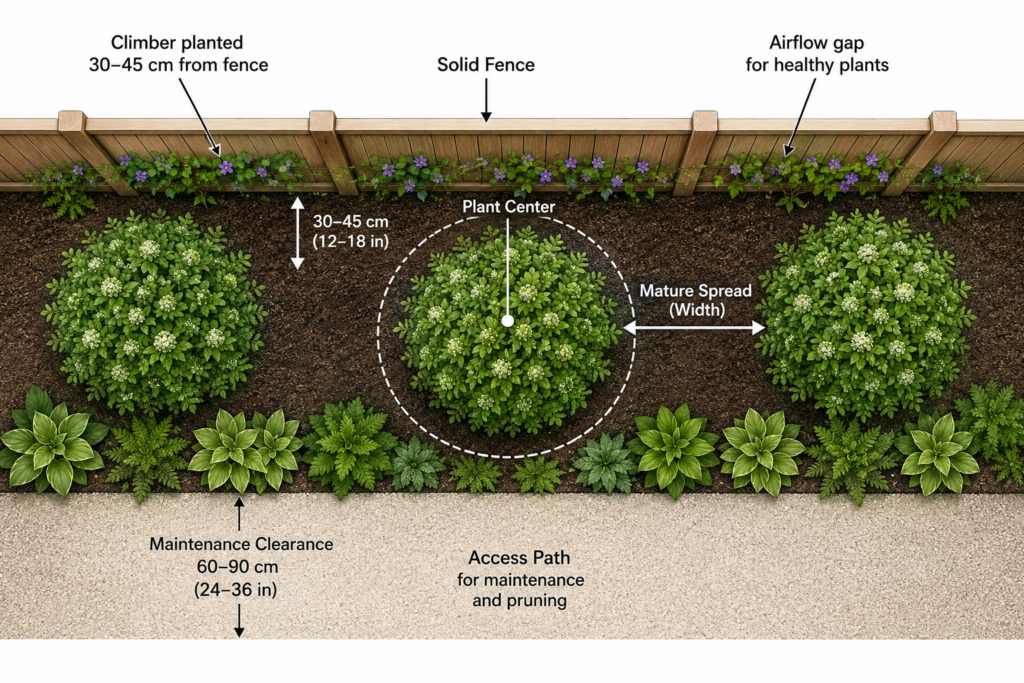
Base spacing on mature width.
Distance from fence = half the mature plant width + maintenance clearance
A shrub expected to become 1.8 metres wide has a 90-centimetre radius. Adding a 30-centimetre access gap places its center about 1.2 metres from the fence.
Practical starting points:
- Climbers: 30–45 centimetres from a solid fence
- Compact shrubs: about half their mature width
- Informal shrubs: enough room to retain their natural form
- Small trees: sufficient room for trunk, canopy, and roots
- Large trees: site-specific planning
Use bulbs, annuals, or containers as temporary fillers instead of crowding permanent plants.
Which Plants Work Best in a Narrow Border Along a Fence?
Narrow borders should emphasize vertical growth and compact forms.
Good choices include:
- Clematis
- Compact climbing roses
- Star jasmine
- Columnar evergreens
- Upright rosemary
- Compact grasses
- Salvia and lavender
- Heucheras and small hostas
- Selected ferns
- Spring bulbs
- Thyme
- Hardy geraniums
A 90-Centimetre Sunny Border
Use a climber at the back, compact salvia or grasses in the middle, and thyme at the edge.
A 90-Centimetre Shaded Border
Use a shade-tolerant climber or narrow evergreen, compact ferns and heucheras, and a low woodland groundcover.
Avoid broad shrubs, thorny plants beside paths, and perennials that repeatedly fall into walkways.
Can Fence Plants Be Grown Entirely in Containers?
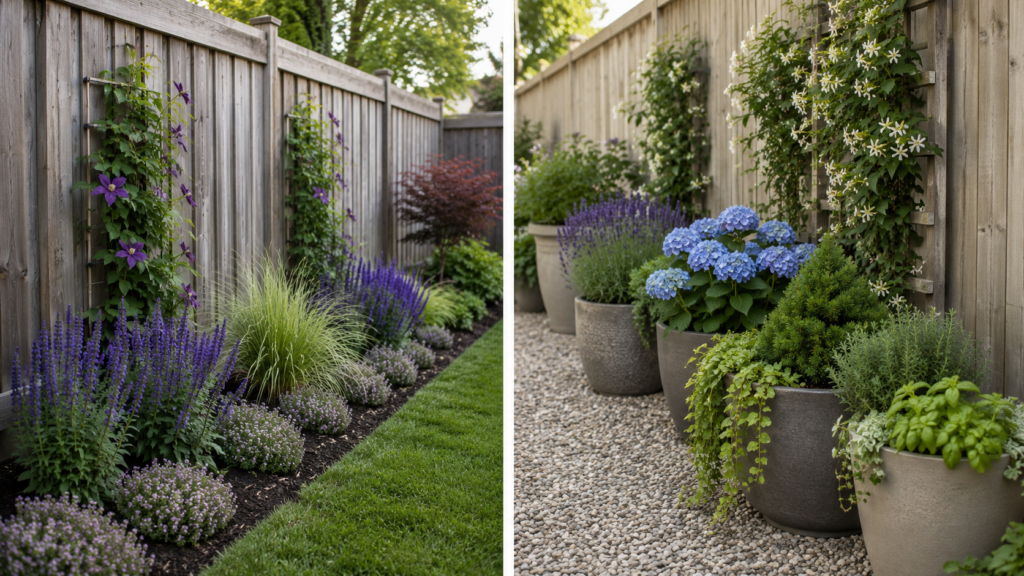
Containers work where the soil is poor, the ground is paved, digging is restricted, or the property is rented.
Suitable plants include:
- Compact clematis
- Patio roses
- Star jasmine
- Dwarf conifers
- Compact hydrangeas
- Ornamental grasses
- Lavender and rosemary
- Herbs and vegetables
- Strawberries
Use fewer large pots rather than many small ones. Large containers provide more root space, retain moisture longer, and resist wind.
Ensure drainage, install supports first, group plants by water needs, and expect more frequent watering than with in-ground planting.
How Can You Create a Layered Planting Design Along a Fence?
Arrange plants in three levels:
- Back: climbers, privacy shrubs, tall grasses, small trees, or trained fruit
- Middle: hydrangeas, salvia, lavender, ferns, nepeta, coneflowers, or compact grasses
- Front: thyme, heuchera, hardy geranium, bulbs, strawberries, or low groundcovers
A 90-centimetre bed supports a climber and two low layers. A 1.5-metre bed can include narrow shrubs, while a two-metre bed may support a small tree and full layered border.
Choose structural plants first, repeat a limited palette, and include interest across more than one season.
What Does a Measured Nine-Metre Fence Layout Look Like?
This illustrative plan suits a sunny nine-metre fence with a 1.2-metre-deep bed.
Back Layer
- Three climbers on separate trellis panels
- Three compact upright grasses as separators
- Root balls away from the dry fence base
- Access around posts and both ends
Middle Layer
- Five repeated groups of salvia, nepeta, or compatible perennials
- Spacing based on mature spread
- Overlapping flowering periods
- Drip irrigation through the root zone
Front Layer
- Repeated thyme or low hardy geranium
- Spring bulbs in temporary gaps
- Clean edging beside the lawn or path
Mark mature plant diameters before digging. The border should not appear completely full on planting day.
Which Edible Plants Can Grow Along a Backyard Fence?
Sunny fences can support grapes, espalier fruit, thornless blackberries, raspberries, passionfruit, beans, cucumbers, herbs, and strawberries.
Grapes need strong support and annual pruning. Espalier fruit creates a flat productive structure, while beans and cucumbers provide removable seasonal coverage.
Use rosemary, thyme, chives, parsley, and strawberries as the lower layer. Keep mint in a container.
Avoid growing food against peeling, contaminated, or heavily treated surfaces. Leave access for harvesting, pruning, and inspection.
Which Plants Should Be Avoided Along a Fence?
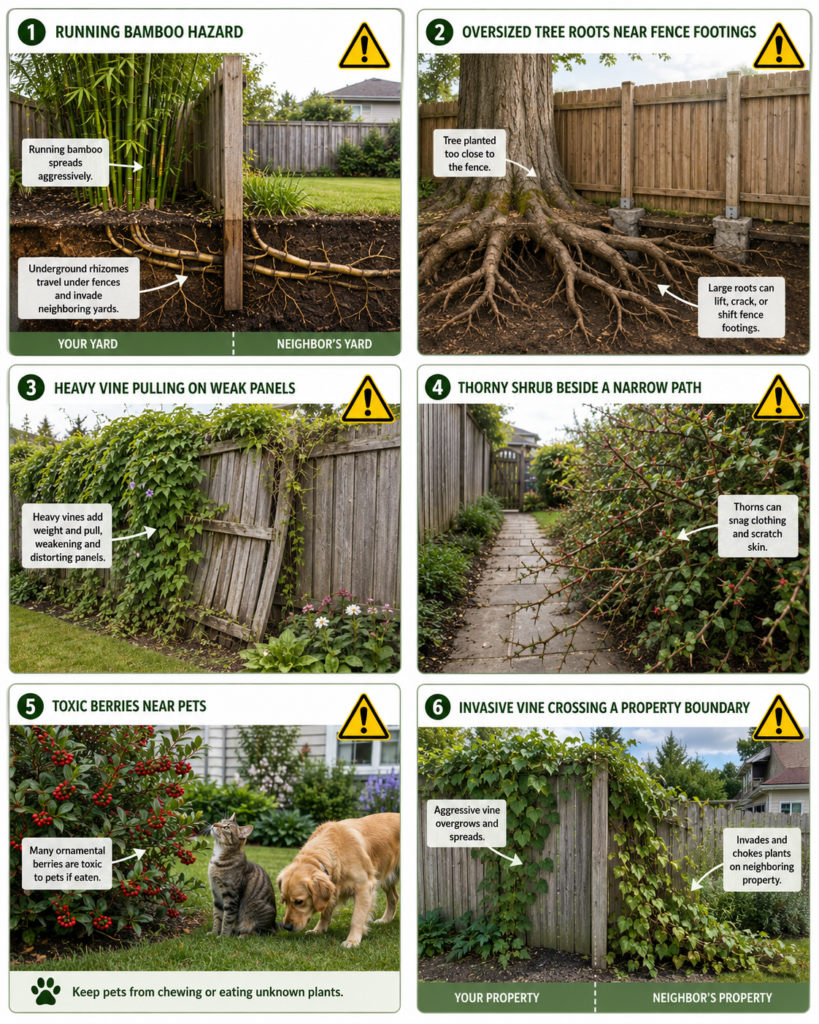
Avoid plants that are invasive, oversized, excessively heavy, difficult to contain, or unsafe for the space.
Problem groups include:
- Locally invasive ivy, honeysuckle, wisteria, bittersweet, or bamboo
- Running bamboo without containment
- Large trees beside shallow footings, drains, or paving
- Broad shrubs in narrow beds
- Heavy climbers on weak panels
- Thorny plants beside gates, pools, or play areas
- Toxic plants where children or pets may chew foliage or fruit
Always verify the botanical name because one common name may include both desirable and invasive species.
How Can Fence Plants Be Kept Safe Around Children, Pets, and Neighbors?
Check leaves, fruit, seeds, sap, roots, and thorns using a reliable species-specific source.
Family Safety Check
- Avoid thorns beside gates and play areas.
- Secure wires and ties.
- Remove hazardous fallen fruit.
- Keep irritating sap away from contact areas.
- Verify toxicity rather than relying on generic claims.
Root and Boundary Check
Small shrubs rarely damage a sound fence, but large trees, running bamboo, cracked foundations, paving, and drains increase risk.
Keep supports and main stems on your property, remove suckers early, and choose plants that can be pruned from your side. Confirm local rules before adding tall screens or spreading plants.
How Should Fence-Line Plants Be Installed?
- Repair the fence.
- Install wires, trellises, or posts.
- Remove rubble and loosen compacted soil.
- Position plants according to mature size.
- Water the full root zone.
- Mulch without covering stems or timber.
- Train climbers early.
- Inspect ties, panels, drains, and boundary growth annually.
Early training is easier than correcting tangled mature growth. During establishment, focus on deep watering, weed control, and balanced growth across the support.
How Much Maintenance Does a Fence Border Require?
Early Spring
Inspect the fence, prune dead growth, cut back grasses, renew ties, and mulch.
Late Spring and Summer
Train vines, water during dry weather, remove suckers, keep gates clear, and watch for pests.
Autumn
Remove diseased debris, divide suitable perennials, plant bulbs, and inspect boundaries.
Winter
Repair visible damage and review plants that outgrew the space.
The first two seasons require the most watering and training. Mature borders should need preventive care rather than constant rescue pruning.
What Are the Best Plant Combinations for Common Goals?
Year-Round Privacy
Narrow evergreens, one controlled climber, and repeated groundcover.
Sunny Flowers
Climbing rose or clematis, salvia, lavender, nepeta, and thyme.
Shady Woodland
Climbing hydrangea, compact hydrangeas, ferns, hostas, heucheras, and bulbs.
Hot and Dry
Star jasmine or bougainvillea, rosemary, lavender, salvia, and thyme.
Edible Border
Grapes or espalier fruit, cane berries, herbs, and strawberries.
Wildlife Border
Locally suitable native shrubs, flowering vines, seed-bearing perennials, grasses, and groundcover.
Low-Maintenance Border
Compact evergreen shrubs, upright grasses, durable perennials, and controlled groundcovers.
Do not combine plants with conflicting moisture needs in the same small irrigation zone.
Plan Your Fence Border Before Buying Plants
Record:
- Fence length and height
- Bed depth
- Fence material
- Sunlight
- Soil drainage
- Main goal
- Structural plant
- Mature dimensions
- Support requirement
- Evergreen requirement
- Invasive status
- Child and pet safety
- Maintenance access
- Expected pruning
Reduce the plan to one structural plant, two or three compatible supporting plants, and one front-layer plant. Use temporary bulbs, annuals, or containers in early gaps.
How Do You Choose the Final Fence-Line Planting Plan?
Follow this sequence:
- Choose the primary goal.
- Record sunlight and microclimate.
- Measure bed depth.
- Select the structural plant.
- Add compatible middle and front layers.
- Confirm mature dimensions and support needs.
- Match water and drainage requirements.
- Check safety and invasive status.
- Preserve fence access.
A good plan may look open during the first year. Correct spacing and compatible care needs matter more than immediate fullness.
How This Fence-Plant Guide Was Created
This guide evaluates plants by sunlight tolerance, mature size, root behavior, evergreen coverage, support load, maintenance, climate suitability, bed depth, and boundary safety.
Regional hardiness, invasive status, toxicity, and availability should be verified before purchase.
FAQs
What are the best plants to grow along a backyard fence?
Clematis, climbing roses, evergreen shrubs, hydrangeas, grasses, lavender, ferns, and trained fruit are strong choices. Match them to light, climate, space, and purpose.
What is the best plant for privacy along a fence?
Narrow evergreen shrubs usually provide the most dependable year-round privacy. Choose a cultivar that fits the bed at maturity.
How close should shrubs be planted to a fence?
Use roughly half the shrub’s mature width, then add clearance for airflow, pruning, and repairs.
Can climbing plants damage a wooden fence?
Yes. Heavy vines can enter gaps, retain moisture, add weight, and conceal rot. Use raised wires or a separate trellis.
Which plants grow well beside a shaded fence?
Climbing hydrangea, hostas, ferns, heucheras, hellebores, and shade-tolerant shrubs work well when matched to moisture levels.
What can I plant in a narrow fence border?
Use climbers, columnar shrubs, compact grasses, upright herbs, bulbs, small perennials, and low groundcovers.
Can fence plants grow in containers?
Yes. Compact shrubs, climbers, grasses, herbs, hydrangeas, and vegetables can grow in large containers with good drainage.
Can fruit plants grow along a fence?
Grapes, espalier fruit, berries, beans, cucumbers, herbs, and strawberries can use sunny fence space effectively.
Which plants should be avoided beside a fence?
Avoid invasive vines, uncontrolled bamboo, oversized trees, broad shrubs in narrow beds, and heavy climbers on weak structures.
How can I stop plants crossing a neighbor’s fence?
Keep supports on your property, prune stems early, remove suckers, and avoid aggressive runners.
How much maintenance does a fence border require?
Most borders need seasonal pruning, watering, mulching, and inspection. Vigorous climbers, fruit, bamboo, and formal hedges need more.
How do I prevent overcrowding?
Use fewer varieties, repeat them in groups, and space permanent plants by mature width.

Myra is the founder and lead writer of Backyard Planter Ideas, where she shares practical, well-researched guidance on planter design, plant selection, and outdoor styling. Her goal is to help homeowners create attractive, functional garden spaces with clear, reliable, and easy-to-apply advice.