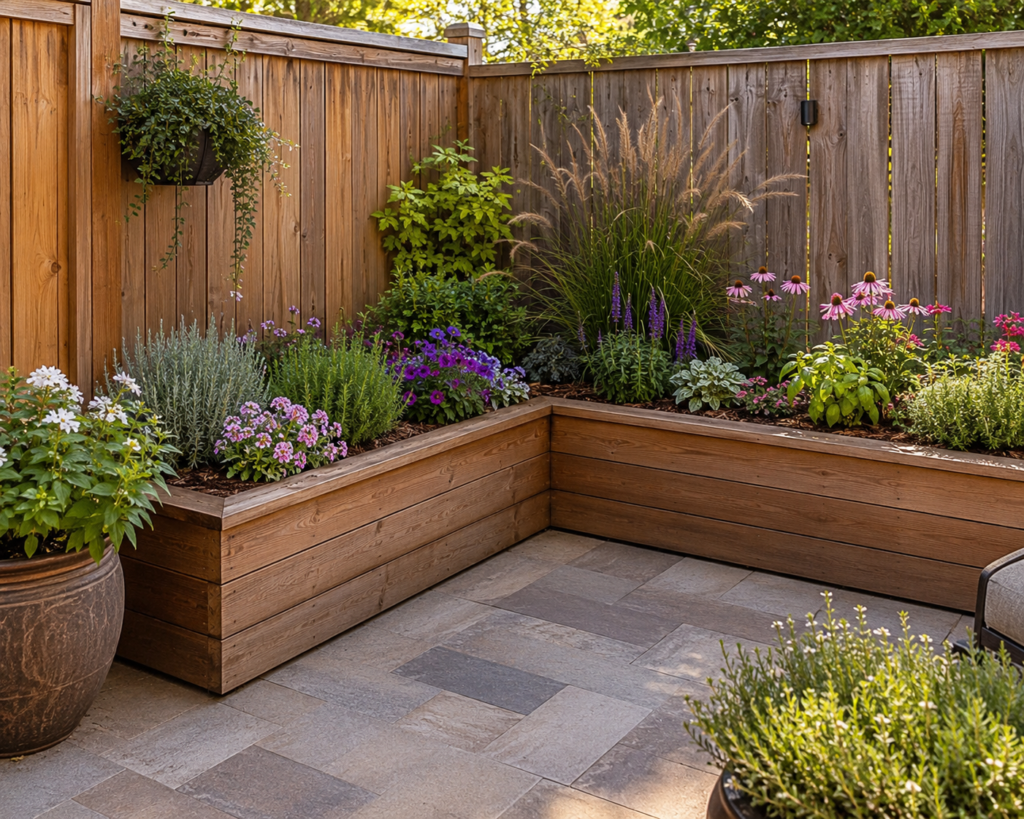
Backyard corner planter ideas include L-shaped raised beds, triangular planters, tiered flower beds, container groups, herb corners, privacy planters with trellises, shrub borders, and built-in seating planters. The best choice depends on sunlight, drainage, soil depth, walking space, maintenance access, and whether the corner sits near a fence, patio, wall, shed, deck, or lawn edge.
An empty backyard corner can feel unfinished, collect weeds, or sit disconnected from the patio. A well-planned corner planter turns that dead zone into a flower display, herb garden, privacy screen, seating feature, or low-maintenance landscape anchor without taking over the center of the yard.
Choose the planter by the corner’s real condition. A sunny fence corner can support lavender, rosemary, thyme, peppers, strawberries, salvia, and pollinator flowers. A shaded corner may need ferns, hostas, heuchera, parsley, or movable containers. An overlooked corner needs height from a trellis, grasses, or shrubs.
| Backyard Corner Problem | Best Planter Idea | Why It Works |
|---|---|---|
| Empty fence corner | L-shaped raised planter | Uses both edges and adds structure |
| Tight patio corner | Container cluster | Flexible and renter-friendly |
| Small backyard | Triangular or slim L-shaped planter | Saves center space |
| Overlooked corner | Trellis planter | Adds height and privacy |
| Shady corner | Foliage planter | Works without strong sun |
| Sunny corner | Herb and flower planter | Productive and colorful |
| Wet corner | Drainage-first raised planter | Keeps roots healthier |
Best Corner Planter to Choose
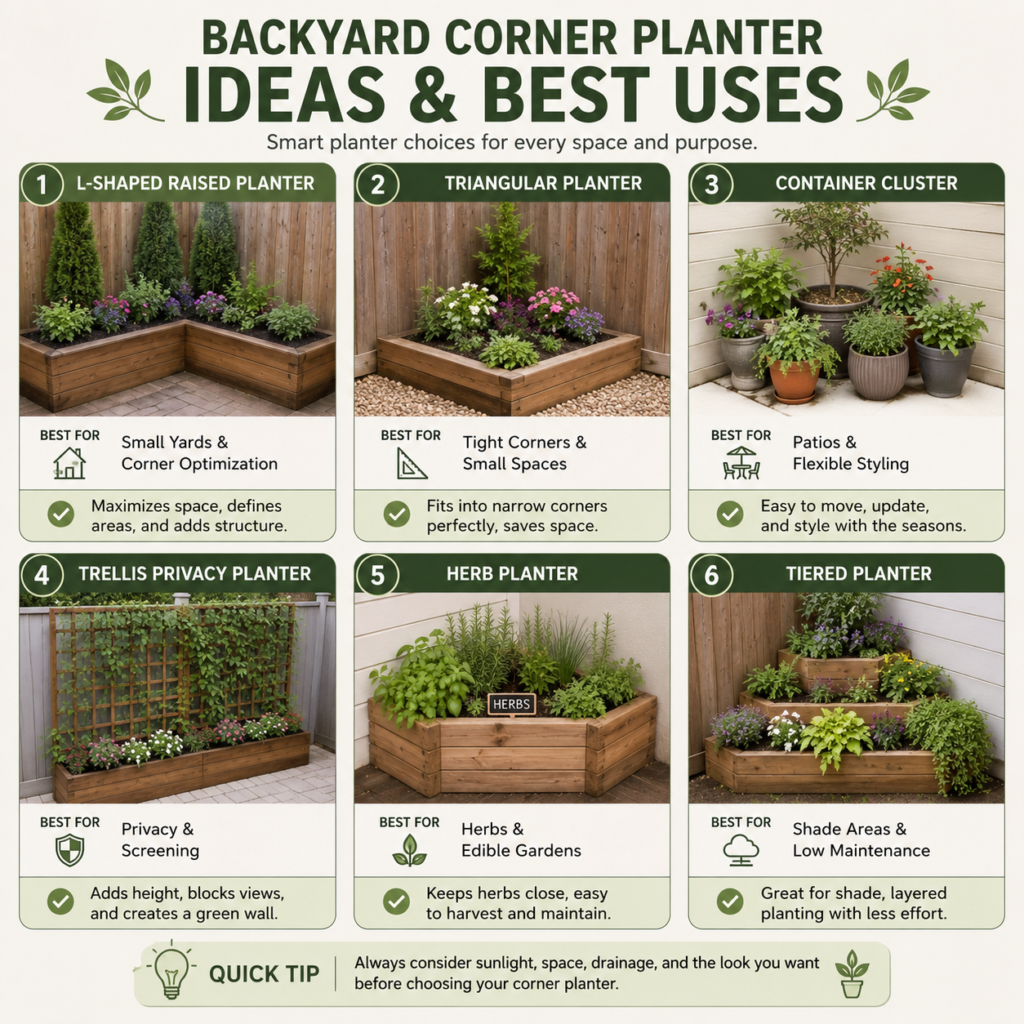
Choose an L-shaped raised corner planter for the best all-round option. It follows the natural corner shape, gives more planting space, and keeps the middle of the backyard open. Choose a triangular planter for tight spaces, containers for patios or rentals, and a trellis planter when privacy is the main goal.
- Best for most yards: L-shaped raised corner planter.
- Best for small patios: container cluster or tiered planter.
- Best for privacy: trellis planter with shrubs, grasses, or climbers.
- Best for herbs: sunny raised planter near the kitchen or grill.
- Best for shade: ferns, hostas, heuchera, and foliage plants.
- Best low-maintenance option: dwarf shrubs, ornamental grasses, mulch, and drip irrigation.
If you are unsure, start with movable containers for one season. They let you test sunlight, watering, mature plant size, and walking space before building anything permanent.
Best Corner Planter for Most Yards
The best backyard corner planter idea for most yards is an L-shaped raised planter. It uses both sides of a corner without pushing too far into the open yard, so it works naturally along fence lines, patio edges, decks, sheds, and boundary walls.
An L-shaped planter also makes plant layering simple. Put taller plants at the back, medium flowers or herbs in the middle, and low or trailing plants at the front. If the corner is too tight, use a triangular planter. If the corner is paved or rented, use containers. If the corner is overlooked, use a trellis planter or shrub-based privacy planter.
The main mistake is choosing the prettiest design without checking how the yard is used. A planter beside a dining area needs chair clearance. A planter near a gate must not block access. A planter near a fence should leave room for repairs.
Best Corner Planter Shapes
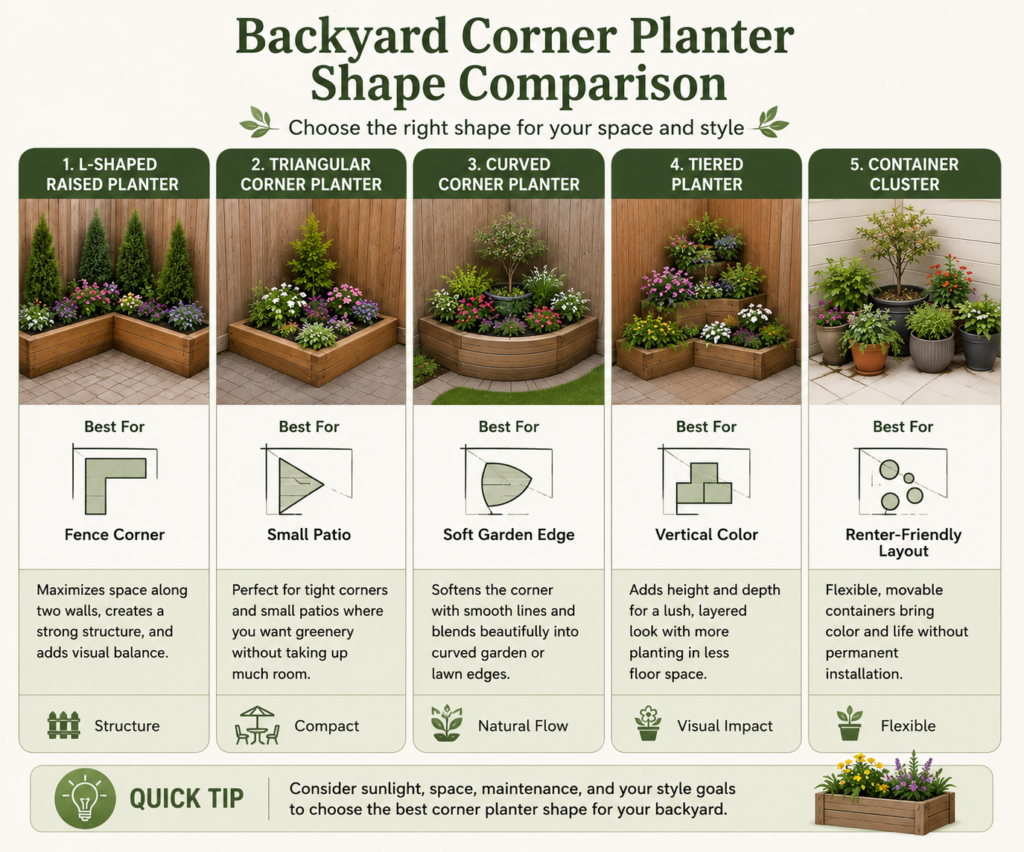
Choose an L-shaped planter for maximum planting room, a triangular planter for tight corners, a curved planter for softer landscaping, and a tiered planter when you need height. Shape affects space use, maintenance access, and how naturally the planter connects to fences, patios, walls, and lawn edges.
| Planter Shape | Best For | Avoid If |
|---|---|---|
| L-shaped planter | Fence corners, larger corners, mixed planting | You need access from every side |
| Triangular planter | Small yards, patios, tight corners | You want long vegetable rows |
| Curved planter | Cottage gardens and soft landscaping | You need the easiest DIY build |
| Tiered planter | Vertical flowers, herbs, focal points | The corner is windy or dry |
| Container group | Renters and seasonal planting | You want a permanent structure |
| Bench planter | Seating corners | The space is too narrow |
Before committing, mark the footprint with a hose, string, chalk, or cardboard. Walk around it, open gates, pull out chairs, and check whether you can still water, prune, and reach the back.
Backyard Corner Planter Soil Depth
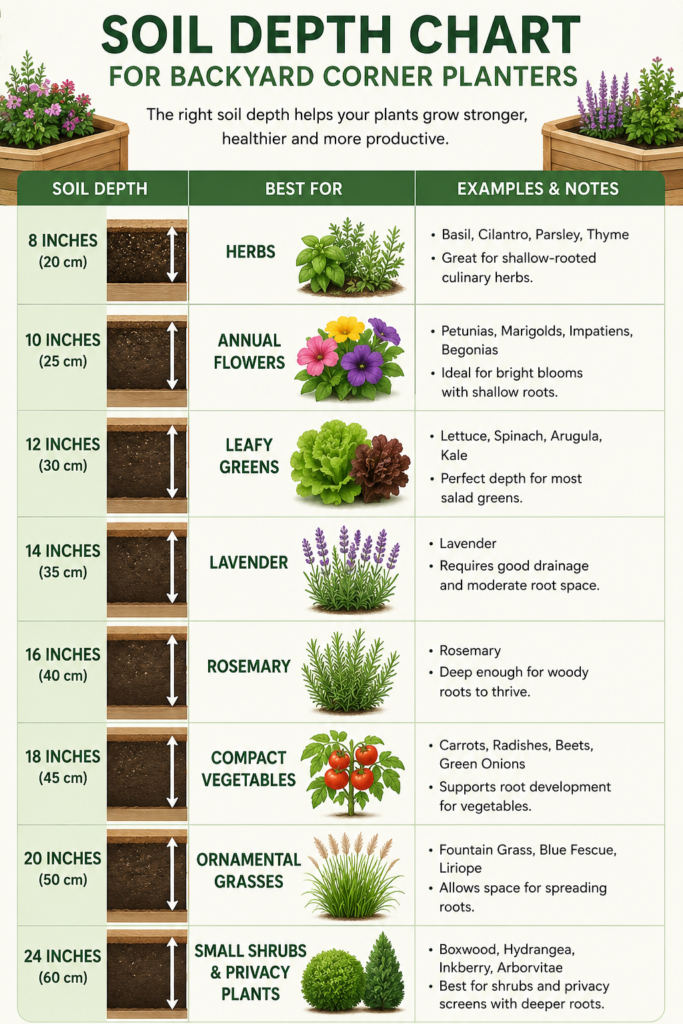
A backyard corner planter usually needs 12 to 18 inches of usable soil for mixed herbs, flowers, leafy greens, and compact vegetables. Shallow herbs, annuals, and groundcovers can grow in less, but shrubs, privacy plants, large perennials, and long-term structural planting usually need 18 to 24 inches or more.
| Plant Type | Suggested Soil Depth |
|---|---|
| Thyme, oregano, alyssum, shallow annuals | 8–12 inches |
| Basil, parsley, lettuce, compact flowers | 10–12 inches |
| Lavender, rosemary, salvia, compact vegetables | 12–18 inches |
| Small shrubs, grasses, privacy plants | 18–24+ inches |
| Dwarf trees or large shrubs | 24+ inches or large containers |
Depth matters because corner planters often sit near fences, walls, patios, and paving where airflow and drainage may be limited. For patios, decks, paving, and concrete corners, soil depth matters more because roots cannot grow into native ground below. Add mulch in sunny corners, avoid compacted soil, and refresh soil yearly in containers.
Corner Planter Drainage
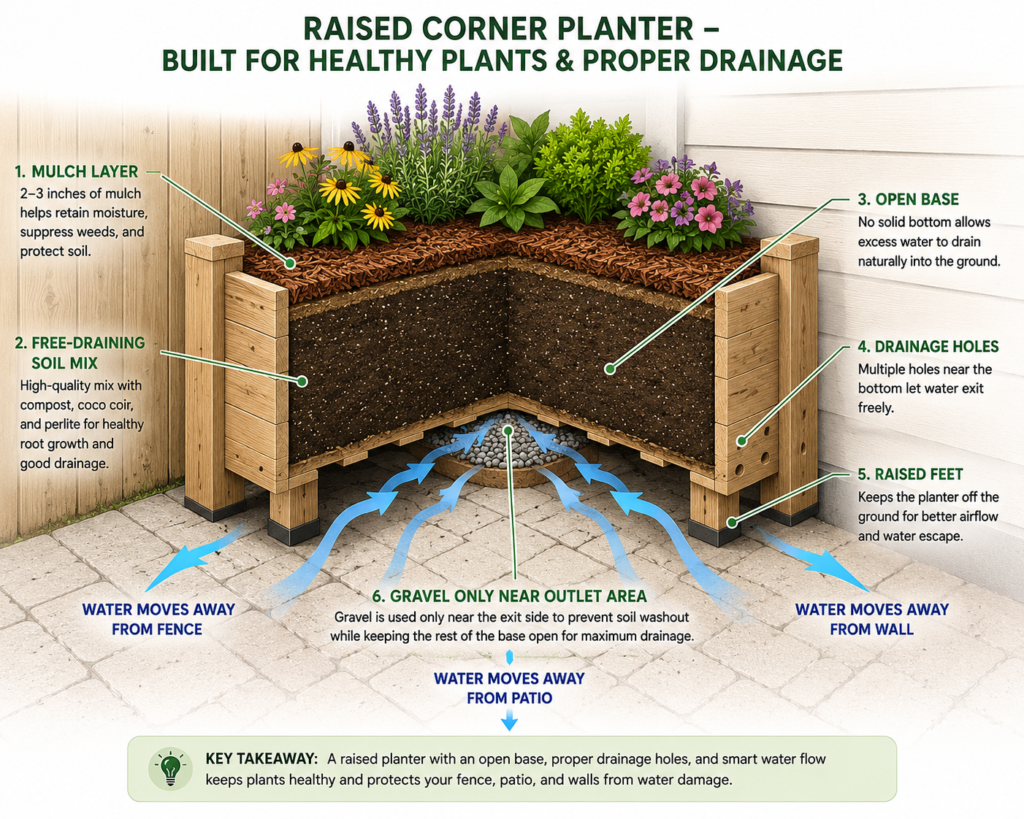
A corner planter needs a clear exit path for water. Use drainage holes, an open or permeable base, free-draining soil, mulch, and a slight slope away from walls, fences, patios, and foundations. Corners often trap water because fences, paving, sheds, walls, and grade changes interrupt runoff.
Good drainage does not mean dry soil. It means soil can hold useful moisture while excess water leaves. If the planter sits on soil, an open-bottom design can let water and roots move downward. If it sits on concrete or pavers, it needs drainage holes, raised feet, side outlets, or a visible overflow route.
- Use drainage holes, side outlets, or an open base.
- Avoid dense soil that compacts heavily.
- Add mulch to reduce splash and fast drying.
- Create an overflow path after heavy rain.
- Slope water away from hard surfaces.
- Check drainage after storms or deep watering.
Do not rely on gravel alone. Gravel does not fix drainage if water has nowhere to escape. Water the empty planter before planting. If water pools, drains slowly, or flows toward a wall, fix the drainage first.
Planters Near Fences and Walls
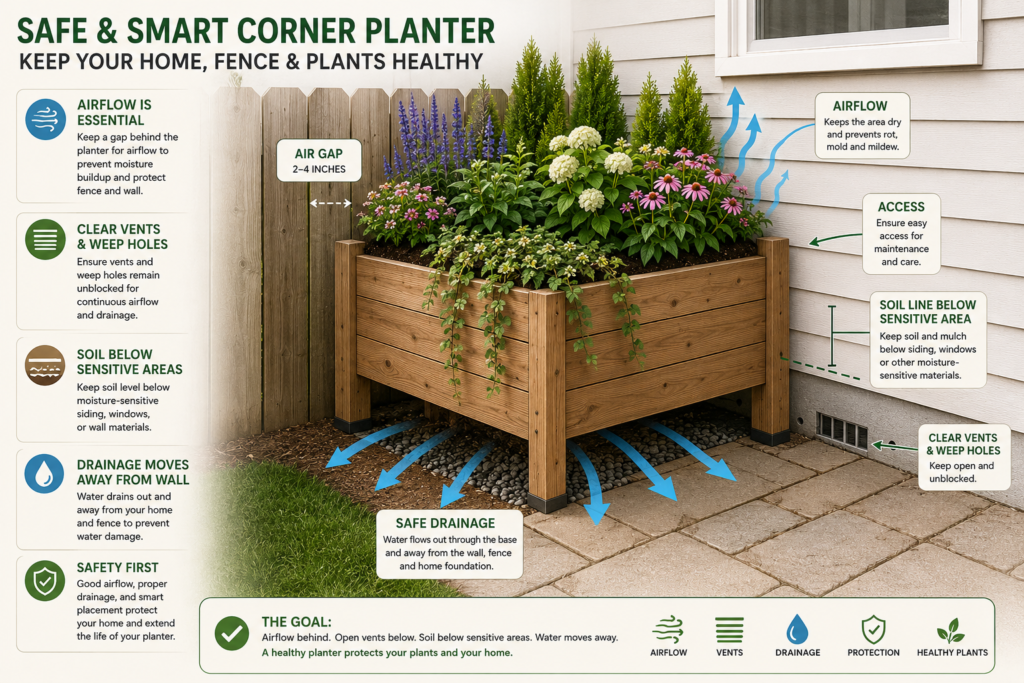
You can place a corner planter near a fence more easily than against a house wall, but you still need airflow, drainage, and maintenance access. Wet soil should not sit directly against untreated timber because it can speed up rot.
A house wall needs more caution. Think about moisture, vents, weep holes, damp-proof levels, foundation drainage, and water direction. The planter should not send water toward the wall or hold wet soil against structural surfaces.
- Leave airflow behind timber fencing where possible.
- Avoid direct wet soil contact with untreated wood.
- Keep vents, drains, weep holes, and inspection points clear.
- Keep soil below moisture-control levels.
- Slope water away from the house.
- Leave room to repair or repaint fences.
- Use containers if drainage direction is unclear.
A planter should improve the corner, not hide future problems. If you are unsure, start with containers or a freestanding raised planter and test the corner through rain, heat, and regular use.
Best Backyard Corner Planter Ideas
The best backyard corner planter ideas match the corner’s purpose. Ask whether the corner needs beauty, privacy, food production, seating, or low-maintenance structure before choosing the design.
- L-shaped raised corner planter: Best all-round option because it follows both sides of the corner.
- Triangular corner planter: Best for tight spaces where a full L-shaped bed feels too large.
- Tiered flower corner planter: Best when you want height in a small footprint.
- Corner herb planter: Best near a back door, patio, grill, or outdoor kitchen.
- Privacy corner planter with trellis: Best for overlooked corners that need screening.
- Modern concrete or metal corner planter: Best for clean patios, gravel gardens, and minimalist layouts.
- Brick corner planter: Best for permanent traditional gardens and warm patios.
- Container cluster corner: Best for renters, paved corners, and quick upgrades.
- Corner planter with built-in bench: Best for seating areas near patios, decks, or fire pits.
- Pollinator corner planter: Best for sunny corners with lavender, salvia, coneflowers, marigolds, thyme, and alyssum.
The best idea is not automatically the biggest one. A small container cluster can outperform a large raised bed if the corner is paved, rented, narrow, or shaded.
Cost, Difficulty, and Maintenance
A container cluster can be created in one afternoon, while a brick or stone planter may need planning, drainage work, and more labor. Beginners should start with containers, triangular planters, or simple timber raised beds because they are easier to adjust.
| Planter Idea | Cost Level | DIY Difficulty | Maintenance | Best For |
|---|---|---|---|---|
| Container cluster | Low to medium | Easy | Low to medium | Renters, patios, quick upgrades |
| Triangular planter | Low to medium | Easy to moderate | Low | Small corners |
| L-shaped timber planter | Medium | Moderate | Medium | Most backyard corners |
| Trellis privacy planter | Medium | Moderate | Medium to high | Overlooked yards |
| Brick or stone planter | Medium to high | Advanced | Low to medium | Permanent structure |
| Composite raised planter | Medium to high | Moderate | Low | Low-maintenance yards |
Choose a permanent option only when you know the corner drains well, receives the right light, and does not block movement or maintenance access.
Best Plants for Corner Planters
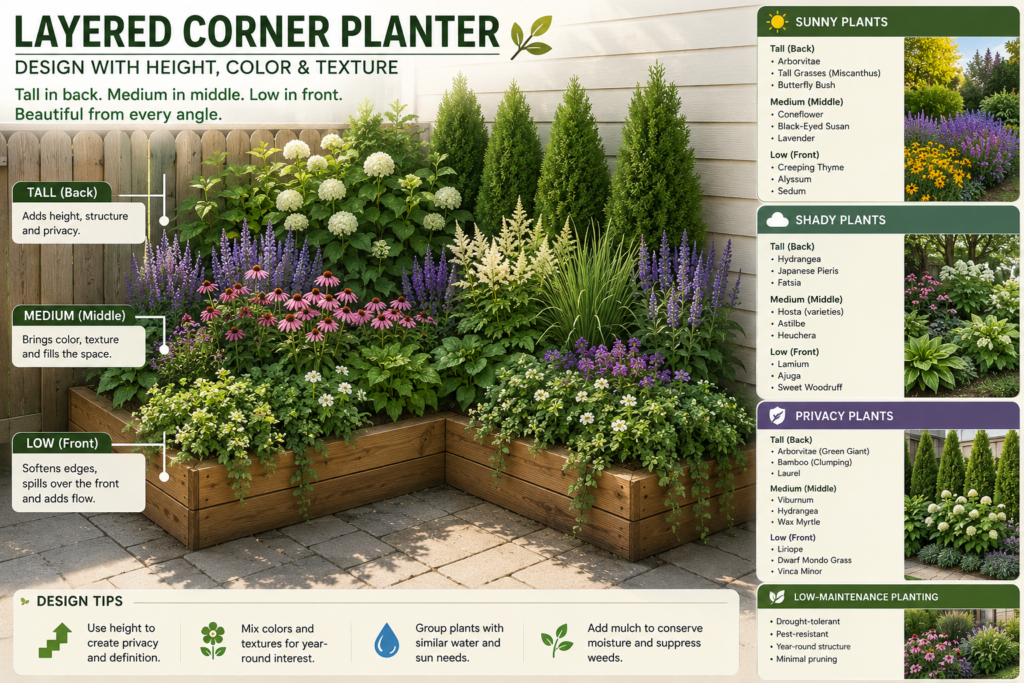
Choose plants by sunlight first, then by height, root depth, water needs, mature size, and maintenance level. A sunny corner can support herbs, flowers, compact vegetables, strawberries, and Mediterranean-style planting. A shaded corner needs foliage plants, shade-tolerant herbs, and flowers that perform without intense direct light.
Use the back-middle-front formula: height at the back, body and color in the middle, and low or trailing plants at the front.
- Sunny corner plants: lavender, rosemary, thyme, oregano, sage, salvia, coneflowers, marigolds, zinnias, ornamental grasses, peppers, compact tomatoes, and strawberries.
- Shady corner plants: ferns, hostas, heuchera, impatiens, begonias, parsley, chives, mint in containers, hydrangeas, and shade-tolerant groundcovers.
- Privacy corner plants: dwarf evergreens, tall grasses, trellis climbers, espaliered shrubs, boxwood-style shrubs, non-invasive clumping bamboo where suitable, and layered shrubs.
Simple Backyard Corner Planter Recipes
- Sunny herb corner: rosemary at the back, lavender in the middle, thyme at the front, and gravel mulch.
- Colorful flower corner: salvia or coneflowers at the back, marigolds or zinnias in the middle, and alyssum or trailing petunias at the front.
- Shady foliage corner: hostas at the back, heuchera in the middle, ferns around the side, and pale impatiens for color.
- Privacy corner: a trellis at the back, one compact evergreen shrub, tall grasses, and low flowers along the front.
- Low-maintenance corner: dwarf shrubs, ornamental grasses, mulch, drip irrigation, and repeated plant groups.
Check mature height, mature width, sunlight needs, watering needs, and root depth before buying plants.
Small Backyard Corner Planters
In a small backyard, keep the planter against the edge, use vertical height, avoid oversized shrubs, and leave open space for walking, seating, pets, or play. The planter should make the yard feel more organized, not smaller.
- Keep the planter along the fence, wall, patio edge, or deck edge.
- Use trellises, obelisks, or tall narrow plants.
- Choose compact herbs, flowers, grasses, and dwarf varieties.
- Leave room for chair movement, gate swing, and walking paths.
- Repeat a few plants instead of many unrelated species.
- Use one main material to reduce visual clutter.
Test the layout before building. Place chairs, bins, pots, or boxes where the planter would go. If the corner feels tight, reduce the footprint or build upward instead of outward.
Best Corner Planter Materials
Wood is easiest for DIY, brick is long-lasting and traditional, metal is modern and slim, stone looks natural, and containers are best for flexibility. The right material depends on budget, climate, style, maintenance tolerance, and whether the planter is temporary or permanent.
| Material | Best For | Main Caution |
|---|---|---|
| Wood | DIY raised planters | Needs rot protection |
| Brick | Permanent traditional corners | Needs drainage planning |
| Stone | Natural garden corners | Heavy and costly |
| Metal | Modern backyards | Can heat up |
| Concrete block | Budget structure | Needs styling |
| Ceramic pots | Patio corners | Can crack in cold climates |
| Composite | Low-maintenance builds | Higher upfront cost |
Choose one dominant material and repeat it elsewhere. If drainage, sunlight, or access is uncertain, start with containers before committing to masonry.
Make a Corner Planter Look Designed
A backyard corner planter looks designed when it uses one main material, clear plant layers, repeated colors, proper spacing, mulch, and one focal point. The easiest formula is back, middle, front.
- Put tall plants at the back or corner point.
- Repeat medium plants through the middle.
- Add low or trailing plants along the front.
- Cover bare soil with mulch, gravel, or composted bark.
- Repeat one or two flower colors.
- Add one vertical feature, such as a trellis, grass, shrub, or small tree.
Good focal points include a trellis, small ornamental tree, tall grass, birdbath, sculptural pot, bench, clipped evergreen, or simple garden light. Avoid making every plant a feature.
Backyard Corner Planter Do’s and Don’ts
| Do This | Avoid This |
|---|---|
| Measure the corner before building | Guessing size from photos |
| Check sunlight first | Planting sun-loving herbs in deep shade |
| Add drainage holes or an open base | Using a sealed planter with no water exit |
| Leave access for repairs | Building against surfaces you may need to fix |
| Use repeated plant groups | Mixing too many unrelated plants |
| Keep one main material | Combining too many finishes |
| Choose plants by mature size | Buying plants only because they look good now |
| Test the layout first | Making a permanent planter too early |
A smaller, simpler planter with good drainage and suitable plants is usually better than a large planter that is hard to maintain.
Backyard Corner Planters Mistakes
The biggest mistakes are poor drainage, oversized plants, blocked access, shallow soil, weak materials, and placing wet soil directly against structural walls. Most failures happen because the planter was designed for a photo instead of the real site.
Avoid building too deep for one-sided access, forgetting drainage holes, placing wet soil against timber fencing, blocking vents or wall access, choosing plants that will outgrow the space, mixing too many materials, planting too densely, using invasive climbers near fences, blocking gates or chairs, and forgetting irrigation in hot sunny corners.
Test the corner before building. Watch the light, check rain movement, mark the planter footprint, and imagine plants at mature size.
Are Backyard Corner Planters Worth It?
Yes, backyard corner planters are worth it when they solve a real problem: empty space, poor layout, lack of privacy, no planting area, an unattractive fence corner, or a backyard that needs stronger structure.
A corner planter can frame a patio, soften a fence, connect a deck to the garden, create a focal point, grow herbs, support pollinators, add privacy, or make a small yard feel intentional. The best option is not always expensive. A few coordinated containers can transform a patio corner, while a timber, brick, or stone planter can create a stronger long-term feature.
Backyard Corner Planter Fit Test
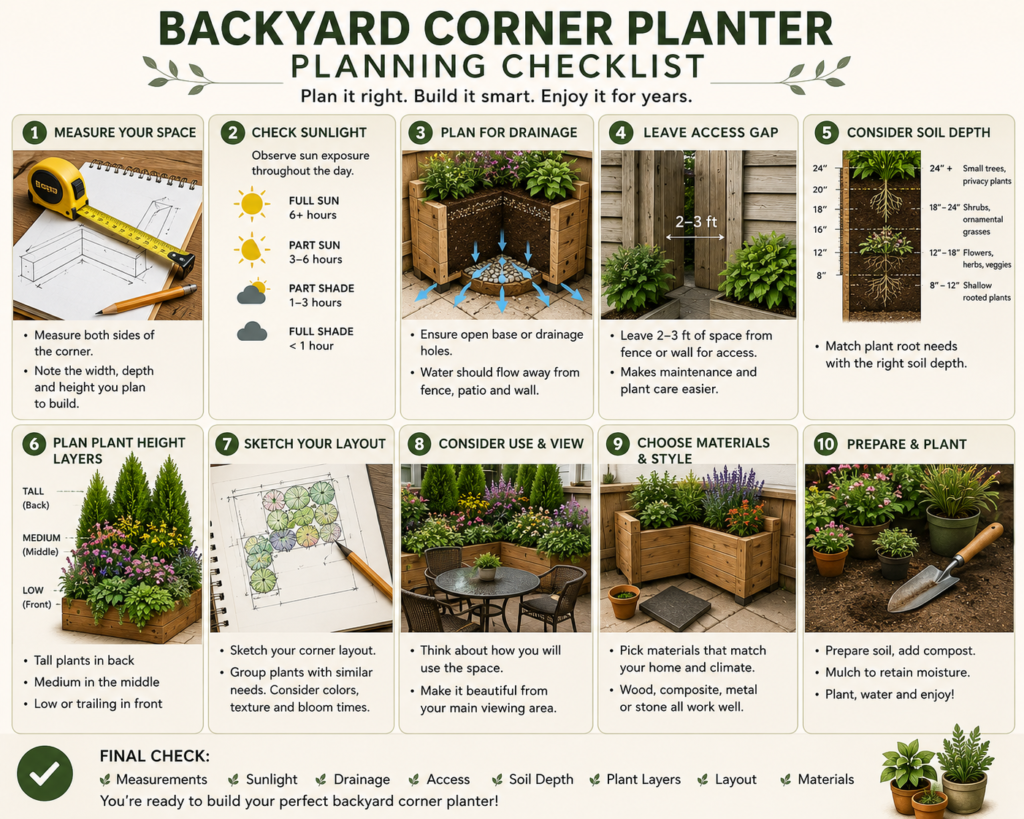
Before choosing a backyard corner planter idea, measure both sides, check morning and afternoon sunlight, watch how water moves after rain, identify nearby fences, walls, patios, decks, sheds, and drains, then decide the main purpose.
| Corner Condition | Best Planter Direction |
|---|---|
| Under 3 feet wide | Container cluster |
| 3–6 feet wide | Triangular planter |
| 6–10 feet wide | L-shaped raised planter |
| 10+ feet wide | Layered shrub and flower bed |
| Overlooked corner | Trellis privacy planter |
| Wet corner | Raised drainage-first planter |
| Shady corner | Foliage and shade-tolerant planting |
| Sunny corner | Herbs, flowers, compact vegetables |
Test the layout for one weekend before building. Place pots, boxes, or garden bags where the planter would go. If the corner feels tight, reduce the footprint before making it permanent.
Final Thoughts
Backyard corner planter ideas work best when beauty and practical planning come together. A good planter should fit the corner shape, match the sunlight, drain properly, leave walking space, and support plants that can thrive in that exact location.
For most yards, an L-shaped raised planter is the best all-round option. For tight corners, use a triangular planter or container cluster. For privacy, add a trellis, tall grasses, or layered shrubs. For patios, use containers, tiered planters, herbs, or a bench planter. For long-term structure, choose brick, stone, composite, or a well-built timber raised bed.
Before making the final choice, ask what problem the corner should solve, how much sun it receives, where extra water will go, whether you can reach every part of the planter, whether plants will still fit when mature, and whether the material matches the rest of the yard.
FAQs
What can I put in an empty backyard corner?
You can add an L-shaped planter, triangular bed, container cluster, herb planter, privacy planter, flower bed, or trellis planter. Choose based on space, sunlight, drainage, and your main goal.
What is the best backyard corner planter idea?
An L-shaped raised planter is best for most yards. It uses both sides of the corner, gives more planting space, and keeps the center of the backyard open.
How deep should a backyard corner planter be?
Most corner planters need 12–18 inches of usable soil. Herbs and annuals can use less, while shrubs and privacy plants usually need 18–24 inches or more.
How do I stop water pooling in a corner planter?
Use drainage holes, an open base, free-draining soil, mulch, and a clear overflow path. Raise the planter if the corner naturally collects rainwater.
Are backyard corner planters good for small yards?
Yes, they use edge space instead of the center of the yard. They can add flowers, herbs, privacy, seating, or structure without making the yard feel crowded.
Myra is the founder and lead writer of Backyard Planter Ideas, where she shares practical, well-researched guidance on planter design, plant selection, and outdoor styling. Her goal is to help homeowners create attractive, functional garden spaces with clear, reliable, and easy-to-apply advice.