Backyard privacy planter ideas use tall containers, dense plants, trellises, shrubs, grasses, bamboo, vines, and planter walls to block unwanted views while keeping outdoor spaces natural and attractive. They work especially well for patios, decks, small yards, pool areas, and fence-line gaps.
Privacy does not always require a tall fence, expensive wall, or permanent outdoor structure. In many backyards, the real problem is not the whole property line. It is one exposed patio seat, one neighbor window, one open deck railing, one pool corner, or one fence gap that makes the space feel uncomfortable.
Which Privacy Planter Should You Choose?
The best backyard privacy planter idea depends on the view you need to block, the space available, and whether you want seasonal or year-round screening. Use the planter style that matches your privacy problem instead of choosing containers only for appearance.
- Neighbor window view: tall rectangular planters with bamboo, arborvitae, or privet.
- Small patio exposure: trellis planter boxes with jasmine, clematis, or ivy.
- Deck railing privacy: lightweight trough planters with grasses, boxwood, or podocarpus.
- Poolside privacy: large low-mess planters with Italian cypress, bamboo, or dwarf palms.
- Fence gap: raised planter screens with holly, laurel, or evergreen shrubs.
- Rental backyard: movable privacy planters with grasses, bamboo, or trellis vines.
Decision clarity: choose trellis planters for small spaces, trough planters for strong screening, movable planters for renters, and built-in planter walls for permanent privacy.
What Are Backyard Privacy Planters?
Backyard privacy planters are outdoor containers used to create natural screening with tall plants, shrubs, bamboo, grasses, vines, small trees, or trellis-supported greenery. Unlike regular decorative pots, they are chosen for height, density, root space, stability, and placement so they can block unwanted views and make patios, decks, pools, and seating areas feel more private.
Privacy planters are useful when:
- A neighbor’s window overlooks your patio
- A deck feels too open
- A fence has gaps or looks unattractive
- A small backyard needs soft screening
- A rental home cannot have permanent construction
- A pool area needs natural privacy
- An outdoor dining space feels too exposed
What Types of Privacy Planters Work Best?
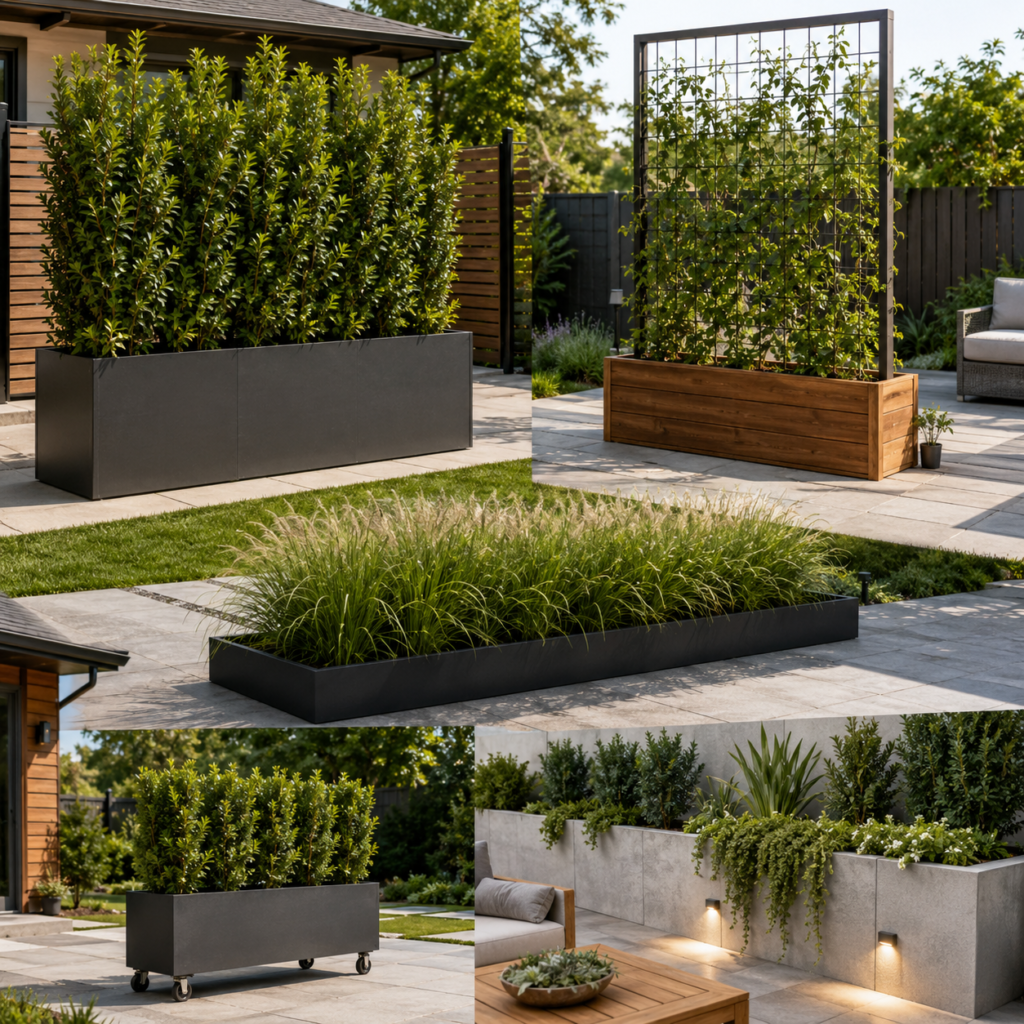
The best backyard privacy planters are tall, stable, wide enough for roots, and positioned where they block the most direct view. Common options include rectangular planters, trough planters, trellis planters, rolling planters, raised planter screens, and built-in planter walls.
- Tall rectangular planters: best for patios, fence lines, and modern backyards.
- Planter boxes with trellis screens: best for vines and small spaces.
- Large trough planters: best for bamboo, grasses, and shrubs.
- Rolling privacy planters: best for renters and flexible layouts.
- Built-in planter walls: best for luxury outdoor rooms.
- Raised planter screens: best for seating areas and patio edges.
What Are the Best Plants for Privacy Planters?
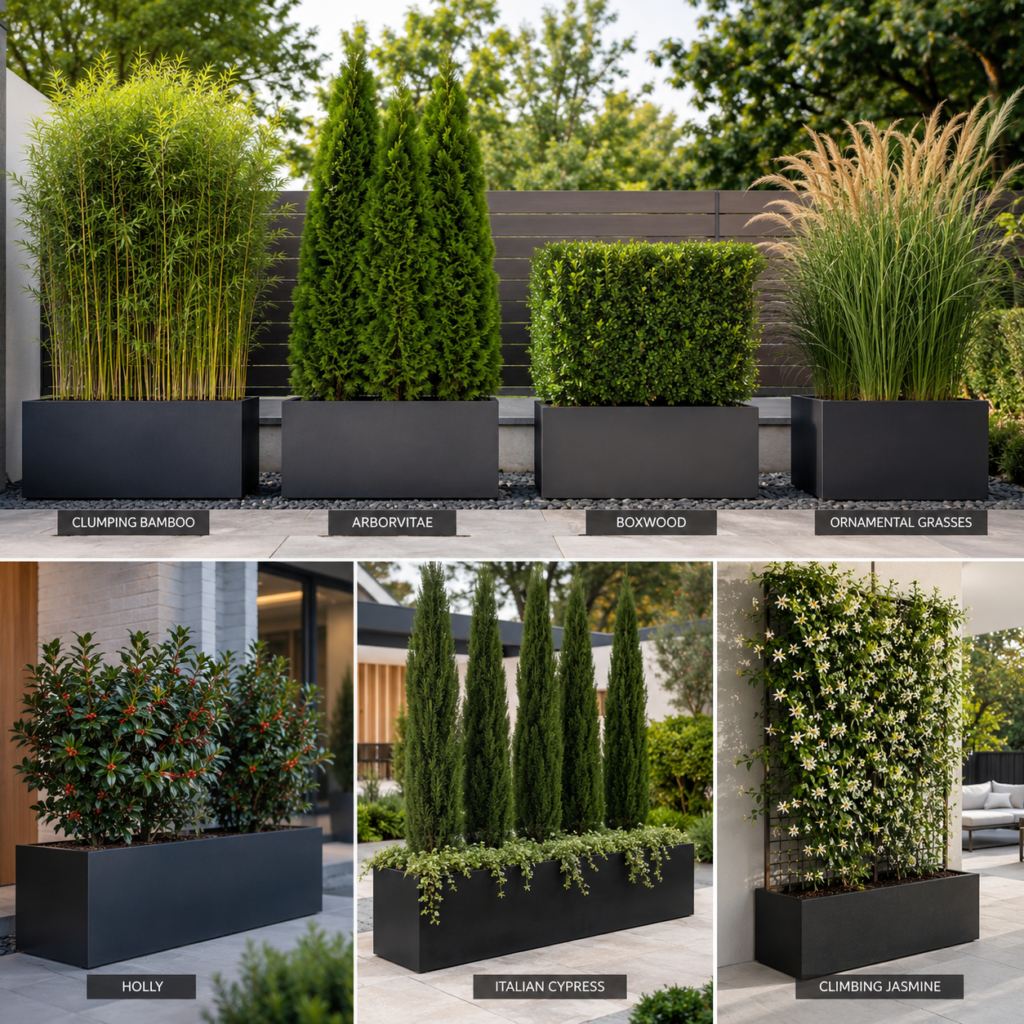
The best plants for privacy planters are dense, upright, container-friendly plants that provide height, coverage, and reliable growth. Strong choices include clumping bamboo, arborvitae, boxwood, privet, holly, laurel, podocarpus, ornamental grasses, Italian cypress, star jasmine, and clematis. The right option depends on your climate, sunlight, planter depth, privacy goal, and maintenance preference.
Best overall privacy planter plants: clumping bamboo for fast height, arborvitae for year-round evergreen privacy, ornamental grasses for soft seasonal screening, and trellis vines for small-space vertical privacy.
Best privacy planter plants include:
- Clumping bamboo: fast vertical screening
- Arborvitae: evergreen privacy and structure
- Boxwood: formal, neat, and easy to shape
- Privet: dense green screening
- Italian cypress: narrow modern privacy
- Ornamental grasses: soft movement and seasonal height
- Star jasmine: fragrant trellis privacy
- Clematis: flowering vertical screen
- Holly: evergreen density
- Laurel: large container screening
Decision clarity: choose bamboo for speed, evergreen shrubs for year-round privacy, grasses for softness, and vines for vertical privacy in tight spaces.
What Privacy Planters Work in Sun or Shade?
Sun exposure has a major effect on how well backyard privacy planters perform. A plant that creates excellent screening in full sun may become thin, weak, or leggy in shade. Before choosing privacy plants, watch the area for a full day and note how many hours of direct sunlight it receives.
Full-sun spaces usually support stronger vertical growth, especially for bamboo, ornamental grasses, Italian cypress, privet, rosemary, and many evergreen shrubs. Part-shade spaces may work better with boxwood, holly, yew, ivy, star jasmine, clematis, and shade-tolerant foliage plants. In deep shade, focus on dense foliage instead of fast height.
- Full sun privacy planters: bamboo, ornamental grasses, Italian cypress, privet, rosemary, lavender, podocarpus.
- Part shade privacy planters: boxwood, holly, star jasmine, clematis, yew, laurel.
- Shade privacy planters: ivy, fatsia, aucuba, shade-tolerant hollies, ferns with trellis screens.
- Hot dry patios: use drought-tolerant plants and larger containers that hold moisture longer.
- Covered decks: choose plants that tolerate filtered light and avoid plants that need intense sun.
A common mistake is choosing plants only because they are tall. Height does not create privacy if the foliage becomes thin. A shorter but denser plant can block views better than a tall plant with sparse leaves. This is especially true in shaded patios and narrow side yards.
Decision clarity: choose sun-loving plants for open patios and pool areas, part-shade evergreens for filtered light, and dense foliage plants for shaded privacy screens.
Can Trellis Planters Create Backyard Privacy?
Yes, trellis planters can create excellent backyard privacy, especially in small spaces. The planter gives climbing plants a strong root base, while the trellis adds vertical height, making this one of the best privacy solutions for patios, decks, balconies, narrow side yards, and compact backyards.
They work well for blocking neighbor views, open patio corners, fence gaps, deck railings, and outdoor dining exposure without using wide hedge-style containers. This makes them especially useful when you need height but have limited floor space.
Best plants for trellis privacy include:
- Star jasmine
- Clematis
- Ivy
- Honeysuckle
- Climbing roses
- Passionflower
- Carolina jessamine
Decision clarity: use trellis planters when you need height in a tight space. Choose large trough planters when you have more room and want denser privacy.
Do Privacy Planters Work in Small Backyards?
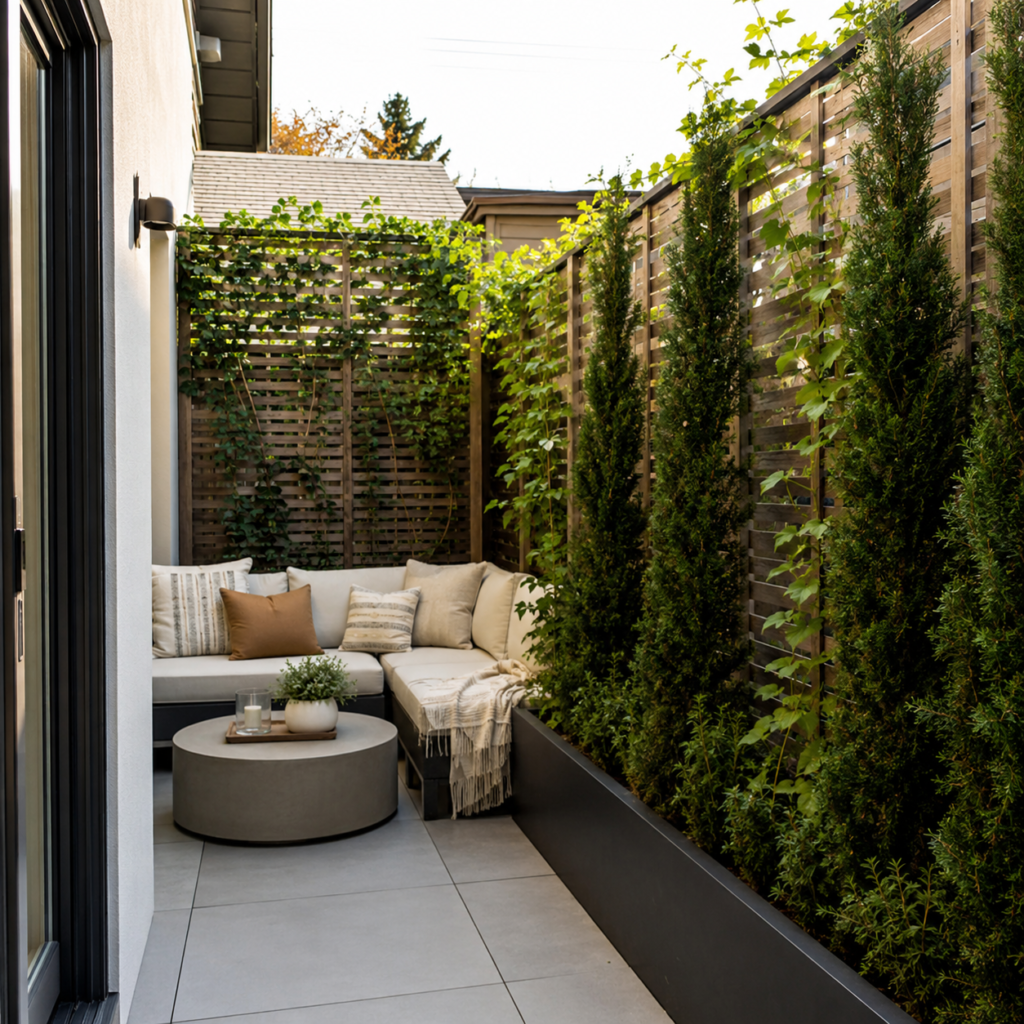
Yes, privacy planters work very well in small backyards because they add height and screening exactly where the space feels exposed. Instead of building a full barrier, you can use narrow containers, vertical designs, and smart placement to block neighbor views, patio exposure, fence gaps, or open seating areas without making the yard feel crowded.
Best small backyard privacy planter ideas include:
- Narrow trough planters along a fence
- Trellis planters behind seating
- Tall corner planters with bamboo
- Slim planters with Italian cypress
- Wall-mounted planters with vines
- Rolling privacy screens
- Tiered planters near patios
The biggest mistake in small backyards is using too many scattered pots. One long planter in the right place usually creates better privacy than several small pots placed randomly around the patio.
What Works for Patios and Decks?
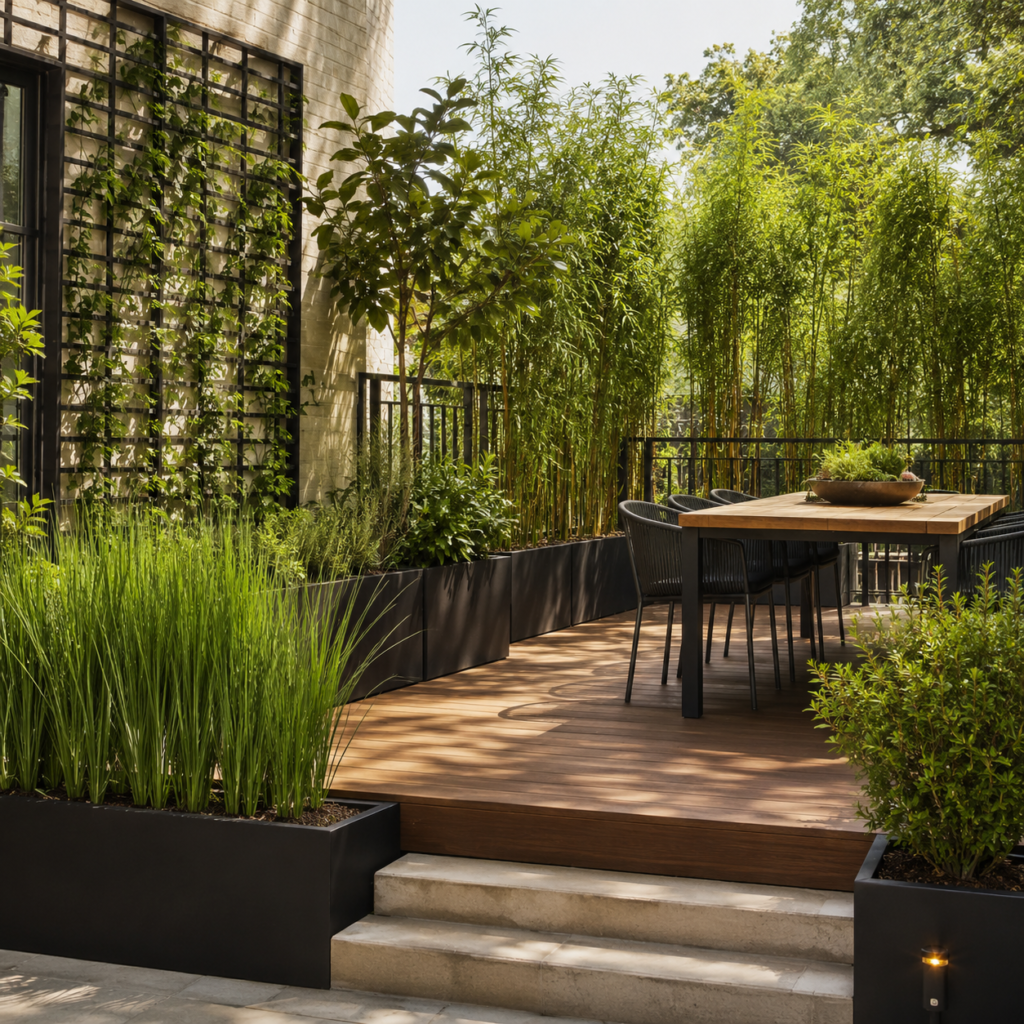
Patios and decks work best with privacy planters placed behind seating, beside dining areas, along railings, or near exposed corners. Patios can usually handle heavier containers, while decks need lighter, stable planters with careful attention to weight, drainage, and wind.
- Patios: trough planters, cedar boxes, concrete planters, trellis planters, bamboo, grasses, and shrubs.
- Decks: lightweight trough planters, railing planters, trellis boxes, rolling planters, and compact evergreens.
- Dining areas: use partial screens behind benches or beside tables.
- Windy decks: avoid narrow lightweight pots and top-heavy trellis screens.
Decision clarity: patios can use heavier permanent planters; decks need lightweight, stable, drainage-safe containers.
What Works Around Pools?
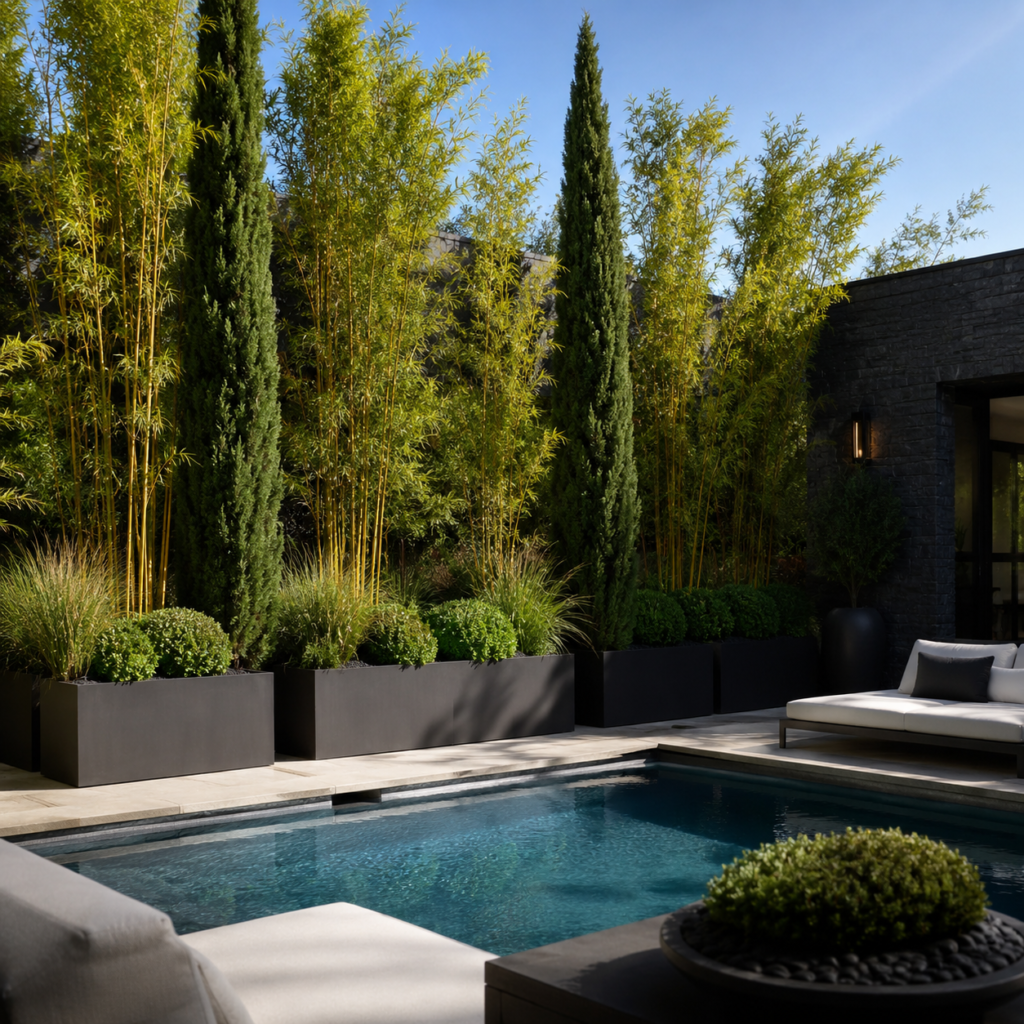
Pool privacy planters should create screening while staying clean, stable, and low-mess. The best designs use simple upright plants that do not drop excessive leaves, fruit, thorns, sticky flowers, or heavy debris into the water. Repeated tall planters with narrow evergreens, bamboo, grasses, or palms can create a resort-style look without crowding the pool area.
Good poolside privacy plants include:
- Italian cypress
- Clumping bamboo
- Boxwood
- Podocarpus
- Dwarf palms in warm climates
- Ornamental grasses
- Privet
- Low-mess holly varieties
Pool safety note: near pools, avoid thorny, toxic, fruiting, fragile, or heavy-shedding plants. Choose stable containers and keep enough walking space around the pool for safe movement and easy maintenance.
Are Privacy Planters Better Than Fences?
Privacy planters are better for soft screening, flexible placement, and natural backyard design. Fences are better for security, pet control, permanent boundaries, and full enclosure.
| Option | Best For | Limitation |
|---|---|---|
| Privacy planters | Natural screening and flexible layouts | Need watering and pruning |
| Fences | Full boundary privacy and security | Can feel hard or expensive |
| Trellis planters | Small spaces and vines | Take time to fill in |
| Hedges | Long-term natural privacy | Slower to establish |
Decision clarity: use fences for boundaries and security; use privacy planters for targeted visual screening, greenery, and outdoor comfort.
How Tall Should Privacy Planters Be?
Most backyard privacy planters work best when the combined planter and plant height reaches 5 to 7 feet. Seated patio privacy may only need 4 to 5 feet, while deck views, pool privacy, and second-story window screening may need 6 to 9 feet.
Simple height rule: seated privacy usually needs 4–5 feet, standing privacy needs 5–7 feet, and second-story window screening may need 7–9 feet of combined planter and plant height.
| Privacy Need | Suggested Height |
|---|---|
| Seated patio privacy | 4–5 feet |
| Neighbor window screening | 6–8 feet |
| Deck privacy | 5–7 feet |
| Pool privacy | 6–9 feet |
| Fence gap coverage | 4–6 feet |
What Size Planter Do You Need?
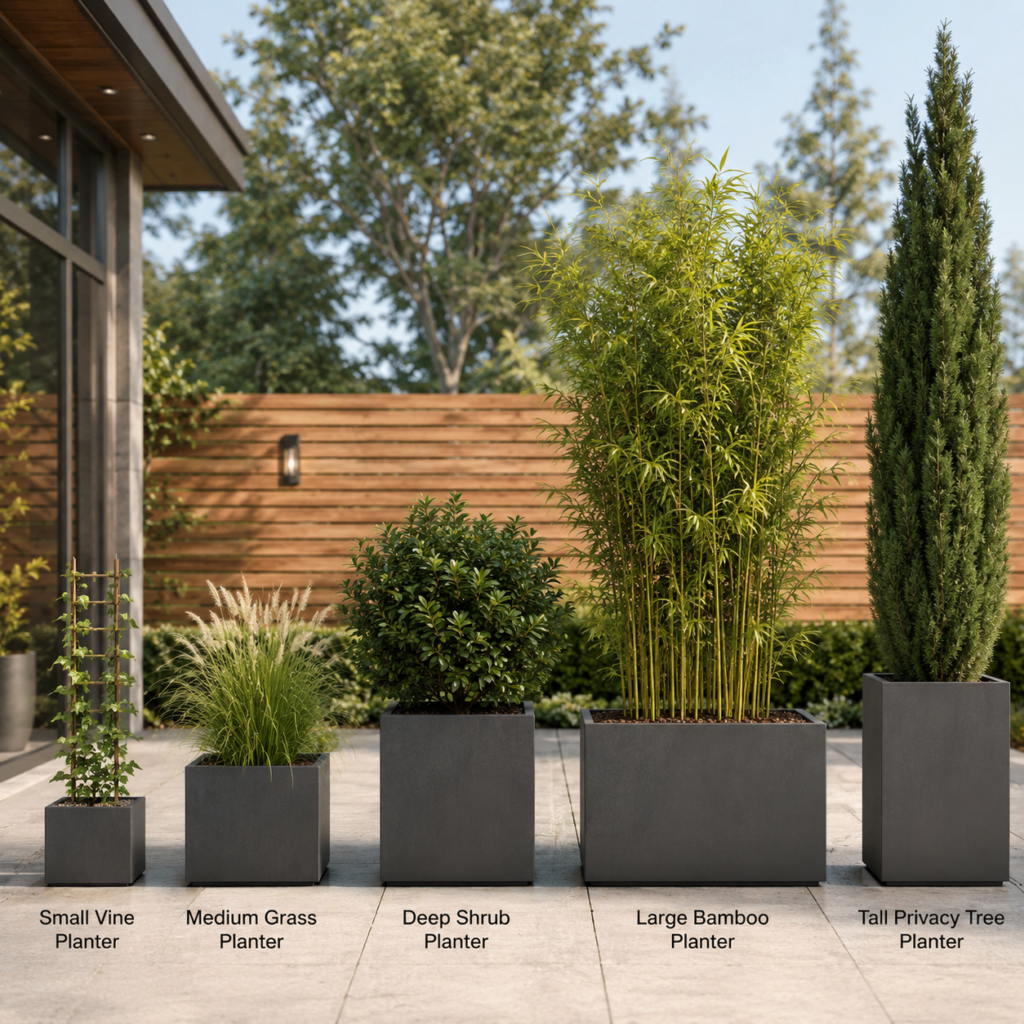
Privacy plants need larger planters than decorative flowers because tall screening plants require root space, soil volume, and stability. Choose a container that supports the mature plant, not just the size it has when purchased.
- Small vines: 12–18 inches deep for trellis planters and light vertical screening.
- Ornamental grasses: 18–24 inches deep for healthy roots and seasonal height.
- Boxwood and shrubs: 20–30 inches deep for dense, long-term structure.
- Bamboo: 24–36 inches deep for stronger root control and stable growth.
- Small privacy trees: 30 inches or deeper for long-term container health.
- Long trough planters: best for a continuous screen along patios, fences, or decks.
Decision clarity: use deeper planters for bamboo, shrubs, and small trees; medium-depth planters for grasses; and avoid tiny decorative pots when privacy is the main goal.
How Do You Stop Planters From Tipping?
Tall privacy planters can tip if they are too narrow, too lightweight, too exposed to wind, or planted with top-heavy plants. Stability is one of the most important parts of privacy planter design, especially on decks, balconies, pool areas, and open patios.
A tall plant acts like a sail in strong wind. A trellis covered with vines can catch even more wind. This is why the planter must be wide, heavy, and properly placed. A beautiful privacy planter is not successful if it leans, rocks, or becomes unsafe after a storm.
To improve stability:
- Choose wide rectangular planters
- Avoid narrow lightweight pots for tall plants
- Use enough soil volume for root support
- Place planters near walls, fences, or corners
- Anchor trellis planters in windy areas
- Avoid top-heavy plant combinations
- Check deck and balcony weight limits
- Keep plants pruned so they do not become unbalanced
The soil also matters. Do not fill a large privacy planter mostly with lightweight filler if it needs to support tall plants. Tall shrubs, bamboo, and trellises need root depth and weight. Drainage must still work properly, because waterlogged roots can weaken plant health.
Decision clarity: if your area is windy, choose wide trough planters, lower-growing dense shrubs, or anchored trellis designs. Avoid tall, narrow pots with lightweight soil.
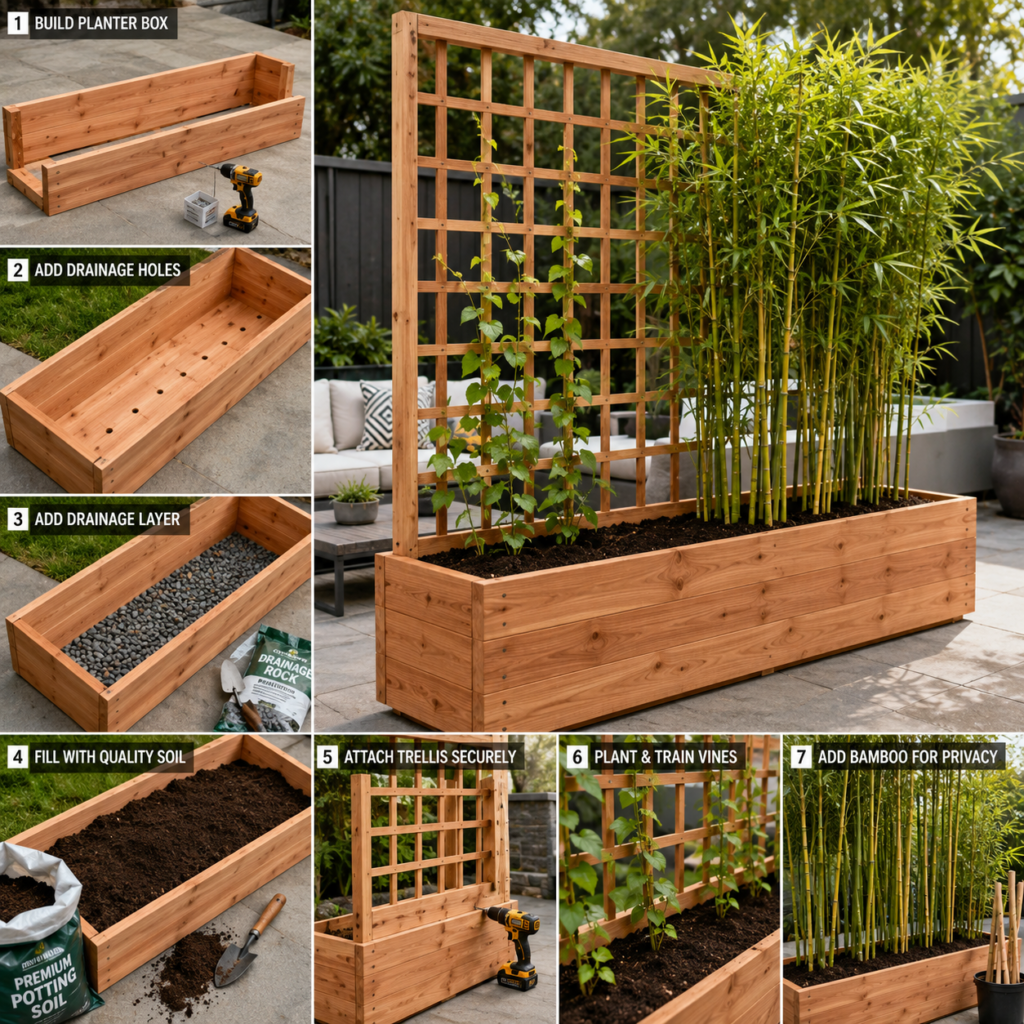
How Do You Build a Privacy Planter Screen?
A simple backyard privacy planter screen starts by blocking one clear view, such as a neighbor window, exposed patio edge, deck railing, or fence gap. The easiest setup is one long rectangular planter placed directly between the seating area and the unwanted view.
- Step 1: choose the exact view you want to block.
- Step 2: measure the height needed while sitting and standing.
- Step 3: choose a wide, stable planter with drainage holes.
- Step 4: select plants based on sun, shade, climate, and mature size.
- Step 5: add quality soil and avoid poor drainage.
- Step 6: place the planter where it interrupts the direct sightline.
- Step 7: water, prune, and check stability regularly.
Easiest setup: use one long rectangular planter, three to five matching privacy plants, working drainage holes, and placement directly between the seating area and the unwanted view.
Decision clarity: start with one exposed area, build one strong privacy screen, and expand only after the first planter solves the main view problem.
How Much Do Privacy Planters Cost?
Backyard privacy planter costs vary by material, size, plant maturity, labor, and whether the design is DIY, store-bought, or built-in. DIY wood planters and resin troughs are usually cheaper, while concrete, fiberglass, mature evergreens, irrigation, and built-in planter walls cost more.
| Privacy Planter Type | Estimated Cost Level |
|---|---|
| DIY wood planter with trellis | Low to medium |
| Plastic or resin tall planters | Low to medium |
| Large fiberglass trough planters | Medium |
| Concrete privacy planters | Medium to high |
| Built-in planter wall | High |
| Mature evergreen screening plants | Medium to high |
Decision clarity: choose DIY wood or resin planters for budget privacy, fiberglass or cedar troughs for a polished look, and built-in planter walls for premium outdoor spaces.
What Safety Mistakes Should You Avoid With Privacy Planters?
Backyard privacy planters are useful, but they can create problems when tall plants, lightweight containers, poor drainage, or unsafe placement are used. The main goal is to create screening without causing tipping, root problems, pool mess, blocked walkways, or risks for children and pets.
- Avoid narrow lightweight pots: they can tip when plants grow tall or wind increases.
- Avoid poor drainage: waterlogged soil can cause weak roots and unhealthy plants.
- Avoid messy pool plants: fruit, flowers, thorns, and heavy leaf drop can create cleanup and safety issues.
- Avoid unsafe plants: check whether plants are toxic or irritating if children or pets use the yard.
Backyard Privacy Planter Checklist
Use this checklist before buying planters, plants, soil, or trellis screens.
- Identify the exact view you want to block.
- Measure privacy height from sitting and standing positions.
- Choose plants that match your climate and sunlight.
- Use large enough planters for root growth.
- Make sure drainage holes work properly.
- Choose stable containers for tall plants.
- Avoid messy plants near pools.
- Use trellis planters for small spaces.
- Use evergreen plants for year-round privacy.
- Repeat planter styles for a cleaner design.
- Consider watering access before placing large planters.
- Avoid overcrowding small yards.
- Check wind exposure before using tall trellises.
- Consider deck weight before adding large containers.
- Check plant safety if pets or children use the yard.
Real-world placement test: place a temporary object where the planter will go. If it blocks the view from your chair, dining table, or pool area, the final privacy planter will likely work in the same position.
How Do You Maintain Privacy Planters?
Backyard privacy planters need consistent care because container plants dry out faster and rely on limited soil volume. Strong privacy depends on healthy, dense growth, not just tall plants.
- Water consistently: especially in sun, heat, or wind.
- Check drainage: prevent soggy roots and weak plants.
- Prune lightly: keep shrubs, vines, and grasses dense.
- Feed during growing season: replace nutrients in container soil.
- Watch root crowding: bamboo, shrubs, and small trees may need larger containers over time.
- Use drip irrigation: helpful for sunny patios and large containers.
Decision clarity: choose low-maintenance plants if you want easy care, and use drip irrigation if the area gets strong sun or wind.
FAQs
Can planters really create backyard privacy?
Yes, planters can create real backyard privacy when they use tall containers, dense plants, trellises, bamboo, shrubs, or grasses. Place them directly between the seating area and the unwanted view.
What are the best plants for backyard privacy planters?
The best plants include clumping bamboo, arborvitae, boxwood, privet, holly, podocarpus, Italian cypress, ornamental grasses, star jasmine, clematis, and ivy. Choose evergreens for year-round privacy.
How tall should privacy planters be?
Most privacy planters should reach 5 to 7 feet when planter and plant height are combined. For decks, pools, or second-story windows, 6 to 9 feet may work better.
What size planter do I need for privacy plants?
Privacy plants need larger containers than flowers. Grasses usually need 18–24 inches of depth, shrubs need 20–30 inches, and bamboo or small privacy trees may need 24–36 inches or deeper.
Are privacy planters better than a fence?
Privacy planters are better for soft screening, greenery, and flexible placement. Fences are better for security, pet control, and permanent property boundaries.
What is the cheapest backyard privacy planter idea?
A DIY wooden planter box with a simple trellis and fast-growing vines is usually the cheapest option. Resin trough planters with ornamental grasses can also be budget-friendly.
What privacy planter works best for a small backyard?
Trellis planter boxes, narrow trough planters, corner planters, and slim containers work best in small backyards. They create vertical privacy without taking up much floor space.
What privacy planter works best around pools?
Pool areas work best with stable, low-mess planters filled with Italian cypress, bamboo, podocarpus, boxwood, dwarf palms, or ornamental grasses. Avoid thorny, fruiting, or heavy-shedding plants.
Can bamboo grow in privacy planters?
Yes, clumping bamboo grows well in large privacy planters and creates fast vertical screening. Avoid running bamboo unless it is carefully contained and monitored.
Are evergreen privacy planters better?
Evergreen privacy planters are better for year-round screening. Arborvitae, boxwood, holly, laurel, yew, podocarpus, privet, and dwarf conifers keep structure through the seasons.
Can trellis planters create privacy?
Yes, trellis planters create strong vertical privacy in patios, decks, small backyards, and narrow side yards. Use climbing plants like jasmine, clematis, ivy, honeysuckle, or climbing roses.
Do privacy planters need drainage holes?
Yes, privacy planters need drainage holes to prevent waterlogged soil, root rot, and weak growth. Tall privacy plants need healthy roots to stay dense and stable.
How do you stop privacy planters from tipping over?
Use wide, heavy containers with enough soil volume and stable placement. In windy areas, place tall planters near walls, fences, corners, or railings.
What privacy plants grow fastest in planters?
Fast-growing privacy plants include clumping bamboo, privet, ornamental grasses, star jasmine, ivy, and some evergreen shrubs. Fast growers may need more pruning and watering.
Can privacy planters be used in rental backyards?
Yes, privacy planters are great for rental backyards because they do not require permanent construction. Movable planters, rolling screens, and trellis boxes are especially useful.
Can privacy planters block second-story neighbor windows?
Yes, but they usually need taller plants, raised containers, trellis screens, or vertical growers. For upper-window privacy, 7 to 9 feet of combined height may be needed.
What is the best material for privacy planters?
Cedar feels natural, fiberglass is lightweight, concrete is stable, resin is affordable, and metal suits modern designs. For tall plants, choose a stable, wide, and deep planter.